

The DOI matches its Crossref record; 248 of the 248 references it cites were found in a registry or an index.
Algae-bacteria interactions: Evolution, ecology and emerging applications
Open accessAbstract
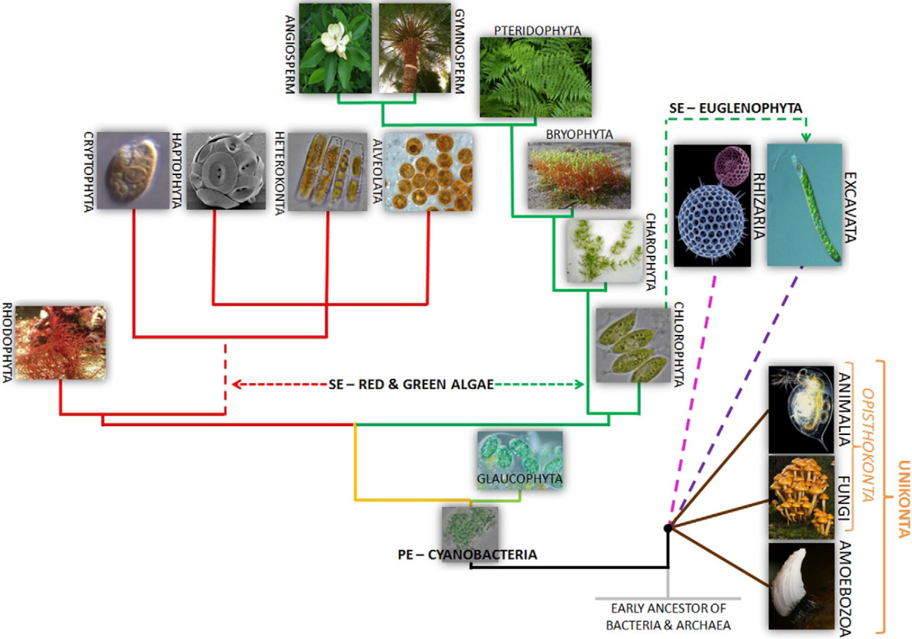
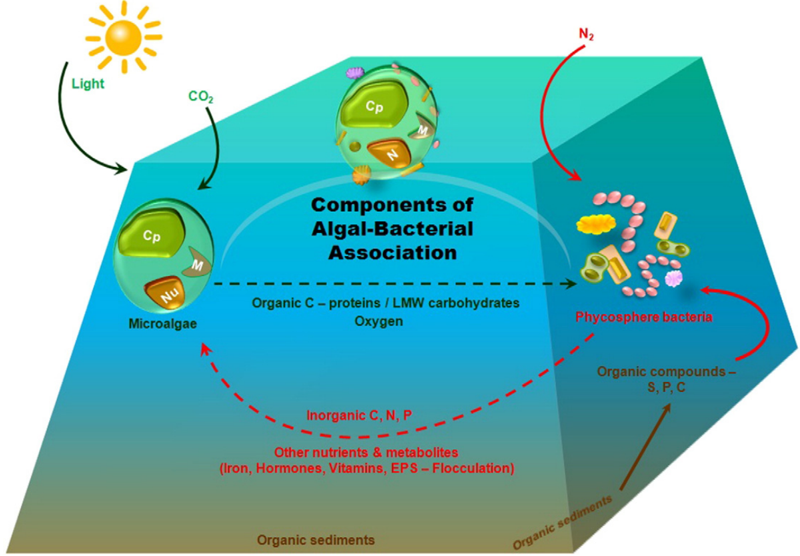
Algae and bacteria have coexisted ever since the early stages of evolution. This coevolution has revolutionized life on earth in many aspects. Algae and bacteria together influence ecosystems as varied as deep seas to lichens and represent all conceivable modes of interactions - from mutualism to parasitism. Several studies have shown that algae and bacteria synergistically affect each other's physiology and metabolism, a classic case being algae-roseobacter interaction. These interactions are ubiquitous and define the primary productivity in most ecosystems. In recent years, algae have received much attention for industrial exploitation but their interaction with bacteria is often considered a contamination during commercialization. A few recent studies have shown that bacteria not only enhance algal growth but also help in flocculation, both essential processes in algal biotechnology. Hence, there is a need to understand these interactions from an evolutionary and ecological standpoint, and integrate this understanding for industrial use. Here we reflect on the diversity of such relationships and their associated mechanisms, as well as the habitats that they mutually influence. This review also outlines the role of these interactions in key evolutionary events such as endosymbiosis, besides their ecological role in biogeochemical cycles. Finally, we focus on extending such studies on algal-bacterial interactions to various environmental and bio-technological applications.
Overview
The claims and statistics of this paper haven’t been checked yet.
Run the check — free, no account needed. It reads the open-access text and checks the sources it cites.
Integrity signals
Registry
Cites
Statistics
Figures

Verification
Claims the paper makes
The claims and statistics of this paper haven’t been checked yet.
Run the check — free, no account needed. It reads the open-access text and checks the sources it cites.
Claims other papers make about this one
Each is checked against this paper’s own text: does it say what the citing paper says it does?
In the citing paper
“However, the mechanisms involved in the interaction do seem to be species-specific, depending on the microenvironment and conditions of each microalga [11].”
From Toward the Enhancement of Microalgal Metabolite Production through Microalgae–Bacteria Consortia (2021) · cites this paper as [11]
Self-check
Percentages, sums and reported differences re-computed from the paper’s own numbers.
The self-check needs the paper’s full text.
Citations
Cites
Primary production of the biosphere: Integrating terrestrial and oceanic components
Field, C. B., Behrenfeld, M. J., Randerson, J. T., & Falkowski, P. (1998) · Science · doi:10.1126/science.281.5374.237 · Cited by 6,371
Coral Reefs Under Rapid Climate Change and Ocean Acidification
Hoegh-Guldberg, O., Mumby, P. J., Hooten, A. J., Steneck, R. S., Greenfield, P., Gomez, E., Harvell, C. D., Sale, P. F., Edwards, A. J., Caldeira, K., et al. (2007) · Science · doi:10.1126/science.1152509 · Cited by 5,885
Commercial Applications of Microalgae
Spolaore, P., Joannis-Cassan, C., Duran, E., & Isambert, A. (2006) · Journal of Bioscience and Bioengineering · doi:10.1263/jbb.101.87 · Cited by 4,285
Going back to the roots: the microbial ecology of the rhizosphere
Philippot, L., Raaijmakers, J. M., Lemanceau, P., & van der Putten, W. H. (2013) · Nature Reviews Microbiology · doi:10.1038/nrmicro3109 · Cited by 4,085
Climate Change, Human Impacts, and the Resilience of Coral Reefs
Hughes, T. P., Baird, A. H., Bellwood, D. R., Card, M. A., Connolly, S. R., Folke, C., Grosberg, R. K., Hoegh‐Guldberg, O., Jackson, J. B. C., Kleypas, J. A., et al. (2003) · Science · doi:10.1126/science.1085046 · Cited by 3,935
Hydrogen production by biological processes: a survey of literature
Das, D. (2001) · International Journal of Hydrogen Energy · doi:10.1016/s0360-3199(00)00058-6 · Cited by 2,118
Functioning of mycorrhizal associations along the mutualism–parasitism continuum*
Johnson, N. C., GRAHAM, J., & SMITH, F. A. (1997) · New Phytologist · doi:10.1046/j.1469-8137.1997.00729.x · Cited by 2,058
Harmful Cyanobacterial Blooms: Causes, Consequences, and Controls
Paerl, H. W., & Otten, T. G. (2013) · Microbial Ecology · doi:10.1007/s00248-012-0159-y · Cited by 2,048
Gray, M. W., Burger, G., & Lang, B. F. (1999) · Science · doi:10.1126/science.283.5407.1476 · Cited by 1,765
The genome sequence of Rickettsia prowazekii and the origin of mitochondria
Andersson, S. G. E., Zomorodipour, A., Andersson, J. O., Sicheritz-Pontén, T., Alsmark, U. C. M., Podowski, R. M., Näslund, A. K., Eriksson, A.-S., Winkler, H. H., & Kurland, C. G. (1998) · Nature · doi:10.1038/24094 · Cited by 1,697
Research works printed but not linked: 2
- Neale, 1987, Algal photoinhibition and photosynthesis in the aquatic environment, Photoinhibition, 9, 39
- Sachs, 2006, A shift to parasitism in the jellyfish symbiont Symbiodinium microadriaticum. Proceedings biological sciences/the royal, Society, 273, 425
Cited by
Sorted by citations
Integrating micro-algae into wastewater treatment: a review
Mohsenpour, S. F., Hennige, S., Willoughby, N., Adeloye, A., & Gutierrez, T. (2021) · Science of The Total Environment · doi:10.1016/j.scitotenv.2020.142168 · Cited by 828
Hena, S., Gutierrez, L., & Croué, J.-P. (2021) · Journal of Hazardous Materials · doi:10.1016/j.jhazmat.2020.124041 · Cited by 478
Fuentes, J., Garbayo, I., Cuaresma, M., Montero, Z., González-del-Valle, M., & Vílchez, C. (2016) · Marine Drugs · doi:10.3390/md14050100 · Cited by 462
Microalgae–bacteria symbiosis in microalgal growth and biofuel production: A review
Yao, S., Lyu, S., An, Y., Lu, J., Gjermansen, C., & Schramm, A. (2019) · Journal of Applied Microbiology · doi:10.1111/jam.14095 · Cited by 296
Al-Jabri, H., Das, P., Khan, S., Thaher, M., & AbdulQuadir, M. (2020) · Water · doi:10.3390/w13010027 · Cited by 270
Metadata
- Authors
- Ramanan, R., Kim, B.-H., Cho, D.-H., Oh, H.-M., & Kim, H.-S.
- Affiliations
- Korea Research Institute of Bioscience and Biotechnology (KR)
- Corresponding author
- Kim, Hee-Sik
- Venue
- Biotechnology Advances
- Publisher
- Elsevier BV
- Published
- 2016-01
- Volume
- 34
- Issue
- 1
- Pages
- 14-29
- ISSN
- 0734-9750 (ISSN-L)
- OpenAlex
- W2188082055
- Cited by
- 1,301
- References
- 248
- Citations by year
- 2026: 112 · 2025: 157 · 2024: 151 · 2023: 141 · 2022: 171 · 2021: 125 · 2020: 129 · 2019: 116 · 2018: 101 · 2017: 74 · 2016: 24
- FWCI
- 6.10
- Type
- journal article
- Language
- en
- Open access
- hybrid
- doi.org
- Licence
- Locations
- Biotechnology Advances (publishedVersion, cc-by-nc-nd)
- PubMed (publishedVersion)
- KRIBB Repository (submittedVersion)
- Funders
- Advanced Biomass R&D Center (ABC) of Global Frontier Project (2015M3A6A2065697)
- Korea Government Ministry of Oceans and Fisheries (20150184)
- KRIBB Research Initiative Program
- Topics
- Physical Sciences › Environmental Science › Ecology › Microbial Community Ecology and Physiology
- Physical Sciences › Energy › Renewable Energy, Sustainability and the Environment › Algal biology and biofuel production
- Life Sciences › Agricultural and Biological Sciences › Ecology, Evolution, Behavior and Systematics › Protist diversity and phylogeny
- Keywords
- algal-bacterial interactions, coevolution, mutualism, parasitism, Roseobacter, endosymbiosis, primary productivity, biogeochemical cycles, algal biotechnology, flocculation, lichens, deep-sea ecosystems
- MeSH terms
- Phaeophyceae, Animals, Biodegradation, Environmental, Biotechnology, Biological Evolution, Host-Parasite Interactions, Lichens, Phytoplankton, Symbiosis, Ecosystem, Aquaculture, Bacterial Physiological Phenomena, Anthozoa, Microalgae
About these checks
Registry, retraction, Cites and statistics results are computed, not judged, with one exception: a printed reference that no index lists is read once by a model before it counts as a citation error. Claims are extracted by a model and kept only when their quote appears verbatim in the text; each cited source is then checked, with a model’s help, for whether it says what the claim relies on. Those verdicts can be wrong — read the claim’s quote and the cited source before relying on one.
Statistics and arithmetic are recomputed, not judged.
Confidence bands are shown only for fields calibrated on our annotated test set. None is calibrated yet, so no band is shown.
What counts as a claim ›How we measure confidence ›How we check this ›
Are you an author, or do you see a problem with this page? Request a review
