

The DOI matches its Crossref record; 87 of the 88 references it cites were found in a registry or an index.
Examining the relationship between burnout and empathy in healthcare professionals: A systematic review
Open accessAbstract
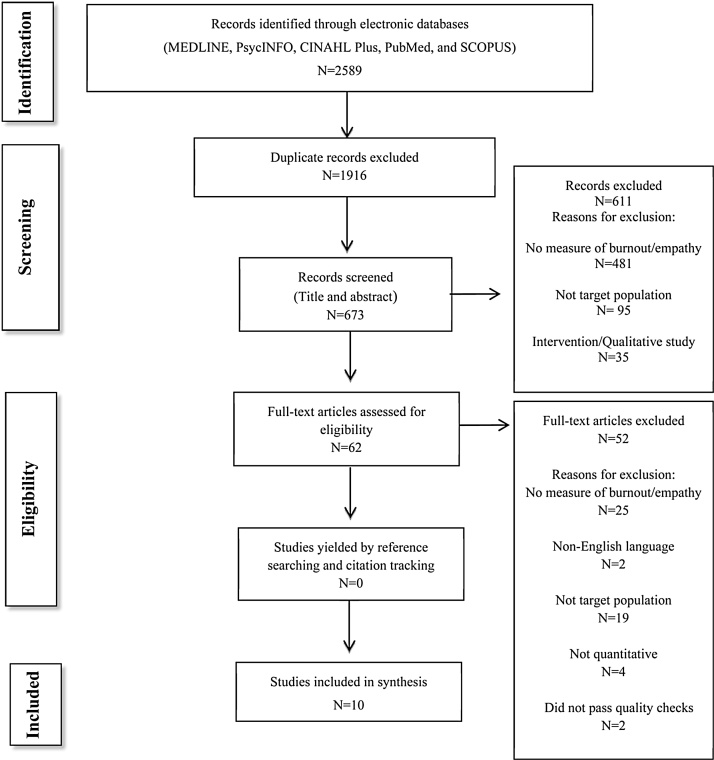
OBJECTIVE: Empathy and burnout are two related yet distinct constructs that are relevant to clinical healthcare staff. The nature of their relationship is uncertain and this review aimed to complete a rigorous, systematic exploration of the literature investigating the relationship between burnout and empathy in healthcare staff. DESIGN: A systematic review was conducted in accordance with the Preferred Reporting Items for Systematic Reviews and Meta-Analyses (PRISMA) guidance. DATA SOURCES: Search terms (Burnout OR Burn-out OR "Burn out") AND (Empathy OR Empath*) enabled identification of studies investigating burnout and empathy in healthcare staff, using five electronic data bases (MEDLINE, PsycINFO, CINAHL Plus, PubMed, and SCOPUS). Manual searching amongst reference lists of eligible articles was also completed. REVIEW METHODS: Databases were searched for studies published in the English language, from inception to February 2017. Key inclusion criteria were: 1) participants who were nurses or medical professionals, 2) full written manuscript in English, 3) use of the Maslach Burnout Inventory to assess burnout and a standardized outcome measure for empathy, 4) quantitative methodology exclusively. RESULTS: Ten eligible studies were reviewed. Of those, seven were conducted in countries where English was not the first language. Eight of the studies provided empirical support for a negative relationship between empathy and burnout. One study provided support for a positive relationship between burnout and empathy. One study reported contradictory evidence with positive and negative correlations between different subscales of the empathy and burnout measures. In general, the quality of the studies was assessed to be good. However, some of the studies failed to provide information pertaining to sample size, with the reporting of data less than adequate from one study. CONCLUSIONS: There was consistent evidence for a negative association between burnout and empathy. This review avoided a common English-speaking country bias of some areas of the literature. Given that all of the studies reviewed were cross sectional, further research is necessary to establish causality.
Overview
The claims and statistics of this paper haven’t been checked yet.
Run the check — free, no account needed. It reads the open-access text and checks the sources it cites.
Integrity signals
Registry
Cites
Statistics
Figures
Verification
Claims the paper makes
The claims and statistics of this paper haven’t been checked yet.
Run the check — free, no account needed. It reads the open-access text and checks the sources it cites.
Claims other papers make about this one
Each is checked against this paper’s own text: does it say what the citing paper says it does?
The source backs part of the claim, not all of it — or backs it for a different population, condition or comparison.
In the citing paper
“Good communication skills of empathizing and expressing the understanding towards patients' biopsychosocial contexts and goals of treatments was found to be associated with better clinical outcomes, professional satisfaction, and might help protect HCP from burnout [27,47,49].”
From The efficacy of applying the Interpersonal Effectiveness skills of dialectical behavior therapy into communication skills workshop for clinical nurses (2023) · cites this paper as [47]
Experimental — accuracy not yet measured
Self-check
Percentages, sums and reported differences re-computed from the paper’s own numbers.
The self-check needs the paper’s full text.
Citations
Cites
Liberati, A., Altman, D. G., Tetzlaff, J., Mulrow, C., Gøtzsche, P. C., Ioannidis, J. P. A., Clarke, M., Devereaux, P. J., Kleijnen, J., & Moher, D. (2009) · PLoS Medicine · doi:10.1371/journal.pmed.1000100 · Cited by 28,164
The measurement of experienced burnout
Maslach, C., & Jackson, S. E. (1981) · Journal of Organizational Behavior · doi:10.1002/job.4030020205 · Cited by 14,496
The job demands-resources model of burnout.
Demerouti, E., Bakker, A. B., Nachreiner, F., & Schaufeli, W. B. (2001) · Journal of Applied Psychology · doi:10.1037/0021-9010.86.3.499 · Cited by 13,643
Liberati, A., Altman, D. G., Tetzlaff, J., Mulrow, C., Gøtzsche, P. C., Ioannidis, J. P. A., Clarke, M., Devereaux, P. J., Kleijnen, J., & Moher, D. (2009) · Annals of Internal Medicine · doi:10.7326/0003-4819-151-4-200908180-00136 · Cited by 10,349
Measuring individual differences in empathy: Evidence for a multidimensional approach.
Davis, M. H. (1983) · Journal of Personality and Social Psychology · doi:10.1037/0022-3514.44.1.113 · Cited by 10,272
Cohen, J. (1992) · Psychological Bulletin · doi:10.1037//0033-2909.112.1.155 · Cited by 8,771
The necessary and sufficient conditions of therapeutic personality change.
Rogers, C. R. (1957) · Journal of Consulting Psychology · doi:10.1037/h0045357 · Cited by 5,599 · cited 1×
“Rogers (1957) termed empathy as the ability of the clinician to sense the service user's private world as if it were their own, without losing the ‘as if’, hypothetical quality.”
Hospital Nurse Staffing and Patient Mortality, Nurse Burnout, and Job Dissatisfaction
Aiken, L. H. (2002) · JAMA · doi:10.1001/jama.288.16.1987 · Cited by 5,226
The functional architecture of human empathy
Decety, J., & Jackson, P. L. (2004) · Behavioral and Cognitive Neuroscience Reviews · doi:10.1177/1534582304267187 · Cited by 3,407 · cited 2×
“The clinical relevance of the emotive, cognitive, and behavioral dimensions have been demonstrated empirically with varied emphasis (Decety& Jackson, 2004; Eisenberg& Eggum, 2009; Mercer&Reynolds, 2002).”
BackgroundResultEmpathy and Moral Development: Implications for Caring and Justice
Raboteg-Šarić, Z., & Hoffman, M. L. (2001) · Contemporary Sociology A Journal of Reviews · doi:10.2307/3089337 · Cited by 2,413
Research works printed but not linked: 2
- Meneghini, 2006, Adaptation and validation on an Italian sample of the balanced emotional empathy scale by Albert Mehrabian, Ric Psicol, 29, 123
- Wright, 2005, Burnout: A spiritual crisis, Nursing Standard, 19, 1
Cited by
Sorted by citations
Items 201–300 of 507
Ahmad, A., Nassar, R. I., Thiab, S. H., Alostath, M., Aldarawish, R., Ramahi, S. M., Abed, A. I., & Assiri, A. A. (2024) · Frontiers in Communication · doi:10.3389/fcomm.2024.1473771 · Cited by 8
García‐Magariño, I., Plaza, I., & Neri, F. (2019) · Journal of Computational Science · doi:10.1016/j.jocs.2019.06.009 · Cited by 8
Victorson, D. E., Sauer, C., Horowitz, B., & Wolf-Beadle, J. (2021) · JONA The Journal of Nursing Administration · doi:10.1097/nna.0000000000001000 · Cited by 8
Bottner, R., Harvey, J., Baysinger, A. N., Mason, K., Patel, S. N., Boulton, A., Christian, N. J., Walker, B., & Moriates, C. P. (2021) · Healthcare · doi:10.1016/j.hjdsi.2021.100579 · Cited by 8
Dual role of empathy in job stress, burnout, and intention to leave among addiction specialists
Bokuchava, T., & Javakhishvili, N. (2022) · PsyCh Journal · doi:10.1002/pchj.583 · Cited by 8
Vail, S. G., Dierst-Davies, R., Kogut, D., Winslow, L. D., Kolb, D., Weckenman, A., Almeida, S., King, H. B., Chessen, E., Strickland, M., et al. (2022) · The Joint Commission Journal on Quality and Patient Safety · doi:10.1016/j.jcjq.2022.11.004 · Cited by 8
Cansel, N., & Varol, F. İ. (2022) · Pediatric Transplantation · doi:10.1111/petr.14430 · Cited by 8
Health care provider experiences in primary care memory clinics: a phenomenological study
Sheiban, L., Stolee, P., McAiney, C. A., & Boscart, V. (2018) · BMC Family Practice · doi:10.1186/s12875-018-0756-z · Cited by 8
Benito, S. P.-D., Ruíz-Núñez, C., Hervás-Pérez, J. P., Ruiz‐Zaldibar, C., López‐Espuela, F., de la Calle, R. C., & Herrera‐Peco, I. (2025) · Nursing Reports · doi:10.3390/nursrep15070223 · Cited by 8
Bennett‐Weston, A., & Howick, J. (2025) · Journal of Participatory Medicine · doi:10.2196/71610 · Cited by 7
Afshari, L., Gyamerah, S. A., Walker, M., Sahibzada, U. F., Aghbar, R. A., Ramachandran, K. K., Muenjohn, N., & Bartram, T. (2025) · Personnel Review · doi:10.1108/pr-12-2024-1126 · Cited by 8
The Prevalence and Characteristics of Difficult Patient Encounters
Jackson, J. L., Kuriyama, A., WHITTLE, J., Davis-Maxwell, A., Thompson, M. A., Murphy, M., Gondi, S., Brennan, K., Ganshert, C., & Fletcher, K. E. (2026) · Annals of Internal Medicine · doi:10.7326/annals-25-01882 · Cited by 7
Contributing to a Healthier World: Exploring the Impact of Wellbeing on Nursing Burnout
Sanders, C., Burke, J., & Muzyk, A. J. (2022) · Journal of Happiness and Health · doi:10.47602/johah.v2i2.14 · Cited by 8
A systems thinking approach to tackle the national challenge of burnout among healthcare workers
Lim, H. Y., & Ooi, S. B. S. (2023) · Singapore Medical Journal · doi:10.4103/singaporemedj.smj-2021-317 · Cited by 7
Lunen, J. C. (2023) · Journal of Medical Education and Curricular Development · doi:10.1177/23821205231207702 · Cited by 7
Correlation between impostor syndrome among doctoral students and supervisor empathy in Tunisia
Slimi, O., Muscella, A., Marsigliante, S., & Bahloul, M. (2024) · Frontiers in Psychology · doi:10.3389/fpsyg.2024.1382969 · Cited by 12
Constructing an empathy education system: Values, principles, and approaches
Jia, K., Kang, R., Wang, Y., Ma, L., & Xiu-li, L. (2024) · Journal of Moral Education · doi:10.1080/03057240.2024.2416686 · Cited by 31
Parker, N., Falconieri, N., Shah, H., LEES, C. C., Timmerman, D., CALSTER, B. V., & Bourne, T. (2025) · Acta Obstetricia Et Gynecologica Scandinavica · doi:10.1111/aogs.70006 · Cited by 7
Nikitara, M., Constantinou, C. S., Andreou, E. P., Latzourakis, E., & Diomidous, M. (2020) · Behavioral Sciences · doi:10.3390/bs10080120 · Cited by 7
Mivshek, M. E., & Schriver, J. L. (2022) · Psychology Crime and Law · doi:10.1080/1068316x.2022.2063862 · Cited by 7
Galván-Villamarín, F., & Díaz, M. F. L. (2022) · Revista de la Facultad de Medicina · doi:10.15446/revfacmed.v70n3.98649 · Cited by 8
Influence of Evidence-Based Design Strategies on Nurse Wellness
Raj, M., Jimenez, F. E., Rich, R. K., Okland, K., Roy, L., Opollo, J. G., Rogers, J. L., & Brittin, J. (2022) · HERD Health Environments Research & Design Journal · doi:10.1177/19375867221110915 · Cited by 7
Simpson, R., Posa, S., Bruno, T. R., Simpson, S., Wasilewski, M. B., Robinson, L. R., Munce, S., Bayley, M. T., & Feinstein, A. (2022) · Journal of Neurology · doi:10.1007/s00415-022-11497-x · Cited by 10
Flynn, V., & Messias, E. (2020) · Springer eBooks · doi:10.1007/978-3-030-33264-8_6 · Cited by 7
The Text Effect: Stress Management and Resiliency Training Pilot for Resident Physicians
Nathan, J., McCray, L. W., & Feldman, N. (2021) · Family Medicine · doi:10.22454/fammed.2021.847102 · Cited by 7
Dementia secondary to thalamic infarct: a case report
Vargas-Cañas, A. S., Carriquiry-Berner, F., & Cargioli-Vila, M. V. (2004) · Revista de Neurología · doi:10.33588/rn.3805.2003386 · Cited by 7
To Feel or Not to Feel: Empathy and Physician Burnout
Kim, K. (2017) · Academic Psychiatry · doi:10.1007/s40596-017-0871-5 · Cited by 7
Manley, A. E., Perry, R. E., Moran, P., Dawson, S., Biddle, L., & Savović, J. (2026) · BMJ Open · doi:10.1136/bmjopen-2025-111351 · Cited by 8
Lohmann, J., John, D., & Dzay, A. (2023) · Wellcome Open Research · doi:10.12688/wellcomeopenres.17916.2 · Cited by 6
Adiva, Y. B., Genzer, S., & Perry, A. (2024) · Social Cognitive and Affective Neuroscience · doi:10.1093/scan/nsae039 · Cited by 6
Emotion recognition and clinical empathy: An observational study of nurses
Shaw, M., Bilog, A. D., Reyes, D., Klim, G., & Taylor, E. J. (2024) · Applied Nursing Research · doi:10.1016/j.apnr.2024.151855 · Cited by 6
Marheinecke, R., Blasberg, J. U., Heilmann, K., Imrie, H., Wesarg, C., & Engert, V. (2024) · Psychoneuroendocrinology · doi:10.1016/j.psyneuen.2024.107216 · Cited by 6
Okan, N., Zengin, F. O., Okan, Y. T., & Şahi̇n, Y. (2025) · Nursing in Critical Care · doi:10.1111/nicc.70079 · Cited by 6
Professional self-concept and job satisfaction among nurses in psychiatric clinics
Yüceyurt, N. K., & Yılmaz, M. (2020) · Progress in Health Sciences · doi:10.5604/01.3001.0014.1913 · Cited by 6
Heckenberg, R. A., Hale, M. W., Kent, S., & Wright, B. J. (2020) · Behavioural Brain Research · doi:10.1016/j.bbr.2020.112826 · Cited by 6
Onibokun, O. O., Morelli, E. M., Illuzzi, J. L., & White, M. A. (2021) · Midwifery · doi:10.1016/j.midw.2021.102941 · Cited by 6
Bukowski, H., Kamal, N. F. A., Bennett, D. M., Rizzo, G., & O’Tuathaigh, C. M. P. (2021) · BMJ Open · doi:10.1136/bmjopen-2020-048597 · Cited by 6
Anestis, E., Eccles, F. J. R., Fletcher, I. J., & Simpson, J. (2023) · BMC Neurology · doi:10.1186/s12883-023-03233-3 · Cited by 8
Empathy, stress and professional burnout syndrome suffered by psychiatric nurses
Wilczek‐Rużyczka, E. (2020) · Psychiatria i Psychologia Kliniczna · doi:10.15557/pipk.2020.0003 · Cited by 6
Brief Mindfulness Practice Course for Healthcare Providers
Seidel, L., Dane, F. C., & CARTER, K. F. (2021) · JONA The Journal of Nursing Administration · doi:10.1097/nna.0000000000001035 · Cited by 6
Díez, N., del Barrio, L. G., Rodríguez-Díez, M. C., Martín‐Lanas, R., Gea, A., & Costa, M. J. (2022) · Family Medicine · doi:10.22454/fammed.2022.169675 · Cited by 6
Coaching Nurses to Care: Empathetic Communication in Challenging Situations
Hannan, J., Fonseca, M., Lara, E. G., Braithwaite, M., Irving, F., & Azutillo, E. (2019) · Springer eBooks · doi:10.1007/978-3-030-29876-0_12 · Cited by 6
Holas, P., Gambin, M., Wojtkowiak, N., Kmita, G., & Łojek, E. (2024) · Health Psychology Report · doi:10.5114/hpr/188097 · Cited by 5
Different empathy types show opposing associations with burnout: systematic review and meta-analyses
Martingano, A. J., Stosic, M. D., & Konrath, S. (2025) · Psychology Health & Medicine · doi:10.1080/13548506.2025.2591859 · Cited by 5
A Typology of Empathic Communication Strategies in Dental Visits
Young, L. B., & Johnsen, D. C. (2025) · European Journal Of Dental Education · doi:10.1111/eje.13081 · Cited by 5
Co‐Producing an Empathy‐Focused Medical Curriculum With Patients, Educators, and Students
Bennett‐Weston, A., Harrell, C., Ward, A., Jones, M., & Howick, J. (2025) · The Clinical Teacher · doi:10.1111/tct.70100 · Cited by 5
Empathy in Action in Healthcare (EACH): A mixed methods study of nurses' and therapists’ empathy
Catlow, R., Aikins-Snyper, F., Carson, M., Jaggi, A., & Bench, S. D. (2020) · International Journal of Orthopaedic and Trauma Nursing · doi:10.1016/j.ijotn.2020.100777 · Cited by 5
Flynn, S. N., Harrington, H. J., Knott, M., & Lin, H. (2020) · Societies · doi:10.3390/soc10020044 · Cited by 5
Factors Associated With Physician Empowerment and Well-being at an Academic Medical Center
Yakes, E. A., Dean, S., Labadie, R. F., Byrne, D. W., Estrada, C. M., Thompson, R. C., Kendall, J., & Yarbrough, M. I. (2020) · Journal of Occupational and Environmental Medicine · doi:10.1097/jom.0000000000001874 · Cited by 5
Załuski, M., Jagielski, P., & Makara‐Studzińska, M. (2020) · Medycyna Pracy · doi:10.13075/mp.5893.00975 · Cited by 5
Empathy in Podiatric Medical Education: Challenges and Opportunities for Comprehensive Care
Barbosa, P., Huchital, M. J., & Weiss, J. J. (2020) · Journal of the American Podiatric Medical Association · doi:10.7547/18-187 · Cited by 5
Khalid, M. H., Ishtiaq, R., Fatima, L., Ahmed, H., Masood, A., Khan, T. M., Sajid, H., Qaiser, R., Awan, M., & Arshad, D. (2021) · European Journal of Medical and Health Sciences · doi:10.24018/ejmed.2021.3.4.945 · Cited by 5
Empathy levels in Australian chiropractic students
Innes, S. I., & Simpson, J. K. (2022) · Journal of Chiropractic Education · doi:10.7899/jce-21-16 · Cited by 5
Ho, A. H. Y., Tan-Ho, G., Low, X. C., Chan, E., Chan, N. G. C., Hum, A. Y. M., Khemlani, M. H., Low, J. A. Y. H., & Tan, W. S. (2023) · Palliative & Supportive Care · doi:10.1017/s1478951523000330 · Cited by 5
Fujikawa, H., Aoki, T., Son, D., Hayashi, M., & Eto, M. (2023) · Medical Teacher · doi:10.1080/0142159x.2023.2259065 · Cited by 5
Resilience and empathy in pharmacy interns: Insights from a three-year cohort study
Halimi, S. N., Mirzaei, A., Rowett, D. S., Whitfield, K., & Luetsch, K. (2023) · Exploratory Research in Clinical and Social Pharmacy · doi:10.1016/j.rcsop.2023.100333 · Cited by 5
Habib, H., Niinuma, S. A., Alrefaie, K., Khalaf, H. A. A., Hani, M. J., Al-Rawi, Z. Y. M., Hussain, Z., Menezes, P., Roy, S. R., Mathew, B., et al. (2025) · BMC Medical Education · doi:10.1186/s12909-024-06625-2 · Cited by 6
Eliciting clinical empathy via transmission of patient-specific symptoms of Parkinson’s disease
Palanica, A., Thommandram, A., & Fossat, Y. (2018) · Cogent Psychology · doi:10.1080/23311908.2018.1526459 · Cited by 5
Empathy and Regard: Perspectives Held by Graduate Students of Rehabilitation Sciences
Metz, A. E., & Christoff, A. (2020) · Internet Journal of Allied Health Sciences and Practice · doi:10.46743/1540-580x/2020.1832 · Cited by 5
Burnout Among All Groups of Physicians—Mitigation Strategies for Dermatologists
Nagler, A. R., Shinkai, K., & Kimball, A. B. (2020) · JAMA Dermatology · doi:10.1001/jamadermatol.2020.2155 · Cited by 5
The Relation Between Emphatic Tendency and Level of Compassion among Midwifery Students
Akın, B., Yılmaz, S. D., & ALAKAŞ, E. (2021) · Clinical and Experimental Health Sciences · doi:10.33808/clinexphealthsci.785324 · Cited by 5
Empathy and prosocial behaviour in early childhood: A review
Combe, K. (2021) · Journal of Health Visiting · doi:10.12968/johv.2021.9.9.380 · Cited by 6
Burnout and Moral Injury Among Consultation-Liaison Psychiatry Trainees
Sales, P. M. G., Arshed, A., Cosmo, C. S. A., Li, P., Garrett, M., & Cohen, M. A. (2021) · Psychodynamic Psychiatry · doi:10.1521/pdps.2021.49.4.543 · Cited by 5
Sadusky, A., & Spinks, J. (2022) · Reflective Practice · doi:10.1080/14623943.2022.2090326 · Cited by 5
Emotional Empathy, Burden and Depression among Family Caregivers of Patients with Schizophrenia
Hussien, M. S., Fahmy, A. M., Barakat, A. H. A., & Ibrahim, F. M. (2023) · Egyptian Journal of Health Care · doi:10.21608/ejhc.2023.311780 · Cited by 5
Wellness in Residency: A Paradigm Shift
Quiros, R. M., & Black, E. (2019) · IntechOpen eBooks · doi:10.5772/intechopen.82343 · Cited by 6
Research on Physician Burnout and Wellbeing: A Solution-Oriented Perspective
Bogue, R. J., & Downing, N. R. (2019) · Springer eBooks · doi:10.1007/978-3-030-15250-5_2 · Cited by 5
What Are Doctors For? A Call for Compassion-Based Metrics as a Measure of Physician Value
Zeller, T. A., Rhoden, P. A., & Pipas, C. F. (2024) · The Annals of Family Medicine · doi:10.1370/afm.3132 · Cited by 4
Beyond the Drill: Understanding Empathy Among Undergraduate Dental Students
Javed, M. Q., Ahmad, Z., Muhammad, M., Ali, K., Riaz, A., & Glanville, R. (2024) · European Journal Of Dental Education · doi:10.1111/eje.13054 · Cited by 4
Banu, A., Ursoniu, S., Goţia, S. L., Putnoky, S., & Șerban, C. L. (2025) · Scientific Reports · doi:10.1038/s41598-025-88264-1 · Cited by 4
Hardin, K. (2025) · American Journal of Speech-Language Pathology · doi:10.1044/2025_ajslp-24-00122 · Cited by 4
A Transition Course to Reverse Empathy Decline in Medical Students
Howick, J., Slavin, D., Bennett‐Weston, A., Eyres, C., Ward, A., Keshtkar, L., Parkinson, S., Williams, C., & Solomon, J. (2025) · The Clinical Teacher · doi:10.1111/tct.70138 · Cited by 4
Sartori, P., Stoll, K. H., Groß, M. M., & Oblasser, C. (2025) · Women and Birth · doi:10.1016/j.wombi.2025.101952 · Cited by 4
Hashish, E. A. A., Abdou, H. A., & Razek, N. M. F. A. (2025) · BMC Nursing · doi:10.1186/s12912-025-03986-x · Cited by 5
Corradi-Perini, C., Paris, E. S. D. C., Beltrão, M. R., Corradi, M. I., Martín-Martín, R., & González-Serna, J. M. G. (2022) · Research Society and Development · doi:10.33448/rsd-v11i3.26816 · Cited by 4
Liu, A., Ben-Zion, S., Schwartz, A., Mahan, J. D., & Reed, S. M. (2023) · Patient Education and Counseling · doi:10.1016/j.pec.2023.107906 · Cited by 4
Factors in turnover intention of cardiothoracic surgery residents
Yu, J., Roh, H. W., Song, M. R., Lee, J. H., Haam, S., & Kim, M. (2023) · Scientific Reports · doi:10.1038/s41598-023-46588-w · Cited by 4
Understanding emotional fatigue: A systematic review of causes, consequences, and coping strategies
Gonçalves, S. D., & Matos, R. S. (2025) · Enfermería Clínica (English Edition) · doi:10.1016/j.enfcle.2025.502190 · Cited by 4
Creating a healthy work environment for the well-being of a cognitive behavioural psychotherapist
Kleszczewska-Albińska, A. (2020) · Psychiatria i Psychologia Kliniczna · doi:10.15557/pipk.2020.0035 · Cited by 4
Active coping style and pharmacist's burnout during pandemic COVID-19
Wardani, L. M. I., Depati, M. C. R., Sombuling, A., & Risnawati, E. (2022) · International Journal of Health Sciences · doi:10.53730/ijhs.v6n3.12107 · Cited by 4
Cipolletta, S., Previdi, S., & Martucci, S. (2023) · International Journal of Environmental Research and Public Health · doi:10.3390/ijerph20032072 · Cited by 4
Communicating Genetic Information: An Empathy-based Framework
Betzler, R. J., & Roberts, J. (2024) · The Journal of Medicine and Philosophy A Forum for Bioethics and Philosophy of Medicine · doi:10.1093/jmp/jhae036 · Cited by 4
Increasing Empathy Through Role-Play: A Meal Planning and Grocery Shopping Activity
Watson, C., Leigh, G. T., & McCarthy, J. (2019) · Teaching and learning in nursing · doi:10.1016/j.teln.2019.01.006 · Cited by 4
Examining the Empathy Profiles and Work Outcomes of Trauma Workers
Anderson, G. G., & Gilin, D. A. (2024) · Journal of Career Assessment · doi:10.1177/10690727241296859 · Cited by 3
Zheng, Y., Shu, Y., Li, Q., & Ling, B. (2025) · Social Science & Medicine · doi:10.1016/j.socscimed.2025.118432 · Cited by 3
Guimarães, L., de Lemos, M. S., Henriques, M. I. R. S., & Paneque, M. (2025) · European Journal of Human Genetics · doi:10.1038/s41431-025-01946-2 · Cited by 3
Ngo, H. L., Sokolovic, N., Hu, J., & Jenkins, J. M. (2025) · BMC Medical Education · doi:10.1186/s12909-025-07917-x · Cited by 3
Chan, Y., Creer, S., Mere, J., Griffiths, A. W., Wright, C. M., Hobson, E., McDermott, C. J., & Mayberry, E. J. (2026) · Muscle & Nerve · doi:10.1002/mus.70309 · Cited by 3
Burnout syndrome in peruvian dental students
Ramírez-López, A. E., & Abanto, A. S. A. (2024) · Brazilian journal of oral sciences/Brazilian Journal of Oral Sciences · doi:10.20396/bjos.v23i00.8671300 · Cited by 3
Sim, A., McNeilage, A. G., Rebbeck, T. J., & Ashton-James, C. E. (2024) · Journal of Occupational Rehabilitation · doi:10.1007/s10926-024-10232-9 · Cited by 3
Laurenzi, C. A., Rabie, S., Mamutse, S., Skeen, S., van Vuuren, N. J., Neethling, R., Field, S., & Honikman, S. (2024) · Health Promotion Practice · doi:10.1177/15248399241285888 · Cited by 3
The Empathetic Involvement of Nurses in the Context of Neuroscience: A Mixed-Methods Study
Bonacaro, A., Cortese, F., Taffurelli, C., Sollami, A., Merlini, C., & Artioli, G. (2024) · Healthcare · doi:10.3390/healthcare12202081 · Cited by 3
Cerqueira, L., Bastos, J. P. S., Neves, D. F., Carneiro, G. D. F., Spinola, R. O., Freire, S., Santos, J. A. M., & Mendonça, M. (2025) · ACM Transactions on Software Engineering and Methodology · doi:10.1145/3748721 · Cited by 3
Seven Empathy Myths: Correcting Misconceptions About a Complex Construct
Martingano, A. J., Konrath, S., Blanch‐Hartigan, D., Davis, M. H., Hall, J. A., Ruben, M. A., Sanders, J. J., & Schwartz, R. (2025) · Social and Personality Psychology Compass · doi:10.1111/spc3.70093 · Cited by 3
Burnout: A Silent Organizational Problem
Quintanilla-Madero, M. B. (2020) · Emerald Group Publishing Limited eBooks · doi:10.1108/978-1-83867-973-620201007 · Cited by 3
Burnout and attitudes toward deliberate self harm amongst UK junior doctors
Wilson, N., & Langan-Martin, J. (2020) · Psychology Health & Medicine · doi:10.1080/13548506.2020.1840599 · Cited by 5
Maeker, É., & Maeker-Poquet, B. (2022) · NPG. Neurologie, psychiatrie, gériatrie/NPG · doi:10.1016/j.npg.2022.02.001 · Cited by 4
Attitudes toward treatment among sex offender treatment providers affect burnout and empathy
Mivshek, M. E., & Schriver, J. L. (2022) · Journal of Sexual Aggression · doi:10.1080/13552600.2022.2070293 · Cited by 3
Empathic Communication Part I: Responding to Stress in the Workplace
Tucker, S., & Hoying, J. (2023) · Springer eBooks · doi:10.1007/978-3-031-16983-0_11 · Cited by 3
Burnout among French pediatric healthcare workers during the COVID-19 pandemic
Ridremont, D., & Boujut, É. (2023) · Psychology Health & Medicine · doi:10.1080/13548506.2023.2216465 · Cited by 3
Metadata
- Authors
- Wilkinson, H., Whittington, R., Perry, L., & Eames, C.
- Affiliations
- University of Liverpool (GB)
- Mersey Care NHS Trust (GB)
- Corresponding author
- Whittington, Richard
- Venue
- Burnout Research
- Publisher
- Elsevier BV
- Published
- 2017-09
- Volume
- 6
- Pages
- 18-29
- ISSN
- 2213-0578 (ISSN-L)
- 2213-0586
- PMC
- PMC5534210
- OpenAlex
- W2727711984
- Cited by
- 509
- References
- 88
- Citations by year
- 2026: 49 · 2025: 79 · 2024: 69 · 2023: 63 · 2022: 69 · 2021: 72 · 2020: 52 · 2019: 41 · 2018: 12 · 2017: 2
- FWCI
- 5.16
- Type
- journal article
- Language
- en
- Open access
- hybrid
- doi.org
- Locations
- Burnout Research (publishedVersion, cc-by)
- PubMed Central (publishedVersion, cc-by)
- PubMed (publishedVersion)
- Liverpool John Moores University (submittedVersion, cc-by)
- Topics
- Health Sciences › Health Professions › General Health Professions › Healthcare professionals’ stress and burnout
- Social Sciences › Psychology › Social Psychology › Stress and Burnout Research
- Health Sciences › Medicine › Psychiatry and Mental health › Empathy and Medical Education
- Keywords
- burnout, empathy, healthcare workers, nurses, physicians, Maslach Burnout Inventory, cross-cultural research
About these checks
Registry, retraction, Cites and statistics results are computed, not judged, with one exception: a printed reference that no index lists is read once by a model before it counts as a citation error. Claims are extracted by a model and kept only when their quote appears verbatim in the text; each cited source is then checked, with a model’s help, for whether it says what the claim relies on. Those verdicts can be wrong — read the claim’s quote and the cited source before relying on one.
Statistics and arithmetic are recomputed, not judged.
Confidence bands are shown only for fields calibrated on our annotated test set. None is calibrated yet, so no band is shown.
What counts as a claim ›How we measure confidence ›How we check this ›
Are you an author, or do you see a problem with this page? Request a review
