

The DOI matches its Crossref record; 87 of the 88 references it cites were found in a registry or an index.
Examining the relationship between burnout and empathy in healthcare professionals: A systematic review
Open accessAbstract
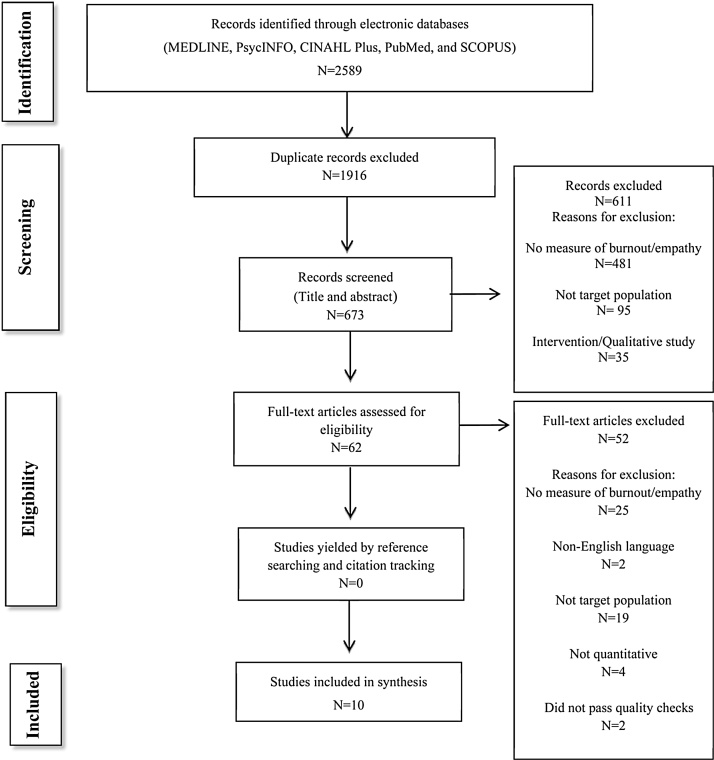
OBJECTIVE: Empathy and burnout are two related yet distinct constructs that are relevant to clinical healthcare staff. The nature of their relationship is uncertain and this review aimed to complete a rigorous, systematic exploration of the literature investigating the relationship between burnout and empathy in healthcare staff. DESIGN: A systematic review was conducted in accordance with the Preferred Reporting Items for Systematic Reviews and Meta-Analyses (PRISMA) guidance. DATA SOURCES: Search terms (Burnout OR Burn-out OR "Burn out") AND (Empathy OR Empath*) enabled identification of studies investigating burnout and empathy in healthcare staff, using five electronic data bases (MEDLINE, PsycINFO, CINAHL Plus, PubMed, and SCOPUS). Manual searching amongst reference lists of eligible articles was also completed. REVIEW METHODS: Databases were searched for studies published in the English language, from inception to February 2017. Key inclusion criteria were: 1) participants who were nurses or medical professionals, 2) full written manuscript in English, 3) use of the Maslach Burnout Inventory to assess burnout and a standardized outcome measure for empathy, 4) quantitative methodology exclusively. RESULTS: Ten eligible studies were reviewed. Of those, seven were conducted in countries where English was not the first language. Eight of the studies provided empirical support for a negative relationship between empathy and burnout. One study provided support for a positive relationship between burnout and empathy. One study reported contradictory evidence with positive and negative correlations between different subscales of the empathy and burnout measures. In general, the quality of the studies was assessed to be good. However, some of the studies failed to provide information pertaining to sample size, with the reporting of data less than adequate from one study. CONCLUSIONS: There was consistent evidence for a negative association between burnout and empathy. This review avoided a common English-speaking country bias of some areas of the literature. Given that all of the studies reviewed were cross sectional, further research is necessary to establish causality.
Overview
The claims and statistics of this paper haven’t been checked yet.
Run the check — free, no account needed. It reads the open-access text and checks the sources it cites.
Integrity signals
Registry
Cites
Statistics
Figures
Verification
Claims the paper makes
The claims and statistics of this paper haven’t been checked yet.
Run the check — free, no account needed. It reads the open-access text and checks the sources it cites.
Claims other papers make about this one
Each is checked against this paper’s own text: does it say what the citing paper says it does?
The source backs part of the claim, not all of it — or backs it for a different population, condition or comparison.
In the citing paper
“Good communication skills of empathizing and expressing the understanding towards patients' biopsychosocial contexts and goals of treatments was found to be associated with better clinical outcomes, professional satisfaction, and might help protect HCP from burnout [27,47,49].”
From The efficacy of applying the Interpersonal Effectiveness skills of dialectical behavior therapy into communication skills workshop for clinical nurses (2023) · cites this paper as [47]
Experimental — accuracy not yet measured
Self-check
Percentages, sums and reported differences re-computed from the paper’s own numbers.
The self-check needs the paper’s full text.
Citations
Cites
Liberati, A., Altman, D. G., Tetzlaff, J., Mulrow, C., Gøtzsche, P. C., Ioannidis, J. P. A., Clarke, M., Devereaux, P. J., Kleijnen, J., & Moher, D. (2009) · PLoS Medicine · doi:10.1371/journal.pmed.1000100 · Cited by 28,164
The measurement of experienced burnout
Maslach, C., & Jackson, S. E. (1981) · Journal of Organizational Behavior · doi:10.1002/job.4030020205 · Cited by 14,496
The job demands-resources model of burnout.
Demerouti, E., Bakker, A. B., Nachreiner, F., & Schaufeli, W. B. (2001) · Journal of Applied Psychology · doi:10.1037/0021-9010.86.3.499 · Cited by 13,643
Liberati, A., Altman, D. G., Tetzlaff, J., Mulrow, C., Gøtzsche, P. C., Ioannidis, J. P. A., Clarke, M., Devereaux, P. J., Kleijnen, J., & Moher, D. (2009) · Annals of Internal Medicine · doi:10.7326/0003-4819-151-4-200908180-00136 · Cited by 10,349
Measuring individual differences in empathy: Evidence for a multidimensional approach.
Davis, M. H. (1983) · Journal of Personality and Social Psychology · doi:10.1037/0022-3514.44.1.113 · Cited by 10,272
Cohen, J. (1992) · Psychological Bulletin · doi:10.1037//0033-2909.112.1.155 · Cited by 8,771
The necessary and sufficient conditions of therapeutic personality change.
Rogers, C. R. (1957) · Journal of Consulting Psychology · doi:10.1037/h0045357 · Cited by 5,599 · cited 1×
“Rogers (1957) termed empathy as the ability of the clinician to sense the service user's private world as if it were their own, without losing the ‘as if’, hypothetical quality.”
Hospital Nurse Staffing and Patient Mortality, Nurse Burnout, and Job Dissatisfaction
Aiken, L. H. (2002) · JAMA · doi:10.1001/jama.288.16.1987 · Cited by 5,226
The functional architecture of human empathy
Decety, J., & Jackson, P. L. (2004) · Behavioral and Cognitive Neuroscience Reviews · doi:10.1177/1534582304267187 · Cited by 3,407 · cited 2×
“The clinical relevance of the emotive, cognitive, and behavioral dimensions have been demonstrated empirically with varied emphasis (Decety& Jackson, 2004; Eisenberg& Eggum, 2009; Mercer&Reynolds, 2002).”
BackgroundResultEmpathy and Moral Development: Implications for Caring and Justice
Raboteg-Šarić, Z., & Hoffman, M. L. (2001) · Contemporary Sociology A Journal of Reviews · doi:10.2307/3089337 · Cited by 2,413
Maslach, C. (1982) · Cited by 2,389
A measure of emotional empathy1
Mehrabian, A., & Epstein, N. (1972) · Journal of Personality · doi:10.1111/j.1467-6494.1972.tb00078.x · Cited by 2,360
The Burnout Companion to Study and Practice: A Critical Analysis
Schaufeli, W. B., & Enzmann, D. (2020) · CRC Press eBooks · doi:10.1201/9781003062745 · Cited by 2,184
The Hazards of Scoring the Quality of Clinical Trials for Meta-analysis
Jüni, P. (1999) · JAMA · doi:10.1001/jama.282.11.1054 · Cited by 1,981
Compassion fatigue: Psychotherapists’ chronic lack of self care.
Figley, C. R. (2002) · Journal of Clinical Psychology · doi:10.1002/jclp.10090 · Cited by 1,614 · cited 1×
“Studies have shown how, despite being an important component in providing effective care, empathy also creates vulnerability for stress related conditions such as compassion fatigue and professional emotional exhaustion (Figley, 2002; Rothschild, 2006).”
BackgroundSpreng*, R. N., McKinnon*, M. C., Mar, R. A., & Levine, B. (2009) · Journal of Personality Assessment · doi:10.1080/00223890802484381 · Cited by 1,161
The Jefferson Scale of Physician Empathy: Development and Preliminary Psychometric Data
Hojat, M., Mangione, S., Nasca, T. J., Cohen, M. J. M., Gonnella, J. S., Erdmann, J. B., Veloski, J. J., & Magee, M. (2001) · Educational and Psychological Measurement · doi:10.1177/00131640121971158 · Cited by 1,052
Human empathy through the lens of social neuroscience.
Decety, J., & Lamm, C. (2006) · The Scientific World JOURNAL · doi:10.1100/tsw.2006.221 · Cited by 1,051 · cited 1×
“Theoretically and conceptually, empathy has seen much attention in the philosophical, psychological, and more recently, cognitive neuroscience literature, with varying definitions and conceptualizations (Decety & Lamm, 2006).”
BackgroundCommunication Patterns of Primary Care Physicians
Roter, D. L. (1997) · JAMA: The Journal of the American Medical Association · doi:10.1001/jama.1997.03540280088045 · Cited by 939 · cited 1×
“Roter et al. (1997) and Suchman, Roter, Green, and Lipkin (1993) found that service users and clinicians felt greater satisfaction with an interaction when there was an increase in empathy.”
BackgroundAdriaenssens, J., Gucht, V. D., & Maes, S. (2014) · International Journal of Nursing Studies · doi:10.1016/j.ijnurstu.2014.11.004 · Cited by 904
Diagnosing measurement equivalence in cross-national research.
Mullen, M. R. (1995) · Journal of International Business Studies · doi:10.1057/palgrave.jibs.8490187 · Cited by 863
Dimensions of therapist response as causal factors in therapeutic change.
Barrett‐Lennard, G. T. (1962) · The Psychological Monographs · doi:10.1037/h0093918 · Cited by 842
Mercer, S. W., & Reynolds, W. (2002) · Europe PMC (PubMed Central) · Cited by 800
Burnout: From tedium to personal growth
(1983) · Children and Youth Services Review · doi:10.1016/0190-7409(83)90036-1 · Cited by 790
Halbesleben, J. R. B., & Demerouti, E. (2005) · Work & Stress · doi:10.1080/02678370500340728 · Cited by 786
Burnout syndrome in critical care nursing staff
Poncet, M. C., Toullic, P., Papazian, L., Kentish-Barnes, N., Timsit, J.-F., Pochard, F., Chevret, S., Schlemmer, B., & Azoulay, É. (2007) · American Journal of Respiratory and Critical Care Medicine · doi:10.1164/rccm.200606-806oc · Cited by 750
KRUPNICK, J. L., Sotsky, S. M., Simmens, S., Moyer, J., & al, E. (1996) · Journal of Consulting and Clinical Psychology · doi:10.1037//0022-006x.64.3.532 · Cited by 732
Burnout in Mental Health Services: A Review of the Problem and Its Remediation
Morse, G. A., Salyers, M. P., Rollins, A. L., Monroe‐DeVita, M., & Pfahler, C. (2011) · Administration and Policy in Mental Health and Mental Health Services Research · doi:10.1007/s10488-011-0352-1 · Cited by 731
Burnout: From Tedium to Personal Growth
Torem, M. S. (1982) · Psychosomatics · doi:10.1016/s0033-3182(82)73308-0 · Cited by 725
Empathy and Moral Development: Implications for Caring and Justice
Stilwell, B. M. (2001) · Journal of the American Academy of Child & Adolescent Psychiatry · doi:10.1097/00004583-200105000-00026 · Cited by 690
Empathy in medical students as related to academic performance, clinical competence and gender
Hojat, M., Gonnella, J. S., Mangione, S., Nasca, T. J., Veloski, J. J., Erdmann, J. B., Callahan, C. A., & Magee, M. M. (2002) · Medical Education · doi:10.1046/j.1365-2923.2002.01234.x · Cited by 671
The Social Neuroscience of Empathy
(2009) · The MIT Press eBooks · doi:10.7551/mitpress/9780262012973.001.0001 · Cited by 609
KRUPNICK, J. L., Sotsky, S. M., Simmens, S. J., Moyer, J., Elkin, I., Watkins, J., & Pilkonis, P. A. (1996) · Journal of Consulting and Clinical Psychology · doi:10.1037/0022-006x.64.3.532 · Cited by 603
Stepien, K. A., & Baernstein, A. (2006) · Journal of General Internal Medicine · doi:10.1111/j.1525-1497.2006.00443.x · Cited by 576
Nurse burnout and quality of care: Cross‐national investigation in six countries
Poghosyan, L., Clarke, S. P., Finlayson, M., & Aiken, L. H. (2010) · Research in Nursing & Health · doi:10.1002/nur.20383 · Cited by 574
On the meaning of Maslach's three dimensions of burnout.
Lee, R. T., & Ashforth, B. E. (1990) · Journal of Applied Psychology · doi:10.1037/0021-9010.75.6.743 · Cited by 515
Elliott, R., Bohart, A. C., Watson, J. C., & Greenberg, L. S. (2011) · Psychotherapy · doi:10.1037/a0022187 · Cited by 511
The burnout companion to study and practice: a critical analysis
O’Sullivan, S. (2021) · Ergonomics · doi:10.1080/00140139.2021.1959733 · Cited by 469
Empathic Responding: Sympathy and Personal Distress
Eisenberg, N., & Eggum, N. D. (2009) · The MIT Press eBooks · doi:10.7551/mitpress/9780262012973.003.0007 · Cited by 459
A test of milieu effects with some of Piaget's tasks.
Goodnow, J. J. (1962) · The Psychological Monographs · doi:10.1037/h0093882 · Cited by 428
Compassion Fatigue and Burnout
Potter, P. A., Deshields, T. L., Divanbeigi, J., Berger, J., Cipriano, D., Norris, L., & Olsen, S. (2010) · Clinical journal of oncology nursing · doi:10.1188/10.cjon.e56-e62 · Cited by 425
Burns, D. D., & Nolen–Hoeksema, S. (1992) · Journal of Consulting and Clinical Psychology · doi:10.1037//0022-006x.60.3.441 · Cited by 315
Exploring Empathy: A Conceptual Fit for Nursing Practice?
Morse, J. M., Anderson, G. W., Bottorff, J. L., Yonge, O. J., O’Brien, B., Solberg, S. M., & McIlveen, K. F. H. (1992) · Journal of Nursing Scholarship · doi:10.1111/j.1547-5069.1992.tb00733.x · Cited by 301
Lamothe, M., Boujut, É., Zenasni, F., & Sultan, S. (2014) · BMC Family Practice · doi:10.1186/1471-2296-15-15 · Cited by 291
Burnout in the working population: relations to psychosocial work factors
Lindblom, K. M., Linton, S. J., Fedeli, C., & Bryngelsson, I. (2006) · International Journal of Behavioral Medicine · doi:10.1207/s15327558ijbm1301_7 · Cited by 274
Preventing Alzheimer's disease and cognitive decline.
(2010) · PubMed Central · Cited by 259
Communication and empathy as precursors to burnout among human service workers
MILLER, K. I., Stiff, J. B., & Ellis, B. H. (1988) · Communication Monographs · doi:10.1080/03637758809376171 · Cited by 236
Burnout in the Mental Health Workforce: A Review
Paris, M., & Hoge, M. A. (2009) · The Journal of Behavioral Health Services & Research · doi:10.1007/s11414-009-9202-2 · Cited by 227
Burnout, working conditions and gender - results from the northern Sweden MONICA Study
Norlund, S., Reuterwall, C., Höög, J., Lindahl, B., Janlert, U., & Birgander, L. S. (2010) · BMC Public Health · doi:10.1186/1471-2458-10-326 · Cited by 226
Developing empathy in nursing students: a cohort longitudinal study
Cunico, L., Sartori, R., Marognolli, O., & Meneghini, A. M. (2012) · Journal of Clinical Nursing · doi:10.1111/j.1365-2702.2012.04105.x · Cited by 217
A longitudinal study of job stress in the nursing profession: causes and consequences
Gelsema, T. I., van der Doef, M., Maes, S., JANSSEN, M., Akerboom, S., & Verhoeven, C. (2006) · Journal of Nursing Management · doi:10.1111/j.1365-2934.2006.00635.x · Cited by 215
Shattell, M. M., Starr, S. S., & Thomas, S. P. (2007) · International Journal of Mental Health Nursing · doi:10.1111/j.1447-0349.2007.00477.x · Cited by 212
Burns, D. D., & Nolen–Hoeksema, S. (1992) · Journal of Consulting and Clinical Psychology · doi:10.1037/0022-006x.60.3.441 · Cited by 210
Physician Satisfaction With Primary Care Office Visits
Suchman, A. L., ROTER, D. L., Green, M., & Lipkin, M. (1993) · Medical Care · doi:10.1097/00005650-199312000-00002 · Cited by 193
Construct validity of an empathy instrument
Monica, E. L. L. (1981) · Research in Nursing & Health · doi:10.1002/nur.4770040406 · Cited by 184
Taylor, P. J., Hutton, P., & Wood, L. (2014) · Psychological Medicine · doi:10.1017/s0033291714002074 · Cited by 177
Evaluation of empathy measurement tools in nursing: systematic review
Yu, J., & Kirk, M. (2009) · Journal of Advanced Nursing · doi:10.1111/j.1365-2648.2009.05071.x · Cited by 166
Brockhouse, R., Msetfi, R. M., Cohen, K., & Joseph, S. (2011) · Journal of Traumatic Stress · doi:10.1002/jts.20704 · Cited by 153
Occupational stress in psychiatric nursing
Joseph, P. (1993) · Journal of Advanced Nursing · doi:10.1046/j.1365-2648.1993.18040591.x · Cited by 150
A comprehensive model for predicting burnout in Korean nurses
Lee, H., Song, R., Cho, Y. S., Lee, G. Z., & Daly, B. (2003) · Journal of Advanced Nursing · doi:10.1046/j.0309-2402.2003.02837.x · Cited by 143
Help for the helper: The psychophysiology of compassion fatigue and vicarious trauma
Guyett, K. (2007) · Journal of Psychosomatic Research · doi:10.1016/j.jpsychores.2006.10.022 · Cited by 140
Yuguero, O., Marsal, J. R., Esquerda, M., Vivanco, L., & Soler-González, J. (2016) · European Journal of General Practice · doi:10.1080/13814788.2016.1233173 · Cited by 133
Regulating the costs of empathy: the price of being human
Hodges, S. D., & Klein, K. J. K. (2001) · The Journal of Socio-Economics · doi:10.1016/s1053-5357(01)00112-3 · Cited by 131
Burnout and empathy in primary care: three hypotheses
Zenasni, F., Boujut, E., Woerner, A., & Sultan, S. (2012) · British Journal of General Practice · doi:10.3399/bjgp12x652193 · Cited by 129
Wilson, A., Wynn, A., & Parker, H. (2002) · Europe PMC (PubMed Central) · Cited by 126
Depression and the workplace: A progress report
Bender, A., & Farvolden, P. (2008) · Current Psychiatry Reports · doi:10.1007/s11920-008-0013-6 · Cited by 126
Can we predict burnout severity from empathy-related brain activity?
Tei, S., Becker, C., Kawada, R., Fujino, J., Jankowski, K. F., Sugihara, G., Murai, T., & Takahashi, H. (2014) · Translational Psychiatry · doi:10.1038/tp.2014.34 · Cited by 125
Empathy and burnout: an analytic cross-sectional study among nurses and nursing students.
Ferri, P., Guerra, E., Marcheselli, L., Cunico, L., & Lorenzo, R. D. (2015) · Acta bio-medica dell'Ateneo parmense/Acta biomedica · Cited by 119
Roberts, S., Lester, K. J., Hudson, J. L., Rapee, R. M., Creswell, C., Cooper, P. J., Thirlwall, K. J., Coleman, J. R. I., Breen, G., Wong, C. C. Y., et al. (2014) · Translational Psychiatry · doi:10.1038/tp.2014.83 · Cited by 118
Krupnick, J. L., Sotsky, S. M., Elkin, I., Simmens, S., Moyer, J., Watkins, J., & Pilkonis, P. A. (2006) · Focus · doi:10.1176/foc.4.2.269 · Cited by 111
Effects of omega-3 fatty acids on cardiovascular disease.
Wang, C., Chung, M., Lichtenstein, A. H., Balk, E. M., Kupelnick, B., DeVine, D., Lawrence, A., & Lau, J. (2004) · PubMed Central · Cited by 96
The limits of empathy: problems in medical education and practice
Smajdor, A., Stöckl, A., & Salter, C. (2011) · Journal of Medical Ethics · doi:10.1136/jme.2010.039628 · Cited by 89
Harzing, A.-W. K., & Maznevski, M. L. (2002) · Language and Intercultural Communication · doi:10.1080/14708470208668081 · Cited by 75
USES OF THE THEMATIC APPERCEPTION TEST
Murray, H. A. (1951) · American Journal of Psychiatry · doi:10.1176/ajp.107.8.577 · Cited by 72
Diamantopoulos, A., & Papadopoulos, N. G. (2009) · Journal of International Business Studies · doi:10.1057/jibs.2009.37 · Cited by 70
Whittington, R., Hockenhull, J., McGuire, J., Leitner, M., Barr, W., Cherry, M. G., Flentje, R., Quinn, B., Dundar, Y., & Dickson, R. (2013) · Health Technology Assessment · doi:10.3310/hta17500 · Cited by 69
Self-citationBurnout, empathy and their relationships: a qualitative study with residents in General Medicine
Picard, J., Catu-Pinault, A., Boujut, É., Botella, M., Jaury, P., & Zenasni, F. (2015) · Psychology Health & Medicine · doi:10.1080/13548506.2015.1054407 · Cited by 66
Association between Sick Leave Prescribing Practices and Physician Burnout and Empathy
Torres, O. Y., Esquerda, M., Marsal, J. R., & Soler-González, J. (2015) · PLoS ONE · doi:10.1371/journal.pone.0133379 · Cited by 64
Significant Effects Due to Rephrasing the Maslach Burnout Inventory's Personal Accomplishment Items
Bouman, A., Brake, H. T., & Hoogstraten, J. (2002) · Psychological Reports · doi:10.2466/pr0.2002.91.3.825 · Cited by 42
Effectiveness of assisted reproductive technology (ART).
Myers, E. R., McCrory, D. C., Mills, A. A., Price, T. M., Swamy, G. K., Tantibhedhyangkul, J., Wu, J. M., & Matchar, D. B. (2008) · PubMed Central · Cited by 36
Tedium Among Personnel Working with Geriatric Patients
Åström, S., Norberg, A., Nilsson, M., & Winblad, B. G. (1987) · Scandinavian Journal of Caring Sciences · doi:10.1111/j.1471-6712.1987.tb00613.x · Cited by 31
Empathy and burnout among physicians of different specialities.
Walocha, E., Tomaszewski, K. A., Wilczek‐Rużyczka, E., & Walocha, J. A. (2013) · PubMed · Cited by 31
Sandhu, D. K., Rose, J., Rostill-Brookes, H., & Thrift, S. (2012) · Journal of Applied Research in Intellectual Disabilities · doi:10.1111/j.1468-3148.2011.00667.x · Cited by 26
Interventions to prevent burnout in high risk individuals: evidence review
Bagnall, A. L., Jones, R. A., Akter, H., & Woodall (2016) · Leeds Beckett Repository (Leeds Beckett University) · Cited by 15
Meneghini, A. M., Sartori, R., & Cunico, L. (2006) · Cited by 13
Avoiding burnout syndrome in palliative care
Nyatanga, B. (2014) · British Journal of Community Nursing · doi:10.12968/bjcn.2014.19.10.515 · Cited by 6
Building your learning environment.
Price, B. (2005) · PubMed · Cited by 4
Research works printed but not linked: 2
- Meneghini, 2006, Adaptation and validation on an Italian sample of the balanced emotional empathy scale by Albert Mehrabian, Ric Psicol, 29, 123
- Wright, 2005, Burnout: A spiritual crisis, Nursing Standard, 19, 1
Cited by
Sorted by citations
Parental Burnout: What Is It, and Why Does It Matter?
Mikolajczak, M., Gross, J. J., & Roskam, I. (2019) · Clinical Psychological Science · doi:10.1177/2167702619858430 · Cited by 464
Strategic regulation of empathy
Weisz, E., & Cikara, M. (2021) · Trends in Cognitive Sciences · doi:10.1016/j.tics.2020.12.002 · Cited by 217
A systematic review of research on empathy in health care
Nembhard, I. M., David, G., Ezzeddine, I., Betts, D., & Radin, J. M. (2022) · Health Services Research · doi:10.1111/1475-6773.14016 · Cited by 203
Barello, S., Caruso, R., Palamenghi, L., Nania, T., Dellafiore, F., Bonetti, L., Silenzi, A., Marotta, C., & Graffigna, G. (2021) · International Archives of Occupational and Environmental Health · doi:10.1007/s00420-021-01669-z · Cited by 155
The development of empathy in the healthcare setting: a qualitative approach
Yu, C. C., Tan, L. L. C., Le, M. K., Tang, B., Liaw, S. Y., Tierney, T., Ho, Y. Y., Beng Eng Evelyn, L. I. M., Lim, D., Ng, R., et al. (2022) · BMC Medical Education · doi:10.1186/s12909-022-03312-y · Cited by 164
Metadata
- Authors
- Wilkinson, H., Whittington, R., Perry, L., & Eames, C.
- Affiliations
- University of Liverpool (GB)
- Mersey Care NHS Trust (GB)
- Corresponding author
- Whittington, Richard
- Venue
- Burnout Research
- Publisher
- Elsevier BV
- Published
- 2017-09
- Volume
- 6
- Pages
- 18-29
- ISSN
- 2213-0578 (ISSN-L)
- 2213-0586
- PMC
- PMC5534210
- OpenAlex
- W2727711984
- Cited by
- 509
- References
- 88
- Citations by year
- 2026: 49 · 2025: 79 · 2024: 69 · 2023: 63 · 2022: 69 · 2021: 72 · 2020: 52 · 2019: 41 · 2018: 12 · 2017: 2
- FWCI
- 5.16
- Type
- journal article
- Language
- en
- Open access
- hybrid
- doi.org
- Locations
- Burnout Research (publishedVersion, cc-by)
- PubMed Central (publishedVersion, cc-by)
- PubMed (publishedVersion)
- Liverpool John Moores University (submittedVersion, cc-by)
- Topics
- Health Sciences › Health Professions › General Health Professions › Healthcare professionals’ stress and burnout
- Social Sciences › Psychology › Social Psychology › Stress and Burnout Research
- Health Sciences › Medicine › Psychiatry and Mental health › Empathy and Medical Education
- Keywords
- burnout, empathy, healthcare workers, nurses, physicians, Maslach Burnout Inventory, cross-cultural research
About these checks
Registry, retraction, Cites and statistics results are computed, not judged, with one exception: a printed reference that no index lists is read once by a model before it counts as a citation error. Claims are extracted by a model and kept only when their quote appears verbatim in the text; each cited source is then checked, with a model’s help, for whether it says what the claim relies on. Those verdicts can be wrong — read the claim’s quote and the cited source before relying on one.
Statistics and arithmetic are recomputed, not judged.
Confidence bands are shown only for fields calibrated on our annotated test set. None is calibrated yet, so no band is shown.
What counts as a claim ›How we measure confidence ›How we check this ›
Are you an author, or do you see a problem with this page? Request a review
