

Compressive strength of concrete with recycled aggregate; a machine learning-based evaluation
Open accessThe DOI matches its Crossref record; 59 of the 59 references it cites were found in a registry or an index; none of the 18 sources its claims cite is checked for support yet.
Abstract
In the recent decades, researchers have shown an increased interest in the reusing recycled concrete aggregate generated by buildings' demolitions because of the undeniable economic and environmental benefits.The main objective of this research is therefore to evaluate the influence of replacing natural fine and coarse aggregate on the 3-, 7-and 28-day compressive strength of concrete using machine learning-based approaches.To this aim, the paper is presented in two parts.Firstly, linear, nonlinear regression and Random Forest methods are used to propose prediction models for estimating compressive strength of concrete with recycled aggregate.Then, the results are compared to those of Artificial Neural Network and M5P models available in the literature in terms of performance metrics parameters and Taylor diagram.Consequently, the most accurate model is introduced and used in the second part for assessing the effect of using recycled aggregates on the concrete compressive strength.To this end, three 10-set databases are generated by replacing natural fine, coarse and both of them with recycled fine, coarse and both of them, respectively, by the portions of 0-90% with the step of 10%.The compressive strength predicted by the ML-based model are evaluated in three different testing ages (3, 7 and 28 days).The results proved the high accuracy of the proposed prediction models and Random Forest model which was developed in this study was the most accurate model.Moreover, it was concluded that incorporating recycled aggregate could decrease compressive strength insignificantly.Finally, reduction in long-term strength of the concrete containing recycled fine aggregate is less than those containing coarse aggregate or both fine and coarse aggregate.
Overview
CoChat Summary
TL;DR
This study develops linear regression, nonlinear regression, and random forest models to predict compressive strength of concrete containing recycled aggregate, then uses the best model to assess replacement effects. It finds recycled aggregate generally lowers compressive strength, with coarse recycled aggregate causing larger reductions than fine recycled aggregate.
Key findings
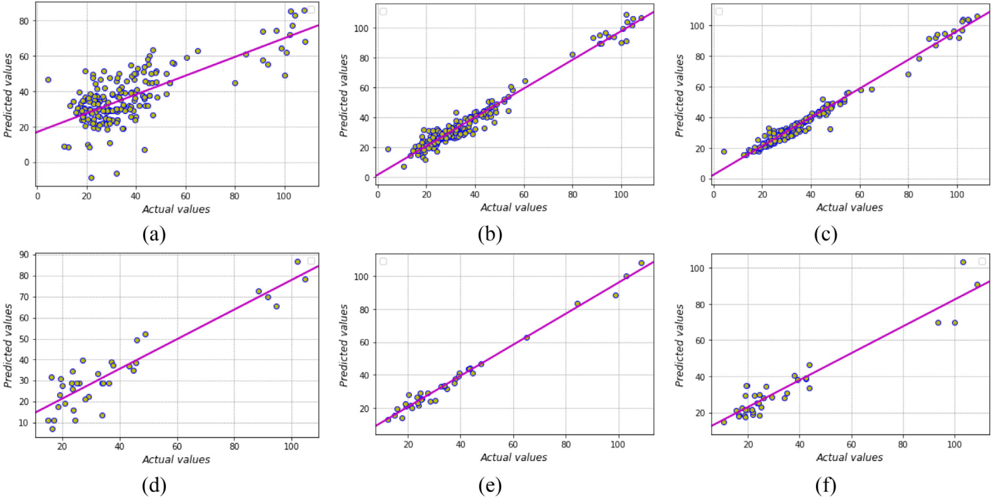
- Among the models proposed in this study, NLR had the highest accuracy on the 85/15 train-test split (R² = 0.98, RMSE = 3.14 MPa, MAE = 2.18 MPa, MAPE = 7.41%), while RF had R² = 0.88 and LR had R² = 0.80 (Table 2). When all models were compared on all data, RF was slightly more accurate than ANN models (RF: R² = 98.48%, RMSE = 2.63 MPa, MAE = 1.83 MPa, MAPE = 7.16%; ANNSSA: R² = 98.41%; ANNGA/ANNGOA: R² = 98.01%; NLR: R² = 96.75%; M5P: R² = 89.68%; LR: R² = 59.31%) (Table 3).
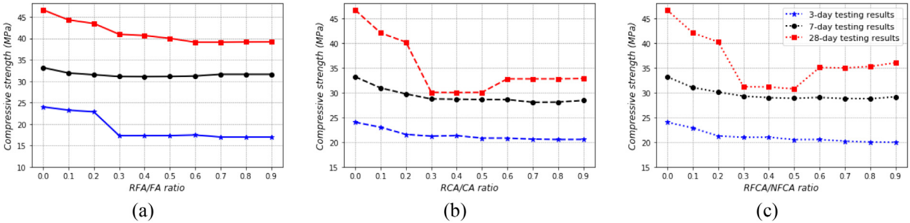
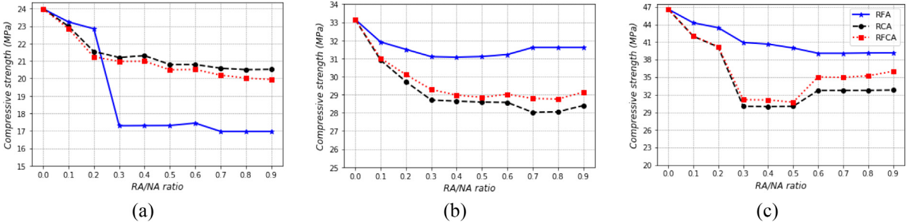
- Replacing natural aggregate with recycled aggregate reduced compressive strength regardless of RA type and testing age; replacement up to about 30% reduced CS noticeably, while 30–90% replacement reduced it slightly.
- At 28 days, strength reduction was 9.88–35.68% for RCA, 4.98–16.15% for RFA, and 9.83–34.06% for RFCA; replacing coarse aggregate caused more reduction than fine or both.
- For concrete with coarse or both fine and coarse recycled aggregate, 28-day strength reduction was higher than at 3 and 7 days; for fine recycled aggregate, 3-day reduction (3.15–29.27%) was higher than 7-day (3.76–6.28%) and 28-day (4.98–16.15%).
Methods
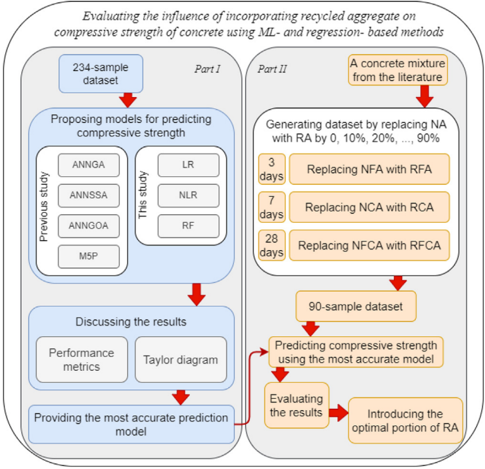
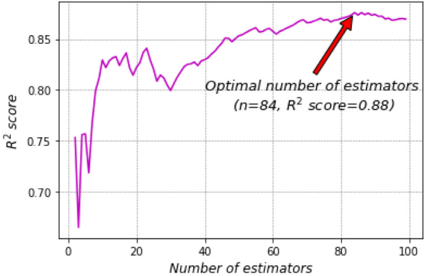
- Used a dataset collected from peer-reviewed publications and previously used by Kandiri et al. (2021); inputs were OPC, sand, coarse aggregate, fine aggregate, W/C, SP/C, CRA, testing age, and FRA; output was compressive strength (MPa). LR, NLR, and RF models were trained/tested with an 85%/15% split; RF used 84 trees based on trial-and-error.
- Compared these models with ANNGA, ANNSSA, ANNGOA, and M5P from the previous study using RMSE, MAE, R², MAPE, and Taylor diagrams.
- For the RA effect assessment, selected a concrete mixture from Poon et al. (2004), generated three sub-datasets (each 30 datasets) by replacing NFA, NCA, and NFCA with RFA, RCA, and RFCA at 0–90% in 10% steps, and predicted 3-, 7-, and 28-day CS with the RF model.
Limitations
- The paper states that other properties (e.g., flexural strength, splitting tensile strength, water absorption, modulus of elasticity) may be affected by RA replacement but were not evaluated, and that factors such as old mortar content and old mortar properties of RCA were not considered; further studies are needed.
- The paper notes disadvantages of RA—reduced modulus of elasticity, ductility, density, durability, and effects on workability, shrinkage, water absorption, and air content—should receive attention when replacing NA with RA.
- Evident from the text: the replacement-scenario results are model predictions from RF rather than new experimental tests, and the dataset details/statistics are referred to the prior study rather than fully reported here.
Model-written summary. Check it against the paper before relying on it.
Integrity signals
Registry
Cites
Statistics
Figures
Verification
Claims the paper makes
0 Valid · 4 Not valid · 10 Not checked · 39 Own results and interpretations
A result the paper reports from its own data — it cites no other source for it, so there is none to check. The quote shows it is in the paper.
In the paper
“Taking the effect of testing age into account, it could be stated that for the concrete containing coarse or both fine and coarse recycled aggregate, the changes of 3-day and 7-day compressive strength is less than 28-day compressive strength.”
§ Compressive strength of concrete with recycled aggregate; a machine learning-based evaluation > 6. The influence of RA on concrete compressive strength
hedgedstates an association- Asserted: passes — The authors put it forward as true.
- Checkable: passes — It can be checked against evidence.
- Load-bearing: passes — The paper’s conclusions depend on it.
- Based: passes — The paper gives a reason why it holds.
A result the paper reports from its own data — it cites no other source for it, so there is none to check. The quote shows it is in the paper.
In the paper
“Furthermore, based on the graphical comparison made in Fig. 8, replacing NA with RA up to almost 30%, reduces CS noticeably.”
- Also stated in: § 7. Summery and conclusions · plain
“Replacing natural aggregate with recycled aggregate up to 30%, reduces concrete compressive strength noticeably and then it decreases slightly for replacement proportions of 30-90%.”
§ Compressive strength of concrete with recycled aggregate; a machine learning-based evaluation > 6. The influence of RA on concrete compressive strength
plainstates a cause- Asserted: passes — The authors put it forward as true.
- Checkable: passes — It can be checked against evidence.
- Load-bearing: passes — The paper’s conclusions depend on it.
- Based: passes — The paper gives a reason why it holds.
- Also stated in: § 7. Summery and conclusions · plain
A result the paper reports from its own data — it cites no other source for it, so there is none to check. The quote shows it is in the paper.
In the paper
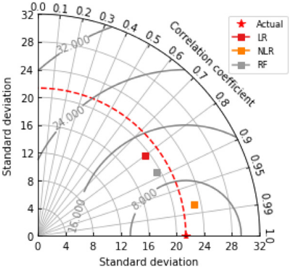
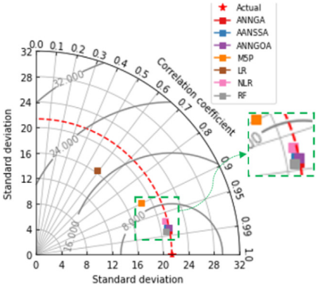
“NLR and M5P models with an insignificantly lower accuracy resulted in R 2 = 97% and 90%, respectively.”
§ Compressive strength of concrete with recycled aggregate; a machine learning-based evaluation > 5.2. Performance comparison of the models proposed in both studies
plain- Asserted: passes — The authors put it forward as true.
- Checkable: passes — It can be checked against evidence.
- Load-bearing: unclear — It is unclear whether the paper’s conclusions depend on it.
- Based: passes — The paper gives a reason why it holds.
A result the paper reports from its own data — it cites no other source for it, so there is none to check. The quote shows it is in the paper.
In the paper
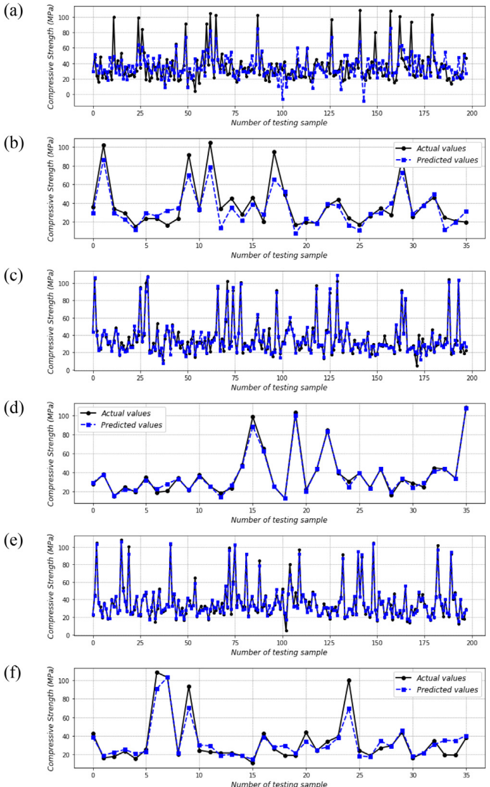
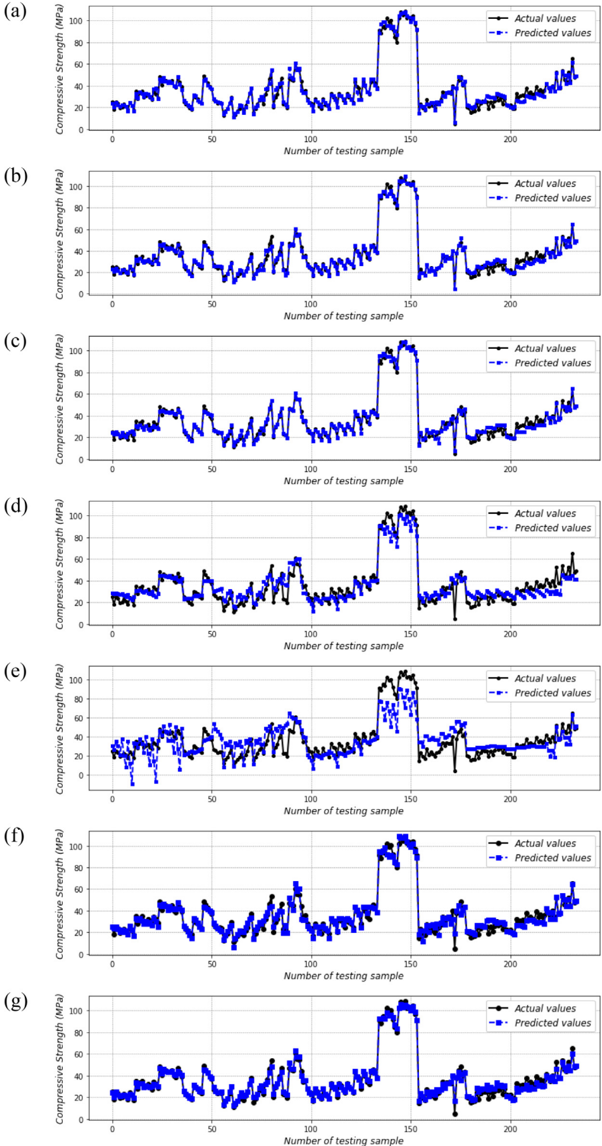
“A deeper consideration of Fig. 8 and the results reported in Table 3 clarifies that the RF model is slightly more accurate than ANN models, hence it is introduced as the best ML-based model for predicting compressive strength of CR and is used for evaluating the optimal percentage of RA in the next section.”
§ Compressive strength of concrete with recycled aggregate; a machine learning-based evaluation > 5.2. Performance comparison of the models proposed in both studies
plain- Asserted: passes — The authors put it forward as true.
- Checkable: passes — It can be checked against evidence.
- Load-bearing: passes — The paper’s conclusions depend on it.
- Based: passes — The paper gives a reason why it holds.
A result the paper reports from its own data — it cites no other source for it, so there is none to check. The quote shows it is in the paper.
In the paper
“Finally, the LR model had the lowest R 2 score (59.31%) which reflects less reliability of this model in comparison to other models.”
§ Compressive strength of concrete with recycled aggregate; a machine learning-based evaluation > 5.2. Performance comparison of the models proposed in both studies
plain- Asserted: passes — The authors put it forward as true.
- Checkable: passes — It can be checked against evidence.
- Load-bearing: passes — The paper’s conclusions depend on it.
- Based: passes — The paper gives a reason why it holds.
26 more claims
Create a free account to see all 53 claims and to verify the 17 references still open.
- It may state two separate claims as one. 15
- Probably not a substantial claim. 11
Claims other papers make about this one
Each is checked against this paper’s own text: does it say what the citing paper says it does?
In the citing paper
“The concrete with RCA and RCFA shows a 10 MPa reduction between ~20 and 30% replacement levels, which indicates load transfer reduction by interfacial degradation around coarse particles [22].”
From Increasing the Reuse Potential of Recycled Aggregates from Concrete and Masonry CDW: Treatment, Performance, and Sustainability for Structural Applications (2026) · cites this paper as [22]
In the citing paper
“These models were selected because they have been widely used in concrete material prediction studies and represent different types of learning methods, including tree-based ensemble models, kernel-based regression, regularized linear regression, and neural network models.”
From Assessing machine learning prediction of recycled aggregate concrete strength with a tabular foundation model (2026) · cites this paper as [127]
Self-check
Percentages, sums and reported differences re-computed from the paper’s own numbers.
Each contradiction between two passages listed here was confirmed by an independent check.
Rated minor: it would not touch a result — a value no result rests on, a p-value that stays on the same side of the significance level, or a conflict that is clerical, resolved elsewhere in the paper, or outside its own findings.
In the paper
§ Compressive strength of concrete with recycled aggregate; a machine learning-based evaluation > 6. The influence of RA on concrete compressive strength
“for the concrete containing coarse or both fine and coarse recycled aggregate, the changes of 3-day and 7-day compressive strength is less than 28-day compressive strength.Considering the numerical compressive strength reported in Table 4, the 3-and 7-day strength values vary in the range of 4.76-16.90%and 6.47-13.26,respectively, while 28-day strength alters in the range of and 9.83-34.06%.”
§ Compressive strength of concrete with recycled aggregate; a machine learning-based evaluation > 6. The influence of RA on concrete compressive strength
“strength reduction reported for concrete containing RCA is in the range of 9.88-35.68%while those of concrete with RFA and RFCA are respectively 4.98-16.15%and 9.83-34.06%.”
Rated minor: it would not touch a result — a value no result rests on, a p-value that stays on the same side of the significance level, or a conflict that is clerical, resolved elsewhere in the paper, or outside its own findings.
In the paper
§ Compressive strength of concrete with recycled aggregate; a machine learning-based evaluation > 5.1. Performance comparison of the LR, NLR and RF models
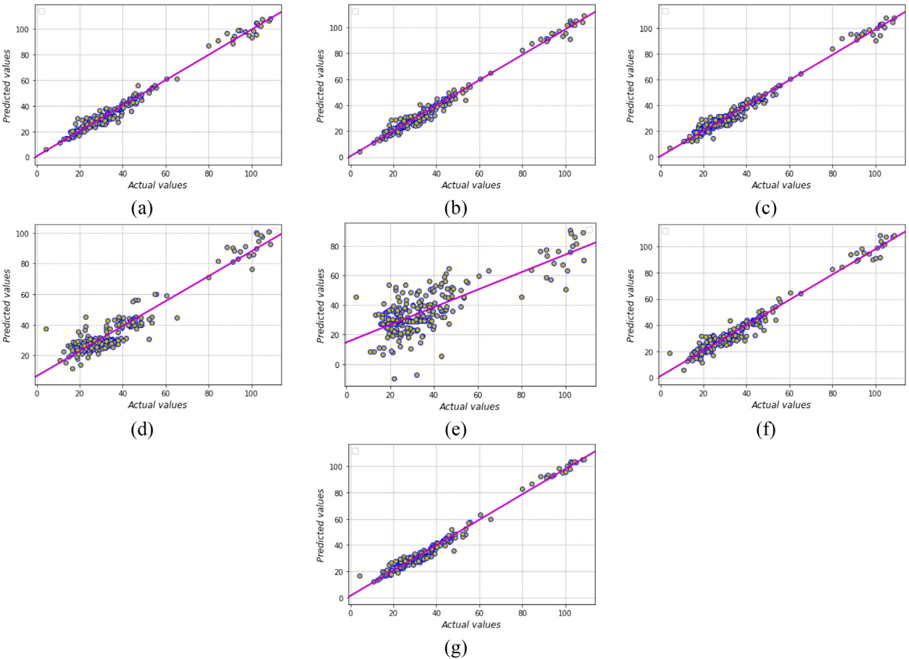
“As depicted in Fig. 5, the NLR model (R 2 = 0.98, std = 23.03,RMSE = 14.41)”
§ Compressive strength of concrete with recycled aggregate; a machine learning-based evaluation > 8. Recommendations and limitations
“| NLR | 0.98 | 3.14 | 2.18 | 7.41 |”
Cited works that were retracted
Works this paper cites that were later retracted, from the retraction notices publishers deposit. Major when the notice came out before this paper was published.
A note, not an issue: for example, a cited work that was retracted only after this paper was published, which its authors could not have known.
In the paper
“Chaboki, 2018, Experimental study on the flexural behaviour and ductility ratio of steel fibres coarse recycled aggregate concrete beams, Constr. Build. Mater., 186, 400, 10.1016/j.conbuildmat.2018.07.132”
Cited work 10.1016/j.conbuildmat.2018.07.132 · retracted 2022-03-03 · notice 10.1016/j.conbuildmat.2022.126958 · this paper published 2022-03
Citations
Cites
1 retracted
Chaboki, H. R., Ghalehnovi, M., Karimipour, A., & de Brito, J. (2018) · Construction and Building Materials · doi:10.1016/j.conbuildmat.2018.07.132 · Cited by 94
RetractedBreiman, L. (2001) · Machine Learning · doi:10.1023/a:1010933404324 · Cited by 133,538
Shape Quantization and Recognition with Randomized Trees
Amit, Y., & Geman, D. (1997) · Neural Computation · doi:10.1162/neco.1997.9.7.1545 · Cited by 1,275
A review of recycled aggregate in concrete applications (2000–2017)
Tam, V. W. Y., Soomro, M., & Evangelista, A. C. J. (2018) · Construction and Building Materials · doi:10.1016/j.conbuildmat.2018.03.240 · Cited by 1,235
Mechanical properties of recycled aggregate concrete under uniaxial loading
Xiao, J., Li, J., & Zhang, C. (2005) · Cement and Concrete Research · doi:10.1016/j.cemconres.2004.09.020 · Cited by 1,175
Emerging Artificial Intelligence Methods in Structural Engineering
Salehi, H., & Burgueño, R. (2018) · Engineering Structures · doi:10.1016/j.engstruct.2018.05.084 · Cited by 1,068
Mechanical behaviour of concrete made with fine recycled concrete aggregates
Evangelista, L., & de Brito, J. (2007) · Cement and Concrete Composites · doi:10.1016/j.cemconcomp.2006.12.004 · Cited by 1,059
A Comprehensive Review on Recycled Aggregate and Recycled Aggregate Concrete
Wang, B., Yan, L., Fu, Q., & Kasal, B. (2021) · Resources, Conservation and Recycling · doi:10.1016/j.resconrec.2021.105565 · Cited by 999
Poon, C. S., Shui, Z. H., Lam, L., Fok, H., & Kou, S. C. (2004) · Cement and Concrete Research · doi:10.1016/s0008-8846(03)00186-8 · Cited by 915
Machine learning prediction of mechanical properties of concrete: Critical review
Ben Chaabene, W., Flah, M., & Nehdi, M. L. (2020) · Construction and Building Materials · doi:10.1016/j.conbuildmat.2020.119889 · Cited by 779
Research works printed but not linked: 2
- Biau, G., 2012. Analysis of a random forests model. J. Mach. Learn. Res. 13, 1063-1095.
- Dabiri, H., Kheyroddin, A., 2017. An analytical study into the seismic behavior of RC pier with elastomeric materials. Asian J. Civil Eng. (BHRC) 18 (7), 1183-1193.
Cited by
Items 101–105 of 105
Amin, I. A., Simatupang, M., & Mokui, H. T. (2026) · JURNAL TEKNIK SIPIL CENDEKIA (JTSC) · doi:10.51988/jtsc.v7i4.765
Machine Learning-Based Prediction of Compressive Strength of Recycled Aggregate Concrete
Kumar, S., Kumar, P., Kumar, A., & Daniyal, M. (2026) · International Journal of Artificial Intelligence and Machine Learning · doi:10.51483/ijaiml.6.9s.2026.93-109
Recycled Aggregate Concrete: A Critical Review of its Properties, Limitations and Applications
., S., & Sehra, M. K. (2026) · International Journal for Research in Applied Science and Engineering Technology · doi:10.22214/ijraset.2026.85233
Khosravi, H., & Bahram, M. (2026) · Applications in Engineering Science · doi:10.1016/j.apples.2026.100365
Nirma University, S. O. E., Joshi, T., Mathur, P., Nirma University, S. O. E., Oza, P., Nirma University, S. O. E., Agrawal, S., Nirma University, S. O. E., Narmawala, H., & Nirma University, S. O. E. (2024) · Advances in Civil and Architectural Engineering · doi:10.13167/2024.29.11 · Cited by 3
Metadata
- Authors
- Dabiri, H., Kioumarsi, M., Kheyroddin, A., Kandiri, A., & Sartipi, F.
- Affiliations
- Università di Camerino (IT)
- OsloMet – Oslo Metropolitan University (NO)
- Semnan University (IR)
- University College Dublin (IE)
- Corresponding author
- Dabiri, Hamed
- Venue
- Cleaner Materials
- Publisher
- Elsevier BV
- Published
- 2022-03
- Volume
- 3
- Pages
- 100044
- ISSN
- 2772-3976 (ISSN-L)
- OpenAlex
- W4205602421
- Cited by
- 105
- References
- 59
- Citations by year
- 2026: 24 · 2025: 25 · 2024: 26 · 2023: 17 · 2022: 13
- FWCI
- 7.84
- Type
- journal article
- Language
- en
- Open access
- gold
- doi.org
- Licence
- cc-by-nc-nd
- www.elsevier.com/tdm/userlicense/1.0/ (tdm)
- www.elsevier.com/legal/tdmrep-license (tdm)
- creativecommons.org/licenses/by-nc-nd/4.0/ (vor)
- Locations
- Cleaner Materials (publishedVersion, cc-by-nc-nd)
- NVA (Nasjonalt vitenarkiv) (submittedVersion, cc-by-nc-nd)
- DOAJ (DOAJ: Directory of Open Access Journals) (submittedVersion)
- Topics
- Physical Sciences › Engineering › Building and Construction › Recycled Aggregate Concrete Performance
- Physical Sciences › Engineering › Civil and Structural Engineering › Innovative concrete reinforcement materials
- Physical Sciences › Engineering › Building and Construction › Materials Engineering and Processing
- Keywords
- recycled concrete aggregate, compressive strength, recycled fine aggregate, recycled coarse aggregate, natural aggregate replacement, concrete strength prediction, random forest, artificial neural networks, linear and nonlinear regression, long-term strength, demolition waste reuse
About these checks
Registry, retraction, Cites and statistics results are computed, not judged, with one exception: a printed reference that no index lists is read once by a model before it counts as a citation error. Claims are extracted by a model and kept only when their quote appears verbatim in the text; each cited source is then checked, with a model’s help, for whether it says what the claim relies on. Those verdicts can be wrong — read the claim’s quote and the cited source before relying on one.
A language model drew the claims from the paper on 2026-11-27, under version 3 of the claim definition (model deepseek-v4.1-flash, prompt extract-v3).
A second model labelled each claim on 2026-11-27 (model jev-1.13-20260917, definition revision gold-guideline-v0.2).
Statistics and arithmetic are recomputed, not judged.
Confidence bands are shown only for fields calibrated on our annotated test set. None is calibrated yet, so no band is shown.
What counts as a claim ›How we measure confidence ›How we check this ›
Are you an author, or do you see a problem with this page? Request a review
Data sources
Bibliographic data: Semantic Scholar, OpenAlex, Crossref.
Contains information from the Semantic Scholar Academic Graph Datasets, made available under the ODC Attribution License (ODC-BY 1.0).
Semantic Scholar’s data is described in: Kinney, R., et al. (2023). The Semantic Scholar Open Data Platform. arXiv:2301.10140.
