

The DOI matches its Crossref record; 99 of the 102 references it cites were found in a registry or an index.
Excessive use of disinfectants against COVID-19 posing a potential threat to living beings
Open accessAbstract
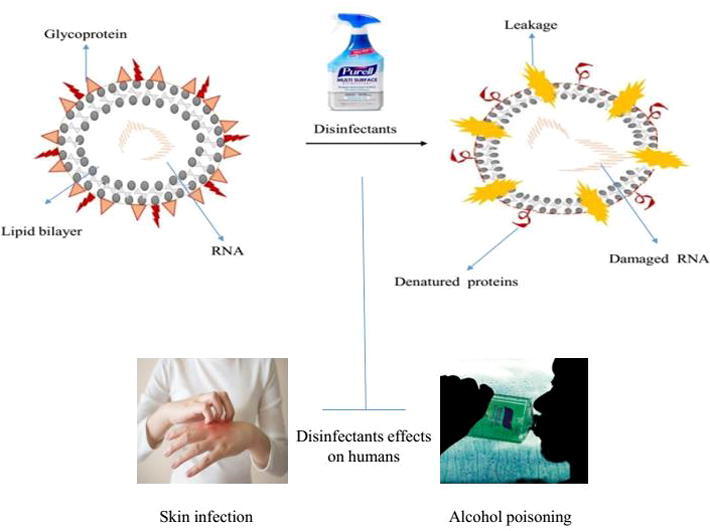
The severe acute respiratory syndrome coronavirus 2 (SARS-CoV-2) emerged in Wuhan city of China in late December 2019 and identified as a novel coronavirus disease 2019 (COVID-19). On January 30, the World Health Organization (WHO) declared the coronavirus outbreak a global public health emergency. The rapid spread of the pathogen across the communities shock the entire population. As no existing therapy were available during the pandemic. Health professionals recommended frequent washing of hands with soap and alcohol-based sanitizers. Disinfectants were extensively sprayed to minimize the possibility of getting COVID-19. Despite the potential benefits of these germicidal agents against COVID-19. Alcohol-based hand sanitizers lead to dry skin, infection, and alcohol poisoning. Children are considered more prone to alcohol poisoning and other major health concern. Precautionary measures should be ensured to protect the community from the possible risk associated with disinfectants.
Overview
The claims and statistics of this paper haven’t been checked yet.
Run the check — free, no account needed. It reads the open-access text and checks the sources it cites.
Integrity signals
Registry
Cites
Statistics
Figures
Verification
Claims the paper makes
The claims and statistics of this paper haven’t been checked yet.
Run the check — free, no account needed. It reads the open-access text and checks the sources it cites.
Claims other papers make about this one
Each is checked against this paper’s own text: does it say what the citing paper says it does?
The source backs part of the claim, not all of it — or backs it for a different population, condition or comparison.
In the citing paper
“The phenomenon of cross-resistance between disinfectants and antimicrobials has been reported for several disinfectants and is associated with a further increase in AMR during the pandemic period [5, 10, 11].”
From Profiling the resistome and virulome of Bacillus strains used for probiotic-based sanitation: a multicenter WGS analysis (2025) · cites this paper as [5]
Experimental — accuracy not yet measuredThe source backs part of the claim, not all of it — or backs it for a different population, condition or comparison.
In the citing paper
“In addition, they have shown high environmental impact and the capacity to favor the selection of disinfectant- and drug-tolerant/resistant strains [5].”
From Profiling the resistome and virulome of Bacillus strains used for probiotic-based sanitation: a multicenter WGS analysis (2025) · cites this paper as [5]
Experimental — accuracy not yet measuredThe source backs part of the claim, not all of it — or backs it for a different population, condition or comparison.
In the citing paper
“Consistent with this, during the COVID-19 pandemic, when chemical disinfection was significantly increased in both sanitary and non-sanitary settings, a significant increase in AMR was recorded [5, 10, 11, 21].”
From Profiling the resistome and virulome of Bacillus strains used for probiotic-based sanitation: a multicenter WGS analysis (2025) · cites this paper as [5]
Experimental — accuracy not yet measured
Self-check
Percentages, sums and reported differences re-computed from the paper’s own numbers.
The self-check needs the paper’s full text.
Citations
Cites
Lai, C.-C., Shih, T.-P., Ko, W.-C., Tang, H.-J., & Hsueh, P.-R. (2020) · International Journal of Antimicrobial Agents · doi:10.1016/j.ijantimicag.2020.105924 · Cited by 6,068
Antiseptics and Disinfectants: Activity, Action, and Resistance
McDonnell, G. E., & Russell, A. D. (1999) · Clinical Microbiology Reviews · doi:10.1128/cmr.12.1.147 · Cited by 4,795
Persistence of coronaviruses on inanimate surfaces and their inactivation with biocidal agents.
Kampf, G., Todt, D., Pfaender, S., & Steinmann, E. (2020) · Journal of Hospital Infection · doi:10.1016/j.jhin.2020.01.022 · Cited by 3,796
Bellini, M., Charalampidis, S., Herbert, P., Bonatsos, V., Crane, J., Muthusamy, A., Dor, F., & Papalois, V. E. (2022) · BioMed Research International · doi:10.1155/2738 · Cited by 2,431
Disinfection, Sterilization, and Preservation
Block, S. S. (1977) · Soil Science · doi:10.1097/00010694-197712000-00013 · Cited by 1,963
Contrasting Computational Models of Mate Preference Integration Across 45 Countries
Conroy‐Beam, D., Buss, D. M., Asao, K., Sorokowska, A., Sorokowski, P., Aavik, T., Akello, G., Alhabahba, M. M., Alm, C., Amjad, N., et al. (2019) · Scientific Reports · doi:10.1038/s41598-019-52748-8 · Cited by 1,796
Guideline for disinfection and sterilization in healthcare facilities, 2008
Rutala, W. A., & Weber, D. J. (2008) · Infection Control and Hospital Epidemiology · Cited by 1,402
How can airborne transmission of COVID-19 indoors be minimised?
Morawska, L., Tang, J. W., Bahnfleth, W., Bluyssen, P. M., Boerstra, A., Buonanno, G., Cao, J., Dancer, S., Floto, A., Franchimon, F., et al. (2020) · Environment International · doi:10.1016/j.envint.2020.105832 · Cited by 1,343
Role of hand hygiene in healthcare-associated infection prevention
Allegranzi, B., & Pittet, D. (2009) · Journal of Hospital Infection · doi:10.1016/j.jhin.2009.04.019 · Cited by 1,064
Encyclopedia of Food Microbiology
(2014) · Elsevier eBooks · doi:10.1016/c2009-1-61842-6 · Cited by 952
Research works printed but not linked: 5
- Bennett, 2014, Mandell, douglas, and bennett's principles and practice of infectious diseases: 2-volume set, Elsevier Health Sciences.
- Moon, J.M., Chun, B.J., Min, Y.I.J.T.J.o.e.m., 2006b. Hemorrhagic gastritis and gas emboli after ingesting 3% hydrogen peroxide. 30, 403-406. · DOI
- Olson, 2007, Poisoning & drug overdose, Lange Medical
- Organization, 2020, Cleaning and disinfection of environmental surfaces in the context of COVID-19: interim guidance, 15 May 2020, World Health
- Tarka, 2016, Evaluation of chemical agents intended for surface disinfection with the use of carrier methods. Bactericidal, yeasticidal and sporocidal activity, Postepy Mikrobiologii, 55, 99
Cited by
Sorted by citations
Items 101–151 of 151
Sessa, F., Panepinto, E., Salerno, M., Chisari, M. G., Esposito, M., Cocimano, G., & Pomara, C. (2024) · Forensic Sciences Research · doi:10.1093/fsr/owae068 · Cited by 1
Neha, M., Das, T., Mittal, P., & Bhattacharya, T. (2026) · Microbial Pathogenesis · doi:10.1016/j.micpath.2026.108446 · Cited by 1
Kambouris, M. E. (2026) · Advanced sciences and technologies for security applications · doi:10.1007/978-3-032-25690-4_3 · Cited by 1
Santoso, I., Fadhilah, Q. G., Abdullah, S., Tamrela, H., & Sugiyanto, A. (2023) · International Journal on Advanced Science Engineering and Information Technology · doi:10.18517/ijaseit.13.1.17474 · Cited by 1
Biodegradation of the Personal Care Products
Hybská, H., Mordačová, M., & Gregušová, M. (2023) · International Conference on Advances in Environmental Engineering (AEE) · doi:10.3390/engproc2023057035 · Cited by 1
Sattar, S. A., Zargar, B., & Tetro, J. A. (2024) · Infection Prevention in Practice · doi:10.1016/j.infpip.2024.100395 · Cited by 1
Liu, Q., Tong, Y., Li, Q., Liao, M., & Wang, J. (2024) · International Journal of Environmental Health Research · doi:10.1080/09603123.2024.2440906 · Cited by 1
Aparajita dhoopa fumigant: vis-a-vis a community disinfectant
Director, I. D. C., Mukhopadhyay, S., Palbag, S., & Drug Inspector, I. D. C. (2021) · Journal of Ayurvedic and Herbal Medicine · doi:10.31254/jahm.2021.7311 · Cited by 1
Dezinfekavimo medžiagų poveikis aplinkai
Andriulaitytė, I., & Valentukevičienė, M. (2022) · Jaunųjų mokslininkų konferencija „Mokslas – Lietuvos ateitis“: Aplinkos apsaugos inžinerija · doi:10.3846/aainz.2022.005 · Cited by 1
The Efficiency of Hand Sanitizers Against Microbes From CoinsPreprint
hashash, S. Y., Menawi, W., Hashash, S., Namrouty, I., Bashoti, H., & Abdullah, N. (2021) · Research Square · doi:10.21203/rs.3.rs-840473/v1 · Cited by 1
Hybská, H., Lobotková, M., Turčániová, E., Salva, J., & Hýrošová, T. (2022) · Research Square · doi:10.21203/rs.3.rs-1802936/v1 · Cited by 1
Zhang, Y., Zhou, J., Zhu, H., Lu, C., Ye, L., Chunyu, L., Lü, G., Wang, C., Fu, P., & Zhou, W. (2023) · Research Square · doi:10.21203/rs.3.rs-2531629/v1 · Cited by 1
de Lavor, V. A., Maurício, R. B., Taumaturgo, L. D. A., Oliveira, L. D. A., Teixeira, S. L. M., & Bachur, T. P. R. (2021) · Amplla Editora eBooks · doi:10.51859/amplla.tam726.2121-1
REPERCUSSÕES SISTÊMICAS DA EXPOSIÇÃO AO DDT
Carneiro, J. A., de Meneses, E. R., de Abreu, M. F. T., de Sá, G. F., Silva, J. V. A., & Bachur, T. P. R. (2021) · Amplla Editora eBooks · doi:10.51859/amplla.tam726.2121-4
A IMPORTÂNCIA DO ARMAZENAMENTO HERMÉTICO COMO MÉTODO DE CONSERVAÇÃO EM CEREAIS
Alves, E. D. O., de Lima, T. A. J. R., Silva, J. D. B., Chaves, R. V., & de Freitas, A. C. (2021) · Amplla Editora eBooks · doi:10.51859/amplla.tam726.2121-15
SINAIS CLÍNICOS DE LESÃO RENAL AGUDA EM PACIENTES VÍTIMAS DE ACIDENTES OFÍDICOS
Pinho-Schwerman, L., Ramos, F. I., Souza, C. R., Miranda, R. J. D. S., & Bachur, T. P. R. (2021) · Amplla Editora eBooks · doi:10.51859/amplla.tam726.2121-12
Oliveira, L. D. A., FILHO, C. G. A. P. D. L., Rabelo, F. C. S., Taumaturgo, L. D. A., PEIXOTO, V. M. T., & Bachur, T. P. R. (2021) · Amplla Editora eBooks · doi:10.51859/amplla.tam726.2121-10
ACIDENTES POR TITYUS SERRULATUS: QUADRO CLÍNICO E TERAPÊUTICA
de Sousa, L. A., Alves, B. L. Q., Chaves, L. P. R., Bessa, L. B., Ramos, N. R. C., & Bachur, T. P. R. (2021) · Amplla Editora eBooks · doi:10.51859/amplla.tam726.2121-13
Erişti, B. (2021) · Psychology and Psychotherapy Research Study · doi:10.31031/pprs.2021.05.000603
Quantitative Fluorescent Detection of Antibacterial Activity with Pyrene-Bearing Tannic Acid
Fujita, T., Hasegawa, J., Onoue, M., Matsubara, R., Yamamoto, T., & Naito, M. (2022) · Bulletin of the Chemical Society of Japan · doi:10.1246/bcsj.20220046
¿Por qué seguimos usando prácticas que no funcionan para evitar la transmisión del SARS-CoV-2?
Thiebaud, C. M., & Larios, J. C. (2022) · Innovare Revista de ciencia y tecnología · doi:10.5377/innovare.v11i1.14090
Health Risks of Pest Control and Disinfection Workers after the COVID-19 Pandemic in South KoreaPreprint
Choi, Y., Huh, D., Kim, L., Lee, S. J., & Moon, K. W. (2022) · SSRN Electronic Journal · doi:10.2139/ssrn.4169705
Ganefati, S. P., Narto, N., Yamtana, Y., & Amri, C. (2022) · IOP Conference Series Earth and Environmental Science · doi:10.1088/1755-1315/1097/1/012031
Lobotková, M., Hybská, H., Turčániová, E., Salva, J., & Hýrošová, T. (2022) · Research Square · doi:10.21203/rs.3.rs-1802936/v2
Soedirham, O., & Putra, M. B. W. (2022) · Advances in Social Sciences Research Journal · doi:10.14738/assrj.912.13551
An overview of COVID 19 effects On Some human Body Function Bio Markers
AL-Farga, A. M., Alkaraan, N. S., Afifi, M., & Morsy, N. (2022) · Journal of Chemistry and Nutritional Biochemistry · doi:10.48185/jcnb.v3i2.666
Analysis of the Use of Robots for the Second Year of the COVID-19 Pandemic
Murphy, R. R., Kathasagaram, A., Millican, T., Clendenin, A., deWitte, P., & Moats, J. (2022) · IEEE International Symposium on Safety, Security, and Rescue Robotics (SSRR) · doi:10.1109/ssrr56537.2022.10018671
Assessment of facial surface tension after CGF Harmony treatment – preliminary report
Łącka, M., Komisarek, O., LUCHOWSKA, A., Kawałkiewicz, W., & Matthews‐Brzozowska, T. (2023) · Journal of Face Aesthetics · doi:10.20883/jofa.59
Patnaik, R., Roy, C., Panda, A. K., Karan, N., & Padhi, S. S. (2023) · Indian Journal of Critical Care Case Report · doi:10.5005/jp-journals-11006-0035
In vitro antimicrobial activity of citrus waste-infused used cooking oil
Rodhi, M. N. M., Sa’at, N. A., Veny, H., & Hamzah, F. (2022) · Malaysian Journal of Chemical Engineering and Technology · doi:10.24191/mjcet.v5i2.19100
ANALISIS PROGRAM PENCEGAHAN COVID-19 DI KAMPUS X JAKARTA
Listyawati, R. W., & Lestari, P. W. (2022) · IKESMA · doi:10.19184/ikesma.v18i3.27191
Andriulaitytė, I., Valentukevičienė, M., & Zigmontienė, A. (2023) · Environmental engineering · doi:10.3846/enviro.2023.857
Hafez, R. N., & Eldin, H. S. (2023) · Ain Shams Journal of Forensic Medicine and Clinical Toxicology · doi:10.21608/ajfm.2023.245032.1114
Eldin, H. M. S., & Hafez, R. N. (2024) · Ain Shams Journal of Forensic Medicine and Clinical Toxicology · doi:10.21608/ajfm.2024.333819
Нечипуренко, О., Furtat, I. M., Vakuliuk, P. V., Lemeshko, V. N., Vortman, M., & Shevchenko, V. V. (2024) · NaUKMA Research Papers Biology and Ecology · doi:10.18523/2617-4529.2024.7.16-26
Defining Essential: How Custodial Labour Became Synonymous with Safety During the COVID-19 Pandemic
Murphy, A. J. (2024) · Research in the sociology of work · doi:10.1108/s0277-283320240000036003
Gallegos‐García, M., Jurado, Z. V. Q., González-Lozano, M. A., Peña, P. P., Escobedo-Bretado, M. A., Cadenas‐Pliego, G., & Cabello-Alvarado, C. (2024) · Polymers · doi:10.3390/polym16223154
Potential Health Impact of Excessive Disinfectant Use during COVID-19 Pandemic
Ghareeb, A. M., latteef, N. S., Salih, W. Y., Obeed, R. J., & Zehraw, H. M. (2024) · Iraqi Journal of Industrial Research · doi:10.53523/ijoirvol11i3id477
Evaluation of Surgical Nurses’ Attitudes Toward Alcohol-Based Hand Sanitizers in Daily Life
Akıncı, N. (2025) · Bandırma Onyedi Eylül Üniversitesi Sağlık Bilimleri ve Araştırmaları Dergisi · doi:10.46413/boneyusbad.1528524
Principles of Biology and Biotechnology: Concepts and Applications
Mohammed, S. J. J., Kadim, R. O. J., Hamid, M. M. R., Hussein, R. M. H., & Sabr, M. A. M. (2025) · Bright Sky Publications eBooks · doi:10.62906/bs.book.354
Disinfection resistance in wastewater influents: data gaps and One Health concept challenges
Turaga, U. T., Reddy, G. S., & Fedler, C. B. (2025) · Environmental Conservation · doi:10.1017/s0376892925100209
Abdullah, A. R., Azmi, L., Aziz, M. A., Abidin, N. W. H. Z., & Jasmiad, M. I. (2025) · International Journal of Community Medicine and Public Health · doi:10.18203/2394-6040.ijcmph20253716
TOXICOLOGICAL SAFETY ASSESSMENT OF THE DISINFECTANT “DEZA ULTRA”
Lysak, О. М., Myronchuk, V. O., & Peleno, R. A. (2025) · Scientific and Technical Bulletin оf State Scientific Research Control Institute of Veterinary Medical Products and Fodder Additives аnd Institute of Animal Biology · doi:10.36359/scivp.2025-26-2.17
D’Accolti, M., Soffritti, I., Bini, F., Mazziga, E., Cason, C., Comar, M., Volta, A., Bisi, M., Fumagalli, D., Mazzacane, S., et al. (2023) · Figshare · doi:10.6084/m9.figshare.22624760
D’Accolti, M., Soffritti, I., Bini, F., Mazziga, E., Cason, C., Comar, M., Volta, A., Bisi, M., Fumagalli, D., Mazzacane, S., et al. (2023) · Figshare · doi:10.6084/m9.figshare.22624763
D’Accolti, M., Soffritti, I., Bini, F., Mazziga, E., Cason, C., Comar, M., Volta, A., Bisi, M., Fumagalli, D., Mazzacane, S., et al. (2023) · Figshare · doi:10.6084/m9.figshare.22624757
Evaluation of disinfectant efficacy against bacterial strains isolated from hospital environments
Jaouhar, S., Bouazzi, O. E., Hamzaoui, N. E., Benammi, D., Toujami, Z., Laaraj, S., Bouzid, J., Saadi, R., Rharib, O., Chriqui, M., et al. (2025) · Multidisciplinary Science Journal · doi:10.31893/multiscience.2026314
Antimicrobial aqueous aerosol formulation using a propolis extract from eutectic solvent extraction
Filipe, A. R. F., Contieri, L. S., Braz, M., Vaz, B. M. C., Fernandes, A. S., Júlio, A. L. G., Rostagno, M. A., Almeida, A., Mesquita, L. M. D. S., Sencadas, V., et al. (2026) · Journal of Molecular Liquids · doi:10.1016/j.molliq.2026.129303
Liu, F., Ma, J., Xiao, Y., Wang, W., Liu, Y., Dong, Q., & Xiao, X. (2026) · Foods · doi:10.3390/foods15061086
Siwe, H., Delbeecke, B., Cools, P., Meuleman, P., Verdonck, P., & Kalmar, A. F. (2026) · BJA Open · doi:10.1016/j.bjao.2026.100566
Sarwar, Z., Aleem, N., Zafar, M. S., Ahmad, F., Ahmad, S., Aslam, M. J., Azam, F., Mushtaq, B., Cayhanto, A., & Fareed, M. A. (2026) · Biomaterials and Biosystems · doi:10.1016/j.bbiosy.2026.100142
Metadata
- Authors
- Ghafoor, D., Khan, Z., Khan, A., Ualiyeva, D., & Zaman, N.
- Affiliations
- Chinese Academy of Sciences (CN)
- Lanzhou University (CN)
- University of Swat (PK)
- Corresponding author
- Khan, Zafran
- Venue
- Current Research in Toxicology
- Publisher
- Elsevier BV
- Published
- 2021
- Volume
- 2
- Pages
- 159-168
- ISSN
- 2666-027X (ISSN-L)
- PMC
- PMC7931675
- OpenAlex
- W3135563563
- Cited by
- 151
- References
- 102
- Citations by year
- 2026: 9 · 2025: 17 · 2024: 25 · 2023: 38 · 2022: 38 · 2021: 24
- FWCI
- 3.66
- Type
- journal article
- Language
- en
- Open access
- gold
- doi.org
- Licence
- Locations
- Current Research in Toxicology (publishedVersion, cc-by-nc-nd)
- PubMed Central (publishedVersion, cc-by-nc-nd)
- PubMed (publishedVersion)
- DOAJ (DOAJ: Directory of Open Access Journals) (submittedVersion, cc-by-sa)
- Topics
- Health Sciences › Medicine › Infectious Diseases › Infection Control in Healthcare
- Life Sciences › Immunology and Microbiology › Applied Microbiology and Biotechnology › Antimicrobial agents and applications
- Health Sciences › Medicine › Pulmonary and Respiratory Medicine › Infection Control and Ventilation
- Keywords
- COVID-19 pandemic, SARS-CoV-2, disinfectants, alcohol-based hand rub, alcohol poisoning, dry skin, children, occupational exposure, environmental health risk
About these checks
Registry, retraction, Cites and statistics results are computed, not judged, with one exception: a printed reference that no index lists is read once by a model before it counts as a citation error. Claims are extracted by a model and kept only when their quote appears verbatim in the text; each cited source is then checked, with a model’s help, for whether it says what the claim relies on. Those verdicts can be wrong — read the claim’s quote and the cited source before relying on one.
Statistics and arithmetic are recomputed, not judged.
Confidence bands are shown only for fields calibrated on our annotated test set. None is calibrated yet, so no band is shown.
What counts as a claim ›How we measure confidence ›How we check this ›
Are you an author, or do you see a problem with this page? Request a review
