

The DOI matches its Crossref record; 3 of the 3 references it cites were found in a registry or an index.
Cross-attention PHV: Prediction of human and virus protein-protein interactions using cross-attention–based neural networks
Open accessPublished version of a preprint
Abstract
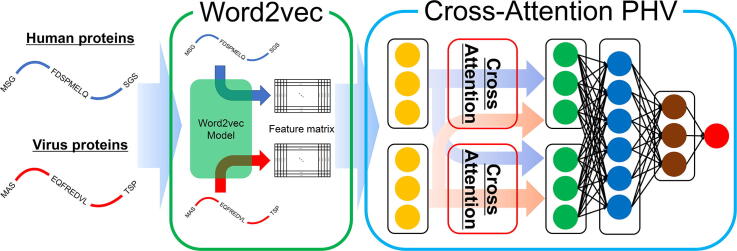
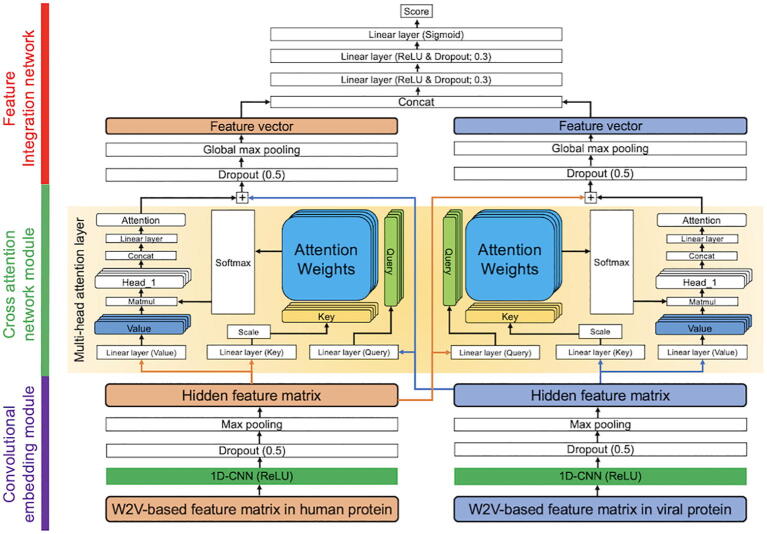
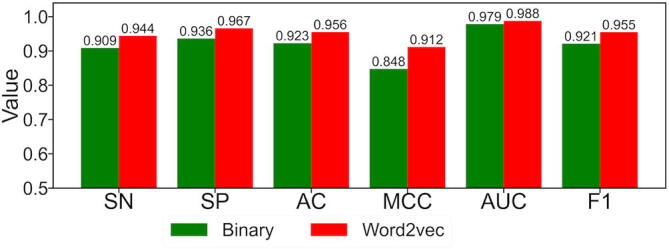
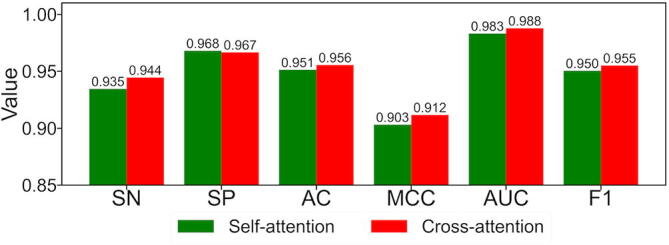
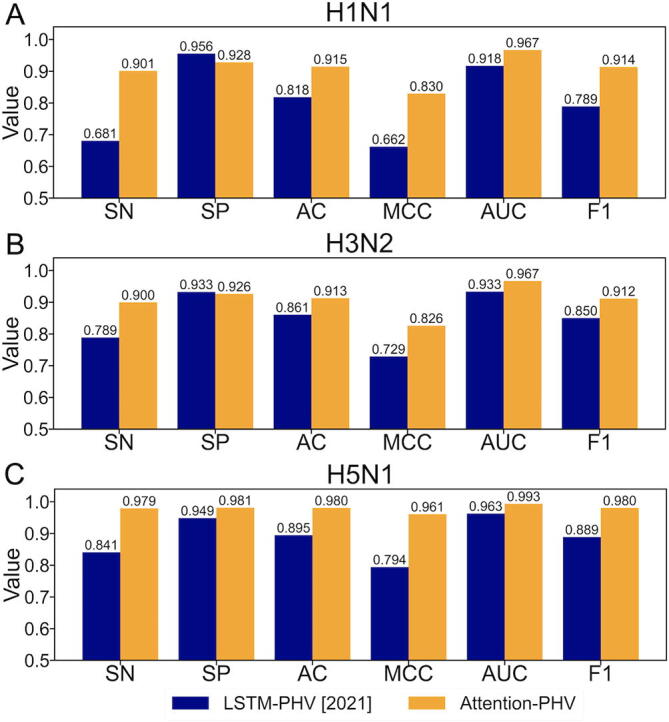
Viral infections represent a major health concern worldwide. The alarming rate at which SARS-CoV-2 spreads, for example, led to a worldwide pandemic. Viruses incorporate genetic material into the host genome to hijack host cell functions such as the cell cycle and apoptosis. In these viral processes, protein-protein interactions (PPIs) play critical roles. Therefore, the identification of PPIs between humans and viruses is crucial for understanding the infection mechanism and host immune responses to viral infections and for discovering effective drugs. Experimental methods including mass spectrometry-based proteomics and yeast two-hybrid assays are widely used to identify human-virus PPIs, but these experimental methods are time-consuming, expensive, and laborious. To overcome this problem, we developed a novel computational predictor, named cross-attention PHV, by implementing two key technologies of the cross-attention mechanism and a one-dimensional convolutional neural network (1D-CNN). The cross-attention mechanisms were very effective in enhancing prediction and generalization abilities. Application of 1D-CNN to the word2vec-generated feature matrices reduced computational costs, thus extending the allowable length of protein sequences to 9000 amino acid residues. Cross-attention PHV outperformed existing state-of-the-art models using a benchmark dataset and accurately predicted PPIs for unknown viruses. Cross-attention PHV also predicted human-SARS-CoV-2 PPIs with area under the curve values >0.95. The Cross-attention PHV web server and source codes are freely available at https://kurata35.bio.kyutech.ac.jp/Cross-attention_PHV/ and https://github.com/kuratahiroyuki/Cross-Attention_PHV, respectively.
Overview
The claims and statistics of this paper haven’t been checked yet.
Run the check — free, no account needed. It reads the open-access text and checks the sources it cites.
Integrity signals
Registry
Cites
Statistics
Figures
Verification
Claims the paper makes
The claims and statistics of this paper haven’t been checked yet.
Run the check — free, no account needed. It reads the open-access text and checks the sources it cites.
Self-check
Percentages, sums and reported differences re-computed from the paper’s own numbers.
The self-check needs the paper’s full text.
Citations
Cites
BERT: Pre-training of Deep Bidirectional Transformers for Language Understanding
Devlin, J., Chang, M.-W., Lee, K., & Toutanova, K. (2018) · arXiv · doi:10.48550/arxiv.1810.04805 · Cited by 73,173
Highly accurate protein structure prediction with AlphaFold
Jumper, J., Evans, R., Pritzel, A., Green, T., Figurnov, M., Ronneberger, O., Tunyasuvunakool, K., Bates, R., Žídek, A., Potapenko, A., et al. (2021) · Nature · doi:10.1038/s41586-021-03819-2 · Cited by 43,764
Structure-based prediction of protein–protein interactions on a genome-wide scale
Zhang, Q. C., Petrey, D., Deng, L., Qiang, L., Shi, Y., Thu, C. A., Bisikirska, B., Lefebvre, C., Accili, D., Hunter, T., et al. (2012) · Nature · doi:10.1038/nature11503 · Cited by 723
Research works printed but not linked: 40
- Burckhardt CJ Greber UF. Virus movements on the plasma membrane support infection and transmission between cells PLoS Pathogens 2009;5:e1000621-e1000621. · DOI
- 10.1083/jcb.201108131 · DOI
- 10.1016/j.jmb.2018.06.024 · DOI
- Parnell G., McLean A., Booth D. et al: Aberrant cell cycle and apoptotic changes characterise severe influenza A infection–a meta-analysis of genomic signatures in circulating leukocytes. PLoS ONE 2011; 6: e17186. · DOI
- Li F.Q., Tam J.P. and Liu D.X.: Cell cycle arrest and apoptosis induced by the coronavirus infectious bronchitis virus in the absence of p53. Virology 2007; 365: 435. · DOI
- Gioti K., Kottaridi C., Voyiatzaki C. et al: Animal coronaviruses induced apoptosis. Life 2021; 11. · DOI
- Mir A., Naghibzadeh M. and Saadati N.: INDEX: Incremental depth extension approach for protein–protein interaction networks alignment. Biosystems 2017; 162: 24. · DOI
- Hayashi T., Matsuzaki Y., Yanagisawa K. et al: MEGADOCK-Web: an integrated database of high-throughput structure-based protein-protein interaction predictions. BMC Bioinf 2018; 19: 62. · DOI
- Singh R Park D Xu J et al. Struct2Net: a web service to predict protein-protein interactions using a structure-based approach Nucleic Acids Res 2010;38:W508-515. · DOI
- Eid F.E., ElHefnawi M. and Heath L.S.: DeNovo: virus-host sequence-based protein-protein interaction prediction. Bioinformatics 2016; 32: 1144. · DOI
- Barman RK Saha S Das S. Prediction of interactions between viral and host proteins using supervised machine learning methods PLoS One 2014;9:e112034. · DOI
- Dey L., Chakraborty S. and Mukhopadhyay A.: Machine learning techniques for sequence-based prediction of viral-host interactions between SARS-CoV-2 and human proteins. Biomed J 2020; 43: 438. · DOI
- 10.3934/mbe.2020176 · DOI
- 10.1016/j.csbj.2022.06.025 · DOI
- Zhou X., Park B., Choi D. et al: A generalized approach to predicting protein-protein interactions between virus and host. BMC Genomics 2018; 19: 568. · DOI
- Alguwaizani S., Park B., Zhou X. et al: Predicting interactions between virus and host proteins using repeat patterns and composition of amino acids. J Healthcare Eng 2018; 2018: 1391265. · DOI
- Yang X., Yang S., Lian X. et al: Transfer learning via multi-scale convolutional neural layers for human–virus protein–protein interaction prediction. Bioinformatics 2021; 37: 4771. · DOI
- 10.1093/bioinformatics/btab147 · DOI
- Mikolov T Chen K Corrado G et al. Efficient estimation of word representations in vector space. 2013 arXiv:1301.3781. · arXiv
- Mikolov T Sutskever I Chen K et al. Distributed representations of words and phrases and their compositionality. 2013 arXiv:1310.4546. · arXiv
- Tsukiyama S Hasan MM Deng H-W et al. BERT6mA: prediction of DNA N6-methyladenine site using deep learning-based approaches Briefings in Bioinformatics 2022;23:bbac053. · DOI
- Charoenkwan P Nantasenamat C Hasan MM et al. BERT4Bitter: a bidirectional encoder representations from transformers (BERT)-based model for improving the prediction of bitter peptides Bioinformatics 2021:btab133. · DOI
- Kurata H., Tsukiyama S. and Manavalan B.: iACVP: markedly enhanced identification of anti-coronavirus peptides using a dataset-specific word2vec model. Briefings Bioinf 2022; 23. · DOI
- Zhang Y.F., Wang X., Kaushik A.C. et al: SPVec: A Word2vec-inspired feature representation method for drug-target interaction prediction. Front Chem 2019; 7: 895. · DOI
- 10.1016/j.csbj.2019.12.005 · DOI
- Tsukiyama S Hasan MM Fujii S et al. LSTM-PHV: prediction of human-virus protein–protein interactions by LSTM with word2vec Briefings in Bioinform 2021;22:bbab228. · DOI
- Chen X Cheng Y Wang S et al. EarlyBERT: Efficient BERT Training via Early-bird Lottery Tickets. 2020 arXiv:2101.00063. · arXiv
- Lei T. When Attention Meets Fast Recurrence: Training Language Models with Reduced Compute. 2021 arXiv:2102.12459. · DOI
- Mildenhall B Srinivasan PP Tancik M et al. NeRF: Representing scenes as neural radiance fields for view synthesis. 2020 arXiv:2003.08934. · DOI · Paper page
- Tolstikhin I Houlsby N Kolesnikov A et al. MLP-Mixer: An all-MLP Architecture for Vision. 2021 arXiv:2105.01601. · arXiv
- 10.1093/bib/bbaa425 · DOI
- The UniProt Consortium. UniProt: the universal protein knowledgebase Nucleic Acids Res 2017;45:D158-D169. · DOI · Paper page
- Henikoff S. and Henikoff J.G.: Amino acid substitution matrices from protein blocks. PNAS 1992; 89: 10915. · DOI · Paper page
- 10.1002/pro.3978 · DOI · Paper page
- 10.1093/bioinformatics/bts565 · DOI · Paper page
- Vaswani A Shazeer N Parmar N et al. Attention is all you need. 2017 arXiv:1706.03762. · arXiv
- Wu H Gu X. Max-pooling dropout for regularization of convolutional neural networks. 2015 arXiv:1512.01400. · DOI
- Pedregosa F Varoquaux G Gramfort A et al. Scikit-learn: machine learning in python. 2012 arXiv:1201.0490. · arXiv
- van der Maaten L. and Hinton G.: Visualizing data using t-SNE. J Machine Learn Res 2008; 9: 2579.
- Wu R Ding F Wang R et al. High-resolution de novo structure prediction from primary sequence bioRxiv 2022:2022.2007.2021.500999.
Metadata
- Authors
- Tsukiyama, S., & Kurata, H.
- Affiliations
- Kyushu Institute of Technology (JP)
- Corresponding author
- Kurata, Hiroyuki
- Venue
- Computational and Structural Biotechnology Journal
- Published
- 2022-01
- Volume
- 20
- Pages
- 5564-5573
- ISSN
- 2001-0370 (ISSN-L)
- PMC
- PMC9546503
- OpenAlex
- W4303520619
- Cited by
- 10
- References
- 3
- Citations by year
- 2026: 2 · 2025: 4 · 2024: 1 · 2023: 3
- FWCI
- 0.65
- Type
- journal article
- Language
- en
- Open access
- gold
- doi.org
- Licence
- Locations
- Computational and Structural Biotechnology Journal (publishedVersion, cc-by)
- bioRxiv (Cold Spring Harbor Laboratory) (acceptedVersion, cc-by-nc)
- PubMed Central (publishedVersion, cc-by)
- PubMed (publishedVersion)
- DOAJ (DOAJ: Directory of Open Access Journals) (submittedVersion, cc-by-sa)
- Funders
- Japan Society for the Promotion of Science (22H03688, 22J22706)
- Topics
- Life Sciences › Biochemistry, Genetics and Molecular Biology › Molecular Biology › Machine Learning in Bioinformatics
- Life Sciences › Biochemistry, Genetics and Molecular Biology › Molecular Biology › Bioinformatics and Genomic Networks
- Life Sciences › Biochemistry, Genetics and Molecular Biology › Molecular Biology › Protein Structure and Dynamics
- Keywords
- protein-protein interaction prediction, human-virus interactions, cross-attention, 1D convolutional neural network, SARS-CoV-2, viral infection, host-virus interaction, web server
About these checks
Registry, retraction, Cites and statistics results are computed, not judged, with one exception: a printed reference that no index lists is read once by a model before it counts as a citation error. Claims are extracted by a model and kept only when their quote appears verbatim in the text; each cited source is then checked, with a model’s help, for whether it says what the claim relies on. Those verdicts can be wrong — read the claim’s quote and the cited source before relying on one.
Statistics and arithmetic are recomputed, not judged.
Confidence bands are shown only for fields calibrated on our annotated test set. None is calibrated yet, so no band is shown.
What counts as a claim ›How we measure confidence ›How we check this ›
Are you an author, or do you see a problem with this page? Request a review
