

Impact of the Jenkyns Event (early Toarcian) on dinosaurs: Comparison with the Triassic/Jurassic transition
Open accessThe DOI matches its Crossref record; 316 of the 318 references it cites were found in a registry or an index, and 1 are not checked yet; none of the 204 sources its claims cite is checked for support yet.
Abstract
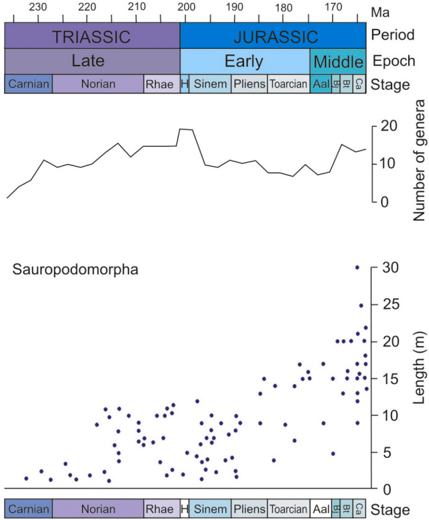
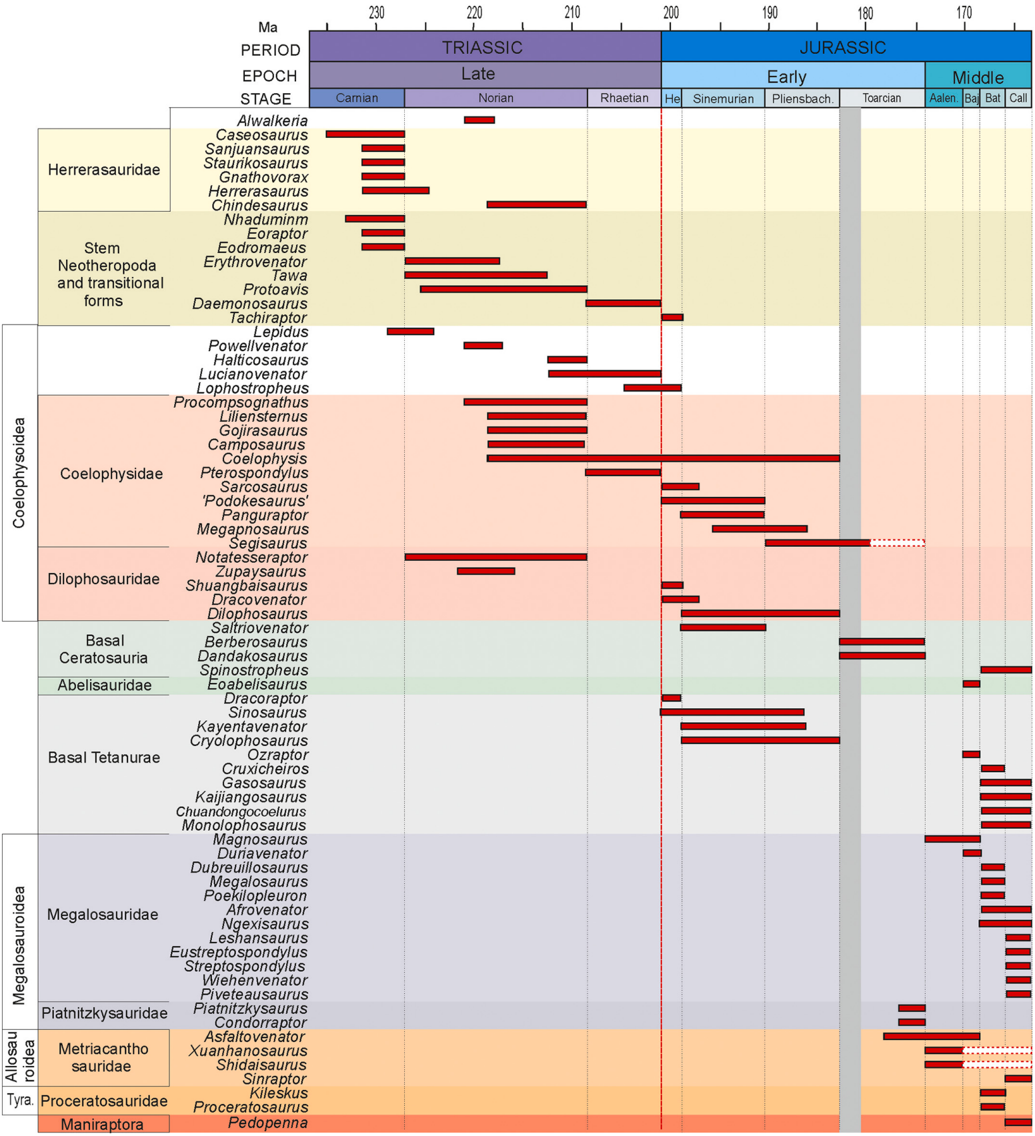
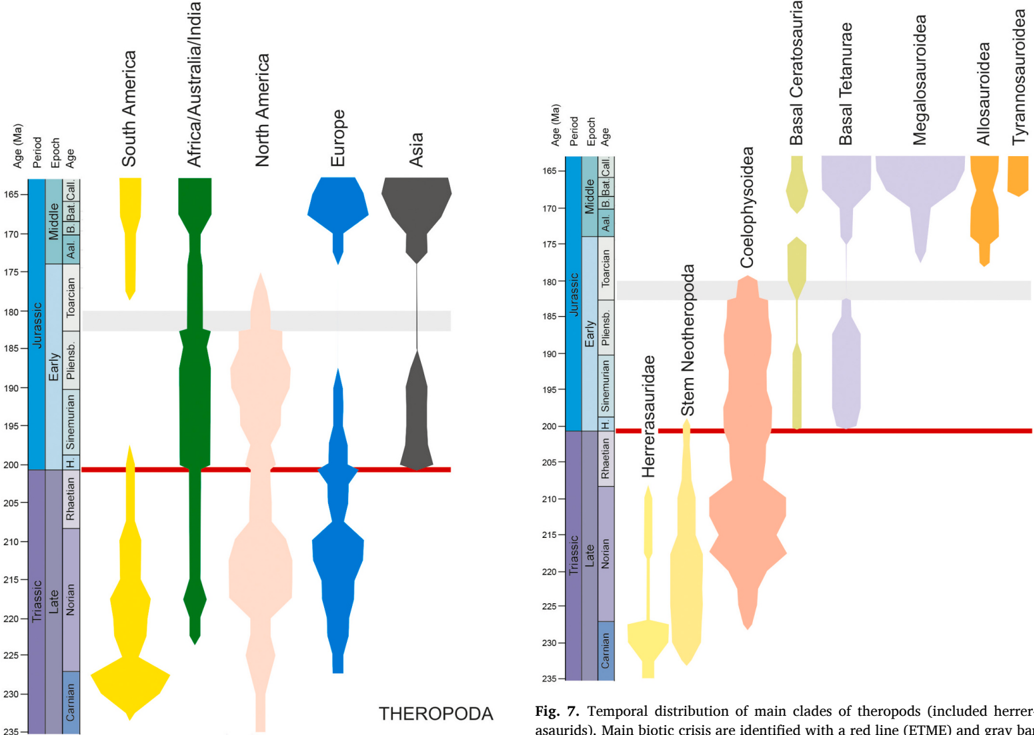
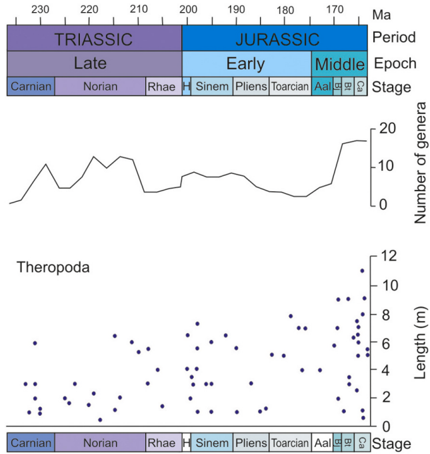
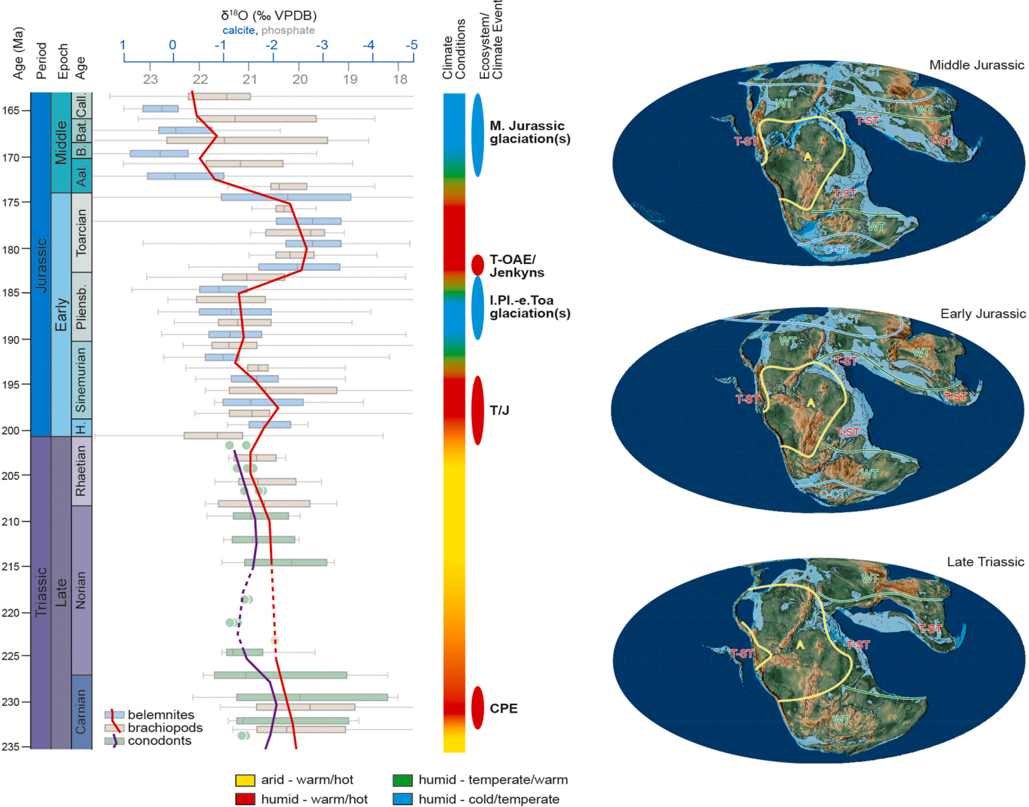
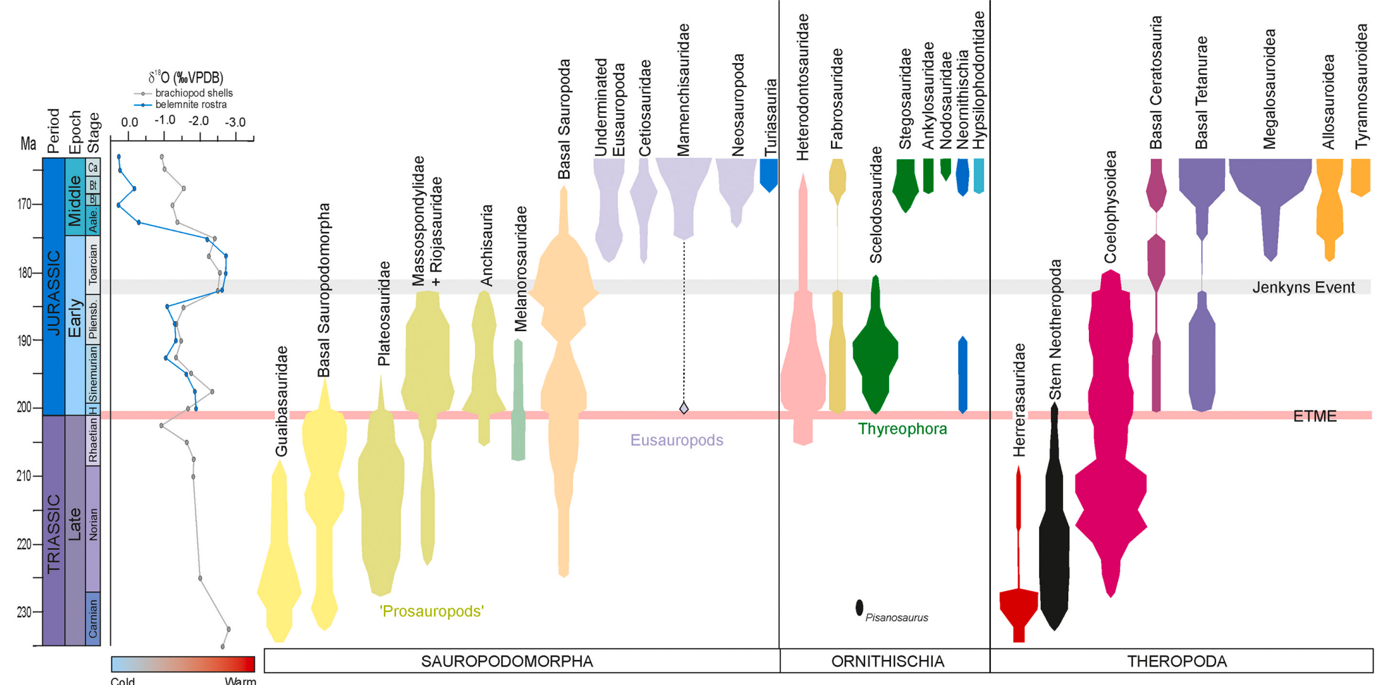
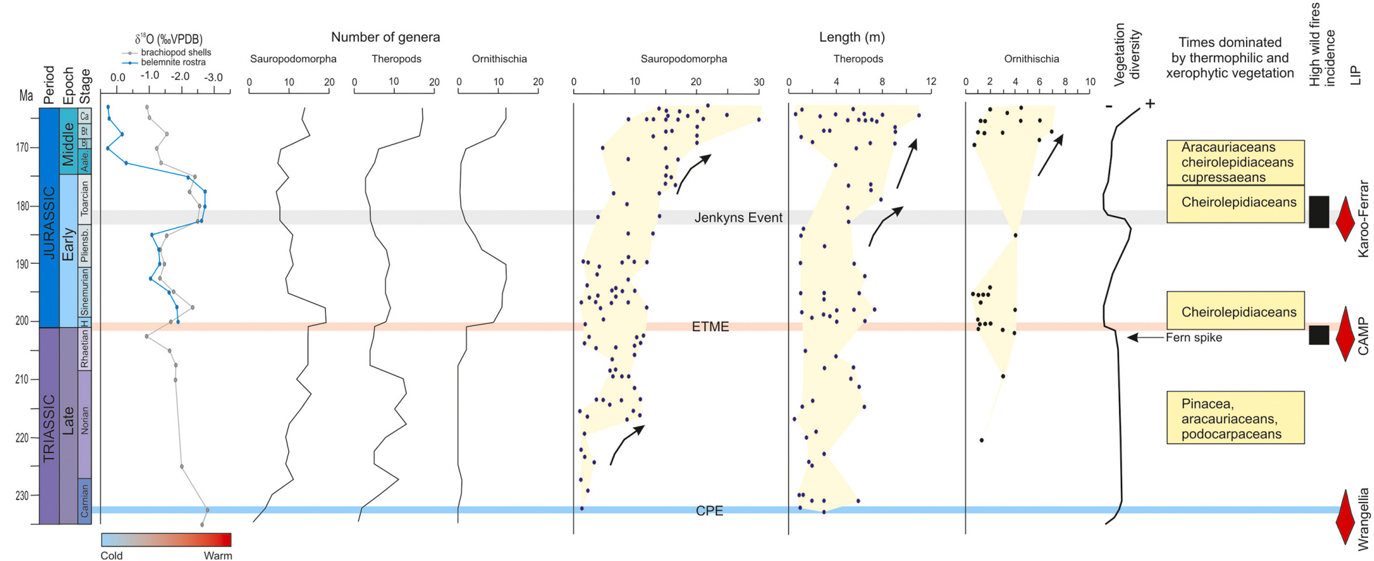
The Early Jurassic Jenkyns Event (∼183 Ma) was characterized in terrestrial environments by global warming, perturbation of the carbon cycle, enhanced weathering and wildfires. Heating and acid rain on land caused a loss of forests and affected diversity and composition of land plant assemblages and the rest of the trophic web. We suggest that the Jenkyns Event, triggered by the activity of the Karoo-Ferrar Large Igneous Province, was pivotal in remodelling terrestrial ecosystems, including plants and dinosaurs. Macroplant assemblages and palynological data show reductions in diversity and richness of conifers, cycadophytes, ginkgophytes, bennetitaleans, and ferns, and continuation of seasonally dry and warm conditions. Major changes occurred to sauropodomorph dinosaurs, with extinction of diverse basal families formerly called ‘prosauropods’ as well as some basal sauropods, and diversification of the derived Eusauropoda in the Toarcian in South America, Africa, and Asia, and wider diversification of new families, including Mamenchisauridae, Cetiosauridae and Neosauropoda (Dicraeosauridae and Macronaria) in the Middle Jurassic, showing massive increase in size and diversification of feeding modes. Ornithischian dinosaurs show patchy records; some heterodontosaurids and scelidosaurids disappeared, and major new clades (Stegosauridae, Ankylosauridae, Nodosauridae) emerged soon after the Jenkyns Event, in the Bajocian and Bathonian worldwide. Among theropod dinosaurs, Coelophysidae and Dilophosauridae died out during the Jenkyns Event and a diversification of theropods (Megalosauroidea, Allosauroidea, Tyrannosauroidea) occurred after this event with substantial increases in size. We suggest then that the Jenkyns Event terrestrial crisis was marked especially by floral changes and origins of major new sauropodomorph and theropod clades, characterized by increasing body size. Comparison with the end Triassic Mass Extinction helps to understand the incidence of climatic changes driven by activity of large igneous provinces on land ecosystems and their great impacts on early dinosaur evolution.
Checked 2026-11-23 · 1 reference not checked yet
Overview
CoChat Summary
TL;DR
The paper reviews the impact of the early Toarcian Jenkyns Event (~183 Ma) on terrestrial ecosystems and dinosaurs, comparing it with the end-Triassic mass extinction. It argues the Jenkyns Event was pivotal in remodelling terrestrial ecosystems, especially through floral turnover and extinctions/radiations of sauropodomorph and theropod clades with increasing body size.
Key findings
- The Jenkyns Event was characterized on land by global warming, carbon-cycle perturbation, enhanced weathering, and wildfires; land-plant diversity and richness dropped, with low-diversity forests dominated by Cheirolepidiaceae and cycads, then Araucariaceae, Cheirolepidiaceae, and Cupressaceae, indicating seasonally dry and warm conditions. Ruebsam et al. (2020b) estimated 5°C warming at the Pliensbachian-Toarcian boundary and a peak of 10°C warming during the Jenkyns Event.
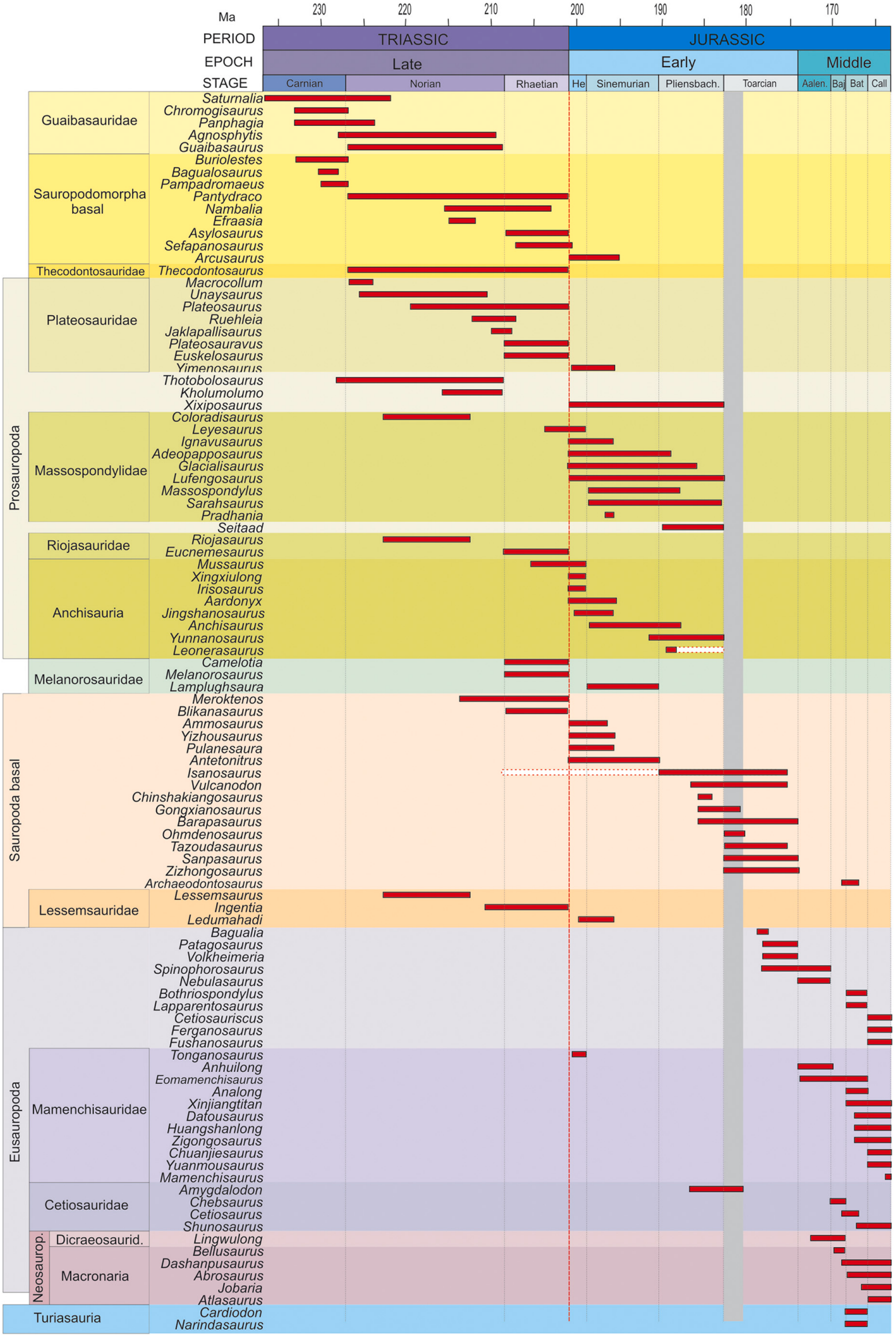
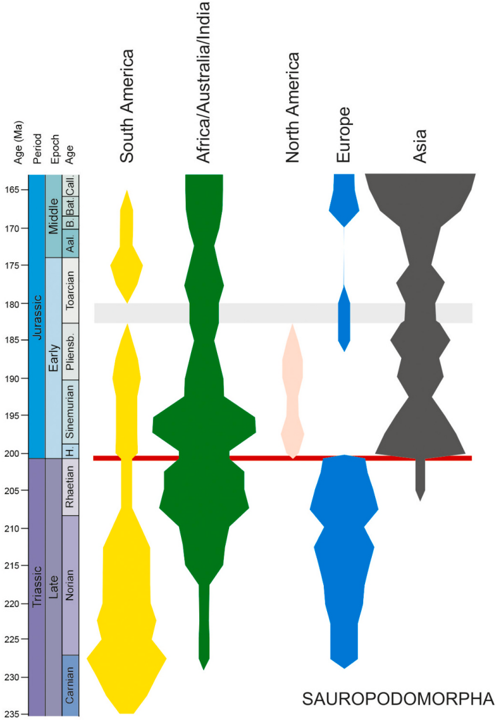
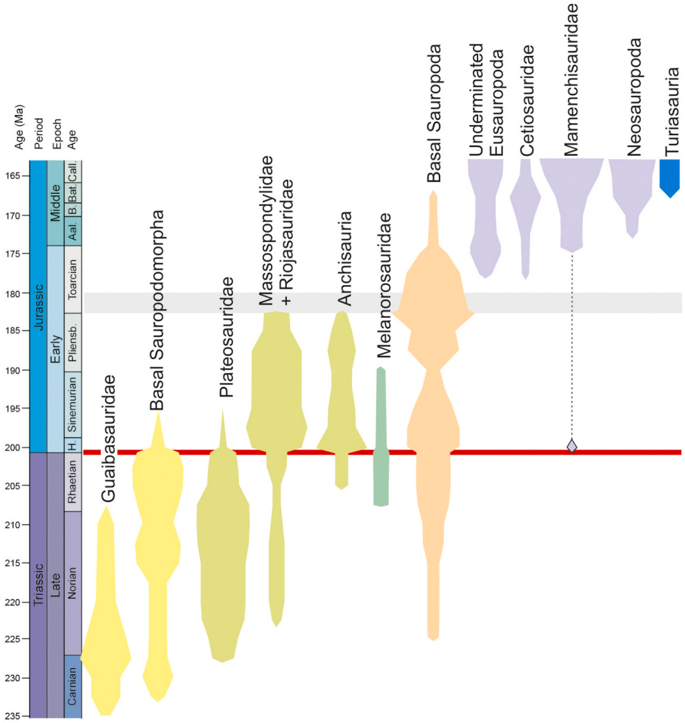
- At the Pliensbachian/Toarcian boundary and through the Jenkyns Event, 10 of 12 genera of sauropodomorphs disappeared (83%), including all “prosauropod” families; some basal Sauropoda survived but most disappeared before the Aalenian. After the event, many Eusauropoda appeared in South America, Africa, and Asia, and Middle Jurassic Mamenchisauridae, Cetiosauridae, and Neosauropoda diversified, with African Macronaria and Asian mamenchisaurids at >20 m and 17 t.
- Coelophysidae and Dilophosauridae died out during the Toarcian, while new basal Ceratosauria were recorded in the Toarcian. After the Jenkyns Event, the first Allosauroidea (*Asfaltovenator vialidadi*, around 8 m) and first megalosauroids appeared; Middle Jurassic theropod radiation included Megalosauroidea, Allosauroidea, and Tyrannosauroidea, with some reaching around or above 10 m.
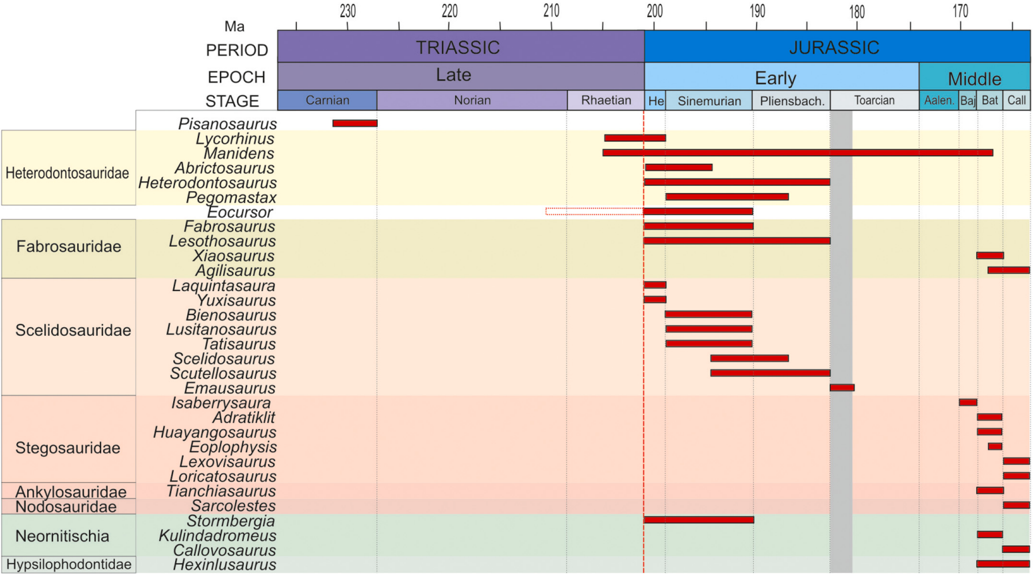
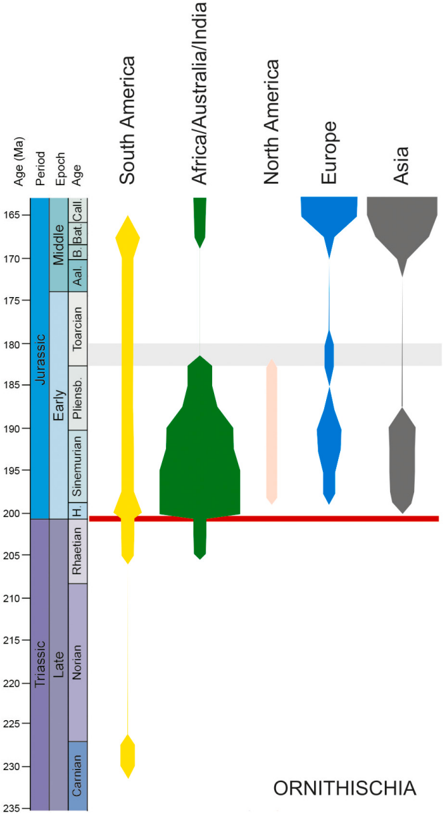
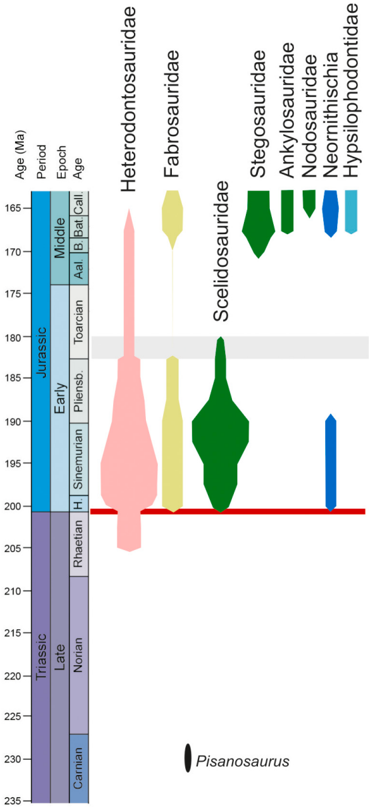
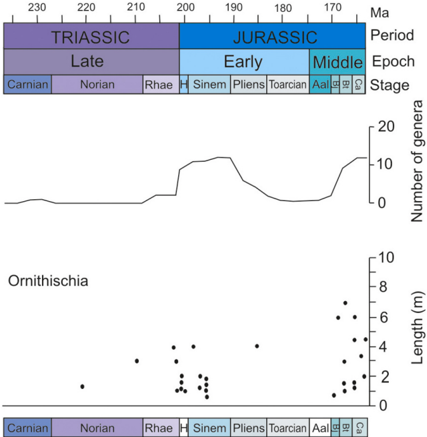
- Ornithischian records are patchy; some heterodontosaurids and scelidosaurids disappeared, and major new clades (Stegosauridae, Ankylosauridae, Nodosauridae) emerged in the Bajocian and Bathonian. For comparison, at the end of the Rhaetian, 13 of 16 genera of sauropodomorphs disappeared (81%), and both the ETME and Jenkyns Event are presented as major events with extinctions followed by radiations.
Methods
- The study compiled 207 species from the literature, updating taxonomic assignments, ages of lithostratigraphic formations, geographic areas, and inferred sizes where available; species and genera were assigned to families and small monophyletic groups, with informal paraphyletic terms for “basal Sauropodomorpha,” “basal Sauropoda,” and “stem Neotheropoda.”
- Climate trends were reconstructed from oxygen isotope data measured on belemnite and brachiopod calcite and conodont phosphates; boxplots with a 2.5 Myr step and smoothing splines were calculated using PAST software.
- The authors distinguish narrative evidence from “typical” or “exemplar” faunas and floras versus diversity-through-time plots, noting that the latter are especially dependent on homogeneous sampling through time and across regions and habitats.
Limitations
- The paper states that the continental fossil record is patchy, with large temporal gaps between sampling horizons, and that dating of continental sedimentary formations is often less certain than for marine formations; diversity-through-time curves depend on homogeneous sampling that is “clearly not possible.”
- The paper states that climate records from continental sedimentary archives are sparse, patchy, and imprecisely dated for the Late Triassic and Early Jurassic, and that absolute temperature reconstructions suffer from poor knowledge of the δ18O of seawater, ice mass effects, and local salinity.
- Evident from the text: the Toarcian dinosaur record is scarce and many taxa lack precise ages; the authors state they cannot discuss trends in dinosaur evolution over such a short timescale and cannot differentiate the impact of global warming and wildfires on dinosaurs at the available temporal resolution.
Model-written summary. Check it against the paper before relying on it.
Integrity signals
Registry
Cites
Statistics
Figures
Verification
Claims the paper makes
0 Valid · 10 Not valid · 101 Not checked · 40 Own results and interpretations
A result the paper states — it cites no source for it, so there is none to check. The quote shows it is in the paper.
In the paper
“diversification of the derived Eusauropoda in the Toarcian in South America, Africa, and Asia”
§ Impact of the Jenkyns Event (early Toarcian) on dinosaurs: Comparison with the Triassic/Jurassic transition > Abstract
plain- Asserted: passes — The authors put it forward as true.
- Checkable: passes — It can be checked against evidence.
- Load-bearing: passes — The paper’s conclusions depend on it.
- Based: passes — The paper gives a reason why it holds.
The paper states this without a source or data behind it here, so there is nothing to check it against. The quote shows it is in the paper.
In the paper
“wider diversification of new families, including Mamenchisauridae, Cetiosauridae and Neosauropoda (Dicraeosauridae and Macronaria) in the Middle Jurassic”
§ Impact of the Jenkyns Event (early Toarcian) on dinosaurs: Comparison with the Triassic/Jurassic transition > Abstract
plain- Asserted: passes — The authors put it forward as true.
- Checkable: passes — It can be checked against evidence.
- Load-bearing: unclear — It is unclear whether the paper’s conclusions depend on it.
- Based: unclear — It is unclear why the paper says it holds.
The paper states this without a source or data behind it here, so there is nothing to check it against. The quote shows it is in the paper.
In the paper
“some heterodontosaurids and scelidosaurids disappeared”
§ Impact of the Jenkyns Event (early Toarcian) on dinosaurs: Comparison with the Triassic/Jurassic transition > Abstract
plainstates an association- Asserted: passes — The authors put it forward as true.
- Checkable: passes — It can be checked against evidence.
- Load-bearing: passes — The paper’s conclusions depend on it.
- Based: unclear — It is unclear why the paper says it holds.
The paper states this without a source or data behind it here, so there is nothing to check it against. The quote shows it is in the paper.
In the paper
“major new clades (Stegosauridae, Ankylosauridae, Nodosauridae) emerged soon after the Jenkyns Event, in the Bajocian and Bathonian worldwide”
§ Impact of the Jenkyns Event (early Toarcian) on dinosaurs: Comparison with the Triassic/Jurassic transition > Abstract
plainstates an association- Asserted: passes — The authors put it forward as true.
- Checkable: passes — It can be checked against evidence.
- Load-bearing: passes — The paper’s conclusions depend on it.
- Based: unclear — It is unclear why the paper says it holds.
The paper states this without a source or data behind it here, so there is nothing to check it against. The quote shows it is in the paper.
In the paper
“a diversification of theropods (Megalosauroidea, Allosauroidea, Tyrannosauroidea) occurred after this event with substantial increases in size”
§ Impact of the Jenkyns Event (early Toarcian) on dinosaurs: Comparison with the Triassic/Jurassic transition > Abstract
plainstates a cause- Asserted: passes — The authors put it forward as true.
- Checkable: passes — It can be checked against evidence.
- Load-bearing: passes — The paper’s conclusions depend on it.
- Based: unclear — It is unclear why the paper says it holds.
46 more claims
Create a free account to see all 151 claims and to verify the 160 references still open.
- Probably not a substantial claim. 34
- It may state two separate claims as one. 80
Self-check
Percentages, sums and reported differences re-computed from the paper’s own numbers.
Each contradiction between two passages listed here was confirmed by an independent check.
Rated major: it would touch a result — a value a result rests on, reported and recomputed p-values on opposite sides of the significance level, two passages that conflict with no sign which is right, or a cited work retracted before this paper was published.
In the paper
§ Impact of the Jenkyns Event (early Toarcian) on dinosaurs: Comparison with the Triassic/Jurassic transition > 4.4. The early Toarcian biotic crisis. What about dinosaurs?
“At the Pliensbachian/Toarcian boundary and through the Jenkyns Event, a total of 10 of 12 genera of sauropodomorphs disappeared (83%), including all 'prosauropod' families (Fig. 14).”
§ Impact of the Jenkyns Event (early Toarcian) on dinosaurs: Comparison with the Triassic/Jurassic transition > 3.1.1. Sauropodomorpha
“Only some basal Sauropoda survived the Jenkyns Event, in Asia with Isanosaurus (Buffetaut et al., 2000), Gongxianosaurus (Yaonan and Wang, 2000), Sanpasaurus (McPhee et al., 2016) and Zizhongosaurus (Hou et al., 1976), in Africa with Vulcanodon (Cooper, 1984) and Tazoudasaurus (Allain et al., 2004), in India with Barapasaurus (Jain et al., 1975), and in Europe with Ohmdenosaurus (Wild, 1978)”
Rated major: it would touch a result — a value a result rests on, reported and recomputed p-values on opposite sides of the significance level, two passages that conflict with no sign which is right, or a cited work retracted before this paper was published.
In the paper
§ Impact of the Jenkyns Event (early Toarcian) on dinosaurs: Comparison with the Triassic/Jurassic transition > 4.4. The early Toarcian biotic crisis. What about dinosaurs?
“new genera of Heterodontosauridae and Fabrosauridae emerged in the Bathonian and Callovian (Fig. 14).”
§ Impact of the Jenkyns Event (early Toarcian) on dinosaurs: Comparison with the Triassic/Jurassic transition > 3.1.3. Ornithischia
“Heterodontosauridae were not recorded, but new genera appeared in the Upper Jurassic and Lower Cretaceous of Laurasia (e.g.Echinodon, Fruitadens, Tianyulong).”
Rated minor: it would not touch a result — a value no result rests on, a p-value that stays on the same side of the significance level, or a conflict that is clerical, resolved elsewhere in the paper, or outside its own findings.
In the paper
§ Impact of the Jenkyns Event (early Toarcian) on dinosaurs: Comparison with the Triassic/Jurassic transition > 3.1.1. Sauropodomorpha
“the first eusauropod, Tonganosaurus (Family Mamenchisauridae) is recorded in the Hettangian of the Yimen Formation (China; Li et al., 2010).”
§ Impact of the Jenkyns Event (early Toarcian) on dinosaurs: Comparison with the Triassic/Jurassic transition > 3.1.1. Sauropodomorpha
“Mamenchisauridae, Cetiosauridae and Neosauropoda (Dicraeosauridae, Macronaria) appeared and diversified during the Middle Jurassic (Fig. 3).”
Citations
Cites
Climate change and evolutionary adaptation
Hoffmann, A. A., & Sgrò, C. M. (2011) · Nature · doi:10.1038/nature09670 · Cited by 3,242
Schouten, S., Hopmans, E. C., Schefuß, E., & Sinninghe Damsté, J. S. (2002) · Earth and Planetary Science Letters · doi:10.1016/s0012-821x(02)00979-2 · Cited by 1,271
Climate Modes of the Phanerozoic
Frakes, L. A., Francis, J. E., & Syktus, J. I. (1992) · Cambridge University Press eBooks · doi:10.1017/cbo9780511628948 · Cited by 1,074
Massive dissociation of gas hydrate during a Jurassic oceanic anoxic event
Hesselbo, S. P., Gröcke, D. R., Jenkyns, H. C., Bjerrum, C. J., Farrimond, P., Morgans Bell, H. S., & Green, O. R. (2000) · Nature · doi:10.1038/35019044 · Cited by 1,005
Sereno, P. C. (1999) · Science · doi:10.1126/science.284.5423.2137 · Cited by 829
Fossil Plants and Global Warming at the Triassic-Jurassic Boundary
McElwain, J. C., Beerling, D. J., & Woodward, F. I. (1999) · Science · doi:10.1126/science.285.5432.1386 · Cited by 666
Hesselbo, S. P., Jenkyns, H. C., Duarte, L. V., & Oliveira, L. C. V. (2007) · Earth and Planetary Science Letters · doi:10.1016/j.epsl.2006.11.009 · Cited by 579
Blackburn, T. J., Olsen, P. E., Bowring, S. A., McLean, N. M., Kent, D. V., Puffer, J., McHone, G., Rasbury, E. T., & Et-Touhami, M. (2013) · Science · doi:10.1126/science.1234204 · Cited by 579
Patterns of Phanerozoic Extinction: a Perspective from Global Data Bases
Sepkoski, J. J. (1996) · Global Events and Event Stratigraphy in the Phanerozoic · doi:10.1007/978-3-642-79634-0_4 · Cited by 509
Astronomical pacing of methane release in the Early Jurassic period
Kemp, D. B., Coe, A. L., Cohen, A. S., & Schwark, L. (2005) · Nature · doi:10.1038/nature04037 · Cited by 501
Research works printed but not linked: 25
- Bai, Z.Q., Yang, J., Wang, G.H., 1990. Yimenosaurus, a new genus of Prosauropoda from Yimen County, Yunnan Province. Yuxiwenbo 1, 14-23.
- Bonaparte, J.F., 1971. Los tetrapodos del sector superior de la Formaci6n Los Colorados, La Rioja, Argentina (Triásico Superior). Opera Lilloana 22, 1-183.
- Bonnan, M.F., Senter, P., 2007. Were the basal sauropodomorph dinosaurs Plateosaurus and Massospondylus habitual quadrupeds? Spec. Pap. Palaeontol. 77, 139-155.
- Bonnan, M.F., Yates, A.M., 2007. A new description of the forelimb of the basal sauropodomorph Melanorosaurus: implications for the evolution of pronation, Manus shape and quadrupedalism in sauropod dinosaurs. Spec. Pap. Palaeontol. 77, 157-168.
- Charig, A.J., 1984. Competition between therapsids and archosaurs during the Triassic period: a review and synthesis of current theories. Symposia of the Zoological Society London 52, 597-628.
- Colbert, E.H., 1989. The Triassic dinosaur Coelophysis. Bull. Museum Northern Arizona 57, 1-160.
- Deng, S., Lu, Y., Zhao, Y., Fan, R., Ma, X., Li, X., 2018. A warming and aridification event in terrestrial ecosystem of North China during the early Jurassic, possibly linked to the Toarcian Oceanic Anoxic Event. In: 5th International Paleontological Congress, París, pp. 9-13.
- Devyatov, V.P., Nikitenko, B.L., Shurygin, B.N., 2011. Jurassic paleogeography of Siberia during major changeovers. Paleontol. Stratigraphy News 16-17, 87-101 [in Russian].
- Escapa, I., Cúneo, R., Cladera, G., 2008. New evidence for the age of the Jurassic flora from Cañadón del Zaino, Sierra De Taquetrén, Chubut. Ameghiniana 45, 633-637.
- Frakes, L.A., 1979. Climates Throughout Geological Time. Elsevier, Amsterdam.
- Grossman, E.L., 2012. Chapter 10 -Oxygen isotope Stratigraphy. In: Gradstein, F., Ogg, F. (Eds.), Geological Timescale 2012. Elsevier, pp. 195-220.
- Hammer, O., Harper, D.A.T., Ryan, P.D., 2001. PAST: paleontological statistics software package for education and data analysis. Palaeontol. Electron. 4, 1-9.
- Hesselbo, S.P., Robinson, S.A., Surlyk, F., Piasecki, S., 2002. Terrestrial and marine extinction at the Triassic-Jurassic boundary synchronized with major carbon-cycle perturbation: a link to initiation of massive volcanism? Geology 30, 251-254. · doi:10.1130/0091-7613(2002)030<0251:tameat>2.0.co;2
- Hou, L.H., Zhou, S.W., Chao, S.C., 1976. New discovery of sauropod dinosaurs from Sichuan. Vertebrata PalAsiatica 14, 160-165.
- Li, K., Yang, C.Y., Liu, J., Wang, Z.X., 2010. A new sauropod dinosaur from the lower Jurassic of Huili, Sichuan, China. Vertebrata Palasiatica 3, 185-202.
- Lu, Y.Z., Deng, S.H., 2009. Palaeoclimate around the Triassic-Jurassic Boundary in southern margin of Junggar Basin. J. Palaeogeogr. (Chinese Ed.) 11, 652-660 (in Chinese with English abstract).
- Meyer, C.A., Thürig, S., Wizevich, M.C., Thürig, B., Marty, D., 2015. The Norian and Rhaetian dinosaur tracks of eastern Switzerland in the light of sequence stratigraphy. Swiss Geoscience Meeting 2015, 154-155.
- Molina-Pérez, R., Larramendi, A., 2020. Dinosaurs facts and figures: the theropods and other sauropodomorphs. Princeton University Press, 272 pp.
- Niedzwiedzki, G., 2008. Theropod dinosaur tracks from the Rhaetian deposits of Seebergen, Thuringia, Germany. Przeglad Geologiczny 50, 539-544.
- Peng, G., 1992. Jurassic ornithopod Agilisaurus louderbacki (Ornithopoda: Fabrosauridae) from Zigong, Sichuan, China. Vertebrata PalAsiatica 30, 39-51.
- Pol, D., Powell, J.E., 2007. New information on Lessemsaurus sauropoides (Dinosauria: Sauropodomorpha) from the Upper Triassic of Argentina. Spec. Pap. Palaeontol. 77, 223-243.
- Sekiya, T., 2012. Re-examination of Chuanjiesaurus anaensis (Dinosauria: Sauropoda) from the Middle Jurassic Chuanjie Formation, Lufeng County, Yunnan Province, Southwest China. Memoir of the Fukui Prefectural Dinosaur Museum 10, 1-54.
- Wang, G.F., You, H.L., Pan, S.G., Wang, T., 2017b. A new crested theropod dinosaur from the early Jurassic of Yunnan Province, China. Vertebrata PalAsiatica 55, 177-186.
- Yadagiri, P., 1982. In: Osteological studies of a carnosaurian dinosaur from Lower Jurassic Kota Formation: Andhra Pradesh. Geological Survey of India, Report for Field Season Programme 1981-1982, 1982, pp. 2-7.
- Young, C.C., Zhao, X.J., 1972. Institute of Vertebrate Paleontology and Paleoanthropology Monographs A. In: Young, C.C. (Ed.), Mamenchisaurus hochuanensis sp. nov., 8 Institute of Vertebrate Paleontology, pp. 1-30, 1.
Cited by
Early Jurassic origin of avian endothermy and thermophysiological diversity in dinosaurs
Chiarenza, A. A., Cantalapiedra, J. L., Jones, L. A., Gamboa, S., Galván, S., Farnsworth, A. J., Valdes, P. J., Sotelo, G., & Varela, S. (2024) · Current Biology · doi:10.1016/j.cub.2024.04.051 · Cited by 23
Baranyi, V., Jin, X., Corso, J. D., Li, B., & Kemp, D. B. (2024) · Palaeogeography Palaeoclimatology Palaeoecology · doi:10.1016/j.palaeo.2024.112180 · Cited by 24
Baranyi, V., Jin, X., Corso, J. D., Shi, Z., Grasby, S. E., & Kemp, D. B. (2023) · Geology · doi:10.1130/g51037.1 · Cited by 24
Kovács, E. B., Ruhl, M., Silva, R. F. L., McElwain, J. C., Reolid, M., Korte, C., Ruebsam, W., & Hesselbo, S. P. (2023) · Palaeogeography Palaeoclimatology Palaeoecology · doi:10.1016/j.palaeo.2023.111977 · Cited by 19
Self-citationBucur, I. I., & Reolid, M. (2023) · Earth-Science Reviews · doi:10.1016/j.earscirev.2023.104666 · Cited by 19
Self-citation
Metadata
- Authors
- Reolid, M., Ruebsam, W., & Benton, M. J.
- Affiliations
- Universidad de Jaén (ES)
- Christian-Albrechts-Universität zu Kiel (DE)
- University of Bristol (GB)
- Corresponding author
- Reolid, M.
- Venue
- Earth-Science Reviews
- Publisher
- Elsevier BV
- Published
- 2022-11
- Volume
- 234
- Pages
- 104196
- ISSN
- 0012-8252 (ISSN-L)
- OpenAlex
- W4297473149
- Cited by
- 32
- References
- 318
- Citations by year
- 2026: 5 · 2025: 10 · 2024: 11 · 2023: 5 · 2022: 1
- FWCI
- 3.87
- Type
- journal article
- Language
- en
- Open access
- hybrid
- doi.org
- Licence
- cc-by-nc-nd
- www.elsevier.com/tdm/userlicense/1.0/ (tdm)
- www.elsevier.com/legal/tdmrep-license (tdm)
- creativecommons.org/licenses/by-nc-nd/4.0/ (vor)
- Locations
- Earth-Science Reviews (publishedVersion, cc-by-nc-nd)
- Funders
- Junta de Andalucía (PY20_00111, PID2019-104625RB-100)
- Topics
- Physical Sciences › Earth and Planetary Sciences › Paleontology › Paleontology and Evolutionary Biology
- Physical Sciences › Earth and Planetary Sciences › Paleontology › Evolution and Paleontology Studies
- Physical Sciences › Earth and Planetary Sciences › Paleontology › Paleontology and Stratigraphy of Fossils
- Keywords
- Toarcian, Lower Jurassic, dinosaur evolution, Triassic-Jurassic transition, large igneous provinces, global warming, carbon cycle perturbation, forest fires, acid rain, plant diversity, sauropodomorph dinosaurs, ornithischian dinosaurs, end-Triassic mass extinction, body size increase, palynology, macrofossils
About these checks
Registry, retraction, Cites and statistics results are computed, not judged, with one exception: a printed reference that no index lists is read once by a model before it counts as a citation error. Claims are extracted by a model and kept only when their quote appears verbatim in the text; each cited source is then checked, with a model’s help, for whether it says what the claim relies on. Those verdicts can be wrong — read the claim’s quote and the cited source before relying on one.
A language model drew the claims from the paper on 2026-11-23, under version 3 of the claim definition (model deepseek-v4.1-flash, prompt extract-v3).
A second model labelled each claim on 2026-11-23 (model jev-1.13-20260917, definition revision gold-guideline-v0.2).
Statistics and arithmetic are recomputed, not judged.
Confidence bands are shown only for fields calibrated on our annotated test set. None is calibrated yet, so no band is shown.
What counts as a claim ›How we measure confidence ›How we check this ›
Are you an author, or do you see a problem with this page? Request a review
How to cite
Cite CoChat for the checks on this page, and the paper for its own findings.
- This page
- CoChat. (2026). Citation check: Impact of the Jenkyns Event (early Toarcian) on dinosaurs: Comparison with the Triassic/Jurassic transition. https://app.cochat.ai/papers/10.1016/j.earscirev.2022.104196
- The paper
- Reolid, M., Ruebsam, W., & Benton, M. J. (2022). Impact of the Jenkyns Event (early Toarcian) on dinosaurs: Comparison with the Triassic/Jurassic transition. Earth-Science Reviews. https://doi.org/10.1016/j.earscirev.2022.104196
Data sources
Bibliographic data: Semantic Scholar, OpenAlex, Crossref.
Contains information from the Semantic Scholar Academic Graph Datasets, made available under the ODC Attribution License (ODC-BY 1.0).
Semantic Scholar’s data is described in: Kinney, R., et al. (2023). The Semantic Scholar Open Data Platform. arXiv:2301.10140.
