

The DOI matches its Crossref record; 38 of the 38 references it cites were found in a registry or an index.
Global and regional projections of the economic burden of Alzheimer's disease and related dementias from 2019 to 2050: A value of statistical life approach
Open accessAbstract
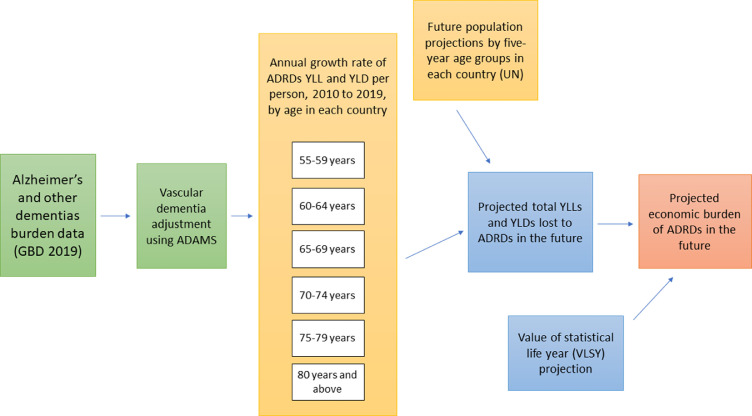
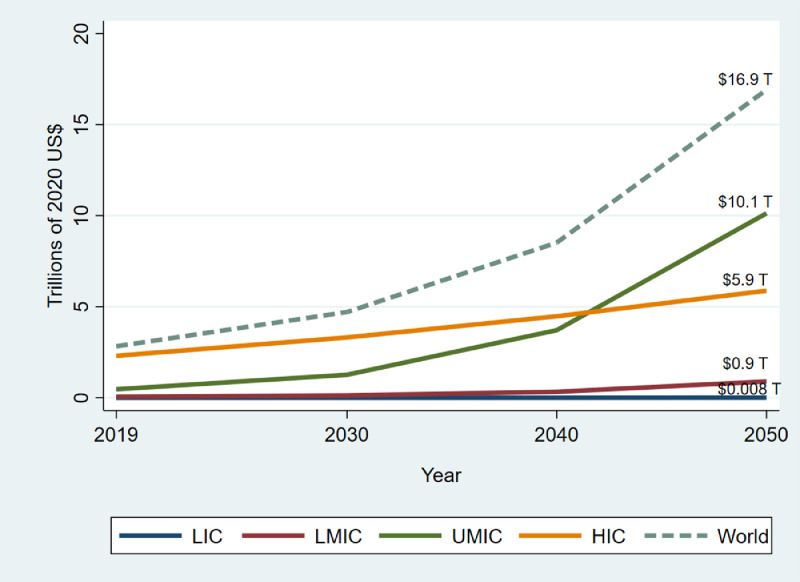
Background: The burden of Alzheimer's disease and related dementias (ADRDs) is expected to grow rapidly with population aging, especially in low- and middle-income countries, in the next few decades. We used a willingness-to-pay approach to project the global, regional, and national economic burden of ADRDs from 2019 to 2050 under status quo. Methods: We projected age group and country-specific disability-adjusted life years (DALYs) lost to ADRDs in future years based on historical growth in disease burden and available population projections. We used country-specific extrapolations of the value of a statistical life (VSL) year and its future projections based on historical income growth to estimate the economic burden - measured in terms of the value of lost DALYs - of ADRDs. A probabilistic uncertainty analysis was used to calculate point estimates and 95% uncertainty bounds of the economic burden. Findings: In 2019, the global VSL-based economic burden of ADRDs was an estimated $2.8 trillion. The burden was projected to increase to $4.7 trillion (95% uncertainty bound: $4 trillion-$5.5 trillion) in 2030, $8.5 trillion ($6.8 trillion-$10.8 trillion) in 2040, and $16.9 trillion ($11.3 trillion-$27.3 trillion) in 2050. Low- and middle-income countries (LMICs) would account for 65% of the global VSL-based economic burden in 2050, as compared with only 18% in 2019. Within LMICs, upper-middle income countries would carry the largest VSL-based economic burden by 2050 (92% of LMICs burden and 60% of global burden). Interpretation: ADRDs have a large and inequitable projected future VSL-based economic burden. Funding: The Davos Alzheimer's Collaborative.
Overview
The claims and statistics of this paper haven’t been checked yet.
Run the check — free, no account needed. It reads the open-access text and checks the sources it cites.
Integrity signals
Registry
Cites
Statistics
Figures
Verification
Claims the paper makes
The claims and statistics of this paper haven’t been checked yet.
Run the check — free, no account needed. It reads the open-access text and checks the sources it cites.
Claims other papers make about this one
Each is checked against this paper’s own text: does it say what the citing paper says it does?
The cited source says what the claim attributes to it.
In the citing paper
“Nandi and colleagues estimated global costs of dementia and found an economic burden of $2.8 trillion in 2019.9”
From Societal Costs of Dementia: 204 Countries, 2000–2019 (2024) · cites this paper as [9]
Self-check
Percentages, sums and reported differences re-computed from the paper’s own numbers.
The self-check needs the paper’s full text.
Citations
Cites
Nichols, E., Steinmetz, J. D., Vollset, S. E., Fukutaki, K., Chalek, J., Abd-Allah, F., Abdoli, A., Abualhasan, A., Abu-Gharbieh, E., Akram, T. T., et al. (2022) · The Lancet Public Health · doi:10.1016/s2468-2667(21)00249-8 · Cited by 5,575
Hearing loss and cognitive decline in older adults
Lin, F. R., Yaffe, K., Xia, J., Xue, Q.-L., Harris, T. B., Purchase-Helzner, E., Satterfield, S., Ayonayon, H. N., Ferrucci, L., Simonsick, E. M., et al. (2013) · JAMA Internal Medicine · doi:10.1001/jamainternmed.2013.1868 · Cited by 4,017
(2015) · HAL · Cited by 2,238
The value of a statistical life: A critical review of market estimates throughout the world
Viscusi, W. K., & Aldy, J. E. (2003) · Journal of Risk and Uncertainty · doi:10.1023/a:1025598106257 · Cited by 2,135
Monetary Costs of Dementia in the United States
Hurd, M. D., Martorell, P., Delavande, A., Mullen, K. J., & Langa, K. M. (2013) · New England Journal of Medicine · doi:10.1056/nejmsa1204629 · Cited by 1,484
Mediterranean diet and risk for Alzheimer's disease
Scarmeas, N., Stern, Y., Tang, M., Mayeux, R., & Luchsinger, J. A. (2006) · Annals of Neurology · doi:10.1002/ana.20854 · Cited by 1,103
The worldwide costs of dementia 2015 and comparisons with 2010
Wimo, A., Guerchet, M., Ali, G., Wu, Y., Prina, A. M., Winblad, B., Jönsson, L., Liu, Z., & Prince, M. (2017) · Alzheimer's & Dementia · doi:10.1016/j.jalz.2016.07.150 · Cited by 1,066
The cost of Alzheimer's disease in China and re‐estimation of costs worldwide
Jia, J., Wei, C., Chen, S., Li, F., Tang, Y., Qin, W., Zhao, L., Jin, H., Xu, H., Wang, F., et al. (2018) · Alzheimer's & Dementia · doi:10.1016/j.jalz.2017.12.006 · Cited by 752
Self-citationThe Value of Health and Longevity
Murphy, K. M., & Topel, R. H. (2006) · Journal of Political Economy · doi:10.1086/508033 · Cited by 605
Relationship Between Education and Dementia: An Updated Systematic Review
Sharp, E. S., & Gatz, M. (2011) · Alzheimer Disease & Associated Disorders · doi:10.1097/wad.0b013e318211c83c · Cited by 591
Research works printed but not linked: 1
- Counts, 2021, Dementia storm on the horizon: the rising incidence of dementia around the world calls for global collaboration and decisive financing, Financ Develop, 58, 54
Cited by
Sorted by citations
Items 301–400 of 404
Alzheimer’s Disease and Dementia: Epidemiology, Social and Economic Challenge
Boz, C., & Mete, A. H. (2024) · doi:10.69860/nobel.9786053359166.3
Patel, A., Gérardin, E., Poujol, J., Dacher, J., Savoye‐Collet, C., Delpierre, C., Wallon, D., Chassagne, P., Grangeon, L., & Burel, J. (2025) · European Journal of Radiology · doi:10.1016/j.ejrad.2025.111915
Xie, D., Cai, Z., Mao, J., Qu, X., Cao, L., & Zhou, J. (2025) · Medicinal Chemistry · doi:10.2174/0115734064364749250102024805
Misclassification in memory modification in AppNL-G-F knock-in mouse model of Alzheimer’s disease
Huang, M.-L., Suzuki, Y., Sasaguri, H., Saito, T., Saido, T. C., & Imayoshi, I. (2025) · eLife · doi:10.1101/2025.01.24.634705
Cognitive benefits of fine particle health-protective behaviors in older adults
No, J., Kim, H. D., & Kim, H.-C. (2025) · International Journal of Environmental Health Research · doi:10.1080/09603123.2025.2464089
Life Expectancy at Risk: The Enduring Impact of El Niño on Human MortalityPreprint
Xu, Y., Zhu, W., Horton, B. P., & Samanta, D. (2025) · SSRN Electronic Journal · doi:10.2139/ssrn.5138883
Epidemiology of old age disorders and challenges across the globe
Nash, M. C., Husain-Krautter, S., & Kyomen, H. H. (2025) · doi:10.1093/med/9780198874799.003.0015
Misclassification in memory modification in AppNL-G-F knock-in mouse model of Alzheimer’s diseasePreprint
Huang, M.-L., Suzuki, Y., Sasaguri, H., Saito, T., Saido, T. C., & Imayoshi, I. (2025) · eLife · doi:10.7554/elife.105347.1
Misclassification in memory modification in AppNL-G-F knock-in mouse model of Alzheimer’s diseasePreprint
Huang, M.-L., Suzuki, Y., Sasaguri, H., Saito, T., Saido, T. C., & Imayoshi, I. (2025) · eLife · doi:10.7554/elife.105347
The Link Between Physical Function, β-Amyloid, and Cognitive Aging in Women
Pedrero‐Chamizo, R., & Szoeke, C. E. I. (2025) · Applied Sciences · doi:10.3390/app15095210
Adachi, Y., Katori, K., Ishiyama, S., Morikawa, S., Saito, T., Saido, T. C., Ikegaya, Y., & Takeuchi, H. (2025) · bioRxiv (Cold Spring Harbor Laboratory) · doi:10.1101/2025.05.02.651821
Carotid ultrasound markers of cognitive impairment in Alzheimer's disease
Zhang, W., Teng, F., Li, Y., & Lou, D. (2025) · Journal of Radiation Research and Applied Sciences · doi:10.1016/j.jrras.2025.101625
Johnson, S. N., Mihelich, K., & Wyatt, T. R. (2025) · Journal of Gerontological Nursing · doi:10.3928/00989134-20250515-02
Neurotoxic Metropolis: Navigating Inflammatory Risks to Brain Health in Urban Environmental Planning
Aldern, C. P., & Clonch, A. (2025) · Journal of city climate policy and economy · doi:10.3138/jccpe-2024-0042
Decoding the Involvement of miRNAs in Alzheimer’s Disease: Focus on Neuroinflammation
Yadav, S., & Wojda, U. (2025) · RNA technologies · doi:10.1007/978-3-031-91072-2_14
Accelerating development of vaccines for prevention and control of Alzheimer's disease
Koff, W. C., & Holtzman, D. M. (2025) · Vaccine · doi:10.1016/j.vaccine.2025.127410
Liquid–Liquid Phase Separation in Hereditary Hearing Loss
Tao, K., Zong, Y., Liu, X., Shi, X., Zhao, Z., & Sun, Y. (2025) · Neuroscience Bulletin · doi:10.1007/s12264-025-01446-9
Deciphering the molecular and neuropathological dimensions of dementia
Dutta, S., Bhattacharjee, P., Noori, S., Adhikari, N., Dule, S., Soyel, M. I., Besra, M., Borah, S., & Gupta, P. (2025) · NPG. Neurologie, psychiatrie, gériatrie/NPG · doi:10.1016/j.npg.2025.05.002
Lynch, D. T., Agus, S., Kayed, R., Rasche, M., Samples, M., & Piccirella, S. (2025) · bioRxiv (Cold Spring Harbor Laboratory) · doi:10.1101/2025.08.05.668780
Circulating Micro RNAs as Diagnostic Signatures for Amyloid Beta Toxicity in Alzheimer's Disease
Hussein, R. M., Jarajreh, H. A. A., & Al-Matarneh, T. M. (2025) · Research Journal of Pharmacy and Technology · doi:10.52711/0974-360x.2025.00495
Ma, S., Jeon, H., Noh, Y., & Noh, J. (2025) · Healthcare · doi:10.3390/healthcare13162076
Cost-effectiveness of 5-Cog paradigm for individuals with cognitive concerns in primary care
Congivaram, H., Walker, J. M., Ayers, E. I., Chalmer, R., Boustani, M. A., Fowler, N. R., Summanwar, D., Verghese, J., & French, D. D. (2025) · Public Health · doi:10.1016/j.puhe.2025.105963
Zilbershlag, Y., Turgeman, R., & Mansbach, W. E. (2025) · Geriatrics and gerontology international/Geriatrics & gerontology international · doi:10.1111/ggi.70177
Ye, L., Lin, N., Luo, Y., Zhang, L., Liu, M., Peng, W., Yu, X., & Li, M. (2025) · medRxiv · doi:10.1101/2025.09.23.25336425
ClinGRAD: Clinically-Guided Genomics and Radiomics Interpretable GNN for Dementia Diagnosis
Hassan, S., Salem, M., Papineni, V. R. K., Elsayed, A., & Yaqub, M. K. (2025) · Lecture notes in computer science · doi:10.1007/978-3-032-05162-2_20
Gao, R., Li, Q., Zhang, Y., Che, F., Zhang, X., Wang, Y., Zhang, Y., Zheng, X., Li, Q., Huang, F., et al. (2025) · Environment Development and Sustainability · doi:10.1007/s10668-025-06891-0
Brown, E. D. L., Sciubba, D., Obeng-Gyasi, B., Silber, B., & Schneider, D. (2025) · Journal of Applied Gerontology · doi:10.1177/07334648251386532
Hsiao, C., Liu, C., Hsieh, S., Chen, H., Yang, Y., & Hsieh, H. (2025) · The Journals of Gerontology Series B · doi:10.1093/geronb/gbaf218
Gandhi, S., Goyal, S., Dixit, N., Patel, S., & Modi, P. (2025) · Chemical Papers · doi:10.1007/s11696-025-04442-5 · Cited by 1
Network analysis of cognition and function in Alzheimer’s disease: a cross-sectional study
Hu, L., Chen, Y., Chen, L., Ye, X., Wang, Y., Huang, L., Wang, Y., Zhu, X., & Chen, S. (2025) · Frontiers in Psychiatry · doi:10.3389/fpsyt.2025.1661313
Self-citationYu, C., Bian, D., Zhang, J., Han, X., Shi, C., & Li, G. (2025) · Journal of Medical Internet Research · doi:10.2196/79274 · Cited by 1
Zhang, J.-X., Wang, D., Xin, D., & Bai, H. (2025) · Research Square · doi:10.21203/rs.3.rs-8249604/v1
Fosgonimeton in mild-to-moderate Alzheimer's disease
Porsteinsson, A. P., Sabbagh, M. N., Tariot, P. N., Church, K. J., Martin, J. S., Ooi, K. C., Daggett, S., Hale, M., Holub, R., & Moebius, H. J. (2025) · Journal of Alzheimer s Disease Reports · doi:10.1177/25424823251405817
Ayoup, M. S., Ghanem, M., Abdel-Hamid, H., Abu-Serie, M. M., Masoud, A. A., Ghareeb, D. A., Hawsawi, M. B., Sonousi, A. S. M., & Kassab, A. E. (2024) · Figshare · doi:10.6084/m9.figshare.26748980
Menardi, A., Rocca, B. L., Saglam, C., Alberti, F., Cecchin, D., Venneri, A., Cagnin, A., & Vallesi, A. (2026) · NeuroImage · doi:10.1016/j.neuroimage.2026.121696 · Cited by 1
Ghafri, R. A., Ghafari, M. A., Ghafri, M. A., Sofy, A. R., Mohammed, M., & Sinawi, H. A. (2026) · Middle East Current Psychiatry · doi:10.1186/s43045-025-00612-z
Hernández, Z. E. A., Alvarez, E. K. E., Villarreal, V. J. M., Luna, S. E. S., & Duchitanga, G. I. S. (2026) · ASCE MAGAZINE · doi:10.70577/asce.v5i1.592
Fang, J., ZHANG, D.-F., Xie, K., Xu, L., & Bi, X.-A. (2025) · IEEE International Conference on Bioinformatics and Biomedicine (BIBM) · doi:10.1109/bibm66473.2025.11356520
Zhang, S., Wang, Z., & Kharrazi, H. H. K. (2025) · IEEE International Conference on Bioinformatics and Biomedicine (BIBM) · doi:10.1109/bibm66473.2025.11356803
Cognitive decline in U.S. military veterans: risk factors and clinical implications
MacLennan, R. J., Chapin, B. A., Solberg, L. M., & Clark, D. J. (2026) · Frontiers in Dementia · doi:10.3389/frdem.2026.1704367
Genomics link obesity and type 2 diabetes to Alzheimer’s disease to unveil novel biological insightsPreprint
Cunha, C., García‐Ureña, M., Martínez, R., Romero-Lado, M. J., Fernández, M. V., Andreassen, O. A., Sims, R., Tsolaki, M., Sleegers, K., Hiltunen, M. O., et al. (2026) · medRxiv · doi:10.64898/2026.02.10.26344393
Chong, Y., Duan, C., Xu, X., Li, Z., Zhang, H., Gong, J., Wu, Q., Xia, L., Zhang, P., & Xia, W. (2026) · Frontiers in Neurology · doi:10.3389/fneur.2026.1738099
King, S. P., Wright, B., & Suphioglu, C. (2026) · Analytica—A Journal of Analytical Chemistry and Chemical Analysis · doi:10.3390/analytica7010020
Chao, T. Y. S., Sun, Y., Lin, H. M., & Lin, Y. (2026) · Planning Practice and Research · doi:10.1080/02697459.2026.2640109
Ji, M., Hu, X., Ma, M., Li, B., Wang, R., & Fang, X. (2026) · Atmospheric Pollution Research · doi:10.1016/j.apr.2026.102986
Li, T. Y., Yu, A. P., Hui, S. S., Chan, D. K. C., Cheng, C. P., Fong, D., Irwin, M. R., & Siu, P. M. (2026) · Mental health and physical activity · doi:10.1016/j.mhpa.2026.100768 · Cited by 1
Yadav, N., Chaudhary, V., Saraswathy, K. N., & Devi, N. K. (2026) · BMC Public Health · doi:10.1186/s12889-026-26940-1
Liu, X., Jia, Y., Kuang, W., Shi, W., Cheng, B., Peng, J., Wen, Y., Li, C., & Shi, C. (2026) · BMC Geriatrics · doi:10.1186/s12877-026-07404-y
Schinazi, V. R., Colombo, G., & Minta, K. (2026) · Springer eBooks · doi:10.1007/978-3-032-20563-6_15 · Cited by 1
Lu, Y., Zhang, X., Zhou, L., & Ye, F. (2026) · Frontiers in Aging Neuroscience · doi:10.3389/fnagi.2026.1780027
Qin, P., Chen, R., Zhang, L., Li, Z., Zhang, C., Wang, Y., & Chang, L. (2026) · Clinical Therapeutics · doi:10.1016/j.clinthera.2026.03.009
Global, regional, and national economic value of reducing amenable tuberculosis mortality
Liu, Y., Zhu, N., & Shen, M. (2026) · Infectious Disease Modelling · doi:10.1016/j.idm.2026.04.003
Yousefzadeh, N., Sharma, O., Oliver, A., O'Keefe, H., Robertson, E. G., Harris, B., Spiers, G., & Craig, D. (2026) · SN Comprehensive Clinical Medicine · doi:10.1007/s42399-026-02319-6
Hemmy, L. S., Cevasco-Trotter, A. M., Silverman, M. J., Wang, S. G., & Yuan, S. H. (2026) · Journal of Alzheimer s Disease · doi:10.1177/13872877261437271
AI-ASSISTED DEMENTIA CARE: A REVIEW OF EFFECTIVENESS AND ETHICAL CHALLENGES
Dybizbańska, W., Dziki, K., Burzej, A., Komenda, M., Szklarska-Komenda, J., Garncarz, K., Marek, A., Jamroch, K., Kacalak, M., & Nowakowska, Z. (2026) · International Journal of Innovative Technologies in Social Science · doi:10.31435/ijitss.2(50).2026.5124
Lu, K., Du, H., Ma, R., Ban, J., Sun, Q., Wang, Q., Zhang, S., Du, P., Zhang, C., & Li, T. (2026) · One Earth · doi:10.1016/j.oneear.2026.101837
Nassanga, R., Kaddumukasa, M., Jones, S. E., Sajatovic, M., Nemani, A., Basiimwa, R. C., Kawooya, M. G., Tumwine, J. K., Lwere, K., Gumikiriza‐Onoria, J. L., et al. (2026) · Degenerative Neurological and Neuromuscular Disease · doi:10.2147/dnnd.s590989
Gould, B., Bulsari, S., & Cesare, M. D. (2026) · Frontiers in Dementia · doi:10.3389/frdem.2026.1790741
Shen, C., Su, J., Liu, L., Li, J., Zhao, X., Wang, Z., Jiang, Y., & Zhao, D. (2026) · Archives of Public Health · doi:10.1186/s13690-026-01957-5
Burns, S., Clarke, P., & Choi, H. (2026) · Population Research and Policy Review · doi:10.1007/s11113-026-10009-3
Bashir, B., andotra, N., Sharma, P., Sharma, T., Chauhan, S., Awasthi, A., Singh, S., Singh, T., Singh, S. K., & Vishwas, S. (2026) · Inflammopharmacology · doi:10.1007/s10787-026-02271-w
Glycolysis: The Bridge Between Cellular Interaction and Alzheimer’s Disease
Lei, Q., He, Y., & Fang, B. (2026) · Biomolecules · doi:10.3390/biom16060796
Knell, G., Meeker, K. L., Zhou, Z., Petersen, M. E., Hall, J. R., & O’Bryant, S. E. (2026) · Journal of Alzheimer s Disease · doi:10.1177/13872877261449514
Huang, Z., Qiu, G., Shi, C., Chen, R., Xue, E., Wang, Z., Xu, D. R., Ao, X., & Wang, Y. (2026) · Alzheimer s & Dementia · doi:10.1002/alz.71560
WU, M., Li, A., Meng, K., Yi, Y., Zhang, Z., Shi, C., He, Y., Ouyang, X., Tan, C., & Wan, X. (2026) · BMC Medicine · doi:10.1186/s12916-026-04982-x
ALMA: A Multimodal Companion Powered by Large Language Models for Alzheimer’s Reminiscence Therapy
Spiță, M.-E., Vavrici, I.-V., & Miron, E. (2026) · International Conference on Development and Application Systems (DAS) · doi:10.1109/das69882.2026.11553360
Nanotechnology-mediated drug delivery for addressing protein aggregation
Tripathi, S., Jaiswal, S., Rana, R., Yadav, P., Mishra, K., Sethi, M., & Chourasia, M. K. (2026) · Elsevier eBooks · doi:10.1016/b978-0-443-33623-2.00004-0
Wang, Y., Ding, P., Qin, H., Zhang, K.-X., Ge, J.-W., Wu, D., Xie, L., & Liang, K. (2026) · Molecular Neurobiology · doi:10.1007/s12035-026-05970-1
Kandasamy, V., Šimić, V., Pamucar, D., & Bačanin, N. (2026) · Engineering Applications of Artificial Intelligence · doi:10.1016/j.engappai.2026.115508
Wang, P.-J., Yang, X., Ji, L., Shi, J., Cai, X., Sun, P., Liu, H.-X., Jiang, F., & Yang, F. (2026) · Frontiers in Aging Neuroscience · doi:10.3389/fnagi.2026.1858299
Educational attainment and dementia among older women in the US: Variation by immigration status
Jacobs, K. J. C., & Brown, M. J. (2026) · Journal of Women & Aging · doi:10.1080/08952841.2026.2685580
Cost–Benefit Analysis of Sanitation Services and Hygiene Practices in Bangladesh
Hutton, G., & Taron, A. (2026) · Water Economics and Policy · doi:10.1142/s2382624x26500153
Escudero, J. P. S., González, D. C. D., Aguillon-Niño, D. F., García-Barrera, M. A., Aguirre–Acevedo, D. C., & Trujillo, N. (2026) · PLOS Digital Health · doi:10.1371/journal.pdig.0001521
Hematological Considerations in Immunotherapy for Alzheimer's Disease
Kumar, R. R., Pandey, R., Antal, S., Rani, S., & Alam, M. S. (2026) · doi:10.1002/9781394336241.ch8
Scerri, A., Scerri, K., & Scerri, C. (2026) · Journal of Alzheimer s Disease · doi:10.1177/13872877261471922
Metabolomic Discoveries for Traditional Chinese Medicine Efficacy in Alzheimer′s Disease
Sun, H., Huang, D., Yang, F., Zhang, P., Yang, D., & Zeng, C. (2026) · BioMed Research International · doi:10.1155/bmri/2455800
Vengadasamy, P., & Vijayalakshmi, A. (2026) · Journal of Natural Remedies · doi:10.18311/jnr/2026/55802
Wani, O. H., Dhaka, P., Pinky, Chaudhary, S. S., Wani, A. A., Iqbal, A., Parvez, S., & Dar, T. A. (2026) · Metabolic Brain Disease · doi:10.1007/s11011-026-01952-3
Pei, J., Perumal, N. C., Meng, P., Long, Q., & Palanisamy, C. P. (2026) · Ageing Research Reviews · doi:10.1016/j.arr.2026.103311
Tariot, P. N., Gitelman, D. R., Govia, I., Partrick, K. A., Scholler, E., Petersen, M. E., & Workgroup, T. C. D. C. A. (2026) · Alzheimer s & Dementia · doi:10.1002/alz.71767
Görgülü, F. F., & Görgülü, O. (2026) · Medicina · doi:10.3390/medicina62081615
Adnan, M., Patel, M. B., Surti, M., & Deshpande, S. (2026) · Journal of Disability Research · doi:10.57197/jdr-2026-0851
Polysaccharides targeting organelle network dysfunction in Alzheimer's disease: A review
Yu, X., Gao, P., Yao, Q., Yuan, F., & 经维新 (2026) · International Journal of Biological Macromolecules · doi:10.1016/j.ijbiomac.2026.154255
Disease, Disability, and Frailty with Increasing Age
Girdhari, K., Pangilinan, A., & Coll, P. P. (2026) · Springer eBooks · doi:10.1007/978-3-032-21928-2_2
Towards Improved P2X7R Cellular Models for Alzheimer’s Disease Drug Discovery
Agius, C. T. A., McKenzie, A. D. J., Woollett, K., Werry, E. L., & Kassiou, M. (2026) · ACS Chemical Neuroscience · doi:10.1021/acschemneuro.6c00089
Yoshikawa, H., Matsumoto, T., Yoshida, E., Ohta, T., Yoshida, T., Noda, Y., Shimohama, S., & Takata, K. (2026) · Bioorganic & Medicinal Chemistry Letters · doi:10.1016/j.bmcl.2026.130778
Chen, I., Chang, L.-C., Ho, C.-N., & Hung, K. (2026) · Frontiers in Aging Neuroscience · doi:10.3389/fnagi.2026.1927383
Gao, L., & Yuan, R. (2026) · Acupuncture & Electro-Therapeutics Research · doi:10.1177/03601293261470424
Marimuthu, A., Singh, M. T., Balasubramanian, S., & Krishnamurthy, P. T. (2026) · Molecular Neurobiology · doi:10.1007/s12035-026-06203-1
Zhang, W., Hui, C., & Tan, M. (2024) · Specialty journal of Pharmacognosy Phytochemistry and Biotechnology · doi:10.51847/7jehvzwpnw
Boyanagari, V. K., Walsh, S., Walsh, B., & O’Shea, E. (2026) · HRB Open Research · doi:10.12688/hrbopenres.14532.1
Corrales, N., Vallejo-Bedia, F., Olivares-Raya, I., Ávila, J., & García‐Escudero, V. (2026) · Applied Sciences · doi:10.3390/app16199488
Rahman, M., Saha, T., Nayeem, M. A. J., Tabassum, A., Abdullah, I., Sultana, S., Jahan, I., Hasan, I., Hayat, S., Papri, N., et al. (2026) · BMJ Open · doi:10.1136/bmjopen-2026-118140
Differential autophagy cargo engagement in amyloid-β-induced neuronal toxicity
Brink, D., Theart, R., & Loos, B. (2026) · Frontiers in Neuroscience · doi:10.3389/fnins.2026.1913175
Buendía, J. A., Zuluaga, A. F., & Martínez-Rodríguez, C. E. (2026) · F1000Research · doi:10.12688/f1000research.157481.3
Modulating TDP-43 Protein Aggregation Directly and Indirectly in C. Elegans
Elshaalia, E. (2026) · Digital Commons - DU (University of Denver) · doi:10.56902/etdcrp.2026.150
Tabi, Y. A., Meyer, E. C., Tabi, A., Rave, J., Philippen, S., & Bartsch, T. (2026) · Dialogues in Health · doi:10.1016/j.dialog.2026.100364
Targeting Ferroptosis with Natural Products: A Promising Strategy for Neurodegenerative Diseases
关维一, Zhang, X., Liu, Z., Ouyang, Y., Li, X., Xu, H., Huang, S., & Yanan, H. (2026) · The American Journal of Chinese Medicine · doi:10.1142/s0192415x26500758
Luo, Q., Li, Z., Liao, Y., Chen, W., Xu, Z., You, X., Xue, G., Duan, Y., Li, J., & Li, S. (2026) · Frontiers in Pharmacology · doi:10.3389/fphar.2026.1942636
Metadata
- Authors
- Nandi, A., Counts, N., Chen, S., Seligman, B., Tortorice, D., Vigo, D., & Bloom, D. E.
- Affiliations
- Population Council (US)
- Albert Einstein College of Medicine (US)
- Heidelberg University (DE)
- University of California, Los Angeles (US)
- College of the Holy Cross (US)
- University of British Columbia (CA)
- Harvard University (US)
- Corresponding author
- Nandi, Arindam
- Venue
- eClinicalMedicine
- Publisher
- Elsevier BV
- Published
- 2022-09
- Volume
- 51
- Pages
- 101580
- ISSN
- 2589-5370 (ISSN-L)
- PMC
- PMC9310134
- OpenAlex
- W4286696753
- Cited by
- 402
- References
- 38
- Citations by year
- 2026: 91 · 2025: 166 · 2024: 95 · 2023: 45 · 2022: 5
- FWCI
- 50.68
- Type
- journal article
- Language
- en
- Open access
- gold
- doi.org
- Licence
- Locations
- EClinicalMedicine (publishedVersion, cc-by-nc-nd)
- PubMed Central (publishedVersion, cc-by-nc-nd)
- PubMed (publishedVersion)
- DOAJ (DOAJ: Directory of Open Access Journals) (submittedVersion, cc-by-sa)
- Funders
- Pfizer
- Merck
- Topics
- Health Sciences › Medicine › Psychiatry and Mental health › Dementia and Cognitive Impairment Research
- Social Sciences › Economics, Econometrics and Finance › Economics and Econometrics › Health Systems, Economic Evaluations, Quality of Life
- Life Sciences › Neuroscience › Cellular and Molecular Neuroscience › Alzheimer's disease research and treatments
- Keywords
- Alzheimer's disease and related dementias, economic burden, value of a statistical life, disability-adjusted life years, population aging, low- and middle-income countries, health disparities, future projections, willingness to pay, global burden of disease
About these checks
Registry, retraction, Cites and statistics results are computed, not judged, with one exception: a printed reference that no index lists is read once by a model before it counts as a citation error. Claims are extracted by a model and kept only when their quote appears verbatim in the text; each cited source is then checked, with a model’s help, for whether it says what the claim relies on. Those verdicts can be wrong — read the claim’s quote and the cited source before relying on one.
Statistics and arithmetic are recomputed, not judged.
Confidence bands are shown only for fields calibrated on our annotated test set. None is calibrated yet, so no band is shown.
What counts as a claim ›How we measure confidence ›How we check this ›
Are you an author, or do you see a problem with this page? Request a review
