

The DOI matches its Crossref record; 32 of the 32 references it cites were found in a registry or an index.
Safety and efficacy of faecal microbiota transplantation in patients with mild to moderate Parkinson's disease (GUT-PARFECT): a double-blind, placebo-controlled, randomised, phase 2 trial
Open accessAbstract
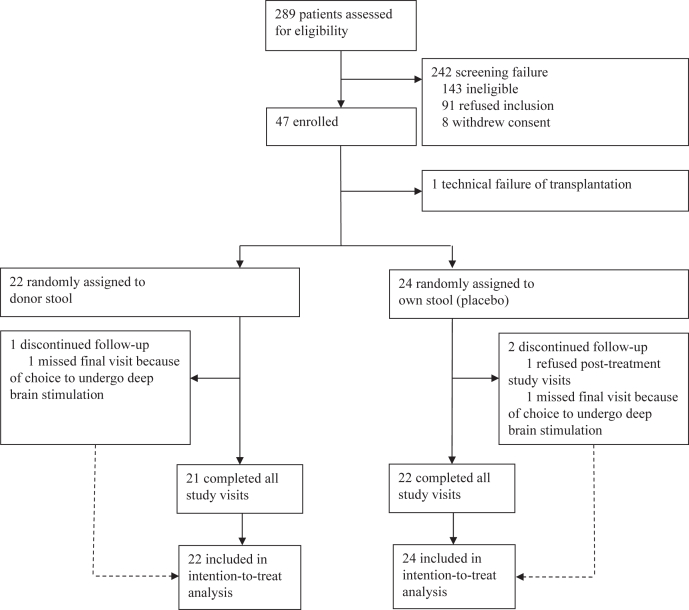
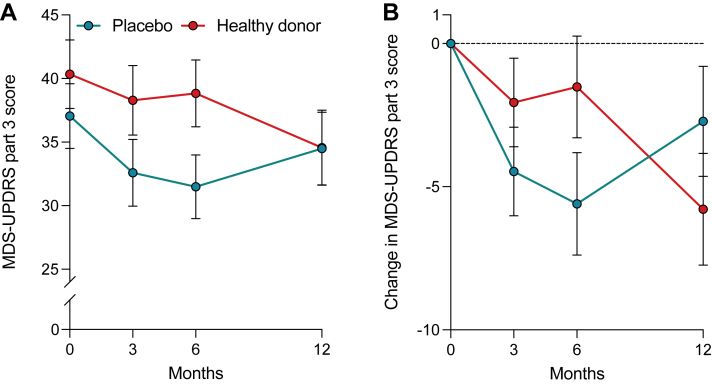
Background: Dysregulation of the gut microbiome has been implicated in Parkinson's disease (PD). This study aimed to evaluate the clinical effects and safety of a single faecal microbiota transplantation (FMT) in patients with early-stage PD. Methods: The GUT-PARFECT trial, a single-centre randomised, double-blind, placebo-controlled trial was conducted at Ghent University Hospital between December 01, 2020 and December 12, 2022. Participants (aged 50-65 years, Hoehn and Yahr stage 2) were randomly assigned to receive nasojejunal FMT with either healthy donor stool or their own stool. Computer-generated randomisation was done in a 1:1 ratio through permutated-block scheduling. Treatment allocation was concealed for participants and investigators. The primary outcome measure at 12 months was the change in the Movement Disorders Society-Unified Parkinson's Disease Rating Scale (MDS-UPDRS) motor score obtained during off-medication evaluations. Intention-to-treat analysis was performed using a mixed model for repeated measures analysis. This completed trial is registered on ClinicalTrials.gov (NCT03808389). Findings: Between December 2020 and December 2021, FMT procedures were conducted on 46 patients with PD: 22 in the healthy donor group and 24 in the placebo group. Clinical evaluations were performed at baseline, 3, 6, and 12 months post-FMT. Full data analysis was possible for 21 participants in the healthy donor group and 22 in the placebo group. After 12 months, the MDS-UPDRS motor score significantly improved by a mean of 5.8 points (95% CI -11.4 to -0.2) in the healthy donor group and by 2.7 points (-8.3 to 2.9) in the placebo group (p = 0.0235). Adverse events were limited to temporary abdominal discomfort. Interpretation: Our findings suggested a single FMT induced mild, but long-lasting beneficial effects on motor symptoms in patients with early-stage PD. These findings highlight the potential of modulating the gut microbiome as a therapeutic approach and warrant a further exploration of FMT in larger cohorts of patients with PD in various disease stages. Funding: Flemish PD patient organizations (VPL and Parkili), Research Foundation Flanders (FWO), Biocodex Microbiota Foundation.
Overview
The claims and statistics of this paper haven’t been checked yet.
Run the check — free, no account needed. It reads the open-access text and checks the sources it cites.
Integrity signals
Registry
Cites
Statistics
Figures
Verification
Claims the paper makes
The claims and statistics of this paper haven’t been checked yet.
Run the check — free, no account needed. It reads the open-access text and checks the sources it cites.
Claims other papers make about this one
Each is checked against this paper’s own text: does it say what the citing paper says it does?
The cited source doesn’t support the claim as written.
In the citing paper
“One study reported no changes in motor function at 6 months post-FMT, although here the treatment group required smaller dose increases than placebo.”
From The gut–brain axis in early Parkinson’s disease: from prodrome to prevention (2025) · cites this paper as [209]
Checked by a reasoning model — may be wrong.
Experimental — accuracy not yet measuredThe source backs part of the claim, not all of it — or backs it for a different population, condition or comparison.
In the citing paper
“In these studies, the clinical findings were associated with a shift toward anti-inflammatory microbial species.”
From The gut–brain axis in early Parkinson’s disease: from prodrome to prevention (2025) · cites this paper as [209]
Experimental — accuracy not yet measuredThe source backs part of the claim, not all of it — or backs it for a different population, condition or comparison.
In the citing paper
“Three of these reported changes in global or motor function, and of these two reported significant improvement UPDRS PD symptom scores at 12 weeks and 12 months, respectively.”
From The gut–brain axis in early Parkinson’s disease: from prodrome to prevention (2025) · cites this paper as [209]
Experimental — accuracy not yet measuredThe cited source says what the claim attributes to it.
In the citing paper
“There are currently four RCTs with available evidence for the role of FMT in treating PD [206–209].”
From The gut–brain axis in early Parkinson’s disease: from prodrome to prevention (2025) · cites this paper as [209]
The check wasn’t confident either way, so it gives no verdict — never disputed.
In the citing paper
“In this study, only 3% of the treatment group were reported to show a change from dysbiotic to non-dysbiotic status, compared to 33% in the placebo arm, suggesting that the FMT treatment failed to produce a significant change in the gut microbiome.”
From The gut–brain axis in early Parkinson’s disease: from prodrome to prevention (2025) · cites this paper as [209]
Experimental — accuracy not yet measured
Self-check
Percentages, sums and reported differences re-computed from the paper’s own numbers.
The self-check needs the paper’s full text.
Citations
Cites
Staging of brain pathology related to sporadic Parkinson’s disease
Braak, H., Tredici, K. D., Rüb, U., de Vos, R. A. I., Jansen Steur, E. N. H., & Braak, E. (2003) · Neurobiology of Aging · doi:10.1016/s0197-4580(02)00065-9 · Cited by 10,777
Bloem, B. R., Okun, M. S., & Klein, C. (2021) · The Lancet · doi:10.1016/s0140-6736(21)00218-x · Cited by 3,920
Duodenal Infusion of Donor Feces for Recurrent Clostridium difficile
van Nood, E., Vrieze, A., Nieuwdorp, M., Fuentes, S., Zoetendal, E. G., de Vos, W. M., Visser, C. E., Kuijper, E. J., Bartelsman, J. F. W. M., Tijssen, J. G. P., et al. (2013) · New England Journal of Medicine · doi:10.1056/nejmoa1205037 · Cited by 3,708
Gut microbiota regulate motor deficits and neuroinflammation in a model of Parkinson's disease
Sampson, T. R., Debelius, J. W., Thron, T., Janssen, S., Shastri, G. G., Ilhan, Z. E., Challis, C., Schretter, C. E., Rocha, S., Gradinaru, V., et al. (2016) · Cell · doi:10.1016/j.cell.2016.11.018 · Cited by 3,622
Non-motor features of Parkinson disease
Schapira, A. H. V., Chaudhuri, K. R., & Jenner, P. (2017) · Nature Reviews Neuroscience · doi:10.1038/nrn.2017.62 · Cited by 2,053
Gut microbiota are related to Parkinson's disease and clinical phenotype
Scheperjans, F., Aho, V., Pereira, P. A. B., Koskinen, K., Paulin, L., Pekkonen, E., Haapaniemi, E., Kaakkola, S., Eerola‐Rautio, J., Pohja, M., et al. (2015) · Movement Disorders · doi:10.1002/mds.26069 · Cited by 1,968
Kim, S., Kwon, S.-H., Kam, T.-I., Panicker, N., Karuppagounder, S. S., Lee, S., Lee, J. H., Kim, W. R., Kook, M., Foss, C. A., et al. (2019) · Neuron · doi:10.1016/j.neuron.2019.05.035 · Cited by 1,397
Inflammation and immune dysfunction in Parkinson disease
Tansey, M. G., Wallings, R. L., Houser, M. C., Herrick, M. K., Keating, C. E., & Joers, V. (2022) · Nature Reviews Immunology · doi:10.1038/s41577-022-00684-6 · Cited by 1,382
European consensus conference on faecal microbiota transplantation in clinical practice
Cammarota, G., Ianiro, G., Tilg, H., Rajilić-Stojanović, M., Kump, P., Satokari, R., Sokol, H., Arkkila, P., Pintus, C., Hart, A., et al. (2017) · Gut · doi:10.1136/gutjnl-2016-313017 · Cited by 1,207
Vagotomy and subsequent risk of Parkinson's disease
Svensson, E., Horváth‐Puhó, E., Thomsen, R. W., Djurhuus, J. C., Pedersen, L., Borghammer, P., & Sørensen, H. T. (2015) · Annals of Neurology · doi:10.1002/ana.24448 · Cited by 806
Cited by
Sorted by citations
Items 101–145 of 145
Gut-Brain Axis in Parkinson’s DiseasePreprint
Zhou, E., & Dettmer, U. (2026) · Preprints.org · doi:10.20944/preprints202601.0779.v1 · Cited by 1
La transplantation de microbiote fécal dans la maladie de Parkinson
d'Esneval, M., Jiménez, M. C., Debove, I., Aybek, S., & Fleury, V. (2024) · Forum Médical Suisse ‒ Swiss Medical Forum · doi:10.4414/fms.2024.1157578842
Fäkale Mikrobiota-Transplantation bei Morbus Parkinson
d'Esneval, M., Jiménez, M. C., Debove, I., Aybek, S., & Fleury, V. (2024) · Swiss Medical Forum ‒ Schweizerisches Medizin-Forum · doi:10.4414/smf.2024.1157578842
Unlocking the Code of Innovation: TRIZ Theory’s Blueprint for Precision Medicine Breakthroughs
Schmidt, R. (2025) · Springer eBooks · doi:10.1007/978-3-031-77302-0_1
Research Advances on the Regulation of Cognitive Dysfunction by Intestinal Microflora
郑, 晋. (2025) · Advances in Clinical Medicine · doi:10.12677/acm.2025.1541059
The role of gut dysbiosis in the pathogenesis of neurodegenerative diseases
Roudenský, P. (2025) · Neurologie pro praxi · doi:10.36290/neu.2025.036
Gut microbiome related therapeutics and dietary supplements
Dhapola, R., Kumari, S., Sharma, P., Vellingiri, B., & HariKrishnaReddy, D. (2025) · Elsevier eBooks · doi:10.1016/b978-0-443-29932-2.00008-6
Attenuating Neurotoxicity Through Fecal Microbiota Transplant: Mechanisms and Therapeutic Potential
Younis, N. K., Alfarttoosi, K. H., Sanghvi, G. V., Roopashree, R., Kashyap, A., Krithiga, T., Taher, W. M., Alwan, M., Jawad, M. J., & Al-Nuaimi, A. M. A. (2025) · Molecular Neurobiology · doi:10.1007/s12035-025-05415-1
Sun, Y., Yang, H., Zhang, J., Cong, S., Wang, L., & Yu, T. (2025) · Frontiers in Aging Neuroscience · doi:10.3389/fnagi.2025.1712302
Exploring promising pharmaceutical candidates for antiaging
Nandi, N. K., Lodhi, A., Kumar, D., Lather, V., & Tripathi, P. N. (2025) · Elsevier eBooks · doi:10.1016/b978-0-443-36295-8.00014-6
Efficacy and Safety of Fecal Microbiota Transplantation for Parkinson’s Disease: A Systematic Review
Faria, I. C., Martins, K. A. M., Corcinio, M. M., de Oliveira, P. S., Nogueira, G. F., Bittarães, A. J. D. S. O., & Braga, M. O. (2025) · Brazilian Journal of Transplantation · doi:10.53855/bjt.v28i1.735_eng
The application of fecal microbiota transplantation in Parkinson’s disease
Wang, B., Ma, D., Li, N., & Luo, T. (2025) · Frontiers in Aging Neuroscience · doi:10.3389/fnagi.2025.1713899
Wang, Z., Zheng, H., Li, L.-J., Cao, L.-L., Shen, L., Qiao, Y., Chen, Y., Wu, L.-Y., Li, G., & Wu, H.-G. (2026) · Frontiers in Aging Neuroscience · doi:10.3389/fnagi.2025.1719326
Peltz, Z., Wiblin, R., Kattunga, V. M., Pai, C., Andersen, J. K., & Chinta, S. J. (2026) · Metabolic Brain Disease · doi:10.1007/s11011-026-01801-3
Wang, S., Zhu, Y., Wang, J., Jin, W., Li, N., Li, Z., Chang, Y., Jiang, C. Q., & Wang, T. (2026) · Scientific Reports · doi:10.1038/s41598-026-43865-2
Faecal microbiota transplant for Parkinson’s disease
Santens, P., Bruggeman, A., Laukens, D., & Vandenbroucke, R. E. (2026) · Brain · doi:10.1093/brain/awag123
Self-citationMojica, E. P., Aranis, N., Ribeiro, J. V., Soto-Rodríguez, A., & Fregni, F. (2026) · Gut Microbiology · doi:10.1016/j.gutmic.2026.100007
The ‘gut feeling’: Connecting neurodegenerative diseases and gut microbiota
Niyogi, S., & Basu, S. (2026) · The Microbe · doi:10.1016/j.microb.2026.100719
Seven years of stool banking: Clinical and microbiological insights from the Ghent Stool Bank
Hamerlinck, H., Boelens, J., Looze, D. A. D., Messiaen, A.-S., Vandendriessche, S., Holvoet, T., & Verhasselt, B. (2026) · International Journal of Infectious Diseases · doi:10.1016/j.ijid.2026.108744
Self-citationGut Microbiome Imbalance: The Root Causes of Neurodegeneration?
Konika, T. A., Shamsuzzaman, M., Uddin, M. E., & Kim, J. (2026) · Springer eBooks · doi:10.1007/978-981-95-7494-0_2
Parkinson’s Disease and the Microbiome: A New Frontier for Early Diagnosis
Chakkittukandiyil, A., & Sajini, D. V. (2026) · Springer eBooks · doi:10.1007/978-981-95-7494-0_4
Voigt, R. M., Keshavarzian, A., & Hall, D. A. (2026) · Annals of Neurology · doi:10.1002/ana.78259
Gut microbiota from health to disease: A role for biofilms?
Buret, A. G., & Allain, T. (2026) · Elsevier eBooks · doi:10.1016/b978-0-443-40306-4.00011-9
Liang, B., Zou, J., Mao, X., Xie, N., & Zhaohui, L. (2026) · Revista de Neurología · doi:10.31083/rn50106
Light, melanin, and the microbial clock: Rewiring the gut–brain–skin axis
Clark, A. P., & Mach, N. (2026) · Frontiers in Neuroendocrinology · doi:10.1016/j.yfrne.2026.101271
Mansour, R. M., Alam-ElDein, K. M., Mageed, S. S. A., El-Sayyad, G. S., Ghanem, A., Shaker, A. A. S., Mohammed, O. A., Farag, D. A. A., abdelnaby, M., Hathout, A., et al. (2026) · European Journal of Neuroscience · doi:10.1111/ejn.70606
Safety of Fecal Microbiota Transplantation in Children: A Single-Center Experience
Varnas, D., & Urbonas, V. (2026) · Children · doi:10.3390/children13081005
Fecal microbiota transplantation in Parkinson’s disease: a systematic review
Eissazade, N., Mosavari, H., Eghdami, S., Rohani, M., Fereshtehnejad, S., & Khoeini, T. (2026) · Neurodegenerative Disease Management · doi:10.1080/17582024.2026.2715585
Balsamo, J. M., & Bess, E. N. (2026) · ACS Bio & Med Chem Au · doi:10.1021/acsbiomedchemau.6c00110
Liao, J., Chen, Y., Lu, Y., Qu, F., Xie, X., Yang, Z., & Wen, W. (2026) · Behavioural Neurology · doi:10.1155/bn/6222269
Arce, A. G. M. (2026) · Revista Tópicos. · doi:10.70773/revistatopicos/787974561
Virobiome-mediated regulation of microbiota–gut–brain axis signaling and neuroimmune homeostasis
Afkhamian, A., Natanzi, A. S., Jafaridarabjerdi, M., Aghaei, S., Haghjou, A., Shafiei, M., Bashkandi, A. H., Shahraki, S., Reiter, R. J., Kashani, H. H., et al. (2026) · Cell Communication and Signaling · doi:10.1186/s12964-026-03067-9
Microbiome and Diseases: Gut–Brain Axis and Neurological Disorders
de Castilhos, J., & Stein‐Thoeringer, C. K. (2026) · Springer eBooks · doi:10.1007/978-3-032-26410-7_18
Mingke, T., Li, J., Zhang, C., Tu, R., & Wang, S. (2026) · Frontiers in Aging Neuroscience · doi:10.3389/fnagi.2026.1973833
Hasanuzzaman, M., Bang, C. S., Lee, J. J., & Gong, E. J. (2026) · Journal of Korean Medical Science · doi:10.3346/jkms.2026.41.e335
Zucchi, E., Niccolai, E., Maio, F. D., Costantini, R. C., Quaranta, G., Guarnaccia, A., Bibbò, S., Martinelli, I., Gianferrari, G., Simonini, C., et al. (2026) · EBioMedicine · doi:10.1016/j.ebiom.2026.106509
Scheperjans, F., Borghammer, P., Pfeiffer, R. F., Appel‐Cresswell, S., & Keshavarzian, A. (2026) · Movement Disorders · doi:10.1002/mds.70566
Beyond the brain: Neurology, the gut, and a gap in training
Demas, A. (2026) · Revue Neurologique · doi:10.1016/j.neurol.2026.09.007
Lin, W., Shu, Z., Liu, G., Fang, J., & Ding, S. (2026) · Probiotics and Antimicrobial Proteins · doi:10.1007/s12602-026-11246-w
Liu, X., Wang, S., Long, W., Tan, X., Li, W., & Gao, L. (2026) · Frontiers in Aging Neuroscience · doi:10.3389/fnagi.2026.1926883
Gut microbial metabolites: linking gut–immune–brain crosstalk to mental and neuropsychiatric health
Wu, Y., Xie, X., Lyu, W., Xu, J.-E., Fan, F., Mao, R., Pan, S., Zhang, L., & Fu, M. (2026) · Frontiers in Immunology · doi:10.3389/fimmu.2026.1993237
Gut-Induced Synuclein Propagation: A New Mechanism in Neurodegenerative Disease
Sun, Y., Li, B., & Ye, K. (2026) · The Neuroscientist · doi:10.1177/10738584261490909
How a once-controversial idea is advancing understanding of Parkinson’s disease
Nuwer, R. (2026) · Nature · doi:10.1038/d41586-026-03169-x
Figura, M., Zając, W., Otto‐Ślusarczyk, D., Milanowski, Ł., Nowak, J. M., Antoniak, A., Kopczyński, M. H., Sadowski, K., Hołubiuk, Ł., Walęcik-Kot, W., et al. (2026) · International Journal of Molecular Sciences · doi:10.3390/ijms27219924
Metadata
- Authors
- Bruggeman, A., Vandendriessche, C., Hamerlinck, H., De Looze, D., Tate, D. J., Vuylsteke, M., De Commer, L., Devolder, L., Raes, J., Verhasselt, B., Laukens, D., Vandenbroucke, R. E., & Santens, P.
- Affiliations
- Ghent University Hospital (BE)
- Ghent University (BE)
- VIB-UGent Center for Inflammation Research (BE)
- Rega Institute for Medical Research (BE)
- Corresponding author
- Santens, Patrick
- ORCID
- Venue
- eClinicalMedicine
- Publisher
- Elsevier BV
- Published
- 2024-05
- Volume
- 71
- Pages
- 102563
- ISSN
- 2589-5370 (ISSN-L)
- PMC
- PMC11056595
- OpenAlex
- W4393224953
- Cited by
- 139
- References
- 32
- Citations by year
- 2026: 48 · 2025: 71 · 2024: 20
- FWCI
- 37.19
- Type
- journal article
- Language
- en
- Open access
- gold
- doi.org
- Licence
- Locations
- EClinicalMedicine (publishedVersion, cc-by-nc-nd)
- PubMed Central (publishedVersion, cc-by-nc-nd)
- PubMed (publishedVersion)
- Ghent University Academic Bibliography (Ghent University) (submittedVersion, cc-by-nc-nd)
- Lirias (KU Leuven) (submittedVersion, cc-by-nc-nd)
- DOAJ (DOAJ: Directory of Open Access Journals) (submittedVersion, cc-by-sa)
- Funders
- Biocodex Microbiota Foundation
- Fonds Wetenschappelijk Onderzoek (1295223N, T000819N)
- Topics
- Health Sciences › Medicine › Clinical Neurology › Parkinson's Disease Mechanisms and Treatments
- Life Sciences › Biochemistry, Genetics and Molecular Biology › Molecular Biology › Gut microbiota and health
- Health Sciences › Medicine › Gastroenterology › Gastrointestinal motility and disorders
- Keywords
- fecal microbiota transplantation, Parkinson's disease, early-stage Parkinson's disease, gut microbiota, motor symptoms, treatment safety, adverse events, microbiota-based therapy
About these checks
Registry, retraction, Cites and statistics results are computed, not judged, with one exception: a printed reference that no index lists is read once by a model before it counts as a citation error. Claims are extracted by a model and kept only when their quote appears verbatim in the text; each cited source is then checked, with a model’s help, for whether it says what the claim relies on. Those verdicts can be wrong — read the claim’s quote and the cited source before relying on one.
Statistics and arithmetic are recomputed, not judged.
Confidence bands are shown only for fields calibrated on our annotated test set. None is calibrated yet, so no band is shown.
What counts as a claim ›How we measure confidence ›How we check this ›
Are you an author, or do you see a problem with this page? Request a review
