

The DOI matches its Crossref record; 86 of the 87 references it cites were found in a registry or an index.
Ten striking facts about agricultural input use in Sub-Saharan Africa
Open accessAbstract
Conventional wisdom holds that Sub-Saharan African farmers use few modern inputs despite the fact that most poverty-reducing agricultural growth in the region is expected to come largely from expanded use of inputs that embody improved technologies, particularly improved seed, fertilizers and other agro-chemicals, machinery, and irrigation. Yet following several years of high food prices, concerted policy efforts to intensify fertilizer and hybrid seed use, and increased public and private investment in agriculture, how low is modern input use in Africa really? This article revisits Africa's agricultural input landscape, exploiting the unique, recently collected, nationally representative, agriculturally intensive, and cross-country comparable Living Standard Measurement Study-Integrated Surveys on Agriculture (LSMS-ISA) covering six countries in the region (Ethiopia, Malawi, Niger, Nigeria, Tanzania, and Uganda). Using data from over 22,000 households and 62,000 agricultural plots, we offer ten potentially surprising facts about modern input use in Africa today.
Overview
The claims and statistics of this paper haven’t been checked yet.
Run the check — free, no account needed. It reads the open-access text and checks the sources it cites.
Integrity signals
Registry
Cites
Statistics
Figures
Verification
Claims the paper makes
The claims and statistics of this paper haven’t been checked yet.
Run the check — free, no account needed. It reads the open-access text and checks the sources it cites.
Self-check
Percentages, sums and reported differences re-computed from the paper’s own numbers.
The self-check needs the paper’s full text.
Citations
Cites
Assessing the Impact of the Green Revolution, 1960 to 2000
Evenson, R. E., & Gollin, D. (2003) · Science · doi:10.1126/science.1078710 · Cited by 2,228 · cited 1×
“The gains from diffusion of these inputs were enjoyed broadly, including to consumers (Evenson and Gollin, 2003), helping to stimulate historically unprecedented economic growth and poverty reduction in east and southeast Asia (David and Otsuka, 1994).”
BackgroundTransforming Traditional Agriculture.
Balogh, T., & Schultz, T. W. (1964) · The Economic Journal · doi:10.2307/2228861 · Cited by 1,994
Safeguarding production—losses in major crops and the role of crop protection
Oerke, E.-C., & Dehne, H. W. (2003) · Crop Protection · doi:10.1016/j.cropro.2003.10.001 · Cited by 1,425 · cited 1×
“30% of attainable yields as collected from sources around the world (Oerke and Dehne, 2004).”
BackgroundThe role of agriculture in economic development
Johnston, B. F., & Mellor, J. W. (1961) · American Economic Review · Cited by 948
Agrifood Industry Transformation and Small Farmers in Developing Countries
Reardon, T., Barrett, C. B., Berdegué, J. A., & Swinnen, J. (2009) · World Development · doi:10.1016/j.worlddev.2008.08.023 · Cited by 945 · cited 2×
“…a middle class, increased access to market and other information through cell phones, and transformation of some food marketing channels—may have changed on-farm incentives and resulted in updates to farm management practices, including modern input use (e.g., Reardon et al., 2009; Tiffen, 2003).”
BackgroundInfluentialSelf-citationIntegrated Soil Fertility Management
Vanlauwe, B., Bationo, A., Chianu, J. N., Giller, K. E., Merckx, R., Mokwunye, U., Ohiokpehai, O., Pypers, P., Tabo, R., Shepherd, K. D., et al. (2010) · Outlook on Agriculture · doi:10.5367/000000010791169998 · Cited by 764
Fertilizer Use in African Agriculture
Morris, M., Kelly, V. A., Kopicki, R. J., & Byerlee, D. (2007) · World Bank, Washington, DC eBooks · doi:10.1596/978-0-8213-6880-0 · Cited by 661
The relation between farm size and farm productivity
Feder, G. (1985) · Journal of Development Economics · doi:10.1016/0304-3878(85)90059-8 · Cited by 622 · cited 1×
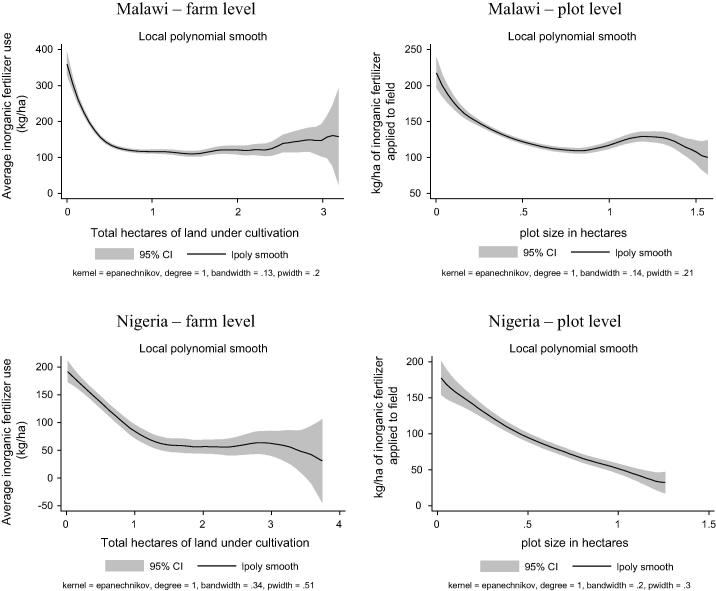
“The inverse (negative) relationship between farm size and productivity is a well-studied and fairly entrenched phenomenon in the agricultural development literature (e.g., Carter, 1984; Feder, 1985; Barrett et al., 2010).”
BackgroundGlobal pesticide consumption and pollution: with China as a focus
Zhang, W., Jiang, F., & Ou, J. (2011) · Cited by 590
Food Security, Farming, and Climate Change to 2050: Scenarios, Results, Policy Options
Nelson, G. C., Rosegrant, M. W., Palazzo, A., Gray, I. D., Ingersoll, C., Robertson, R., Tokgöz, S., Zhu, T., Sulser, T. B., Ringler, C., et al. (2010) · International Food Policy Research Institute eBooks · doi:10.2499/9780896291867 · Cited by 578
Cited by
Sorted by citations
Takahashi, K., Muraoka, R., & Otsuka, K. (2019) · Agricultural Economics · doi:10.1111/agec.12539 · Cited by 508
Smallholder maize area and yield mapping at national scales with Google Earth Engine
Jin, Z., Azzari, G., You, C., Tommaso, S. D., Aston, S., Burke, M., & Lobell, D. B. (2019) · Remote Sensing of Environment · doi:10.1016/j.rse.2019.04.016 · Cited by 397
Review: Food loss and waste in Sub-Saharan Africa
Sheahan, M., & Barrett, C. B. (2017) · Food Policy · doi:10.1016/j.foodpol.2017.03.012 · Cited by 323
“Particularly given evidence of low levels of paired inputs with known complementarity gains in SSA farming (Sheahan and Barrett, 2017), reallocation of resources already on-farm could lead to productivity gains without the use of additional inputs.”
BackgroundSelf-citationJEPSON, P. C., Murray, K., Bach, O., Bonilla, M. A., & Neumeister, L. (2020) · The Lancet Planetary Health · doi:10.1016/s2542-5196(19)30266-9 · Cited by 213
Campenhout, B. V., Spielman, D. J., & Lecoutere, E. (2020) · American Journal of Agricultural Economics · doi:10.1002/ajae.12089 · Cited by 196
Metadata
- Authors
- Sheahan, M., & Barrett, C. B.
- Affiliations
- Cornell University (US)
- Corresponding author
- Sheahan, Megan
- Venue
- Food Policy
- Publisher
- Elsevier BV
- Published
- 2017-02
- Volume
- 67
- Pages
- 12-25
- ISSN
- 0306-9192 (ISSN-L)
- PMC
- PMC5384438
- OpenAlex
- W2534397573
- Semantic Scholar
- 0119de42f830ef1f9a0fb240310e89ecd368143f
- Cited by
- 594
- References
- 87
- Citations by year
- 2026: 74 · 2025: 69 · 2024: 60 · 2023: 76 · 2022: 61 · 2021: 70 · 2020: 75 · 2019: 47 · 2018: 40 · 2017: 19
- FWCI
- 120.77
- Type
- journal article
- Language
- en
- Open access
- hybrid
- doi.org
- Locations
- Food Policy (publishedVersion, cc-by)
- PubMed Central (publishedVersion, cc-by)
- PubMed (publishedVersion)
- RePEc: Research Papers in Economics (submittedVersion)
- Funders
- International Fine Particle Research Institute
- Topics
- Life Sciences › Agricultural and Biological Sciences › General Agricultural and Biological Sciences › Agricultural Innovations and Practices
- Life Sciences › Agricultural and Biological Sciences › General Agricultural and Biological Sciences › Agricultural Economics and Practices
- Social Sciences › Economics, Econometrics and Finance › Economics and Econometrics › Agricultural economics and policies
- Keywords
- agricultural input use, modern agricultural inputs, fertilizer use, improved varieties, hybrid seeds, agrochemicals, agricultural machinery, irrigation, agricultural intensification, smallholder farmers, sub-Saharan Africa, food prices, agricultural growth
About these checks
Registry, retraction, Cites and statistics results are computed, not judged, with one exception: a printed reference that no index lists is read once by a model before it counts as a citation error. Claims are extracted by a model and kept only when their quote appears verbatim in the text; each cited source is then checked, with a model’s help, for whether it says what the claim relies on. Those verdicts can be wrong — read the claim’s quote and the cited source before relying on one.
Statistics and arithmetic are recomputed, not judged.
Confidence bands are shown only for fields calibrated on our annotated test set. None is calibrated yet, so no band is shown.
What counts as a claim ›How we measure confidence ›How we check this ›
Are you an author, or do you see a problem with this page? Request a review
