

The DOI matches its Crossref record; 207 of the 207 references it cites were found in a registry or an index.
Reactive oxygen species in the pathogenesis of sarcopenia
Open accessAbstract
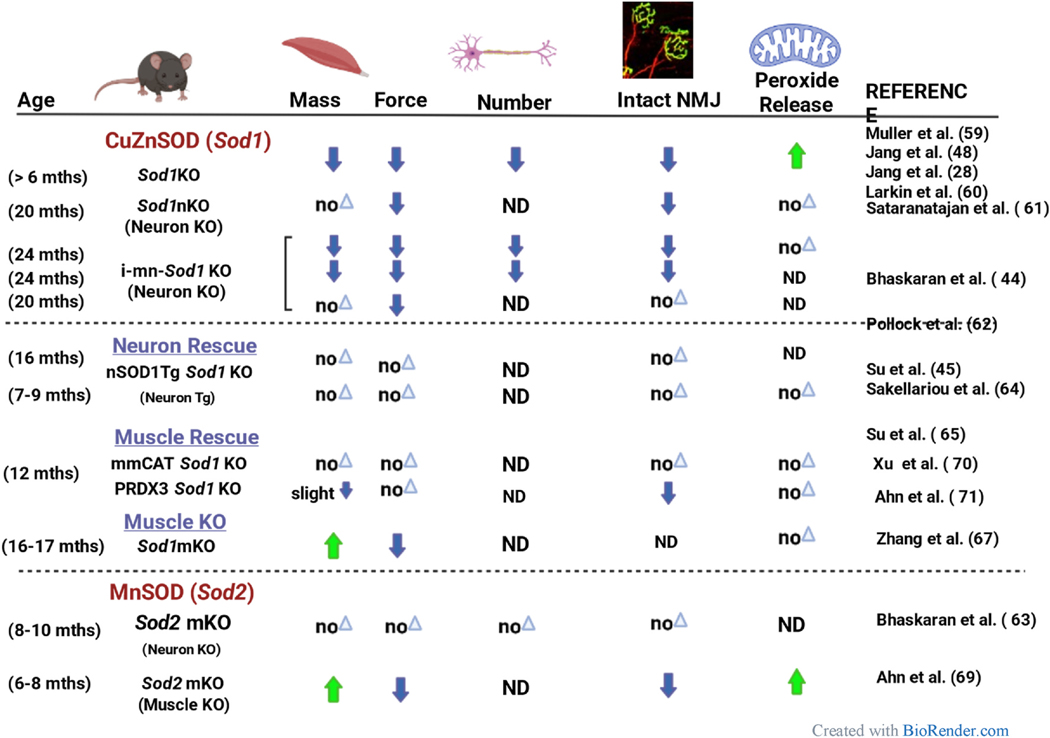
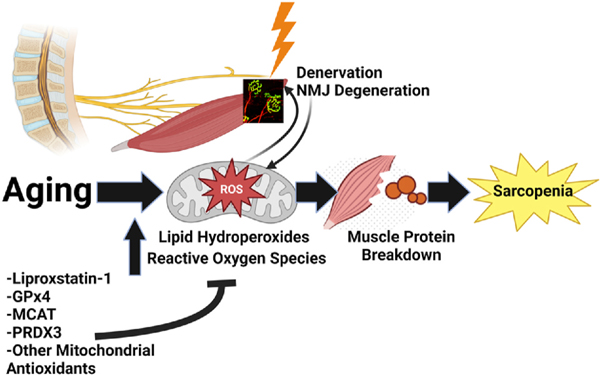
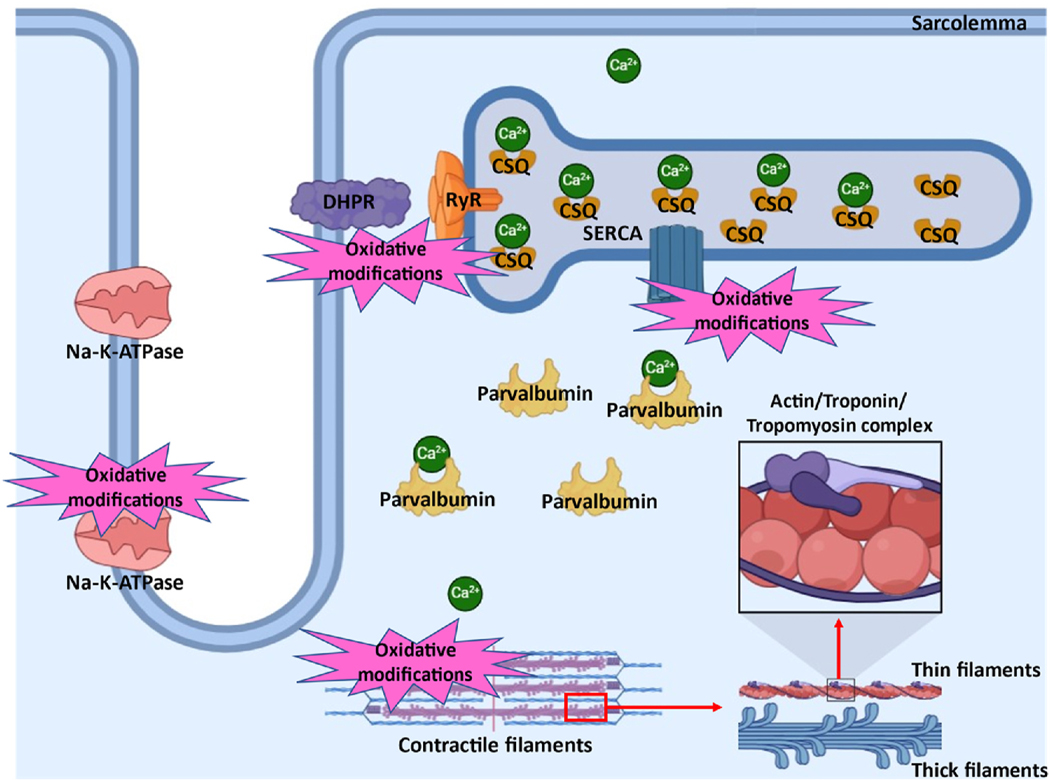
One of the most critical factors impacting healthspan in the elderly is the loss of muscle mass and function, clinically referred to as sarcopenia. Muscle atrophy and weakness lead to loss of mobility, increased risk of injury, metabolic changes and loss of independence. Thus, defining the underlying mechanisms of sarcopenia is imperative to enable the development of effective interventions to preserve muscle function and quality in the elderly and improve healthspan. Over the past few decades, understanding the roles of mitochondrial dysfunction and oxidative stress has been a major focus of studies seeking to reveal critical molecular pathways impacted during aging. In this review, we will highlight how oxidative stress might contribute to sarcopenia by discussing the impact of oxidative stress on the loss of innervation and alteration in the neuromuscular junction (NMJ), on muscle mitochondrial function and atrophy pathways, and finally on muscle contractile function.
Overview
The claims and statistics of this paper haven’t been checked yet.
Run the check — free, no account needed. It reads the open-access text and checks the sources it cites.
Integrity signals
Registry
Cites
Statistics
Figures
Verification
Claims the paper makes
The claims and statistics of this paper haven’t been checked yet.
Run the check — free, no account needed. It reads the open-access text and checks the sources it cites.
Claims other papers make about this one
Each is checked against this paper’s own text: does it say what the citing paper says it does?
The source backs part of the claim, not all of it — or backs it for a different population, condition or comparison.
In the citing paper
“Mitochondrial dysfunction leads to decreased energy production in muscle cells, impairing their ability to maintain mass and function [7,8].”
From A Narrative Review on GLP-1 Receptor Agonists for Obesity in Older Women: Maximizing Weight Loss While Preserving Lean Mass (2026) · cites this paper as [7]
Experimental — accuracy not yet measured
Self-check
Percentages, sums and reported differences re-computed from the paper’s own numbers.
The self-check needs the paper’s full text.
Citations
Cites
Items 201–207 of 207
Varshney, R., Ranjit, R., Chiao, Y. A., Kinter, M. T., & Ahn, B. (2021) · International Journal of Molecular Sciences · doi:10.3390/ijms22042039 · Cited by 15
Redox modulation of diaphragm contractility: Interaction between DHPR and RyR channels
Lawler, J. M., Kim, J., Kwak, H., & Barnes, W. S. (2010) · Free Radical Biology and Medicine · doi:10.1016/j.freeradbiomed.2010.09.025 · Cited by 14
Cardiolipin drives the catalytic activity of GPX4 on membranes: Insights from the R152H mutant
Roveri, A., Giacinto, F. D., Rossetto, M., Cozza, G., Cheng, Q., Miotto, G., Zennaro, L., Paolo, M. L. D., Arnér, E. S. J., Spirito, M. D., et al. (2023) · Redox Biology · doi:10.1016/j.redox.2023.102806 · Cited by 14
Wang, Z.-M., Messi, M. L., Rodrigues, A. C. Z., & Delbono, O. (2022) · Molecular and Cellular Neuroscience · doi:10.1016/j.mcn.2022.103730 · Cited by 9
Altered cross-bridge properties in skeletal muscle dystrophies
Guellich, A., Négroni, E., Decostre, V., Demoule, A., & Coirault, C. (2014) · Frontiers in Physiology · doi:10.3389/fphys.2014.00393 · Cited by 8
Paul, T. A., Macpherson, P. C. D., Janetzke, T. L., Davis, C. S., Jackson, M. J., McArdle, A., & Brooks, S. V. (2023) · GeroScience · doi:10.1007/s11357-023-00774-w · Cited by 3
[Primary urethral carcinoma in a female: report of a case].
Nakanoma, T., Hayashi, S., & Yamamoto, Y. (1992) · PubMed · Cited by 1
Research works printed but not linked: 2
- Xu, 2021, Muscle mitochondrial catalase expression prevents neuromuscular junction disruption, atrophy, and weakness in a mouse model of accelerated sarcopenia, J. Cachexia Sarcopenia Muscle., 12, 1582, 10.1002/jcsm.12768 · DOI
- McClung, 2009, Calpain-1 is required for hydrogen peroxide-induced myotube atrophy, Am. J. Physiol. Cell Physiol., 296, C363, 10.1152/ajpcell.00497.2008 · DOI
Cited by
Sorted by citations
Pathological and Inflammatory Consequences of Aging
García‐Domínguez, M. (2025) · Biomolecules · doi:10.3390/biom15030404 · Cited by 78
Papadopoulos, E., Irving, B. A., Brown, J. C., Heymsfield, S. B., Sattar, S., Alibhai, S. M. H., Williams, G. R., & Dunne, R. F. (2025) · Drugs & Aging · doi:10.1007/s40266-025-01252-y · Cited by 28
Self-citationCui, X., Liu, H., Liu, Y., Yu, Z., Wang, D., Wei, W., & Wang, S. (2025) · Frontiers in Medicine · doi:10.3389/fmed.2025.1665708 · Cited by 24
Analysis of the mechanism of skeletal muscle atrophy from the pathway of decreased protein synthesis
Chen, P., Jia, F., Wang, M., & Yang, S. (2025) · Frontiers in Physiology · doi:10.3389/fphys.2025.1533394 · Cited by 17
Moscucci, F., Baratta, F., Pastori, D., Menichelli, D., Mattioli, A. V., Gallina, S., Lospinuso, I., Sciomer, S., Piccirillo, G., & Desideri, G. (2026) · Nutrients · doi:10.3390/nu18040632 · Cited by 11
“This decline in muscle mass, combined with the accumulation of visceral fat, creates a dangerous interplay that exacerbates frailty and reduces functional capacity [6,7].”
Metadata
- Authors
- Xu, H., Brown, J. L., Bhaskaran, S., & Van Remmen, H.
- Affiliations
- Oklahoma Medical Research Foundation (US)
- Venue
- Free Radical Biology and Medicine
- Publisher
- Elsevier BV
- Published
- 2025-02
- Volume
- 227
- Pages
- 446-458
- ISSN
- 0891-5849 (ISSN-L)
- PMC
- PMC11816180
- OpenAlex
- W4404813617
- Cited by
- 61
- References
- 206
- Citations by year
- 2026: 34 · 2025: 27
- FWCI
- 2.49
- Type
- journal article
- Language
- en
- Open access
- hybrid
- doi.org
- Licence
- Locations
- Free Radical Biology and Medicine (publishedVersion, cc-by-nc-nd)
- PubMed (publishedVersion)
- PubMed Central (acceptedVersion, cc-by-nc-nd)
- Funders
- National Institute on Aging
- US Department of Veterans Affairs
- Topics
- Life Sciences › Biochemistry, Genetics and Molecular Biology › Molecular Biology › Muscle Physiology and Disorders
- Health Sciences › Medicine › Physiology (medical) › Nutrition and Health in Aging
- Health Sciences › Medicine › Physiology (medical) › Exercise and Physiological Responses
- Keywords
- sarcopenia, reactive oxygen species, oxidative stress, muscle atrophy, muscle weakness, mitochondrial dysfunction, neuromuscular junction, aging, healthspan, muscle contractility, older adults
- MeSH terms
- Aging, Animals, Humans, Mitochondria, Mitochondria, Muscle, Muscle Contraction, Muscular Atrophy, Neuromuscular Junction, Reactive Oxygen Species, Oxidative Stress, Muscle, Skeletal, Sarcopenia
About these checks
Registry, retraction, Cites and statistics results are computed, not judged, with one exception: a printed reference that no index lists is read once by a model before it counts as a citation error. Claims are extracted by a model and kept only when their quote appears verbatim in the text; each cited source is then checked, with a model’s help, for whether it says what the claim relies on. Those verdicts can be wrong — read the claim’s quote and the cited source before relying on one.
Statistics and arithmetic are recomputed, not judged.
Confidence bands are shown only for fields calibrated on our annotated test set. None is calibrated yet, so no band is shown.
What counts as a claim ›How we measure confidence ›How we check this ›
Are you an author, or do you see a problem with this page? Request a review
