

40Ar-39Ar step heating ages of North American tektites and of impact melt rock samples from the Chesapeake Bay impact structure
Open accessThe DOI matches its Crossref record; 75 of the 75 references it cites were found in a registry or an index; none of the 44 sources its claims cite is checked for support yet.
Overview
CoChat Summary
TL;DR
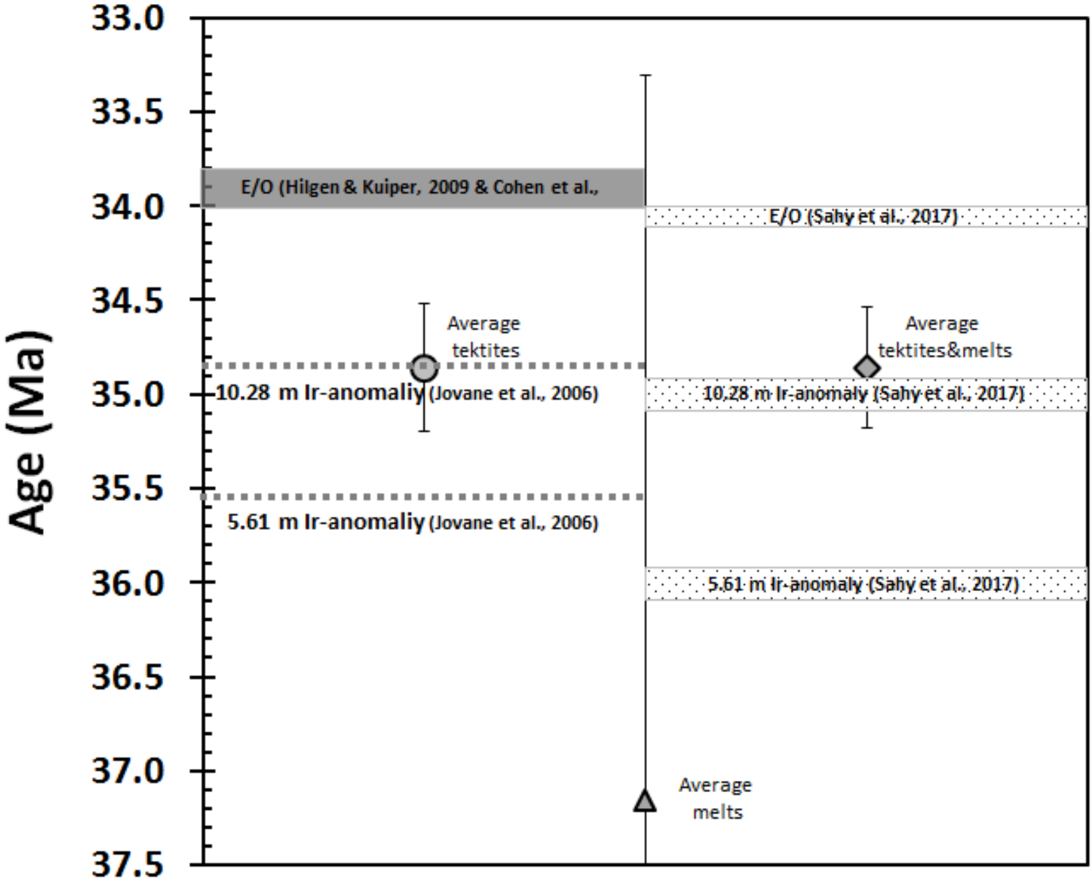
New 40Ar-39Ar step-heating ages for North American tektites and Chesapeake Bay impact melt rocks support a Chesapeake Bay impact event at 34.86 ± 0.32 Ma (2σ), nominally younger than the previously recalculated literature average of 35.20 ± 0.54 Ma. The study reports the first radio-isotopic ages for impactites from within the Chesapeake Bay crater and the first complete 40Ar/39Ar step-heating dataset for North American tektites.
Key findings
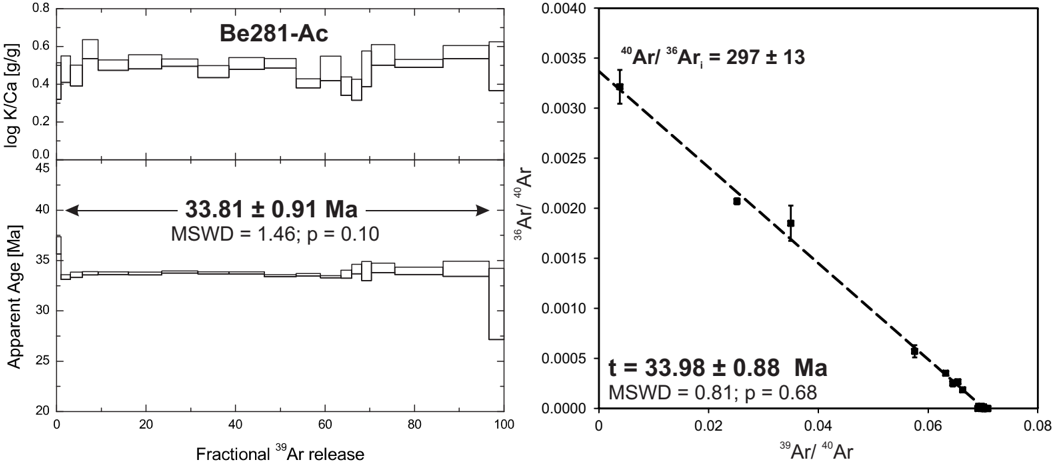
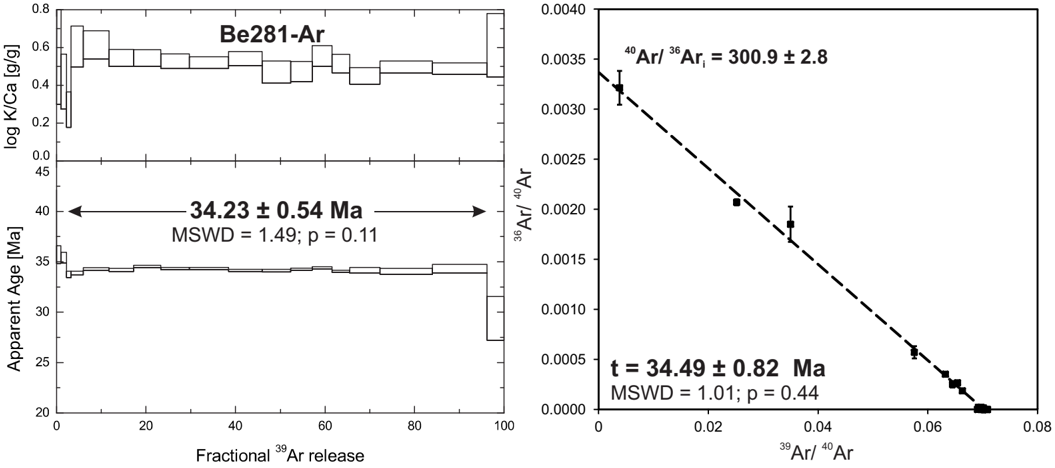
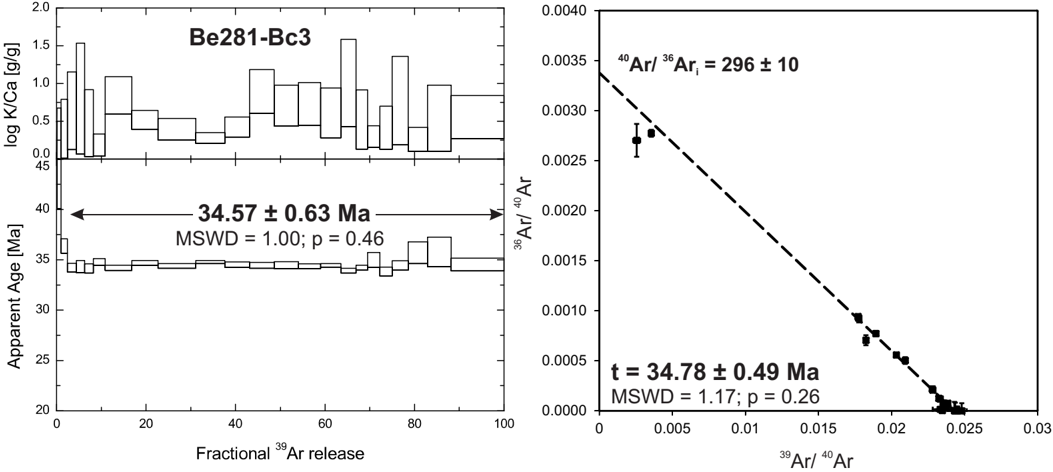
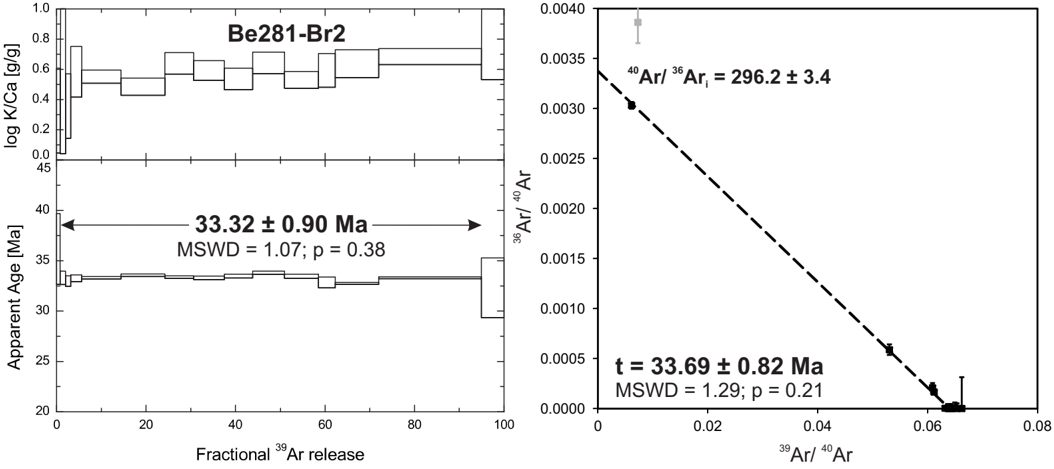
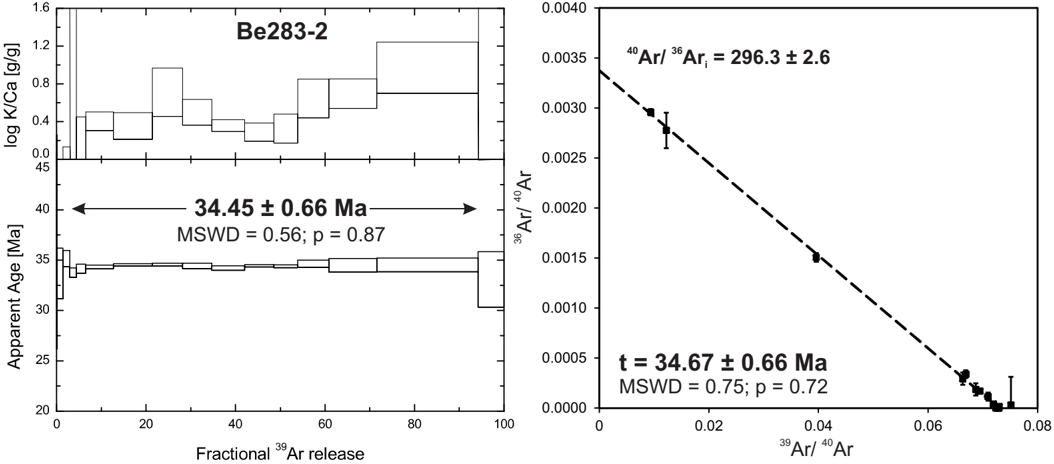
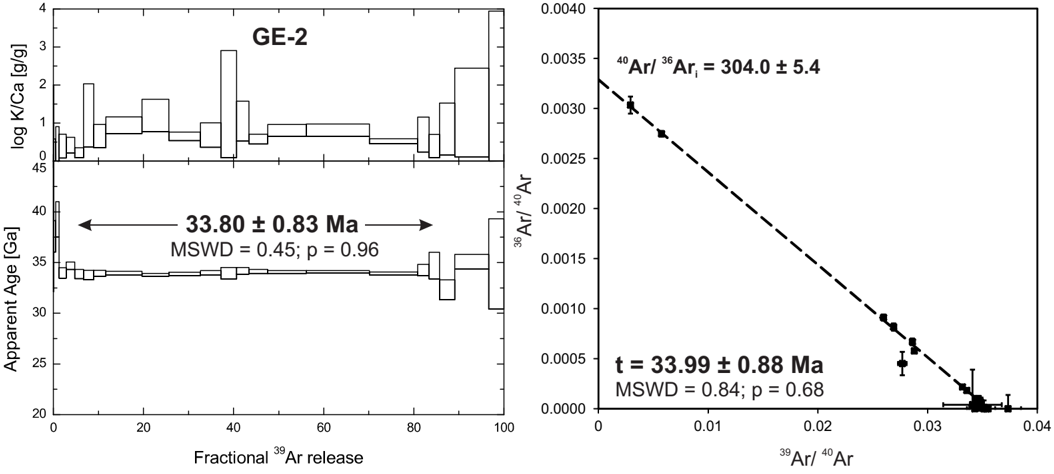
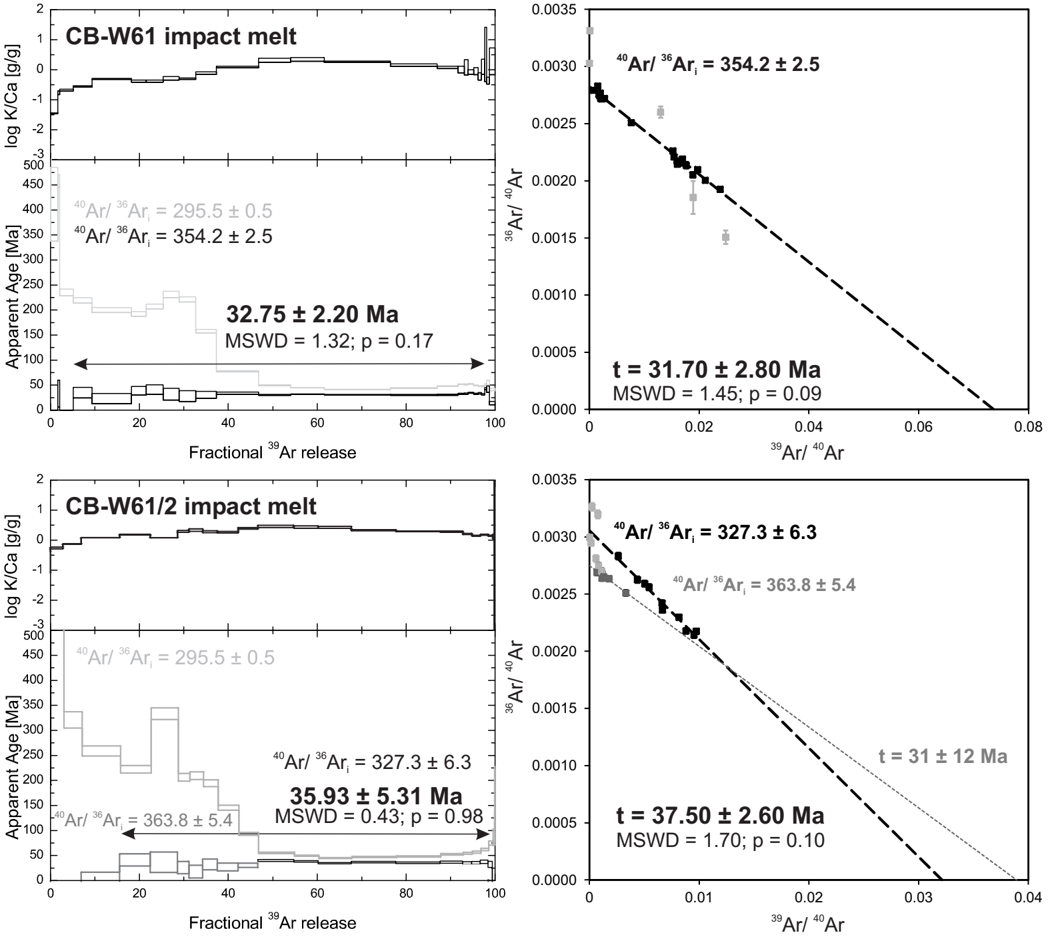
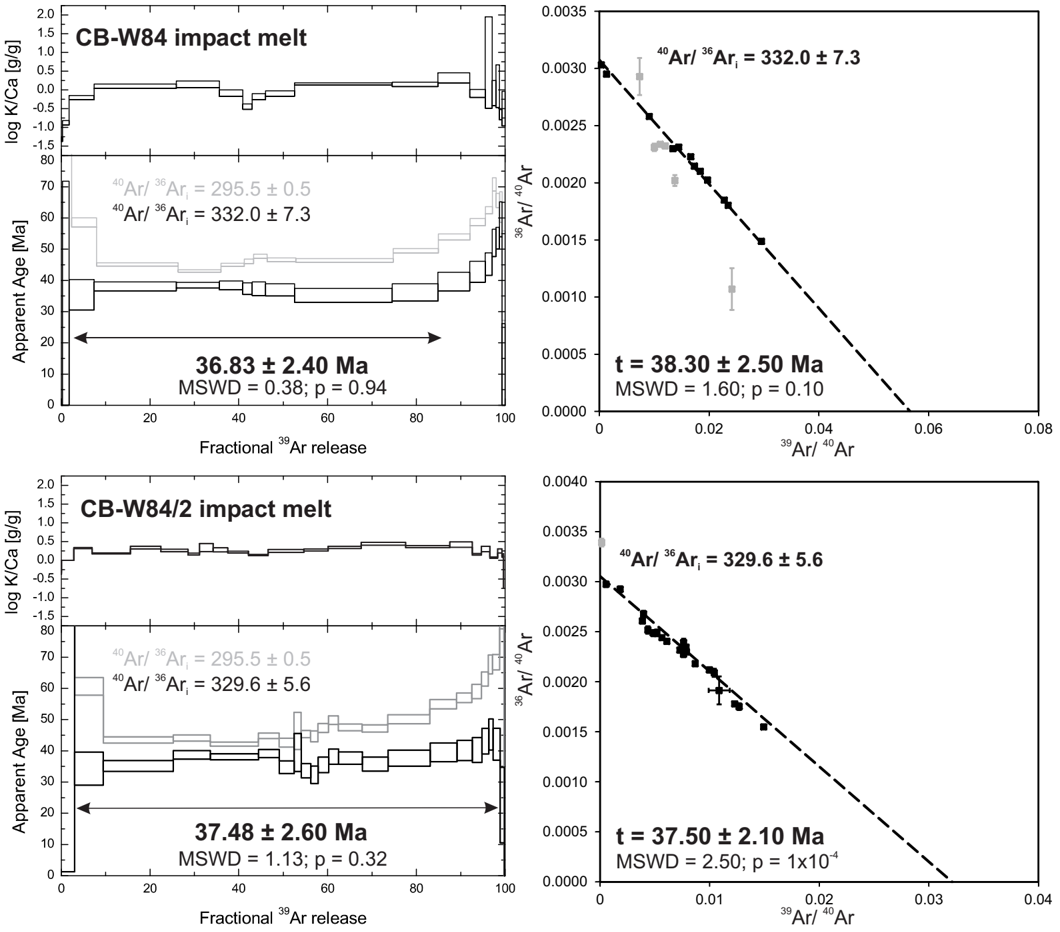
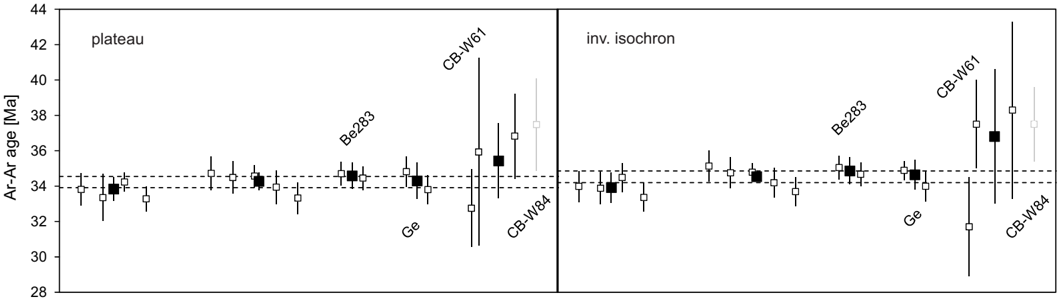
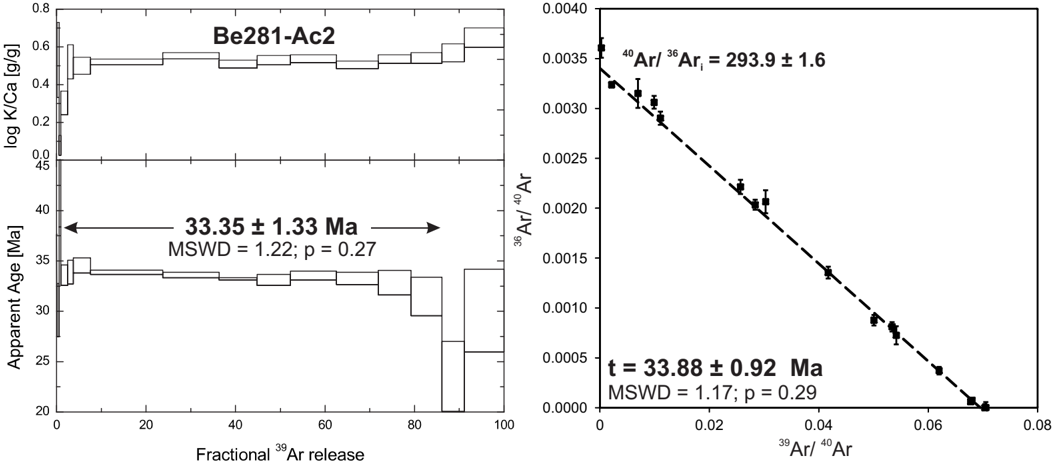
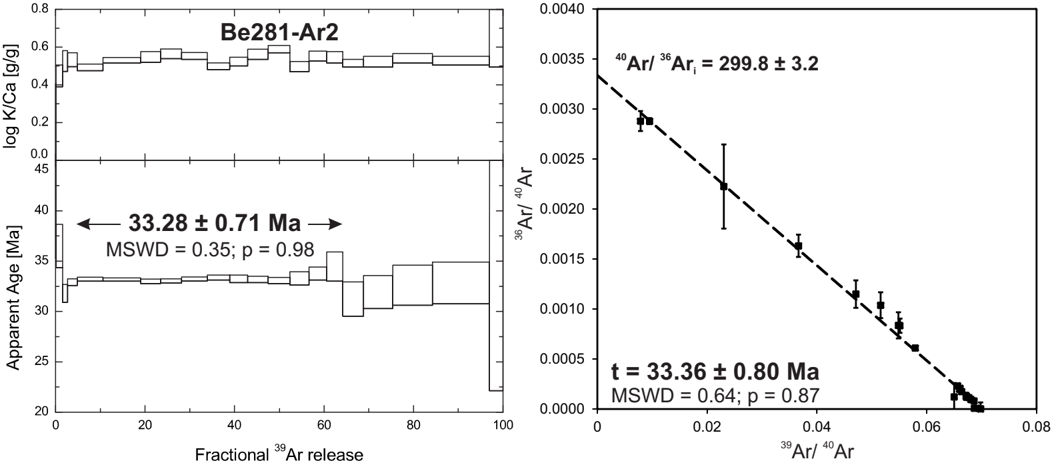
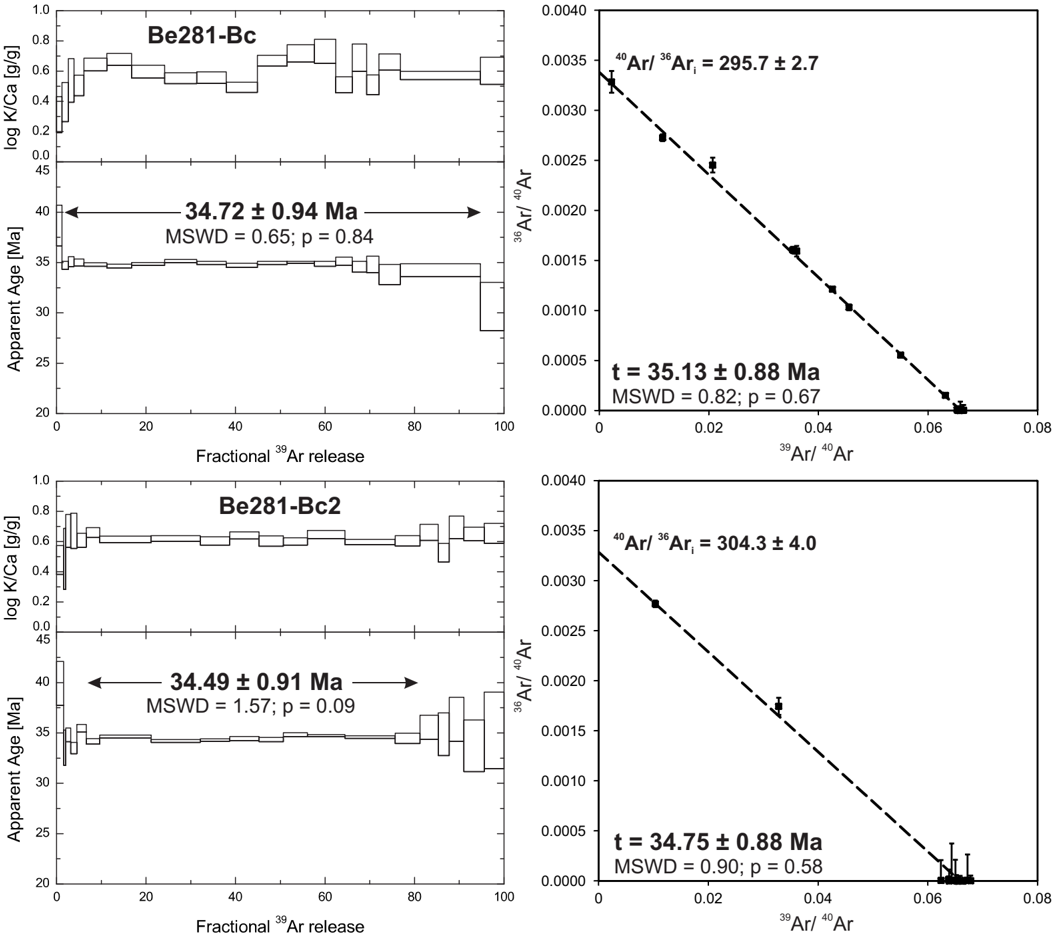
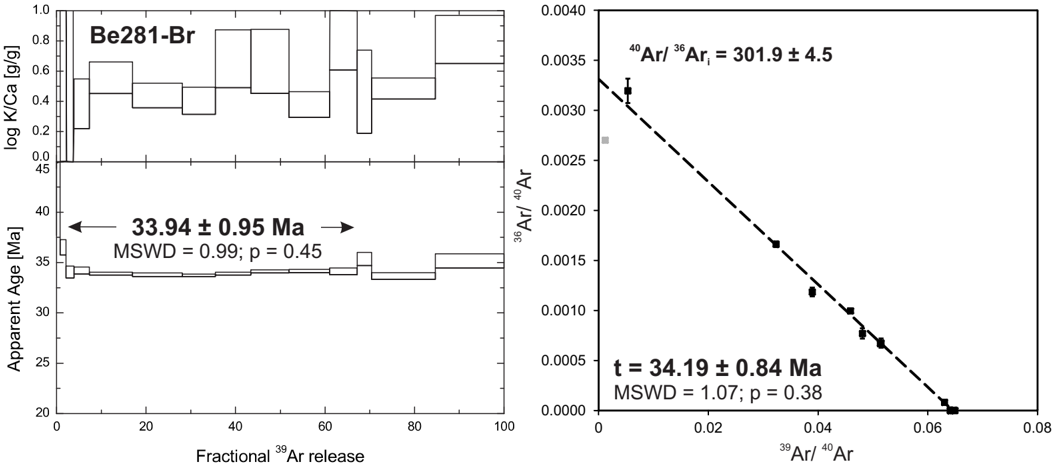
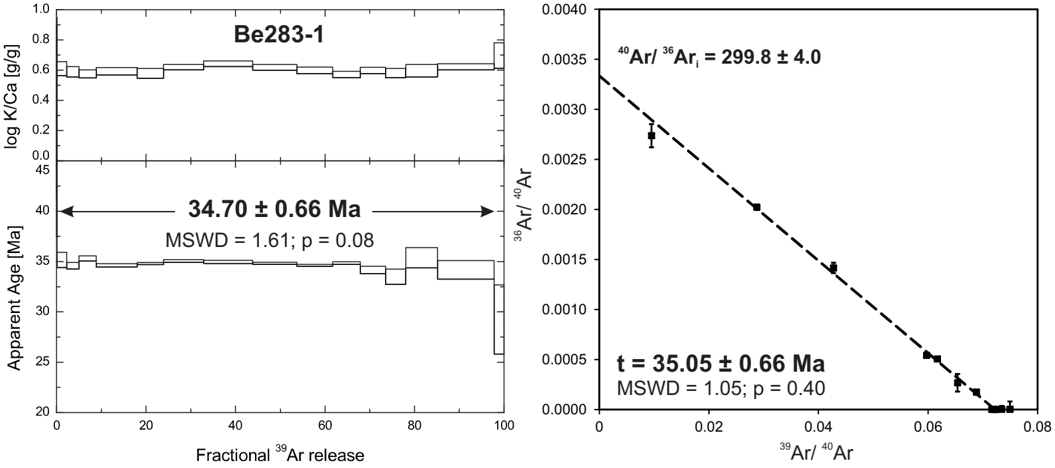
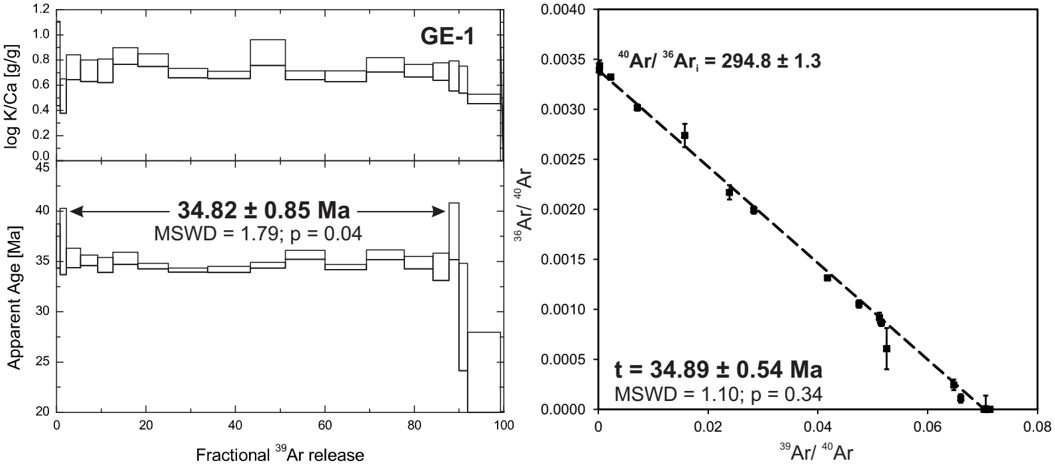
The North American tektites give a mean plateau age of 34.22 ± 0.29 Ma (MSWD = 0.78, P = 0.51) and a mean inverse isochron age of 34.53 ± 0.25 Ma (MSWD = 0.96, P = 0.41) using Steiger and Jäger (1977) decay constants. The Chesapeake Bay impact melt rocks give a mean plateau age of 35.43 ± 2.13 Ma (MSWD = 3.5, P = 0.06) and a mean inverse isochron age of 36.82 ± 3.81 Ma (MSWD = 0.83, P = 0.36); the melt ages are indistinguishable within uncertainties from the tektite ages. Combining tektite and impact melt inverse isochron data yields 34.86 ± 0.23 (0.32) Ma (2σ) for the Chesapeake Bay impact event, and the preferred quoted age is 34.86 ± 0.32 Ma. The impact melt rocks contain clear excess 40Ar, with 40Ar/36Ar intercepts of 354.2 ± 2.5 (CB-W61), 363.8 ± 5.4 and 327.3 ± 6.3 (CB-W61-2), 332.0 ± 7.3 (CB-W84), and 329.6 ± 5.6 (CB-W84-2); tektites are overall devoid of excess 40Ar, though some low- and high-temperature extractions indicate minor excess, e.g. Be281-Br total K-Ar age of 36.65 Ma.
Methods
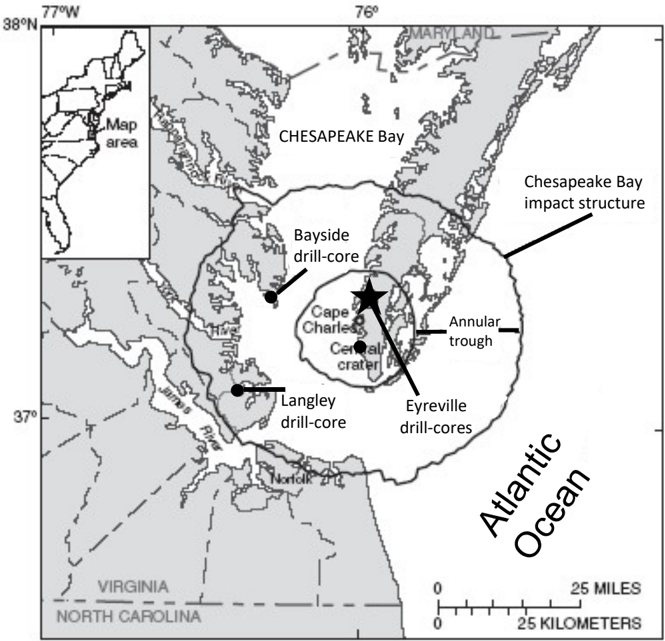
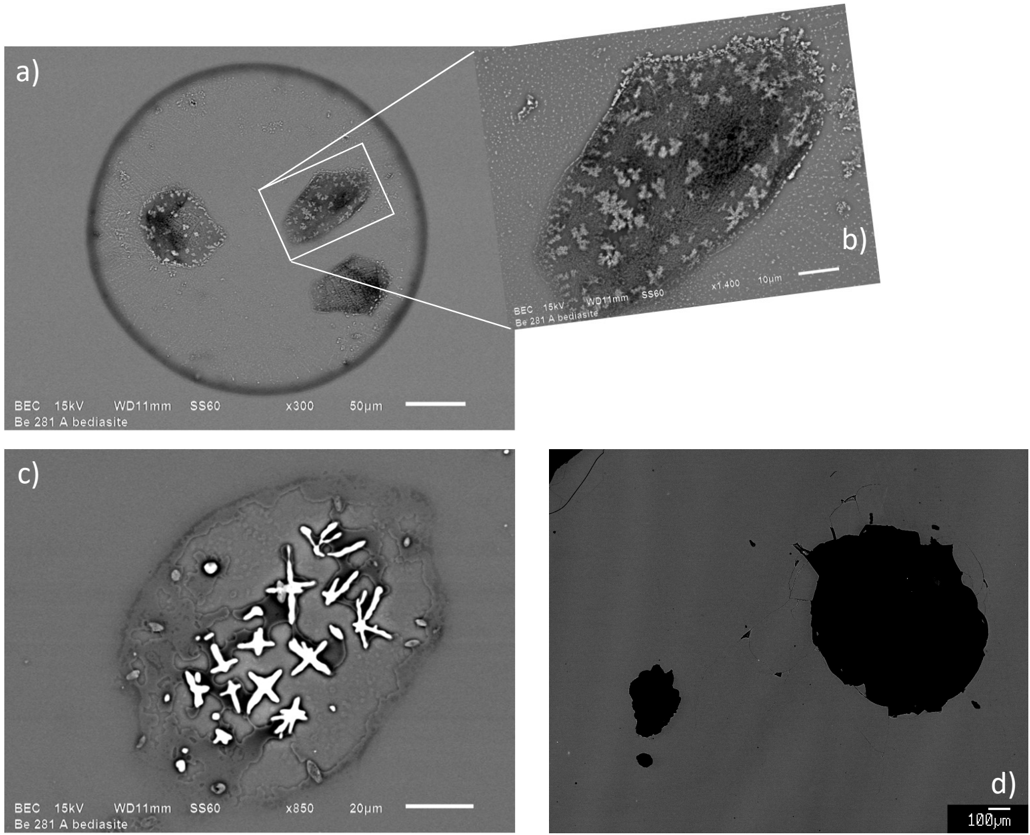
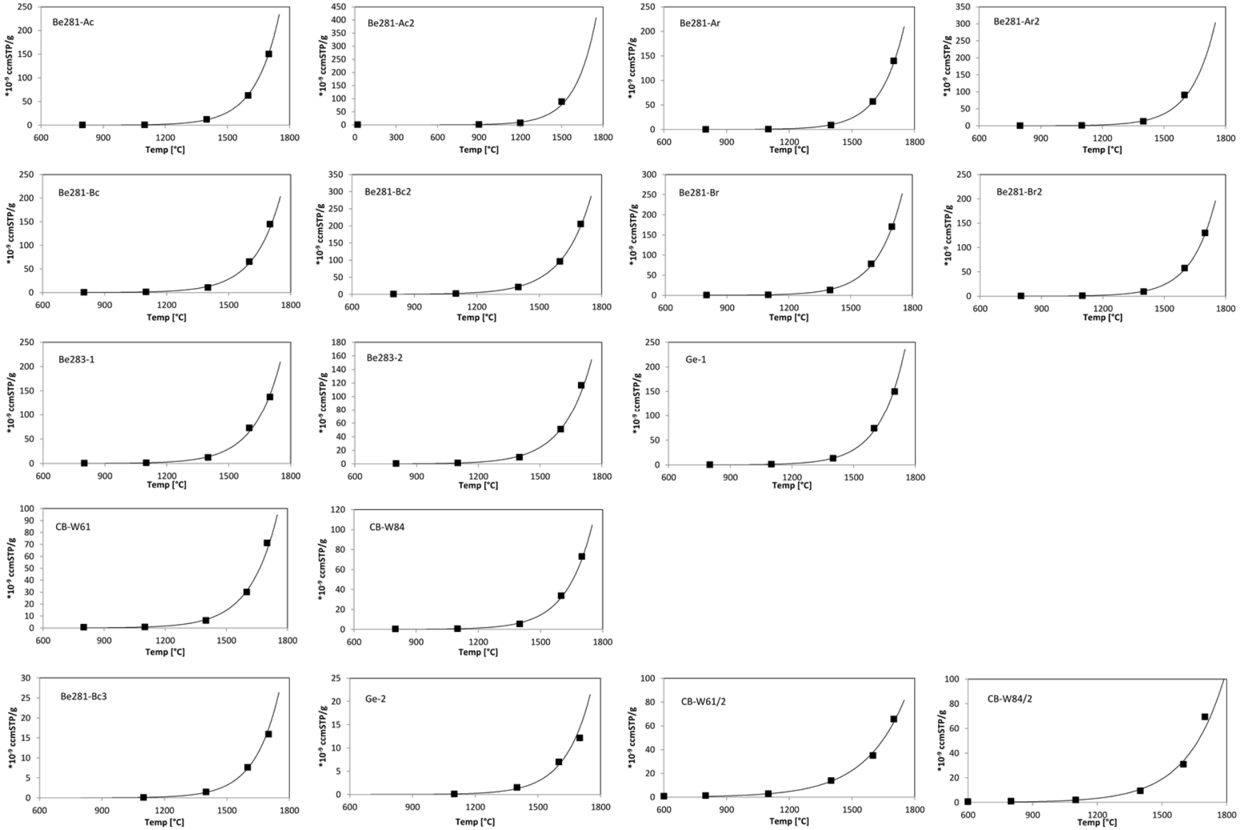
The study used 40Ar-39Ar step heating on core, rim, and bulk aliquots of four North American tektites (bediasites Be281-A, Be281-B, Be283, and one georgiaite) and on melt groundmass extracted from two clast-rich impact melt rocks, CB-W61 and CB-W84, from the ICDP-USGS Eyreville drill-core, Chesapeake Bay impact structure. Samples were irradiated at the Portuguese Research Reactor with Cd shielding, using HD-B1 biotite fluence monitors (24.18 ± 0.09 Ma), then step heated in an inductively heated Mo-furnace up to 1750°C over 15–26 steps; argon isotopes were measured on a modified VARIAN MAT CH5 mass spectrometer. Ages were calculated from plateaus comprising ≥50% of total 39Ar released and from inverse isochrons; excess 40Ar in impact melts was corrected using sample-specific 40Ar/36Ar intercepts. SEM and electron microprobe analyses were also used to inspect tektites and melt samples.
Limitations
Stated: impact melt ages have large uncertainties and complex release spectra; sample CB-W84-2 was excluded from mean age calculations due to a very low isochron P value; the melt rock ages tend slightly older, possibly from a small excess argon component not included in the isochron correction; possible systematic uncertainties and insufficient inter-calibration of the HD-B1 and Taylor Creek sanidine standards are discussed; excess argon at ~1–2% of the radiogenic component may remain undetected in some cases. Evident from the text: only two impact melt rock samples were analyzed, and the impact melt age corrections depend on identifying and separating multiple excess argon carrier phases, which the paper notes is difficult for such heterogeneous impactites.
Model-written summary. Check it against the paper before relying on it.
Integrity signals
Registry
Cites
Statistics
Figures

Verification
Claims the paper makes
0 Valid · 0 Not valid · 35 Not checked · 110 Own results and interpretations
A result the paper reports from its own data — it cites no other source for it, so there is none to check. The quote shows it is in the paper.
In the paper
“In general, the argon age spectra of the tektites show well-defined age plateaux (we use plateaux instead of plateaus to follow the correct French spelling of the word) encompassing up to 99% of the fractional 39 Ar released.”
§ Ar step heating ages of North American tektites and of impact melt rock samples from the Chesapeake Bay impact structure > 4.2 40 Ar-39 Ar step heating analyses of tektites
plain- Asserted: passes — The authors put it forward as true.
- Checkable: passes — It can be checked against evidence.
- Load-bearing: passes — The paper’s conclusions depend on it.
- Based: passes — The paper gives a reason why it holds.
A result the paper reports from its own data — it cites no other source for it, so there is none to check. The quote shows it is in the paper.
In the paper
“Splits CB-W61 and CB-W61-2 show a non-uniform K/Ca spectrum suggestive of the existence of different argon carrier phases.”
§ Ar step heating ages of North American tektites and of impact melt rock samples from the Chesapeake Bay impact structure > 4.3 ICDP-USGS Eyreville drill-core Impact melts CB-W61 and CB-W84
hedgedstates an association- Asserted: passes — The authors put it forward as true.
- Checkable: passes — It can be checked against evidence.
- Load-bearing: unclear — It is unclear whether the paper’s conclusions depend on it.
- Based: passes — The paper gives a reason why it holds.
A result the paper reports from its own data — it cites no other source for it, so there is none to check. The quote shows it is in the paper.
In the paper
“Using these 40 Ar/ 36 Ar initial values to correct the respective step-heating data used for the apparent age spectrum, an age of 35.93±5.31Ma (MSWD=0.43,P=0.98) is obtained corresponding to 84% of 39 Ar released.”
§ Ar step heating ages of North American tektites and of impact melt rock samples from the Chesapeake Bay impact structure > 4.3 ICDP-USGS Eyreville drill-core Impact melts CB-W61 and CB-W84
plainstates a causeSingle case- Asserted: passes — The authors put it forward as true.
- Checkable: passes — It can be checked against evidence.
- Load-bearing: passes — The paper’s conclusions depend on it.
- Based: passes — The paper gives a reason why it holds.
A result the paper reports from its own data — it cites no other source for it, so there is none to check. The quote shows it is in the paper.
In the paper
“While in sample CB-W61 only one additional excess argon carrier phase was identified”
§ Ar step heating ages of North American tektites and of impact melt rock samples from the Chesapeake Bay impact structure > 4.3 ICDP-USGS Eyreville drill-core Impact melts CB-W61 and CB-W84
plainSingle case- Asserted: passes — The authors put it forward as true.
- Checkable: passes — It can be checked against evidence.
- Load-bearing: unclear — It is unclear whether the paper’s conclusions depend on it.
- Based: passes — The paper gives a reason why it holds.
A result the paper reports from its own data — it cites no other source for it, so there is none to check. The quote shows it is in the paper.
In the paper
“This correction yields a flat spectrum over 84% of 39 Ar released (see Fig 6A, sample CB-W61-2 dark grey and black boxes for age spectrum, and respective initial 40 Ar/ 36 Ar values).”
§ Ar step heating ages of North American tektites and of impact melt rock samples from the Chesapeake Bay impact structure > 4.3 ICDP-USGS Eyreville drill-core Impact melts CB-W61 and CB-W84
plainstates a causeSingle case- Asserted: passes — The authors put it forward as true.
- Checkable: passes — It can be checked against evidence.
- Load-bearing: passes — The paper’s conclusions depend on it.
- Based: passes — The paper gives a reason why it holds.
63 more claims
Create a free account to see all 145 claims and to verify the 37 references still open.
- Probably not a substantial claim. 34
- It may state two separate claims as one. 52
- The quote only partly states this claim. 1
Self-check
Percentages, sums and reported differences re-computed from the paper’s own numbers.
Each contradiction between two passages listed here was confirmed by an independent check.
Rated minor: it would not touch a result — a value no result rests on, a p-value that stays on the same side of the significance level, or a conflict that is clerical, resolved elsewhere in the paper, or outside its own findings.
In the paper
§ Ar step heating ages of North American tektites and of impact melt rock samples from the Chesapeake Bay impact structure > 4.3 ICDP-USGS Eyreville drill-core Impact melts CB-W61 and CB-W84
“When calculating mean ages, sample W84-2 was excluded due to its very low isochron P value.”
§ Ar step heating ages of North American tektites and of impact melt rock samples from the Chesapeake Bay impact structure > 6. Conclusions
“| CB-W84 | 1 | 37.48±2.60 (2.60) |”
Rated minor: it would not touch a result — a value no result rests on, a p-value that stays on the same side of the significance level, or a conflict that is clerical, resolved elsewhere in the paper, or outside its own findings.
In the paper
§ Ar step heating ages of North American tektites and of impact melt rock samples from the Chesapeake Bay impact structure > 3. Samples and Methods
“calculated 40 Ar/ 39 Ar ages increase by about 1%, for Mesozoic ages”
§ Ar step heating ages of North American tektites and of impact melt rock samples from the Chesapeake Bay impact structure > 6. Conclusions
“| Melt rock mean | 2 | 35.43±2.13 (2.13) 34.76±2.15 (2.15) |”
Rated minor: it would not touch a result — a value no result rests on, a p-value that stays on the same side of the significance level, or a conflict that is clerical, resolved elsewhere in the paper, or outside its own findings.
In the paper
§ Ar step heating ages of North American tektites and of impact melt rock samples from the Chesapeake Bay impact structure > 2. The Chesapeake Bay impact structure: geology and age
“section C provides material from 0 to 140.2 m depth”
§ Ar step heating ages of North American tektites and of impact melt rock samples from the Chesapeake Bay impact structure > 2. The Chesapeake Bay impact structure: geology and age
“section C completely overlaps with the top portion of section A”
Rated minor: it would not touch a result — a value no result rests on, a p-value that stays on the same side of the significance level, or a conflict that is clerical, resolved elsewhere in the paper, or outside its own findings.
In the paper
§ Ar step heating ages of North American tektites and of impact melt rock samples from the Chesapeake Bay impact structure > 2. The Chesapeake Bay impact structure: geology and age
“Section A comprises material obtained between 126.9 and 940.9 m, section B includes depths between 737.6 and 1766.3 m”
§ Ar step heating ages of North American tektites and of impact melt rock samples from the Chesapeake Bay impact structure > 2. The Chesapeake Bay impact structure: geology and age
“Sections A and B partly overlap between the depths of 618.2 and 1095.7 m”
Citations
Cites
Trends, Rhythms, and Aberrations in Global Climate 65 Ma to Present
Zachos, J., Pagani, M., Sloan, L., Thomas, E., & Billups, K. (2001) · Science · doi:10.1126/science.1059412 · Cited by 10,458
Subcommission on geochronology: Convention on the use of decay constants in geo- and cosmochronology
Steiger, R. H., & Jäger, E. (1977) · Earth and Planetary Science Letters · doi:10.1016/0012-821x(77)90060-7 · Cited by 9,994
Extraterrestrial Cause for the Cretaceous-Tertiary Extinction
Alvarez, L. W., Alvarez, W., Asaro, F., & Michel, H. V. (1980) · Science · doi:10.1126/science.208.4448.1095 · Cited by 3,198
The ICS International Chronostratigraphic Chart
Cohen, K. M., Finney, S. C., Gibbard, P. L., & Fan, J.-X. (2013) · Episodes · doi:10.18814/epiiugs/2013/v36i3/002 · Cited by 3,192
Intercalibration of standards, absolute ages and uncertainties in 40Ar/39Ar dating
Renne, P. R., Swisher, C. C., Deino, A. L., Karner, D. B., Owens, T. L., & DePaolo, D. J. (1998) · Chemical Geology · doi:10.1016/s0009-2541(97)00159-9 · Cited by 1,788
Geochronology and thermochronology by the [40]Ar/[39]Ar method
McDougall, I., & Harrison, T. M. (1988) · Cited by 1,579
The Chicxulub Asteroid Impact and Mass Extinction at the Cretaceous-Paleogene Boundary
Schulte, P., Alegret, L., Arenillas, I., Arz, J. A., Barton, P. J., Bown, P. R., Bralower, T. J., Christeson, G. L., Claeys, P., Cockell, C. S., et al. (2010) · Science · doi:10.1126/science.1177265 · Cited by 1,323
Hildebrand, A. R., Penfield, G. T., Kring, D. A., Pilkington, M., Camargo Z., A., Jacobsen, S. B., & Boynton, W. V. (1991) · Geology · doi:10.1130/0091-7613(1991)019<0867:ccapct>2.3.co;2 · Cited by 956
Renne, P. R., Mundil, R., Balco, G., Min, K., & Ludwig, K. R. (2010) · Geochimica et Cosmochimica Acta · doi:10.1016/j.gca.2010.06.017 · Cited by 929
Renne, P. R., Balco, G., Ludwig, K. R., Mundil, R., & Min, K. (2011) · Geochimica et Cosmochimica Acta · doi:10.1016/j.gca.2011.06.021 · Cited by 700
Calibration of the interlaboratory 40Ar39Ar dating standard, MMhb-1
Samson, S. D., & Alexander, E. C. (1987) · Chemical Geology: Isotope Geoscience section · doi:10.1016/0168-9622(87)90025-x · Cited by 649
Geochronology and Theromochronology By The 40 Ar/39 Ar Method
McDougall, I., & Harrison, T. M. (1999) · doi:10.1093/oso/9780195109207.001.0001 · Cited by 623
Neukum, G., & Ivanov, B. A. (2021) · University of Arizona Press eBooks · doi:10.2307/j.ctv23khmpv.18 · Cited by 349
Age calibration of the Fish Canyon sanidine 40Ar/39Ar dating standard using primary K–Ar standards
Jourdan, F., & Renne, P. R. (2006) · Geochimica et Cosmochimica Acta · doi:10.1016/j.gca.2006.09.002 · Cited by 270
KOROCHANTSEVA, E. V., TRIELOFF, M., LORENZ, C. A., BUYKIN, A. I., IVANOVA, M. A., SCHWARZ, W. H., HOPP, J., & JESSBERGER, E. K. (2007) · Meteoritics & Planetary Science · doi:10.1111/j.1945-5100.2007.tb00221.x · Cited by 227
Self-citationGeochemical Evidence for a Comet Shower in the Late Eocene
Farley, K. A., Montanari, A., Shoemaker, E. M., & Shoemaker, C. S. (1998) · Science · doi:10.1126/science.280.5367.1250 · Cited by 174
Asteroid breakup linked to the Great Ordovician Biodiversification Event
Schmitz, B., Harper, D. A. T., Peucker-Ehrenbrink, B., Stouge, S., Alwmark, C., Cronholm, A., Bergström, S. M., Tassinari, M., & Xiaofeng, W. (2008) · Nature Geoscience · doi:10.1038/ngeo.2007.37 · Cited by 170
An appraisal of the ages of terrestrial impact structures
Jourdan, F., Renne, P. R., & Reimold, W. U. (2009) · Earth and Planetary Science Letters · doi:10.1016/j.epsl.2009.07.009 · Cited by 167
Impact Origin of the Chesapeake Bay Structure and the Source of the North American Tektites
Koeberl, C., Poag, C. W., Reimold, W. U., & Brandt, D. (1996) · Science · doi:10.1126/science.271.5253.1263 · Cited by 145
The age of the Popigai impact event and its relation to events at the Eocene/Oligocene boundary
Bottomley, R. J., Grieve, R. A. F., York, D., & Масайтис, В. Л. (1997) · Nature · doi:10.1038/41073 · Cited by 136
Decision on the Eocene-Oligocene boundary stratotype
Silvá, I. P., & Jenkins, D. G. (1993) · Episodes · doi:10.18814/epiiugs/1993/v16i3/002 · Cited by 130
Schwarz, W. H., & Trieloff, M. (2007) · Chemical Geology · doi:10.1016/j.chemgeo.2007.03.016 · Cited by 130
Self-citationFission track evidence for the simultaneous origin of tektites and other natural glasses
Fleischer, R. L., & Price, P. B. (1964) · Geochimica et Cosmochimica Acta · doi:10.1016/0016-7037(64)90029-8 · Cited by 129
Dalrymple, G. B., & Duffield, W. A. (1988) · Geophysical Research Letters · doi:10.1029/gl015i005p00463 · Cited by 126
Modeling the formation of the K–Pg boundary layer
Artemieva, N., & Morgan, J. (2009) · Icarus · doi:10.1016/j.icarus.2009.01.021 · Cited by 122
Mexican site for K/T impact crater?
POPE, K. O., Ocampo, A., & Duller, C. E. (1991) · Nature · doi:10.1038/351105a0 · Cited by 114
The Chesapeake Bay Crater : Geology and Geophysics of a Late Eocene Submarine Impact Structure
Poag, C. W., Koeberl, C., & Reimold, W. U. (2003) · Cited by 101
How big was the Chesapeake Bay impact? Insight from numerical modeling
Collins, G. S., & Wünnemann, K. (2005) · Geology · doi:10.1130/g21854.1 · Cited by 98
Iridium anomalies of late Eocene age at Massignano (Italy), and ODP Site 689B (Maud Rise, Antarctic)
Montanari, A., Asaro, F., Michel, H. V., & Kennett, J. P. (1993) · Palaios · doi:10.2307/3515017 · Cited by 97
Ferrière, L., Koeberl, C., Reimold, W. U., & Uwe (2008) · European Journal of Mineralogy · doi:10.1127/0935-1221/2009/0021-1898 · Cited by 88
Astronomic calibration of the late Eocene/early Oligocene Massignano section (central Italy)
Jovane, L., Florindo, F., Sprovieri, M., & Pälike, H. (2006) · Geochemistry Geophysics Geosystems · doi:10.1029/2005gc001195 · Cited by 79
North American microtektites from the Caribbean Sea and their fission track age
Glass, B. P., Baker, R., Storzer, D., & Wagner, G. A. (1973) · Earth and Planetary Science Letters · doi:10.1016/0012-821x(73)90113-1 · Cited by 77
Deep Drilling into the Chesapeake Bay Impact Structure
Gohn, G. S., Koeberl, C., Miller, K. G., Reimold, W. U., Browning, J. V., Cockell, C. S., Horton, J. W., Kenkmann, T., Kulpecz, A. A., Powars, D. S., et al. (2008) · Science · doi:10.1126/science.1158708 · Cited by 76
On the simultaneous origin of tektites and other natural glasses
Fleischer, R. L., Price, P. B., & Walker, R. M. (1965) · Geochimica et Cosmochimica Acta · doi:10.1016/0016-7037(65)90111-0 · Cited by 71
Glass, B. P., Hall, C. M., & York, D. (1986) · Chemical Geology Isotope Geoscience section · doi:10.1016/0168-9622(86)90070-9 · Cited by 65
Fission track ages of North American tektites
Storzer, D., & Wagner, G. A. (1971) · Earth and Planetary Science Letters · doi:10.1016/0012-821x(71)90093-8 · Cited by 64
A method for intercalibration of U-Th-Pb and 40Ar/39Ar ages in the Phanerozoic
Villeneuve, M., Sandeman, H. A., & Davis, W. J. (2000) · Geochimica et Cosmochimica Acta · doi:10.1016/s0016-7037(00)00484-1 · Cited by 58
Bodiselitsch, B., Montanari, A., Koeberl, C., & Coccioni, R. (2004) · Earth and Planetary Science Letters · doi:10.1016/j.epsl.2004.04.028 · Cited by 55
Schwarz, W. H., Kossert, K., Trieloff, M., & Hopp, J. (2011) · Geochimica et Cosmochimica Acta · doi:10.1016/j.gca.2011.06.022 · Cited by 53
Self-citationThe age of the Mistastin Lake crater, Labrador, Canada
Mak, E. K., York, D., Grieve, R. A. F., & Dence, M. R. (1976) · Earth and Planetary Science Letters · doi:10.1016/0012-821x(76)90116-3 · Cited by 51
Di Vincenzo, G., & Skála, R. (2009) · Geochimica et Cosmochimica Acta · doi:10.1016/j.gca.2008.10.002 · Cited by 50
Comet or Asteroid Shower in the Late Eocene?
Tagle, R., & Claeys, P. (2004) · Science · doi:10.1126/science.1098481 · Cited by 48
Coeval argon‐40/argon‐39 ages of moldavites from the Bohemian and Lusatian strewn fields
Schwarz, W., & Lippolt, H. J. (2002) · Meteoritics and Planetary Science · doi:10.1111/j.1945-5100.2002.tb01161.x · Cited by 43
Self-citationDeutsch, A., & Koeberl, C. (2006) · Meteoritics and Planetary Science · doi:10.1111/j.1945-5100.2006.tb00985.x · Cited by 40
Upper Eocene Impact Ejecta/Spherule Layers in Marine Sediments
Glass, B. P. (2002) · Geochemistry · doi:10.1078/0009-2819-00017 · Cited by 39
Horton, J. W., Powars, D. S., & Gohn, G. S. (2005) · USGS professional paper · doi:10.3133/pp1688 · Cited by 39
Poag, C. W., Koeberl, C., & Reimold, W. U. (2004) · Impact studies · doi:10.1007/978-3-642-18900-5 · Cited by 39
Schwarz, W. H., Trieloff, M., Bollinger, K., Gantert, N., Fernandes, V. A., Meyer, H.-P., Povenmire, H., Jessberger, E. K., Guglielmino, M., & Koeberl, C. (2016) · Geochimica et Cosmochimica Acta · doi:10.1016/j.gca.2015.12.037 · Cited by 37
Self-citationWinzer, S. R., Lum, R. K. L., & Schuhmann, S. (1976) · Geochimica et Cosmochimica Acta · doi:10.1016/0016-7037(76)90193-9 · Cited by 34
Chesapeake Bay impact structure drilled
Gohn, G. S., Koeberl, C., Miller, K. G., Reimold, W. U., Cockell, C. S., Horton, J. W., Sanford, W. E., & Voytek, M. A. (2006) · Eos · doi:10.1029/2006eo350001 · Cited by 32
Storzer, D., & Wagner, G. (1979) · Meteoritics and Planetary Science · Cited by 32
Late Eocene 3He and Ir anomalies associated with ordinary chondritic spinels
Boschi, S., Schmitz, B., Heck, P. R., Cronholm, A., Defouilloy, C., Kita, N. T., Monechi, S., Montanari, A., Rout, S. S., & Terfelt, F. (2017) · Geochimica et Cosmochimica Acta · doi:10.1016/j.gca.2017.01.028 · Cited by 30
Sahy, D., Condon, D. J., Hilgen, F. J., & Kuiper, K. F. (2017) · Paleoceanography · doi:10.1002/2017pa003197 · Cited by 28
A Muong-Nong type Georgia tektite
Glass, B. P., Koeberl, C., Blum, J. D., Senftle, F., Izett, G. A., Evans, B. J., Thorpe, A. N., Povenmire, H., & Strange, R. L. (1995) · Geochimica et Cosmochimica Acta · doi:10.1016/0016-7037(95)00290-g · Cited by 28
Self-citationSchwarz, W. H., & Lippolt, H. J. (2014) · Meteoritics & Planetary Science · doi:10.1111/maps.12309 · Cited by 25
Self-citationLunar helium-3 in marine sediments: Implications for a late Eocene asteroid shower
FRITZ, J., Tagle, R., & Artemieva, N. A. (2007) · Icarus · doi:10.1016/j.icarus.2007.03.026 · Cited by 24
Self-citationGarlick, G. D., Naeser, C. W., & O’Neil, J. R. (1971) · Geochimica et Cosmochimica Acta · doi:10.1016/0016-7037(71)90071-8 · Cited by 24
A critical evaluation of the numerical age of the Eocene-Oligocene boundary
Hilgen, F. J., & Kuiper, K. F. (2009) · Geological Society of America eBooks · doi:10.1130/2009.2452(09 · Cited by 23
Horton, J. W., Gibson, R. L., Reimold, W. U., Wittmann, A. D., Gohn, G. S., & Edwards, L. E. (2009) · Geological Society of America eBooks · doi:10.1130/2009.2458(02 · Cited by 22
Catchings, R. D., Powars, D. S., Gohn, G. S., Horton, J. W., Goldman, M. R., & Hole, J. A. (2008) · Journal of Geophysical Research Atmospheres · doi:10.1029/2007jb005421 · Cited by 20
Glass, B. P., HALL, C., & YORK, D. (1986) · Chemical Geology Isotope Geoscience section · doi:10.1016/0168-9622(86)90097-7 · Cited by 18
Horton, J. W., Kunk, M. J., Belkin, H. E., Aleinikoff, J. N., Jackson, J. C., & Chou, I. (2009) · Geological Society of America eBooks · doi:10.1130/2009.2458(14 · Cited by 17
Poag, C. W., & Commeau, J. A. (1995) · The Journal of Foraminiferal Research · doi:10.2113/gsjfr.25.2.134 · Cited by 16
Edwards, L. E., Powars, D. S., Gohn, G. S., & Dypvik, H. (2009) · Geological Society of America eBooks · doi:10.1130/2009.2458(03 · Cited by 14
Albin, E. F., & Wampler, J. M. (1996) · Lunar and Planetary Science Conference · Cited by 13
Edwards, L. E., Powars, D. S., Browning, J. V., McLaughlin, P. P., Miller, K. G., Self‐Trail, J. M., Kulpecz, A. A., & Elbra, T. (2009) · Geological Society of America eBooks · doi:10.1130/2009.2458(04 · Cited by 11
Deep drilling in the Chesapeake Bay impact structure—An overview
Gohn, G. S., Koeberl, C., Miller, K. G., & Reimold, W. U. (2009) · Geological Society of America eBooks · doi:10.1130/2009.2458(01 · Cited by 11
Lay, T. (1991) · Nature · doi:10.1038/352105a0 · Cited by 10
Reimold, W. U., Bartošová, K., Schmitt, R. T., Hansen, B., Crasselt, C., Koeberl, C., Wittmann, A. D., & Powars, D. S. (2009) · Geological Society of America eBooks · doi:10.1130/2009.2458(29 · Cited by 9
Self‐Trail, J. M., Edwards, L. E., & Litwin, R. J. (2009) · Geological Society of America eBooks · doi:10.1130/2009.2458(28 · Cited by 9
Paleoenvironmental recovery from the Chesapeake Bay bolide impact: The benthic foraminiferal record
Poag, C. W. (2009) · Geological Society of America eBooks · doi:10.1130/2009.2458(32 · Cited by 7
Schulte, P., Wade, B. S., Kontny, A., & Self‐Trail, J. M. (2009) · Geological Society of America eBooks · doi:10.1130/2009.2458(35 · Cited by 7
Grube, R., & Mohr, B. A. R. (2007) · Cited by 6
Horton, & Izett, G. A. (2005) · Professional Paper · doi:10.3133/pp1688e · Cited by 2
(2009) · doi:10.1130/2009.2458(17
Self-citation
Research works printed but not linked: 3
- Horton J. W., Aleinikoff J. N., Kunk M. J., Jackson J. C., Belkin H. and Chou I.-M. (2007) Initial studies of breccias, blocks, and crystalline rocks in the ICDP-USGS Eyreville-B core, Chesapeake Bay impact structure, 1095-1766 m depth. Geol. Soc. of America Conf. 39, 451.
- Kunk M. J., Horton J. W. Jr. and McAleer R. J. (2009) 40 Ar/ 39 Ar dating results from the ICDP-USGS Eyreville B core: Constraints on the thermal history of the Chesapeake Bay impact structure. Geol. Soc. of America Conf. 41, 596.
- Obradovich J. D., Snee L. W. and Izett G. A. (1989) Is there more than one glassy impact layer in the late Eocene? Geol. Soc. of America Conf. 21, A134.
Cited by
Schmieder, M., & Kring, D. A. (2020) · Astrobiology · doi:10.1089/ast.2019.2085 · Cited by 205
Theory and classification of mass extinction causation
Algeo, T. J., & Shen, J. (2023) · National Science Review · doi:10.1093/nsr/nwad237 · Cited by 113
Continental flood basalts drive Phanerozoic extinctions
Green, T., Renne, P. R., & Keller, C. B. (2022) · Proceedings of the National Academy of Sciences · doi:10.1073/pnas.2120441119 · Cited by 77
Resolving the age of the Haughton impact structure using coupled 40Ar/39Ar and U-Pb geochronology
Erickson, T. M., Kirkland, C. L., Jourdan, F., Schmieder, M., Hartnady, M. I. H., Cox, M. A., & Timms, N. E. (2021) · Geochimica et Cosmochimica Acta · doi:10.1016/j.gca.2021.04.008 · Cited by 26
Ross, C. H., Stockli, D. F., Erickson, T. M., & Gulick, S. P. S. (2023) · Geochimica et Cosmochimica Acta · doi:10.1016/j.gca.2023.12.028 · Cited by 16
Metadata
- Authors
- Assis Fernandes, V., Hopp, J., Schwarz, W. H., Fritz, J. P., Trieloff, M., & Povenmire, H.
- Affiliations
- Heidelberg University (DE)
- Florida Institute of Technology (US)
- Venue
- Geochimica et Cosmochimica Acta
- Publisher
- Elsevier BV
- Published
- 2019-06
- Volume
- 255
- Pages
- 289-308
- ISSN
- 0016-7037 (ISSN-L)
- OpenAlex
- W2922267491
- Cited by
- 18
- References
- 75
- Citations by year
- 2026: 3 · 2025: 1 · 2024: 2 · 2023: 3 · 2022: 2 · 2021: 3 · 2020: 3 · 2019: 1
- FWCI
- 1.20
- Type
- journal article
- Language
- en
- Open access
- Licence
- cc-by-nc-nd
- www.elsevier.com/tdm/userlicense/1.0/ (tdm)
- www.elsevier.com/legal/tdmrep-license (tdm)
- doi.org/10.15223/policy-017 (stm-asf)
- doi.org/10.15223/policy-037 (stm-asf)
- doi.org/10.15223/policy-012 (stm-asf)
- doi.org/10.15223/policy-029 (stm-asf)
- doi.org/10.15223/policy-004 (stm-asf)
- Locations
- Geochimica et Cosmochimica Acta (publishedVersion)
- Research Explorer (The University of Manchester) (publishedVersion, cc-by-nc-nd)
- Funders
- European Commission (749815)
- Klaus Tschira Stiftung (Be283)
- Deutsche Forschungsgemeinschaft (FE 1211/1-2)
- Topics
- Physical Sciences › Earth and Planetary Sciences › Space and Planetary Science › Astro and Planetary Science
- Physical Sciences › Earth and Planetary Sciences › Geochemistry and Petrology › Geological and Geochemical Analysis
- Physical Sciences › Earth and Planetary Sciences › Geology › Geological Studies and Exploration
- Keywords
- Chesapeake Bay impact structure, tektites, impact melt rocks, 40Ar/39Ar geochronology, excess argon, impact cratering, Chesapeake Bay, age spectra
About these checks
Registry, retraction, Cites and statistics results are computed, not judged, with one exception: a printed reference that no index lists is read once by a model before it counts as a citation error. Claims are extracted by a model and kept only when their quote appears verbatim in the text; each cited source is then checked, with a model’s help, for whether it says what the claim relies on. Those verdicts can be wrong — read the claim’s quote and the cited source before relying on one.
A language model drew the claims from the paper on 2026-11-23, under version 3 of the claim definition (model deepseek-v4.1-flash, prompt extract-v3).
A second model labelled each claim on 2026-11-23 (model jev-1.13-20260917, definition revision gold-guideline-v0.2).
Statistics and arithmetic are recomputed, not judged.
Confidence bands are shown only for fields calibrated on our annotated test set. None is calibrated yet, so no band is shown.
What counts as a claim ›How we measure confidence ›How we check this ›
Are you an author, or do you see a problem with this page? Request a review
Data sources
Bibliographic data: Semantic Scholar, OpenAlex, Crossref.
Contains information from the Semantic Scholar Academic Graph Datasets, made available under the ODC Attribution License (ODC-BY 1.0).
Semantic Scholar’s data is described in: Kinney, R., et al. (2023). The Semantic Scholar Open Data Platform. arXiv:2301.10140.
