

The DOI matches its Crossref record; 195 of the 201 references it cites were found in a registry or an index, and 6 are not checked yet.
Assessing AI adoption in developing country academia: A trust and privacy-augmented UTAUT framework
Open accessAbstract
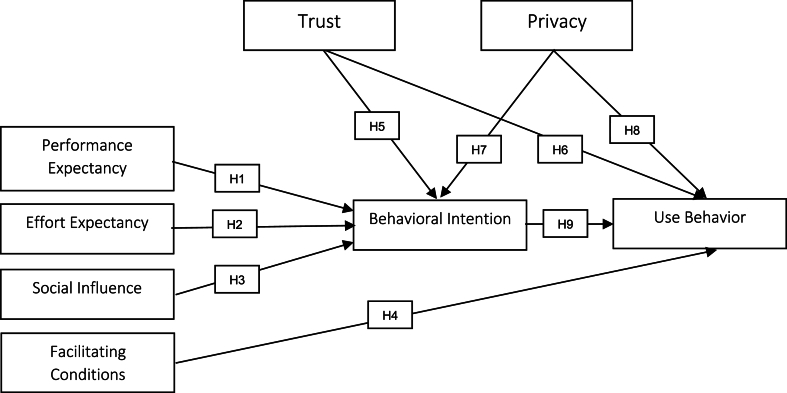
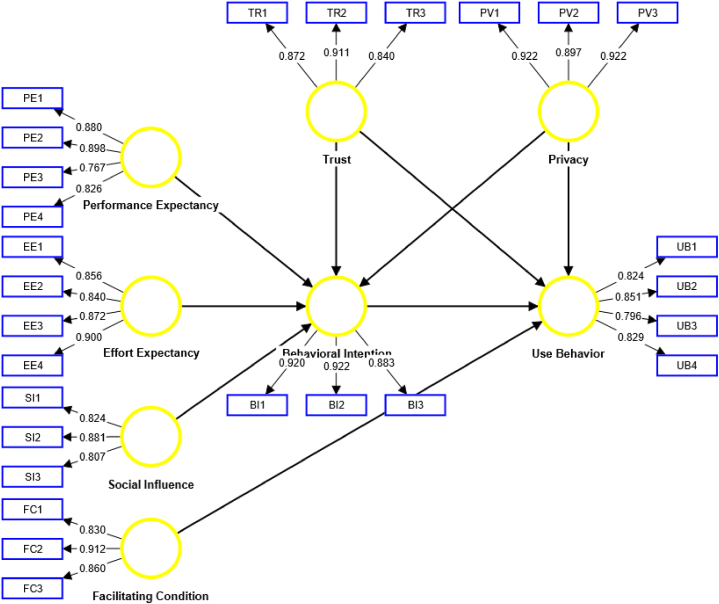
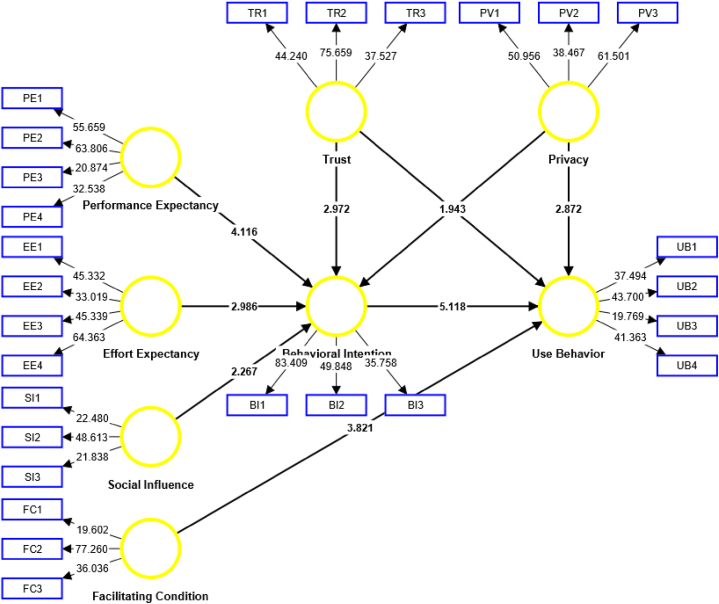
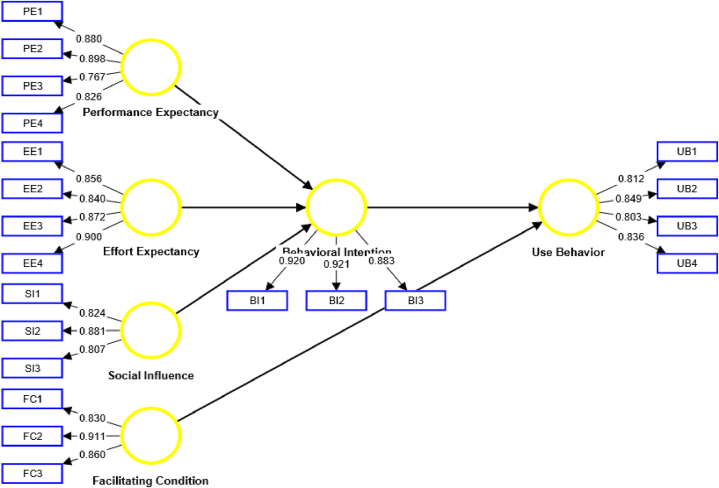
The rapid evolution of Artificial Intelligence (AI) and its widespread adoption have given rise to a critical need for understanding the underlying factors that shape users' behavioral intentions. Therefore, the main objective of this study is to explain user perceived behavioral intentions and use behavior of AI technologies for academic purposes in a developing country. This study has adopted the unified theory of acceptance and use of technology (UTAUT) model and extended it with two dimensions: trust and privacy. Data have been collected from 310 AI users including teachers, researchers, and students. This study finds that users' behavioral intention is positively and significantly associated with trust, social influence, effort expectancy, and performance expectancy. Privacy, on the other hand, has a negative yet significant relationship with behavioral intention unveiling that concerns over privacy can deter users from intending to use AI technologies which is a valuable insight for developers and educators. In determining use behavior, facilitating condition, behavioral intention, and privacy have significant positive impact. This study hasn't found any significant relationship between trust and use behavior elucidating that service providers should have unwavering focus on security measures, credible endorsements, and transparency to build user confidence. In an era dominated by the fourth industrial revolution, this research underscores the pivotal roles of trust and privacy in technology adoption. In addition, this study sheds light on users' perspective to effectively align AI-based technologies with the education system of developing countries. The practical implications encompass insights for service providers, educational institutions, and policymakers, facilitating the smooth adoption of AI technologies in developing countries while emphasizing the importance of trust, privacy, and ongoing refinement.
Overview
The claims and statistics of this paper haven’t been checked yet.
Run the check — free, no account needed. It reads the open-access text and checks the sources it cites.
Integrity signals
Registry
Cites
Statistics
Figures
Verification
Claims the paper makes
The claims and statistics of this paper haven’t been checked yet.
Run the check — free, no account needed. It reads the open-access text and checks the sources it cites.
Claims other papers make about this one
Each is checked against this paper’s own text: does it say what the citing paper says it does?
The source backs part of the claim, not all of it — or backs it for a different population, condition or comparison.
In the citing paper
“Recent expansions of UTAUT have integrated trust, privacy concerns, and ethical considerations as critical moderators, which mirrors the distinctive challenges introduced by AI systems (Rana et al., 2024).”
From A Multi-Dimensional Decision Framework for Evaluating and Selecting AI-Enabled Instructional Technology in U.S. Higher Education (2025) · cites this paper as Rana et al., 2024
Experimental — accuracy not yet measuredThe source backs part of the claim, not all of it — or backs it for a different population, condition or comparison.
In the citing paper
“Trust in the credibility of the AI system's output, defined as the conviction that the tool will deliver accurate, reliable, and impartial information, was consistently linked to higher adoption intentions (Rana et al., 2024).”
From A Multi-Dimensional Decision Framework for Evaluating and Selecting AI-Enabled Instructional Technology in U.S. Higher Education (2025) · cites this paper as Rana et al., 2024
Experimental — accuracy not yet measured
Self-check
Percentages, sums and reported differences re-computed from the paper’s own numbers.
The self-check needs the paper’s full text.
Citations
Cites
The theory of planned behavior
Ajzen, I. (1991) · Organizational Behavior and Human Decision Processes · doi:10.1016/0749-5978(91)90020-t · Cited by 90,587
Perceived usefulness, perceived ease of use, and user acceptance of information technology
Davis, F. D. (1989) · MIS Quarterly · doi:10.2307/249008 · Cited by 68,483
User Acceptance of Information Technology: Toward A Unified View1
Venkatesh, V., Morris, M. G., Davis, G. B., & Davis, F. D. (2003) · MIS Quarterly · doi:10.2307/30036540 · Cited by 45,035
Principles and Practice of Structural Equation Modeling
Tabri, N., & Elliott, C. M. (2012) · Canadian Graduate Journal of Sociology and Criminology · doi:10.15353/cgjsc.v1i1.3787 · Cited by 39,094
A new criterion for assessing discriminant validity in variance-based structural equation modeling
Henseler, J., Ringle, C. M., & Sarstedt, M. (2015) · Journal of the Academy of Marketing Science · doi:10.1007/s11747-014-0403-8 · Cited by 38,459
(1975) · PhilPapers (PhilPapers Foundation) · Cited by 36,737
Statistical Power Analysis for the Behavioral Sciences
Cohen, J. (2013) · doi:10.4324/9780203771587 · Cited by 25,373
A Theoretical Extension of the Technology Acceptance Model: Four Longitudinal Field Studies
Venkatesh, V., & Davis, F. D. (2000) · Management Science · doi:10.1287/mnsc.46.2.186.11926 · Cited by 23,066
Venkatesh, V., Thong, J. Y. L., & Xu, X. (2012) · MIS Quarterly · doi:10.2307/41410412 · Cited by 15,756
Structural equation models with unobservable variables and measurement error: Algebra and statistics
Fornell, C., & Larcker, D. F. (1981) · Journal of Marketing Research · doi:10.1177/002224378101800313 · Cited by 13,287
Research works printed but not linked: 27
- Quon, 2022, AiED: artificial intelligence for the detection of intracranial interictal epileptiform discharges, Clin. Neurophysiol., 133, 1, 10.1016/j.clinph.2021.09.018 · DOI
- Tapalova, 2022, Artificial intelligence in education: AIEd for personalised learning pathways, electron, J. E-Learn., 20, 639
- Dastjerdi, 2023, A novel framework for investigating organizational adoption of AI-integrated CRM systems in the healthcare sector; using a hybrid fuzzy decision-making approach, Telemat. Inform. Rep., 11
- Ocaña-Fernández, 2019, Artificial intelligence and its implications in higher education, J. Educ. Psychol. - Propos. Represent., 7, 553
- Purdy, 2016, Why artificial intelligence is the future of growth, Remarks AI Soc. Econ. Implic, Artif. Intell. Technol., 1
- Kizilcec, 2023, To advance AI use in education, focus on understanding educators, Int. J. Artif. Intell. Educ.
- Wang, 2020, When artificial intelligence meets educational leaders' data-informed decision-making: a cautionary tale, Stud. Educ. Eval., 69
- Sattikar, 2012, vol. 2
- Saxena, 2023, Structure, objectives, and operational framework for ethical integration of artificial intelligence in educational, Sage Sci. Rev. Educ. Technol., 6, 88
- Khosravi, 2022, Explainable artificial intelligence in education, Comput. Educ. Artif. Intell., 3, 10.1016/j.caeai.2022.100074 · DOI · Paper page
- Kronemann, 2023, How AI encourages consumers to share their secrets? The role of anthropomorphism, personalisation, and privacy concerns and avenues for future research, Span, J. Mark.-ESIC, 27, 3
- Saunders, 2016
- Hooper, 2008, Structural equation modelling: guidelines for determining model fit, Electron, J. Bus. Res. Methods, 6, 53
- Kock, 2020, Harman's single factor test in PLS-SEM: checking for common method bias, Data Anal. Perspect. J., 2, 1
- Saunders, 2016
- Rana, 2022, Drivers of consumers' online purchase intention in Bangladesh, Dhaka Univ. J. Manag., 14, 115
- Venkatesh, 2000, A theoretical extension of the technology acceptance model: four longitudinal field studies, Manag. Sci., 46, 186, 10.1287/mnsc.46.2.186.11926 · DOI · Paper page
- Dwivedi, 2019, Re-examining the unified theory of acceptance and use of technology (UTAUT): towards a revised theoretical model, Inf. Syst. Front, 21, 719, 10.1007/s10796-017-9774-y · DOI · Paper page
- Almatari, 2013, Factors influencing students' intention to use M-learning, J. Inf. Syst. Res. Innov. JISRII, 5, 1
- Bakar, 2014, The role of facilitating condition and social influence towards continuance intention to use e-learning, Int. J. Tech. Res. Appl., 2, 12
- Muhaimin, 2019, Predicting factors affecting intention to use Web 2.0 in learning: evidence from science education, J. Balt, Sci. Educ., 18, 595
- Guleria, 2023, ChatGPT: ethical concerns and challenges in academics and research, J. Infect. Dev. Ctries., 17, 1292, 10.3855/jidc.18738 · DOI
- Xu, 2011, Florida Atlantic University, information privacy concerns: linking individual perceptions with institutional privacy assurances, J. Assoc. Inf. Syst. Online, 12, 798
- Wang, 2021, Managing privacy in the digital economy, Fundam. Res., 1, 543, 10.1016/j.fmre.2021.08.009 · DOI
- Mardjo, 2018, Exploring Facebook users' willingness to accept f-commerce using the integrated unified theory of acceptance and use of technology 2 (UTAUT2), trust and risk under the moderating role of age and gender Literature review, UTCC Int. J. Bus. Econ. UTCC IJBE, 10, 139
- Chatterjee, 2021, Understanding AI adoption in manufacturing and production firms using an integrated TAM-TOE model, Technol. Forecast. Soc. Change, 170, 10.1016/j.techfore.2021.120880 · DOI · Paper page
- Dwivedi, 2021, Artificial Intelligence (AI): multidisciplinary perspectives on emerging challenges, opportunities, and agenda for research, practice and policy, Int. J. Inf. Manag., 57
Cited by
Sorted by citations
Ayinaddis, S. G. (2025) · Journal of Innovation & Knowledge · doi:10.1016/j.jik.2025.100682 · Cited by 208
Emon, M. M. H., & Khan, T. (2025) · Telematics and Informatics Reports · doi:10.1016/j.teler.2025.100188 · Cited by 99
Ajisafe, O. M., Adekunle, Y. A., Egbon, E., Ogbonna, C. E., & Olawade, D. B. (2025) · Life Sciences · doi:10.1016/j.lfs.2025.123821 · Cited by 61
Adiyono, A., Suwartono, T., Nurhayati, S., Dalimarta, F. F., & Wijayanti, O. (2025) · International Journal of Learning Teaching and Educational Research · doi:10.26803/ijlter.24.3.22 · Cited by 51
Ninghardjanti, P., Umam, M. C., Subarno, A., Winarno, W., Langgi, N. R., & Widodo, J. (2025) · Frontiers in Education · doi:10.3389/feduc.2025.1719625 · Cited by 50
Metadata
- Authors
- Rana, M. M., Siddiqee, M. S., Sakib, M. N., & Ahamed, M. R.
- Affiliations
- University of Dhaka (BD)
- Corresponding author
- Sakib, Md. Nazmus
- ORCID
- Sakib, Md. Nazmus
- Venue
- Heliyon
- Publisher
- Elsevier BV
- Published
- 2024-09
- Volume
- 10
- Issue
- 18
- Pages
- e37569
- ISSN
- 2405-8440 (ISSN-L)
- PMC
- PMC11417232
- OpenAlex
- W4402404634
- Cited by
- 143
- References
- 197
- Citations by year
- 2026: 80 · 2025: 61 · 2024: 2
- FWCI
- 53.36
- Type
- journal article
- Language
- en
- Open access
- gold
- doi.org
- Licence
- Locations
- Heliyon (publishedVersion, cc-by-nc-nd)
- SSRN Electronic Journal (acceptedVersion)
- PubMed Central (publishedVersion, cc-by-nc-nd)
- PubMed (publishedVersion)
- DOAJ (DOAJ: Directory of Open Access Journals) (submittedVersion, cc-by-sa)
- Topics
- Social Sciences › Decision Sciences › Information Systems and Management › Technology Adoption and User Behaviour
- Social Sciences › Education › Artificial Intelligence in Education
- Social Sciences › Sociology and Political Science › Privacy, Security, and Data Protection
- Keywords
- artificial intelligence adoption, technology acceptance, UTAUT, trust, privacy concerns, behavioral intention, use behavior, developing countries, academia, social influence, effort expectancy, performance expectancy, facilitating conditions, artificial intelligence in education
About these checks
Registry, retraction, Cites and statistics results are computed, not judged, with one exception: a printed reference that no index lists is read once by a model before it counts as a citation error. Claims are extracted by a model and kept only when their quote appears verbatim in the text; each cited source is then checked, with a model’s help, for whether it says what the claim relies on. Those verdicts can be wrong — read the claim’s quote and the cited source before relying on one.
Statistics and arithmetic are recomputed, not judged.
Confidence bands are shown only for fields calibrated on our annotated test set. None is calibrated yet, so no band is shown.
What counts as a claim ›How we measure confidence ›How we check this ›
Are you an author, or do you see a problem with this page? Request a review
