

The DOI matches its Crossref record; 195 of the 201 references it cites were found in a registry or an index, and 6 are not checked yet.
Assessing AI adoption in developing country academia: A trust and privacy-augmented UTAUT framework
Open accessAbstract
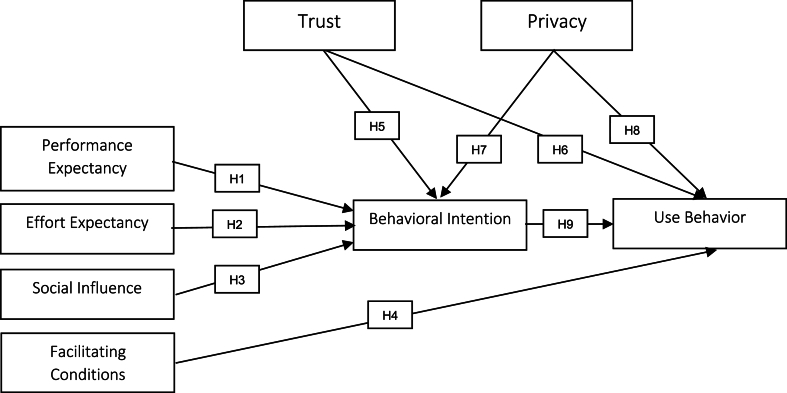
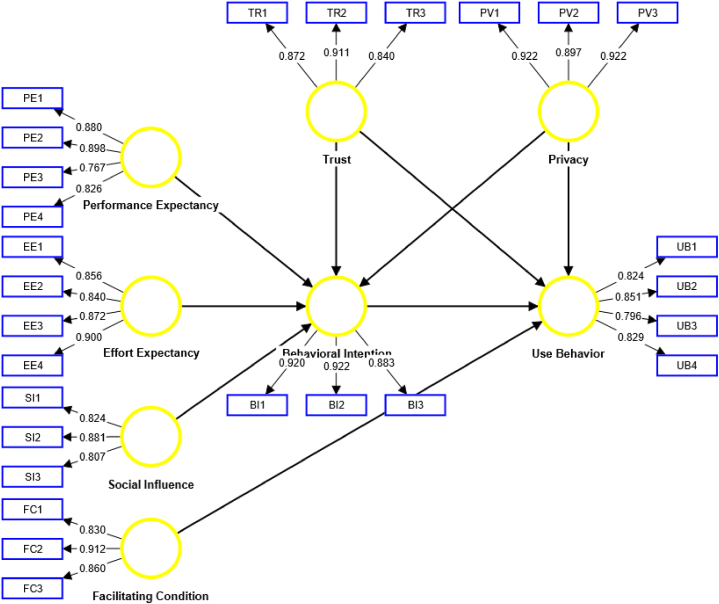
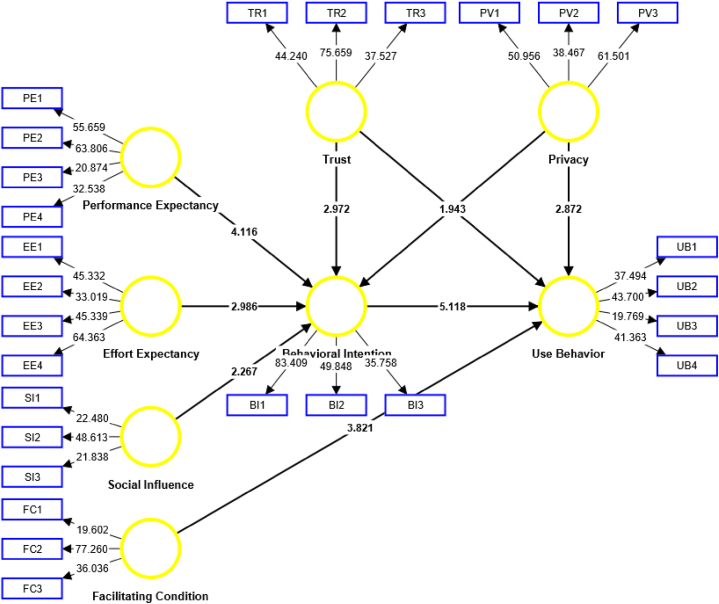
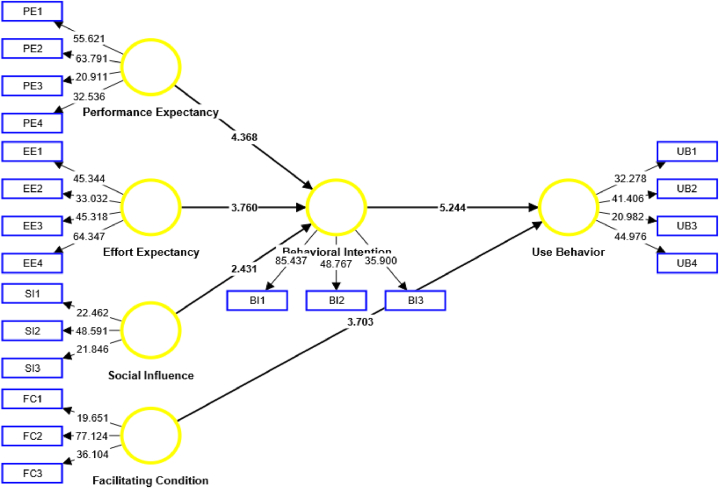
The rapid evolution of Artificial Intelligence (AI) and its widespread adoption have given rise to a critical need for understanding the underlying factors that shape users' behavioral intentions. Therefore, the main objective of this study is to explain user perceived behavioral intentions and use behavior of AI technologies for academic purposes in a developing country. This study has adopted the unified theory of acceptance and use of technology (UTAUT) model and extended it with two dimensions: trust and privacy. Data have been collected from 310 AI users including teachers, researchers, and students. This study finds that users' behavioral intention is positively and significantly associated with trust, social influence, effort expectancy, and performance expectancy. Privacy, on the other hand, has a negative yet significant relationship with behavioral intention unveiling that concerns over privacy can deter users from intending to use AI technologies which is a valuable insight for developers and educators. In determining use behavior, facilitating condition, behavioral intention, and privacy have significant positive impact. This study hasn't found any significant relationship between trust and use behavior elucidating that service providers should have unwavering focus on security measures, credible endorsements, and transparency to build user confidence. In an era dominated by the fourth industrial revolution, this research underscores the pivotal roles of trust and privacy in technology adoption. In addition, this study sheds light on users' perspective to effectively align AI-based technologies with the education system of developing countries. The practical implications encompass insights for service providers, educational institutions, and policymakers, facilitating the smooth adoption of AI technologies in developing countries while emphasizing the importance of trust, privacy, and ongoing refinement.
Overview
The claims and statistics of this paper haven’t been checked yet.
Run the check — free, no account needed. It reads the open-access text and checks the sources it cites.
Integrity signals
Registry
Cites
Statistics
Figures
Verification
Claims the paper makes
The claims and statistics of this paper haven’t been checked yet.
Run the check — free, no account needed. It reads the open-access text and checks the sources it cites.
Claims other papers make about this one
Each is checked against this paper’s own text: does it say what the citing paper says it does?
The source backs part of the claim, not all of it — or backs it for a different population, condition or comparison.
In the citing paper
“Recent expansions of UTAUT have integrated trust, privacy concerns, and ethical considerations as critical moderators, which mirrors the distinctive challenges introduced by AI systems (Rana et al., 2024).”
From A Multi-Dimensional Decision Framework for Evaluating and Selecting AI-Enabled Instructional Technology in U.S. Higher Education (2025) · cites this paper as Rana et al., 2024
Experimental — accuracy not yet measuredThe source backs part of the claim, not all of it — or backs it for a different population, condition or comparison.
In the citing paper
“Trust in the credibility of the AI system's output, defined as the conviction that the tool will deliver accurate, reliable, and impartial information, was consistently linked to higher adoption intentions (Rana et al., 2024).”
From A Multi-Dimensional Decision Framework for Evaluating and Selecting AI-Enabled Instructional Technology in U.S. Higher Education (2025) · cites this paper as Rana et al., 2024
Experimental — accuracy not yet measured
Self-check
Percentages, sums and reported differences re-computed from the paper’s own numbers.
The self-check needs the paper’s full text.
Citations
Cites
The theory of planned behavior
Ajzen, I. (1991) · Organizational Behavior and Human Decision Processes · doi:10.1016/0749-5978(91)90020-t · Cited by 90,587
Perceived usefulness, perceived ease of use, and user acceptance of information technology
Davis, F. D. (1989) · MIS Quarterly · doi:10.2307/249008 · Cited by 68,483
User Acceptance of Information Technology: Toward A Unified View1
Venkatesh, V., Morris, M. G., Davis, G. B., & Davis, F. D. (2003) · MIS Quarterly · doi:10.2307/30036540 · Cited by 45,035
Principles and Practice of Structural Equation Modeling
Tabri, N., & Elliott, C. M. (2012) · Canadian Graduate Journal of Sociology and Criminology · doi:10.15353/cgjsc.v1i1.3787 · Cited by 39,094
A new criterion for assessing discriminant validity in variance-based structural equation modeling
Henseler, J., Ringle, C. M., & Sarstedt, M. (2015) · Journal of the Academy of Marketing Science · doi:10.1007/s11747-014-0403-8 · Cited by 38,459
(1975) · PhilPapers (PhilPapers Foundation) · Cited by 36,737
Statistical Power Analysis for the Behavioral Sciences
Cohen, J. (2013) · doi:10.4324/9780203771587 · Cited by 25,373
A Theoretical Extension of the Technology Acceptance Model: Four Longitudinal Field Studies
Venkatesh, V., & Davis, F. D. (2000) · Management Science · doi:10.1287/mnsc.46.2.186.11926 · Cited by 23,066
Venkatesh, V., Thong, J. Y. L., & Xu, X. (2012) · MIS Quarterly · doi:10.2307/41410412 · Cited by 15,756
Structural equation models with unobservable variables and measurement error: Algebra and statistics
Fornell, C., & Larcker, D. F. (1981) · Journal of Marketing Research · doi:10.1177/002224378101800313 · Cited by 13,287
An integrative model of organizational trust
Mayer, R. C., Davis, J. H., & Schoorman, F. D. (1995) · The Academy of Management Review · doi:10.2307/258792 · Cited by 10,736
Not So Different After All: A Cross-Discipline View Of Trust
Rousseau, D. M., Sitkin, S. B., Burt, R. S., & Camerer, C. (1998) · Academy of Management Review · doi:10.5465/amr.1998.926617 · Cited by 10,274
Understanding information technology usage: a test of competing models
Taylor, S., & Todd, P. A. (1995) · Information Systems Research · doi:10.1287/isre.6.2.144 · Cited by 8,815
Developing and validating trust measures for e-commerce: an integrative typology
McKnight, D. H., Choudhury, V., & Kacmar, C. (2002) · Information Systems Research · doi:10.1287/isre.13.3.334.81 · Cited by 5,550
Dwivedi, Y. K., Hughes, L., Ismagilova, E., Aarts, G., Coombs, C., Crick, T., Duan, Y., Dwivedi, R., Edwards, J., Eirug, A., et al. (2021) · International Journal of Information Management · doi:10.1016/j.ijinfomgt.2019.08.002 · Cited by 4,611 · cited 1×
“Artificial intelligence (AI) is considered to be the future of information science technologies and studying the reasons of adoption of this novel innovation is a fascinating area for researchers since the number of users are increasing geometrically every day [205,229, 232,237,238].”
BackgroundDwivedi, Y. K., Kshetri, N., Hughes, L., Slade, E. L., Jeyaraj, A., Kar, A. K., Baabdullah, A. M., Koohang, A., Raghavan, V., Ahuja, M., et al. (2023) · International Journal of Information Management · doi:10.1016/j.ijinfomgt.2023.102642 · Cited by 4,584
Artificial Intelligence in Education: A Review
Chen, L., Chen, P., & Lin, Z. (2020) · IEEE Access · doi:10.1109/access.2020.2988510 · Cited by 4,133
Personal Computing: Toward a Conceptual Model of Utilization1
Thompson, R. L., Higgins, C. A., & Howell, J. M. (1991) · MIS Quarterly · doi:10.2307/249443 · Cited by 3,814
Parasuraman, A. (2000) · Journal of Service Research · doi:10.1177/109467050024001 · Cited by 3,328
Internet Users' Information Privacy Concerns (IUIPC): The Construct, the Scale, and a Causal Model
Malhotra, N. K., Kim, S. S., & Agarwal, J. (2004) · Information Systems Research · doi:10.1287/isre.1040.0032 · Cited by 3,173
Chatting and cheating: Ensuring academic integrity in the era of ChatGPT
Cotton, D. R. E., Cotton, P. A., & Shipway, J. R. (2024) · Innovations in Education and Teaching International · doi:10.1080/14703297.2023.2190148 · Cited by 3,087
Chatting and Cheating. Ensuring academic integrity in the era of ChatGPT
Cotton, D., Cotton, P., & Shipway, J. R. (2023) · doi:10.35542/osf.io/mrz8h · Cited by 3,079
Human trust in artificial intelligence: Review of empirical research
Glikson, E., & Woolley, A. W. (2020) · Academy of Management Annals · doi:10.5465/annals.2018.0057 · Cited by 2,921
Determinants of social desirability bias in sensitive surveys: a literature review
Krumpal, I. (2013) · Quality & Quantity · doi:10.1007/s11135-011-9640-9 · Cited by 2,860
An integrative model of organizational trust: past, present, and future
Schoorman, F. D., Mayer, R. C., & Davis, J. H. (2007) · Academy of Management Review · doi:10.5465/amr.2007.24348410 · Cited by 2,794
Duan, Y., Edwards, J. S., & Dwivedi, Y. K. (2019) · International Journal of Information Management · doi:10.1016/j.ijinfomgt.2019.01.021 · Cited by 2,628 · cited 1×
“The use of AI is considered controversial [147] and antagonistic [148] in many decision-making instances.”
BackgroundMethods of coping with social desirability bias: A review
Nederhof, A. J. (1985) · European Journal of Social Psychology · doi:10.1002/ejsp.2420150303 · Cited by 2,340 · cited 1×
“We ensured confidentiality and anonymity of the respondents ’ responses to reduce social desirability bias that results from respondents participating in a manner they perceive as more socially acceptable rather than being truthful [181,182].”
BackgroundThe Legacy of the Technology Acceptance Model and a Proposal for a Paradigm Shift.
Bagozzi, R. P. (2007) · Journal of the Association for Information Systems · doi:10.17705/1jais.00122 · Cited by 2,238
Dwivedi, Y. K., Rana, N. P., Jeyaraj, A., Clement, M., & Williams, M. D. (2019) · Information Systems Frontiers · doi:10.1007/s10796-017-9774-y · Cited by 2,137
Exploring the impact of artificial intelligence on teaching and learning in higher education
Popenici, S. A. D., & Kerr, S. (2017) · Research and Practice in Technology Enhanced Learning · doi:10.1186/s41039-017-0062-8 · Cited by 2,019
Information Privacy Research: an Interdisciplinary Review1
Smith, H. J., Dinev, T., & Xu, H. (2011) · MIS Quarterly · doi:10.2307/41409970 · Cited by 2,013
Alalwan, A. A., Dwivedi, Y. K., & Rana, N. P. (2017) · International Journal of Information Management · doi:10.1016/j.ijinfomgt.2017.01.002 · Cited by 1,944
An Introduction to Structural Equation Modeling
Hair, J. F., Hult, G. T. M., Ringle, C. M., Sarstedt, M., Danks, N. P., & Ray, S. (2021) · Classroom companion: business · doi:10.1007/978-3-030-80519-7_1 · Cited by 1,932
Scherer, R., Siddiq, F., & Tondeur, J. (2019) · Computers & Education · doi:10.1016/j.compedu.2018.09.009 · Cited by 1,923
A comprehensive AI policy education framework for university teaching and learning
Chan, C. K. Y. (2023) · International Journal of Educational Technology in Higher Education · doi:10.1186/s41239-023-00408-3 · Cited by 1,577
Reed, M. S., Evely, A. C., Cundill, G., Fazey, I., Glass, J. H., Laing, A., Newig, J., Parrish, B., Prell, C., Raymond, C., et al. (2010) · Ecology and Society · doi:10.5751/es-03564-1504r01 · Cited by 1,570
Artificial intelligence in education: Addressing ethical challenges in K-12 settings
Akgun, S., & Greenhow, C. (2022) · AI and Ethics · doi:10.1007/s43681-021-00096-7 · Cited by 1,473 · cited 1×
“Along with that, in educational environment where the AI tools are perceived as reliable, transparent, and ethically designed, there has a higher possibility of those tools being integrated in daily academic events, emphasizing the positive impact of trust on use behavior [151,152].”
BackgroundVision, challenges, roles and research issues of Artificial Intelligence in Education
Hwang, G.-J., Xie, H., Wah, B. W., & Gašević, D. (2020) · Computers and Education: Artificial Intelligence · doi:10.1016/j.caeai.2020.100001 · Cited by 1,435
Solove, D. J. (2006) · University of Pennsylvania Law Review · doi:10.2307/40041279 · Cited by 1,388
Privacy in the Digital Age: a Review of Information Privacy Research in Information Systems1
Bélanger, F., & Crossler, R. E. (2011) · MIS Quarterly · doi:10.2307/41409971 · Cited by 1,339
Understanding Technology Adoption: Theory and Future Directions for Informal Learning
Straub, E. T. (2009) · Review of Educational Research · doi:10.3102/0034654308325896 · Cited by 1,286
What Differences Make a Difference?: The Promise and Reality of Diverse Teams in Organizations
Mannix, E., & Neale, M. A. (2005) · Psychological Science in the Public Interest · doi:10.1111/j.1529-1006.2005.00022.x · Cited by 1,276
Luo, X. R., Li, H., Zhang, J., & Shim, J. P. (2010) · Decision Support Systems · doi:10.1016/j.dss.2010.02.008 · Cited by 1,194
ChatGPT for Education and Research: Opportunities, Threats, and Strategies
Rahman, M. M., & Watanobe, Y. (2023) · Applied Sciences · doi:10.3390/app13095783 · Cited by 1,080
New Technology and Digital Worlds: Analyzing Evidence of Equity in Access, Use, and Outcomes
Warschauer, M., & Matuchniak, T. (2010) · Review of Research in Education · doi:10.3102/0091732x09349791 · Cited by 1,047
Lee, D., & Yoon, S. N. (2021) · International Journal of Environmental Research and Public Health · doi:10.3390/ijerph18010271 · Cited by 1,017
Application and theory gaps during the rise of artificial intelligence in education
Chen, X., Xie, H., Zou, D., & Hwang, G.-J. (2020) · Computers and Education: Artificial Intelligence · doi:10.1016/j.caeai.2020.100002 · Cited by 1,003
Baker, R. S., & Hawn, A. (2022) · International Journal of Artificial Intelligence in Education · doi:10.1007/s40593-021-00285-9 · Cited by 993
Privacy and artificial intelligence: challenges for protecting health information in a new era
Murdoch, B. (2021) · BMC Medical Ethics · doi:10.1186/s12910-021-00687-3 · Cited by 991
Revolutionizing education with AI: Exploring the transformative potential of ChatGPT
Adiguzel, T., Kaya, M. H., & Cansu, F. K. (2023) · Contemporary Educational Technology · doi:10.30935/cedtech/13152 · Cited by 975 · cited 1×
“The use of AI is swelling in almost every sector, and the educational sector is no exception, as the use of AI opens an original prospect for learning in higher education, staff support, and student assortment [53,54].”
BackgroundTrust in AI and Its Role in the Acceptance of AI Technologies
Choung, H., David, P., & Ross, A. (2023) · International Journal of Human–Computer Interaction · doi:10.1080/10447318.2022.2050543 · Cited by 963 · cited 2×
“The term “ Trust ” has been demarcated as the assurance user gain in the AI based learning system ’ s ability to provide an efficient and reliable service [95,98].”
BackgroundThe role of data privacy in marketing
Martin, K. D., & Murphy, P. E. (2017) · Journal of the Academy of Marketing Science · doi:10.1007/s11747-016-0495-4 · Cited by 902 · cited 1×
“As per the study of Martin and Murphy [164], in the competitive perspective of educational technologies, AI solution providers offer a superior privacy protection which not only attract more users base but also retain them over time.”
BackgroundWhat is Education For? On Good Education, Teacher Judgement, and Educational Professionalism
Biesta, G. (2015) · European Journal of Education · doi:10.1111/ejed.12109 · Cited by 900
Explainable Artificial Intelligence in education
Khosravi, H., Shum, S. B., Chen, G., Conati, C., Tsai, Y.-S., Kay, J., Knight, S., Martinez-Maldonado, R., Sadiq, S., & Gašević, D. (2022) · Computers and Education: Artificial Intelligence · doi:10.1016/j.caeai.2022.100074 · Cited by 863
The Ethical Implications of Using Artificial Intelligence in Auditing
Munoko, I., Brown‐Liburd, H. L., & Vasarhelyi, M. A. (2020) · Journal of Business Ethics · doi:10.1007/s10551-019-04407-1 · Cited by 852
Understanding AI adoption in manufacturing and production firms using an integrated TAM-TOE model
Chatterjee, S., Rana, N. P., Dwivedi, Y. K., & Baabdullah, A. M. (2021) · Technological Forecasting and Social Change · doi:10.1016/j.techfore.2021.120880 · Cited by 825
A systematic review of algorithm aversion in augmented decision making
Burton, J. W., Stein, M., & Jensen, T. B. (2020) · Journal of Behavioral Decision Making · doi:10.1002/bdm.2155 · Cited by 814
Díaz-Rodríguez, N., Del Ser, J., Coeckelbergh, M., López de Prado, M., Herrera-Viedma, E., & Herrera, F. (2023) · Information Fusion · doi:10.1016/j.inffus.2023.101896 · Cited by 800
Information Privacy Concerns: Linking Individual Perceptions with Institutional Privacy Assurances
Xu, H., Dinev, T., Smith, J., & Hart, P. (2011) · Journal of the Association for Information Systems · doi:10.17705/1jais.00281 · Cited by 776
Lee, C., & Coughlin, J. F. (2015) · Journal of Product Innovation Management · doi:10.1111/jpim.12176 · Cited by 771
Open AI in Education, the Responsible and Ethical Use of ChatGPT Towards Lifelong Learning
Mhlanga, D. (2023) · Sustainable Development Goals Series · doi:10.1007/978-3-031-37776-1_17 · Cited by 718
Challenges and Future Directions of Big Data and Artificial Intelligence in Education
Luan, H., Geczy, P., Lai, H., Gobert, J., Yang, S. J. H., Ogata, H., Baltes, J., Guerra, R., Li, P., & Tsai, C.-C. (2020) · Frontiers in Psychology · doi:10.3389/fpsyg.2020.580820 · Cited by 667
Southworth, J., Migliaccio, K., Glover, J., Glover, J., Reed, D., McCarty, C., Brendemuhl, J., & Thomas, A. (2023) · Computers and Education: Artificial Intelligence · doi:10.1016/j.caeai.2023.100127 · Cited by 647 · cited 1×
“At the university level, the adoption of AI is endorsed for a significant element called enthusiasm of people, and a greater aptitude towards AI will provide the students a greater latent for potential achievement [55,56].”
BackgroundBernacki, M. L., Greene, M. J., & Lobczowski, N. G. (2021) · Educational Psychology Review · doi:10.1007/s10648-021-09615-8 · Cited by 618
Šumak, B., Heričko, M., & Pušnik, M. (2011) · Computers in Human Behavior · doi:10.1016/j.chb.2011.08.005 · Cited by 602
What influences algorithmic decision-making? A systematic literature review on algorithm aversion
Mahmud, H., Islam, A. K. M. N., Ahmed, S. I., & Smolander, K. (2022) · Technological Forecasting and Social Change · doi:10.1016/j.techfore.2021.121390 · Cited by 601
Oke, A., & Fernandes, F. A. P. (2020) · Journal of Open Innovation Technology Market and Complexity · doi:10.3390/joitmc6020031 · Cited by 589
Nazaretsky, T., Ariely, M., Cukurova, M., & Alexandron, G. (2022) · British Journal of Educational Technology · doi:10.1111/bjet.13232 · Cited by 589
Wach, K., Duong, C. D., Ejdys, J., Kazlauskaitė, R., Korzynski, P., Mazurek, G., Paliszkiewicz, J., & Ziemba, E. (2023) · Entrepreneurial Business and Economics Review · doi:10.15678/eber.2023.110201 · Cited by 584 · cited 1×
“…as the students have struggled to advance their interpersonal skills i.e. conflict resolution, empathy, collaboration, and networking skills [77,78]; (d) users privacy and data security, whereas the student ’ s academic record, learning behaviors and personal information may be vulnerable to…”
BackgroundCao, G., Duan, Y., Edwards, J. S., & Dwivedi, Y. K. (2021) · Technovation · doi:10.1016/j.technovation.2021.102312 · Cited by 571
Crawford, J., Cowling, M., & Allen, K.-A. (2023) · Journal of University Teaching and Learning Practice · doi:10.53761/1.20.3.02 · Cited by 547 · cited 1×
“AI encourages more significant real-time learning, revised outcomes, and an appropriate knowledge setting when educational assessment progresses more swiftly than ever before [66,87].”
BackgroundTechnology and the future of language teaching
Kessler, G. (2018) · Foreign Language Annals · doi:10.1111/flan.12318 · Cited by 529
Impact of Trust and Privacy Concerns on Technology Acceptance in Healthcare: An Indian Perspective
Dhagarra, D., Goswami, M., & Kumar, G. (2020) · International Journal of Medical Informatics · doi:10.1016/j.ijmedinf.2020.104164 · Cited by 517
Do I Trust You Online, and If So, Will I Buy? An Empirical Study of Two Trust-Building Strategies
Lim, K. H., Sia, C. L., Lee, M. K. O., & Benbasat, I. (2006) · Journal of Management Information Systems · doi:10.2753/mis0742-1222230210 · Cited by 505
Preparing teachers for the application of AI-powered technologies in foreign language education
Pokrivcakova, S. (2019) · Journal of Language and Cultural Education · doi:10.2478/jolace-2019-0025 · Cited by 489
Artificial intelligence and education in China
Knox, J. (2020) · Learning, Media and Technology · doi:10.1080/17439884.2020.1754236 · Cited by 489
Madan, R., & Ashok, M. (2023) · Government Information Quarterly · doi:10.1016/j.giq.2022.101774 · Cited by 468
Medical 4.0 technologies for healthcare: Features, capabilities, and applications
Haleem, A., Javaid, M., Pratap Singh, R., & Suman, R. (2022) · Internet of Things and Cyber-Physical Systems · doi:10.1016/j.iotcps.2022.04.001 · Cited by 468
A review on artificial intelligence in education
Huang, J., Saleh, S., & Liu, Y. (2021) · Academic Journal of Interdisciplinary Studies · doi:10.36941/ajis-2021-0077 · Cited by 439
Liu, K., & Tao, D. (2021) · Computers in Human Behavior · doi:10.1016/j.chb.2021.107026 · Cited by 436
Gansser, O. A., & Reich, C. S. (2021) · Technology in Society · doi:10.1016/j.techsoc.2021.101535 · Cited by 435
Cubric, M. (2020) · Technology in Society · doi:10.1016/j.techsoc.2020.101257 · Cited by 416
Menon, D., & Shilpa, K. (2023) · Heliyon · doi:10.1016/j.heliyon.2023.e20962 · Cited by 359
Bedué, P., & Fritzsche, A. (2021) · Journal of Enterprise Information Management · doi:10.1108/jeim-06-2020-0233 · Cited by 357
Fuchs, K. (2023) · Frontiers in Education · doi:10.3389/feduc.2023.1166682 · Cited by 353 · cited 2×
“Fuchs [63] illustrates the complex perspective of NLP (Natural Language Processing) models like Google Bard and ChatGPT in higher education, weighing both the challenges and advantages they present.”
BackgroundPromoting students' well-being by developing their readiness for the artificial intelligence age
Dai, Y., Chai, C.-S., Lin, P.-Y., Jong, M. S.-Y., Guo, Y., & Qin, J. (2020) · Sustainability · doi:10.3390/su12166597 · Cited by 330
Su, J., Zhong, Y., & Ng, D. T. K. (2022) · Computers and Education Artificial Intelligence · doi:10.1016/j.caeai.2022.100065 · Cited by 313
The history of UTAUT model and its impact on ICT acceptance and usage by academicians
Oye, N. D., Iahad, N. A., & Ab.Rahim, N. (2012) · Education and Information Technologies · doi:10.1007/s10639-012-9189-9 · Cited by 311
Academic and Administrative Role of Artificial Intelligence in Education
Ahmad, S. F., Alam, M. M., Rahmat, M. K., Mubarik, M. S., & Hyder, S. I. (2022) · Sustainability · doi:10.3390/su14031101 · Cited by 309
Towards artificial intelligence-based assessment systems
Luckin, R. (2017) · Nature Human Behaviour · doi:10.1038/s41562-016-0028 · Cited by 303 · cited 1×
“The AI-based applications acclimate students ’ and teachers ’ preferences and learning styles, thus developing the knowledge base [59,60].”
BackgroundA systematic review of artificial intelligence impact assessments
Stahl, B. C., Antoniou, J., Bhalla, N., Brooks, L., Jansen, P., Lindqvist, B., Kirichenko, A., Marchal, S., Rodrigues, R., Santiago, N., et al. (2023) · Artificial Intelligence Review · doi:10.1007/s10462-023-10420-8 · Cited by 303
Agarwal, P., Swami, S., & Malhotra, S. K. (2022) · Journal of Science and Technology Policy Management · doi:10.1108/jstpm-08-2021-0122 · Cited by 302
Explore success factors that impact artificial intelligence adoption on telecom industry in China
Chen, H., Li, L., & Chen, Y. (2021) · Journal of Management Analytics · doi:10.1080/23270012.2020.1852895 · Cited by 300
Deep learning goes to school: toward a relational understanding of AI in education
Perrotta, C., & Selwyn, N. (2020) · Learning, Media and Technology · doi:10.1080/17439884.2020.1686017 · Cited by 299
Faqih, K. M. S., & Jaradat, M.-I. R. M. (2021) · Technology in Society · doi:10.1016/j.techsoc.2021.101787 · Cited by 297
Winkler-Schwartz, A., Bissonnette, V., Mirchi, N., Ponnudurai, N., Yilmaz, R., Ledwos, N., Siyar, S., Azarnoush, H., Karlık, B., & Maestro, R. F. D. (2019) · Journal of surgical education · doi:10.1016/j.jsurg.2019.05.015 · Cited by 295
Flanagin, A. J., & Metzger, M. J. (2013) · Computers in Human Behavior · doi:10.1016/j.chb.2013.02.001 · Cited by 277
Exploring the AI competencies of elementary school teachers in South Korea
Kim, K., & Kwon, K. (2023) · Computers and Education Artificial Intelligence · doi:10.1016/j.caeai.2023.100137 · Cited by 265
Chong, L., Zhang, G., Goucher-Lambert, K., Kotovsky, K., & Cagan, J. (2022) · Computers in Human Behavior · doi:10.1016/j.chb.2021.107018 · Cited by 262
Nye, B. D. (2015) · International Journal of Artificial Intelligence in Education · doi:10.1007/s40593-014-0028-6 · Cited by 259
Tian, W., Ge, J., Zhao, Y., & Zheng, X. (2024) · Frontiers in Psychology · doi:10.3389/fpsyg.2024.1268549 · Cited by 258
Social companionship with artificial intelligence: Recent trends and future avenues
Chaturvedi, R., Verma, S., Das, R., & Dwivedi, Y. K. (2023) · Technological Forecasting and Social Change · doi:10.1016/j.techfore.2023.122634 · Cited by 244
IRobot: Teaching the Basics of Artificial Intelligence in High Schools
Burgsteiner, H., Kandlhofer, M., & Steinbauer, G. (2016) · Proceedings of the AAAI Conference on Artificial Intelligence · doi:10.1609/aaai.v30i1.9864 · Cited by 241
Teo, T. P., & Noyes, J. (2012) · Interactive Learning Environments · doi:10.1080/10494820.2011.641674 · Cited by 237
UTAUT as a Model for Understanding Intention to Adopt AI and Related Technologies among Librarians
Andrews, J. E., Ward, H. L., & Yoon, J. (2021) · The Journal of Academic Librarianship · doi:10.1016/j.acalib.2021.102437 · Cited by 237
Marsh, J. A., & Farrell, C. C. (2015) · Educational Management Administration & Leadership · doi:10.1177/1741143214537229 · Cited by 233
Re-designed flipped learning model in an academic course: The role of co-creation and co-regulation
Blau, I., & Shamir‐Inbal, T. (2017) · Computers & Education · doi:10.1016/j.compedu.2017.07.014 · Cited by 227
Raffaghelli, J. E., Rodríguez, M. E., Guerrero‐Roldán, A., & Bañeres, D. (2022) · Computers & Education · doi:10.1016/j.compedu.2022.104468 · Cited by 227
Smart home: Highly-educated students' acceptance
Baudier, P., Ammi, C., & Deboeuf-Rouchon, M. (2018) · Technological Forecasting and Social Change · doi:10.1016/j.techfore.2018.06.043 · Cited by 216
Wang, Y. (2020) · Studies In Educational Evaluation · doi:10.1016/j.stueduc.2020.100872 · Cited by 215
Trust and mistrust of online health sites
Sillence, E., Briggs, P., Fishwick, L., & Harris, P. (2004) · Proceedings of the SIGCHI Conference on Human Factors in Computing Systems · doi:10.1145/985692.985776 · Cited by 211
Understanding User Trust in Artificial Intelligence-Based Educational Systems: Evidence from China
Qin, F., Li, K., & Yan, J. (2020) · British Journal of Educational Technology · doi:10.1111/bjet.12994 · Cited by 204
Security and Privacy in Cloud Computing: Technical Review
Abdulsalam, Y. S., & Hedabou, M. (2021) · Future Internet · doi:10.3390/fi14010011 · Cited by 197
Technology with No Human Responsibility?
Johnson, D. G. (2015) · Journal of Business Ethics · doi:10.1007/s10551-014-2180-1 · Cited by 195
An artificial intelligence educational strategy for the digital transformation
Cantú-Ortiz, F. J., Galeano Sánchez, N., Garrido, L., Terashima-Marin, H., & Brena, R. F. (2020) · International Journal on Interactive Design and Manufacturing (IJIDeM) · doi:10.1007/s12008-020-00702-8 · Cited by 192
To Advance AI Use in Education, Focus on Understanding Educators
Kizilcec, R. F. (2023) · International Journal of Artificial Intelligence in Education · doi:10.1007/s40593-023-00351-4 · Cited by 190
The Roles of Artificial Intelligence in Education: Current Progress and Future Prospects
McArthur, D., Lewis, M. W., & Bishary, M. (2005) · i-manager’s Journal on Educational Psychology · doi:10.26634/jet.1.4.972 · Cited by 187
Optimizing Students’ Mental Health and Academic Performance: AI-Enhanced Life Crafting
Dekker, I., De Jong, E. M., Schippers, M. C., De Bruijn-Smolders, M., Alexiou, A., & Giesbers, B. (2020) · Frontiers in Psychology · doi:10.3389/fpsyg.2020.01063 · Cited by 176
Is chess the drosophila of artificial intelligence? A social history of an algorithm
Ensmenger, N. L. (2011) · Social Studies of Science · doi:10.1177/0306312711424596 · Cited by 176
Mouta, A., Llorente, A. M. P., & Sánchez, E. M. T. (2023) · International Journal of Artificial Intelligence in Education · doi:10.1007/s40593-023-00384-9 · Cited by 175
Kim, J., & Lee, K. S.-S. (2020) · Asia Pacific Journal of Education · doi:10.1080/02188791.2020.1776213 · Cited by 174
ChatGPT: ethical concerns and challenges in academics and research
Guleria, A., Krishan, K., Sharma, V., & Kanchan, T. (2023) · The Journal of Infection in Developing Countries · doi:10.3855/jidc.18738 · Cited by 170
Attié, E. A., & Meyer‐Waarden, L. (2022) · Technological Forecasting and Social Change · doi:10.1016/j.techfore.2022.121485 · Cited by 168
Academic dishonesty and trustworthy assessment in online learning: A systematic literature review
Surahman, E., & Wang, T. (2022) · Journal of Computer Assisted Learning · doi:10.1111/jcal.12708 · Cited by 155
Uzir, M. U. H., Halbusi, H. A., Lim, R., Jerin, I., Hamid, A. B. A., Ramayah, T., & Haque, A. (2021) · Technology in Society · doi:10.1016/j.techsoc.2021.101780 · Cited by 155
International Technology Adoption
Phillips, L. A. W., Calantone, R. J., & Lee, M. (1994) · Journal of Business and Industrial Marketing · doi:10.1108/08858629410059762 · Cited by 151
Picciano, A. G., Seaman, J., Shea, P., & Swan, K. P. (2011) · The Internet and Higher Education · doi:10.1016/j.iheduc.2011.07.004 · Cited by 149
Saheb, T., Saheb, T., & Carpenter, D. O. (2021) · Computers in Biology and Medicine · doi:10.1016/j.compbiomed.2021.104660 · Cited by 148
Dakakni, D., & Safa, N. (2023) · Computers and Education Artificial Intelligence · doi:10.1016/j.caeai.2023.100179 · Cited by 145
Willison, R., Warkentin, M. E., & Johnston, A. C. (2016) · Information Systems Journal · doi:10.1111/isj.12129 · Cited by 143
Hou, Y. T.-Y., & Jung, M. F. (2021) · Proceedings of the ACM on Human-Computer Interaction · doi:10.1145/3479864 · Cited by 135
Brewing service quality in higher education
Yeo, R. K. (2008) · Quality Assurance in Education · doi:10.1108/09684880810886277 · Cited by 134
The dark sides of AI personal assistant: effects of service failure on user continuance intention
Sun, Y., Li, S., & Yu, L. (2021) · Electronic Markets · doi:10.1007/s12525-021-00483-2 · Cited by 133
Farrokhi, A., Shirazi, F., Hajli, N., & Tajvidi, M. (2020) · Industrial Marketing Management · doi:10.1016/j.indmarman.2020.09.015 · Cited by 126
Qushem, U. B., Christopoulos, A., Oyelere, S. S., Ogata, H., & Laakso, M. (2021) · Education Sciences · doi:10.3390/educsci11070338 · Cited by 114
Tanantong, T., & Wongras, P. (2024) · Systems · doi:10.3390/systems12010028 · Cited by 114
An Analysis of the Role of Artificial Intelligence in Education and Teaching
Malik, G., Tayal, D. K., & Vij, S. (2018) · Advances in intelligent systems and computing · doi:10.1007/978-981-10-8639-7_42 · Cited by 112
Açikgöz, F., & Perez‐Vega, R. (2021) · International Journal of Human-Computer Interaction · doi:10.1080/10447318.2021.1987677 · Cited by 110
Critical integrative argumentation: Toward complexity in students’ thinking
Nussbaum, E. M. (2020) · Educational Psychologist · doi:10.1080/00461520.2020.1845173 · Cited by 103
Chai, F., Ma, J., Wang, Y., Zhu, J., & Han, T. (2024) · Frontiers in Psychology · doi:10.3389/fpsyg.2024.1221177 · Cited by 103
Harnessing Artificial Intelligence for Innovation in Education
Tan, S. (2023) · Springer eBooks · doi:10.1007/978-981-19-9201-8_8 · Cited by 101
Eynon, R., & Young, E. (2020) · Science Technology & Human Values · doi:10.1177/0162243920906475 · Cited by 91
Rensfeldt, A. B., & Rahm, L. (2022) · Postdigital Science and Education · doi:10.1007/s42438-022-00344-x · Cited by 88
GPT revolution and digital entrepreneurial intentions
Abaddi, S. (2023) · Journal of Entrepreneurship in Emerging Economies · doi:10.1108/jeee-07-2023-0260 · Cited by 84
Roshanaei, M. (2024) · Education and Information Technologies · doi:10.1007/s10639-024-12605-2 · Cited by 84
Wang, X.-M., & Hwang, G. (2017) · Educational Technology Research and Development · doi:10.1007/s11423-017-9551-0 · Cited by 83
Artificial Intelligence and Its Implications in Higher Education.
Ocaña-Fernández, Y., Valenzuela-Fernández, L. A., & Garro-Aburto, L. L. (2019) · Cited by 82
Ng, K., & Dyne, L. V. (2001) · Organizational Behavior and Human Decision Processes · doi:10.1006/obhd.2000.2927 · Cited by 80
Ghatrifi, M. O. M. A., Amairi, J. S. S. A., & Thottoli, M. M. (2023) · Computers and Education Artificial Intelligence · doi:10.1016/j.caeai.2023.100144 · Cited by 80
The role of institutional and self in the formation of trust in artificial intelligence technologies
Wong, L.-W., Tan, G., Ooi, K., & Dwivedi, Y. K. (2023) · Internet Research · doi:10.1108/intr-07-2021-0446 · Cited by 77
More trust or more risk? User acceptance of artificial intelligence virtual assistant
Xiong, Y., Shi, Y., Pu, Q., & Liu, N. (2023) · Human Factors and Ergonomics in Manufacturing & Service Industries · doi:10.1002/hfm.21020 · Cited by 76
How communications by AI-enabled voice assistants impact the customer journey
Grewal, D., Guha, A., Schweiger, E. B., Ludwig, S., & Wetzels, M. G. M. (2022) · Journal of service management · doi:10.1108/josm-11-2021-0452 · Cited by 73
Abadie, A., Roux, M., Chowdhury, S., & Dey, P. K. (2023) · Journal of Business Research · doi:10.1016/j.jbusres.2023.113866 · Cited by 73
Distler, V., Lallemand, C., & Koenig, V. (2019) · Computers in Human Behavior · doi:10.1016/j.chb.2019.106227 · Cited by 71
Artificial intelligence in developing countries
Kshetri, N. (2020) · IT Professional · doi:10.1109/mitp.2019.2951851 · Cited by 71
Managing privacy in the digital economy
Wang, C., Zhang, N., & Wang, C. (2021) · Fundamental Research · doi:10.1016/j.fmre.2021.08.009 · Cited by 68
Why or Why Not? The Effect of Justification Styles on Chatbot Recommendations
Wilkinson, D., Alkan, Ö., Liao, Q. V., Mattetti, M., Vejsbjerg, I., Knijnenburg, B. P., & Daly, E. (2021) · ACM Transactions on Information Systems · doi:10.1145/3441715 · Cited by 67
Artificial Intelligence in Education
Flogie, A., & Aberšek, B. (2021) · IntechOpen eBooks · doi:10.5772/intechopen.96498 · Cited by 66
Medical professionals' adoption of AI-based medical devices: UTAUT model with trust mediation
Kim, Y. J., Choi, J. H., & Fotso, G. M. N. (2024) · Journal of Open Innovation Technology Market and Complexity · doi:10.1016/j.joitmc.2024.100220 · Cited by 66
Exploring the factors that influence academic performance in Jordanian higher education institutions
Al‐Okaily, M., Magatef, S. G., Al-Okaily, A., & Shiyyab, F. S. (2024) · Heliyon · doi:10.1016/j.heliyon.2024.e33783 · Cited by 65
Factors influencing clinicians' willingness to use an AI-based clinical decision support system
Choudhury, A. (2022) · Frontiers in Digital Health · doi:10.3389/fdgth.2022.920662 · Cited by 64
Lozano, A., & Blanco Fontao, C. (2023) · Education Sciences · doi:10.3390/educsci13070733 · Cited by 60
Al‐Okaily, M. (2024) · Journal of financial reporting & accounting · doi:10.1108/jfra-09-2023-0567 · Cited by 56
Rasheed, H. M. W., Chen, Y., Khizar, H. M. U., & Safeer, A. A. (2023) · Heliyon · doi:10.1016/j.heliyon.2023.e16968 · Cited by 53
The Past Decade and Future of AI’s Impact on Society
Bryson, J. J. (2019) · OPUS 4 (Zuse Institute Berlin) · Cited by 53
Learning outcomes’ role in higher education teaching
Nasrallah, R. (2014) · Education Business and Society Contemporary Middle Eastern Issues · doi:10.1108/ebs-03-2014-0016 · Cited by 52
The analysis of security and privacy risks in smart education environments
Kamenskih, A. N. (2022) · Journal of Smart Cities and Society · doi:10.3233/scs-210114 · Cited by 51
Delving into educators’ perspectives on ChatGPT in management education: a qualitative exploration
Bhaskar, P., & Gupta, P. K. (2024) · Interactive Technology and Smart Education · doi:10.1108/itse-08-2023-0169 · Cited by 49
Integrating LA and EDM for Improving Students Success in Higher Education Using FCN Algorithm
Hooda, M., Rana, C., Dahiya, O., Shet, J. P., & Singh, B. K. (2022) · Mathematical Problems in Engineering · doi:10.1155/2022/7690103 · Cited by 49
Lemay, D. J., Doleck, T., & Bazelais, P. (2017) · Computers in Human Behavior · doi:10.1016/j.chb.2017.05.022 · Cited by 48
Artificial intelligence and cardiology: Current status and perspective
Nakamura, T., & Sasano, T. (2021) · Journal of Cardiology · doi:10.1016/j.jjcc.2021.11.017 · Cited by 45
Wisdom in the Age of AI Education
Peters, M. A., & Green, B. (2024) · Postdigital Science and Education · doi:10.1007/s42438-024-00460-w · Cited by 45
Goni, M. A., & Tabassum, M. (2020) · Athens Journal of Mass Media and Communications · doi:10.30958/ajmmc.6-4-1 · Cited by 45
Buckner, E. S. (2011) · Journal of Comparative & International Higher Education · Cited by 44
El-Haggar, N., Amouri, L., Alsumayt, A., Alghamedy, F. H., & Aljameel, S. S. (2023) · Applied Sciences · doi:10.3390/app13159003 · Cited by 44
Antecedents and Outcomes of Blockchain Technology Adoption: Meta-Analysis
Mishra, N. K., Raj, A., Jeyaraj, A., & Gupta, R. (2023) · Journal of Computer Information Systems · doi:10.1080/08874417.2023.2205370 · Cited by 42
Student partnership in assessment in higher education: a systematic review
Chan, C. K. Y., & Chen, S. W. (2023) · Assessment & Evaluation in Higher Education · doi:10.1080/02602938.2023.2224948 · Cited by 38
AiED: Artificial intelligence for the detection of intracranial interictal epileptiform discharges
Quon, R. J., Meisenhelter, S., Camp, E. J., Testorf, M. E., Song, Y., Song, Q., Culler, G. W., Moein, P., & Jobst, B. C. (2021) · Clinical Neurophysiology · doi:10.1016/j.clinph.2021.09.018 · Cited by 37
Determining the Factors that Affect the Use of Virtual Classrooms: A Modification of the UTAUT Model
Alshammarı, S. H. (2021) · Journal of Information Technology Education Research · doi:10.28945/4709 · Cited by 36
Editorial: Critical social research
Harvey, L. (2023) · Quality in Higher Education · doi:10.1080/13538322.2022.2154139 · Cited by 36
User acceptance model of computer-based assessment: moderating effect and intention-behavior effect
Lin, J., & Lai, Y.-C. “. (2019) · Australasian Journal of Educational Technology · doi:10.14742/ajet.4684 · Cited by 31
AI Adoption in Universities in Emerging Economies: Prospects, Challenges and Recommendations
Sharma, H., Soetan, T. O., Farinloye, T., Mogaji, E., & Noite, M. D. F. (2022) · Re-imagining Educational Futures in Developing Countries · doi:10.1007/978-3-030-88234-1_9 · Cited by 31
Temporality and inequity: How dominant cultures of time promote injustices in schools
Saul, R. (2020) · The Review of Education Pedagogy & Cultural Studies · doi:10.1080/10714413.2020.1729078 · Cited by 29
Dastjerdi, M., Keramati, A., & Keramati, N. (2023) · Telematics and Informatics Reports · doi:10.1016/j.teler.2023.100078 · Cited by 28
Ehrari, H., Ulrich, F., & Andersen, H. B. (2020) · Communications of the Association for Information Systems · doi:10.17705/1cais.04711 · Cited by 27
Zarifis, A., & Fu, S. (2023) · Digital · doi:10.3390/digital3040018 · Cited by 25
Improving teacher evaluation: key issues for appraisers in a globalised era
Flores, M. A., & Derrington, M. L. (2018) · Teachers and Teaching · doi:10.1080/13540602.2018.1427017 · Cited by 24
Factors Affecting Mobile Learning Acceptance in Higher Education: An Empirical Study
Abdallah, N., Abdallah, O., & Bohra, O. (2021) · International Journal of Advanced Computer Science and Applications · doi:10.14569/ijacsa.2021.0120482 · Cited by 20
Brecht, F., Fabian, B., Kunz, S., & Müller, S. (2012) · Journal of the Association for Information Systems · Cited by 18
Consumer Adoption of Artificial Intelligence: A Review of Theories and Antecedents
Bawack, R. E., & Desveaud, K. (2022) · Hawaii International Conference on System Sciences (HICSS) · doi:10.24251/hicss.2022.526 · Cited by 17
AI and Disaster Risk: A Practitioner Perspective
Moitra, A., Wagenaar, D., Kalirai, M., Ahmed, S. I., & Soden, R. (2022) · Proceedings of the ACM on Human-Computer Interaction · doi:10.1145/3555163 · Cited by 17
Liu, C., Wan, P., Hwang, G., Tu, Y., & Wang, Y. (2021) · Interactive Learning Environments · doi:10.1080/10494820.2020.1823855 · Cited by 15
Study on the influencing factors of the flexibility of university IT management in Education 4.0
Sorour, S. E., Santosa, P. I., Wasilah, W., & Nugroho, L. E. (2021) · International Journal of Innovation and Learning · doi:10.1504/ijil.2021.10037402 · Cited by 14
Application status and development of big data in medical education in China
Liu, K., Cao, Y., Hu, Y. H., & Wei, L. (2019) · Medical Data Mining · doi:10.53388/mdm2018023 · Cited by 11
Bokhari, S. A. A., & Myeong, S. (2023) · International Electronic Conference on Applied Sciences (ASEC) · doi:10.3390/asec2023-15963 · Cited by 10
Ensuring Trust and Security in AI: Challenges and Solutions for Safe Integration
Konda, S. R. (2019) · International journal of computer science and technology · doi:10.5281/zenodo.10779268 · Cited by 9
Budiarani, V. H., & Nugroho, S. S. (2023) · Springer proceedings in business and economics · doi:10.1007/978-981-99-5118-5_5 · Cited by 5
Drivers of Consumers’ Online Purchase Intention in Bangladesh.
Rana, M. M., & Abir, H. R. (2022) · Dhaka University Journal of Management · doi:10.57240/dujm140108 · Cited by 4
Self-citationA Multivariate Model of Ridesharing Service Quality in Bangladesh
Rana, M. M., & Khan, M. M. R. (2022) · Dhaka University Journal of Management · doi:10.57240/dujmjune08 · Cited by 2
Self-citationMete, M., Erdoğan, G., & Yuksel, R. (2022) · Developments in marketing science: proceedings of the Academy of Marketing Science · doi:10.1007/978-3-030-95346-1_71 · Cited by 1
Research works printed but not linked: 27
- Quon, 2022, AiED: artificial intelligence for the detection of intracranial interictal epileptiform discharges, Clin. Neurophysiol., 133, 1, 10.1016/j.clinph.2021.09.018 · DOI
- Tapalova, 2022, Artificial intelligence in education: AIEd for personalised learning pathways, electron, J. E-Learn., 20, 639
- Dastjerdi, 2023, A novel framework for investigating organizational adoption of AI-integrated CRM systems in the healthcare sector; using a hybrid fuzzy decision-making approach, Telemat. Inform. Rep., 11
- Ocaña-Fernández, 2019, Artificial intelligence and its implications in higher education, J. Educ. Psychol. - Propos. Represent., 7, 553
- Purdy, 2016, Why artificial intelligence is the future of growth, Remarks AI Soc. Econ. Implic, Artif. Intell. Technol., 1
- Kizilcec, 2023, To advance AI use in education, focus on understanding educators, Int. J. Artif. Intell. Educ.
- Wang, 2020, When artificial intelligence meets educational leaders' data-informed decision-making: a cautionary tale, Stud. Educ. Eval., 69
- Sattikar, 2012, vol. 2
- Saxena, 2023, Structure, objectives, and operational framework for ethical integration of artificial intelligence in educational, Sage Sci. Rev. Educ. Technol., 6, 88
- Khosravi, 2022, Explainable artificial intelligence in education, Comput. Educ. Artif. Intell., 3, 10.1016/j.caeai.2022.100074 · DOI · Paper page
- Kronemann, 2023, How AI encourages consumers to share their secrets? The role of anthropomorphism, personalisation, and privacy concerns and avenues for future research, Span, J. Mark.-ESIC, 27, 3
- Saunders, 2016
- Hooper, 2008, Structural equation modelling: guidelines for determining model fit, Electron, J. Bus. Res. Methods, 6, 53
- Kock, 2020, Harman's single factor test in PLS-SEM: checking for common method bias, Data Anal. Perspect. J., 2, 1
- Saunders, 2016
- Rana, 2022, Drivers of consumers' online purchase intention in Bangladesh, Dhaka Univ. J. Manag., 14, 115
- Venkatesh, 2000, A theoretical extension of the technology acceptance model: four longitudinal field studies, Manag. Sci., 46, 186, 10.1287/mnsc.46.2.186.11926 · DOI · Paper page
- Dwivedi, 2019, Re-examining the unified theory of acceptance and use of technology (UTAUT): towards a revised theoretical model, Inf. Syst. Front, 21, 719, 10.1007/s10796-017-9774-y · DOI · Paper page
- Almatari, 2013, Factors influencing students' intention to use M-learning, J. Inf. Syst. Res. Innov. JISRII, 5, 1
- Bakar, 2014, The role of facilitating condition and social influence towards continuance intention to use e-learning, Int. J. Tech. Res. Appl., 2, 12
- Muhaimin, 2019, Predicting factors affecting intention to use Web 2.0 in learning: evidence from science education, J. Balt, Sci. Educ., 18, 595
- Guleria, 2023, ChatGPT: ethical concerns and challenges in academics and research, J. Infect. Dev. Ctries., 17, 1292, 10.3855/jidc.18738 · DOI
- Xu, 2011, Florida Atlantic University, information privacy concerns: linking individual perceptions with institutional privacy assurances, J. Assoc. Inf. Syst. Online, 12, 798
- Wang, 2021, Managing privacy in the digital economy, Fundam. Res., 1, 543, 10.1016/j.fmre.2021.08.009 · DOI
- Mardjo, 2018, Exploring Facebook users' willingness to accept f-commerce using the integrated unified theory of acceptance and use of technology 2 (UTAUT2), trust and risk under the moderating role of age and gender Literature review, UTCC Int. J. Bus. Econ. UTCC IJBE, 10, 139
- Chatterjee, 2021, Understanding AI adoption in manufacturing and production firms using an integrated TAM-TOE model, Technol. Forecast. Soc. Change, 170, 10.1016/j.techfore.2021.120880 · DOI · Paper page
- Dwivedi, 2021, Artificial Intelligence (AI): multidisciplinary perspectives on emerging challenges, opportunities, and agenda for research, practice and policy, Int. J. Inf. Manag., 57
Cited by
Sorted by citations
Ayinaddis, S. G. (2025) · Journal of Innovation & Knowledge · doi:10.1016/j.jik.2025.100682 · Cited by 208
Emon, M. M. H., & Khan, T. (2025) · Telematics and Informatics Reports · doi:10.1016/j.teler.2025.100188 · Cited by 99
Ajisafe, O. M., Adekunle, Y. A., Egbon, E., Ogbonna, C. E., & Olawade, D. B. (2025) · Life Sciences · doi:10.1016/j.lfs.2025.123821 · Cited by 61
Adiyono, A., Suwartono, T., Nurhayati, S., Dalimarta, F. F., & Wijayanti, O. (2025) · International Journal of Learning Teaching and Educational Research · doi:10.26803/ijlter.24.3.22 · Cited by 51
Ninghardjanti, P., Umam, M. C., Subarno, A., Winarno, W., Langgi, N. R., & Widodo, J. (2025) · Frontiers in Education · doi:10.3389/feduc.2025.1719625 · Cited by 50
Metadata
- Authors
- Rana, M. M., Siddiqee, M. S., Sakib, M. N., & Ahamed, M. R.
- Affiliations
- University of Dhaka (BD)
- Corresponding author
- Sakib, Md. Nazmus
- ORCID
- Sakib, Md. Nazmus
- Venue
- Heliyon
- Publisher
- Elsevier BV
- Published
- 2024-09
- Volume
- 10
- Issue
- 18
- Pages
- e37569
- ISSN
- 2405-8440 (ISSN-L)
- PMC
- PMC11417232
- OpenAlex
- W4402404634
- Cited by
- 143
- References
- 197
- Citations by year
- 2026: 80 · 2025: 61 · 2024: 2
- FWCI
- 53.36
- Type
- journal article
- Language
- en
- Open access
- gold
- doi.org
- Licence
- Locations
- Heliyon (publishedVersion, cc-by-nc-nd)
- SSRN Electronic Journal (acceptedVersion)
- PubMed Central (publishedVersion, cc-by-nc-nd)
- PubMed (publishedVersion)
- DOAJ (DOAJ: Directory of Open Access Journals) (submittedVersion, cc-by-sa)
- Topics
- Social Sciences › Decision Sciences › Information Systems and Management › Technology Adoption and User Behaviour
- Social Sciences › Education › Artificial Intelligence in Education
- Social Sciences › Sociology and Political Science › Privacy, Security, and Data Protection
- Keywords
- artificial intelligence adoption, technology acceptance, UTAUT, trust, privacy concerns, behavioral intention, use behavior, developing countries, academia, social influence, effort expectancy, performance expectancy, facilitating conditions, artificial intelligence in education
About these checks
Registry, retraction, Cites and statistics results are computed, not judged, with one exception: a printed reference that no index lists is read once by a model before it counts as a citation error. Claims are extracted by a model and kept only when their quote appears verbatim in the text; each cited source is then checked, with a model’s help, for whether it says what the claim relies on. Those verdicts can be wrong — read the claim’s quote and the cited source before relying on one.
Statistics and arithmetic are recomputed, not judged.
Confidence bands are shown only for fields calibrated on our annotated test set. None is calibrated yet, so no band is shown.
What counts as a claim ›How we measure confidence ›How we check this ›
Are you an author, or do you see a problem with this page? Request a review
