

The DOI matches its Crossref record; 82 of the 82 references it cites were found in a registry or an index.
Effective nurse–patient relationships in mental health care: A systematic review of interventions to improve the therapeutic alliance
Open accessAbstract
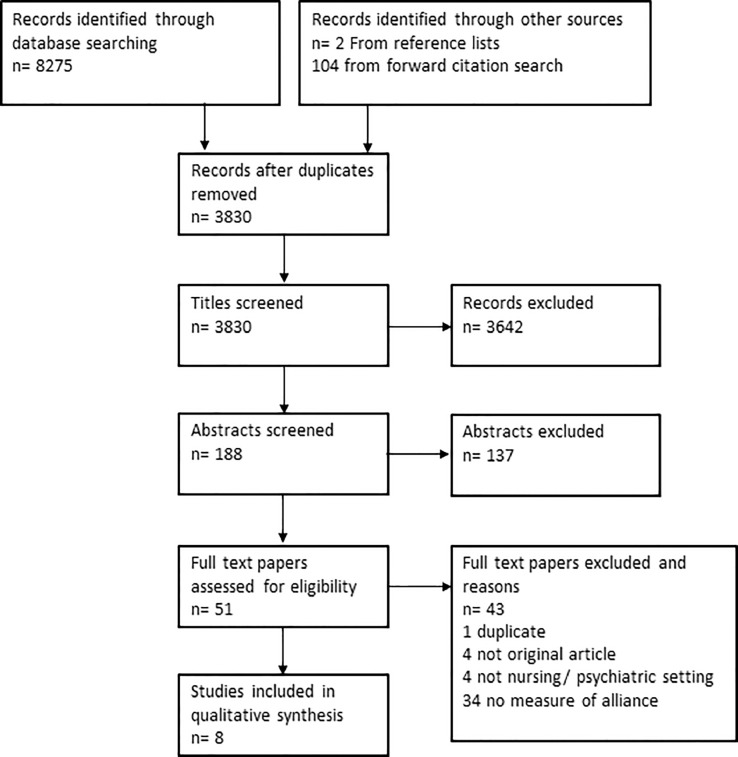
BACKGROUND: Therapeutic alliance is a core part of the nursing role and key to the attainment of positive outcomes for people utilising mental health care services. However, these relationships are sometimes difficult to develop and sustain, and nursing staff would arguably benefit from evidence-based support to foster more positive relationships. OBJECTIVES: We aimed to collate and critique papers reporting on interventions targeted at improving the nurse-patient therapeutic alliance in mental health care settings. DESIGN: Systematic literature review. DATA SOURCES: The online databases of Excerpta Medica database (Embase), PsycINFO, Medical Literature Analysis and Retrieval System Online (MEDLINE) and Cumulative Index of Nursing and Allied Health Literature (CINAHL) were searched, eligible full text paper references lists reviewed for additional works and a forward citation search conducted. REVIEW METHODS: Original journal articles in English language were included where they reported on interventions targeting the nurse-patient therapeutic relationship and included a measure of alliance. Data were extracted using a pre-determined extraction form and inter-rater reliability evaluations were conducted. Information pertaining to design, participants, interventions and findings was collated. The papers were subject to quality assessment. RESULTS: Relatively few eligible papers (n = 8) were identified, highlighting the limitations of the evidence base in this area. A range of interventions were tested, drawing on diverse theoretical and procedural underpinnings. Only half of the studies reported statistically significant results and were largely weak in methodological quality. CONCLUSIONS: The evidence base for methods to support nursing staff to develop and maintain good therapeutic relationships is poor, despite this being a key aspect of the nursing role and a major contributor to positive outcomes for service users. We reflect on why this might be and make specific recommendations for the development of a stronger evidence base, with the hope that this paper serves as a catalyst for a renewed research agenda into interventions that support good therapeutic relationships that serve both staff and patients.
Overview
The claims and statistics of this paper haven’t been checked yet.
Run the check — free, no account needed. It reads the open-access text and checks the sources it cites.
Integrity signals
Registry
Cites
Statistics
Figures
Verification
Claims the paper makes
The claims and statistics of this paper haven’t been checked yet.
Run the check — free, no account needed. It reads the open-access text and checks the sources it cites.
Claims other papers make about this one
Each is checked against this paper’s own text: does it say what the citing paper says it does?
The cited source says what the claim attributes to it.
In the citing paper
“In line with previous literature, our review reinforces that the quality of the therapeutic relationship is central to how psychiatric care is experienced [164,165].”
From Factors Associated with Perceived Coercion in Adults Receiving Psychiatric Care: A Scoping Review (2025) · cites this paper as [164]
In the citing paper
“These complex processes can be hindered by the nature of organizational structures and positions that limit the care HCPs can offer [90].”
From Therapeutic Adherence of People with Mental Disorders: An Evolutionary Concept Analysis (2023) · cites this paper as [90]
Self-check
Percentages, sums and reported differences re-computed from the paper’s own numbers.
The self-check needs the paper’s full text.
Citations
Cites
Preferred Reporting Items for Systematic Reviews and Meta-Analyses: the PRISMA statement
Moher, D., Liberati, A., Tetzlaff, J., Altman, D. G., & for the PRISMA Group (2009) · BMJ · doi:10.1136/bmj.b2535 · Cited by 83,823
Preferred reporting items for systematic reviews and meta-analyses: the PRISMA Statement.
(2009) · PubMed Central · Cited by 44,859
Preferred reporting items for systematic reviews and meta-analyses: The PRISMA statement
Moher, D., Liberati, A., Tetzlaff, J., Altman, D. G., & the PRISMA Group* (2009) · Annals of Internal Medicine · doi:10.7326/0003-4819-151-4-200908180-00135 · Cited by 37,554
The generalizability of the psychoanalytic concept of the working alliance.
Bordin, E. S. (1979) · Psychotherapy: Theory, Research & Practice · doi:10.1037/h0085885 · Cited by 5,238
Development and validation of the working alliance inventory
Horvath, A. O., & Greenberg, L. S. (1989) · Journal of Counseling Psychology · doi:10.1037//0022-0167.36.2.223 · Cited by 3,520
Relation of the therapeutic alliance with outcome and other variables: a meta-analytic review
Martin, D. J., Garske, J. P., & Davis, M. K. (2000) · Journal of Consulting and Clinical Psychology · doi:10.1037//0022-006x.68.3.438 · Cited by 3,355
Evaluating non-randomised intervention studies
Deeks, J., Dinnes, J., D'Amico, R., Sowden, A., Sakarovitch, C., Song, F., Petticrew, M., & Altman, D. (2003) · Health Technology Assessment · doi:10.3310/hta7270 · Cited by 2,907
Fitzpatrick, K. K., Darcy, A., & Vierhile, M. (2017) · JMIR Mental Health · doi:10.2196/mental.7785 · Cited by 2,730
Thomas, B. H., Ciliska, D., Dobbins, M., & Micucci, S. (2004) · Worldviews on Evidence-Based Nursing · doi:10.1111/j.1524-475x.2004.04006.x · Cited by 2,118
Popay, J., Roberts, H., Sowden, A., Petticrew, M., Arai, L., Rodgers, M., Britten, N., Roen, K., & Duffy, S. (2006) · Lancaster University · doi:10.13140/2.1.1018.4643 · Cited by 2,070
Cited by
Sorted by citations
Bickman, L. (2020) · Administration and Policy in Mental Health and Mental Health Services Research · doi:10.1007/s10488-020-01065-8 · Cited by 184
Hope and Optimism as an Opportunity to Improve the “Positive Mental Health” Demand
Laranjeira, C., & Querido, A. (2022) · Frontiers in Psychology · doi:10.3389/fpsyg.2022.827320 · Cited by 87
Anderson, T., Valiauga, R., Tallo, C., Hong, C. B., Manoranjithan, S., Domingo, C. N., Paudel, M., Untaroiu, A., Barr, S., & Goldhaber, K. (2024) · Journal of Child and Adolescent Psychiatric Nursing · doi:10.1111/jcap.70009 · Cited by 124
Raphael, J., Price, O., Hartley, S., Haddock, G., Bucci, S., & Berry, K. (2021) · International Journal of Nursing Studies · doi:10.1016/j.ijnurstu.2021.103870 · Cited by 80
Self-citationConnell, C., Jones, E. S., Haslam, M., Firestone, J., Pope, G., & Thompson, C. (2022) · Mental Health Review Journal · doi:10.1108/mhrj-02-2022-0012 · Cited by 71
Metadata
- Authors
- Hartley, S., Raphael, J., Lovell, K., & Berry, K.
- Affiliations
- Manchester Academic Health Science Centre (GB)
- University of Manchester (GB)
- Corresponding author
- Hartley, Samantha
- Venue
- International Journal of Nursing Studies
- Publisher
- Elsevier BV
- Published
- 2020-02
- Volume
- 102
- Pages
- 103490
- ISSN
- 0020-7489 (ISSN-L)
- PMC
- PMC7026691
- OpenAlex
- W2991412702
- Cited by
- 245
- References
- 82
- Citations by year
- 2026: 43 · 2025: 35 · 2024: 52 · 2023: 39 · 2022: 45 · 2021: 23 · 2020: 7
- FWCI
- 2.96
- Type
- journal article
- Language
- en
- Open access
- hybrid
- doi.org
- Licence
- Locations
- International Journal of Nursing Studies (publishedVersion, cc-by-nc-nd)
- PubMed Central (publishedVersion, cc-by-nc-nd)
- PubMed (publishedVersion)
- Research Explorer (The University of Manchester) (submittedVersion, other-oa)
- Funders
- National Institute for Health Research
- Topics
- Social Sciences › Psychology › Clinical Psychology › Psychotherapy Techniques and Applications
- Social Sciences › Psychology › Clinical Psychology › Psychiatric care and mental health services
- Health Sciences › Health Professions › General Health Professions › Patient-Provider Communication in Healthcare
- Keywords
- therapeutic relationship, psychiatric nursing, nursing interventions, nurse-patient relationship, mental health services, evidence base, methodological quality
- MeSH terms
- Therapeutic Alliance, Humans, Mental Health Services, Nurse-Patient Relations
About these checks
Registry, retraction, Cites and statistics results are computed, not judged, with one exception: a printed reference that no index lists is read once by a model before it counts as a citation error. Claims are extracted by a model and kept only when their quote appears verbatim in the text; each cited source is then checked, with a model’s help, for whether it says what the claim relies on. Those verdicts can be wrong — read the claim’s quote and the cited source before relying on one.
Statistics and arithmetic are recomputed, not judged.
Confidence bands are shown only for fields calibrated on our annotated test set. None is calibrated yet, so no band is shown.
What counts as a claim ›How we measure confidence ›How we check this ›
Are you an author, or do you see a problem with this page? Request a review
