

The DOI matches its Crossref record; 40 of the 40 references it cites were found in a registry or an index; none of the 16 sources its claims cite is checked for support yet.
MutaBind2: Predicting the Impacts of Single and Multiple Mutations on Protein-Protein Interactions
Open accessAbstract
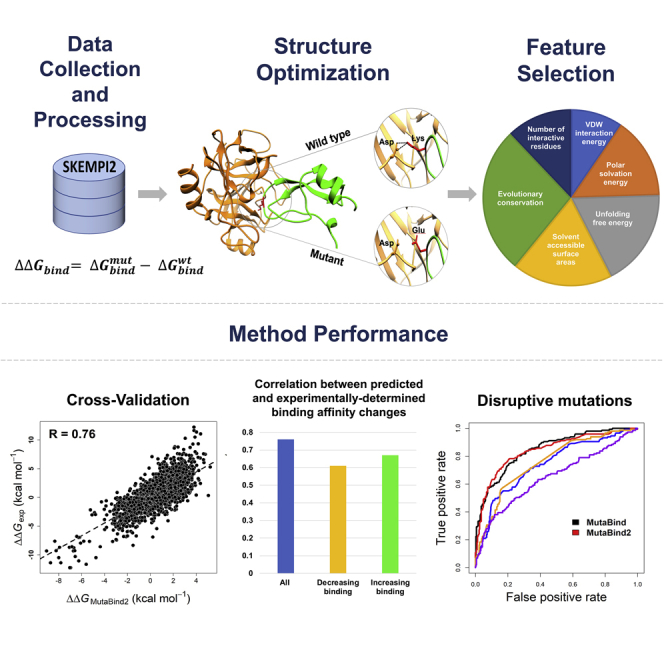
Missense mutations may affect proteostasis by destabilizing or over-stabilizing protein complexes and changing the pathway flux. Predicting the effects of stabilizing mutations on protein-protein interactions is notoriously difficult because existing experimental sets are skewed toward mutations reducing protein-protein binding affinity and many computational methods fail to correctly evaluate their effects. To address this issue, we developed a method MutaBind2, which estimates the impacts of single as well as multiple mutations on protein-protein interactions. MutaBind2 employs only seven features, and the most important of them describe interactions of proteins with the solvent, evolutionary conservation of the site, and thermodynamic stability of the complex and each monomer. This approach shows a distinct improvement especially in evaluating the effects of mutations increasing binding affinity. MutaBind2 can be used for finding disease driver mutations, designing stable protein complexes, and discovering new protein-protein interaction inhibitors.
Overview
AI snapshot
Written from the paper’s full text.
TL;DR
MutaBind2 is a structure-based method that predicts the effects of single and multiple mutations on protein-protein binding affinity using a seven-term scoring function. It improves performance especially for mutations that increase binding affinity, while requiring a 3D structure of the protein-protein complex.
Key findings
- MutaBind2 uses only seven features, with the most important describing protein-solvent interactions, evolutionary conservation of the site, and thermodynamic stability of the complex and each monomer.
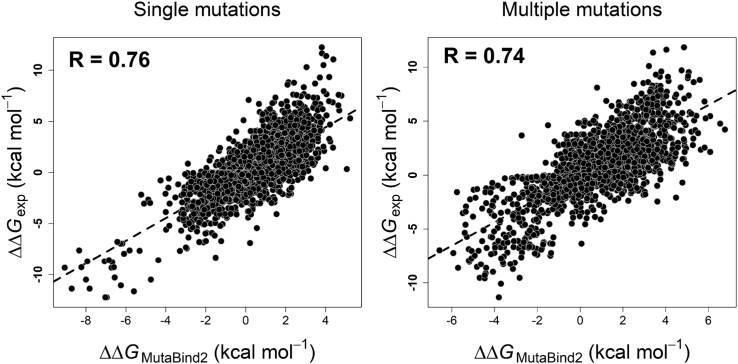
- In cross-validation, MutaBind2 achieved Pearson R = 0.76 for single mutations and R = 0.74 for multiple mutations under leave-one-complex-out (CV4); under leave-one-binding-site-out (CV5), R = 0.69 for single and R = 0.71 for multiple mutations.
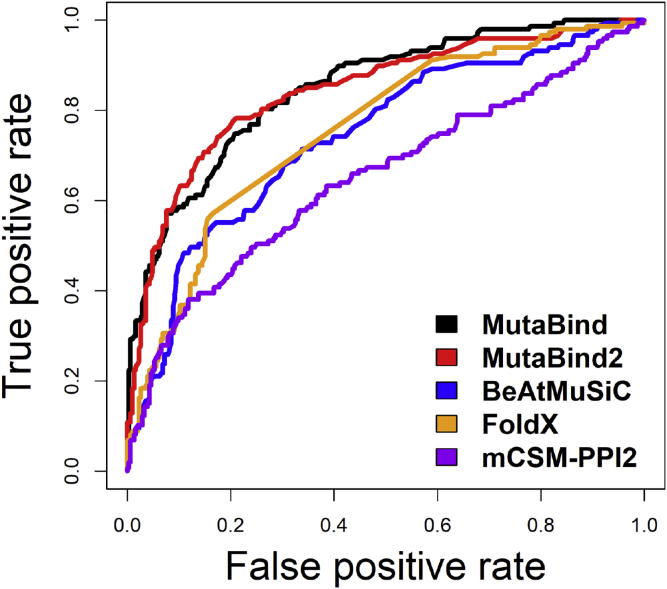
- On the independent S1748 set, retraining on the SKEMPI set enriched with reverse mutations improved R from 0.38 to 0.63 and reduced RMSE from 1.51 to 1.25 kcal mol−1; for highly increasing mutations, MutaBind2 reached AUC = 0.86 versus MutaBind 0.65, BeAtMuSiC 0.56, and FoldX 0.74.
- For multiple mutations, the worst performance was for three or more mutations on the same chain (R = 0.61 in CV4), and the best was for double mutations on multiple chains (R = 0.85 in CV4).
Methods
- MutaBind2 employs a new minimization protocol and a scoring function with seven terms, trained on a larger SKEMPI2 dataset containing 1.7 times more mutations and 3.3 times more complexes than SKEMPI, and enriched with structural models of reverse mutations to balance mutations increasing binding affinity.
- Performance was assessed with five cross-validation procedures (CV1–CV5), independent test sets including S1748, S4191, M1707, S487, and S8338, and comparisons with BeAtMuSiC, FoldX, iSEE, and mCSM-PPI2.
- The paper also evaluated predictions against yeast two-hybrid data covering 4,797 mutation-interaction pairs, of which 451 mutations could be mapped to known 3D structures and 147 were interaction-disruptive; main metrics included Pearson R, RMSE, slope, ROC/AUC, MCC, sensitivity, and specificity.
Limitations
- Stated: MutaBind2 requires the 3D structure of a protein-protein complex; six of seven features are calculated from that structure, limiting application to mutations that cannot be mapped to a structural complex.
- Stated: multiple-mutation instances with more than 10 mutations are not supported because such cases are rare in the training data and prediction accuracy is low.
- Evident from the text: outliers are more likely in complexes with higher protein-protein binding affinity and at mutated sites with more hydrogen bonds, and performance improves significantly after removing 5% outliers.
Model-written summary. Check it against the paper before relying on it.
Integrity signals
Registry
Cites
Statistics
Figures
Verification
Claims the paper makes
20 Own result · 10 Not checked yet · 3 No basis given · 2 Own interpretation
A result the paper reports from its own data — it cites no other source for it, so there is none to check. The quote shows it is in the paper.
In the paper
“This approach shows a distinct improvement especially in evaluating the effects of mutations increasing binding affinity.”
- Also stated in: § Validation of MutaBind2 on Independent Test Sets · boosted
“predictions for mutations increasing binding affinity were significantly improved without compromising the accuracy for predicting mutations decreasing binding affinity (Table 1).”
§ MutaBind2: Predicting the Impacts of Single and Multiple Mutations on Protein-Protein Interactions > Abstract
boosteddirect- Asserted: passes — The authors put it forward as true.
- Checkable: passes — It can be checked against evidence.
- Load-bearing: passes — The paper’s conclusions depend on it.
- Based: passes — The paper gives a reason why it holds.
- Also stated in: § Validation of MutaBind2 on Independent Test Sets · boosted
In the paper
“Consistent with the observation of Pires et al. (Pires et al., 2016), the outliers usually correspond to those mutations with extreme experimental values (highly decreasing/increasing binding affinity)”
§ MutaBind2: Predicting the Impacts of Single and Multiple Mutations on Protein-Protein Interactions > Results and Discussion > Evaluating the Performance of MutaBind2 Using Cross-Validation
What the sources say
- Not checked yetcites Pires et al., 2016 source
plaincorrelational- Asserted: passes — The authors put it forward as true.
- Checkable: passes — It can be checked against evidence.
- Load-bearing: unclear — It is unclear whether the paper’s conclusions depend on it.
- Based: passes — The paper gives a reason why it holds.
The paper states this without a source or data behind it here, so there is nothing to check it against. The quote shows it is in the paper.
In the paper
“MutaBind2 employs only seven features”
- Also stated in: § Results and Discussion · plain
“we designed a scoring function with seven terms instead of 10 used in the previous MutaBind version”
§ MutaBind2: Predicting the Impacts of Single and Multiple Mutations on Protein-Protein Interactions > Abstract
plain- Asserted: passes — The authors put it forward as true.
- Checkable: passes — It can be checked against evidence.
- Load-bearing: passes — The paper’s conclusions depend on it.
- Based: passes — The paper gives a reason why it holds.
- Also stated in: § Results and Discussion · plain
A result the paper reports from its own data — it cites no other source for it, so there is none to check. The quote shows it is in the paper.
In the paper
“Figures 3 and S5 show excellent performance of MutaBind and MutaBind2 in distinguishing interaction-disruptive from other mutations.”
§ MutaBind2: Predicting the Impacts of Single and Multiple Mutations on Protein-Protein Interactions > Results and Discussion > Validation of MutaBind2 on Independent Test Sets
plaincorrelational- Asserted: passes — The authors put it forward as true.
- Checkable: passes — It can be checked against evidence.
- Load-bearing: passes — The paper’s conclusions depend on it.
- Based: passes — The paper gives a reason why it holds.
A result the paper reports from its own data — it cites no other source for it, so there is none to check. The quote shows it is in the paper.
In the paper
“Figure S11A shows that the performance is improved significantly after removing 5% outliers.”
§ MutaBind2: Predicting the Impacts of Single and Multiple Mutations on Protein-Protein Interactions > Results and Discussion > Evaluating the Performance of MutaBind2 Using Cross-Validation
plaindirect- Asserted: passes — The authors put it forward as true.
- Checkable: passes — It can be checked against evidence.
- Load-bearing: unclear — It is unclear whether the paper’s conclusions depend on it.
- Based: passes — The paper gives a reason why it holds.
In the paper
“We obtained comparable correlation coefficients with mCSM-PPI2 using the CV4 and CV5 cross-validations (Table 2)”
§ MutaBind2: Predicting the Impacts of Single and Multiple Mutations on Protein-Protein Interactions > Results and Discussion > Validation of MutaBind2 on Independent Test Sets
What the sources say
- Not checked yetcites Rodrigues et al., 2019 source
plain- Asserted: passes — The authors put it forward as true.
- Checkable: passes — It can be checked against evidence.
- Load-bearing: unclear — It is unclear whether the paper’s conclusions depend on it.
- Based: passes — The paper gives a reason why it holds.
A result the paper reports from its own data — it cites no other source for it, so there is none to check. The quote shows it is in the paper.
In the paper
“the MutaBind2 model parameterized on this training set shows the best performance on S487 compared with other methods (more comparisons can be found in Table S5).”
§ MutaBind2: Predicting the Impacts of Single and Multiple Mutations on Protein-Protein Interactions > Results and Discussion > Validation of MutaBind2 on Independent Test Sets
plain- Asserted: passes — The authors put it forward as true.
- Checkable: passes — It can be checked against evidence.
- Load-bearing: passes — The paper’s conclusions depend on it.
- Based: passes — The paper gives a reason why it holds.
A result the paper reports from its own data — it cites no other source for it, so there is none to check. The quote shows it is in the paper.
In the paper
“which points to a slightly better performance for MutaBind2 in terms of the slope of the regression line indicating that predicted and experimental values are on the same scale.”
§ MutaBind2: Predicting the Impacts of Single and Multiple Mutations on Protein-Protein Interactions > Results and Discussion > Validation of MutaBind2 on Independent Test Sets
hedgedcorrelational- Asserted: passes — The authors put it forward as true.
- Checkable: passes — It can be checked against evidence.
- Load-bearing: unclear — It is unclear whether the paper’s conclusions depend on it.
- Based: passes — The paper gives a reason why it holds.
A result the paper reports from its own data — it cites no other source for it, so there is none to check. The quote shows it is in the paper.
In the paper
“we developed a method MutaBind2, which estimates the impacts of single as well as multiple mutations on protein-protein interactions.”
- Also stated in: § Introduction · plain
“In addition to single mutations, it can predict the effects of multiple mutations on protein binding affinity.”
§ MutaBind2: Predicting the Impacts of Single and Multiple Mutations on Protein-Protein Interactions > Abstract
plain- Asserted: passes — The authors put it forward as true.
- Checkable: passes — It can be checked against evidence.
- Load-bearing: passes — The paper’s conclusions depend on it.
- Based: passes — The paper gives a reason why it holds.
- Rests on an assumption: Large-scale rapid experimental assays that would allow the assessment of thousands of variants are still limited.
- Also stated in: § Introduction · plain
A result the paper reports from its own data — it cites no other source for it, so there is none to check. The quote shows it is in the paper.
In the paper
“Table 3 and Figure S6 demonstrate the high performance of MutaBind2 in predicting mutations highly decreasing and highly increasing binding affinity (see Methods for details).”
§ MutaBind2: Predicting the Impacts of Single and Multiple Mutations on Protein-Protein Interactions > Results and Discussion > Prediction of Mutations Highly Decreasing and Increasing Binding Affinity
boosted- Asserted: passes — The authors put it forward as true.
- Checkable: passes — It can be checked against evidence.
- Load-bearing: passes — The paper’s conclusions depend on it.
- Based: passes — The paper gives a reason why it holds.
The paper states this without a source or data behind it here, so there is nothing to check it against. The quote shows it is in the paper.
In the paper
“In addition, FoldX and MutaBind2 provide predictions and structural models for multiple mutations introduced at the same time in a protein complex.”
§ MutaBind2: Predicting the Impacts of Single and Multiple Mutations on Protein-Protein Interactions > Results and Discussion > Prediction of Mutations Highly Decreasing and Increasing Binding Affinity
plain- Asserted: passes — The authors put it forward as true.
- Checkable: passes — It can be checked against evidence.
- Load-bearing: passes — The paper’s conclusions depend on it.
- Based: passes — The paper gives a reason why it holds.
In the paper
“we can conclude that the MutaBind2 for single mutations significantly outperforms the previous version of MutaBind, which had R = 0.68 and R = 0.57 for “CV4” and “CV5,” respectively (Li et al., 2016b)”
§ MutaBind2: Predicting the Impacts of Single and Multiple Mutations on Protein-Protein Interactions > Results and Discussion > Evaluating the Performance of MutaBind2 Using Cross-Validation
What the sources say
- Not checked yetcites Li et al., 2016b
boosteddirect- Asserted: passes — The authors put it forward as true.
- Checkable: passes — It can be checked against evidence.
- Load-bearing: passes — The paper’s conclusions depend on it.
- Based: passes — The paper gives a reason why it holds.
A result the paper reports from its own data — it cites no other source for it, so there is none to check. The quote shows it is in the paper.
In the paper
“As the number of multiple mutations with more than 10 mutations is small in our training dataset and prediction accuracy for these multiple mutations is low, the upper limit of 10 mutations was used in the study.”
§ MutaBind2: Predicting the Impacts of Single and Multiple Mutations on Protein-Protein Interactions > Results and Discussion > Limitation of the Study
plain- Asserted: passes — The authors put it forward as true.
- Checkable: passes — It can be checked against evidence.
- Load-bearing: passes — The paper’s conclusions depend on it.
- Based: passes — The paper gives a reason why it holds.
A result the paper reports from its own data — it cites no other source for it, so there is none to check. The quote shows it is in the paper.
In the paper
“MutaBind2 could correctly classify them as either increasing or decreasing binding affinity (Figures S11C and S11D).”
§ MutaBind2: Predicting the Impacts of Single and Multiple Mutations on Protein-Protein Interactions > Results and Discussion > Evaluating the Performance of MutaBind2 Using Cross-Validation
hedged- Asserted: passes — The authors put it forward as true.
- Checkable: passes — It can be checked against evidence.
- Load-bearing: unclear — It is unclear whether the paper’s conclusions depend on it.
- Based: passes — The paper gives a reason why it holds.
A result the paper reports from its own data — it cites no other source for it, so there is none to check. The quote shows it is in the paper.
In the paper
“In addition to single mutations, it can predict the effects of multiple mutations on protein binding affinity.”
- Also stated in: § Results and Discussion · plain
“we added a new functionality of predicting the effects of multiple mutations (up to 10 mutations) on binding affinity”
§ MutaBind2: Predicting the Impacts of Single and Multiple Mutations on Protein-Protein Interactions > Introduction
plaindirect- Asserted: passes — The authors put it forward as true.
- Checkable: passes — It can be checked against evidence.
- Load-bearing: passes — The paper’s conclusions depend on it.
- Based: passes — The paper gives a reason why it holds.
- Also stated in: § Results and Discussion · plain
In the paper
“existing experimental sets are skewed toward mutations reducing protein-protein binding affinity”
- Also stated in: § Introduction · plain
“the existing experimental sets are enriched with mutations that decrease binding”
§ MutaBind2: Predicting the Impacts of Single and Multiple Mutations on Protein-Protein Interactions > Abstract
What the sources say
- Not checked yetcites Usmanova et al., 2018 source
plaincorrelational- Asserted: passes — The authors put it forward as true.
- Checkable: passes — It can be checked against evidence.
- Load-bearing: passes — The paper’s conclusions depend on it.
- Based: passes — The paper gives a reason why it holds.
- Also stated in: § Introduction · plain
None of the sources cited for this claim have been checked yet.
In the paper
“many computational methods fail to correctly evaluate their effects”
- Also stated in: § Introduction · plain
“existing computational methods perform much better for mutations decreasing than for mutations increasing binding affinity”
§ MutaBind2: Predicting the Impacts of Single and Multiple Mutations on Protein-Protein Interactions > Abstract
What the sources say
plain- Asserted: passes — The authors put it forward as true.
- Checkable: passes — It can be checked against evidence.
- Load-bearing: passes — The paper’s conclusions depend on it.
- Based: passes — The paper gives a reason why it holds.
- Rests on an assumption: The methodologies of training procedures employed by many computational methods rely on experimental sets enriched with mutations that decrease binding.
- Also stated in: § Introduction · plain
A conclusion the paper draws from its own results — it cites no other source for it, so there is none to check. The quote shows it is in the paper.
In the paper
“Six features out of seven in our model are calculated using 3D structure of a protein-protein complex, which limits the application to those mutations that could not be mapped to the structural complex.”
§ MutaBind2: Predicting the Impacts of Single and Multiple Mutations on Protein-Protein Interactions > Results and Discussion > Limitation of the Study
plaindirect- Asserted: passes — The authors put it forward as true.
- Checkable: passes — It can be checked against evidence.
- Load-bearing: passes — The paper’s conclusions depend on it.
- Based: passes — The paper gives a reason why it holds.
None of the sources cited for this claim have been checked yet.
In the paper
“Critically, existing computational methods perform much better for mutations decreasing than for mutations increasing binding affinity.”
§ MutaBind2: Predicting the Impacts of Single and Multiple Mutations on Protein-Protein Interactions > Introduction
What the sources say
plaincorrelational- Asserted: passes — The authors put it forward as true.
- Checkable: passes — It can be checked against evidence.
- Load-bearing: passes — The paper’s conclusions depend on it.
- Based: passes — The paper gives a reason why it holds.
- Rests on an assumption: The methodologies of training procedures employed by many computational methods rely on experimental sets enriched with mutations that decrease binding.
In the paper
“the amplitude of this bias increased with the number of introduced mutations in a protein (Usmanova et al., 2018).”
§ MutaBind2: Predicting the Impacts of Single and Multiple Mutations on Protein-Protein Interactions > Introduction
What the sources say
- Not checked yetcites Usmanova et al., 2018 source
plaindirect- Asserted: passes — The authors put it forward as true.
- Checkable: passes — It can be checked against evidence.
- Load-bearing: passes — The paper’s conclusions depend on it.
- Based: passes — The paper gives a reason why it holds.
- Rests on an assumption: The methodologies of training procedures employed by many computational methods rely on experimental sets enriched with mutations that decrease binding.
A conclusion the paper draws from its own results — it cites no other source for it, so there is none to check. The quote shows it is in the paper.
In the paper
“Therefore, our model cannot be applied to the multiple mutation instances with more than 10 mutations.”
§ MutaBind2: Predicting the Impacts of Single and Multiple Mutations on Protein-Protein Interactions > Results and Discussion > Limitation of the Study
plain- Asserted: passes — The authors put it forward as true.
- Checkable: passes — It can be checked against evidence.
- Load-bearing: passes — The paper’s conclusions depend on it.
- Based: passes — The paper gives a reason why it holds.
- It may state two separate claims as one. 14
A result the paper reports from its own data — it cites no other source for it, so there is none to check. The quote shows it is in the paper.
In the paper
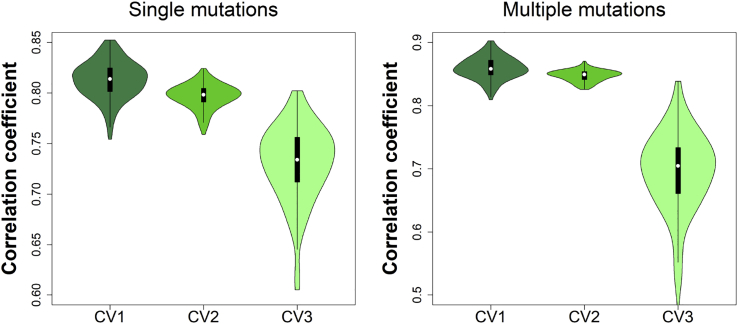
“The correlation coefficients of each cross-validation round exceed 0.80 for “CV1” and “CV2” and about 0.70 for “CV3” cross-validation for both single and multiple mutations.”
§ MutaBind2: Predicting the Impacts of Single and Multiple Mutations on Protein-Protein Interactions > Results and Discussion > Evaluating the Performance of MutaBind2 Using Cross-Validation
plaincorrelational- Asserted: passes — The authors put it forward as true.
- Checkable: passes — It can be checked against evidence.
- Load-bearing: passes — The paper’s conclusions depend on it.
- Based: passes — The paper gives a reason why it holds.
It may state two separate claims as one.
The paper states this without a source or data behind it here, so there is nothing to check it against. The quote shows it is in the paper.
In the paper
“Importantly, MutaBind and MutaBind2, unlike other methods mentioned earlier, estimate interactions of a protein with the solvent, which is one of the most important terms together with the site evolutionary conservation and thermodynamic stability of a protein complex and each binding partner (Table S2).”
§ MutaBind2: Predicting the Impacts of Single and Multiple Mutations on Protein-Protein Interactions > Results and Discussion > Prediction of Mutations Highly Decreasing and Increasing Binding Affinity
plain- Asserted: passes — The authors put it forward as true.
- Checkable: passes — It can be checked against evidence.
- Load-bearing: passes — The paper’s conclusions depend on it.
- Based: passes — The paper gives a reason why it holds.
It may state two separate claims as one.
A result the paper reports from its own data — it cites no other source for it, so there is none to check. The quote shows it is in the paper.
In the paper
“we found that the outliers are more likely to appear in complexes with higher protein-protein binding affinity and at the mutated sites with higher number of hydrogen bonds (Figure S11B).”
§ MutaBind2: Predicting the Impacts of Single and Multiple Mutations on Protein-Protein Interactions > Results and Discussion > Evaluating the Performance of MutaBind2 Using Cross-Validation
hedgedcorrelational- Asserted: passes — The authors put it forward as true.
- Checkable: passes — It can be checked against evidence.
- Load-bearing: unclear — It is unclear whether the paper’s conclusions depend on it.
- Based: passes — The paper gives a reason why it holds.
It may state two separate claims as one.
A result the paper reports from its own data — it cites no other source for it, so there is none to check. The quote shows it is in the paper.
In the paper
“The Pearson correlation coefficient between experimental and computed ΔΔG values using the “leave-one-complex-out” (“CV4”) procedure reaches 0.76 for single mutations and 0.74 for multiple mutations (Table 1 and Figure 2).”
§ MutaBind2: Predicting the Impacts of Single and Multiple Mutations on Protein-Protein Interactions > Results and Discussion > Evaluating the Performance of MutaBind2 Using Cross-Validation
plaincorrelational- Asserted: passes — The authors put it forward as true.
- Checkable: passes — It can be checked against evidence.
- Load-bearing: passes — The paper’s conclusions depend on it.
- Based: passes — The paper gives a reason why it holds.
It may state two separate claims as one.
A result the paper reports from its own data — it cites no other source for it, so there is none to check. The quote shows it is in the paper.
In the paper
“We found that MutaBind2 performed well for almost all categories; the worst performance was observed for three or more mutations introduced on the same chain (R = 0.61 in CV4 validation), and the best performance was achieved for double mutations on multiple chains (R = 0.85 in CV4 validation).”
§ MutaBind2: Predicting the Impacts of Single and Multiple Mutations on Protein-Protein Interactions > Results and Discussion > Prediction of Mutations Highly Decreasing and Increasing Binding Affinity
plaincorrelational- Asserted: passes — The authors put it forward as true.
- Checkable: passes — It can be checked against evidence.
- Load-bearing: passes — The paper’s conclusions depend on it.
- Based: passes — The paper gives a reason why it holds.
It may state two separate claims as one.
A result the paper reports from its own data — it cites no other source for it, so there is none to check. The quote shows it is in the paper.
In the paper
“the correlation coefficient remained statistically significant, being equal to 0.69 for single mutations and 0.71 for multiple mutations (Table 1 and Figure S4D).”
§ MutaBind2: Predicting the Impacts of Single and Multiple Mutations on Protein-Protein Interactions > Results and Discussion > Evaluating the Performance of MutaBind2 Using Cross-Validation
plaincorrelational- Asserted: passes — The authors put it forward as true.
- Checkable: passes — It can be checked against evidence.
- Load-bearing: passes — The paper’s conclusions depend on it.
- Based: passes — The paper gives a reason why it holds.
It may state two separate claims as one.
A result the paper reports from its own data — it cites no other source for it, so there is none to check. The quote shows it is in the paper.
In the paper
“MutaBind2 further improves the performance for both interfacial and non-interfacial mutations compared with the previous version and outperforms other methods on the S1748 set (Figure S7).”
§ MutaBind2: Predicting the Impacts of Single and Multiple Mutations on Protein-Protein Interactions > Results and Discussion > Prediction of Mutations Highly Decreasing and Increasing Binding Affinity
plaindirect- Asserted: passes — The authors put it forward as true.
- Checkable: passes — It can be checked against evidence.
- Load-bearing: passes — The paper’s conclusions depend on it.
- Based: passes — The paper gives a reason why it holds.
It may state two separate claims as one.
A result the paper reports from its own data — it cites no other source for it, so there is none to check. The quote shows it is in the paper.
In the paper
“we trained our models on a much larger dataset from SKEMPI2, which encompassed 1.7 times more mutations and 3.3 times more complexes compared with SKEMPI used for training of MutaBind.”
§ MutaBind2: Predicting the Impacts of Single and Multiple Mutations on Protein-Protein Interactions > Results and Discussion
plain- Asserted: passes — The authors put it forward as true.
- Checkable: passes — It can be checked against evidence.
- Load-bearing: passes — The paper’s conclusions depend on it.
- Based: passes — The paper gives a reason why it holds.
It may state two separate claims as one.
A result the paper reports from its own data — it cites no other source for it, so there is none to check. The quote shows it is in the paper.
In the paper
“the most important of them describe interactions of proteins with the solvent, evolutionary conservation of the site, and thermodynamic stability of the complex and each monomer.”
- Also stated in: § Prediction of Mutations Highly Decreasing and Increasing Binding Affinity · plain
“MutaBind and MutaBind2, unlike other methods mentioned earlier, estimate interactions of a protein with the solvent, which is one of the most important terms together with the site evolutionary conservation and thermodynamic stability of a protein complex and each binding partner (Table S2).”
§ MutaBind2: Predicting the Impacts of Single and Multiple Mutations on Protein-Protein Interactions > Abstract
plain- Asserted: passes — The authors put it forward as true.
- Checkable: passes — It can be checked against evidence.
- Load-bearing: passes — The paper’s conclusions depend on it.
- Based: passes — The paper gives a reason why it holds.
It may state two separate claims as one.
- Also stated in: § Prediction of Mutations Highly Decreasing and Increasing Binding Affinity · plain
A result the paper reports from its own data — it cites no other source for it, so there is none to check. The quote shows it is in the paper.
In the paper
“the performance on an independent S1748 set improved considerably (the correlation coefficient increased from 0.38 to 0.63, and root-mean-square error decreased from 1.51 to 1.25 kcal mol−1).”
§ MutaBind2: Predicting the Impacts of Single and Multiple Mutations on Protein-Protein Interactions > Results and Discussion > Validation of MutaBind2 on Independent Test Sets
plaindirect- Asserted: passes — The authors put it forward as true.
- Checkable: passes — It can be checked against evidence.
- Load-bearing: passes — The paper’s conclusions depend on it.
- Based: passes — The paper gives a reason why it holds.
It may state two separate claims as one.
- Rests on an assumption: The methodologies of training procedures employed by many computational methods rely on experimental sets enriched with mutations that decrease binding.
A result the paper reports from its own data — it cites no other source for it, so there is none to check. The quote shows it is in the paper.
In the paper
“Moreover, predictions for mutations increasing binding affinity were significantly improved without compromising the accuracy for predicting mutations decreasing binding affinity (Table 1).”
§ MutaBind2: Predicting the Impacts of Single and Multiple Mutations on Protein-Protein Interactions > Results and Discussion > Validation of MutaBind2 on Independent Test Sets
plaindirect- Asserted: passes — The authors put it forward as true.
- Checkable: passes — It can be checked against evidence.
- Load-bearing: passes — The paper’s conclusions depend on it.
- Based: passes — The paper gives a reason why it holds.
It may state two separate claims as one.
- Rests on an assumption: The methodologies of training procedures employed by many computational methods rely on experimental sets enriched with mutations that decrease binding.
None of the sources cited for this claim have been checked yet.
In the paper
“Missense mutations may affect proteostasis by destabilizing or over-stabilizing protein complexes and changing the pathway flux.”
- Also stated in: § Introduction · hedged
“However, the latter may also have important consequences leading to disruption of proteostasis by over-stabilizing transient protein complexes (Nishi et al., 2013, Stefl et al., 2013, Rutten et al., 2018, Shoichet et al., 1995, Nagatani et al., 2007, Witham et al., 2011, Jubb et al., 2016) and changing the pathway flux.”
§ MutaBind2: Predicting the Impacts of Single and Multiple Mutations on Protein-Protein Interactions > Abstract
What the sources say
- Not checked yetcites Nishi et al., 2013
- Not checked yetcites Stefl et al., 2013
- Not checked yetcites Rutten et al., 2018
hedgedconditional- Asserted: passes — The authors put it forward as true.
- Checkable: passes — It can be checked against evidence.
- Load-bearing: passes — The paper’s conclusions depend on it.
- Based: passes — The paper gives a reason why it holds.
It may state two separate claims as one.
- Also stated in: § Introduction · hedged
In the paper
“MutaBind2 can be used for finding disease driver mutations, designing stable protein complexes, and discovering new protein-protein interaction inhibitors.”
- Also stated in: § Introduction · plain
“MutaBind2 can be applied to a large number of tasks, including, but not limited to, finding disease driver mutations and understanding their molecular mechanisms, assessing the effects of sequence variants on protein fitness, structural modeling of mutant complexes, and designing protein interaction inhibitors (Goncearenco et al., 2017).”
§ MutaBind2: Predicting the Impacts of Single and Multiple Mutations on Protein-Protein Interactions > Abstract
What the sources say
- Not checked yetcites Goncearenco et al., 2017
plain- Asserted: passes — The authors put it forward as true.
- Checkable: passes — It can be checked against evidence.
- Load-bearing: passes — The paper’s conclusions depend on it.
- Based: passes — The paper gives a reason why it holds.
It may state two separate claims as one.
- Rests on an assumption: Large-scale rapid experimental assays that would allow the assessment of thousands of variants are still limited.
- Also stated in: § Introduction · plain
In the paper
“The previous version, MutaBind, could predict single mutations highly decreasing binding affinity relatively well but failed to annotate mutations highly increasing affinity.”
§ MutaBind2: Predicting the Impacts of Single and Multiple Mutations on Protein-Protein Interactions > Results and Discussion > Prediction of Mutations Highly Decreasing and Increasing Binding Affinity
What the sources say
- Not checked yetcites Li et al., 2016b
hedged- Asserted: passes — The authors put it forward as true.
- Checkable: passes — It can be checked against evidence.
- Load-bearing: passes — The paper’s conclusions depend on it.
- Based: passes — The paper gives a reason why it holds.
It may state two separate claims as one.
- Rests on an assumption: The methodologies of training procedures employed by many computational methods rely on experimental sets enriched with mutations that decrease binding.
The paper relies on this without support.
Proteins and their binding interfaces tend to be optimized in evolution with regard to their stability.
“proteins and their binding interfaces tend to be optimized in evolution with regard to their stability”
The paper relies on this without support.
The methodologies of training procedures employed by many computational methods rely on experimental sets enriched with mutations that decrease binding.
“the methodologies of training procedures employed by many computational methods rely on these experimental sets”
The paper relies on this without support.
Large-scale rapid experimental assays that would allow the assessment of thousands of variants are still limited.
“large-scale rapid experimental assays that would allow the assessment of thousands of variants are still limited”
The paper relies on this without support.
The majority of mutations produce rather subtle effects with unclear clinical significance.
“the majority of mutations produce rather subtle effects with unclear clinical significance”
Claims other papers make about this one
Each is checked against this paper’s own text: does it say what the citing paper says it does?
In the citing paper
“Considering that the seven features used in MutaBind2 are manually designed, these features may not comprehensively characterize the impacts of mutations.”
From Deep geometric representations for modeling effects of mutations on protein-protein binding affinity (2021) · cites this paper as [15]
In the citing paper
“These poor results of MutaBind2 were consistent with the previous report that MutaBind2 does not generalize to the cases with large-number mutations [15].”
From Deep geometric representations for modeling effects of mutations on protein-protein binding affinity (2021) · cites this paper as [15]
Citations
Cites
DeLong, E. R., DeLong, D. M., & Clarke-Pearson, D. L. (1988) · Biometrics · doi:10.2307/2531595 · Cited by 22,649
Guerois, R., Nielsen, J. E., & Serrano, L. (2002) · Journal of Molecular Biology · doi:10.1016/s0022-2836(02)00442-4 · Cited by 1,728
mCSM: Predicting the effects of mutations in proteins using graph-based signatures
Pires, D. E. V., Ascher, D. B., & Blundell, T. L. (2014) · Bioinformatics · doi:10.1093/bioinformatics/btt691 · Cited by 1,066
A relationship between protein stability and protein function.
Shoichet, B. K., Baase, W. A., Kuroki, R., & Matthews, B. W. (1995) · Proceedings of the National Academy of Sciences · doi:10.1073/pnas.92.2.452 · Cited by 712
Widespread macromolecular interaction perturbations in human genetic disorders
Sahni, N., Yi, S., Taipale, M., Fuxman Bass, J. I., Coulombe-Huntington, J., Yang, F., Peng, J., Weile, J., Karras, G. I., Wang, Y., et al. (2015) · Cell · doi:10.1016/j.cell.2015.04.013 · Cited by 594
Jankauskaitė, J., Jiménez-García, B., Dapkūnas, J., Fernández-Recio, J., & Moal, I. H. (2019) · Bioinformatics · doi:10.1093/bioinformatics/bty635 · Cited by 389 · cited 2×
“In addition, a “CV5” cross-validation accounted for similarities between binding sites of different complexes (the definition of similar binding sites is taken from (Jankauskaite et al., 2019; Moal and Fernandez-Recio, 2012)).”
BackgroundThree-dimensional reconstruction of protein networks provides insight into human genetic disease
Wang, X., Wei, X., Thijssen, B., Das, J., Lipkin, S. M., & Yu, H. (2012) · Nature Biotechnology · doi:10.1038/nbt.2106 · Cited by 385
mCSM-PPI2: predicting the effects of mutations on protein–protein interactions
Rodrigues, C. H. M., Myung, Y., Pires, D. E. V., & Ascher, D. B. (2019) · Nucleic Acids Research · doi:10.1093/nar/gkz383 · Cited by 369
Molecular Mechanisms of Disease-Causing Missense Mutations
Stefl, S. K., Nishi, H., Petukh, M. G., Panchenko, A. R., & Alexov, E. (2013) · Journal of Molecular Biology · doi:10.1016/j.jmb.2013.07.014 · Cited by 345
Self-citationBeAtMuSiC: prediction of changes in protein–protein binding affinity on mutations
Dehouck, Y., Kwasigroch, J. M., Rooman, M., & Gilis, D. (2013) · Nucleic Acids Research · doi:10.1093/nar/gkt450 · Cited by 338
Cited by
Sorted by citations
Mutations Strengthened SARS-CoV-2 Infectivity
Chen, J., Wang, R., Wang, M., & Wei, G. (2020) · Journal of Molecular Biology · doi:10.1016/j.jmb.2020.07.009 · Cited by 468
“These databases have been used as benchmarks for evaluating the predictive power of various computational methods [18, 22, 23, 25, 27, 39].”
MethodPremPS: Predicting the impact of missense mutations on protein stability
Chen, Y., Lu, H., Zhang, N., Zhu, Z., Wang, S., & Li, M. (2020) · PLoS Computational Biology · doi:10.1371/journal.pcbi.1008543 · Cited by 263
Self-citationNew insights into protein–protein interaction modulators in drug discovery and therapeutic advance
Nada, H., Choi, Y., Kim, S.-D., Jeong, K. S., Meanwell, N. A., & Lee, K. (2024) · Signal Transduction and Targeted Therapy · doi:10.1038/s41392-024-02036-3 · Cited by 241
“98 The combination of computational methods such as MD simulations, docking and CAS provide a powerful tool for accelerating the identi fi cation process of hot spots within PPIs and pave the way for the development of targeted therapeutics through structure-based drug design.”
Shan, S., Luo, S., Yang, Z., Hong, J., Su, Y., Ding, F., Fu, L., Li, C., Chen, P., Ma, J., et al. (2022) · Proceedings of the National Academy of Sciences · doi:10.1073/pnas.2122954119 · Cited by 157
“Anadditionalsubset consisting of multipoint mutations (M1707) (40) was also used as a benchmark; Pearson correlation on this subset is reported in SI Appendix , Table S1.”
Deep geometric representations for modeling effects of mutations on protein-protein binding affinity
Liu, X., Luo, Y., Li, P., Song, S., & Peng, J. (2021) · PLOS Computational Biology · doi:10.1371/journal.pcbi.1009284 · Cited by 140
“In addition, Zhang et al. [15] collected 1337 variants with multi-point mutations and parts of their reversed mutations to build a multi-point mutation dataset, named the M1707 dataset.”
Influential
Metadata
- Authors
- Zhang, N., Chen, Y., Lu, H., Zhao, F., Alvarez, R. V., Goncearenco, A., Panchenko, A. R., & Li, M.
- Affiliations
- Soochow University (CN)
- National Institutes of Health (US)
- Corresponding author
- Panchenko, Anna R.
- Li, Minghui
- ORCID
- Venue
- iScience
- Publisher
- Elsevier BV
- Published
- 2020-03
- Volume
- 23
- Issue
- 3
- Pages
- 100939
- ISSN
- 2589-0042 (ISSN-L)
- PMC
- PMC7068639
- OpenAlex
- W3007500173
- Semantic Scholar
- 5faf5bb301204d9c646e0e1108a5e0d0424aa099
- Cited by
- 199
- References
- 40
- Citations by year
- 2026: 15 · 2025: 35 · 2024: 41 · 2023: 45 · 2022: 29 · 2021: 25 · 2020: 8
- FWCI
- 8.68
- Type
- journal article
- Language
- en
- Open access
- gold
- doi.org
- Licence
- Locations
- iScience (publishedVersion, cc-by-nc-nd)
- Europe PMC (PubMed Central) (publishedVersion, cc-by-nc-nd)
- PubMed Central (publishedVersion, cc-by-nc-nd)
- PubMed (publishedVersion)
- DOAJ (DOAJ: Directory of Open Access Journals) (submittedVersion, cc-by-sa)
- Funders
- Natural Science Foundation of Jiangsu Province
- National Natural Science Foundation of China
- Topics
- Life Sciences › Biochemistry, Genetics and Molecular Biology › Molecular Biology › Machine Learning in Bioinformatics
- Life Sciences › Biochemistry, Genetics and Molecular Biology › Molecular Biology › Protein Structure and Dynamics
- Life Sciences › Biochemistry, Genetics and Molecular Biology › Genetics › Genomics and Rare Diseases
- Keywords
- protein-protein interaction, missense mutations, binding affinity prediction, stabilizing mutations, multiple mutations, protein complex stability, evolutionary conservation, solvent accessibility, protein-protein interaction inhibitors, proteostasis
About these checks
Registry, retraction, Cites and statistics results are computed, not judged, with one exception: a printed reference that no index lists is read once by a model before it counts as a citation error. Claims are extracted by a model and kept only when their quote appears verbatim in the text; each cited source is then checked, with a model’s help, for whether it says what the claim relies on. Those verdicts can be wrong — read the claim’s quote and the cited source before relying on one.
A language model drew the claims from the paper on 2026-10-10, under version 3 of the claim definition (model deepseek-v4.1-flash, prompt extract-v3).
A second model labelled each claim on 2026-10-10 (model jev-1.13-20260917, definition revision gold-guideline-v0.2).
Statistics and arithmetic are recomputed, not judged.
Confidence bands are shown only for fields calibrated on our annotated test set. None is calibrated yet, so no band is shown.
What counts as a claim ›How we measure confidence ›How we check this ›
Are you an author, or do you see a problem with this page? Request a review
