

The DOI matches its Crossref record; 40 of the 40 references it cites were found in a registry or an index; none of the 16 sources its claims cite is checked for support yet.
MutaBind2: Predicting the Impacts of Single and Multiple Mutations on Protein-Protein Interactions
Open accessAbstract
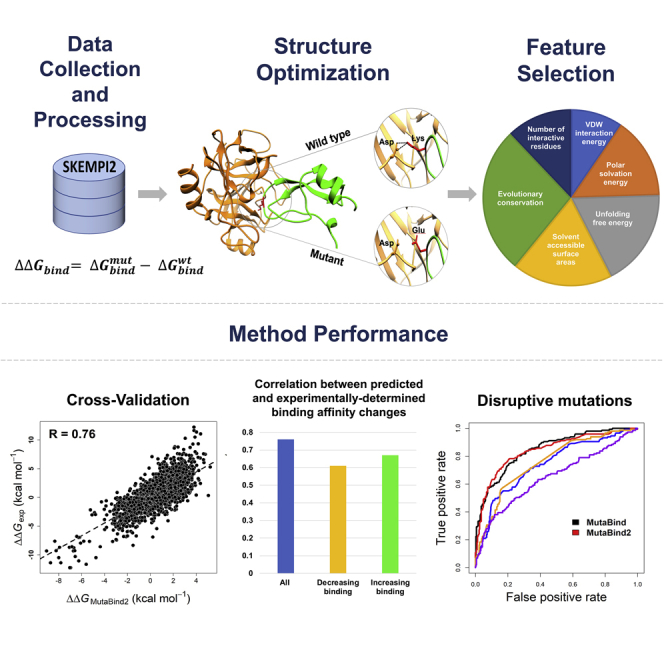
Missense mutations may affect proteostasis by destabilizing or over-stabilizing protein complexes and changing the pathway flux. Predicting the effects of stabilizing mutations on protein-protein interactions is notoriously difficult because existing experimental sets are skewed toward mutations reducing protein-protein binding affinity and many computational methods fail to correctly evaluate their effects. To address this issue, we developed a method MutaBind2, which estimates the impacts of single as well as multiple mutations on protein-protein interactions. MutaBind2 employs only seven features, and the most important of them describe interactions of proteins with the solvent, evolutionary conservation of the site, and thermodynamic stability of the complex and each monomer. This approach shows a distinct improvement especially in evaluating the effects of mutations increasing binding affinity. MutaBind2 can be used for finding disease driver mutations, designing stable protein complexes, and discovering new protein-protein interaction inhibitors.
Overview
AI snapshot
Written from the paper’s full text.
TL;DR
MutaBind2 is a structure-based method that predicts the effects of single and multiple mutations on protein-protein binding affinity using a seven-term scoring function. It improves performance especially for mutations that increase binding affinity, while requiring a 3D structure of the protein-protein complex.
Key findings
- MutaBind2 uses only seven features, with the most important describing protein-solvent interactions, evolutionary conservation of the site, and thermodynamic stability of the complex and each monomer.
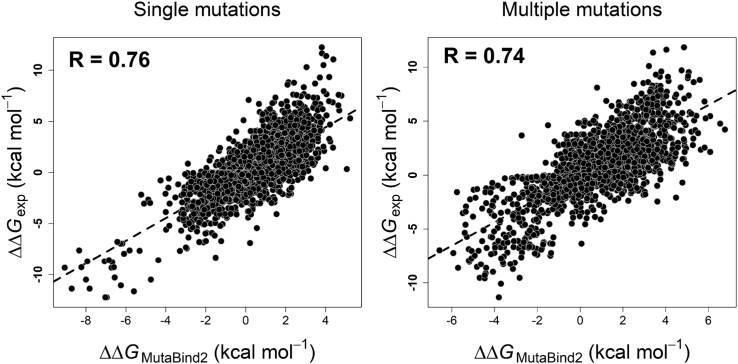
- In cross-validation, MutaBind2 achieved Pearson R = 0.76 for single mutations and R = 0.74 for multiple mutations under leave-one-complex-out (CV4); under leave-one-binding-site-out (CV5), R = 0.69 for single and R = 0.71 for multiple mutations.
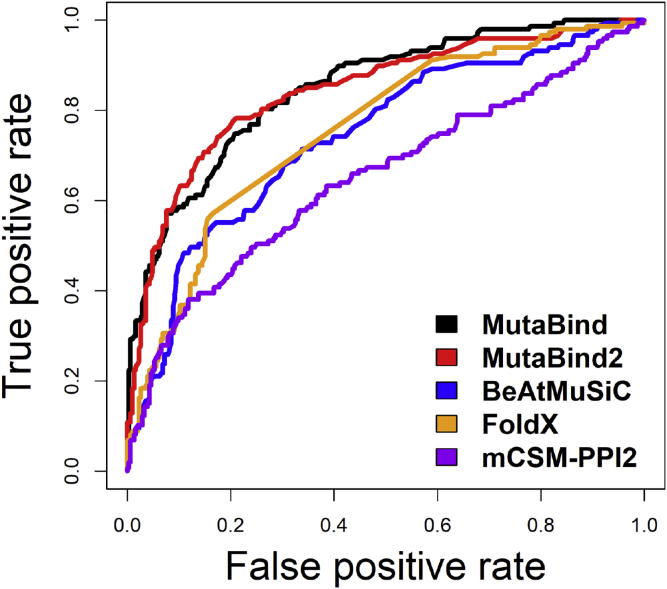
- On the independent S1748 set, retraining on the SKEMPI set enriched with reverse mutations improved R from 0.38 to 0.63 and reduced RMSE from 1.51 to 1.25 kcal mol−1; for highly increasing mutations, MutaBind2 reached AUC = 0.86 versus MutaBind 0.65, BeAtMuSiC 0.56, and FoldX 0.74.
- For multiple mutations, the worst performance was for three or more mutations on the same chain (R = 0.61 in CV4), and the best was for double mutations on multiple chains (R = 0.85 in CV4).
Methods
- MutaBind2 employs a new minimization protocol and a scoring function with seven terms, trained on a larger SKEMPI2 dataset containing 1.7 times more mutations and 3.3 times more complexes than SKEMPI, and enriched with structural models of reverse mutations to balance mutations increasing binding affinity.
- Performance was assessed with five cross-validation procedures (CV1–CV5), independent test sets including S1748, S4191, M1707, S487, and S8338, and comparisons with BeAtMuSiC, FoldX, iSEE, and mCSM-PPI2.
- The paper also evaluated predictions against yeast two-hybrid data covering 4,797 mutation-interaction pairs, of which 451 mutations could be mapped to known 3D structures and 147 were interaction-disruptive; main metrics included Pearson R, RMSE, slope, ROC/AUC, MCC, sensitivity, and specificity.
Limitations
- Stated: MutaBind2 requires the 3D structure of a protein-protein complex; six of seven features are calculated from that structure, limiting application to mutations that cannot be mapped to a structural complex.
- Stated: multiple-mutation instances with more than 10 mutations are not supported because such cases are rare in the training data and prediction accuracy is low.
- Evident from the text: outliers are more likely in complexes with higher protein-protein binding affinity and at mutated sites with more hydrogen bonds, and performance improves significantly after removing 5% outliers.
Model-written summary. Check it against the paper before relying on it.
Integrity signals
Registry
Cites
Statistics
Figures
Verification
Claims the paper makes
20 Own result · 10 Not checked yet · 3 No basis given · 2 Own interpretation
A result the paper reports from its own data — it cites no other source for it, so there is none to check. The quote shows it is in the paper.
In the paper
“This approach shows a distinct improvement especially in evaluating the effects of mutations increasing binding affinity.”
- Also stated in: § Validation of MutaBind2 on Independent Test Sets · boosted
“predictions for mutations increasing binding affinity were significantly improved without compromising the accuracy for predicting mutations decreasing binding affinity (Table 1).”
§ MutaBind2: Predicting the Impacts of Single and Multiple Mutations on Protein-Protein Interactions > Abstract
boosteddirect- Asserted: passes — The authors put it forward as true.
- Checkable: passes — It can be checked against evidence.
- Load-bearing: passes — The paper’s conclusions depend on it.
- Based: passes — The paper gives a reason why it holds.
- Also stated in: § Validation of MutaBind2 on Independent Test Sets · boosted
In the paper
“Consistent with the observation of Pires et al. (Pires et al., 2016), the outliers usually correspond to those mutations with extreme experimental values (highly decreasing/increasing binding affinity)”
§ MutaBind2: Predicting the Impacts of Single and Multiple Mutations on Protein-Protein Interactions > Results and Discussion > Evaluating the Performance of MutaBind2 Using Cross-Validation
What the sources say
- Not checked yetcites Pires et al., 2016 source
plaincorrelational- Asserted: passes — The authors put it forward as true.
- Checkable: passes — It can be checked against evidence.
- Load-bearing: unclear — It is unclear whether the paper’s conclusions depend on it.
- Based: passes — The paper gives a reason why it holds.
The paper states this without a source or data behind it here, so there is nothing to check it against. The quote shows it is in the paper.
In the paper
“MutaBind2 employs only seven features”
- Also stated in: § Results and Discussion · plain
“we designed a scoring function with seven terms instead of 10 used in the previous MutaBind version”
§ MutaBind2: Predicting the Impacts of Single and Multiple Mutations on Protein-Protein Interactions > Abstract
plain- Asserted: passes — The authors put it forward as true.
- Checkable: passes — It can be checked against evidence.
- Load-bearing: passes — The paper’s conclusions depend on it.
- Based: passes — The paper gives a reason why it holds.
- Also stated in: § Results and Discussion · plain
A result the paper reports from its own data — it cites no other source for it, so there is none to check. The quote shows it is in the paper.
In the paper
“Figures 3 and S5 show excellent performance of MutaBind and MutaBind2 in distinguishing interaction-disruptive from other mutations.”
§ MutaBind2: Predicting the Impacts of Single and Multiple Mutations on Protein-Protein Interactions > Results and Discussion > Validation of MutaBind2 on Independent Test Sets
plaincorrelational- Asserted: passes — The authors put it forward as true.
- Checkable: passes — It can be checked against evidence.
- Load-bearing: passes — The paper’s conclusions depend on it.
- Based: passes — The paper gives a reason why it holds.
A result the paper reports from its own data — it cites no other source for it, so there is none to check. The quote shows it is in the paper.
In the paper
“Figure S11A shows that the performance is improved significantly after removing 5% outliers.”
§ MutaBind2: Predicting the Impacts of Single and Multiple Mutations on Protein-Protein Interactions > Results and Discussion > Evaluating the Performance of MutaBind2 Using Cross-Validation
plaindirect- Asserted: passes — The authors put it forward as true.
- Checkable: passes — It can be checked against evidence.
- Load-bearing: unclear — It is unclear whether the paper’s conclusions depend on it.
- Based: passes — The paper gives a reason why it holds.
In the paper
“We obtained comparable correlation coefficients with mCSM-PPI2 using the CV4 and CV5 cross-validations (Table 2)”
§ MutaBind2: Predicting the Impacts of Single and Multiple Mutations on Protein-Protein Interactions > Results and Discussion > Validation of MutaBind2 on Independent Test Sets
What the sources say
- Not checked yetcites Rodrigues et al., 2019 source
plain- Asserted: passes — The authors put it forward as true.
- Checkable: passes — It can be checked against evidence.
- Load-bearing: unclear — It is unclear whether the paper’s conclusions depend on it.
- Based: passes — The paper gives a reason why it holds.
A result the paper reports from its own data — it cites no other source for it, so there is none to check. The quote shows it is in the paper.
In the paper
“the MutaBind2 model parameterized on this training set shows the best performance on S487 compared with other methods (more comparisons can be found in Table S5).”
§ MutaBind2: Predicting the Impacts of Single and Multiple Mutations on Protein-Protein Interactions > Results and Discussion > Validation of MutaBind2 on Independent Test Sets
plain- Asserted: passes — The authors put it forward as true.
- Checkable: passes — It can be checked against evidence.
- Load-bearing: passes — The paper’s conclusions depend on it.
- Based: passes — The paper gives a reason why it holds.
A result the paper reports from its own data — it cites no other source for it, so there is none to check. The quote shows it is in the paper.
In the paper
“which points to a slightly better performance for MutaBind2 in terms of the slope of the regression line indicating that predicted and experimental values are on the same scale.”
§ MutaBind2: Predicting the Impacts of Single and Multiple Mutations on Protein-Protein Interactions > Results and Discussion > Validation of MutaBind2 on Independent Test Sets
hedgedcorrelational- Asserted: passes — The authors put it forward as true.
- Checkable: passes — It can be checked against evidence.
- Load-bearing: unclear — It is unclear whether the paper’s conclusions depend on it.
- Based: passes — The paper gives a reason why it holds.
A result the paper reports from its own data — it cites no other source for it, so there is none to check. The quote shows it is in the paper.
In the paper
“we developed a method MutaBind2, which estimates the impacts of single as well as multiple mutations on protein-protein interactions.”
- Also stated in: § Introduction · plain
“In addition to single mutations, it can predict the effects of multiple mutations on protein binding affinity.”
§ MutaBind2: Predicting the Impacts of Single and Multiple Mutations on Protein-Protein Interactions > Abstract
plain- Asserted: passes — The authors put it forward as true.
- Checkable: passes — It can be checked against evidence.
- Load-bearing: passes — The paper’s conclusions depend on it.
- Based: passes — The paper gives a reason why it holds.
- Rests on an assumption: Large-scale rapid experimental assays that would allow the assessment of thousands of variants are still limited.
- Also stated in: § Introduction · plain
A result the paper reports from its own data — it cites no other source for it, so there is none to check. The quote shows it is in the paper.
In the paper
“Table 3 and Figure S6 demonstrate the high performance of MutaBind2 in predicting mutations highly decreasing and highly increasing binding affinity (see Methods for details).”
§ MutaBind2: Predicting the Impacts of Single and Multiple Mutations on Protein-Protein Interactions > Results and Discussion > Prediction of Mutations Highly Decreasing and Increasing Binding Affinity
boosted- Asserted: passes — The authors put it forward as true.
- Checkable: passes — It can be checked against evidence.
- Load-bearing: passes — The paper’s conclusions depend on it.
- Based: passes — The paper gives a reason why it holds.
- It may state two separate claims as one. 14
A result the paper reports from its own data — it cites no other source for it, so there is none to check. The quote shows it is in the paper.
In the paper
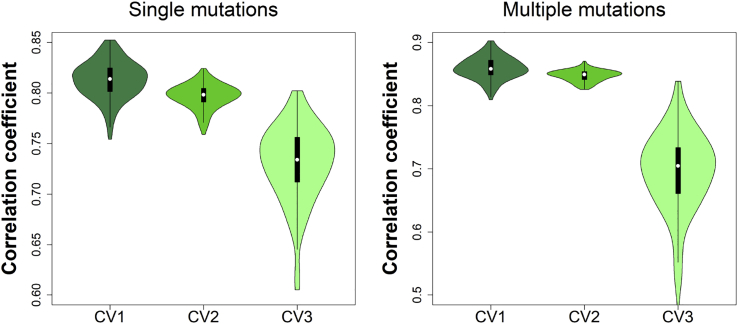
“The correlation coefficients of each cross-validation round exceed 0.80 for “CV1” and “CV2” and about 0.70 for “CV3” cross-validation for both single and multiple mutations.”
§ MutaBind2: Predicting the Impacts of Single and Multiple Mutations on Protein-Protein Interactions > Results and Discussion > Evaluating the Performance of MutaBind2 Using Cross-Validation
plaincorrelational- Asserted: passes — The authors put it forward as true.
- Checkable: passes — It can be checked against evidence.
- Load-bearing: passes — The paper’s conclusions depend on it.
- Based: passes — The paper gives a reason why it holds.
It may state two separate claims as one.
The paper states this without a source or data behind it here, so there is nothing to check it against. The quote shows it is in the paper.
In the paper
“Importantly, MutaBind and MutaBind2, unlike other methods mentioned earlier, estimate interactions of a protein with the solvent, which is one of the most important terms together with the site evolutionary conservation and thermodynamic stability of a protein complex and each binding partner (Table S2).”
§ MutaBind2: Predicting the Impacts of Single and Multiple Mutations on Protein-Protein Interactions > Results and Discussion > Prediction of Mutations Highly Decreasing and Increasing Binding Affinity
plain- Asserted: passes — The authors put it forward as true.
- Checkable: passes — It can be checked against evidence.
- Load-bearing: passes — The paper’s conclusions depend on it.
- Based: passes — The paper gives a reason why it holds.
It may state two separate claims as one.
A result the paper reports from its own data — it cites no other source for it, so there is none to check. The quote shows it is in the paper.
In the paper
“we found that the outliers are more likely to appear in complexes with higher protein-protein binding affinity and at the mutated sites with higher number of hydrogen bonds (Figure S11B).”
§ MutaBind2: Predicting the Impacts of Single and Multiple Mutations on Protein-Protein Interactions > Results and Discussion > Evaluating the Performance of MutaBind2 Using Cross-Validation
hedgedcorrelational- Asserted: passes — The authors put it forward as true.
- Checkable: passes — It can be checked against evidence.
- Load-bearing: unclear — It is unclear whether the paper’s conclusions depend on it.
- Based: passes — The paper gives a reason why it holds.
It may state two separate claims as one.
A result the paper reports from its own data — it cites no other source for it, so there is none to check. The quote shows it is in the paper.
In the paper
“The Pearson correlation coefficient between experimental and computed ΔΔG values using the “leave-one-complex-out” (“CV4”) procedure reaches 0.76 for single mutations and 0.74 for multiple mutations (Table 1 and Figure 2).”
§ MutaBind2: Predicting the Impacts of Single and Multiple Mutations on Protein-Protein Interactions > Results and Discussion > Evaluating the Performance of MutaBind2 Using Cross-Validation
plaincorrelational- Asserted: passes — The authors put it forward as true.
- Checkable: passes — It can be checked against evidence.
- Load-bearing: passes — The paper’s conclusions depend on it.
- Based: passes — The paper gives a reason why it holds.
It may state two separate claims as one.
A result the paper reports from its own data — it cites no other source for it, so there is none to check. The quote shows it is in the paper.
In the paper
“We found that MutaBind2 performed well for almost all categories; the worst performance was observed for three or more mutations introduced on the same chain (R = 0.61 in CV4 validation), and the best performance was achieved for double mutations on multiple chains (R = 0.85 in CV4 validation).”
§ MutaBind2: Predicting the Impacts of Single and Multiple Mutations on Protein-Protein Interactions > Results and Discussion > Prediction of Mutations Highly Decreasing and Increasing Binding Affinity
plaincorrelational- Asserted: passes — The authors put it forward as true.
- Checkable: passes — It can be checked against evidence.
- Load-bearing: passes — The paper’s conclusions depend on it.
- Based: passes — The paper gives a reason why it holds.
It may state two separate claims as one.
A result the paper reports from its own data — it cites no other source for it, so there is none to check. The quote shows it is in the paper.
In the paper
“the correlation coefficient remained statistically significant, being equal to 0.69 for single mutations and 0.71 for multiple mutations (Table 1 and Figure S4D).”
§ MutaBind2: Predicting the Impacts of Single and Multiple Mutations on Protein-Protein Interactions > Results and Discussion > Evaluating the Performance of MutaBind2 Using Cross-Validation
plaincorrelational- Asserted: passes — The authors put it forward as true.
- Checkable: passes — It can be checked against evidence.
- Load-bearing: passes — The paper’s conclusions depend on it.
- Based: passes — The paper gives a reason why it holds.
It may state two separate claims as one.
A result the paper reports from its own data — it cites no other source for it, so there is none to check. The quote shows it is in the paper.
In the paper
“MutaBind2 further improves the performance for both interfacial and non-interfacial mutations compared with the previous version and outperforms other methods on the S1748 set (Figure S7).”
§ MutaBind2: Predicting the Impacts of Single and Multiple Mutations on Protein-Protein Interactions > Results and Discussion > Prediction of Mutations Highly Decreasing and Increasing Binding Affinity
plaindirect- Asserted: passes — The authors put it forward as true.
- Checkable: passes — It can be checked against evidence.
- Load-bearing: passes — The paper’s conclusions depend on it.
- Based: passes — The paper gives a reason why it holds.
It may state two separate claims as one.
A result the paper reports from its own data — it cites no other source for it, so there is none to check. The quote shows it is in the paper.
In the paper
“we trained our models on a much larger dataset from SKEMPI2, which encompassed 1.7 times more mutations and 3.3 times more complexes compared with SKEMPI used for training of MutaBind.”
§ MutaBind2: Predicting the Impacts of Single and Multiple Mutations on Protein-Protein Interactions > Results and Discussion
plain- Asserted: passes — The authors put it forward as true.
- Checkable: passes — It can be checked against evidence.
- Load-bearing: passes — The paper’s conclusions depend on it.
- Based: passes — The paper gives a reason why it holds.
It may state two separate claims as one.
A result the paper reports from its own data — it cites no other source for it, so there is none to check. The quote shows it is in the paper.
In the paper
“the most important of them describe interactions of proteins with the solvent, evolutionary conservation of the site, and thermodynamic stability of the complex and each monomer.”
- Also stated in: § Prediction of Mutations Highly Decreasing and Increasing Binding Affinity · plain
“MutaBind and MutaBind2, unlike other methods mentioned earlier, estimate interactions of a protein with the solvent, which is one of the most important terms together with the site evolutionary conservation and thermodynamic stability of a protein complex and each binding partner (Table S2).”
§ MutaBind2: Predicting the Impacts of Single and Multiple Mutations on Protein-Protein Interactions > Abstract
plain- Asserted: passes — The authors put it forward as true.
- Checkable: passes — It can be checked against evidence.
- Load-bearing: passes — The paper’s conclusions depend on it.
- Based: passes — The paper gives a reason why it holds.
It may state two separate claims as one.
- Also stated in: § Prediction of Mutations Highly Decreasing and Increasing Binding Affinity · plain
A result the paper reports from its own data — it cites no other source for it, so there is none to check. The quote shows it is in the paper.
In the paper
“the performance on an independent S1748 set improved considerably (the correlation coefficient increased from 0.38 to 0.63, and root-mean-square error decreased from 1.51 to 1.25 kcal mol−1).”
§ MutaBind2: Predicting the Impacts of Single and Multiple Mutations on Protein-Protein Interactions > Results and Discussion > Validation of MutaBind2 on Independent Test Sets
plaindirect- Asserted: passes — The authors put it forward as true.
- Checkable: passes — It can be checked against evidence.
- Load-bearing: passes — The paper’s conclusions depend on it.
- Based: passes — The paper gives a reason why it holds.
It may state two separate claims as one.
- Rests on an assumption: The methodologies of training procedures employed by many computational methods rely on experimental sets enriched with mutations that decrease binding.
A result the paper reports from its own data — it cites no other source for it, so there is none to check. The quote shows it is in the paper.
In the paper
“Moreover, predictions for mutations increasing binding affinity were significantly improved without compromising the accuracy for predicting mutations decreasing binding affinity (Table 1).”
§ MutaBind2: Predicting the Impacts of Single and Multiple Mutations on Protein-Protein Interactions > Results and Discussion > Validation of MutaBind2 on Independent Test Sets
plaindirect- Asserted: passes — The authors put it forward as true.
- Checkable: passes — It can be checked against evidence.
- Load-bearing: passes — The paper’s conclusions depend on it.
- Based: passes — The paper gives a reason why it holds.
It may state two separate claims as one.
- Rests on an assumption: The methodologies of training procedures employed by many computational methods rely on experimental sets enriched with mutations that decrease binding.
None of the sources cited for this claim have been checked yet.
In the paper
“Missense mutations may affect proteostasis by destabilizing or over-stabilizing protein complexes and changing the pathway flux.”
- Also stated in: § Introduction · hedged
“However, the latter may also have important consequences leading to disruption of proteostasis by over-stabilizing transient protein complexes (Nishi et al., 2013, Stefl et al., 2013, Rutten et al., 2018, Shoichet et al., 1995, Nagatani et al., 2007, Witham et al., 2011, Jubb et al., 2016) and changing the pathway flux.”
§ MutaBind2: Predicting the Impacts of Single and Multiple Mutations on Protein-Protein Interactions > Abstract
What the sources say
- Not checked yetcites Nishi et al., 2013
- Not checked yetcites Stefl et al., 2013
- Not checked yetcites Rutten et al., 2018
hedgedconditional- Asserted: passes — The authors put it forward as true.
- Checkable: passes — It can be checked against evidence.
- Load-bearing: passes — The paper’s conclusions depend on it.
- Based: passes — The paper gives a reason why it holds.
It may state two separate claims as one.
- Also stated in: § Introduction · hedged
In the paper
“MutaBind2 can be used for finding disease driver mutations, designing stable protein complexes, and discovering new protein-protein interaction inhibitors.”
- Also stated in: § Introduction · plain
“MutaBind2 can be applied to a large number of tasks, including, but not limited to, finding disease driver mutations and understanding their molecular mechanisms, assessing the effects of sequence variants on protein fitness, structural modeling of mutant complexes, and designing protein interaction inhibitors (Goncearenco et al., 2017).”
§ MutaBind2: Predicting the Impacts of Single and Multiple Mutations on Protein-Protein Interactions > Abstract
What the sources say
- Not checked yetcites Goncearenco et al., 2017
plain- Asserted: passes — The authors put it forward as true.
- Checkable: passes — It can be checked against evidence.
- Load-bearing: passes — The paper’s conclusions depend on it.
- Based: passes — The paper gives a reason why it holds.
It may state two separate claims as one.
- Rests on an assumption: Large-scale rapid experimental assays that would allow the assessment of thousands of variants are still limited.
- Also stated in: § Introduction · plain
In the paper
“The previous version, MutaBind, could predict single mutations highly decreasing binding affinity relatively well but failed to annotate mutations highly increasing affinity.”
§ MutaBind2: Predicting the Impacts of Single and Multiple Mutations on Protein-Protein Interactions > Results and Discussion > Prediction of Mutations Highly Decreasing and Increasing Binding Affinity
What the sources say
- Not checked yetcites Li et al., 2016b
hedged- Asserted: passes — The authors put it forward as true.
- Checkable: passes — It can be checked against evidence.
- Load-bearing: passes — The paper’s conclusions depend on it.
- Based: passes — The paper gives a reason why it holds.
It may state two separate claims as one.
- Rests on an assumption: The methodologies of training procedures employed by many computational methods rely on experimental sets enriched with mutations that decrease binding.
The paper relies on this without support.
Proteins and their binding interfaces tend to be optimized in evolution with regard to their stability.
“proteins and their binding interfaces tend to be optimized in evolution with regard to their stability”
The paper relies on this without support.
The methodologies of training procedures employed by many computational methods rely on experimental sets enriched with mutations that decrease binding.
“the methodologies of training procedures employed by many computational methods rely on these experimental sets”
The paper relies on this without support.
Large-scale rapid experimental assays that would allow the assessment of thousands of variants are still limited.
“large-scale rapid experimental assays that would allow the assessment of thousands of variants are still limited”
The paper relies on this without support.
The majority of mutations produce rather subtle effects with unclear clinical significance.
“the majority of mutations produce rather subtle effects with unclear clinical significance”
Claims other papers make about this one
Each is checked against this paper’s own text: does it say what the citing paper says it does?
In the citing paper
“Considering that the seven features used in MutaBind2 are manually designed, these features may not comprehensively characterize the impacts of mutations.”
From Deep geometric representations for modeling effects of mutations on protein-protein binding affinity (2021) · cites this paper as [15]
In the citing paper
“These poor results of MutaBind2 were consistent with the previous report that MutaBind2 does not generalize to the cases with large-number mutations [15].”
From Deep geometric representations for modeling effects of mutations on protein-protein binding affinity (2021) · cites this paper as [15]
Citations
Cites
DeLong, E. R., DeLong, D. M., & Clarke-Pearson, D. L. (1988) · Biometrics · doi:10.2307/2531595 · Cited by 22,649
Guerois, R., Nielsen, J. E., & Serrano, L. (2002) · Journal of Molecular Biology · doi:10.1016/s0022-2836(02)00442-4 · Cited by 1,728
mCSM: Predicting the effects of mutations in proteins using graph-based signatures
Pires, D. E. V., Ascher, D. B., & Blundell, T. L. (2014) · Bioinformatics · doi:10.1093/bioinformatics/btt691 · Cited by 1,066
A relationship between protein stability and protein function.
Shoichet, B. K., Baase, W. A., Kuroki, R., & Matthews, B. W. (1995) · Proceedings of the National Academy of Sciences · doi:10.1073/pnas.92.2.452 · Cited by 712
Widespread macromolecular interaction perturbations in human genetic disorders
Sahni, N., Yi, S., Taipale, M., Fuxman Bass, J. I., Coulombe-Huntington, J., Yang, F., Peng, J., Weile, J., Karras, G. I., Wang, Y., et al. (2015) · Cell · doi:10.1016/j.cell.2015.04.013 · Cited by 594
Jankauskaitė, J., Jiménez-García, B., Dapkūnas, J., Fernández-Recio, J., & Moal, I. H. (2019) · Bioinformatics · doi:10.1093/bioinformatics/bty635 · Cited by 389 · cited 2×
“In addition, a “CV5” cross-validation accounted for similarities between binding sites of different complexes (the definition of similar binding sites is taken from (Jankauskaite et al., 2019; Moal and Fernandez-Recio, 2012)).”
BackgroundThree-dimensional reconstruction of protein networks provides insight into human genetic disease
Wang, X., Wei, X., Thijssen, B., Das, J., Lipkin, S. M., & Yu, H. (2012) · Nature Biotechnology · doi:10.1038/nbt.2106 · Cited by 385
mCSM-PPI2: predicting the effects of mutations on protein–protein interactions
Rodrigues, C. H. M., Myung, Y., Pires, D. E. V., & Ascher, D. B. (2019) · Nucleic Acids Research · doi:10.1093/nar/gkz383 · Cited by 369
Molecular Mechanisms of Disease-Causing Missense Mutations
Stefl, S. K., Nishi, H., Petukh, M. G., Panchenko, A. R., & Alexov, E. (2013) · Journal of Molecular Biology · doi:10.1016/j.jmb.2013.07.014 · Cited by 345
Self-citationBeAtMuSiC: prediction of changes in protein–protein binding affinity on mutations
Dehouck, Y., Kwasigroch, J. M., Rooman, M., & Gilis, D. (2013) · Nucleic Acids Research · doi:10.1093/nar/gkt450 · Cited by 338
Cited by
Sorted by citations
Mutations Strengthened SARS-CoV-2 Infectivity
Chen, J., Wang, R., Wang, M., & Wei, G. (2020) · Journal of Molecular Biology · doi:10.1016/j.jmb.2020.07.009 · Cited by 468
“These databases have been used as benchmarks for evaluating the predictive power of various computational methods [18, 22, 23, 25, 27, 39].”
MethodPremPS: Predicting the impact of missense mutations on protein stability
Chen, Y., Lu, H., Zhang, N., Zhu, Z., Wang, S., & Li, M. (2020) · PLoS Computational Biology · doi:10.1371/journal.pcbi.1008543 · Cited by 263
Self-citationNew insights into protein–protein interaction modulators in drug discovery and therapeutic advance
Nada, H., Choi, Y., Kim, S.-D., Jeong, K. S., Meanwell, N. A., & Lee, K. (2024) · Signal Transduction and Targeted Therapy · doi:10.1038/s41392-024-02036-3 · Cited by 241
“98 The combination of computational methods such as MD simulations, docking and CAS provide a powerful tool for accelerating the identi fi cation process of hot spots within PPIs and pave the way for the development of targeted therapeutics through structure-based drug design.”
Shan, S., Luo, S., Yang, Z., Hong, J., Su, Y., Ding, F., Fu, L., Li, C., Chen, P., Ma, J., et al. (2022) · Proceedings of the National Academy of Sciences · doi:10.1073/pnas.2122954119 · Cited by 157
“Anadditionalsubset consisting of multipoint mutations (M1707) (40) was also used as a benchmark; Pearson correlation on this subset is reported in SI Appendix , Table S1.”
Deep geometric representations for modeling effects of mutations on protein-protein binding affinity
Liu, X., Luo, Y., Li, P., Song, S., & Peng, J. (2021) · PLOS Computational Biology · doi:10.1371/journal.pcbi.1009284 · Cited by 140
“In addition, Zhang et al. [15] collected 1337 variants with multi-point mutations and parts of their reversed mutations to build a multi-point mutation dataset, named the M1707 dataset.”
InfluentialCancer driver mutations: predictions and reality
Ostroverkhova, D. S., Przytycka, T. M., & Panchenko, A. R. (2023) · Trends in Molecular Medicine · doi:10.1016/j.molmed.2023.03.007 · Cited by 147
Self-citationSAAMBE-3D: Predicting Effect of Mutations on Protein–Protein Interactions
Pahari, S., Li, G., Murthy, A. K., Liang, S., Fragoza, R., Yu, H., & Alexov, E. (2020) · International Journal of Molecular Sciences · doi:10.3390/ijms21072563 · Cited by 111
Qiu, Y., & Wei, G. (2023) · Briefings in Bioinformatics · doi:10.1093/bib/bbad289 · Cited by 90
“In general, statistical models and machine learning models such as linear regression [117], ridge regression [33], support vector machine (SVM) [118],random forest [119],gradient boosting tree [120] have accurate performance for small training set.”
Chen, C., Boorla, V. S., Banerjee, D., Chowdhury, R., Cavener, V. S., Nissly, R. H., Gontu, A., Boyle, N. R., Vandegrift, K. J., Nair, M. S., et al. (2021) · Proceedings of the National Academy of Sciences · doi:10.1073/pnas.2106480118 · Cited by 81
“Using MutaBind2 and mCSM-PPI2, the performance in both %VC and r value was worse than that of both MM-GBSA and Rosetta.”
MethodRecent advances in user-friendly computational tools to engineer protein function
Sequeiros-Borja, C. E., Surpeta, B., & Brezovský, J. (2020) · Briefings in Bioinformatics · doi:10.1093/bib/bbaa150 · Cited by 81
Takahashi, Y., Bosmans, K. C., Hsu, P., Paul, K., Seitz, C., Yeh, C., Wang, Y., Yarmolinsky, D., Sierla, M., Vahisalu, T., et al. (2022) · Science Advances · doi:10.1126/sciadv.abq6161 · Cited by 77
Revealing the Threat of Emerging SARS-CoV-2 Mutations to Antibody Therapies
Chen, J., Gao, K., Wang, R., & Wei, G. (2021) · Journal of Molecular Biology · doi:10.1016/j.jmb.2021.167155 · Cited by 72
Pandemic danger to the deep: The risk of marine mammals contracting SARS-CoV-2 from wastewater
Mathavarajah, S., Stoddart, A. K., Gagnon, G. A., & Dellaire, G. (2020) · The Science of The Total Environment · doi:10.1016/j.scitotenv.2020.143346 · Cited by 72
“…for comparisons between human ACE2 and the orthologous ACE2 sequences, we utilized the MutaBind2 tool to model and predict whether these mutations (i) improve or (ii) reduce SARS-CoV-2 binding affinity to the receptor (Mihindukulasuriya, Wu, St Leger, Nordhausen, & Wang, 2008; Zhang et al., 2020).”
Deep mutational scanning: A versatile tool in systematically mapping genotypes to phenotypes
Wei, H., & Li, X. (2023) · Frontiers in Genetics · doi:10.3389/fgene.2023.1087267 · Cited by 77
“, 2020) are often troublesome while predicting folding and binding energy changes based on the protein structures (Capriotti et al., 2005; Schymkowitz et al., 2005; Zhang et al., 2020) is not as accurate as experiment results.”
BackgroundAntibody design using deep learning: from sequence and structure design to affinity maturation
Joubbi, S., Micheli, A., Milazzo, P., Maccari, G., Ciano, G., Cardamone, D., & Medini, D. (2024) · Briefings in Bioinformatics · doi:10.1093/bib/bbae307 · Cited by 56
Accelerating therapeutic protein design with computational approaches toward the clinical stage
Chen, Z., Wang, X., Chen, X., Huang, J., Wang, C., Wang, J., & Wang, Z. (2023) · Computational and Structural Biotechnology Journal · doi:10.1016/j.csbj.2023.04.027 · Cited by 49
Kornienko, J., Rodríguez‐Martínez, M., Fenzl, K., Hinze, F., Schraivogel, D., Grosch, M., Tunaj, B., Lindenhofer, D., Schraft, L., Kueblbeck, M., et al. (2023) · Nature Communications · doi:10.1038/s41467-023-39965-6 · Cited by 47
Wee, J., & Xia, K. (2022) · Briefings in Bioinformatics · doi:10.1093/bib/bbac024 · Cited by 48
Sun, T., Chen, Y., Wen, Y., Zhu, Z., & Li, M. (2021) · Communications Biology · doi:10.1038/s42003-021-02826-3 · Cited by 43
“With a large amount of experimental data available, many data-driven machine learning methods have been developed to assess the impact of mutations on protein stability 30 – 36 and protein – protein interactions 37 – 47 , including PremPS 30 , MutaBind 39 , and MutaBind2 40 introduced by us.”
BackgroundSelf-citationLions, tigers and kittens too: ACE2 and susceptibility to COVID-19
Mathavarajah, S., & Dellaire, G. (2020) · Evolution Medicine and Public Health · doi:10.1093/emph/eoaa021 · Cited by 44
Li, G., Pahari, S., Murthy, A. K., Liang, S., Fragoza, R., Yu, H., & Alexov, E. (2020) · Bioinformatics · doi:10.1093/bioinformatics/btaa761 · Cited by 44
Xiao, S., Alshahrani, M., Gupta, G., Tao, P., & Verkhivker, G. M. (2023) · Journal of Chemical Information and Modeling · doi:10.1021/acs.jcim.3c00778 · Cited by 37
Implications of disease-related mutations at protein–protein interfaces
Xiong, D., Lee, D., Li, L., Zhao, Q., & Yu, H. (2021) · Current Opinion in Structural Biology · doi:10.1016/j.sbi.2021.11.012 · Cited by 40
“Some of them, such as mCSM-PPI2 [36], iSEE [37], TopNetTree [38], MutaBind2 [39], ELASPIC2 [40], and so on, have been developed with structure-based features using extra trees, random forest, gradient boosting decision tree, convolutional neural network, transformer neural network, graph neural…”
BackgroundAccurate prediction of antibody function and structure using bio-inspired antibody language model
Jing, H., Gao, Z., Xu, S. Y., Shen, T., Peng, Z., He, S., You, T., Ye, S., Lin, W. J., & Sun, S. (2024) · Briefings in Bioinformatics · doi:10.1093/bib/bbae245 · Cited by 35
“The testing set is composed of subsets from S1131 [29] and M1707 [30] datasets.”
Cheng, J. H. T., Bredow, M., Monaghan, J., & diCenzo, G. C. (2021) · Molecular Plant-Microbe Interactions · doi:10.1094/mpmi-11-20-0314-sc · Cited by 34
Structure-function relationships of the disease-linked A218T oxytocin receptor variant
Meyer, M., Jurek, B., Alfonso‐Prieto, M., Ribeiro, R. P., Milenkovic, V. M., Winter, J. J., Hoffmann, P., Wetzel, C. H., Giorgetti, A., Carloni, P., et al. (2022) · Molecular Psychiatry · doi:10.1038/s41380-021-01241-8 · Cited by 32
“We then estimated the change in OXTR/OXTR binding energy upon mutation (ΔΔGbind), using the SAAMBE-3D [62], MutaBind2 [63], and mCSM-PPI2 [64] servers.”
MethodVerkhivker, G. M., Alshahrani, M., & Gupta, G. (2023) · Viruses · doi:10.3390/v15051143 · Cited by 29
“5 RBD-ACE2 complexes were obtained with the aid of the MutaBind2 approach that utilizes molecular mechanics force fields and fast side-chain optimization algorithms via the random forest (RF) method [94,95].”
MethodBeyond sequence: Structure-based machine learning
Durairaj, J., de Ridder, D., & van Dijk, A. D. J. (2022) · Computational and Structural Biotechnology Journal · doi:10.1016/j.csbj.2022.12.039 · Cited by 32
Mechanism of activation and the rewired network: New drug design concepts
Nussinov, R., Zhang, M., Maloney, R., Tsai, C., Yavuz, B. R., Tunçbağ, N., & Jang, H. (2021) · Medicinal Research Reviews · doi:10.1002/med.21863 · Cited by 30
Tsai, K., Lee, Y.-C., & Tseng, T.-S. (2021) · Frontiers in Microbiology · doi:10.3389/fmicb.2021.698365 · Cited by 32
Free energy perturbation calculations of mutation effects on SARS-CoV-2 RBD::ACE2 binding affinity
Sergeeva, A. P., Katsamba, P. S., Liao, J., Sampson, J. M., Bahna, F., Mannepalli, S., Morano, N. C., Shapiro, L., Friesner, R. A., & Honig, B. (2023) · Journal of Molecular Biology · doi:10.1016/j.jmb.2023.168187 · Cited by 27
“Mutabind2 predictions were run on the https://lilab.jysw.suda.edu.cn/research/mutabind2/ webserver. mCSM-PPI2 predictions were submitted as a query to the following webserver: http://biosig.unimelb.edu.au/mcsm_ppi2/.”
InfluentialLuo, S., Su, Y., Wu, Z., Su, C., Peng, J., & Ma, J. (2023) · bioRxiv (Cold Spring Harbor Laboratory) · doi:10.1101/2023.02.28.530137 · Cited by 31
“Statistical methods rely on feature engineering, which uses descriptors summarizing geometric, physical, evolutionary, and motif properties of proteins to predict mutational effects (Geng et al., 2019a; Zhang et al., 2020).”
MethodQuantification of biases in predictions of protein–protein binding affinity changes upon mutations
Tsishyn, M., Pucci, F., & Rooman, M. J. (2023) · Briefings in Bioinformatics · doi:10.1093/bib/bbad491 · Cited by 33
“Many studies have been dedicated over the last decade to the development of bioinformatics tools to predict the impact of mutations on protein-protein binding affinity (∆Gb), which is the thermodynamic descriptor of protein-protein interactions [7, 8, 9, 10, 11, 12].”
BackgroundTracking the pipeline: immunoinformatics and the COVID-19 vaccine design
Rezaei, S., Sefidbakht, Y., & Uskoković, V. (2021) · Briefings in Bioinformatics · doi:10.1093/bib/bbab241 · Cited by 24
Sampson, J. M., Cannon, D. A., Duan, J., Epstein, J. C. K., Sergeeva, A. P., Katsamba, P. S., Mannepalli, S. M., Bahna, F. A., Adihou, H., Guéret, S. M., et al. (2024) · Journal of Molecular Biology · doi:10.1016/j.jmb.2024.168640 · Cited by 24
Pennica, C., Hanna, G., Islam, S. A., Sternberg, M. J. E., & David, A. (2023) · Journal of Molecular Biology · doi:10.1016/j.jmb.2023.168060 · Cited by 25
“Missense3D-PPI was benchmarked against Missense3D, 13 MutaBind2, 17 BeAtMuSiC 16 and mCSM-PPI2.”
InfluentialPremPRI: Predicting the Effects of Missense Mutations on Protein–RNA Interactions
Zhang, N., Lu, H., Chen, Y., Zhu, Z., Yang, Q., Wang, S., & Li, M. (2020) · International Journal of Molecular Sciences · doi:10.3390/ijms21155560 · Cited by 24
Self-citationMohseni Behbahani, Y., Laine, E., & Carbone, A. (2023) · Bioinformatics · doi:10.1093/bioinformatics/btad231 · Cited by 23
“To overcome this limitation, several efficient computational methods have been developed (Table S 2) [60, 78, 76, 73, 42, 20, 59, 3, 75, 54, 23].”
MethodYu, G., Zhao, Q., Bi, X., & Wang, J. (2024) · Bioinformatics · doi:10.1093/bioinformatics/btae232 · Cited by 23
“M1707 is a subset with 1707 multiple point mutations, including 1337 multiple point mutations plus reverse mutations (Zhang et al. 2020).”
BackgroundCollagen’s primary structure determines collagen:HSP47 complex stoichiometry
Abraham, E. T., Öcal, S., Mörgelin, M., Schmid, P. W. N., Büchner, J., Baumann, U., & Gebauer, J. M. (2021) · Journal of Biological Chemistry · doi:10.1016/j.jbc.2021.101169 · Cited by 19
Jiang, Y., Quan, L., Li, K., Li, Y., Zhou, Y., Wu, T., & Lyu, Q. (2023) · IEEE Transactions on Computational Biology and Bioinformatics · doi:10.1109/tcbb.2022.3233627 · Cited by 21
“As a development of MutaBind, MutaBind2 [19] achieved the best performance in SKEMPI2.”
MethodWang, J., Wang, Y., Xiao, H., Yang, W., Zuo, W., You, Z., Wu, C., & Bao, J. (2024) · Journal of Biological Chemistry · doi:10.1016/j.jbc.2024.108050 · Cited by 22
“S149 had previously been reported as an O-GlcNAcylation site (41), con fi rming the accuracy of these predictions (Fig.”
Liu, X., Feng, H., Wu, J., & Xia, K. (2022) · Journal of Chemical Information and Modeling · doi:10.1021/acs.jcim.2c00580 · Cited by 19
Pandey, P., Panday, S. K., Rimal, P., Ancona, N., & Alexov, E. (2023) · International Journal of Molecular Sciences · doi:10.3390/ijms241512073 · Cited by 20
“Similarly, the cases with MutaBind2 and mCSM-PPI2.”
BackgroundInfluentialDecoding the functional impact of the cancer genome through protein–protein interactions
Fu, H., Mo, X., & Ivanov, A. A. (2025) · Nature reviews. Cancer · doi:10.1038/s41568-024-00784-6 · Cited by 22
Delaunay, M., & Ha‐Duong, T. (2021) · Methods in molecular biology · doi:10.1007/978-1-0716-1855-4_11 · Cited by 17
Duplicated Flagellins in Pseudomonas Divergently Contribute to Motility and Plant Immune Elicitation
Luo, Y., Wang, J., Gu, Y., Zhang, L.-Q., & Wei, H. (2023) · Microbiology Spectrum · doi:10.1128/spectrum.03621-22 · Cited by 18
Surfaces: a software to quantify and visualize interactions within and between proteins and ligands
Teruel, N., Borges, V. M., & Najmanovich, R. (2023) · Bioinformatics · doi:10.1093/bioinformatics/btad608 · Cited by 20
Ma, X., Ma, L., & Huo, Y. (2021) · Trends in biotechnology · doi:10.1016/j.tibtech.2021.11.002 · Cited by 17
Han, J., Liu, T., Zhang, X., Yang, Y., Shi, Y., Li, J., Ma, M., Zhu, W., Gong, L., & Xu, Z. (2022) · Computers in Biology and Medicine · doi:10.1016/j.compbiomed.2022.106212 · Cited by 17
“, MuPIPR, MutaBind2, ProAffiMuSeq, and ENDscriptIIWeb server[19-23], which gain unprecedented success in PPI predicting tasks, it’s unsatisfactory for these methods in predicting binding affinity between SARSCoV-2 and hACE2 because these methods are designed for broad-spectrum protein affinity predictions.”
MethodDey, L., & Mukhopadhyay, A. (2021) · IEEE Transactions on Computational Biology and Bioinformatics · doi:10.1109/tcbb.2021.3066597 · Cited by 17
Lim, H., Jeon, H.-N., Lim, S., Jang, Y., Kim, T., Cho, H., Pan, J., & No, K. T. (2022) · Computational and Structural Biotechnology Journal · doi:10.1016/j.csbj.2022.01.027 · Cited by 17
Arribas‐Carreira, L., Dallabona, C., Swanson, M. A., Farris, J. D., Østergaard, E., Tsiakas, K., Hempel, M., Acquaviva, C., Koutsoukos, S. A., Stence, N. V., et al. (2022) · Human Molecular Genetics · doi:10.1093/hmg/ddac246 · Cited by 17
Yu, H., Mao, G., Pei, Z., Cen, J., Meng, W., Wang, Y., Zhang, S., Li, S., Xu, Q., Sun, M., et al. (2023) · Molecules · doi:10.3390/molecules28196838 · Cited by 16
“MutaBind2 [29] combined with the mCSM-AB2 [27] platform was used to virtually screen affinity-improving mutants.”
BackgroundMethodGurusinghe, S. N. S., Wu, Y., DeGrado, W. F., & Shifman, J. M. (2025) · Bioinformatics · doi:10.1093/bioinformatics/btaf270 · Cited by 15
“Incorporation of advanced machine learning techniques into the model building (Pires et al. 2014; Cang and Wei 2017; Xiong et al. 2017; Pahari et al. 2020; Zhang et al. 2020) improved prediction accuracy achieving correlations of � 0.7 for single mutations.”
InfluentialCarvalho, P. P. D., & Alves, N. A. (2021) · Journal of Biomolecular Structure and Dynamics · doi:10.1080/07391102.2021.1965028 · Cited by 15
“Nevertheless, these alignments display high similarity between pangolins and SARS-CoV-2, which also support previous conclusions on pangolins being the probable origin of SARS-CoV-2 (Lam et al., 2020; Zhang et al., 2020).”
MethodResultInfluentialWang, H., Rizvi, S. R. A., Dong, D., Lou, J., Wang, Q., Sopipong, W., Su, Y., Najar, F. Z., Agarwal, P. K., Kozielski, F., et al. (2023) · eLife · doi:10.7554/elife.87884 · Cited by 19
“We further assessed the effects of single mutations in NSP10 on the protein-protein interactions in complexes using Mutabind2 software ( Zhang et al., 2020 ).”
MethodLiu, Z., Qian, W., Cai, W., Song, W., Wang, W., Maharjan, D. T., Cheng, W., Chen, J., Xu, F., Wang, H., et al. (2023) · Research · doi:10.34133/research.0219 · Cited by 16
Zheng, F., Jiang, X., Wen, Y., Yang, Y., & Li, M. (2024) · Computational and Structural Biotechnology Journal · doi:10.1016/j.csbj.2023.12.018 · Cited by 14
“In previous work, we developed a set of data-driven machine learning methods to evaluate the impact of missense mutations on protein stability [4] and their interactions with other molecules [5 – 10].”
MethodSelf-citationLin, Y.-J., Menon, A. S., Hu, Z., & Brenner, S. E. (2024) · Human Genomics · doi:10.1186/s40246-024-00663-z · Cited by 17
Wells, J. N., Leber, V., Edwardes, L. V., Allyjaun, S., Peach, M., Tomkins, J., Kefala-Stavridi, A., Faull, S. V., Aramayo, R., Pestana, C. M., et al. (2024) · bioRxiv · doi:10.1038/s41467-024-55772-z · Cited by 15
Rational optimization of a human neutralizing antibody of SARS-CoV-2
Chen, J., Wu, F., Dan, L., Kong, W., Cai, X., Yang, J., Sun, X., & Cao, P. (2021) · Computers in Biology and Medicine · doi:10.1016/j.compbiomed.2021.104550 · Cited by 13
Peka, M., & Balatsky, V. (2023) · Future Virology · doi:10.2217/fvl-2022-0152 · Cited by 13
Islam, S. R., Prusty, D., & Manna, S. K. (2021) · medRxiv · doi:10.1101/2021.01.28.21250666 · Cited by 13
SARS-CoV-2 receptor-binding domain deep mutational AlphaFold2 structures
Kilim, O., Mentes, A., Pál, B., Csabai, I., & Gellért, Á. (2023) · Scientific Data · doi:10.1038/s41597-023-02035-z · Cited by 16
“An end goal could be to use this representation to build predictive models to predict P in a similar fashion to previously proposed methods 42–44 .”
MuToN Quantifies Binding Affinity Changes upon Protein Mutations by Geometric Deep Learning
Li, P., & Liu, Z. (2024) · Advanced Science · doi:10.1002/advs.202402918 · Cited by 11
França, V. L. B., BEZERRA, E. M., da COSTA, R. F., Carvalho, H. F., Freire, V. N., & Matos, G. (2024) · ACS Chemical Neuroscience · doi:10.1021/acschemneuro.4c00453 · Cited by 13
Ge, F., Arif, M., Yan, Z., Alahmadi, H., Worachartcheewan, A., & Shoombuatong, W. (2024) · ACS Omega · doi:10.1021/acsomega.3c07662 · Cited by 13
Rivera-Márquez, K., Núñez-Muñoz, L. A., Calderón-Pérez, B., Torre-Almaráz, R. D. L., Vargas-Hernández, B. Y., Ruíz‐Medrano, R., & Xoconostle‐Cázares, B. (2022) · Frontiers in Plant Science · doi:10.3389/fpls.2022.984846 · Cited by 11
“cn/research/ mutabind2/), and binding affinity energies were evaluated (Zhang et al., 2020) for all possible mutations in each candidate, selecting the most favorable.”
BackgroundRana, M. M., & Nguyen, D. D. (2023) · The Journal of Physical Chemistry Letters · doi:10.1021/acs.jpclett.3c02679 · Cited by 11
Knockout mice with pituitary malformations help identify human cases of hypopituitarism
Martinez-Mayer, J., Brinkmeier, M. L., O’Connell, S. P., Ukagwu, A. E., Marti, M. A., Miras, M. B., Forclaz, M. V., Benzrihen, M. G., Cheung, L., Camper, S. A., et al. (2024) · Genome Medicine · doi:10.1186/s13073-024-01347-y · Cited by 9
Espiritu, D., Sheng, Y., Peng, Y., Ostroverkhova, D. S., Li, S., Landsman, D., Aristizabal, M. J., & Panchenko, A. R. (2025) · Nucleic Acids Research · doi:10.1093/nar/gkaf899 · Cited by 11
“Muta-Bind2 was used to verify predicted changes in binding affinity for a selection of interactions, given that this rigorous method requires structure minimization and calculation of interactions with the solvent and is therefore more time-consuming ( Supplementary Table S3 ) [ 28 ].”
InfluentialSelf-citationSARS-CoV-2 Spike mutations modify the interaction between virus Spike and human ACE2 receptors
Mishra, P. M., Anjum, F., Uversky, V. N., & Nandi, C. K. (2022) · Biochemical and Biophysical Research Communications · doi:10.1016/j.bbrc.2022.06.064 · Cited by 9
“After obtaining the details of Spike interface residues such as type and position by PIIMS, each residue positionwas replaced with 19 other standard amino acids sequentially using the Mutabind2 mutation modeling tools to observe the effect of the mutation on the interface of interaction.”
InfluentialPersistent Tor-algebra for protein–protein interaction analysis
Liu, X., Feng, H., Lü, Z., & Xia, K. (2023) · Briefings in Bioinformatics · doi:10.1093/bib/bbad046 · Cited by 11
Zhang, Y., Dong, M., Deng, J., Wu, J., Zhao, Q., Gao, X., & Xiong, D. (2024) · Communications Biology · doi:10.1038/s42003-024-07066-9 · Cited by 9
“Classical machine learning-based methods have been developed to employ various traditional machine learning algorithms, such as Gaussian process regression 16 , decision trees 17 , and random forest 18,19 , to explore the intrinsic relationship between a mutation and its impact on binding af fi nity.”
Шаповалов, І., Rimal, P., Poudel, P., Lewtas, V., Bell, M. A., Panday, S. K., Laight, B. J., Harper, D., Grieve, S., Baillie, G. S., et al. (2025) · Journal of Biological Chemistry · doi:10.1016/j.jbc.2025.110243 · Cited by 10
“The binding free energy change upon mutation DD G binding was predicted using six prediction tools, namely: SAAMBE-3D (51), SAAMBE-SEQ (52), mCSM-PPI2 (53), BeAtMuSiC (54), MutaBind2 (55), and SSIPe (56).”
Singh, J., Vashishtha, S., Rahman, S. A., Ehtesham, N. Z., Alam, A., Kundu, B., & Dobrindt, U. (2022) · Biochemistry · doi:10.1021/acs.biochem.2c00301 · Cited by 9
Wu, B., Hand, W. R., & Alexov, E. G. (2021) · International Journal of Molecular Sciences · doi:10.3390/ijms221910290 · Cited by 9
“with third party tools such as BeAtMuSiC [71], mCSM-PPI2 [72], and MutaBind2 [73].”
MethodWang, H., Rizvi, S. R. A., Dong, D., Lou, J., Wang, Q., Sopipong, W., Su, Y., Najar, F. Z., Agarwal, P. K., Kozielski, F., et al. (2023) · eLife · doi:10.7554/elife.87884.3 · Cited by 9
A deep generative model of the SARS-CoV-2 spike protein predicts future variantsPreprint
Dhodapkar, R. M. (2023) · bioRxiv (Cold Spring Harbor Laboratory) · doi:10.1101/2023.01.17.524472 · Cited by 9
“The changes to binding energy generated by the predicted point substitutions between the SARSCoV-2 S glycoprotein and other binding targets of interest was assessed using MutaBind2 [9].”
MethodLombardi, G., & Carbone, A. (2024) · bioRxiv (Cold Spring Harbor Laboratory) · doi:10.1101/2024.08.24.609515 · Cited by 10
Diplock, N., Baudin, M., Xiang, X. (., Liang, L., Dai, W., Murphy, J. M., Lucet, I. S., Hassan, J. A., & Lewis, J. D. (2024) · PLANT PHYSIOLOGY · doi:10.1093/plphys/kiae268 · Cited by 8
Zhang, M., Wang, X., Xu, S., Ge, F., Paixao, I. C., Song, J., & Yu, D. (2024) · Journal of Chemical Information and Modeling · doi:10.1021/acs.jcim.4c00739 · Cited by 8
Bioinformatic approach to identifying causative missense polymorphisms in animal genomes
Peka, M., & Balatsky, V. (2024) · BMC Genomics · doi:10.1186/s12864-024-11126-z · Cited by 10
“To evaluate changes in binding free energy (ΔΔG binding , kcal/mol) associated with the interaction of monomeric protein subunits in ABCG2 or MSTN under the influence of missense polymorphisms, the mmCSM-PPI [75], MutaBind2 [76], BindProfX [77], and SSIPe [78] tools were used.”
Alpha-1 antitrypsin inhibits pertussis toxin
Lietz, S., Sommer, A., Sokolowski, L.-M., Kling, C., Alfonso, A. R. R., Preising, N., Alpízar-Pedraza, D., King, J., Streit, L., Schröppel, B., et al. (2024) · Journal of Biological Chemistry · doi:10.1016/j.jbc.2024.107950 · Cited by 7
“The original hit fractions 34, 35, 36, and 41 were then subjected to further chromatographic fractionation, resulting in novel subfractions that were screened again (Fig.”
Abbasi, W. A., Abbas, S. A., & Andleeb, S. (2021) · Journal of Bioinformatics and Computational Biology · doi:10.1142/s0219720021500153 · Cited by 8
“Among these proposed methods, a few have been reported reasonably accurate on predicting change in binding affinity on mutations (Geng et al., 2019; Li et al., 2016; Pahari et al., 2020; Rodrigues et al., 2019; Witvliet et al., 2016; Zhang et al., 2020).”
BackgroundMethodAbbad, A., Anga, L., Faouzi, A., Iounes, N., & Nourlil, J. (2021) · PLoS ONE · doi:10.1371/journal.pone.0258750 · Cited by 7
“Interestingly, the assessment of estimated protein-protein relative binding affinity via mutation prediction tools, Mutabind2 and DyanMut, returned divergent Gibson free energy for PLOS ONE | https://doi.org/10.1371/journal.pone.0258750 October 14, 2021 18 / 23 DPP4 –MERS-CoV S1 RBD complex in contrast to MD simulatio…”
MethodInfluentialOrtiz-Vilchis, P., De-la-Cruz-García, J.-S., & Ramírez-Arellano, A. (2023) · Biology · doi:10.3390/biology12010140 · Cited by 8
“Moreover, ML tools have helped to classify diseases [35] and prognostic mutations [36] and detect molecular diseases [37] based on PPI, as well as to identify infectious diseases and the PPIs between humans and viruses [38–40].”
BackgroundSarma, H., Kiewhuo, K., Jamir, E., & Sastry, G. N. (2023) · Biophysical Chemistry · doi:10.1016/j.bpc.2023.107070 · Cited by 8
Predator: Predicting the Impact of Cancer Somatic Mutations on Protein-Protein Interactions
Berber, I., Erten, C., & Kazan, H. (2023) · IEEE Transactions on Computational Biology and Bioinformatics · doi:10.1109/tcbb.2023.3262119 · Cited by 7
“For mCSM_PPI2 and MutaBind2, we use the web implementations provided in [31] and [33], respectively. mCSM-PPI2 classifies a mutation disruptive if its predicted score is greater than 0, and nondisruptive otherwise.”
Dehkordi, M. F., Mafakher, L., Harifi, A., Samiee-Rad, F., & Rahmani, B. (2023) · PLoS ONE · doi:10.1371/journal.pone.0294417 · Cited by 7
“Furthermore, the effect of each mutation on the protein-protein interaction of human PC with FVa was assessed using the Muta-bind2 [74] and mCSM-PPI2 [75] web servers.”
Methodde Oliveira, E. H. D., Monteleone-Cassiano, A. C., Tavares, L., Santos, J. C., de Lima, T. M., Gomes, G. F., Tanaka, P. P., Monteiro, C. J., Munuera, M. G., Batah, S. S., et al. (2024) · Antiviral Research · doi:10.1016/j.antiviral.2024.105968 · Cited by 7
Ridha, F., & Gromiha, M. M. (2024) · Briefings in Bioinformatics · doi:10.1093/bib/bbae598 · Cited by 7
“This prominence is consistent with findings from a previous study where the thermodynamic stability of complexes was an important feature for the prediction of affinity changes upon mutations [10].”
Biomolecular Topology: Modelling and Analysis
Liu, J., Xia, K., Wu, J., Yau, S. S. ‐., & Wei, G. (2022) · Acta Mathematica Sinica English Series · doi:10.1007/s10114-022-2326-5 · Cited by 9
“With the ever-increasing PPI data, a great amount of data-driven learning models have been developed [81, 176], such as mCSM [170], ELASPIC [182], BindProf [26], MutaBind [223], iSEE [80], MuPIPR [226], ProAffiMuSeq [104], and GeoPPI [129].”
MethodMurmu, S., Rashmi, M., Nagrale, D. T., Kour, T., Singh, M. K., Chaurasia, A., Behera, S. K., Shankar, R., Ranjan, R., Jha, G. K., et al. (2025) · Journal of Cotton Research · doi:10.1186/s42397-024-00203-z · Cited by 7
M., D. D. V., Arumugam, N., Almansour, A. I., Sivaramakrishnan, V., & Kanchi, S. (2024) · International Journal of Biological Macromolecules · doi:10.1016/j.ijbiomac.2024.132247 · Cited by 7
Decoding the effects of mutation on protein interactions using machine learning
Wang, X., Li, A., Zhao, Y., & Peng, Y. (2025) · Biophysics Reviews · doi:10.1063/5.0249920 · Cited by 7
Structural basis for catalysis by human lipoyl synthase
Esakova, O. A., Warui, D. M., Neti, S. S., Alumasa, J. N., & Booker, S. J. (2025) · Nature Communications · doi:10.1038/s41467-025-61393-x · Cited by 6
Dechkla, M., Charoenjotivadhanakul, S., Imtong, C., Visitsattapongse, S., Li, H., & Angsuthanasombat, C. (2022) · Toxins · doi:10.3390/toxins14100652 · Cited by 6
“energy (∆∆Gbind) in Cry4Aa-Cq-mALP1264 interactions upon each mutation as indicated using the MutaBind2 program [49].”
MethodHassi, K., Weston, T., Rinaldi, G., Ng, J. C.-F., Smahi, A., Twelves, S., Davan-Wetton, C. S. A., Fakhreddine, D., Fraternali, F., & Capon, F. (2023) · Journal of Investigative Dermatology · doi:10.1016/j.jid.2023.06.191 · Cited by 7
Metadata
- Authors
- Zhang, N., Chen, Y., Lu, H., Zhao, F., Alvarez, R. V., Goncearenco, A., Panchenko, A. R., & Li, M.
- Affiliations
- Soochow University (CN)
- National Institutes of Health (US)
- Corresponding author
- Panchenko, Anna R.
- Li, Minghui
- ORCID
- Venue
- iScience
- Publisher
- Elsevier BV
- Published
- 2020-03
- Volume
- 23
- Issue
- 3
- Pages
- 100939
- ISSN
- 2589-0042 (ISSN-L)
- PMC
- PMC7068639
- OpenAlex
- W3007500173
- Semantic Scholar
- 5faf5bb301204d9c646e0e1108a5e0d0424aa099
- Cited by
- 199
- References
- 40
- Citations by year
- 2026: 15 · 2025: 35 · 2024: 41 · 2023: 45 · 2022: 29 · 2021: 25 · 2020: 8
- FWCI
- 8.68
- Type
- journal article
- Language
- en
- Open access
- gold
- doi.org
- Licence
- Locations
- iScience (publishedVersion, cc-by-nc-nd)
- Europe PMC (PubMed Central) (publishedVersion, cc-by-nc-nd)
- PubMed Central (publishedVersion, cc-by-nc-nd)
- PubMed (publishedVersion)
- DOAJ (DOAJ: Directory of Open Access Journals) (submittedVersion, cc-by-sa)
- Funders
- Natural Science Foundation of Jiangsu Province
- National Natural Science Foundation of China
- Topics
- Life Sciences › Biochemistry, Genetics and Molecular Biology › Molecular Biology › Machine Learning in Bioinformatics
- Life Sciences › Biochemistry, Genetics and Molecular Biology › Molecular Biology › Protein Structure and Dynamics
- Life Sciences › Biochemistry, Genetics and Molecular Biology › Genetics › Genomics and Rare Diseases
- Keywords
- protein-protein interaction, missense mutations, binding affinity prediction, stabilizing mutations, multiple mutations, protein complex stability, evolutionary conservation, solvent accessibility, protein-protein interaction inhibitors, proteostasis
About these checks
Registry, retraction, Cites and statistics results are computed, not judged, with one exception: a printed reference that no index lists is read once by a model before it counts as a citation error. Claims are extracted by a model and kept only when their quote appears verbatim in the text; each cited source is then checked, with a model’s help, for whether it says what the claim relies on. Those verdicts can be wrong — read the claim’s quote and the cited source before relying on one.
A language model drew the claims from the paper on 2026-10-10, under version 3 of the claim definition (model deepseek-v4.1-flash, prompt extract-v3).
A second model labelled each claim on 2026-10-10 (model jev-1.13-20260917, definition revision gold-guideline-v0.2).
Statistics and arithmetic are recomputed, not judged.
Confidence bands are shown only for fields calibrated on our annotated test set. None is calibrated yet, so no band is shown.
What counts as a claim ›How we measure confidence ›How we check this ›
Are you an author, or do you see a problem with this page? Request a review
