

The DOI matches its Crossref record; 73 of the 75 references it cites were found in a registry or an index.
Recent advances in wearable sensors and portable electronics for sleep monitoring
Open accessAbstract
Despite the increasing awareness of the importance of sleep, the number of people suffering from insufficient sleep has increased every year. The gold-standard sleep assessment uses polysomnography (PSG) with various sensors to identify sleep patterns and disorders. However, due to the high cost of PSG and limited availability, many people with sleep disorders are left undiagnosed. Recent wearable sensors and electronics enable portable, continuous monitoring of sleep at home, overcoming the limitations of PSG. This report reviews the advances in wearable sensors, miniaturized electronics, and system packaging for home sleep monitoring. New devices available in the market and systems are collectively summarized based on their overall structure, form factor, materials, and sleep assessment method. It is expected that this review provides a comprehensive view of newly developed technologies and broad insights on wearable sensors and portable electronics toward advanced sleep monitoring as well as at-home sleep assessment.
Overview
The claims and statistics of this paper haven’t been checked yet.
Run the check — free, no account needed. It reads the open-access text and checks the sources it cites.
Integrity signals
Registry
Cites
Statistics
Figures
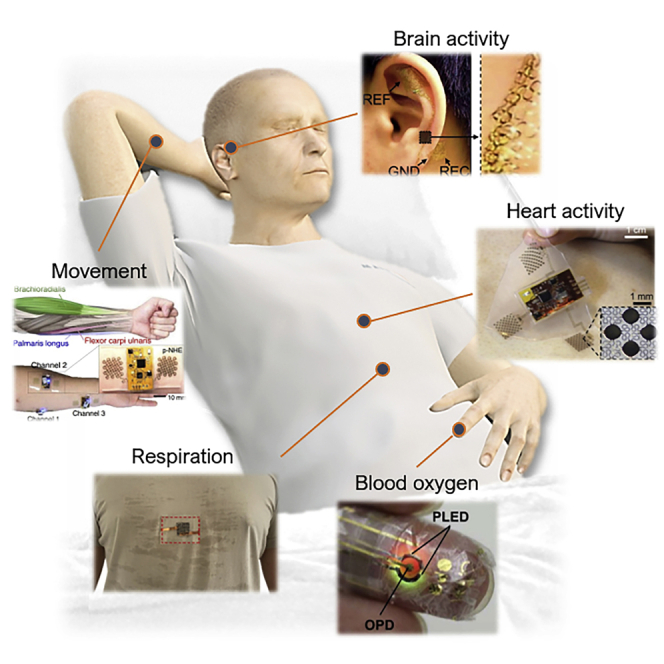
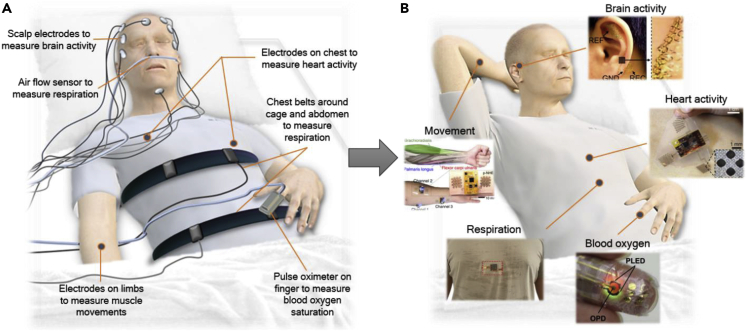
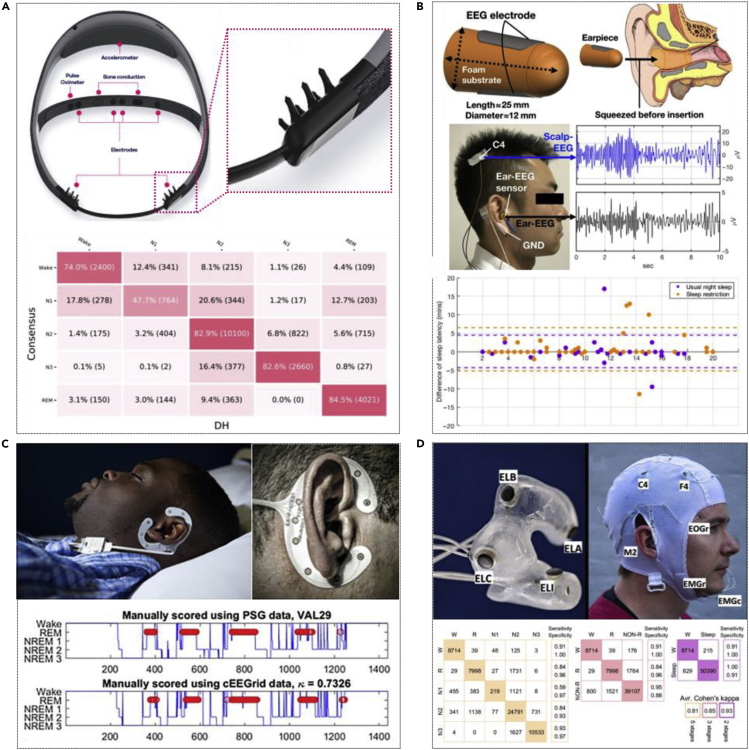
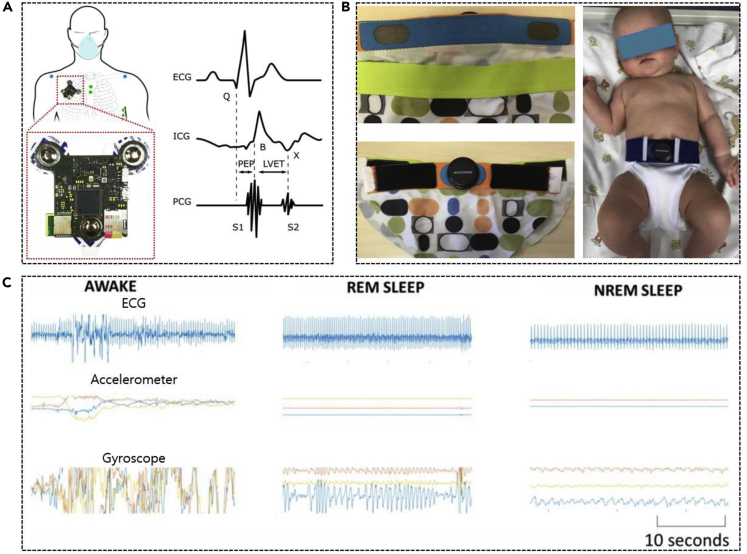
Verification
Claims the paper makes
The claims and statistics of this paper haven’t been checked yet.
Run the check — free, no account needed. It reads the open-access text and checks the sources it cites.
Claims other papers make about this one
Each is checked against this paper’s own text: does it say what the citing paper says it does?
In the citing paper
“The validation studies could align wearable data with gold-standard polysomnography (PSG) in measuring sleep duration and detecting sleep events [241].”
From The emergence of AI-based wearable sensors for digital health technology: a review (2023) · cites this paper as [241]
Self-check
Percentages, sums and reported differences re-computed from the paper’s own numbers.
The self-check needs the paper’s full text.
Citations
Cites
Huang, Y., & Zhao, N. (2020) · Psychiatry Research · doi:10.1016/j.psychres.2020.112954 · Cited by 3,736
Sleep Health: Can We Define It? Does It Matter?
Buysse, D. J. (2014) · SLEEP · doi:10.5665/sleep.3298 · Cited by 2,768
The epidemiology of adult obstructive sleep apnea
Punjabi, N. M. (2008) · Proceedings of the American Thoracic Society · doi:10.1513/pats.200709-155mg · Cited by 2,361
AASM Scoring Manual Updates for 2017 (Version 2.4)
Berry, R. B., Brooks, R., Gamaldo, C. E., Harding, S. M., Lloyd, R. M., Quan, S. F., Troester, M. M., & Vaughn, B. V. (2017) · Journal of Clinical Sleep Medicine · doi:10.5664/jcsm.6576 · Cited by 1,605
The role and validity of actigraphy in sleep medicine: an update
Sadeh, A. (2011) · Sleep Medicine Reviews · doi:10.1016/j.smrv.2010.10.001 · Cited by 1,415
Morgenthaler, T., Alessi, C., Friedman, L., Owens, J., Kapur, V., Boehlecke, B., Brown, T., Chesson, A., Coleman, J., Lee-Chiong, T., et al. (2007) · Sleep · doi:10.1093/sleep/30.4.519 · Cited by 1,142
Ultraflexible organic photonic skin
Yokota, T., Zalar, P., Kaltenbrunner, M., Jinno, H., Matsuhisa, N., Kitanosako, H., Tachibana, Y., Yukita, W., Koizumi, M., & Someya, T. (2016) · Science Advances · doi:10.1126/sciadv.1501856 · Cited by 1,024
Why Sleep Matters-The Economic Costs of Insufficient Sleep: A Cross-Country Comparative Analysis.
Hafner, M., Stepanek, M., Taylor, J., Troxel, W., & van Stolk, C. (2017) · Rand health quarterly · doi:10.7249/rb9962 · Cited by 687
A Prospective Study of Sleep Duration and Mortality Risk in Women
Patel, S. R., Ayas, N. T., Malhotra, M. R., White, D. P., Schernhammer, E. S., Speizer, F. E., Stampfer, M. J., & Hu, F. B. (2004) · Sleep · doi:10.1093/sleep/27.3.440 · Cited by 663
Why Sleep Matters—The Economic Costs of Insufficient Sleep: A Cross-Country Comparative Analysis
Hafner, M., Štěpánek, M., Taylor, J., Troxel, W., & Stolk, C. V. (2016) · Rand health quarterly · doi:10.7249/rhq-06-04-11 · Cited by 633
Cited by
Sorted by citations
Items 201–207 of 207
Sleep Data Repositories in Practice
Maghsoudi, A., Razjouyan, J., Sharafkhaneh, A., & Werner, J. K. (2026) · Sleep Medicine Clinics · doi:10.1016/j.jsmc.2026.08.003
Morphic Sensors for Respiratory and Cardiac Ubiquitous Monitoring
Bifulco, P., Naik, G. R., Brandwood, B., Jayarathna, T., & Breen, P. P. (2026) · World Congress on Medical Physics and Biomedical Engineering, September 7 - 12, 2009, Munich, Germany · doi:10.1007/978-3-032-39674-7_57
Building a Sleep Data Repository
Maghsoudi, A., Mohamed, S. D., Pyarajan, S., Studnicki, A., & Werner, J. K. (2026) · Sleep Medicine Clinics · doi:10.1016/j.jsmc.2026.08.018
Aleksandrov, A., Agaltsov, M., Aleksandrova, A., & Александрович, К. И. (2026) · IntechOpen eBooks · doi:10.5772/intechopen.1018067
Advancements in polysomnographic equipment and digital integration
Rangari, A. P., Jadhav, U. S., & Ghewade, B. (2026) · Egyptian Journal of Chest Diseases and Tuberculosis · doi:10.4103/ecdt.ecdt_98_25
From stretchable materials and functional fibers to intelligent textile sensing systems
Papaefstathiou, M., Elgendi, M., & Menon, C. (2026) · Communications Materials · doi:10.1038/s43246-026-01333-4
Wearable Sensor-Based Detection and Monitoring of Neurological Disorders
Aves, M., Sharma, I. C., Kandari, N., Sharma, V., & Kumar, R. (2026) · Advances in computational intelligence and robotics book series · doi:10.4018/979-8-2600-1036-5.ch005
Metadata
- Authors
- Kwon, S., Kim, H., & Yeo, W.-H.
- Affiliations
- Georgia Institute of Technology (US)
- Corresponding author
- Yeo, Woon-Hong
- Venue
- iScience
- Publisher
- Elsevier BV
- Published
- 2021-05
- Volume
- 24
- Issue
- 5
- Pages
- 102461
- ISSN
- 2589-0042 (ISSN-L)
- PMC
- PMC8113882
- OpenAlex
- W3156201172
- Cited by
- 209
- References
- 75
- Citations by year
- 2026: 37 · 2025: 45 · 2024: 47 · 2023: 38 · 2022: 34 · 2021: 8
- FWCI
- 2.69
- Type
- journal article
- Language
- en
- Open access
- gold
- doi.org
- Licence
- Locations
- iScience (publishedVersion, cc-by-nc-nd)
- PubMed Central (publishedVersion, cc-by-nc-nd)
- PubMed (publishedVersion)
- DOAJ (DOAJ: Directory of Open Access Journals) (submittedVersion, cc-by-sa)
- Funders
- National Institutes of Health
- Topics
- Physical Sciences › Engineering › Biomedical Engineering › Non-Invasive Vital Sign Monitoring
- Physical Sciences › Engineering › Biomedical Engineering › Advanced Sensor and Energy Harvesting Materials
- Social Sciences › Psychology › Experimental and Cognitive Psychology › Sleep and related disorders
- Keywords
- wearable sensors, portable electronics, sleep monitoring, home sleep testing, sleep disorders, polysomnography, miniaturized electronics, system packaging
About these checks
Registry, retraction, Cites and statistics results are computed, not judged, with one exception: a printed reference that no index lists is read once by a model before it counts as a citation error. Claims are extracted by a model and kept only when their quote appears verbatim in the text; each cited source is then checked, with a model’s help, for whether it says what the claim relies on. Those verdicts can be wrong — read the claim’s quote and the cited source before relying on one.
Statistics and arithmetic are recomputed, not judged.
Confidence bands are shown only for fields calibrated on our annotated test set. None is calibrated yet, so no band is shown.
What counts as a claim ›How we measure confidence ›How we check this ›
Are you an author, or do you see a problem with this page? Request a review
