

The DOI matches its Crossref record; 265 of the 266 references it cites were found in a registry or an index, and 1 are not checked yet.
Biochar for ameliorating soil fertility and microbial diversity: From production to action of the black gold
Open accessAbstract
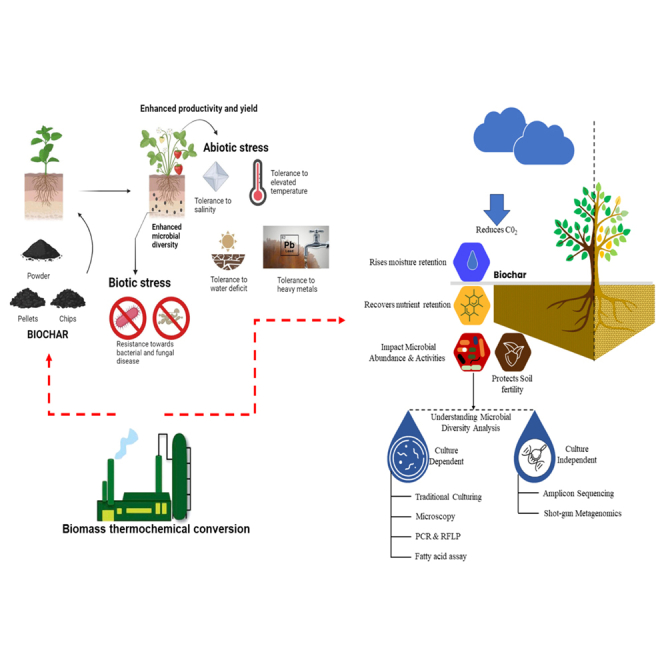
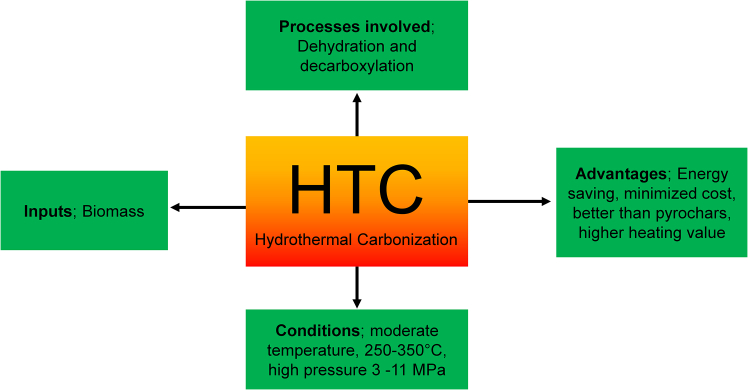
This article evaluated different production strategies, characteristics, and applications of biochar for ameliorating soil fertility and microbial diversity. The biochar production techniques are evolving, indicating that newer methods (including hydrothermal and retort carbonization) operate with minimum temperatures, yet resulting in high yields with significant improvements in different properties, including heating value, oxygen functionality, and carbon content, compared to the traditional methods. It has been found that the temperature, feedstock type, and moisture content play critical roles in the fabrication process. The alkaline nature of biochar is attributed to surface functional groups and addresses soil acidity issues. The porous structure and oxygen-containing functional groups contribute to soil microbial adhesion, affecting soil health and nutrient availability, improving plant root morphology, photosynthetic pigments, enzyme activities, and growth even under salinity stress conditions. The review underscores the potential of biochar to address diverse agricultural challenges, emphasizing the need for further research and application-specific considerations.
Overview
The claims and statistics of this paper haven’t been checked yet.
Run the check — free, no account needed. It reads the open-access text and checks the sources it cites.
Integrity signals
Registry
Cites
Statistics
Figures
Verification
Claims the paper makes
The claims and statistics of this paper haven’t been checked yet.
Run the check — free, no account needed. It reads the open-access text and checks the sources it cites.
Claims other papers make about this one
Each is checked against this paper’s own text: does it say what the citing paper says it does?
In the citing paper
“In the realm of soil remediation, ABB plays a dual role in reducing contamination and enhancing soil fertility [67].”
From Algal-Based Carbonaceous Materials for Environmental Remediation: Advances in Wastewater Treatment, Carbon Sequestration, and Biofuel Applications (2025) · cites this paper as [67]
Self-check
Percentages, sums and reported differences re-computed from the paper’s own numbers.
The self-check needs the paper’s full text.
Citations
Cites
2 retracted
Awasthi, M. K., Awasthi, S. K., Wang, Q., Wang, Z., Lahori, A. H., Ren, X., Chen, H., Wang, M., Zhao, J., & Zhang, Z. (2017) · Bioresource Technology · doi:10.1016/j.biortech.2017.12.037 · Cited by 81
RetractedLalarukh, I., Amjad, S. F., Mansoora, N., Al-Dhumri, S. A., Alshahri, A. H., Almutari, M. M., Alhusayni, . S., Al-Shammari, W. B., Poczai, P., Abbas, M., et al. (2022) · Scientific Reports · doi:10.1038/s41598-022-16866-0 · Cited by 34
RetractedBiochar effects on soil biota – A review
Lehmann, J., Rillig, M. C., Thies, J., Masiello, C. A., Hockaday, W. C., & Crowley, D. (2011) · Soil Biology and Biochemistry · doi:10.1016/j.soilbio.2011.04.022 · Cited by 5,074
Biochar for environmental management: science and technology
(2009) · Choice Reviews Online · doi:10.5860/choice.47-0296 · Cited by 2,947
A communal catalogue reveals Earth's multiscale microbial diversity
Thompson, L. R., Sanders, J. G., McDonald, D., Amir, A., Ladau, J., Locey, K. J., Prill, R. J., Tripathi, A., Gibbons, S. M., Ackermann, G., et al. (2017) · Nature · doi:10.1038/nature24621 · Cited by 2,684
Biochar for Environmental Management: Science and Technology
Lehmann, J., & Joseph, S. (2009) · Routledge eBooks · doi:10.4324/9781849770552 · Cited by 2,324
Weber, K., & Quicker, P. (2018) · Fuel · doi:10.1016/j.fuel.2017.12.054 · Cited by 1,522
Gul, S., Whalen, J. K., Thomas, B. W., Sachdeva, V., & Deng, H. (2015) · Agriculture Ecosystems & Environment · doi:10.1016/j.agee.2015.03.015 · Cited by 1,345
Agro-industrial wastes and their utilization using solid state fermentation: A review
Sadh, P. K., Duhan, S., & Duhan, J. S. (2018) · Bioresources and Bioprocessing · doi:10.1186/s40643-017-0187-z · Cited by 1,302
Biochar to improve soil fertility. A review
Ding, Y., Liu, Y., Liu, S., Li, Z., Tan, X., Huang, X., Zeng, G., Zhou, L., & Zheng, B. (2016) · Agronomy for Sustainable Development · doi:10.1007/s13593-016-0372-z · Cited by 1,144
Research works printed but not linked: 2
- Kumar Yadav, 2018, Biochar and their impacts on soil properties and crop productivity: a review, J. Pharmacogn. Phytochemistry (Elsevier), 7, 49
- Adeniyi, 2020, Production of hybrid biochar by retort-heating of elephant grass (Pennisetum purpureum) and low density polyethylene (LDPE) for waste management and product development, J. Mater. Environ. Sci., 2020, 1940
Cited by
Sorted by citations
Mnyango, J. I., Nyoni, B., Phiri, C., Fouda-Mbanga, B. G., Amusat, S. O., Maringa, A., Yalala-Ndlovu, B., Hlabano-Moyo, B. M., Tywabi-Ngeva, Z., & Hlangothi, S. P. (2025) · Next Materials · doi:10.1016/j.nxmate.2025.100974 · Cited by 44
González Fernández, L. A., Medellín Castillo, N. A., Sánchez Polo, M., Navarro Frómeta, A. E., & Vilasó Cadre, J. E. (2025) · Processes · doi:10.3390/pr13020556 · Cited by 37
Liang, B., Wei, J., Gao, Y., Ma, Z., & Xue, X. (2025) · Land Degradation and Development · doi:10.1002/ldr.5619 · Cited by 23
Rasool, A., Brožová, K., Chromíková, J., Pertile, E., Halfar, J., Malíková, P., Motyka, O., Drabinová, S., Čabanová, K., & Heviánková, S. (2026) · Biochar · doi:10.1007/s42773-026-00601-3 · Cited by 22
Saldarriaga, J. F., & López, J. E. (2025) · Sustainability · doi:10.3390/su172411285 · Cited by 21
Metadata
- Authors
- Ighalo, J. O., Ohoro, C. R., Ojukwu, V. E., Oniye, M., Shaikh, W. A., Biswas, J. K., Seth, C. S., Mohan, G. B. M., Chandran, S. A., & Rangabhashiyam, S.
- Affiliations
- Kansas State University (US)
- North-West University (ZA)
- Nnamdi Azikiwe University (NG)
- Nazarbayev University (KZ)
- The Neotia University (IN)
- University of Kalyani (IN)
- University of Delhi (IN)
- University of Georgia (US)
- SASTRA University (IN)
- Corresponding author
- Biswas, Jayanta Kumar
- ORCID
- Venue
- iScience
- Publisher
- Elsevier BV
- Published
- 2025-01
- Volume
- 28
- Issue
- 1
- Pages
- 111524
- ISSN
- 2589-0042 (ISSN-L)
- PMC
- PMC11728978
- OpenAlex
- W4404935968
- Cited by
- 107
- References
- 265
- Citations by year
- 2026: 77 · 2025: 30
- FWCI
- 3.31
- Type
- journal article
- Language
- en
- Open access
- gold
- doi.org
- Licence
- Locations
- iScience (publishedVersion, cc-by-nc-nd)
- PubMed Central (publishedVersion, cc-by-nc-nd)
- PubMed (publishedVersion)
- Nazarbayev University Repository (Nazarbayev University) (submittedVersion, cc-by)
- Funders
- Department of Science and Technology, Ministry of Science and Technology, India
- Topics
- Life Sciences › Agricultural and Biological Sciences › Soil Science › Soil Carbon and Nitrogen Dynamics
- Physical Sciences › Energy › Fuel Technology › Thermochemical Biomass Conversion Processes
- Life Sciences › Agricultural and Biological Sciences › Soil Science › Agricultural Science and Fertilization
- Keywords
- biochar, soil fertility, soil microbial diversity, biochar production, hydrothermal carbonization, pyrolysis temperature, feedstock type, moisture content, oxygen-containing functional groups, soil acidity, soil pH, soil porosity, nutrient availability, plant growth, salt stress, soil health
About these checks
Registry, retraction, Cites and statistics results are computed, not judged, with one exception: a printed reference that no index lists is read once by a model before it counts as a citation error. Claims are extracted by a model and kept only when their quote appears verbatim in the text; each cited source is then checked, with a model’s help, for whether it says what the claim relies on. Those verdicts can be wrong — read the claim’s quote and the cited source before relying on one.
Statistics and arithmetic are recomputed, not judged.
Confidence bands are shown only for fields calibrated on our annotated test set. None is calibrated yet, so no band is shown.
What counts as a claim ›How we measure confidence ›How we check this ›
Are you an author, or do you see a problem with this page? Request a review
