

The DOI matches its Crossref record; 207 of the 213 references it cites were found in a registry or an index.
The role of platelet-rich plasma in biomedicine: A comprehensive overview
Open accessAbstract
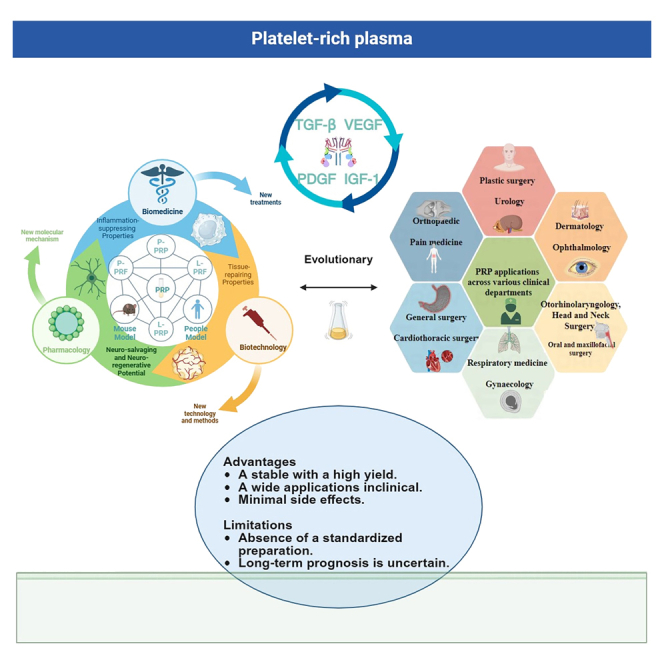
Biomedicine has seen significant advancements in the 21st century, with platelet-rich plasma (PRP) playing a crucial role in clinical practice. This blood derivative, enriched with platelet components, has shown great potential for promoting tissue repair and regeneration. Its wide range of applications and the presence of anti-inflammatory and growth-promoting factors make it a valuable tool in the field of biomedicine. The exploration of PRP in clinical settings has been gaining momentum. Despite its cost-effectiveness, safety, and therapeutic efficacy, the widespread clinical adoption of PRP has been hindered by the absence of consistent preparation standards and standardized treatment protocols. This article provides a comprehensive analysis of the clinical uses, physiological roles, molecular mechanisms, and preparation techniques of PRP in biomedicine. The aim is to offer a thorough understanding of the potential applications and benefits of PRP in medical practice.
Overview
The claims and statistics of this paper haven’t been checked yet.
Run the check — free, no account needed. It reads the open-access text and checks the sources it cites.
Integrity signals
Registry
Cites
Statistics
Figures
Verification
Claims the paper makes
The claims and statistics of this paper haven’t been checked yet.
Run the check — free, no account needed. It reads the open-access text and checks the sources it cites.
Claims other papers make about this one
Each is checked against this paper’s own text: does it say what the citing paper says it does?
The source backs part of the claim, not all of it — or backs it for a different population, condition or comparison.
In the citing paper
“Additionally, heterogeneity in study methodologies-particularly in PRP preparation, MSC sourcing, and peptide dosing-poses a challenge in drawing definitive conclusions regarding treatment efficacy [122,123].”
From Advancements in Regenerative Therapies for Orthopedics: A Comprehensive Review of Platelet-Rich Plasma, Mesenchymal Stem Cells, Peptide Therapies, and Biomimetic Applications (2025) · cites this paper as [123]
Experimental — accuracy not yet measured
Self-check
Percentages, sums and reported differences re-computed from the paper’s own numbers.
The self-check needs the paper’s full text.
Citations
Cites
1 retracted
Cui, K., Gong, S., Bai, J., Xue, L., Li, X., & Wang, X. (2023) · International Wound Journal · doi:10.1111/iwj.14596 · Cited by 5
RetractedGurtner, G. C., Werner, S., Barrandon, Y., & Longaker, M. T. (2008) · Nature · doi:10.1038/nature07039 · Cited by 6,542
Dohan Ehrenfest, D. M., Rasmusson, L., & Albrektsson, T. (2009) · Trends in Biotechnology · doi:10.1016/j.tibtech.2008.11.009 · Cited by 2,008
Platelet-Rich Plasma (PRP): What Is PRP and What Is Not PRP?
Marx, R. E. (2001) · Implant Dentistry · doi:10.1097/00008505-200110000-00002 · Cited by 1,704
Tzavlaki, K., & Moustakas, A. (2020) · Biomolecules · doi:10.3390/biom10030487 · Cited by 796
Angiogenesis in wound repair: Angiogenic growth factors and the extracellular matrix
Li, J., Zhang, Y., & Kirsner, R. S. (2003) · Microscopy Research and Technique · doi:10.1002/jemt.10249 · Cited by 740
Signaling Receptors for TGF-β Family Members
Heldin, C.-H., & Moustakas, A. (2016) · Cold Spring Harbor Perspectives in Biology · doi:10.1101/cshperspect.a022053 · Cited by 711
Role of platelet‐derived growth factor in wound healing
Pierce, G. F., Mustoe, T. A., Altrock, B. W., Deuel, T. F., & Thomason, A. (1991) · Journal of Cellular Biochemistry · doi:10.1002/jcb.240450403 · Cited by 618
Primary prevention of peri‐implantitis: Managing peri‐implant mucositis
Jepsen, S., Berglundh, T., Genco, R., Aass, A. M., Demirel, K., Derks, J., Figuero, E., Giovannoli, J. L., Goldstein, M., Lambert, F., et al. (2015) · Journal of Clinical Periodontology · doi:10.1111/jcpe.12369 · Cited by 592
Research works printed but not linked: 2
- Chen, 2024, Investigation of the effect of anticoagulants on platelet recovery, enrichment factor, PDGF, TGF-β1 and optimal dose in the preparation of platelet-rich plasma, Panminerva Med.
- He, 2020, Conservative treatment of patients with bladder genital tract fistula: Three case reports, Medicine (Baltim.), 99
Cited by
Glinkowski, W., Gut, G., & Śladowski, D. (2025) · Journal of Clinical Medicine · doi:10.3390/jcm14113983 · Cited by 54
Goulian, A. J., Goldstein, B., & Saad, M. A. (2025) · Journal of Clinical Medicine · doi:10.3390/jcm14062061 · Cited by 25
“Additionally, heterogeneity in study methodologies-particularly in PRP preparation, MSC sourcing, and peptide dosing-poses a challenge in drawing definitive conclusions regarding treatment efficacy [122,123].”
Moustakli, E., Potiris, A., Zikopoulos, A., Zachariou, A., Topis, S., Panagopoulos, P., Domali, E., Drakakis, P., & Stavros, S. (2025) · Biomedicines · doi:10.3390/biomedicines13051257 · Cited by 27
Shang, K., Liu, Y., & Qadeer, A. (2025) · Experimental Biology and Medicine · doi:10.3389/ebm.2025.10746 · Cited by 22
Zhou, H., Huang, Q., Chen, Y., Wang, J., & Jiang, H. (2025) · Journal of Pain Research · doi:10.2147/jpr.s546655 · Cited by 17
Self-citationPandey, G., Kolipaka, T., Srinivasarao, D. A., Abraham, N., Jain, A., & Srivastava, S. (2025) · Journal of Drug Delivery Science and Technology · doi:10.1016/j.jddst.2025.106852 · Cited by 17
Beyond Killing: The Overlooked Contribution of Neutrophils to Tissue Repair
Anitua, E., Troya, M., & Alkhraisat, M. H. (2025) · International Journal of Molecular Sciences · doi:10.3390/ijms26178669 · Cited by 16
Li, Y., You, H., Ou, C., Zhu, H., Cheng, B., & Tian, J. (2025) · Frontiers in Bioengineering and Biotechnology · doi:10.3389/fbioe.2025.1628565 · Cited by 11
Pham, G. M.-T. (2025) · Journal of Clinical Medicine · doi:10.3390/jcm14196959 · Cited by 10
Nguyen, L. V., & Nguyen, T. (2025) · Clinical Cosmetic and Investigational Dermatology · doi:10.2147/ccid.s528663 · Cited by 9
Zhang, Y., Yang, S., Zhang, N.-N., & Huang, G.-L. (2025) · BMC Oral Health · doi:10.1186/s12903-025-06484-3 · Cited by 8
Self-citationAutogenous Injections in Temporomandibular Disorders: A Systematic Review
Orzeszek, S., Małysa, A., Jenča, A., Gębska, M., Sluzalec-Wieckiewicz, K., Ziętek, M., & Seweryn, P. (2025) · Journal of Clinical Medicine · doi:10.3390/jcm14186640 · Cited by 6
Ibrahim, H., Abdelghany, M., Yusuf, A., Morsi, H., & Elshorbagy, G. (2025) · African Journal of Urology · doi:10.1186/s12301-025-00521-x · Cited by 5
Topical therapies for diabetic foot ulcers: a systematic review and network meta-analysis
Chen, L. J., Chen, J.-C., Lin, T., Shi, F., Chen, D., Wang, C., Gao, Y., Nair, H. K. R., & Ran, X. (2026) · BMJ Open Diabetes Research & Care · doi:10.1136/bmjdrc-2026-006026 · Cited by 3
Kasirer‐Friede, A. (2025) · International Journal of Translational Medicine · doi:10.3390/ijtm5030025 · Cited by 2
Hassan, A. E., Fahmy, M. M., Othman, A. A. A., Nosair, N. A. E.-A., Sherief, D., Esmael, K., Darweash, A., & Elgamal, R. (2025) · BMC Musculoskeletal Disorders · doi:10.1186/s12891-025-09339-8 · Cited by 2
Bueno, L. M. M., dos Santos, C. P. C., Cruel, P. T. E., Romanini, G., Castilho, L. R., Oliveira, C. R. D. S., Buchaim, D. V., & Buchaim, R. L. (2026) · Materials · doi:10.3390/ma19020224 · Cited by 2
Petrović, D., Dinic, M., Švraka, D., Pantovic, V., Kostova, E. P., Malenković, G., & Ljubić, A. (2026) · International Journal of Molecular Sciences · doi:10.3390/ijms27052177 · Cited by 2
Parmar, T., Lingam, S., AlSamhori, J., Elias, J., Ashkar, I., Ilyasu, S., Daher, M., & Abboud, J. A. (2026) · Regenerative Medicine · doi:10.1080/17460751.2026.2643235 · Cited by 2
Arif, A., Kanggas, F. Z. H., Rachmawati, A., Hidayati, R., & Kurniawan, C. S. (2025) · Jurnal Al-Dustur · doi:10.30863/aldustur.v8i1.8690 · Cited by 1
Pakpattaraphaiboon, P., Jitaroon, K., & Limpornpugdee, S. (2025) · Clinical Otolaryngology · doi:10.1111/coa.70062 · Cited by 1
Platelet-rich plasma and hyaluronic acid in the treatment of acute ankle sprains: A review
Chen, Y.-T., Wu, W., Lee, R., Yu, T., Chen, I., & Yeh, K. (2025) · Biomolecules and Biomedicine · doi:10.17305/bb.2025.13327 · Cited by 1
Zou, L., Ma, Y., Hu, M., Sun, Z., Zhijun, S., Gao, J., & Cai, X. (2026) · Journal of Bioenergetics and Biomembranes · doi:10.1007/s10863-026-10105-1 · Cited by 1
Sussman, W., Fitzpatrick, J., DeMers, A., & Everts, P. A. (2026) · Bioengineering · doi:10.3390/bioengineering13070780 · Cited by 1
Platelet Lysate-Based Biomaterials for Regenerative Tissue Engineering: A Comprehensive Review
Huo, Z., Sun, Q., Xiao, J., Zhu, W., Yang, H., & Li, J. (2026) · International Journal of Nanomedicine · doi:10.2147/ijn.s630536 · Cited by 1
Potential role of platelet rich plasma (PRP) to improve bovine semen quality: A review
Lestari, T. D., Pasang, G. S., Khairullah, A. R., Rimayanti, R., Utama, S., Safitri, E., Mulyati, S., Mustofa, I., Madyawati, S. P., Restiadi, T. I., et al. (2026) · Journal of Advanced Veterinary Research/Journal of Advanced Veterinary Research · Cited by 1
Suárez-Ahedo, C. (2025) · Arthroscopy The Journal of Arthroscopic and Related Surgery · doi:10.1016/j.arthro.2025.07.035 · Cited by 1
Toward Standardization in Platelet-Rich Plasma Therapy for Anal Fistula: A Commentary
Şahin, A. (2025) · Diseases of the Colon & Rectum · doi:10.1097/dcr.0000000000003970
Mehrizi, S. A., Heidari, N., Heidari, A., Ghane, Y., & Nilforoushzadeh, M. A. (2025) · Current Stem Cell Research & Therapy · doi:10.2174/011574888x395962250826111450
Repurposing surplus plasma and expired platelets into useful biotherapies
Goubran, H. A., Epstein, J. S., & Burnouf, T. (2025) · Transfusion and Apheresis Science · doi:10.1016/j.transci.2025.104277
Lu, C., Luo, Y., Wei, X., Li, L., & Hu, Z. (2025) · Journal of Orthopaedic Surgery and Research · doi:10.1186/s13018-025-06406-7
Hassan, F. E., Elgilil, N. M. A., Aboulhoda, B. E., Abdallah, H. A., Rashed, L., & Shaban, S. M. (2025) · Histochemistry and Cell Biology · doi:10.1007/s00418-025-02427-9
Карбоксітерапія як перспективний компонент ад’ювантної терапії артритів колінного суглоба
Бойко, С. О., Pushkash, I. I., Popovich, Y. М., & Skripynets, Y. P. (2024) · Likarska sprava · doi:10.31640/ls-2024-4-09
ЗБАГАЧЕНА ТРОМБОЦИТАМИ ПЛАЗМА: СУЧАСНЕ РОЗУМІННЯ ЕФЕКТИВНОСТІ ТА ТЕРАПЕВТИЧНОГО ЗАСТОСУВАННЯ
Лавренко, А. В. (2025) · Bulletin of Problems Biology and Medicine · doi:10.29254/2523-4110-2025-4-179/addition-48-50
Platelet-rich Plasma: Prospects in the Treatment of Peripheral Nervous System Diseases. A Review.
Chаrnukha, T. N., П., П. М., Линник, О. В., & Asaevich, V. I. (2025) · Comorbidity neurology · doi:10.62505/3034-185x-2025-2-4-20-28
Arutiunova, O. (2026) · Перспективи та інновації науки · doi:10.52058/2786-4952-2025-12(58)-2076-2086
Breakthroughs in Biomedical Research: Review/Minireview Issue
(2026) · Frontiers Media SA eBooks · doi:10.3389/978-2-8325-7380-8
Jia, S., Guo, Y., Zhang, C., Sun, X., Wang, L., & Wang, H. (2026) · Frontiers in Pharmacology · doi:10.3389/fphar.2026.1727021
Self-citationRghebi, N. (2026) · Razi Medical Journal · doi:10.69667/rmj.26213
Wang, X., Huang, Y., Xiao, X., Sun, B., Shi, L., Qiao, Y., Chen, C. M., Liu, X., & Sun, D. (2026) · Colloids and Surfaces A Physicochemical and Engineering Aspects · doi:10.1016/j.colsurfa.2026.140827
Yang, C.-C., Jiang, Y., & Kuo, H. (2026) · International Urology and Nephrology · doi:10.1007/s11255-026-05200-6
Self-citationPlatelet-Rich Plasma in Orthodontics. Healing and Stability Enhancement: A Review
Aldawoody, A. D., & Hasan, Y. (2026) · DENTAL JOURNAL OF INDIRA GANDHI INSTITUTE OF MEDICAL SCIENCES · doi:10.25259/djigims_43_2025
Guedes, A., de MATTOS, E. D. S. R., Barreto, E. S. R., & Júnior, C. R. A. (2026) · World Journal of Orthopedics · doi:10.5312/wjo.116587
Wakid, M. H., Zalat, R., Hammam, O. A., Alsulami, M. N., & El-Wakil, E. S. (2026) · Pharmaceuticals · doi:10.3390/ph19060908
Kim, S.-H., Back, E.-S., Lim, M., Kim, M. J., Yun, C., & Choi, Y.-S. (2026) · Regenerative Biomaterials · doi:10.1093/rb/rbag127
Wang, Z., Mak, M. W.-Y., Gao, X., Ye, Y.-T., Yik, C. L.-P., Dong, T. T.-X., & Tsim, K. W. K. (2026) · Pharmaceutics · doi:10.3390/pharmaceutics18070856
The Role of Platelet Rich Plasma (PRP) in the Treatment of Lumbar Spine Disease: A Narrative Review
Patton, S. L., Ayer, R., Fanous, S., Latif, U., & Lam, C. M. (2026) · Current Pain and Headache Reports · doi:10.1007/s11916-026-01529-w
Anitua, E., Troya, M., Tierno, R., Muruzábal, F., & Alkhraisat, M. H. (2026) · Expert Opinion on Biological Therapy · doi:10.1080/14712598.2026.2716332
Lafont, Z., Maniaci, A., Bouland, C., & Lechien, J. R. (2026) · American Journal of Otolaryngology · doi:10.1016/j.amjoto.2026.104915
Stavros, S., Potiris, A., Daskalaki, M. A., Dafopoulos, S., Moustakli, E., Karampitsakos, T., Sioutis, D., Dafopoulos, K. C., Thomakos, N., Daskalakis, G., et al. (2026) · Medical Sciences · doi:10.3390/medsci14050576
Transforming Orthopedic Services at a National Referral Hospital: Expertise, Technology, and Policy
Sumarwoto, T., Sari, A. W., Riza'i, A., Pamela, D. S., Idulhaq, M., & Romaniyanto (2026) · JMMR (Jurnal Medicoeticolegal dan Manajemen Rumah Sakit) · doi:10.18196/jmmr.v15i2.702
Li, Y., Liu, Y., Guo, Y., Li, Y., Dong, Y., Liu, H., Meng, Z., Zhao, Z., Yu, S., Liu, Z., et al. (2026) · Advanced Healthcare Materials · doi:10.1002/adhm.71777
Self-citationLiu, J., Hassan, W., & Zhang, J. (2026) · Journal of Tissue Viability · doi:10.1016/j.jtv.2026.101052
Abdelshakour, M. M., Zaki, A. M., Ali, R. A. H., Aladl, A. S., & Rageh, M. A. (2026) · Irish Journal of Medical Science (1971 -) · doi:10.1007/s11845-026-04634-2
Acosta, F. I. M., Albán, S. M. J., Iza, V. P. G., Peralta, A. P., & Larreategui, C. A. D. (2026) · Ciencia y Educación
Zakaria, O. M., Jazei, E. A. A., & Alhumam, A. (2026) · Nephro-Urology Monthly · doi:10.5812/numonthly-166398
Singh, G., Arunachalam, S., Subramanian, V., Haranahalli, S., Pal, S., Vinay, D., Dolui, S., Ramesh, M., & Sahoo, S. (2026) · Transfusion Clinique et Biologique · doi:10.1016/j.tracli.2026.10.003
Megahed, M. A., Alghzawi, H. M., Rifai, M., Hassan, A. A., Refaat, O., Magdy, I. M., Abozaid, B.-E., Abedelbaky, A. A., Farag, M. E., & Tawfik, J. W. (2026) · European Archives of Oto-Rhino-Laryngology · doi:10.1007/s00405-026-10723-w
Platelet-Loaded Anisotropic Cryogel for Rapid Hemostasis and Infected Wound Healing
Zhu, T., Wang, Z., Miao, W., & Huang, R. (2026) · ACS Applied Bio Materials · doi:10.1021/acsabm.6c01484
Alshareef, S. A., Albugami, R. R., Alshammari, M., Mohammed, S., & Eltayeb, R. (2026) · Frontiers in Medicine · doi:10.3389/fmed.2026.1956249
Platelet-rich plasma for diabetic foot ulcer: A bibliometric analysis and knowledge graph mapping
Li, J., Hu, Z.-M., Hu, D., Cheng, Y., Huang, C.-J., & Gao, X. (2026) · World Journal of Diabetes · doi:10.4239/wjd.127064
Metadata
- Authors
- Zhang, Z., Liu, P., Xue, X., Zhang, Z., Wang, L., Jiang, Y., Zhang, C., Zhou, H., Lv, S., Shen, W., Yang, S., & Wang, F.
- Affiliations
- Xidian University (CN)
- Chinese PLA General Hospital (CN)
- Corresponding author
- Yang, Shiming
- Wang, Fangyuan
- Venue
- iScience
- Publisher
- Elsevier BV
- Published
- 2025-02
- Volume
- 28
- Issue
- 2
- Pages
- 111705
- ISSN
- 2589-0042 (ISSN-L)
- PMC
- PMC11787504
- OpenAlex
- W4406071180
- Cited by
- 48
- References
- 213
- Citations by year
- 2026: 24 · 2025: 23
- FWCI
- 9.76
- Type
- journal article
- Language
- en
- Open access
- gold
- doi.org
- Licence
- cc-by-nc-nd
- www.elsevier.com/tdm/userlicense/1.0/ (tdm)
- www.elsevier.com/legal/tdmrep-license (tdm)
- creativecommons.org/licenses/by-nc-nd/4.0/ (vor)
- Locations
- iScience (publishedVersion, cc-by-nc-nd)
- PubMed Central (publishedVersion, cc-by-nc-nd)
- PubMed (publishedVersion)
- DOAJ (DOAJ: Directory of Open Access Journals) (submittedVersion)
- Funders
- National Key Research and Development Program of China (2020YFC2005203)
- Key Technologies Research and Development Program (2022YFC2402701, 2022YFC2402704)
- National Natural Science Foundation of China
- National Natural Science Foundation of China-China Academy of General Technology Joint Fund for Basic Research (81820108009)
- Topics
- Health Sciences › Dentistry › Periodontics › Periodontal Regeneration and Treatments
- Health Sciences › Medicine › Hematology › Blood transfusion and management
- Life Sciences › Biochemistry, Genetics and Molecular Biology › Cell Biology › Mesenchymal stem cell research
- Keywords
- platelet-rich plasma, tissue regeneration, tissue repair, anti-inflammatory factors, growth factors, clinical application, standardized treatment protocol, molecular mechanisms
About these checks
Registry, retraction, Cites and statistics results are computed, not judged, with one exception: a printed reference that no index lists is read once by a model before it counts as a citation error. Claims are extracted by a model and kept only when their quote appears verbatim in the text; each cited source is then checked, with a model’s help, for whether it says what the claim relies on. Those verdicts can be wrong — read the claim’s quote and the cited source before relying on one.
Statistics and arithmetic are recomputed, not judged.
Confidence bands are shown only for fields calibrated on our annotated test set. None is calibrated yet, so no band is shown.
What counts as a claim ›How we measure confidence ›How we check this ›
Are you an author, or do you see a problem with this page? Request a review
Data sources
Bibliographic data: Semantic Scholar, OpenAlex, Crossref.
Contains information from the Semantic Scholar Academic Graph Datasets, made available under the ODC Attribution License (ODC-BY 1.0).
Semantic Scholar’s data is described in: Kinney, R., et al. (2023). The Semantic Scholar Open Data Platform. arXiv:2301.10140.
