

The DOI matches its Crossref record; 61 of the 61 references it cites were found in a registry or an index.
Subjective cognitive decline and rates of incident Alzheimer's disease and non-Alzheimer's disease dementia
Open accessAbstract
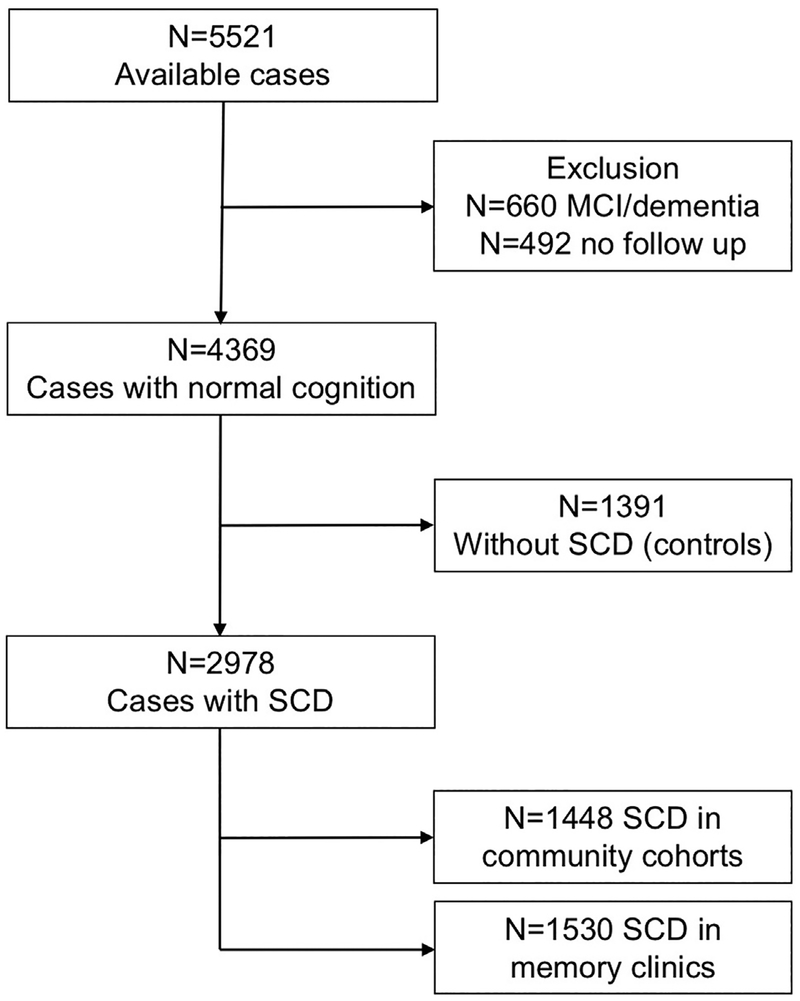
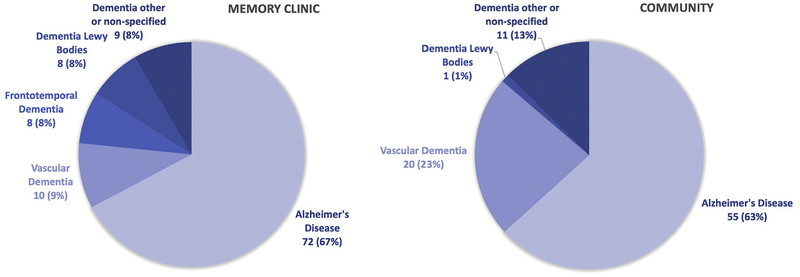
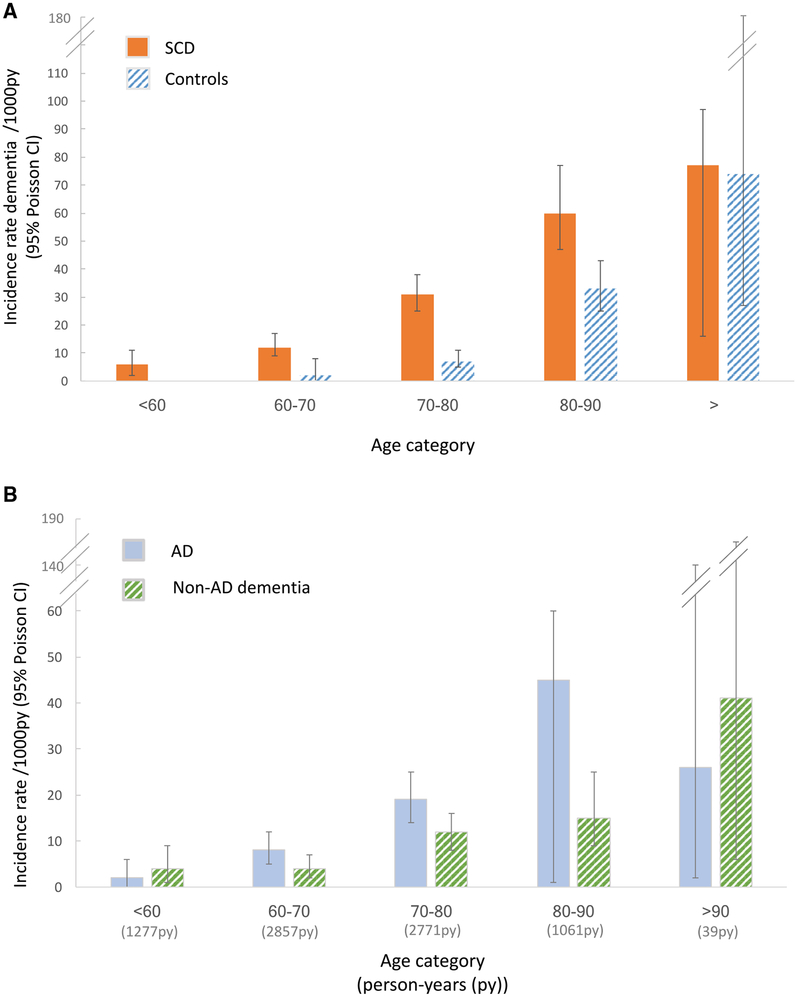
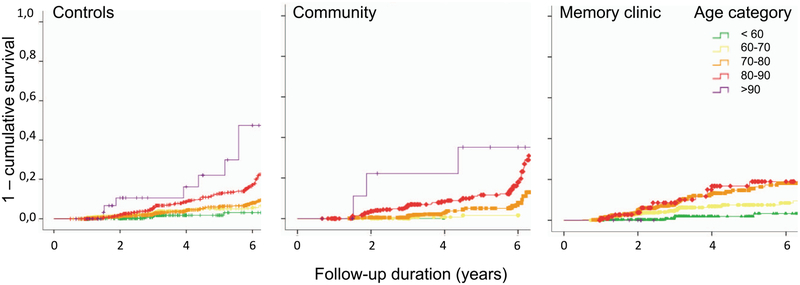
INTRODUCTION: In this multicenter study on subjective cognitive decline (SCD) in community-based and memory clinic settings, we assessed the (1) incidence of Alzheimer's disease (AD) and non-AD dementia and (2) determinants of progression to dementia. METHODS: Eleven cohorts provided 2978 participants with SCD and 1391 controls. We estimated dementia incidence and identified risk factors using Cox proportional hazards models. RESULTS: In SCD, incidence of dementia was 17.7 (95% Poisson confidence interval 15.2-20.3)/1000 person-years (AD: 11.5 [9.6-13.7], non-AD: 6.1 [4.7-7.7]), compared with 14.2 (11.3-17.6) in controls (AD: 10.1 [7.7-13.0], non-AD: 4.1 [2.6-6.0]). The risk of dementia was strongly increased in SCD in a memory clinic setting but less so in a community-based setting. In addition, higher age (hazard ratio 1.1 [95% confidence interval 1.1-1.1]), lower Mini-Mental State Examination (0.7 [0.66-0.8]), and apolipoprotein E ε4 (1.8 [1.3-2.5]) increased the risk of dementia. DISCUSSION: SCD can precede both AD and non-AD dementia. Despite their younger age, individuals with SCD in a memory clinic setting have a higher risk of dementia than those in community-based cohorts.
Overview
The claims and statistics of this paper haven’t been checked yet.
Run the check — free, no account needed. It reads the open-access text and checks the sources it cites.
Integrity signals
Registry
Cites
Statistics
Figures
Verification
Claims the paper makes
The claims and statistics of this paper haven’t been checked yet.
Run the check — free, no account needed. It reads the open-access text and checks the sources it cites.
Claims other papers make about this one
Each is checked against this paper’s own text: does it say what the citing paper says it does?
The source backs part of the claim, not all of it — or backs it for a different population, condition or comparison.
In the citing paper
“SCD is postulated to manifest at a relatively late phase of preclinical AD and is associated with increased risks of AD biomarker abnormalities and future cognitive decline and dementia [2, 4, 6]”
From Neuroimaging advances regarding subjective cognitive decline in preclinical Alzheimer's disease (2020) · cites this paper as [6]
Experimental — accuracy not yet measuredThe cited source says what the claim attributes to it.
In the citing paper
“SCD is postulated to manifest at a relatively late phase of preclinical AD and is associated with increased risks of AD biomarker abnormalities and future cognitive decline and dementia [2, 4, 6]”
From Neuroimaging advances regarding subjective cognitive decline in preclinical Alzheimer's disease (2020) · cites this paper as [6]
In the citing paper
“Subjective cognitive decline might be a risk factor of clinical progression,24 but the ability of subjective cognitive decline to predict progression to objective cognitive decline (ie, mild cognitive decline, or dementia, or both) remains low (OR 1·5–3·081).”
From Clinical diagnosis of Alzheimer’s disease: Recommendations of the International Working Group (2021) · cites this paper as [81]
Self-check
Percentages, sums and reported differences re-computed from the paper’s own numbers.
The self-check needs the paper’s full text.
Citations
Cites
Folstein, M. F., Folstein, S. E., & McHugh, P. R. (1975) · Journal of Psychiatric Research · doi:10.1016/0022-3956(75)90026-6 · Cited by 88,282
McKhann, G., Drachman, D., Folstein, M., Katzman, R., Price, D., & Stadlan, E. M. (1984) · Neurology · doi:10.1212/wnl.34.7.939 · Cited by 27,915
Hirono, N., Mori, E., Ikejiri, Y., Imamura, T., Shimomura, T., Hashimoto, M., Yamashita, H., & Ikeda, M. (1997) · PubMed · Cited by 21,012
Kok, J. S., Berg, I. J., & Scherder, E. J. A. (2013) · Dementia and Geriatric Cognitive Disorders Extra · doi:10.1159/000353441 · Cited by 20,589
Older Adults' Reasons for Using Technology while Aging in Place
Peek, S. T. M., Luijkx, K. G., Rijnaard, M. D., Nieboer, M. E., van der Voort, C. S., Aarts, S., van Hoof, J., Vrijhoef, H. J., & Wouters, E. (2015) · Gerontology · doi:10.1159/000430949 · Cited by 19,852
Sensitivity and False Alarm Rate of a Fall Sensor in Long-Term Fall Detection in the Elderly
Kangas, M., Korpelainen, R., Vikman, I., Nyberg, L., & Jämsä, T. J. (2014) · Gerontology · doi:10.1159/000362720 · Cited by 19,007
McKhann, G. M., Knopman, D. S., Chertkow, H., Hyman, B. T., Jack, C. R., Kawas, C. H., Klunk, W. E., Koroshetz, W. J., Manly, J. J., Mayeux, R., et al. (2011) · Alzheimer's & Dementia · doi:10.1016/j.jalz.2011.03.005 · Cited by 18,657
Albert, M. S., DeKosky, S. T., Dickson, D., Dubois, B., Feldman, H. H., Fox, N. C., Gamst, A., Holtzman, D. M., Jagust, W. J., Petersen, R. C., et al. (2011) · Alzheimer's & Dementia · doi:10.1016/j.jalz.2011.03.008 · Cited by 10,152
Corder, E. H., Saunders, A. M., Strittmatter, W. J., Schmechel, D. E., Gaskell, P. C., Small, G. W., Roses, A. D., Haines, J. L., & Pericak-Vance, M. A. (1993) · Science · doi:10.1126/science.8346443 · Cited by 9,429
Sperling, R. A., Aisen, P. S., Beckett, L. A., Bennett, D. A., Craft, S., Fagan, A. M., Iwatsubo, T., Jack, C. R., Kaye, J., Montine, T. J., et al. (2011) · Alzheimer's & Dementia · doi:10.1016/j.jalz.2011.03.003 · Cited by 7,155
Cited by
Sorted by citations
Items 301–400 of 428
Update Amyloid-Bildgebung in der Diagnostik der Neurodegeneration
Drzezga, A. E., & Giehl, K. (2022) · Angewandte Nuklearmedizin · doi:10.1055/a-1712-6110 · Cited by 1
Development of the subjective cognitive function decline scale for middle-aged Koreans
So, Y., Hahm, J., Lee, S., Kim, J., & Moon, K. (2024) · Aging & Mental Health · doi:10.1080/13607863.2024.2442598 · Cited by 1
Ryu, S. Y., Lee, C., Ho, S. H., Hong, Y. J., Jeong, J. H., Park, K. H., Wang, M. J., Choi, S. H., Kim, S., & Yang, D. W. (2025) · Dementia and Geriatric Cognitive Disorders · doi:10.1159/000543230 · Cited by 1
Peterson, K. A., Leddy, A., & Hornberger, M. (2025) · PLOS Digital Health · doi:10.1371/journal.pdig.0000682 · Cited by 1
Almkvist, O., Gyllenhammar, M., Norberg, S., Roeseler, M. L., Westman, E., & Ekman, U. (2025) · Scientific Reports · doi:10.1038/s41598-025-07664-5 · Cited by 1
Masebo, L., Whitfield, T. J., Demnitz‐King, H., Heslegrave, A., Poisnel, G., Antoine Lutz, A., Frison, É., Wirth, M., Hye, A., Jessen, F., et al. (2025) · The Journal of Prevention of Alzheimer s Disease · doi:10.1016/j.tjpad.2025.100299 · Cited by 2
Choi, Y. J., Oh, D. J., Han, J. W., & Kim, K. W. (2025) · Journal of Alzheimer s Disease · doi:10.1177/13872877251390383 · Cited by 1
Pairwise Comparisons of COVID-19 Infection and Smoking Behaviors on Subjective Cognitive Decline
Xie, Z., Cho, B., German, M., Spaulding, A., & Stallings‐Smith, S. (2025) · American Journal of Preventive Medicine · doi:10.1016/j.amepre.2025.108121 · Cited by 1
Hippocampal and cortical activities reflect early hyperexcitability in an Alzheimer's mouse model
Diachenko, M., Krivoshein, G., van den Maagdenberg, A. M. J. M., Mansvelder, H. D., van Kesteren, R. E., Tolner, E. A., & Linkenkaer‐Hansen, K. (2025) · Brain Communications · doi:10.1093/braincomms/fcaf443 · Cited by 3
Álvarez‐Pérez, Y., Duarte‐Díaz, A., Molina, Y., Figueroa, N., Diaz‐Galvan, P., García-Cabello, E., Gonzalez‐Burgos, L., Yánez-Pérez, R., Rivero‐Santana, A., Olofsson, J., et al. (2025) · Journal of Alzheimer s Disease · doi:10.1177/13872877251397411 · Cited by 1
Xie, Z., Barr, E., Terrell, K. R., Stallings‐Smith, S., & Hamadi, H. Y. (2025) · The Journal of LGBTQ+ Mental Health · doi:10.1080/19359705.2025.2600026 · Cited by 1
Peterson, K. A., Leddy, A., Ellis, F., Meiser‐Stedman, R., & Hornberger, M. (2025) · Neuropsychology Review · doi:10.1007/s11065-025-09688-0 · Cited by 1
Launay, A., Taconnat, L., Vanneste, S., Matysiak, A., & Baudouin, A. (2026) · Acta Psychologica · doi:10.1016/j.actpsy.2026.106274 · Cited by 1
Lam, A. K. F., Almgren, H., Palmer, J. R., D'Rozario, A. L., D’Souza, A., Yee, B. J., Mowszowski, L., Calamante, F., & Naismith, S. L. (2026) · Alzheimer s & Dementia · doi:10.1002/alz.71197 · Cited by 1
Dementia risk factors, everyday functioning, and healthy aging across cognitive status
Whiteley, N., Farrer, T. J., & Schmitter‐Edgecombe, M. (2026) · Archives of Clinical Neuropsychology · doi:10.1093/arclin/acag022 · Cited by 1
Marinou, S., & Taler, V. (2026) · Journal of Neuropsychology · doi:10.1111/jnp.70049 · Cited by 1
Magnani, A., Pierobon, A., Torlaschi, V., Fundarò, C., & Maffoni, M. (2026) · Frontiers in Psychology · doi:10.3389/fpsyg.2026.1808150 · Cited by 1
Detection of Parkinson’s Disease in Alzheimer’s Patients Utilizing Brain Imaging
Bhatia, M., Kaur, A., Bhatia, S., Mridula, & Dwivedi, P. (2022) · Traitement du signal · doi:10.18280/ts.390439 · Cited by 1
Stojanovic, M., Waters, A. B., Kiselica, A. M., & Benge, J. F. (2023) · Applied Neuropsychology Adult · doi:10.1080/23279095.2023.2247109 · Cited by 1
Andriuta, D., Roussel, M., Chêne, G., Fischer, C., Mangin, J., Dubois, B., Vellas, B. J., Pasquier, F., Tison, F., Blanc, F., et al. (2024) · Revue Neurologique · doi:10.1016/j.neurol.2024.02.394 · Cited by 1
Lee, J.-W., Kim, M., Kim, H., Kim, S., Um, Y. H., Wang, S., Lim, H. K., Lee, C. U., & Kang, D. W. (2024) · Frontiers in Aging Neuroscience · doi:10.3389/fnagi.2024.1410185 · Cited by 2
Ikanga, J. N., Patel, S. S., Schwinne, M., Obenauf, C., Epenge, E., Gikelekele, G., Tshengele, N., Kavugho, I., Mampunza, S. M. M., Mananga, L., et al. (2025) · Frontiers in Aging Neuroscience · doi:10.3389/fnagi.2025.1552348 · Cited by 1
Lin, Y., Lin, P., Zeng, G., Wu, S., Chen, R., Xiao, Y., & Chen, H. (2025) · Frontiers in Psychology · doi:10.3389/fpsyg.2025.1545325 · Cited by 1
A Novel Two-Stage Feature Selection Framework for Efficiently Diagnosing Alzheimer's Disease
Lu, P., Gao, W., Pan, J., Yang, H., & Ding, X. (2024) · International Conference on Data Science and Information Technology (DSIT) · doi:10.1109/dsit61374.2024.10881133 · Cited by 1
Lu, P., Chen, M., Chen, L., Lin, F. Y., Yang, H., Wang, Y., & Ding, X. (2025) · Journal of Alzheimer s Disease · doi:10.1177/13872877251343241 · Cited by 2
Subjective Cognitive Decline and Antisaccade Latency: Exploring Early Markers of Dementia Risk
Wilcockson, T. D. W., Begde, A., & Hogervorst, E. (2025) · Journal of dementia and Alzheimer's disease · doi:10.3390/jdad2020016 · Cited by 1
Early diagnosis of Lewy body disease in elderly individuals with subjective cognitive decline
Fujishiro, H. (2019) · Journal of the Neurological Sciences · doi:10.1016/j.jns.2019.05.004 · Cited by 1
Fujishiro, H., Ota, K., Yamagata, M., & Nagahama, Y. (2020) · Psychogeriatrics · doi:10.1111/psyg.12599 · Cited by 1
Management of Patients with Dementia: An Introduction
Frederiksen, K. S., & Waldemar, G. (2021) · Springer eBooks · doi:10.1007/978-3-030-77904-7_1 · Cited by 1
Sabatini, S., Martyr, A., Ukoumunne, O. C., Ballard, C. G., Collins, R., Pentecost, C., Rusted, J. M., Quinn, C., Anstey, K. J., Kim, S., et al. (2021) · Research Square · doi:10.21203/rs.3.rs-151894/v1
Demencia prevenció: A korai diagnózistól a személyre szabott intervencióig
Manga, A., Havadi-Nagy, M., Székely, O., & Vidnyánszky, Z. (2021) · Scientia et Securitas · doi:10.1556/112.2021.00031
Singleton, E. H., Fieldhouse, J. L. P., Hooft, J. J. V. ’., Scarioni, M., van Engelen, M. E., Sikkes, S. A. M., de Boer, C., Bocancea, D. I., van den Berg, E., Scheltens, P., et al. (2022) · medRxiv · doi:10.1101/2022.02.07.22270260
Yu, Y., Lv, J., Liu, J., Chen, Y., Chen, K., & Yang, Y.-F. (2022) · Research Square · doi:10.21203/rs.3.rs-1567017/v1
Xue, C., Qi, W., Yuan, Q., Hu, G., Ge, H., Rao, J., Xiao, C., & Chen, J. (2021) · Research Square · doi:10.21203/rs.3.rs-394271/v2
Xue, C., Qi, W., Yuan, Q., Hu, G., Ge, H., Rao, J., Xiao, C., & Chen, J. (2021) · Research Square · doi:10.21203/rs.3.rs-394271/v1
Novel perspectives from existing data on early Alzheimer’s disease pathology and dementia care use
Janssen, O. (2022) · Research Publications (Maastricht University) · doi:10.26481/dis.20220617oj
Ding, C., Wang, L., Han, Y., & Jiang, J. (2022) · Annual International Conference of the IEEE Engineering in Medicine and Biology Society (EMBC) · doi:10.1109/embc48229.2022.9870934
Detection and Intervention of Subjective Cognitive Decline in Pre-Alzheimer’s Disease
何, 雅. (2022) · International Journal of Psychiatry and Neurology · doi:10.12677/ijpn.2022.114010
Randolph, J. J., Wishart, H. A., & Rabin, L. A. (2022) · Springer eBooks · doi:10.1007/978-3-031-11389-5_9
Kann, M., Zeiger, P., Rizer, S. J., Stephanie, C., & Azar, M. (2023) · Journal of Geriatric Medicine and Gerontology · doi:10.23937/2469-5858/1510146
Impact of Cognitive Priming on Alzheimer’s Disease
Abdessalem, H. B., & Frasson, C. (2023) · Advances in experimental medicine and biology · doi:10.1007/978-3-031-31982-2_21
Lewis, J. D., Swanberg, M. M., Bien, E., Porcelan, J., & Broderick, P. J. (2023) · Springer eBooks · doi:10.1007/978-3-031-14372-4_6
Prevalencia de quejas subjetivas de memoria: estudio poblacional en España
García, J. G., Aguilar, E. G., Quino, T. V., Blanco, M., & Barrull, C. (2023) · Revista Española de Geriatría y Gerontología · doi:10.1016/j.regg.2023.101426
Chen, Q., Chen, F., Long, C., Zhu, Y., Jiang, Y., Zhu, Z., Lu, J., Zhang, X., Nedelská, Z., Hort, J., et al. (2023) · Figshare · doi:10.6084/m9.figshare.22697055
Marchant, N. L., Lau, Y., Bansal, A., Palix, C., Demnitz‐King, H., Wirth, M., Klimecki, O., Chételat, G., Poisnel, G., & Medit‐Ageing Research Group (2024) · Research Square · doi:10.21203/rs.3.rs-4246401/v1
Medication Monitoring Interactive System Based on Human Body Feature Points and Label Recognition
Qian, S., & Yang, Y. (2024) · Communications in computer and information science · doi:10.1007/978-3-031-61947-2_23
Salisbury, D. L., Warry, W., Soderlund, P. D., Cruikshank, K. R., Fergen, J. T., & Jacklin, K. M. (2024) · Journal of Clinical Exercise Physiology · doi:10.31189/2165-6193-13.3.69
Subjektívny pokles kognície: koncept a súvislosti
Filozofická fakulta Univerzity Komenského, B., Krakovska, S., Hajdúk, M., Heretik, A., Košutzká, Z., & Brandoburová, P. (2024) · Ceskoslovenska psychologie · doi:10.51561/cspsych.68.4.388 · Cited by 1
Predictive value of an unsupervised web-based assessment of the neuropsychological function
Werrmann, M., Gür-Tok, Y., Eid, M., & Niedeggen, M. (2025) · Scientific Reports · doi:10.1038/s41598-025-85614-x
Katz, A. J., Chang, P.-S., Gao, S., Apostolova, L. G., Passey, R. T., Yang, Z., Ceniza, D., & Lu, Y. Y.-F. (2025) · Contemporary Clinical Trials · doi:10.1016/j.cct.2025.107836
Waterink, L., van der Lee, S. J., Nijland, D. M., van der Zee, F. I., Visser, L. N. C., Pijnenburg, Y. A. L., Sikkes, S. A. M., van der Flier, W. M., & Zwan, M. D. (2025) · The Journal of Prevention of Alzheimer s Disease · doi:10.1016/j.tjpad.2025.100099
The complexity of Alzheiemer's disease: New frontiers
Stefanova, E. D. (2024) · Medicinski podmladak · doi:10.5937/mp75-54670
Wei, M., Wang, L., Yu, X., Hu, W., Wang, M., Zhang, Q., Guo, T., Zhong, J., Li, C., Jiang, J., et al. (2025) · CNS Neuroscience & Therapeutics · doi:10.1111/cns.70264
Селезнева, Н. Д., If, R., Колыхалов, И. В., & Si, G. (2025) · S S Korsakov Journal of Neurology and Psychiatry · doi:10.17116/jnevro202512504236
Jun, H., Ryu, M., Chae, H., Chu, H., Kim, K., Lee, D.-E., Jin, H., Joo, S., Park, D., Leem, J., et al. (2025) · World Journal of Clinical Cases · doi:10.12998/wjcc.v13.i25.107484
Yeh, A.-Y., Chao, Y., Strauss, S. M., & Chou, C. (2025) · Western Journal of Nursing Research · doi:10.1177/01939459251350812
Селезнева, Н. Д., If, R., Колыхалов, И. В., & Si, G. (2025) · Neuroscience and Behavioral Physiology · doi:10.1007/s11055-025-01880-2
Zarich, S., Cole, R. M., Fairchild, K., Spakowicz, D. J., Sparagna, G. C., Madison, A. A., Ni, A., & Belury, M. A. (2025) · JMIR Research Protocols · doi:10.2196/82032
Zhu, M., Wang, L., Ding, X., Wang, Q., & Li, Z. (2025) · Geriatric Nursing · doi:10.1016/j.gerinurse.2025.103657
Tolentino, A. C., Barros, F. M. R., Smaniotto, L., de Souza, M. G., Schumacher, A. L., Marques, R. F., Barnes, L. L., Mella, L. F. B., & de Azevedo, R. C. S. (2025) · Psychogeriatrics · doi:10.1111/psyg.70114 · Cited by 1
The immuno-neurological axis: association between autoimmune diseases and dementia risk
Lee, W., Ma, X., & Lee, S. (2025) · GeroScience · doi:10.1007/s11357-025-01904-2
Gagliardi, G. P., Houot, M., Cacciamani, F., Habert, M., Dubois, B., & Epelbaum, S. (2020) · Figshare · doi:10.6084/m9.figshare.12308129
Chen, Q., Chen, F., Long, C., Zhu, Y., Jiang, Y., Zhu, Z., Lu, J., Zhang, X., Nedelská, Z., Hort, J., et al. (2023) · Figshare · doi:10.6084/m9.figshare.22697070
Whitfield, T. J., Chouliaras, L., Morrell, R., Rubio, D., Radford, D., Marchant, N. L., & Walker, Z. (2024) · Figshare · doi:10.6084/m9.figshare.26129662
Schliep, K. C., Barbeau, W. A., Lynch, K. E., Sorweid, M. K., Varner, M. W., Foster, N. L., & Qeadan, F. (2022) · Figshare · doi:10.6084/m9.figshare.19586923
Perna, L., Stocker, H. R., Burow, L., Beyer, L., Trares, K., Kurz, C., Guersel, S., Holleczek, B., Tatò, M., Beyreuther, K. T., et al. (2024) · Figshare · doi:10.6084/m9.figshare.26638728
Ko, Y.-A., Billheimer, J. T., Lyssenko, N. N., Kueider‐Paisley, A., Wolk, D. A., Arnold, S. E., Leung, Y. Y., Shaw, L. M. J., Trojanowski, J. Q., Kaddurah‐Daouk, R., et al. (2024) · Figshare · doi:10.6084/m9.figshare.26557490
Ko, Y.-A., Billheimer, J. T., Lyssenko, N. N., Kueider‐Paisley, A., Wolk, D. A., Arnold, S. E., Leung, Y. Y., Shaw, L. M. J., Trojanowski, J. Q., Kaddurah‐Daouk, R., et al. (2024) · Figshare · doi:10.6084/m9.figshare.26557502
Ssonko, M., Hardy, A., Naganathan, V., Kalula, S., & Combrinck, M. I. (2023) · Figshare · doi:10.6084/m9.figshare.24782570
Bohn, L., Drouin, S. M., McFall, G. P., Rolfson, D. B., Andrew, M. K., & Dixon, R. A. (2024) · Figshare · doi:10.6084/m9.figshare.26652204
Gagliardi, G. P., Houot, M., Cacciamani, F., Habert, M., Dubois, B., & Epelbaum, S. (2020) · Figshare · doi:10.6084/m9.figshare.12308117
Schliep, K. C., Barbeau, W. A., Lynch, K. E., Sorweid, M. K., Varner, M. W., Foster, N. L., & Qeadan, F. (2022) · Figshare · doi:10.6084/m9.figshare.19586917
Dubbelman, M. A., Jutten, R. J., Tomaszewski‐Farias, S. E., Amariglio, R. E., Buckley, R. F., Visser, P. J., Rentz, D. M., Johnson, K. A., Properzi, M. J., Schultz, A. P., et al. (2020) · Figshare · doi:10.6084/m9.figshare.13167204
Chen, Q., Chen, F., Long, C., Zhu, Y., Jiang, Y., Zhu, Z., Lu, J., Zhang, X., Nedelská, Z., Hort, J., et al. (2023) · Figshare · doi:10.6084/m9.figshare.22697067
Röhr, S., Pabst, A., Riedel-Heller, S. G., Jessen, F., Turana, Y., Handajani, Y. S., Brayne, C., Matthews, F. E., Stephan, B. C. M., Lipton, R. B., et al. (2020) · Figshare · doi:10.6084/m9.figshare.13467567
Schliep, K. C., Barbeau, W. A., Lynch, K. E., Sorweid, M. K., Varner, M. W., Foster, N. L., & Qeadan, F. (2022) · Figshare · doi:10.6084/m9.figshare.19586914
Schliep, K. C., Barbeau, W. A., Lynch, K. E., Sorweid, M. K., Varner, M. W., Foster, N. L., & Qeadan, F. (2022) · Figshare · doi:10.6084/m9.figshare.19586929
Schliep, K. C., Barbeau, W. A., Lynch, K. E., Sorweid, M. K., Varner, M. W., Foster, N. L., & Qeadan, F. (2022) · Figshare · doi:10.6084/m9.figshare.19586920
Chen, Q., Chen, F., Long, C., Zhu, Y., Jiang, Y., Zhu, Z., Lu, J., Zhang, X., Nedelská, Z., Hort, J., et al. (2023) · Figshare · doi:10.6084/m9.figshare.22697061
Schliep, K. C., Barbeau, W. A., Lynch, K. E., Sorweid, M. K., Varner, M. W., Foster, N. L., & Qeadan, F. (2022) · Figshare · doi:10.6084/m9.figshare.19586935
Chen, Q., Chen, F., Long, C., Zhu, Y., Jiang, Y., Zhu, Z., Lu, J., Zhang, X., Nedelská, Z., Hort, J., et al. (2023) · Figshare · doi:10.6084/m9.figshare.22697058
Ko, Y.-A., Billheimer, J. T., Lyssenko, N. N., Kueider‐Paisley, A., Wolk, D. A., Arnold, S. E., Leung, Y. Y., Shaw, L. M., Trojanowski, J. Q., Kaddurah‐Daouk, R., et al. (2024) · Figshare · doi:10.6084/m9.figshare.26557484
Chen, Q., Chen, F., Long, C., Zhu, Y., Jiang, Y., Zhu, Z., Lu, J., Zhang, X., Nedelská, Z., Hort, J., et al. (2023) · Figshare · doi:10.6084/m9.figshare.22697064
Whitfield, T. J., Demnitz‐King, H., Schlosser, M., Barnhofer, T., Frison, É., Coll‐Padrós, N., Dautricourt, S., Requier, F., Delarue, M., Gonneaud, J., et al. (2022) · Figshare · doi:10.6084/m9.figshare.21009578
Lee, Y. C., Kang, J. M., Lee, H., Kim, K., Kim, S., Yu, T. Y., Lee, E.-M., Kim, C. T., Kim, D. K., Lewis, M., et al. (2020) · Figshare · doi:10.6084/m9.figshare.12262808
Oliver, M. D., Morrison, C., Kamal, F., Graham, J., & Dadar, M. (2024) · Figshare · doi:10.6084/m9.figshare.26558042
Ko, Y.-A., Billheimer, J. T., Lyssenko, N. N., Kueider‐Paisley, A., Wolk, D. A., Arnold, S. E., Leung, Y. Y., Shaw, L. M., Trojanowski, J. Q., Kaddurah‐Daouk, R., et al. (2024) · Figshare · doi:10.6084/m9.figshare.26557496
Gagliardi, G. P., Kuppe, M. K., Lois, C., Hanseeuw, B. J., & Vannini, P. (2021) · Figshare · doi:10.6084/m9.figshare.14850632
Ko, Y.-A., Billheimer, J. T., Lyssenko, N. N., Kueider‐Paisley, A., Wolk, D. A., Arnold, S. E., Leung, Y. Y., Shaw, L. M. J., Trojanowski, J. Q., Kaddurah‐Daouk, R., et al. (2024) · Figshare · doi:10.6084/m9.figshare.26557487
Sannemann, L., Schild, A.-K., Altenstein, S., Bartels, C., Brosseron, F., Büerger, K., Cosma, N. C., Fließbach, K., Freiesleben, S. D., Glanz, W., et al. (2020) · Figshare · doi:10.6084/m9.figshare.13106433
Ko, Y.-A., Billheimer, J. T., Lyssenko, N. N., Kueider‐Paisley, A., Wolk, D. A., Arnold, S. E., Leung, Y. Y., Shaw, L. M. J., Trojanowski, J. Q., Kaddurah‐Daouk, R., et al. (2024) · Figshare · doi:10.6084/m9.figshare.26557493
Gagliardi, G. P., Houot, M., Cacciamani, F., Habert, M., Dubois, B., & Epelbaum, S. (2020) · Figshare · doi:10.6084/m9.figshare.12308120
Sabatini, S., Martyr, A., Ukoumunne, O. C., Ballard, C. G., Collins, R., Pentecost, C., Rusted, J. M., Quinn, C., Anstey, K. J., Kim, S., et al. (2022) · Figshare · doi:10.6084/m9.figshare.20438520
Metadata
- Authors
- Slot, R. E. R., Sikkes, S. A. M., Berkhof, J., Brodaty, H., Buckley, R., Cavedo, E., Dardiotis, E., Guillo‐Benarous, F., Hampel, H., Kochan, N. A., Lista, S., Luck, T., Maruff, P., Molinuevo, J. L., Kornhuber, J., Reisberg, B., Riedel‐Heller, S. G., Risacher, S. L., Roehr, S., Sachdev, P. S., Scarmeas, N., Scheltens, P., Shulman, M. B., Saykin, A. J., Verfaillie, S. C. J., Visser, P. J., Vos, S. J. B., Wagner, M., Wolfsgruber, S., Jessen, F., Initiative, T. A. D. N., the DESCRIPA working group, the INSIGHT‐preAD study group, SCD‐I working group, & van der Flier, W. M.
- Affiliations
- Amsterdam Neuroscience (NL)
- Amsterdam University Medical Centers (NL)
- UNSW Sydney (AU)
- Harvard University (US)
- Centre National de la Recherche Scientifique (FR)
- University of Thessaly (GR)
- NYU Langone Health (US)
- Nordhausen University of Applied Sciences (DE)
- Florey Institute of Neuroscience and Mental Health (AU)
- Neurology Department Hospital Clínic i Universitari‐IDIBAPS and BarcelonaBeta Brain Research Center Pasqual Maragall Foundation Barcelona Spain
- Friedrich-Alexander-Universität Erlangen-Nürnberg (DE)
- Institute of Social Medicine Occupational Health and Public Health (ISAP) Faculty of Medicine University of Leipzig Leipzig Germany
- Indiana University Indianapolis (US)
- National and Kapodistrian University of Athens (GR)
- Maastricht University (NL)
- University of Bonn (DE)
- University of Cologne (DE)
- Alzheimer Center Amsterdam Department of Neurology Amsterdam Neuroscience Vrije Universiteit Amsterdam Amsterdam UMC Amsterdam the Netherlands
- Corresponding author
- the Alzheimer's Disease Neuroimaging Initiative
- ORCID
- Slot, Rosalinde E.R.
- Sikkes, Sietske A.M.
- Berkhof, Johannes
- Brodaty, Henry
- Buckley, Rachel
- Cavedo, Enrica
- Dardiotis, Efthimios
- Hampel, Harald
- Kochan, Nicole A.
- Lista, Simone
- Luck, Tobias
- Maruff, Paul
- Kornhuber, Johannes
- Reisberg, Barry
- Risacher, Shannon L.
- Sachdev, Perminder S.
- Scarmeas, Nikolaos
- Scheltens, Philip
- Shulman, Melanie B.
- Saykin, Andrew J.
- Verfaillie, Sander C.J.
- Visser, Pieter Jelle
- Vos, Stephanie J.B.
- Wagner, Michael
- Wolfsgruber, Steffen
- Jessen, Frank
- Venue
- Alzheimer's & Dementia
- Publisher
- Wiley
- Published
- 2018-12-13
- Volume
- 15
- Issue
- 3
- Pages
- 465-476
- ISSN
- 1552-5260 (ISSN-L)
- 1552-5279
- PMC
- PMC6465066
- OpenAlex
- W2904079367
- Cited by
- 428
- References
- 61
- Citations by year
- 2026: 39 · 2025: 55 · 2024: 68 · 2023: 65 · 2022: 65 · 2021: 54 · 2020: 62 · 2019: 17 · 2018: 3
- FWCI
- 26.57
- Type
- journal article
- Language
- en
- Open access
- hybrid
- doi.org
- Licence
- Locations
- Alzheimer s & Dementia (publishedVersion, cc-by-nc-nd)
- PubMed (publishedVersion)
- Pure Amsterdam UMC (publishedVersion, cc-by)
- VU Research Portal (publishedVersion, other-oa)
- Europe PMC (PubMed Central) (acceptedVersion, cc-by-nc-nd)
- PubMed Central (acceptedVersion, cc-by-nc-nd)
- Minerva Access (University of Melbourne) (submittedVersion, cc-by-nc-nd)
- HAL (submittedVersion, cc-by-nc-nd)
- Research Publications (Maastricht University) (submittedVersion, cc-by-nc-nd)
- University of Thessaly Institutional Repository (University of Thessaly) (submittedVersion)
- CINECA IRIS Institutial Research Information System (University of Genoa) (submittedVersion, other-oa)
- Massey Research Online (Massey University) (submittedVersion)
- Amsterdam UMC (VU Amsterdam) - Institutional Repository (submittedVersion, other-oa)
- IUScholarWorks (Indiana University) (submittedVersion)
- Purdue University Indianapolis (Indiana University) (submittedVersion)
- Research Publications (Maastricht University) (submittedVersion, other-oa)
- Data Archiving and Networked Services (DANS) (submittedVersion, other-oa)
- Funders
- ZonMw
- Alzheimer's Association (IIRG-09-133014)
- Centre Hospitalier Universitaire de Bordeaux (CIC EC7)
- AXA Research Fund
- U.S. Department of Health and Human Services (AG08051, AG03051)
- National Institute on Aging (P30 AG010133, R01 AG019771, K01 AG049050)
- U.S. Department of Defense (W81XWH-12-2-0012)
- National Institute of Biomedical Imaging and Bioengineering
- Topics
- Health Sciences › Medicine › Psychiatry and Mental health › Dementia and Cognitive Impairment Research
- Life Sciences › Neuroscience › Cellular and Molecular Neuroscience › Alzheimer's disease research and treatments
- Health Sciences › Medicine › Oncology › Cancer-related cognitive impairment studies
- Keywords
- subjective cognitive decline, Alzheimer's disease
- MeSH terms
- Aged, Aged, 80 and over, Dementia, Female, Humans, Male, Middle Aged, Risk Factors, Self Concept, Cohort Studies, Incidence, Disease Progression, Diagnostic Self Evaluation, Cognitive Dysfunction
About these checks
Registry, retraction, Cites and statistics results are computed, not judged, with one exception: a printed reference that no index lists is read once by a model before it counts as a citation error. Claims are extracted by a model and kept only when their quote appears verbatim in the text; each cited source is then checked, with a model’s help, for whether it says what the claim relies on. Those verdicts can be wrong — read the claim’s quote and the cited source before relying on one.
Statistics and arithmetic are recomputed, not judged.
Confidence bands are shown only for fields calibrated on our annotated test set. None is calibrated yet, so no band is shown.
What counts as a claim ›How we measure confidence ›How we check this ›
Are you an author, or do you see a problem with this page? Request a review
