

The DOI matches its Crossref record; 50 of the 50 references it cites were found in a registry or an index.
Warfarin analogs target disulfide bond-forming enzymes and suggest a residue important for quinone and coumarin binding
Open accessPublished version of a preprint
Abstract
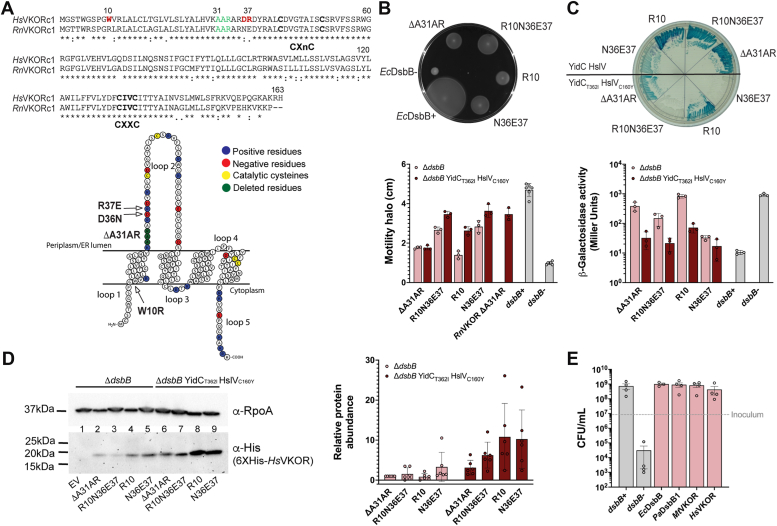
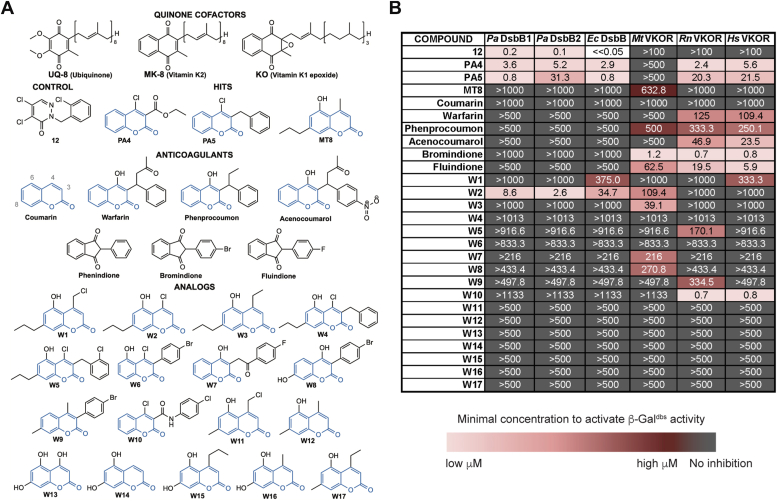
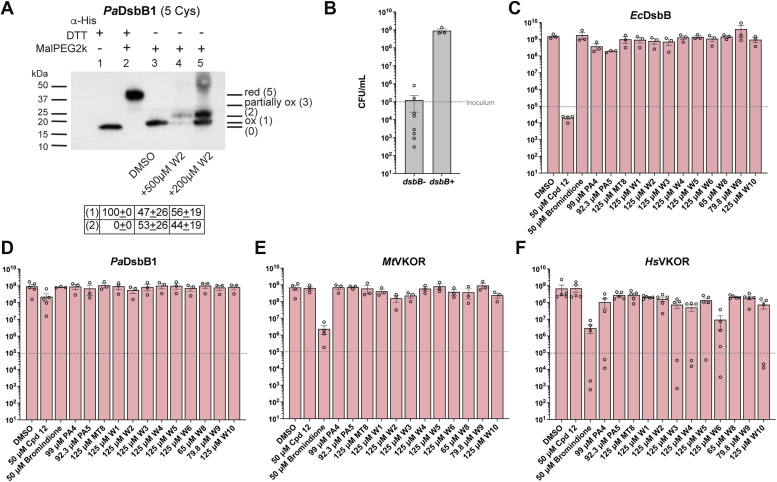
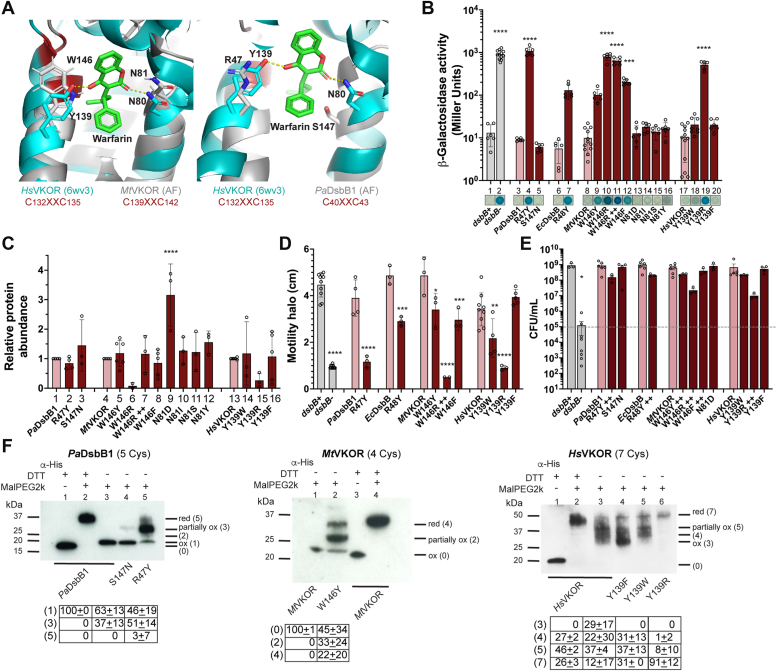
Disulfide bond formation has a central role in protein folding of both eukaryotes and prokaryotes. In bacteria, disulfide bonds are catalyzed by DsbA and DsbB/VKOR enzymes. First, DsbA, a periplasmic disulfide oxidoreductase, introduces disulfide bonds into substrate proteins. Then, the membrane enzyme, either DsbB or VKOR, regenerate DsbA's activity by the formation of de novo disulfide bonds which reduce quinone. We have previously performed a high-throughput chemical screen and identified a family of warfarin analogs that target either bacterial DsbB or VKOR. In this work, we expressed functional human VKORc1 in Escherichia coli and performed a structure-activity-relationship analysis to study drug selectivity between bacterial and mammalian enzymes. We found that human VKORc1 can function in E. coli by removing two positive residues, allowing the search for novel anticoagulants using bacteria. We also found one warfarin analog capable of inhibiting both bacterial DsbB and VKOR and a second one antagonized only the mammalian enzymes when expressed in E. coli. The difference in the warfarin structure suggests that substituents at positions three and six in the coumarin ring can provide selectivity between the bacterial and mammalian enzymes. Finally, we identified the two amino acid residues responsible for drug binding. One of these is also essential for de novo disulfide bond formation in both DsbB and VKOR enzymes. Our studies highlight a conserved role of this residue in de novo disulfide-generating enzymes and enable the design of novel anticoagulants or antibacterials using coumarin as a scaffold.
Overview
The claims and statistics of this paper haven’t been checked yet.
Run the check — free, no account needed. It reads the open-access text and checks the sources it cites.
Integrity signals
Registry
Cites
Statistics
Figures
Verification
Claims the paper makes
The claims and statistics of this paper haven’t been checked yet.
Run the check — free, no account needed. It reads the open-access text and checks the sources it cites.
Self-check
Percentages, sums and reported differences re-computed from the paper’s own numbers.
The self-check needs the paper’s full text.
Citations
Cites
Highly accurate protein structure prediction with AlphaFold
Jumper, J., Evans, R., Pritzel, A., Green, T., Figurnov, M., Ronneberger, O., Tunyasuvunakool, K., Bates, R., Žídek, A., Potapenko, A., et al. (2021) · Nature · doi:10.1038/s41586-021-03819-2 · Cited by 43,764
Paysan-Lafosse, T., Blum, M., Chuguransky, S., Grego, T., Pinto, B. L., Salazar, G. A., Bileschi, M. L., Bork, P., Bridge, A., Colwell, L., et al. (2023) · Nucleic Acids Research · doi:10.1093/nar/gkac993 · Cited by 2,399
The molecular basis of blood coagulation
Furie, B., & Furie, B. C. (1988) · Cell · doi:10.1016/0092-8674(88)90567-3 · Cited by 1,247
Mutations in VKORC1 cause warfarin resistance and multiple coagulation factor deficiency type 2
Rost, S., Fregin, A., Ivaskevicius, V., Conzelmann, E., Hörtnagel, K., Pelz, H.-J., Lappegard, K., Seifried, E., Scharrer, I., Tuddenham, E. G. D., et al. (2004) · Nature · doi:10.1038/nature02214 · Cited by 1,134
Amann, E., Ochs, B., & Abel, K.-J. (1988) · Gene · doi:10.1016/0378-1119(88)90440-4 · Cited by 1,061
Identification of a protein required for disulfide bond formation in vivo
Bardwell, J. C. A., McGovern, K., & Beckwith, J. (1991) · Cell · doi:10.1016/0092-8674(91)90532-4 · Cited by 979
Identification of the gene for vitamin K epoxide reductase
Li, T., Chang, C.-Y., Jin, D.-Y., Lin, P.-J., Khvorova, A., & Stafford, D. W. (2004) · Nature · doi:10.1038/nature02254 · Cited by 707
vonHeijne, G. (1989) · Nature · doi:10.1038/341456a0 · Cited by 591
A pathway for disulfide bond formation in vivo.
Bardwell, J. C., Lee, J. O., Jander, G., Martin, N., Belin, D., & Beckwith, J. (1993) · Proceedings of the National Academy of Sciences · doi:10.1073/pnas.90.3.1038 · Cited by 408
Weiss, D. S., Chen, J. C., Ghigo, J.-M., Boyd, D., & Beckwith, J. (1999) · Journal of Bacteriology · doi:10.1128/jb.181.2.508-520.1999 · Cited by 386
Metadata
- Authors
- Chavez, D., Amarquaye, G. N., Mejia-Santana, A., Dyotima, Ryan, K., Zeng, L., & Landeta, C.
- Affiliations
- Indiana University Bloomington (US)
- Corresponding author
- Landeta, Cristina
- ORCID
- Venue
- Journal of Biological Chemistry
- Publisher
- Elsevier BV
- Published
- 2024-06
- Volume
- 300
- Issue
- 6
- Pages
- 107383
- ISSN
- 0021-9258 (ISSN-L)
- PMC
- PMC11208910
- OpenAlex
- W4396979285
- Cited by
- 4
- References
- 50
- Citations by year
- 2026: 1 · 2025: 3
- FWCI
- 0.54
- Type
- journal article
- Language
- en
- Open access
- gold
- doi.org
- Licence
- www.elsevier.com/tdm/userlicense/1.0/ (tdm)
- www.elsevier.com/legal/tdmrep-license (tdm)
- creativecommons.org/licenses/by/4.0/ (vor)
- Locations
- Journal of Biological Chemistry (publishedVersion)
- bioRxiv (Cold Spring Harbor Laboratory) (acceptedVersion, cc-by-nd)
- PubMed Central (publishedVersion, cc-by)
- PubMed (publishedVersion)
- Funders
- Indiana University Bloomington
- Topics
- Life Sciences › Biochemistry, Genetics and Molecular Biology › Molecular Biology › Redox biology and oxidative stress
- Life Sciences › Biochemistry, Genetics and Molecular Biology › Structural Biology › Enzyme Structure and Function
- Life Sciences › Pharmacology, Toxicology and Pharmaceutics › Toxicology › Bioactive Compounds and Antitumor Agents
- Keywords
- VKORC1, DsbB, DsbA, disulfide bond formation, quinone reduction, structure-activity relationship, enzyme selectivity, anticoagulant drug design, antibiotic design, Escherichia coli, protein folding
- MeSH terms
- Anticoagulants, Bacterial Proteins, Coumarins, Disulfides, Escherichia coli, Humans, Membrane Proteins, Protein Binding, Structure-Activity Relationship, Warfarin, Benzoquinones, Protein Disulfide-Isomerases, Escherichia coli Proteins, Vitamin K Epoxide Reductases
About these checks
Registry, retraction, Cites and statistics results are computed, not judged, with one exception: a printed reference that no index lists is read once by a model before it counts as a citation error. Claims are extracted by a model and kept only when their quote appears verbatim in the text; each cited source is then checked, with a model’s help, for whether it says what the claim relies on. Those verdicts can be wrong — read the claim’s quote and the cited source before relying on one.
Statistics and arithmetic are recomputed, not judged.
Confidence bands are shown only for fields calibrated on our annotated test set. None is calibrated yet, so no band is shown.
What counts as a claim ›How we measure confidence ›How we check this ›
Are you an author, or do you see a problem with this page? Request a review
How to cite
Cite CoChat for the checks on this page, and the paper for its own findings.
- This page
- CoChat. (2026). Citation check: Warfarin analogs target disulfide bond-forming enzymes and suggest a residue important for quinone and coumarin binding. https://app.cochat.ai/papers/10.1016/j.jbc.2024.107383
- The paper
- Chavez, D., Amarquaye, G. N., Mejia-Santana, A., Dyotima, Ryan, K., Zeng, L., & Landeta, C. (2024). Warfarin analogs target disulfide bond-forming enzymes and suggest a residue important for quinone and coumarin binding. Journal of Biological Chemistry. https://doi.org/10.1016/j.jbc.2024.107383
Data sources
Bibliographic data: Semantic Scholar, OpenAlex, Crossref.
Contains information from the Semantic Scholar Academic Graph Datasets, made available under the ODC Attribution License (ODC-BY 1.0).
Semantic Scholar’s data is described in: Kinney, R., et al. (2023). The Semantic Scholar Open Data Platform. arXiv:2301.10140.
