

The DOI matches its Crossref record; 68 of the 68 references it cites were found in a registry or an index.
Redox control of the deubiquitinating enzyme Ubp2 regulates translation during stress
Open accessPublished version of a preprint
Abstract
Protein ubiquitination is essential to govern cells' ability to cope with harmful environments by regulating many aspects of protein dynamics from synthesis to degradation. As important as the ubiquitination process, the reversal of ubiquitin chains mediated by deubiquitinating enzymes (DUBs) is critical for proper recovery from stress and re-establishment of proteostasis. Although it is known that ribosomes are decorated with K63-linked polyubiquitin chains that control protein synthesis under stress, the mechanisms by which these ubiquitin chains are reversed and regulate proteostasis during stress recovery remain elusive. Here, we showed in budding yeast that the DUB Ubp2 is redox-regulated during oxidative stress in a reversible manner, which determines the levels of K63-linked polyubiquitin chains present on ribosomes. We also demonstrate that Ubp2 can cleave single ubiquitin moieties out of chains and its activity is modulated by a series of repeated domains and the formation of disulfide bonds. By combining cellular, biochemical, and proteomics analyses, we showed that Ubp2 is crucial for restoring translation after stress cessation, indicating an important role in determining the cellular response to oxidative stress. Our work demonstrates a novel role for Ubp2, revealing that a range of signaling pathways can be controlled by redox regulation of DUB activity in eukaryotes, which in turn will define cellular states of health and diseases.
Overview
The claims and statistics of this paper haven’t been checked yet.
Run the check — free, no account needed. It reads the open-access text and checks the sources it cites.
Integrity signals
Registry
Cites
Statistics
Figures
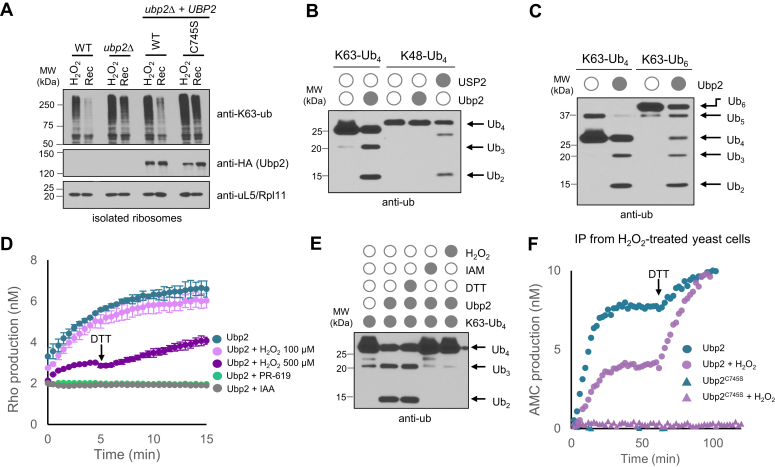
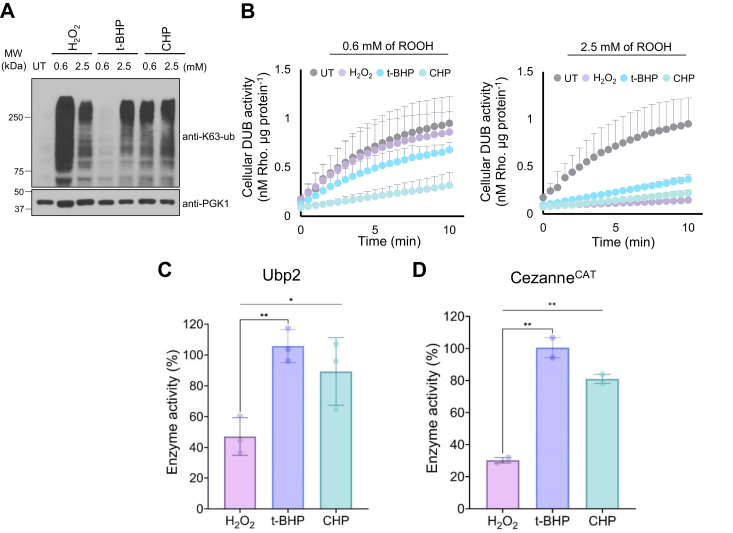
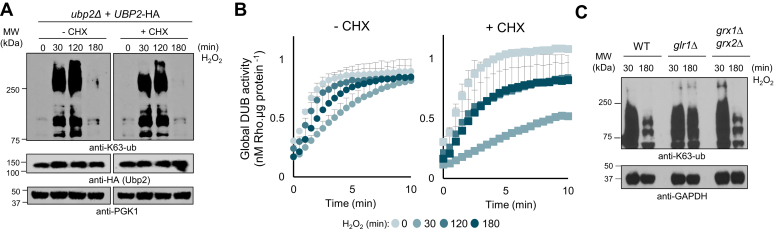
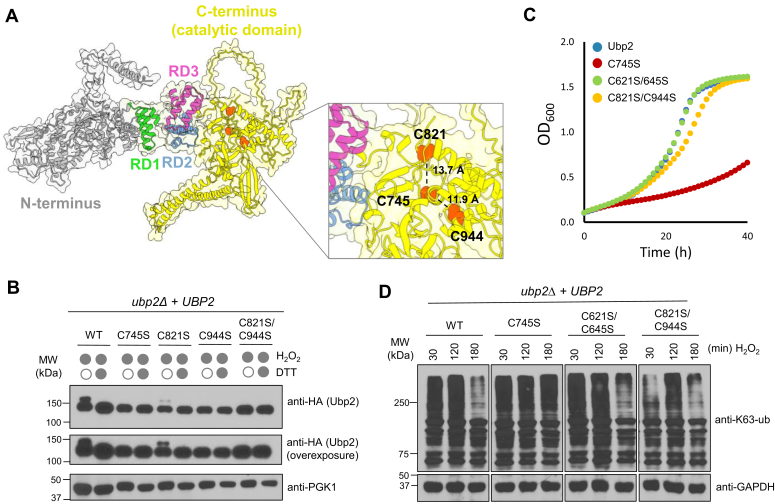
Verification
Claims the paper makes
The claims and statistics of this paper haven’t been checked yet.
Run the check — free, no account needed. It reads the open-access text and checks the sources it cites.
Self-check
Percentages, sums and reported differences re-computed from the paper’s own numbers.
The self-check needs the paper’s full text.
Citations
Cites
Highly accurate protein structure prediction with AlphaFold
Jumper, J., Evans, R., Pritzel, A., Green, T., Figurnov, M., Ronneberger, O., Tunyasuvunakool, K., Bates, R., Žídek, A., Potapenko, A., et al. (2021) · Nature · doi:10.1038/s41586-021-03819-2 · Cited by 43,764
ggplot2: Elegant Graphics for Data Analysis
Ginestet, C. (2011) · Journal of the Royal Statistical Society Series A: Statistics in Society · doi:10.1111/j.1467-985x.2010.00676_9.x · Cited by 13,726
Complex heatmaps reveal patterns and correlations in multidimensional genomic data
Gu, Z., Eils, R., & Schlesner, M. (2016) · Bioinformatics · doi:10.1093/bioinformatics/btw313 · Cited by 10,034
UniProt: the Universal Protein Knowledgebase in 2023
The UniProt Consortium, Bateman, A., Martin, M.-J., Orchard, S., Magrane, M., Ahmad, S., Alpi, E., Bowler-Barnett, E. H., Britto, R., Bye-A-Jee, H., et al. (2023) · Nucleic Acids Research · doi:10.1093/nar/gkac1052 · Cited by 7,210
Self-citationSherman, B. T., Hao, M., Qiu, J., Jiao, X., Baseler, M. W., Lane, H. C., Imamichi, T., & Chang, W. (2022) · Nucleic Acids Research · doi:10.1093/nar/gkac194 · Cited by 6,142
Cox, J., Hein, M. Y., Luber, C. A., Paron, I., Nagaraj, N., & Mann, M. (2014) · Molecular & Cellular Proteomics · doi:10.1074/mcp.m113.031591 · Cited by 5,180
Genomic Expression Programs in the Response of Yeast Cells to Environmental Changes
Gasch, A. P., Spellman, P. T., Kao, C. M., Carmel-Harel, O., Eisen, M. B., Storz, G., Botstein, D., & Brown, P. O. (2000) · Molecular Biology of the Cell · doi:10.1091/mbc.11.12.4241 · Cited by 4,815
UCSF ChimeraX: Tools for structure building and analysis
Meng, E. C., Goddard, T. D., Pettersen, E. F., Couch, G. S., Pearson, Z. J., Morris, J. H., & Ferrin, T. E. (2023) · Protein Science · doi:10.1002/pro.4792 · Cited by 4,442
The integrated stress response
Pakos‐Zebrucka, K., Koryga, I., Mnich, K., Ljujic, M., Samali, A., & Gorman, A. M. (2016) · The EMBO Reports · doi:10.15252/embr.201642195 · Cited by 2,659
Saccharomyces Genome Database: the genomics resource of budding yeast
Cherry, J. M., Hong, E. L., Amundsen, C., Balakrishnan, R., Binkley, G., Chan, E. T., Christie, K. R., Costanzo, M. C., Dwight, S. S., Engel, S. R., et al. (2012) · Nucleic Acids Research · doi:10.1093/nar/gkr1029 · Cited by 1,796
Ubiquitin: structures, functions, mechanisms
Pickart, C. M., & Eddins, M. J. (2004) · Biochimica et Biophysica Acta (BBA) - Molecular Cell Research · doi:10.1016/j.bbamcr.2004.09.019 · Cited by 1,407
Mechanisms of Deubiquitinase Specificity and Regulation
Mevissen, T. E. T., & Komander, D. (2017) · Annual Review of Biochemistry · doi:10.1146/annurev-biochem-061516-044916 · Cited by 1,027
Mechanism and function of deubiquitinating enzymes
Amerik, A. Y., & Hochstrasser, M. (2004) · Biochimica et Biophysica Acta (BBA) - Molecular Cell Research · doi:10.1016/j.bbamcr.2004.10.003 · Cited by 974
Deubiquitylating enzymes and drug discovery: emerging opportunities
Harrigan, J. A., Jacq, X., Martin, N. M., & Jackson, S. P. (2018) · Nature Reviews Drug Discovery · doi:10.1038/nrd.2017.152 · Cited by 940
The emerging complexity of protein ubiquitination
Komander, D. (2009) · Biochemical Society Transactions · doi:10.1042/bst0370937 · Cited by 821
Regulation of DNA Damage Responses by Ubiquitin and SUMO
Jackson, S. P., & Durocher, D. (2013) · Molecular Cell · doi:10.1016/j.molcel.2013.01.017 · Cited by 601
Ribosome assembly in eukaryotes
Fromont-Racine, M., Senger, B., Saveanu, C., & Fasiolo, F. (2003) · Gene · doi:10.1016/s0378-1119(03)00629-2 · Cited by 593
A comprehensive strategy enabling high-resolution functional analysis of the yeast genome
Breslow, D. K., Cameron, D. M., Collins, S. R., Schuldiner, M., Stewart-Ornstein, J., Newman, H. W., Braun, S., Madhani, H. D., Krogan, N. J., & Weissman, J. S. (2008) · Nature Methods · doi:10.1038/nmeth.1234 · Cited by 534
Callister, S. J., Barry, R. C., Adkins, J. N., Johnson, E. T., Qian, W.-J., Webb-Robertson, B.-J. M., Smith, R. D., & Lipton, M. S. (2006) · Journal of Proteome Research · doi:10.1021/pr050300l · Cited by 492
Mechanisms and functions of ribosome-associated protein quality control
Joazeiro, C. A. P. (2019) · Nature Reviews Molecular Cell Biology · doi:10.1038/s41580-019-0118-2 · Cited by 456
The Ubiquitin–Proteasome System of Saccharomyces cerevisiae
Finley, D., Ulrich, H. D., Sommer, T., & Kaiser, P. (2012) · Genetics · doi:10.1534/genetics.112.140467 · Cited by 433
Emerging Roles of Ubiquitin in Transcription Regulation
Conaway, R. C., Brower, C. S., & Conaway, J. W. (2002) · Science · doi:10.1126/science.1067466 · Cited by 391
Finley, D., Sadis, S., Monia, B. P., Boucher, P., Ecker, D. J., Crooke, S. T., & Chau, V (1994) · Molecular and Cellular Biology · doi:10.1128/mcb.14.8.5501 · Cited by 374
Thiol-Based Redox Switches and Gene Regulation
Antelmann, H., & Helmann, J. D. (2011) · Antioxidants & Redox Signaling · doi:10.1089/ars.2010.3400 · Cited by 365
Deubiquitinating enzymes (DUBs): Regulation, homeostasis, and oxidative stress response
Snyder, N. A., & Silva, G. M. (2021) · Journal of Biological Chemistry · doi:10.1016/j.jbc.2021.101077 · Cited by 347
Self-citationUbiquitin-mediated regulation of autophagy
Chen, R.-H., Chen, Y.-H., & Huang, T.-Y. (2019) · Journal of Biomedical Science · doi:10.1186/s12929-019-0569-y · Cited by 322
JAMM: A Metalloprotease-Like Zinc Site in the Proteasome and Signalosome
Ambroggio, X. I., Rees, D. C., & Deshaies, R. J. (2003) · PLoS Biology · doi:10.1371/journal.pbio.0020002 · Cited by 263
Translational Control under Stress: Reshaping the Translatome
Advani, V. M., & Ivanov, P. V. (2019) · BioEssays · doi:10.1002/bies.201900009 · Cited by 227
K63 polyubiquitination is a new modulator of the oxidative stress response
Silva, G. M., Finley, D. J., & Vogel, C. (2015) · Nature Structural & Molecular Biology · doi:10.1038/nsmb.2955 · Cited by 204
Self-citationReactive cysteine in proteins: Protein folding, antioxidant defense, redox signaling and more
Netto, L. E. S., de Oliveira, M. A., Monteiro, G., Demasi, A. P. D., Cussiol, J. R. R., Discola, K. F., Demasi, M., Silva, G. M., Alves, S. V., Faria, V. G., et al. (2006) · Comparative Biochemistry and Physiology Part C Toxicology & Pharmacology · doi:10.1016/j.cbpc.2006.07.014 · Cited by 185
Self-citationYan, L. L., & Zaher, H. S. (2020) · Molecular Cell · doi:10.1016/j.molcel.2020.11.033 · Cited by 179
Cellular proteostasis: degradation of misfolded proteins by lysosomes
Jackson, M. P., & Hewitt, E. W. (2016) · Essays in Biochemistry · doi:10.1042/ebc20160005 · Cited by 166
Meyer, C., Garzia, A., Morozov, P. S., Molina, H., & Tuschl, T. (2020) · Molecular Cell · doi:10.1016/j.molcel.2019.12.024 · Cited by 162
The Rsp5 ubiquitin ligase is coupled to and antagonized by the Ubp2 deubiquitinating enzyme
Kee, Y., Lyon, N., & Huibregtse, J. M. (2005) · The EMBO Journal · doi:10.1038/sj.emboj.7600710 · Cited by 158
Reversible inactivation of deubiquitinases by reactive oxygen species in vitro and in cells
Lee, J., Baek, K., Soetandyo, N., & Ye, Y. (2013) · Nature Communications · doi:10.1038/ncomms2532 · Cited by 149
Protein Expression Regulation under Oxidative Stress
Vogel, C., Silva, G. M., & Marcotte, E. M. (2011) · Molecular & Cellular Proteomics · doi:10.1074/mcp.m111.009217 · Cited by 144
Self-citationRegulation of A20 and other OTU deubiquitinases by reversible oxidation
Kulathu, Y., García, F., Mevissen, T. E. T., Busch, M., Arnaudo, N., Carroll, K. S., Barford, D., & Komander, D. (2013) · Nature Communications · doi:10.1038/ncomms2567 · Cited by 141
Lippman, S. I., & Broach, J. R. (2009) · Proceedings of the National Academy of Sciences · doi:10.1073/pnas.0907027106 · Cited by 135
Substrate specificity of the ubiquitin and Ubl proteases
Ronau, J. A., Beckmann, J. F., & Hochstrasser, M. (2016) · Cell Research · doi:10.1038/cr.2016.38 · Cited by 131
Kee, Y., Muñoz, W. R. X. O., Lyon, N., & Huibregtse, J. M. (2006) · Journal of Biological Chemistry · doi:10.1074/jbc.m608756200 · Cited by 107
Two Deubiquitylases Act on Mitofusin and Regulate Mitochondrial Fusion along Independent Pathways
den Brave, F., Dittmar, G., Langer, T., & Escobar‐Henriques, M. (2013) · Molecular Cell · doi:10.1016/j.molcel.2012.12.003 · Cited by 106
Molecular Mechanisms of DUBs Regulation in Signaling and Disease
Li, Y., & Reverter, D. (2021) · International Journal of Molecular Sciences · doi:10.3390/ijms22030986 · Cited by 93
Bonacci, T., Suzuki, A., Grant, G. D., Stanley, N., Cook, J. G., Brown, N. G., & Emanuele, M. J. (2018) · The EMBO Journal · doi:10.15252/embj.201798701 · Cited by 92
The Yeast Protein Database (YPD): a curated proteome database for Saccharomyces cerevisiae
Hodges, P. E. (1998) · Nucleic Acids Research · doi:10.1093/nar/26.1.68 · Cited by 83
iRQC, a surveillance pathway for 40S ribosomal quality control during mRNA translation initiation
Garshott, D. M., An, H., Sundaramoorthy, E., Leonard, M., Vicary, A. C., Harper, J. W., & Bennett, E. J. (2021) · Cell Reports · doi:10.1016/j.celrep.2021.109642 · Cited by 81
Expanding Role of Ubiquitin in Translational Control
Dougherty, S. E., Maduka, A. O., Inada, T., & Silva, G. M. (2020) · International Journal of Molecular Sciences · doi:10.3390/ijms21031151 · Cited by 74
Self-citationDistinct regulatory ribosomal ubiquitylation events are reversible and hierarchically organized
Garshott, D. M., Sundaramoorthy, E., Leonard, M., et al. (2020) · eLife · doi:10.7554/elife.54023 · Cited by 72
K48-linked ubiquitination and protein degradation regulate 53BP1 recruitment at DNA damage sites
Mallette, F. A., & Richard, S. (2012) · Cell Research · doi:10.1038/cr.2012.58 · Cited by 69
Ma, H., Wang, M., Gai, Y., Fu, H., Zhang, B., Ruan, R., Chung, K.-R., & Li, H. (2018) · Applied and Environmental Microbiology · doi:10.1128/aem.00086-18 · Cited by 67
Ren, J., Kee, Y., Huibregtse, J. M., & Piper, R. C. (2007) · Molecular Biology of the Cell · doi:10.1091/mbc.e06-06-0557 · Cited by 66
Fang, N. N., Zhu, M., Rose, A., Wu, K., & Mayor, T. (2016) · Nature Communications · doi:10.1038/ncomms12907 · Cited by 64
Site-Specific K63 Ubiquitinomics Provides Insights into Translation Regulation under Stress
Back, S., Gorman, A. W., Vogel, C., & Silva, G. M. (2018) · Journal of Proteome Research · doi:10.1021/acs.jproteome.8b00623 · Cited by 54
Self-citationDeubiquitinases in Neurodegeneration
Bello, A. I., Goswami, R., Brown, S. L., Costanzo, K. M., Shores, T., Allan, S. K., Odah, R., & Mohan, R. D. (2022) · Cells · doi:10.3390/cells11030556 · Cited by 45
Ubiquitin-dependent regulation of transcription in development and disease
Mark, K. G., & Rapé, M. (2021) · EMBO Reports · doi:10.15252/embr.202051078 · Cited by 40
van den Heuvel, J., Ashiono, C., Gillet, L. C. J., Dörner, K., Wyler, E., Zemp, I., & Kutay, U. (2021) · eLife · doi:10.7554/elife.70560 · Cited by 40
Takehara, Y., Yashiroda, H., Matsuo, Y., Zhao, X., Kamigaki, A., Matsuzaki, T., Kosako, H., Inada, T., & Murata, S. (2021) · iScience · doi:10.1016/j.isci.2021.102145 · Cited by 39
Ho, H.-C., MacGurn, J. A., & Emr, S. D. (2017) · Molecular Biology of the Cell · doi:10.1091/mbc.e17-01-0008 · Cited by 36
Guerra, P., Vuillemenot, L.-A., van Oppen, Y. B., Been, M., & Milias‐Argeitis, A. (2022) · Journal of Cell Science · doi:10.1242/jcs.260378 · Cited by 35
Simões, V., Cizubu, B. K., Harley, L., Zhou, Y., Pajak, J., Snyder, N. A., Bouvette, J., Borgnia, M. J., Arya, G., Bartesaghi, A., et al. (2022) · Cell Reports · doi:10.1016/j.celrep.2022.110860 · Cited by 34
Self-citationStructural impact of K63 ubiquitin on yeast translocating ribosomes under oxidative stress
Zhou, Y., Kastritis, P. L., Dougherty, S. E., Bouvette, J., Hsu, A. L., Burbaum, L., Mosalaganti, S., Pfeffer, S., Hagen, W. J. H., Förster, F. G., et al. (2020) · Proceedings of the National Academy of Sciences · doi:10.1073/pnas.2005301117 · Cited by 32
Self-citationCavellini, L., Meurisse, J., Findinier, J., Erpapazoglou, Z., Belgareh‐Touzé, N., Weissman, A. M., & Cohen, M. M. (2017) · Nature Communications · doi:10.1038/ncomms15832 · Cited by 29
Ubp2 Regulates Rsp5 Ubiquitination Activity In Vivo and In Vitro
Lam, M. H. Y., & Emili, A. (2013) · PLoS ONE · doi:10.1371/journal.pone.0075372 · Cited by 21
Zhang, R., Yuan, H., Wang, S., et al. (2017) · Scientific Reports · doi:10.1038/srep42200 · Cited by 20
The ubiquitin conjugase Rad6 mediates ribosome pausing during oxidative stress
Meydan, S., Barros, G. C., Simões, V., Harley, L., Cizubu, B. K., Guydosh, N. R., & Silva, G. M. (2023) · Cell Reports · doi:10.1016/j.celrep.2023.113359 · Cited by 19
Self-citationMass spectrometry analysis of K63-ubiquitinated targets in response to oxidative stress
Silva, G. M., & Vogel, C. (2015) · Data in Brief · doi:10.1016/j.dib.2015.05.002 · Cited by 10
Self-citationFoncillas, R. P., Davidsson, J., Carlquist, M., & Gorwa‐Grauslund, M. F. (2022) · Biotechnology Reports · doi:10.1016/j.btre.2022.e00735 · Cited by 10
Adaptor linked K63 di-ubiquitin activates Nedd4/Rsp5 E3 ligase
Zhu, L., Zhang, Q. H., Cordeiro, C. D., Banjade, S., Sardana, R., Mao, Y., & Emr, S. D. (2022) · eLife · doi:10.7554/elife.77424 · Cited by 7
Context specific ubiquitin modification of ribosomes regulates translation under oxidative stressPreprint
Dougherty, S. E., Barros, G. C., Foster, M. W., Teo, G., Choi, H., & Silva, G. M. (2024) · bioRxiv (Cold Spring Harbor Laboratory) · doi:10.1101/2024.05.02.592277 · Cited by 3
Self-citation
Research works printed but not linked: 1
- Koepp, 2013, Ubp2 regulates Rsp5 ubiquitination activity in vivo and in vitro, PLoS One, 8
Metadata
- Authors
- Santos, C. M., Cizubu, B. K., Okonkwo, D. A., Chen, C.-Y., Maske, N., Snyder, N. A., Simões, V., Washington, E. J., & Silva, G. M.
- Affiliations
- Duke University (US)
- Corresponding author
- Silva, Gustavo M.
- Venue
- Journal of Biological Chemistry
- Publisher
- Elsevier BV
- Published
- 2024-11
- Volume
- 300
- Issue
- 11
- Pages
- 107870
- ISSN
- 0021-9258 (ISSN-L)
- PMC
- PMC11570842
- OpenAlex
- W4403280454
- Cited by
- 5
- References
- 68
- Citations by year
- 2025: 4 · 2024: 1
- FWCI
- 0.68
- Type
- journal article
- Language
- en
- Open access
- gold
- doi.org
- Licence
- cc-by-nc-nd
- www.elsevier.com/tdm/userlicense/1.0/ (tdm)
- www.elsevier.com/legal/tdmrep-license (tdm)
- creativecommons.org/licenses/by-nc-nd/4.0/ (vor)
- Locations
- Journal of Biological Chemistry (publishedVersion, cc-by-nc-nd)
- bioRxiv (Cold Spring Harbor Laboratory) (acceptedVersion, cc-by-nc-nd)
- PubMed Central (publishedVersion, cc-by-nc-nd)
- PubMed (publishedVersion)
- Funders
- The Chan Zuckerberg Initiative (SDL2022-253663)
- National Institutes of Health
- National Institute of General Medical Sciences (GM137954)
- Topics
- Life Sciences › Biochemistry, Genetics and Molecular Biology › Molecular Biology › Ubiquitin and proteasome pathways
- Life Sciences › Biochemistry, Genetics and Molecular Biology › Molecular Biology › Redox biology and oxidative stress
- Life Sciences › Biochemistry, Genetics and Molecular Biology › Cell Biology › Autophagy in Disease and Therapy
- Keywords
- deubiquitinase, redox regulation, oxidative stress, translational regulation, disulfide bonds, proteostasis, stress recovery, Saccharomyces cerevisiae
- MeSH terms
- Oxidation-Reduction, Endopeptidases, Ribosomes, Saccharomyces cerevisiae, Protein Biosynthesis, Oxidative Stress, Ubiquitin, Saccharomyces cerevisiae Proteins, Ubiquitination
About these checks
Registry, retraction, Cites and statistics results are computed, not judged, with one exception: a printed reference that no index lists is read once by a model before it counts as a citation error. Claims are extracted by a model and kept only when their quote appears verbatim in the text; each cited source is then checked, with a model’s help, for whether it says what the claim relies on. Those verdicts can be wrong — read the claim’s quote and the cited source before relying on one.
Statistics and arithmetic are recomputed, not judged.
Confidence bands are shown only for fields calibrated on our annotated test set. None is calibrated yet, so no band is shown.
What counts as a claim ›How we measure confidence ›How we check this ›
Are you an author, or do you see a problem with this page? Request a review
Data sources
Bibliographic data: Semantic Scholar, OpenAlex, Crossref.
Contains information from the Semantic Scholar Academic Graph Datasets, made available under the ODC Attribution License (ODC-BY 1.0).
Semantic Scholar’s data is described in: Kinney, R., et al. (2023). The Semantic Scholar Open Data Platform. arXiv:2301.10140.
