

The DOI matches its Crossref record; 22 of the 22 references it cites were found in a registry or an index; 11 of the 24 sources its claims cite were checked for support.
Real-world safety and effectiveness of elexacaftor/tezacaftor/ivacaftor in people with cystic fibrosis: Interim results of a long-term registry-based study
Open accessAbstract
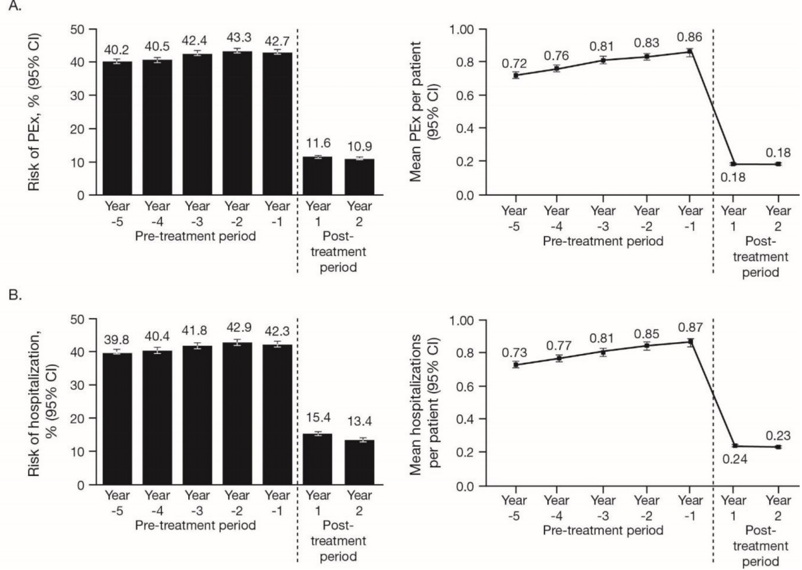
Background Phase 3 clinical trials showed elexacaftor/tezacaftor/ivacaftor (ELX/TEZ/IVA) was safe and efficacious in people with cystic fibrosis (CF) with ≥1 F508del-CFTR allele. To assess long-term effects of ELX/TEZ/IVA under real-world conditions of use, a 5-year observational registry-based study is being conducted. We report interim results from the first 2 years of follow-up. Methods The study included people with CF in the US Cystic Fibrosis Foundation Patient Registry (CFFPR) who initiated ELX/TEZ/IVA between October 2019 and December 2020. Pulmonary exacerbations (PEx), percent predicted forced expiratory volume in 1 second (ppFEV 1 ), hospitalizations, bacterial pathogens, body mass index (BMI), CF complications and comorbidities, and liver function tests (LFTs) after treatment initiation were compared with the 5-year pre-treatment period. Death and lung transplantation were assessed relative to 2019 CFFPR data. Results 16,116 people with CF were included (mean treatment duration 20.4 months). Among those with 5 years of pre-treatment data, mean PEx/patient/year declined to 0.18 (95% CI: 0.17, 0.19) in Years 1 and 2 post-treatment from 0.86 (95% CI: 0.83, 0.88) in the baseline year (79% reduction), after a continued increase observed pre-treatment. Similarly, a decline in mean hospitalizations/patient/year was observed in Year 1 that was sustained in Year 2 (74% reduction from baseline year). The mean absolute change in ppFEV 1 from baseline was +8.2 percentage points (95% CI: 8.0, 8.4) in Year 1 and +8.9 percentage points (95% CI: 8.7, 9.1) in Year 2, after a continued decline observed pre-treatment. Positive bacterial cultures decreased for all evaluated pathogens, and mean BMI increased by 1.6 kg/m 2 (95% CI: 1.5, 1.6) by Year 2. No new safety concerns were identified based on evaluation of CF complications, comorbidities, and LFTs. The annualized rates of death (0.47% [95% CI: 0.39, 0.55]) and lung transplantation (0.16% [95% CI: 0.12, 0.22]) were considerably lower than reported in 2019 (1.65% and 1.08%, respectively). Conclusions ELX/TEZ/IVA treatment was associated with sustained improvements in lung function, reduced frequency of PEx and all-cause hospitalization, increased BMI, and lower prevalence of positive bacterial cultures. Additionally, there was a 72% lower rate of death and 85% lower rate of lung transplantation relative to the year before ELX/TEZ/IVA availability. These results, from the largest cohort of ELX/TEZ/IVA-treated people to date, extend our understanding of the broad clinical benefits of ELX/TEZ/IVA.
Overview
AI snapshot
Written from the paper’s full text.
TL;DR
Interim results from a 5-year registry-based study of 16,116 people with cystic fibrosis initiating elexacaftor/tezacaftor/ivacaftor in the US CFFPR show sustained improvements in pulmonary exacerbations, lung function, hospitalizations, BMI, and bacterial pathogens, with lower death and lung transplantation rates than 2019 historical data. No new safety concerns were identified.
Key findings
- Among 11,951 people with 5 years of pre-treatment data, mean pulmonary exacerbations/patient/year declined to 0.18 (95% CI: 0.17, 0.19) in post-treatment Years 1 and 2 from 0.86 (95% CI: 0.83, 0.88) in the baseline year, a 79% reduction; mean hospitalizations/patient/year declined by 74% (0.23 in Year 2 vs. 0.87 at baseline).
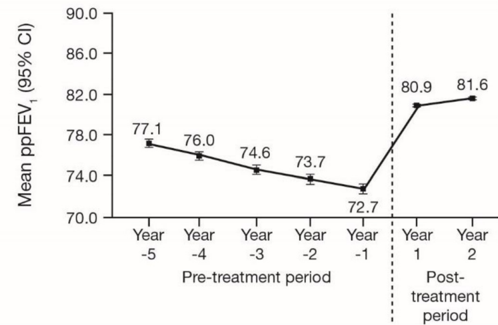
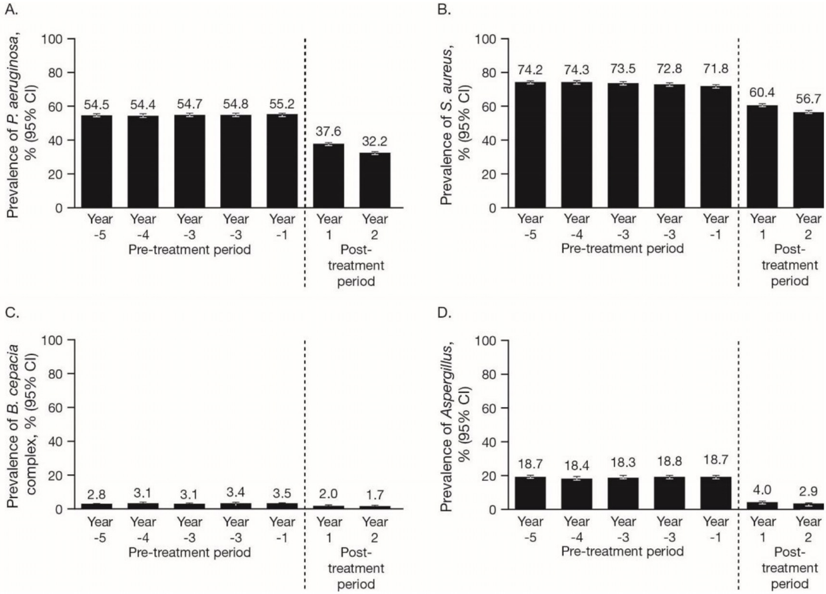
- Mean ppFEV1 increased from 72.7 at baseline to 80.9 in Year 1 (+8.2 percentage points; 95% CI: 8.0, 8.4) and 81.6 in Year 2 (+8.9 percentage points; 95% CI: 8.7, 9.1); mean BMI increased by 1.6 kg/m² (95% CI: 1.5, 1.6) by Year 2, and positive bacterial cultures decreased for all evaluated pathogens.
- Annualized death rate was 0.47% (95% CI: 0.39, 0.55) and lung transplantation rate was 0.16% (95% CI: 0.12, 0.22), 72% and 85% lower than 2019 rates of 1.65% and 1.08%, respectively. No new safety concerns were identified based on CF complications, comorbidities, and liver function tests.
Methods
- Observational, registry-based cohort study using the US Cystic Fibrosis Foundation Patient Registry; included all people with CF initiating ELX/TEZ/IVA between October 21, 2019 and December 31, 2020, followed until death, loss to follow-up, treatment discontinuation, or December 31, 2021 (n = 16,116; mean treatment duration 20.4 months).
- Outcomes included pulmonary exacerbations, all-cause hospitalizations, ppFEV1, bacterial pathogens, BMI, CF complications/comorbidities, liver function tests, death, and lung transplantation; post-treatment outcomes were compared descriptively with the 5-year pre-treatment period, and death/lung transplantation annualized rates were compared with 2019 CFFPR data for people aged ≥12 years with ≥1 F508del allele.
- Analyses were descriptive with no statistical hypothesis testing and no imputation of missing data.
Limitations
- The paper states that data came from routine clinical practice without standardized assessments, no imputation was performed, and residual confounding is possible in the historical comparison despite similar baseline demographics; analyses of disease progression required 5 years of pre-treatment data, though 1-year analyses were consistent, and reasons for treatment discontinuation were unavailable.
- The paper notes that the interim analysis overlapped with the SARS-CoV-2 pandemic, which may have partially affected some outcomes such as pulmonary exacerbations, although other outcomes and pre-pandemic studies supported the clinical benefits.
- Evident from the text: the observational registry design cannot establish causality, and registry-based outcome ascertainment may be incomplete or subject to misclassification.
Model-written summary. Check it against the paper before relying on it.
Integrity signals
Registry
Cites
Statistics
Figures
Verification
Claims the paper makes
63 Own result · 11 Own method · 11 Own interpretation · 7 Not checked yet · 3 Partly supported · 3 No full text of the sources · 2 No basis given · 1 Supported · 1 Supported so far · 1 Mixed support · accuracy not yet measured
Some cited sources support this claim and some don’t — read each source’s verdict below.
In the paper
“However, clinical studies of ELX/TEZ/IVA completed before the start of the pandemic reported similar robust decreases in the frequency of PEx [ 8-10 , 12 ].”
§ Real-world safety and effectiveness of elexacaf tor/tezacaf tor/ivacaf tor in people with cystic fibrosis: Interim results of a long-term registry-based study > 4. Discussion
What the sources say
- Supportedcites [8] Middleton, 2019, Elexacaftor–tezacaftor–ivacaftor for cystic fibrosis with a single Phe508del allele, N Engl J Med source
The Results > Population section dates this trial to June 2018–April 2019, before the pandemic. Results > Efficacy reports a 63% lower annualized rate of pulmonary exacerbations with elexacaftor–tezacaftor–ivacaftor than with placebo, supporting the claimed robust decrease. This paper supports one of the clinical studies cited, not a claim about the results of every study in the citation group. (LLM, conf=0.94)
- Partly supportedcites [9] Heijerman, 2019, Efficacy and safety of the elexacaftor plus tezacaftor plus ivacaftor combination regimen in people with cystic fibrosis homozygous for the F508del mutation: a double-blind, randomised, phase 3 trial, Lancet sourceExperimental — accuracy not yet measured
The Results (Safety) report pulmonary exacerbations in 2% of the ELX/TEZ/IVA group versus 12% of the TEZ/IVA group. The Discussion describes this as a reduction, but cautions that pulmonary exacerbations were not an efficacy outcome in this four-week trial. The source therefore supports an observed decrease, not an established robust decrease in exacerbation frequency. (LLM, conf=0.84)
- Disputedcites [10] Zemanick, 2021, A phase 3 open-label study of elexacaftor/tezacaftor/ivacaftor in children 6 through 11 years of age with cystic fibrosis and at least one F508del allele, Am J Respir Crit Care Med sourceExperimental — accuracy not yet measured
The Results > Population section says this trial ran through August 7, 2020, and the Discussion explicitly says it overlapped with the early months of the SARS-CoV-2 pandemic, contrary to the claim that it was completed before the pandemic. Methods > Outcome Measures lists pulmonary exacerbations as an endpoint, but the passages found do not report a decrease in their frequency. (LLM, conf=0.88)
Checked by a reasoning model — may be wrong.
- Partly supportedcites [12] Griese, 2021, Safety and efficacy of elexacaftor/tezacaftor/ivacaftor for 24 weeks or longer in people with cystic fibrosis and one or more F508del alleles: interim results of an open-label phase 3 clinical trial, Am J Respir Crit Care Med sourceExperimental — accuracy not yet measured
The Results report a pulmonary-exacerbation event rate of 0.30 per 48 weeks in both genotype groups, and the Discussion says improvements in that rate were maintained or continued with ELX/TEZ/IVA. This supports the direction of the claim, but the paper presents an interim analysis of an ongoing open-label extension, not a completed study, and the cited passages do not establish that it ended before the pandemic. (LLM, conf=0.84)
plaindirect- Asserted: passes — The authors put it forward as true.
- Checkable: passes — It can be checked against evidence.
- Load-bearing: passes — The paper’s conclusions depend on it.
- Based: passes — The paper gives a reason why it holds.
- Supported
The cited sources support only part of this claim — read each source’s verdict below.
In the paper
“These results demonstrated that ELX/TEZ/IVA is a superior treatment option for people with CF with ≥1 F508del-CFTR allele.”
§ Real-world safety and effectiveness of elexacaf tor/tezacaf tor/ivacaf tor in people with cystic fibrosis: Interim results of a long-term registry-based study > 1. Introduction
What the sources say
- Partly supportedcites [11] Munck, 2020, Tezacaftor/ivacaftor in people with cystic fibrosis heterozygous for minimal function CFTR mutations, J Cyst Fibros sourceExperimental — accuracy not yet measured
The Discussion and Conclusions reports that the ELX/TEZ/IVA triple combination has been found efficacious in people with F/MF or F/F genotypes, while this study found no meaningful benefit from dual TEZ/IVA in the F/MF group. The study did not test ELX/TEZ/IVA or establish that it is a superior treatment option for everyone with at least one F508del-CFTR allele. (LLM, conf=0.85)
boosteddirect- Asserted: passes — The authors put it forward as true.
- Checkable: passes — It can be checked against evidence.
- Load-bearing: passes — The paper’s conclusions depend on it.
- Based: passes — The paper gives a reason why it holds.
- Partly supported
The cited sources support only part of this claim — read each source’s verdict below.
In the paper
“Phase 3 clinical trials showed elexacaftor/tezacaftor/ivacaftor (ELX/TEZ/IVA) was safe and efficacious in people with cystic fibrosis (CF) with ≥1 F508del-CFTR allele.”
- Also stated in: § 1. Introduction · plain
“The triple-combination regimen of elexacaftor (ELX) (CFTR corrector), tezacaftor (TEZ) (CFTR corrector), and ivacaftor (IVA) (CFTR potentiator) was shown in pivotal Phase 3 clinical trials to be efficacious and safe in people with CF with ≥1 F508del-CFTR allele [8][9][10] .”
§ Real-world safety and effectiveness of elexacaf tor/tezacaf tor/ivacaf tor in people with cystic fibrosis: Interim results of a long-term registry-based study > Abstract
What the sources say
- Partly supportedcites [8] Middleton, 2019, Elexacaftor–tezacaftor–ivacaftor for cystic fibrosis with a single Phe508del allele, N Engl J Med sourceExperimental — accuracy not yet measured
The Discussion reports that this phase 3 trial found elexacaftor–tezacaftor–ivacaftor efficacious, with no worrisome safety signals, in patients aged 12 or older with one Phe508del allele and a minimal-function mutation (page not provided). The claim extends that finding to all people with at least one F508del allele and refers to multiple trials; this paper reports one such trial, while listing a separate homozygous trial in its References. (LLM, conf=0.88)
- Partly supportedcites [9] Heijerman, 2019, Efficacy and safety of the elexacaftor plus tezacaftor plus ivacaftor combination regimen in people with cystic fibrosis homozygous for the F508del mutation: a double-blind, randomised, phase 3 trial, Lancet sourceExperimental — accuracy not yet measured
The Discussion reports that this phase 3 trial demonstrated efficacy and safety over four weeks in participants homozygous for F508del. It also notes marked clinical improvements and refers to a safety profile in a concurrent trial of people heterozygous for F508del, but does not itself establish the same safety-and-efficacy conclusion for the full ≥1-allele population. (LLM, conf=0.82)
- Supportedcites [10] Zemanick, 2021, A phase 3 open-label study of elexacaftor/tezacaftor/ivacaftor in children 6 through 11 years of age with cystic fibrosis and at least one F508del allele, Am J Respir Crit Care Med source
The Abstract reports that this phase 3 study found ELX/TEZ/IVA safe and efficacious in children aged 6–11 with at least one F508del-CFTR allele. The Discussion and At a Glance Commentary also report consistent safety and efficacy findings from phase 3 studies in patients aged 12 and older. (LLM, conf=0.90)
plaindirect- Asserted: passes — The authors put it forward as true.
- Checkable: passes — It can be checked against evidence.
- Load-bearing: passes — The paper’s conclusions depend on it.
- Based: passes — The paper gives a reason why it holds.
- Also stated in: § 1. Introduction · plain
The cited sources support only part of this claim — read each source’s verdict below.
In the paper
“Treatment with ELX/TEZ/IVA led to robust and clinically meaningful improvements in lung function (as assessed by percent predicted forced expiratory volume in 1 second [ppFEV 1 ]), CFTR function (as assessed by sweat chloride concentration), and respiratory symptoms (as assessed by Cystic Fibrosis Questionnaire-Revised respiratory domain score), exceeding improvements seen with the dual CFTR Modul”
§ Real-world safety and effectiveness of elexacaf tor/tezacaf tor/ivacaf tor in people with cystic fibrosis: Interim results of a long-term registry-based study > 1. Introduction
What the sources say
- Partly supportedcites [11] Munck, 2020, Tezacaftor/ivacaftor in people with cystic fibrosis heterozygous for minimal function CFTR mutations, J Cyst Fibros sourceExperimental — accuracy not yet measured
The Discussion and Conclusions reports that triple-combination therapy provides clinical benefit in people with F/MF or F/F genotypes. It does not report a robust, clinically meaningful sweat-chloride improvement with ELX/TEZ/IVA. The sweat-chloride reduction in §3.2, Efficacy, was modest and measured with dual tezacaftor/ivacaftor, not the triple combination. (LLM, conf=0.88)
boosteddirect- Asserted: passes — The authors put it forward as true.
- Checkable: passes — It can be checked against evidence.
- Load-bearing: passes — The paper’s conclusions depend on it.
- Based: passes — The paper gives a reason why it holds.
- Partly supported
The sources with a verdict support this claim; the rest weren’t checked yet, have no full text we could read, or their verdicts aren’t rated yet.
In the paper
“demonstrates that the improvements in lung function with ELX/TEZ/IVA treatment are durable over time”
§ Real-world safety and effectiveness of elexacaf tor/tezacaf tor/ivacaf tor in people with cystic fibrosis: Interim results of a long-term registry-based study > 4. Discussion
What the sources say
- Supportedcites [12] Griese, 2021, Safety and efficacy of elexacaftor/tezacaftor/ivacaftor for 24 weeks or longer in people with cystic fibrosis and one or more F508del alleles: interim results of an open-label phase 3 clinical trial, Am J Respir Crit Care Med source
The Discussion states that improvements in ppFEV1, a measure of lung function, were maintained or improved over an additional 24 weeks for F/MF participants or 36 weeks for F/F participants. The Results likewise report that efficacy was maintained from the parent studies. This supports durability over the follow-up reported in this interim analysis. (LLM, conf=0.94)
- Not checked yetcites [13] Griese, 2022, Long-term safety and efficacy of elexacaftor/tezacaftor/ivacaftor in people with cystic fibrosis and at least one F508del allele: 144-week interim results from an open-label extension study, J Cyst Fibros source
Checked before — its earlier verdict is held back until a new check runs.
boosteddirect- Asserted: passes — The authors put it forward as true.
- Checkable: passes — It can be checked against evidence.
- Load-bearing: passes — The paper’s conclusions depend on it.
- Based: passes — The paper gives a reason why it holds.
- Supported
A result the paper reports from its own data — it cites no other source for it, so there is none to check. The quote shows it is in the paper.
In the paper
“and 85% lower for lung transplantation (1.08% had a lung transplant in 2019) ( Table 2 ).”
- Also stated in: § 4. Discussion · plain
“Most notably, the post-treatment annualized rate of death and lung transplantation was 72% and 85% lower, respectively, compared to what was observed in the historical population.”
§ Real-world safety and effectiveness of elexacaf tor/tezacaf tor/ivacaf tor in people with cystic fibrosis: Interim results of a long-term registry-based study > 3.7. Death and lung transplantation
plaindirectn = 31- Asserted: passes — The authors put it forward as true.
- Checkable: passes — It can be checked against evidence.
- Load-bearing: passes — The paper’s conclusions depend on it.
- Based: passes — The paper gives a reason why it holds.
- Also stated in: § 4. Discussion · plain
A result the paper reports from its own data — it cites no other source for it, so there is none to check. The quote shows it is in the paper.
In the paper
“In the subset of 11,951 people who had ≥1 clinical encounter in each of the 5 pre-treatment years as well as post-treatment, the percentage (95% CI) of patients with ≥1 PEx declined in Years 1 and 2 post-treatment (11.6% [11.1, 12.2] and 10.9% [10.3, 11.4], respectively) as compared to each of the years during the 5-year pre-treatment period (40.2% [39.4,41.1] in Year -5, 40.5% [39.6, 41.4] in”
§ Real-world safety and effectiveness of elexacaf tor/tezacaf tor/ivacaf tor in people with cystic fibrosis: Interim results of a long-term registry-based study > 3.2. PEx and hospitalizations
plaincorrelationaln = 11,951- Asserted: passes — The authors put it forward as true.
- Checkable: passes — It can be checked against evidence.
- Load-bearing: passes — The paper’s conclusions depend on it.
- Based: passes — The paper gives a reason why it holds.
A result the paper reports from its own data — it cites no other source for it, so there is none to check. The quote shows it is in the paper.
In the paper
“Additionally, there was a 72% lower rate of death and 85% lower rate of lung transplantation relative to the year before ELX/TEZ/IVA availability.”
§ Real-world safety and effectiveness of elexacaf tor/tezacaf tor/ivacaf tor in people with cystic fibrosis: Interim results of a long-term registry-based study > Abstract
plaindirect- Asserted: passes — The authors put it forward as true.
- Checkable: passes — It can be checked against evidence.
- Load-bearing: passes — The paper’s conclusions depend on it.
- Based: passes — The paper gives a reason why it holds.
- Rests on an assumption: The 2019 CFFPR data for all people with CF aged ≥12 years with ≥1 F508del allele represent the population who would initially become eligible for ELX/TEZ/IVA treatment.
A result the paper reports from its own data — it cites no other source for it, so there is none to check. The quote shows it is in the paper.
In the paper
“No new safety concerns were identified during the interim analysis period.”
- Also stated in: § 4. Discussion · plain
“There were no new safety concerns identified during this interim analysis.”
§ Real-world safety and effectiveness of elexacaf tor/tezacaf tor/ivacaf tor in people with cystic fibrosis: Interim results of a long-term registry-based study > 3.6. CF complications and comorbidities, and LFTs
plain- Asserted: passes — The authors put it forward as true.
- Checkable: passes — It can be checked against evidence.
- Load-bearing: passes — The paper’s conclusions depend on it.
- Based: passes — The paper gives a reason why it holds.
- Also stated in: § 4. Discussion · plain
A result the paper reports from its own data — it cites no other source for it, so there is none to check. The quote shows it is in the paper.
In the paper
“the annualized rate of lung transplantation for the full post-treatment period was 0.16% (95% CI: 0.12, 0.22).”
§ Real-world safety and effectiveness of elexacaf tor/tezacaf tor/ivacaf tor in people with cystic fibrosis: Interim results of a long-term registry-based study > 3.7. Death and lung transplantation
plainn = 31- Asserted: passes — The authors put it forward as true.
- Checkable: passes — It can be checked against evidence.
- Load-bearing: passes — The paper’s conclusions depend on it.
- Based: passes — The paper gives a reason why it holds.
- Probably not a substantial claim. 14
- It may state two separate claims as one. 16
- The quote only partly states this claim. 1
Every source the paper cites for this claim was checked and supports it.
In the paper
“While people with CF experience depression and anxiety at a rate 2-3 × greater than the general population [20]”
§ Real-world safety and effectiveness of elexacaf tor/tezacaf tor/ivacaf tor in people with cystic fibrosis: Interim results of a long-term registry-based study > 4. Discussion
What the sources say
- Supportedcites [20] Quittner, 2014, Prevalence of depression and anxiety in patients with cystic fibrosis and parent caregivers: results of The International Depression Epidemiological Study across nine countries, Thorax source
The Discussion reports that elevated depression in patients with CF was twice the rate in community populations and that elevated anxiety rates were two to three times those in community samples. The study measured elevated symptoms in adolescents and adults with CF, rather than diagnosed disorders. (LLM, conf=0.92)
plaincorrelational- Asserted: passes — The authors put it forward as true.
- Checkable: passes — It can be checked against evidence.
- Load-bearing: fails — The paper’s conclusions may not depend on it.
- Based: passes — The paper gives a reason why it holds.
Probably not a substantial claim. The paper’s conclusions may not depend on it.
- Supported
A result the paper reports from its own data — it cites no other source for it, so there is none to check. The quote shows it is in the paper.
In the paper
“Mean treatment duration was 20.4 months (median [IQR] 23.0 [19.0, 24.0]) at the time of this interim analysis and 60.9% of the cohort had a prior history of CFTR modulator use.”
§ Real-world safety and effectiveness of elexacaf tor/tezacaf tor/ivacaf tor in people with cystic fibrosis: Interim results of a long-term registry-based study > 3.1. Cohort characteristics
plainn = 16,116- Asserted: passes — The authors put it forward as true.
- Checkable: passes — It can be checked against evidence.
- Load-bearing: fails — The paper’s conclusions may not depend on it.
- Based: passes — The paper gives a reason why it holds.
Probably not a substantial claim. The paper’s conclusions may not depend on it.
The paper states this without a source or data behind it here, so there is nothing to check it against. The quote shows it is in the paper.
In the paper
“This is the largest real-world study of outcomes among people with CF treated with ELX/TEX/IVA.”
§ Real-world safety and effectiveness of elexacaf tor/tezacaf tor/ivacaf tor in people with cystic fibrosis: Interim results of a long-term registry-based study > 4. Discussion
plain- Asserted: passes — The authors put it forward as true.
- Checkable: passes — It can be checked against evidence.
- Load-bearing: fails — The paper’s conclusions may not depend on it.
- Based: fails — The paper may give no reason why it holds.
Probably not a substantial claim. The paper’s conclusions may not depend on it. The paper may give no reason why it holds.
A result the paper reports from its own data — it cites no other source for it, so there is none to check. The quote shows it is in the paper.
In the paper
“the mean change in ppFEV 1 from baseline observed in Year 1 was similar to that in Year 2 (8.2 and 8.9 percentage points, respectively)”
§ Real-world safety and effectiveness of elexacaf tor/tezacaf tor/ivacaf tor in people with cystic fibrosis: Interim results of a long-term registry-based study > 4. Discussion
plain- Asserted: passes — The authors put it forward as true.
- Checkable: passes — It can be checked against evidence.
- Load-bearing: passes — The paper’s conclusions depend on it.
- Based: passes — The paper gives a reason why it holds.
It may state two separate claims as one.
A result the paper reports from its own data — it cites no other source for it, so there is none to check. The quote shows it is in the paper.
In the paper
“Similar declines in PEx were observed across genotype subgroups, subgroups of people with CF with mild to moderate and severe lung function impairment at baseline, and subgroups of people with CF with and without prior CFTR modulator use (Supplementary Fig. S1, S2, and S3).”
§ Real-world safety and effectiveness of elexacaf tor/tezacaf tor/ivacaf tor in people with cystic fibrosis: Interim results of a long-term registry-based study > 3.2. PEx and hospitalizations
plainn = 11,951- Asserted: passes — The authors put it forward as true.
- Checkable: passes — It can be checked against evidence.
- Load-bearing: unclear — It is unclear whether the paper’s conclusions depend on it.
- Based: passes — The paper gives a reason why it holds.
It may state two separate claims as one.
A result the paper reports from its own data — it cites no other source for it, so there is none to check. The quote shows it is in the paper.
In the paper
“Declines in hospitalization were also observed in genotype subgroups, subgroups of people with CF with mild to moderate and severe lung function impairment at baseline, and subgroups of people with CF with and without prior CFTR modulator use (Supplementary Fig. S4, S5, and S6).”
§ Real-world safety and effectiveness of elexacaf tor/tezacaf tor/ivacaf tor in people with cystic fibrosis: Interim results of a long-term registry-based study > 3.2. PEx and hospitalizations
plaincorrelational- Asserted: passes — The authors put it forward as true.
- Checkable: passes — It can be checked against evidence.
- Load-bearing: passes — The paper’s conclusions depend on it.
- Based: passes — The paper gives a reason why it holds.
It may state two separate claims as one.
A result the paper reports from its own data — it cites no other source for it, so there is none to check. The quote shows it is in the paper.
In the paper
“The mean absolute change in ppFEV 1 from baseline was + 8.2 percentage points (95% CI: 8.0, 8.4) in Year 1 and + 8.9 percentage points (95% CI: 8.7, 9.1) in Year 2, after a continued decline observed pre-treatment.”
§ Real-world safety and effectiveness of elexacaf tor/tezacaf tor/ivacaf tor in people with cystic fibrosis: Interim results of a long-term registry-based study > Abstract
plain- Asserted: passes — The authors put it forward as true.
- Checkable: passes — It can be checked against evidence.
- Load-bearing: passes — The paper’s conclusions depend on it.
- Based: passes — The paper gives a reason why it holds.
It may state two separate claims as one.
A result the paper reports from its own data — it cites no other source for it, so there is none to check. The quote shows it is in the paper.
In the paper
“Mean change from baseline (Year -1) to Year 2 in ppFEV 1 was 10.1 percentage points (95% CI: 9.7, 10.5) for people with an F /MF genotype, 9.4 percentage points (95% CI: 9.1, 9.6) for people with the F/F genotype, 4.9 percentage points (95% CI: 4.1, 5.8) for people with an F /G genotype, and 2.2 percentage points (95% CI: 1.6, 2.8) for people with an F/ RF genotype.”
§ Real-world safety and effectiveness of elexacaf tor/tezacaf tor/ivacaf tor in people with cystic fibrosis: Interim results of a long-term registry-based study > 3.3. Lung function
plain- Asserted: passes — The authors put it forward as true.
- Checkable: passes — It can be checked against evidence.
- Load-bearing: passes — The paper’s conclusions depend on it.
- Based: passes — The paper gives a reason why it holds.
It may state two separate claims as one.
A result the paper reports from its own data — it cites no other source for it, so there is none to check. The quote shows it is in the paper.
In the paper
“In this subset, mean ppFEV 1 declined continuously in the 5year pre-treatment period (77.1 in Year -5, 76.0 in Year -4, 74.6 in Year -3, 73.7 in Year -2, and 72.7 in baseline Year -1), but then increased significantly after treatment initiation to 80.9 in Year 1 (8.2 percentage points [95% CI: 8.0, 8.4] increase compared to baseline Year -1) and 81.6 in Year 2 (8.9 percentage points [95% CI: 8.7,”
§ Real-world safety and effectiveness of elexacaf tor/tezacaf tor/ivacaf tor in people with cystic fibrosis: Interim results of a long-term registry-based study > 3.3. Lung function
plaindirectn = 9,381- Asserted: passes — The authors put it forward as true.
- Checkable: passes — It can be checked against evidence.
- Load-bearing: passes — The paper’s conclusions depend on it.
- Based: passes — The paper gives a reason why it holds.
It may state two separate claims as one.
A result the paper reports from its own data — it cites no other source for it, so there is none to check. The quote shows it is in the paper.
In the paper
“Mean treatment duration was 20.4 months (median [IQR] 23.0 [19.0, 24.0]) at the time of this interim analysis and 60.9% of the cohort had a prior history of CFTR modulator use.”
§ Real-world safety and effectiveness of elexacaf tor/tezacaf tor/ivacaf tor in people with cystic fibrosis: Interim results of a long-term registry-based study > 3.1. Cohort characteristics
plainn = 16,116- Asserted: passes — The authors put it forward as true.
- Checkable: passes — It can be checked against evidence.
- Load-bearing: fails — The paper’s conclusions may not depend on it.
- Based: passes — The paper gives a reason why it holds.
Probably not a substantial claim. The paper’s conclusions may not depend on it.
A result the paper reports from its own data — it cites no other source for it, so there is none to check. The quote shows it is in the paper.
In the paper
“CF complications and comorbidities (including si- nus disease, CF-related diabetes, gallstones/cholecystectomy, depression, anxiety, and hypertension) were generally comparable between the pre-treatment period and following ELX/TEZ/IVA initiation or increased consistent with age-related CF disease progression (Supplementary Fig. S11).”
- Also stated in: § 4. Discussion · plain
“LFTs and CF complications and comorbidities were generally consistent between the 5-year pre-treatment period and the first year following ELX/TEZ/IVA initiation.”
§ Real-world safety and effectiveness of elexacaf tor/tezacaf tor/ivacaf tor in people with cystic fibrosis: Interim results of a long-term registry-based study > 3.6. CF complications and comorbidities, and LFTs
plain- Asserted: passes — The authors put it forward as true.
- Checkable: passes — It can be checked against evidence.
- Load-bearing: passes — The paper’s conclusions depend on it.
- Based: passes — The paper gives a reason why it holds.
It may state two separate claims as one.
- Also stated in: § 4. Discussion · plain
A result the paper reports from its own data — it cites no other source for it, so there is none to check. The quote shows it is in the paper.
In the paper
“this is the first study to systematically evaluate the incidence of death and lung transplantation among people with CF treated with ELX/TEZ/IVA and to demonstrate dramatic declines in both outcomes following start of therapy.”
§ Real-world safety and effectiveness of elexacaf tor/tezacaf tor/ivacaf tor in people with cystic fibrosis: Interim results of a long-term registry-based study > 4. Discussion
boosteddirect- Asserted: passes — The authors put it forward as true.
- Checkable: passes — It can be checked against evidence.
- Load-bearing: passes — The paper’s conclusions depend on it.
- Based: passes — The paper gives a reason why it holds.
It may state two separate claims as one.
In the paper
“This interim analysis overlapped with the SARS-CoV-2 pandemic, in which social distancing, restrictions on social interactions, and mask use might have partially impacted on some of the observed clinical outcome patterns, including PEx [21] .”
§ Real-world safety and effectiveness of elexacaf tor/tezacaf tor/ivacaf tor in people with cystic fibrosis: Interim results of a long-term registry-based study > 4. Discussion
What the sources say
- Not checked — no full text of the sourcecites [21] Patel, 2021, Reduction of pulmonary exacerbations in young children with cystic fibrosis during the COVID-19 pandemic, Pediatr Pulmonol source
hedgedconditional- Asserted: passes — The authors put it forward as true.
- Checkable: passes — It can be checked against evidence.
- Load-bearing: fails — The paper’s conclusions may not depend on it.
- Based: passes — The paper gives a reason why it holds.
Probably not a substantial claim. The paper’s conclusions may not depend on it.
A conclusion the paper draws from its own results — it cites no other source for it, so there is none to check. The quote shows it is in the paper.
In the paper
“Results from this interim analysis of an ongoing 5-year observational registry-based study support the positive benefit-risk profile of ELX/TEZ/IVA established in the Phase 3 clinical trials, with no new safety concerns identified.”
§ Real-world safety and effectiveness of elexacaf tor/tezacaf tor/ivacaf tor in people with cystic fibrosis: Interim results of a long-term registry-based study > 5. Conclusions
plainn = 11,951- Asserted: passes — The authors put it forward as true.
- Checkable: passes — It can be checked against evidence.
- Load-bearing: passes — The paper’s conclusions depend on it.
- Based: passes — The paper gives a reason why it holds.
It may state two separate claims as one.
- Rests on an assumption: Data in the US CFFPR are accurate and complete enough to estimate the outcomes studied.
A conclusion the paper draws from its own results — it cites no other source for it, so there is none to check. The quote shows it is in the paper.
In the paper
“Improvements were seen in a broad range of clinically important outcomes in the first post-treatment year that were maintained into the second post-treatment year, suggestive of CF disease modification with ELX/TEZ/IVA treatment.”
§ Real-world safety and effectiveness of elexacaf tor/tezacaf tor/ivacaf tor in people with cystic fibrosis: Interim results of a long-term registry-based study > 5. Conclusions
hedgedconditionaln = 11,951- Asserted: passes — The authors put it forward as true.
- Checkable: passes — It can be checked against evidence.
- Load-bearing: passes — The paper’s conclusions depend on it.
- Based: passes — The paper gives a reason why it holds.
It may state two separate claims as one.
- Rests on an assumption: Data in the US CFFPR are accurate and complete enough to estimate the outcomes studied.
What the paper did — it cites no source for this, so there is none to check. The quote shows it is in the paper.
In the paper
“Imputation was not conducted for missing data in this study”
§ Real-world safety and effectiveness of elexacaf tor/tezacaf tor/ivacaf tor in people with cystic fibrosis: Interim results of a long-term registry-based study > 4. Discussion
plain- Asserted: passes — The authors put it forward as true.
- Checkable: passes — It can be checked against evidence.
- Load-bearing: fails — The paper’s conclusions may not depend on it.
- Based: passes — The paper gives a reason why it holds.
Probably not a substantial claim. The paper’s conclusions may not depend on it.
What the paper did — it cites no source for this, so there is none to check. The quote shows it is in the paper.
In the paper
“Additionally, for patients who met the definition of treatment discontinuation during the study, the reason for discontinuation was not available from the patient registry.”
§ Real-world safety and effectiveness of elexacaf tor/tezacaf tor/ivacaf tor in people with cystic fibrosis: Interim results of a long-term registry-based study > 4. Discussion
plain- Asserted: passes — The authors put it forward as true.
- Checkable: passes — It can be checked against evidence.
- Load-bearing: fails — The paper’s conclusions may not depend on it.
- Based: passes — The paper gives a reason why it holds.
Probably not a substantial claim. The paper’s conclusions may not depend on it.
What the paper did — it cites no source for this, so there is none to check. The quote shows it is in the paper.
In the paper
“Among people with ≥1 encounter in each of the 5 years before treatment initiation and in the post-treatment period, 98.4% had available bacterial cultures during the year before treatment initiation.”
§ Real-world safety and effectiveness of elexacaf tor/tezacaf tor/ivacaf tor in people with cystic fibrosis: Interim results of a long-term registry-based study > 3.4. Bacterial pathogens
plain- Asserted: passes — The authors put it forward as true.
- Checkable: passes — It can be checked against evidence.
- Load-bearing: unclear — It is unclear whether the paper’s conclusions depend on it.
- Based: passes — The paper gives a reason why it holds.
The quote only partly states this claim.
What the paper did — it cites no source for this, so there is none to check. The quote shows it is in the paper.
In the paper
“However, we also conducted analyses that required availability of only 1 year of pre-treatment outcome data for each participant and the findings were consistent with the results presented here.”
§ Real-world safety and effectiveness of elexacaf tor/tezacaf tor/ivacaf tor in people with cystic fibrosis: Interim results of a long-term registry-based study > 4. Discussion
plain- Asserted: passes — The authors put it forward as true.
- Checkable: passes — It can be checked against evidence.
- Load-bearing: unclear — It is unclear whether the paper’s conclusions depend on it.
- Based: passes — The paper gives a reason why it holds.
It may state two separate claims as one.
A conclusion the paper draws from its own results — it cites no other source for it, so there is none to check. The quote shows it is in the paper.
In the paper
“While the SARS-CoV-2 pandemic could have partially impacted on PEx frequency, other outcomes should not be similarly affected (e.g., change in ppFEV 1 , death, or organ transplantation) and these outcomes also showed clear clinical benefits consistent with ELX/TEZ/IVA Phase 3 clinical trials.”
§ Real-world safety and effectiveness of elexacaf tor/tezacaf tor/ivacaf tor in people with cystic fibrosis: Interim results of a long-term registry-based study > 4. Discussion
boosted- Asserted: passes — The authors put it forward as true.
- Checkable: passes — It can be checked against evidence.
- Load-bearing: passes — The paper’s conclusions depend on it.
- Based: passes — The paper gives a reason why it holds.
It may state two separate claims as one.
What the paper did — it cites no source for this, so there is none to check. The quote shows it is in the paper.
In the paper
“We analyzed data collected during routine clinical practice, where there are no standardized assessments as is common in clinical studies with primary data collection.”
§ Real-world safety and effectiveness of elexacaf tor/tezacaf tor/ivacaf tor in people with cystic fibrosis: Interim results of a long-term registry-based study > 4. Discussion
plain- Asserted: passes — The authors put it forward as true.
- Checkable: passes — It can be checked against evidence.
- Load-bearing: passes — The paper’s conclusions depend on it.
- Based: passes — The paper gives a reason why it holds.
Probably not a substantial claim.
What the paper did — it cites no source for this, so there is none to check. The quote shows it is in the paper.
In the paper
“Our analyses of disease progression outcomes required the availability of 5 years of pre-treatment outcome data for each participant and not all people with CF had retrospective data available.”
§ Real-world safety and effectiveness of elexacaf tor/tezacaf tor/ivacaf tor in people with cystic fibrosis: Interim results of a long-term registry-based study > 4. Discussion
plain- Asserted: passes — The authors put it forward as true.
- Checkable: passes — It can be checked against evidence.
- Load-bearing: passes — The paper’s conclusions depend on it.
- Based: passes — The paper gives a reason why it holds.
Probably not a substantial claim. It may state two separate claims as one.
What the paper did — it cites no source for this, so there is none to check. The quote shows it is in the paper.
In the paper
“we acknowledge that there could be residual confounding due to differences in the historical (comparison) population compared to our study population.”
§ Real-world safety and effectiveness of elexacaf tor/tezacaf tor/ivacaf tor in people with cystic fibrosis: Interim results of a long-term registry-based study > 4. Discussion
hedgedconditional- Asserted: passes — The authors put it forward as true.
- Checkable: passes — It can be checked against evidence.
- Load-bearing: fails — The paper’s conclusions may not depend on it.
- Based: passes — The paper gives a reason why it holds.
Probably not a substantial claim. The paper’s conclusions may not depend on it.
What the paper did — it cites no source for this, so there is none to check. The quote shows it is in the paper.
In the paper
“In the post-treatment period, which coincided with the SARS-CoV-2 pandemic, the availability of bacterial culture was 87.8% in Year 1 and 89.0% in Year 2.”
§ Real-world safety and effectiveness of elexacaf tor/tezacaf tor/ivacaf tor in people with cystic fibrosis: Interim results of a long-term registry-based study > 3.4. Bacterial pathogens
plain- Asserted: passes — The authors put it forward as true.
- Checkable: passes — It can be checked against evidence.
- Load-bearing: fails — The paper’s conclusions may not depend on it.
- Based: passes — The paper gives a reason why it holds.
Probably not a substantial claim. The paper’s conclusions may not depend on it.
In the paper
“The US CFFPR is the largest national CF disease registry worldwide, collecting data across > 120 Cystic Fibrosis Foundation-accredited care centers and representing approximately 84% of all people in the United States with CF [14] .”
§ Real-world safety and effectiveness of elexacaf tor/tezacaf tor/ivacaf tor in people with cystic fibrosis: Interim results of a long-term registry-based study > 2.1. Study objective, design, and population
What the sources say
- Not checked — no full text of the sourcecites [14] Knapp, 2016, The Cystic Fibrosis Foundation Patient Registry. Design and methods of a national observational disease registry, Ann Am Thorac Soc source
plain- Asserted: passes — The authors put it forward as true.
- Checkable: passes — It can be checked against evidence.
- Load-bearing: fails — The paper’s conclusions may not depend on it.
- Based: passes — The paper gives a reason why it holds.
Probably not a substantial claim. The paper’s conclusions may not depend on it. It may state two separate claims as one.
What the paper did — it cites no source for this, so there is none to check. The quote shows it is in the paper.
In the paper
“However, the baseline demographics of the patients in this study are similar to those of the historical (comparison) population, suggesting that confounding may be limited.”
§ Real-world safety and effectiveness of elexacaf tor/tezacaf tor/ivacaf tor in people with cystic fibrosis: Interim results of a long-term registry-based study > 4. Discussion
hedgedconditional- Asserted: passes — The authors put it forward as true.
- Checkable: passes — It can be checked against evidence.
- Load-bearing: passes — The paper’s conclusions depend on it.
- Based: passes — The paper gives a reason why it holds.
It may state two separate claims as one.
A conclusion the paper draws from its own results — it cites no other source for it, so there is none to check. The quote shows it is in the paper.
In the paper
“decreasing the frequency of PEx episodes is a key goal in treatment for people with CF.”
§ Real-world safety and effectiveness of elexacaf tor/tezacaf tor/ivacaf tor in people with cystic fibrosis: Interim results of a long-term registry-based study > 4. Discussion
plain- Asserted: passes — The authors put it forward as true.
- Checkable: passes — It can be checked against evidence.
- Load-bearing: passes — The paper’s conclusions depend on it.
- Based: passes — The paper gives a reason why it holds.
Probably not a substantial claim.
None of the sources cited for this claim have been checked yet.
In the paper
“As PEx are associated with declining lung function, reduced quality of life, and increased mortality [16]”
§ Real-world safety and effectiveness of elexacaf tor/tezacaf tor/ivacaf tor in people with cystic fibrosis: Interim results of a long-term registry-based study > 4. Discussion
What the sources say
- Not checked yetcites [16] Stanford, 2021, Pulmonary exacerbations in adults with cystic fibrosis. A grown-up issue in a changing cystic fibrosis landscape, Chest source
Checked before — its earlier verdict is held back until a new check runs.
plaincorrelational- Asserted: passes — The authors put it forward as true.
- Checkable: passes — It can be checked against evidence.
- Load-bearing: passes — The paper’s conclusions depend on it.
- Based: passes — The paper gives a reason why it holds.
Probably not a substantial claim. It may state two separate claims as one.
- Not checked yet
The paper relies on this without support.
The 2019 CFFPR data for all people with CF aged ≥12 years with ≥1 F508del allele represent the population who would initially become eligible for ELX/TEZ/IVA treatment.
“which was then compared with the period before ELX/TEZ/IVA availability (2019 CFFPR data for all people with CF aged ≥12 years with ≥1 F508del allele, representing the population who would initially become eligible for ELX/TEZ/IVA treatment).”
The paper relies on this without support.
The US CFFPR accurately and completely records ELX/TEZ/IVA initiation, outcomes, and covariates for the study population.
“For this interim analysis, the data source was the US Cystic Fibrosis Foundation Patient Registry (CFFPR).”
The paper relies on this without support.
The reduced availability of bacterial cultures during the SARS-CoV-2 pandemic does not bias the comparison of pathogen prevalence before and after ELX/TEZ/IVA initiation.
“In the post-treatment period, which coincided with the SARS-CoV-2 pandemic, the availability of bacterial culture was 87.8% in Year 1 and 89.0% in Year 2.”
The paper relies on this without support.
Data in the US CFFPR are accurate and complete enough to estimate the outcomes studied.
“We analyzed data collected during routine clinical practice, where there are no standardized assessments as is common in clinical studies with primary data collection.”
Claims other papers make about this one
Each is checked against this paper’s own text: does it say what the citing paper says it does?
In the citing paper
“However, results from studies on the safety and efficacy of real-world use of ELX/TEZ/IVA have been consistent with the results reported here [25].”
Citations
Cites
Identification of the Cystic Fibrosis Gene: Cloning and Characterization of Complementary DNA
Riordan, J. R., Rommens, J. M., Kerem, B.-S., Alon, N., Rozmahel, R., Grzelczak, Z., Zielenski, J., Lok, S., Plavsic, N., Chou, J.-L., et al. (1989) · Science · doi:10.1126/science.2475911 · Cited by 7,418
Elexacaftor–Tezacaftor–Ivacaftor for Cystic Fibrosis with a Single Phe508del Allele
Middleton, P. G., Mall, M. A., Dřevínek, P., Lands, L. C., McKone, E. F., Polineni, D., Ramsey, B. W., Taylor-Cousar, J. L., Tullis, E., Vermeulen, F., et al. (2019) · New England Journal of Medicine · doi:10.1056/nejmoa1908639 · Cited by 2,198
Self-citationElborn, J. S. (2016) · The Lancet · doi:10.1016/s0140-6736(16)00576-6 · Cited by 1,805
Heijerman, H. G. M., McKone, E. F., Downey, D. G., Van Braeckel, E., Rowe, S. M., Tullis, E., Mall, M. A., Welter, J. J., Ramsey, B. W., McKee, C. M., et al. (2019) · The Lancet · doi:10.1016/s0140-6736(19)32597-8 · Cited by 1,414
Self-citationO'Sullivan, B. P., & Freedman, S. D. (2009) · The Lancet · doi:10.1016/s0140-6736(09)60327-5 · Cited by 1,320
Rescue of CF airway epithelial cell function in vitro by a CFTR potentiator, VX-770
Goor, F. V., Hadidaꝉ, S., Grootenhuis, P. D. J., Burton, B., Cao, D., Neuberger, T., Turnbull, A., Singh, A. K., Joubran, J., Hazlewood, A., et al. (2009) · Proceedings of the National Academy of Sciences · doi:10.1073/pnas.0904709106 · Cited by 1,225
The future of cystic fibrosis care: a global perspective
Bell, S. C., Mall, M. A., Gutierrez, H., Macek, M., Madge, S. L., Davies, J. C., Burgel, P., Tullis, E., Castaños, C., Castellani, C., et al. (2019) · The Lancet Respiratory Medicine · doi:10.1016/s2213-2600(19)30337-6 · Cited by 1,081
VX-445–Tezacaftor–Ivacaftor in Patients with Cystic Fibrosis and One or Two Phe508del Alleles
Keating, D., Marigowda, G., Burr, L., Daines, C., Mall, M. A., McKone, E. F., Ramsey, B. W., Rowe, S. M., Sass, L. A., Tullis, E., et al. (2018) · New England Journal of Medicine · doi:10.1056/nejmoa1807120 · Cited by 726
Self-citationCFTR Function and Prospects for Therapy
Riordan, J. R. (2008) · Annual Review of Biochemistry · doi:10.1146/annurev.biochem.75.103004.142532 · Cited by 610
Quittner, A. L., Goldbeck, L., Abbott, J., Duff, A., Lambrecht, P., Solé, A., Tibosch, M. M., Bergsten Brucefors, A., Yüksel, H., Catastini, P., et al. (2014) · Thorax · doi:10.1136/thoraxjnl-2014-205983 · Cited by 524
Knapp, E. A., Fink, A. K., Goss, C. H., Sewall, A., Ostrenga, J., Dowd, C., Elbert, A., Petren, K. M., & Marshall, B. C. (2016) · Annals of the American Thoracic Society · doi:10.1513/annalsats.201511-781oc · Cited by 346
Self-citationZemanick, E. T., Taylor-Cousar, J. L., Davies, J., Gibson, R. L., Mall, M. A., McKone, E. F., McNally, P., Ramsey, B. W., Rayment, J. H., Rowe, S. M., et al. (2021) · American Journal of Respiratory and Critical Care Medicine · doi:10.1164/rccm.202102-0509oc · Cited by 305
Self-citationBessonova, L., Volkova, N., Higgins, M., Bengtsson, L., Tian, S., Simard, C., Konstan, M. W., Sawicki, G. S., Sewall, A., Nyangoma, S., et al. (2018) · Thorax · doi:10.1136/thoraxjnl-2017-210394 · Cited by 214
Self-citationGriese, M., Costa, S., Linnemann, R. W., Mall, M. A., McKone, E. F., Polineni, D., Quon, B. S., Ringshausen, F. C., Taylor-Cousar, J. L., Withers, N. J., et al. (2021) · American Journal of Respiratory and Critical Care Medicine · doi:10.1164/rccm.202008-3176le · Cited by 163
Pulmonary Exacerbations in Adults With Cystic Fibrosis
Stanford, G. E., Dave, K., & Simmonds, N. J. (2021) · Chest · doi:10.1016/j.chest.2020.09.084 · Cited by 70
The impact of CFTR modulator therapies on CF airway microbiology
Rogers, G. B., Taylor, S. L., Hoffman, L. R., & Burr, L. D. (2020) · Journal of Cystic Fibrosis · doi:10.1016/j.jcf.2019.07.008 · Cited by 52
Patel, S., Thompson, M. D., Slaven, J. E., Sanders, D. B., & Ren, C. L. (2021) · Pediatric Pulmonology · doi:10.1002/ppul.25250 · Cited by 40
Tezacaftor/ivacaftor in people with cystic fibrosis heterozygous for minimal function CFTR mutations
Munck, A., Kerem, E., Ellemunter, H., Campbell, D., Wang, L. T., Ahluwalia, N., Owen, C. A., & Wainwright, C. (2020) · Journal of Cystic Fibrosis · doi:10.1016/j.jcf.2020.04.015 · Cited by 33
Self-citationCFTR modulators: transformative therapies for cystic fibrosis
Dwight, M., & Marshall, B. (2021) · Journal of Managed Care & Specialty Pharmacy · doi:10.18553/jmcp.2021.27.2.281 · Cited by 9
Griese, M., Tullis, E., Chilvers, M., Fabrizzi, B., Jain, R., Legg, J., Mall, M., McKone, E., Polineni, D., Poplawska, K., et al. (2022) · Journal of Cystic Fibrosis · doi:10.1016/s1569-1993(22)00861-x · Cited by 9
Self-citationMenten, E., Saroya, T., DiMango, E., & Keating, C. (2021) · Journal of Cystic Fibrosis · doi:10.1016/s1569-1993(21)01602-7 · Cited by 3
Triple Therapy for Cystic Fibrosis Phe508del –Gating and –Residual Function Genotypes
(2021) · New England Journal of Medicine · doi:10.1056/nejmc2115966 · Cited by 3
Cited by
Sorted by citations
Mall, M. A., Burgel, P., Castellani, C., Davies, J. C., Salathe, M. A., & Taylor‐Cousar, J. L. (2024) · Nature Reviews Disease Primers · doi:10.1038/s41572-024-00538-6 · Cited by 236
CFTR modulator therapy: Transforming the landscape of clinical care in cystic fibrosis
Taylor-Cousar, J. L., Robinson, P. D., Shteinberg, M., & Downey, D. G. (2023) · The Lancet · doi:10.1016/s0140-6736(23)01609-4 · Cited by 173
Keating, C. L., Yonker, L. M., Vermeulen, F. L., Prais, D., Linnemann, R. W., Trimble, A. T., Kotsimbos, T. C., Mermis, J. D., Braun, A. T., O’Carroll, M., et al. (2025) · The Lancet Respiratory Medicine · doi:10.1016/s2213-2600(24)00411-9 · Cited by 132
Self-citationDaines, C. L., Tullis, E., Costa, S., Linnemann, R. W., Mall, M. A., McKone, E. F., Polineni, D., Quon, B. S., Ringshausen, F. C., Rowe, S. M., et al. (2023) · European Respiratory Journal · doi:10.1183/13993003.02029-2022 · Cited by 100
Self-citationBurgel, P., Southern, K. W., Addy, C., Battezzati, A., Berry, C. A., Bouchara, J., Brokaar, E. J., Brown, A. W., Azevedo, P., Durieu, I., et al. (2024) · Journal of Cystic Fibrosis · doi:10.1016/j.jcf.2024.01.005 · Cited by 101
Metadata
- Authors
- Bower, J. K., Volkova, N., Ahluwalia, N., Sahota, G., Xuan, F., Chin, A., Weinstock, T. G., Ostrenga, J., & Elbert, A.
- Affiliations
- Vertex Pharmaceuticals (United States) (US)
- Cystic Fibrosis Foundation (US)
- Corresponding author
- Bower, Julie K.
- Venue
- Journal of Cystic Fibrosis
- Publisher
- Elsevier BV
- Published
- 2023-07
- Volume
- 22
- Issue
- 4
- Pages
- 730-737
- ISSN
- 1569-1993 (ISSN-L)
- OpenAlex
- W4353046996
- Cited by
- 140
- References
- 22
- Citations by year
- 2026: 35 · 2025: 51 · 2024: 33 · 2023: 21
- FWCI
- 25.67
- Type
- journal article
- Language
- en
- Open access
- hybrid
- doi.org
- Licence
- Locations
- Journal of Cystic Fibrosis (publishedVersion, cc-by-nc-nd)
- PubMed (publishedVersion)
- Funders
- Vertex Pharmaceuticals Incorporated
- Topics
- Health Sciences › Medicine › Pulmonary and Respiratory Medicine › Cystic Fibrosis Research Advances
- Life Sciences › Pharmacology, Toxicology and Pharmaceutics › Pharmacology › Pharmacogenetics and Drug Metabolism
- Health Sciences › Medicine › Pulmonary and Respiratory Medicine › Inhalation and Respiratory Drug Delivery
- Keywords
- elexacaftor/tezacaftor/ivacaftor, CFTR modulator therapy, F508del-CFTR, pulmonary exacerbations, hospitalization reduction, FEV1 decline, pathogenic bacteria, body mass index, liver function tests, lung transplantation, long-term safety, real-world effectiveness
- MeSH terms
- Aminophenols, Cystic Fibrosis, Humans, Indoles, Mutation, Pyrazoles, Pyridines, Pyrrolidines, Registries, Quinolones, Cystic Fibrosis Transmembrane Conductance Regulator, Benzodioxoles, Chloride Channel Agonists
About these checks
Registry, retraction, Cites and statistics results are computed, not judged, with one exception: a printed reference that no index lists is read once by a model before it counts as a citation error. Claims are extracted by a model and kept only when their quote appears verbatim in the text; each cited source is then checked, with a model’s help, for whether it says what the claim relies on. Those verdicts can be wrong — read the claim’s quote and the cited source before relying on one.
A language model drew the claims from the paper on 2026-11-10, under version 3 of the claim definition (model deepseek-v4.1-flash, prompt extract-v3).
A second model labelled each claim on 2026-11-10 (model jev-1.13-20260917, definition revision gold-guideline-v0.2).
Cited sources are checked with a language model’s help (gpt-6-sol).
Statistics and arithmetic are recomputed, not judged.
Confidence bands are shown only for fields calibrated on our annotated test set. None is calibrated yet, so no band is shown.
What counts as a claim ›How we measure confidence ›How we check this ›
Are you an author, or do you see a problem with this page? Request a review
