

The DOI matches its Crossref record; 32 of the 33 references it cites were found in a registry or an index.
Contribution of Major Lifestyle Risk Factors for Incident Heart Failure in Older Adults
Open accessAbstract
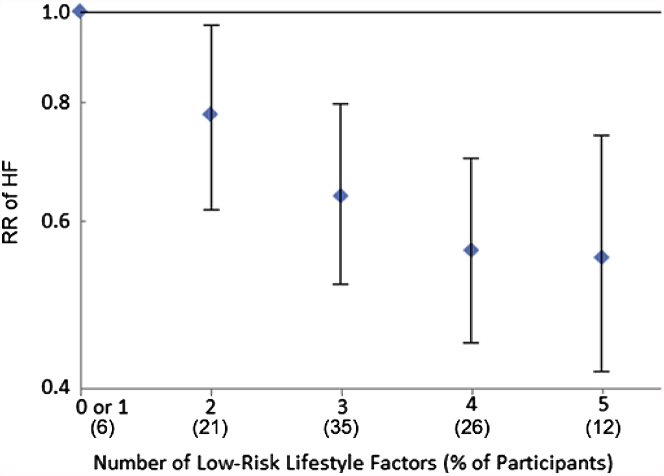
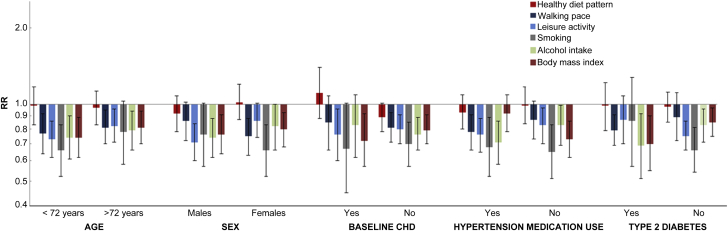
OBJECTIVES: The goal of this study was to determine the relative contribution of major lifestyle factors on the development of heart failure (HF) in older adults. BACKGROUND: HF incurs high morbidity, mortality, and health care costs among adults ≥65 years of age, which is the most rapidly growing segment of the U.S. METHODS: We prospectively investigated separate and combined associations of lifestyle risk factors with incident HF (1,380 cases) over 21.5 years among 4,490 men and women in the Cardiovascular Health Study, which is a community-based cohort of older adults. Lifestyle factors included 4 dietary patterns (Alternative Healthy Eating Index, Dietary Approaches to Stop Hypertension, an American Heart Association 2020 dietary goals score, and a Biologic pattern, which was constructed using previous knowledge of cardiovascular disease dietary risk factors), 4 physical activity metrics (exercise intensity, walking pace, energy expended in leisure activity, and walking distance), alcohol intake, smoking, and obesity. RESULTS: No dietary pattern was associated with developing HF (p > 0.05). Walking pace and leisure activity were associated with a 26% and 22% lower risk of HF, respectively (pace >3 mph vs. <2 mph; hazard ratio [HR]: 0.74; 95% confidence interval [CI]: 0.63 to 0.86; leisure activity ≥845 kcal/week vs. <845 kcal/week; HR: 0.78; 95% CI: 0.69 to 0.87). Modest alcohol intake, maintaining a body mass index <30 kg/m(2), and not smoking were also independently associated with a lower risk of HF. Participants with ≥4 healthy lifestyle factors had a 45% (HR: 0.55; 95% CI: 0.42 to 0.74) lower risk of HF. Heterogeneity by age, sex, cardiovascular disease, hypertension medication use, and diabetes was not observed. CONCLUSIONS: Among older U.S. adults, physical activity, modest alcohol intake, avoiding obesity, and not smoking, but not dietary patterns, were associated with a lower risk of HF.
Overview
The claims and statistics of this paper haven’t been checked yet.
Run the check — free, no account needed. It reads the open-access text and checks the sources it cites.
Integrity signals
Registry
Cites
Statistics
Figures
Verification
Claims the paper makes
The claims and statistics of this paper haven’t been checked yet.
Run the check — free, no account needed. It reads the open-access text and checks the sources it cites.
Claims other papers make about this one
Each is checked against this paper’s own text: does it say what the citing paper says it does?
The source backs part of the claim, not all of it — or backs it for a different population, condition or comparison.
In the citing paper
“Early primary prevention strategies and treatment of associated risk factors reduce incident, symptomatic heart failure and should include lifestyle intervention with nutrition, physical activity, weight management, and smoking cessation (271-274) (Fig. 10.6).”
From 10. Cardiovascular Disease and Risk Management: Standards of Care in Diabetes—2025 (2025) · cites this paper as [271]
Experimental — accuracy not yet measuredThe source backs part of the claim, not all of it — or backs it for a different population, condition or comparison.
In the citing paper
“Early primary prevention strategies and treatment of associated risk factors reduce incident, symptomatic heart failure and should include lifestyle intervention with nutrition, physical activity, weight management, and smoking cessation (268–271) (Fig. 10.5).”
From 10. Cardiovascular Disease and Risk Management: Standards of Care in Diabetes—2026 (2026) · cites this paper as [268]
Experimental — accuracy not yet measured
Self-check
Percentages, sums and reported differences re-computed from the paper’s own numbers.
The self-check needs the paper’s full text.
Citations
Cites
1 retracted
RETRACTED: Primary Prevention of Cardiovascular Disease with a Mediterranean Diet
Estruch, R., Ros, E., Salas-Salvadó, J., Covas, M.-I., Corella, D., Arós, F., Gómez-Gracia, E., Ruiz-Gutiérrez, V., Fiol, M., Lapetra, J., et al. (2013) · New England Journal of Medicine · doi:10.1056/nejmoa1200303 · Cited by 4,257
RetractedHeart Disease and Stroke Statistics—2023 Update: A Report From the American Heart Association
Tsao, C. W., Aday, A. W., Almarzooq, Z. I., Anderson, C. A. M., Arora, P., Avery, C. L., Baker-Smith, C. M., Beaton, A. Z., Boehme, A. K., Buxton, A. E., et al. (2023) · Circulation · doi:10.1161/cir.0000000000001123 · Cited by 8,300
Heart Disease and Stroke Statistics—2012 Update: A Report From the American Heart Association
Writing Group Members, Roger, V. L., Go, A. S., Lloyd-Jones, D. M., Benjamin, E. J., Berry, J. D., Borden, W. B., Bravata, D. M., Dai, S., Ford, E. S., et al. (2012) · Circulation · doi:10.1161/cir.0b013e31823ac046 · Cited by 7,333
Self-citationA Clinical Trial of the Effects of Dietary Patterns on Blood Pressure
Appel, L. J., Moore, T. J., Obarzanek, E., Vollmer, W. M., Svetkey, L. P., Sacks, F. M., Bray, G. A., Vogt, T. M., Cutler, J. A., Windhauser, M. M., et al. (1997) · New England Journal of Medicine · doi:10.1056/nejm199704173361601 · Cited by 5,981
Heart Disease and Stroke Statistics—2010 Update: A Report From the American Heart Association
WRITING GROUP MEMBERS, Lloyd-Jones, D., Adams, R. J., Brown, T. M., Carnethon, M., Dai, S., De Simone, G., Ferguson, T. B., Ford, E., Furie, K., et al. (2010) · Circulation · doi:10.1161/circulationaha.109.192667 · Cited by 5,700
Self-citationHEART DISEASE AND STROKE STATISTICS–2014 UPDATE: A REPORT FROM THE AMERICAN HEART ASSOCIATION
Tarver, T. (2014) · Journal of Consumer Health on the Internet · doi:10.1080/15398285.2014.902284 · Cited by 5,595
Lloyd-Jones, D. M., Hong, Y., Labarthe, D., Mozaffarian, D., Appel, L. J., Van Horn, L., Greenlund, K., Daniels, S., Nichol, G., Tomaselli, G. F., et al. (2010) · Circulation · doi:10.1161/circulationaha.109.192703 · Cited by 4,750
Self-citationReproducibility and validity of a semiquantitative food frequency questionnaire
WILLETT, W. C., SAMPSON, L., STAMPFER, M. J., ROSNER, B., BAIN, C., WITSCHI, J., HENNEKENS, C. H., & SPEIZER, F. E. (1985) · American Journal of Epidemiology · doi:10.1093/oxfordjournals.aje.a114086 · Cited by 4,274
The Cardiovascular Health Study: design and rationale.
Fried, L. P., Borhani, N. O., Enright, P., Furberg, C. D., Gardin, J. M., Kronmal, R. A., Kuller, L. H., Manolio, T. A., Mittelmark, M. B., Newman, A., et al. (1991) · Annals of Epidemiology · doi:10.1016/1047-2797(91)90005-w · Cited by 3,652
Self-citationO'Connor (2009) · doi:10.1001/jama.2009.454 · Cited by 2,173
Cited by
Sorted by citations
Heart Disease and Stroke Statistics—2016 Update: A Report From the American Heart Association
Mozaffarian, D., Benjamin, E. J., Go, A. S., Arnett, D. K., Blaha, M. J., Cushman, M., Das, S. R., de Ferranti, S., Després, J.-P., Fullerton, H. J., et al. (2016) · Circulation · doi:10.1161/cir.0000000000000350 · Cited by 6,596
Self-citationHeidenreich, P. A., Bozkurt, B., Aguilar, D., Allen, L. A., Byun, J. J., Colvin, M. M., Deswal, A., Drazner, M. H., Dunlay, S. M., Evers, L. R., et al. (2022) · Circulation · doi:10.1161/cir.0000000000001063 · Cited by 4,922
Schwingshackl, L., & Hoffmann, G. (2015) · Journal of the Academy of Nutrition and Dietetics · doi:10.1016/j.jand.2014.12.009 · Cited by 1,022
Bechthold, A., Boeing, H., Schwedhelm, C., Hoffmann, G., Knüppel, S., Iqbal, K., De Henauw, S., Michels, N., Devleesschauwer, B., Schlesinger, S., et al. (2019) · Critical Reviews in Food Science and Nutrition · doi:10.1080/10408398.2017.1392288 · Cited by 693
“…al. 2014; Zhang et al. 2011) (Supplemental Table 5), 13 for nuts (12 reports) (Albert et al. 2002; Bernstein et al. 2012b; Bernstein et al. 2010; Del Gobbo et al. 2015; di Giuseppe et al. 2015; Djousse et al. 2010; Djousse et al. 2008; Fraser et al. 1992; Haring et al. 2014; Haring et al. 2015;…”
InfluentialSchwingshackl, L., Bogensberger, B., & Hoffmann, G. (2018) · Journal of the Academy of Nutrition and Dietetics · doi:10.1016/j.jand.2017.08.024 · Cited by 606
Metadata
- Authors
- Del Gobbo, L. C., Kalantarian, S., Imamura, F., Lemaitre, R., Siscovick, D. S., Psaty, B. M., & Mozaffarian, D.
- Affiliations
- Harvard University (US)
- University of Cambridge (GB)
- University of Washington (US)
- Group Health Cooperative (US)
- Brigham and Women's Hospital (US)
- Venue
- JACC: Heart Failure
- Publisher
- Elsevier BV
- Published
- 2015-07
- Volume
- 3
- Issue
- 7
- Pages
- 520-528
- ISSN
- 2213-1779 (ISSN-L)
- PMC
- PMC4508377
- OpenAlex
- W844777641
- Cited by
- 186
- References
- 33
- Citations by year
- 2026: 10 · 2025: 13 · 2024: 20 · 2023: 13 · 2022: 17 · 2021: 21 · 2020: 23 · 2019: 19 · 2018: 14 · 2017: 12 · 2016: 17 · 2015: 7
- FWCI
- 12.13
- Type
- journal article
- Language
- en
- Open access
- hybrid
- doi.org
- Licence
- Locations
- JACC Heart Failure (publishedVersion, cc-by)
- Europe PMC (PubMed Central) (publishedVersion)
- PubMed Central (publishedVersion, cc-by)
- PubMed (publishedVersion)
- Apollo (University of Cambridge) (submittedVersion, cc-by)
- Funders
- National Heart, Lung, and Blood Institute (HL080295)
- National Institute on Aging (AG023629)
- Medical Research Council Unit Programme (MC_UU_125015/5)
- Topics
- Health Sciences › Medicine › Cardiology and Cardiovascular Medicine › Cardiovascular Health and Risk Factors
- Health Sciences › Medicine › Cardiology and Cardiovascular Medicine › Heart Failure Treatment and Management
- Health Sciences › Medicine › Cardiology and Cardiovascular Medicine › Cardiovascular Function and Risk Factors
- Keywords
- heart failure, older adults, lifestyle risk factors, physical activity, walking speed, leisure-time physical activity, alcohol consumption, smoking, obesity, dietary habits, healthy lifestyle, incident heart failure risk
- MeSH terms
- Aged, Alcohol Drinking, Diet, Female, Heart Failure, Humans, Male, Motor Activity, Obesity, Prospective Studies, Risk Factors, Smoking, United States, Cohort Studies, Incidence, Proportional Hazards Models, Sedentary Behavior
About these checks
Registry, retraction, Cites and statistics results are computed, not judged, with one exception: a printed reference that no index lists is read once by a model before it counts as a citation error. Claims are extracted by a model and kept only when their quote appears verbatim in the text; each cited source is then checked, with a model’s help, for whether it says what the claim relies on. Those verdicts can be wrong — read the claim’s quote and the cited source before relying on one.
Statistics and arithmetic are recomputed, not judged.
Confidence bands are shown only for fields calibrated on our annotated test set. None is calibrated yet, so no band is shown.
What counts as a claim ›How we measure confidence ›How we check this ›
Are you an author, or do you see a problem with this page? Request a review
