

The DOI matches its Crossref record; 38 of the 39 references it cites were found in a registry or an index, and 1 are not checked yet.
Sample size in multistakeholder Delphi surveys: at what minimum sample size do replicability of results stabilize?
Open accessAbstract
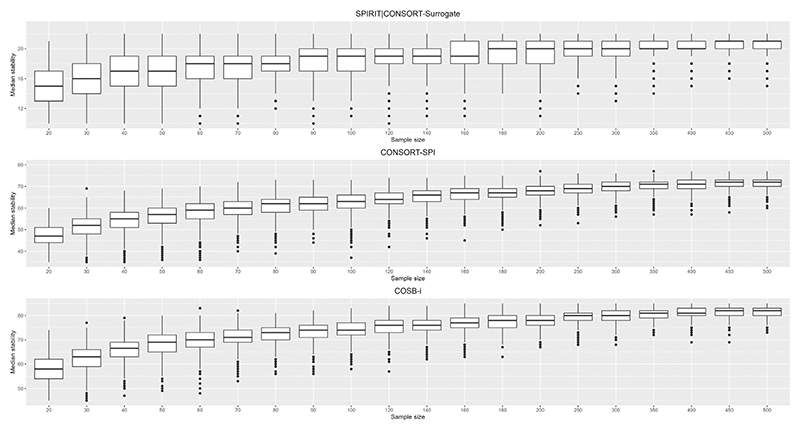
BACKGROUND AND OBJECTIVE: The minimum sample size for multistakeholder Delphi surveys remains understudied. Drawing from three large international multistakeholder Delphi surveys, this study aimed to: 1) investigate the effect of increasing sample size on replicability of results; 2) assess whether the level of replicability of results differed with participant characteristics: for example, gender, age, and profession. METHODS: We used data from Delphi surveys to develop guidance for improved reporting of health-care intervention trials: SPIRIT (Standard Protocol Items: Recommendations for Interventional Trials) and CONSORT (Consolidated Standards of Reporting Trials) extension for surrogate end points (n = 175, 22 items rated); CONSORT-SPI [CONSORT extension for Social and Psychological Interventions] (n = 333, 77 items rated); and core outcome set for burn care (n = 553, 88 items rated). Resampling with replacement was used to draw random subsamples from the participant data set in each of the three surveys. For each subsample, the median value of all rated survey items was calculated and compared to the medians from the full participant data set. The median number (and interquartile range) of medians replicated was used to calculate the percentage replicability (and variability). High replicability was defined as ≥80% and moderate as 60% and <80% RESULTS: The average median replicability (variability) as a percentage of total number of items rated from the three datasets was 81% (10%) at a sample size of 60. In one of the datasets (CONSORT-SPI), a ≥80% replicability was reached at a sample size of 80. On average, increasing the sample size from 80 to 160 increased the replicability of results by a further 3% and reduced variability by 1%. For subgroup analysis based on participant characteristics (eg, gender, age, professional role), using resampled samples of 20 to 100 showed that a sample size of 20 to 30 resulted to moderate replicability levels of 64% to 77%. CONCLUSION: We found that a minimum sample size of 60-80 participants in multistakeholder Delphi surveys provides a high level of replicability (≥80%) in the results. For Delphi studies limited to individual stakeholder groups (such as researchers, clinicians, patients), a sample size of 20 to 30 per group may be sufficient.
Overview
The claims and statistics of this paper haven’t been checked yet.
Run the check — free, no account needed. It reads the open-access text and checks the sources it cites.
Integrity signals
Registry
Cites
Statistics
Figures
Verification
Claims the paper makes
The claims and statistics of this paper haven’t been checked yet.
Run the check — free, no account needed. It reads the open-access text and checks the sources it cites.
Claims other papers make about this one
Each is checked against this paper’s own text: does it say what the citing paper says it does?
The cited source says what the claim attributes to it.
In the citing paper
“There is no formal sample size calculation for Delphi studies [46, 47].”
From Essential Information About Chronobiology and Chronotherapy for the Optimal Care of People With Bipolar Disorders: An Expert Consensus (2026) · cites this paper as [46]
The cited source says what the claim attributes to it.
In the citing paper
“Publications suggest that the results of single stakeholder Delphi studies stabilise [44], and achieve moderate replicability, with 20–30 participants [46].”
From Essential Information About Chronobiology and Chronotherapy for the Optimal Care of People With Bipolar Disorders: An Expert Consensus (2026) · cites this paper as [46]
Self-check
Percentages, sums and reported differences re-computed from the paper’s own numbers.
The self-check needs the paper’s full text.
Citations
Cites
Sample sizes for saturation in qualitative research: A systematic review of empirical tests
Hennink, M., & Kaiser, B. N. (2022) · Social Science & Medicine · doi:10.1016/j.socscimed.2021.114523 · Cited by 6,311
The Delphi method as a research tool: an example, design considerations and applications
Okoli, C., & Pawlowski, S. D. (2004) · Information & Management · doi:10.1016/j.im.2003.11.002 · Cited by 4,771
The Delphi Technique: Making Sense of Consensus
Hsu, C.-C., & Sandford, B. A. (2007) · University of Massachusetts Amherst · doi:10.7275/pdz9-th90 · Cited by 4,500 · cited 3×
“It has been used to build consensus in various exercises such as needs assessment, policy determination, estimation of disease prevalence, and development of clinical and health reporting guidelines [6–9].”
Consensus development methods, and their use in clinical guideline development.
Murphy, M., Black, Lamping, McKee, M., Sanderson, Askham, & Marteau (1998) · Health Technology Assessment · doi:10.3310/hta2030 · Cited by 2,076
Guidance for Developers of Health Research Reporting Guidelines
Moher, D., Schulz, K. F., Simera, I., & Altman, D. G. (2010) · PLoS Medicine · doi:10.1371/journal.pmed.1000217 · Cited by 1,437
International Encyclopedia of Education
(1986) · Oxford Review of Education · doi:10.1080/0305498860120107 · Cited by 1,261
Delphi Technique in Health Sciences: A Map
Niederberger, M., & Spranger, J. (2020) · Frontiers in Public Health · doi:10.3389/fpubh.2020.00457 · Cited by 1,072
Stability of response characteristics of a Delphi panel: application of bootstrap data expansion
Akins, R. B., Tolson, H., & Cole, B. R. (2005) · BMC Medical Research Methodology · doi:10.1186/1471-2288-5-37 · Cited by 994
Consensus development methods, and their use in clinical guideline development.
Murphy, M. P., Black, N. A., Lamping, D. L., et al. (1998) · PubMed · Cited by 965
Cruz Rivera, S., Liu, X., Chan, A.-W., Denniston, A. K., Calvert, M. J., The SPIRIT-AI and CONSORT-AI Working Group, SPIRIT-AI and CONSORT-AI Steering Group, Darzi, A., Holmes, C., Yau, C., et al. (2020) · Nature Medicine · doi:10.1038/s41591-020-1037-7 · Cited by 933
Cited by
Sorted by citations
Items 101–176 of 176
Pan, Q., Zheng, S., & Liang, J. (2025) · Journal of Health Psychology · doi:10.1177/13591053251390399
The Human Factor in Blockchain Governance
Koning, H. A. (2026) · Lecture notes in networks and systems · doi:10.1007/978-3-032-05877-5_7
Wang, J., Jutaputthi, T., Cheng, Y., Ye, Z., Xu, M., Wu, Y., & Jin, Z. (2026) · Journal of Multidisciplinary Healthcare · doi:10.2147/jmdh.s561192
Rostron, H., Pini, S. A., Galloway, A., Gilbert, A. W., Livermore, P., & Redmond, A. C. (2026) · NIHR Open Research · doi:10.3310/nihropenres.14191.1
Marrie, R. A., Fakolade, A. O., Maxwell, C., Rotstein, D., Tremlett, H. L., Yeh, E. A., & Finlayson, M. L. (2026) · Multiple Sclerosis Journal - Experimental Translational and Clinical · doi:10.1177/20552173251398975
The name game: evolving terminology in work-family/work-life research
Duxbury, L. E., Wadsworth, S. M., & Lanctot, A. (2026) · Community Work & Family · doi:10.1080/13668803.2026.2625888
Wu, L., Gong, Y., Liu, X., Ning, Y., Song, J., Zhang, Z., Zhou, H., & Xiong, H. (2026) · Journal of Multidisciplinary Healthcare · doi:10.2147/jmdh.s559427
Cullen, K., Brotherhood, E., Hayes, O. S., Mansfield, V., Gonzalez, A. S., Zimmermann, N., Stott, J. C. H., & Fitzsimmons, D. F. (2026) · BMJ Open · doi:10.1136/bmjopen-2025-110399
Rocha-Gomes, J. R., Sousa‐Pinto, B., & Neves, A. L. (2026) · BMJ Open · doi:10.1136/bmjopen-2025-104466
Tan, G. A., Peiris, C. L., Taylor, N. F., Harding, K. E., & Dennett, A. M. (2026) · Research Square · doi:10.21203/rs.3.rs-8846045/v1
(2026) · Advances in computational intelligence and robotics book series · doi:10.4018/979-8-3373-9340-7.ch007
Alshyyab, M. A., Albsoul, R. A., FitzGerald, G., Manasra, A. R. A., & Borkoles, E. (2026) · Journal of Health Organization and Management · doi:10.1108/jhom-05-2025-0247
Shields, G., Farragher, T. M., Davies, L. M., Verma, A., Kirkham, J. J., Makara, D., & Clarkson, P. (2026) · Journal of Mental Health · doi:10.1080/09638237.2026.2645543
Leoni, M. L. G., & Varrassi, G. (2026) · Preprints.org · doi:10.20944/preprints202603.2357.v1
O’Connor, C. M. C., Houlden, S., Poulos, C. J., Callisaya, M. L., Collins, A., Miskovski, K., Petrie, G., Quinn, J., Taylor, N., Kurrle, S. E., et al. (2026) · Implementation Science Communications · doi:10.1186/s43058-026-00917-y
Phillips, G., Coad, J., Hickson, M., & Manning, J. C. (2026) · Nutrition and Health · doi:10.1177/02601060261439096
Quality indicators for Delphi Studies: a Delphi StudyPreprint
Landeta, J., Lertxundi, A. L., Guimón, J., & Alón, I. (2026) · SSRN Electronic Journal · doi:10.2139/ssrn.6603320
Mo, M., Zhai, D., Tao, N., Zhang, N., Zhang, Y., & Guqing, Z. E. N. G. (2026) · Risk Management and Healthcare Policy · doi:10.2147/rmhp.s585801
What classroom practices could teachers use to support children with anxiety? A Delphi study
Johnson, C. L., Quach, J., Jorm, A. F., Gregg, K. J., Luke, M. A., Dougall, R., & Hart, L. (2026) · Mental Health & Prevention · doi:10.1016/j.mhp.2026.200513
Watson, M. A., Johnston, L. M., Miller, L., & Ryan, A. K. (2026) · Disability and Rehabilitation · doi:10.1080/09638288.2026.2666068
Mealings, K. T., Hughes, S., Halvorsen, L., Nash, K., Coe, L.-J., Macqueen, D., Ward, K., & McMahon, C. M. (2026) · BMJ Open · doi:10.1136/bmjopen-2025-111701
Byrd, E. K., Mulhall, P., Shields, N., Gray, K. M., Hilgenkamp, T. I. M., Kahonde, C. K., Ng, K., Ptomey, L. T., Purcell, R., Sit, C. H.-P., et al. (2026) · BMJ Paediatrics Open · doi:10.1136/bmjpo-2025-003999
Alberotanza, G., Skou, S. T., Hartvigsen, J., Dideriksen, M., Nyberg, M., Rasmussen, H., & Bricca, A. (2026) · JOSPT open. · doi:10.2519/josptopen.2026.0216
Dibben, G. O., Brage, S., Buman, M. P., Duncan, E., Foster, C. E., Granat, M. H., Hillsdon, M. M., Martin, A., Matthews, C. E., Vasankari, T. J., et al. (2026) · Journal for the Measurement of Physical Behaviour · doi:10.1123/jmpb.2025-0085
Self-citationCerullo, G., Videira‐Silva, A., Jácome, C. I. O., Reis-Pina, P., & Nunes, R. (2026) · BMJ Supportive & Palliative Care · doi:10.1136/spcare-2026-006298
Kelly, S. H., Walker, S. L., Willis, N., Ferrand, R. A., Fuller, L. C., Kpokiri, E. E., Karimatsenga, V., & Langan, S. (2026) · Wellcome Open Research · doi:10.12688/wellcomeopenres.26218.1
Supporting entrepreneurial resilience: An experimental study protocol
Sinha, K., Byambadorj, N., Magnani, E., Zhu, R., Chirico, F., Gu, Y., & Green, R. (2026) · PLoS ONE · doi:10.1371/journal.pone.0349194
Tio, V. B. V., Mustaruddin, M., Fitriana, A., Listiana, E., & Ahmadi, A. (2026) · JEMSI (Jurnal Ekonomi Manajemen dan Akuntansi) · doi:10.35870/jemsi.v12i3.6667
Development of a core outcome set for studies on centralization of healthcare services
Pfisterer‐Heise, S., Scharfe, J., Pachanov, A., Kugler, C. M., Shehu, E., Mathes, T., Mantke, R., & Pieper, D. (2026) · BMC Health Services Research · doi:10.1186/s12913-026-14861-z
Newbould, R., Blom, I. M., Bigmore, K., Waddington, H. S., Green, R., Haines, A., & Benton, L. (2026) · Wellcome Open Research · doi:10.12688/wellcomeopenres.26773.1
Smith, C., Bernhardt, L., Birt, L., Hansjee, D., MacDiarmid, L., Manning, J. C., Parmar, P., Smithard, D., & Wright, D. J. (2026) · Health Services and Outcomes Research Methodology · doi:10.1007/s10742-026-00389-6
Fadel, M. G., Walshaw, J., Yiasemidou, M., Boal, M. W. E., Pecchini, F., Elhadi, M., Massey, L. H., Carrano, F. M., Fehervari, M., Walsh, C. M., et al. (2026) · Surgical Endoscopy · doi:10.1007/s00464-026-12781-x
Fadel, M. G., Walshaw, J., Yiasemidou, M., Boal, M. W. E., Pecchini, F., Elhadi, M., Massey, L. H., Carrano, F. M., Fehervari, M., Walsh, C. M., et al. (2026) · United European Gastroenterology Journal · doi:10.1002/ueg2.70224
Purcell, S., Robinson, K., O’Connor, M., Salsberg, J., Morrissey, A., & Hayes, S. (2026) · BMJ Open · doi:10.1136/bmjopen-2025-108366
Sun, Z., & Zhang, F. (2026) · Frontiers in Psychology · doi:10.3389/fpsyg.2026.1804440
Tailoring the CFIR to Medication Adherence Interventions: A Delphi and Living Lab Study
Lansink, M. A. M. O., van den Bemt, B. J. F., Gompel, C. H. P. A. V. D. S.-V., Vervloet, M., van Dijk, L., & Bekker, C. (2026) · Pharmacy · doi:10.3390/pharmacy14030088
Conzatti, A. B. Z., Hardt, L. P. A., Hardt, C., & Hardt, M. (2026) · Buildings · doi:10.3390/buildings16132591
Consensus on curriculum design for a person-centred leadership learning programme—a delphi study
Baldie, D. J., Cardiff, S., Sanders, K., Cope, G., Hølge‐Hazelton, B., Kjerholt, M., & McCance, T. (2026) · Frontiers in Health Services · doi:10.3389/frhs.2026.1866482
Kelly, S. H., Walker, S. L., Willis, N., Ferrand, R. A., Fuller, L. C., Kpokiri, E. E., Karimatsenga, V., & Langan, S. (2026) · Wellcome Open Research · doi:10.12688/wellcomeopenres.26218.2
Leoni, M. L. G., Tran, Y. V., Phạm, V. P., & Varrassi, G. (2026) · Advancements in health research. · doi:10.4081/ahr.2026.142
Filosa, E., Schönenberger, N., Essien, U. R., Gagnon, C. L., Gnjidic, D., O’Donnell, L. K., Manias, E., McCarthy, L. M., Moriarty, F., Nguyen‐Soenen, J., et al. (2026) · JMIR Research Protocols · doi:10.2196/92082
Author response: Heritability of movie-evoked brain activity and connectivity
Gruskin, D. C., Vieira, D. J., Lee, J. K., & Patel, G. H. (2026) · eLife · doi:10.7554/elife.106081.2.sa0
Macdonald, T., Dinnes, J., Maniatopoulos, G., Solebo, A. L., Hogg, H. D. J., Alderman, J. E., Engelmann, J., Owen, R., Ganapathi, S., Ng, V., et al. (2026) · The Lancet Digital Health · doi:10.1016/j.landig.2026.101033
Herrmann, J., Fangmeier, F., Winter, A., Engelhardt-Lohrke, C., Herzog, K., Martini, J., & Schepper, F. (2026) · Zeitschrift für Evidenz Fortbildung und Qualität im Gesundheitswesen · doi:10.1016/j.zefq.2026.05.014
Smith, T., Mazibuko, L., Dlamini, S., Shelembe, N., Mtshali, N., Psaros, C., Shahmanesh, M., Seeley, J., & Ngwenya, N. B. (2026) · Health Literacy and Communication Open · doi:10.1080/28355245.2026.2682614
Sampath, K. K., Engel, R. M., & Keter, D. L. (2026) · BMJ Open · doi:10.1136/bmjopen-2026-117380
Data Mining Approach to Predict Bank Saving Decisions Employing Classification Method
Arifin, F. H., & Supatmi, S. (2025) · Proceeding of International Student Conference on Earth and Environmental Research · doi:10.34010/incitest.v1i.834
Ghosh, P., Reck, N., Schneider, G., Asin, J., Okuni, J. B., Muvunyi, C. M., Asaduzzaman, M., Kobialka, R. M., Abdelkhalek, A., Basher, A., et al. (2026) · BMJ Open · doi:10.1136/bmjopen-2025-112822
Belkin, I. S., Shapira, O., Michael-Bitton, G., & Zemah-Shamir, S. (2026) · Ecological Indicators · doi:10.1016/j.ecolind.2026.115208
Haile, A. M., Bantigegn, F., & Yoseph, T. (2026) · BMJ Open · doi:10.1136/bmjopen-2026-123401
Escudero, A. A., Ortiz-Gutiérrez, R. M., Carpio-Calatayud, E., Díaz‐Arribas, M. J., Cano‐de‐la‐Cuerda, R., & Martín‐Casas, P. (2026) · Patient Preference and Adherence · doi:10.2147/ppa.s618604
Brage, M. B. V., & Otero-Enríquez, R. (2026) · Urban Science · doi:10.3390/urbansci10080463
A Delphi–Monte Carlo Framework for Probabilistic KPI Estimation in Public-Sector AI Projects
Ismailova, R., Ibadildin, N., Kadyrova, A., Yesmagulova, N., & Symbat, I. (2026) · Systems · doi:10.3390/systems14081003
Mashayekh‐Amiri, S., Mohammad‐Alizadeh‐Charandabi, S., Nourizadeh, R., Vaezi, M., Meedya, S., & Mirghafourvand, M. (2026) · International Journal of Women s Health · doi:10.2147/ijwh.s622869
Bellmann, K. P., de Vries, G., & Scholten, L. (2026) · Humanities and Social Sciences Communications · doi:10.1057/s41599-026-08780-x
Kelly, S. H., Walker, S. L., Willis, N., Ferrand, R. A., Fuller, L. C., Kpokiri, E. E., Karimatsenga, V., & Langan, S. (2026) · Wellcome Open Research · doi:10.12688/wellcomeopenres.26218.3
Shabbir, C. A., Castleton, P., Mengistu, T. S., Damabi, N. M., Mahmood, M. A., Meherali, S. M., Salam, R. A., Mengesha, Z. B., Bhaumik, S., Tessema, G. A., et al. (2026) · Australian and New Zealand Journal of Public Health · doi:10.1016/j.anzjph.2026.100589
Matola, B. W., Nyasulu, J. C. Y., & Nicol, E. (2026) · PLoS ONE · doi:10.1371/journal.pone.0357408
Wallin, K., Hanberger, L., Lundell, I. W., Alehagen, S., & Hultsjö, S. (2026) · Health Expectations · doi:10.1111/hex.70856
Future-proofing the workforce for person-centered healthcare
Slater, P. F., & Middleton, R. (2026) · Frontiers research topics · doi:10.3389/978-2-8325-8671-6
Chan, V. W., Graham, B., Ng, H. H. L., Griffiths, S., Kotecha, D., Ismail, H., Jenkins, P., Zhong, J., Lakshminarayan, R., & Wah, T. M. (2026) · PLoS ONE · doi:10.1371/journal.pone.0337255
COSMYC: a Core Outcome Set for MYopia clinical trials with Children and young people
Dahlmann-Noor, A. H., Jacobson, M., Islam, L., Gorst, S. L., Baker, H., Freemantle, N., Rivas, C. A., & Azuara‐Blanco, A. (2026) · British Journal of Ophthalmology · doi:10.1136/bjo-2026-330475
Wei, X.-H., Chen, X.-Y., Wang, Y.-Y., Fu, J.-J., Yang, G.-Y., Sun, J., & Lu, C.-L. (2026) · Evidence-Based Chinese Medicine and Technology Assessment · doi:10.26599/ecmta.2026.9570046
Mollaeian, S., Azimi, B., Mohammadnezhad, G., Mousavi, S. F., Molavi, B., Kalani, P., & Esmaily, H. (2026) · Iranian journal of pharmaceutical research · doi:10.5812/ijpr-171391
Ribeiro, A. C. E., & Facin, A. L. F. (2026) · IFIP advances in information and communication technology · doi:10.1007/978-3-032-38610-6_6
Emmers, E., Jacobs, K., Saenen, L., Pirson, L., Casanova, M. L., Silveira-Maia, M., İnci, S., & Santos, M. (2026) · Social Sciences & Humanities Open · doi:10.1016/j.ssaho.2026.103747
Wicaksono, T., Prathivi, M. D. G., Masyhuri, M., Zahirah, K. F., Poernomo, W., Bernardus, D., & Illés, C. B. (2026) · Journal of Retailing and Consumer Services · doi:10.1016/j.jretconser.2026.104997
Boele, F. W., Visser, F., Zijlmans, M., Schuur, M., Peters, S., Saridin, F. N., van den Berg, L., Altinbas, A., Fronczek, R., Thijs, R. D., et al. (2026) · Epileptic Disorders · doi:10.1002/epd2.70413
Sánchez-Feliciano, A., James, W. D., Fitzgerald, M. P., Watson, A., Peron, A., Gil‐Nagel, A., Myers, K. A., Tokumoto, K., Lagae, L. G., Spinner, N. B., et al. (2026) · Epilepsia · doi:10.1002/epi.70525
Grey, G., Shafran, R., Brem, C., Hata, A., Pilling, S., Lewis, G., Krebs, G., Saunders, R., & Buckman, J. E. J. (2026) · Journal of Affective Disorders · doi:10.1016/j.jad.2026.122608
Ofori, J. N. A., Ogunseiju, O. R., Catrambone, R., Starner, T. E., & Nnaji, C. A. (2026) · Safety Science · doi:10.1016/j.ssci.2026.107512
Hurley, K. L., McNee, R., Bryant, M., Akhter, Z., Bell, Z., Farrand, C., Frank, L., Grainge, S., Heslehurst, N., McKerracher, L., et al. (2026) · Global Food Security · doi:10.1016/j.gfs.2026.100947
Development of a Core Outcome Set for Pancreatic Cancer Rehabilitation – A Study Protocol
Brennan, L., Smith, V. A., Kirkham, J. J., Lucey, N., Sheill, G., Deasy, P., Doran, P., O'Kane, G. M., Griffin, O. M., & O’Neill, L. M. (2026) · HRB Open Research · doi:10.12688/hrbopenres.14558.1
King, C. E., Melvin, G. A., Jorm, A. F., & Yap, M. B. H. (2026) · Child Psychiatry & Human Development · doi:10.1007/s10578-026-02111-6
Gray, C. S., Armit, L., Babl, F. E., Powell, C., Yock‐Corrales, A., Santhanam, I., Johnson, M. D., Dalziel, S. R., Yong-Kwang, G. O., Millar, M. M., et al. (2026) · BMJ Open · doi:10.1136/bmjopen-2026-124611
Core Concepts in Veterinary Public Health Education: Results of a Modified Delphi Survey
Rist, C., Wishnie, J. K., de Vuurst, P. V., Ojodare, T. A., KuKanich, K. S., Kreisler, R. E., Wahl, R. L., Yancey, C. B., Gallagher, C. A., Hervé-Claude, L. P., et al. (2026) · Journal of Veterinary Medical Education · doi:10.3138/jvme-2026-0043
Metadata
- Authors
- Manyara, A. M., Purvis, A., Ciani, O., Collins, G. S., & Taylor, R. S.
- Affiliations
- University of Bristol (GB)
- University of Glasgow (GB)
- Bocconi University (IT)
- MRC/CSO Social and Public Health Sciences Unit (GB)
- Corresponding author
- Manyara, Anthony Muchai
- Venue
- Journal of Clinical Epidemiology
- Publisher
- Elsevier BV
- Published
- 2024-10
- Volume
- 174
- Pages
- 111485
- ISSN
- 0895-4356 (ISSN-L)
- PMC
- PMC7617918
- OpenAlex
- W4401027269
- Cited by
- 163
- References
- 36
- Citations by year
- 2026: 93 · 2025: 67 · 2024: 3
- FWCI
- 116.49
- Type
- journal article
- Language
- en
- Open access
- hybrid
- doi.org
- Licence
- Locations
- Journal of Clinical Epidemiology (publishedVersion, cc-by)
- PubMed (publishedVersion)
- University of Birmingham Research Portal (University of Birmingham) (publishedVersion, cc-by)
- ENLIGHTEN (Jurnal Bimbingan dan Konseling Islam) (acceptedVersion, cc-by-sa)
- PubMed Central (acceptedVersion, cc-by)
- Archivio istituzionale della Ricerca - Bocconi (submittedVersion, cc-by-nc-nd)
- Explore Bristol Research (submittedVersion, cc-by)
- Funders
- Cancer Research UK (C49297/A27294)
- Economic and Social Research Council
- National Institute for Health and Care Research
- UKRI MRC (MR/V038400/1, 304823-01)
- Topics
- Social Sciences › Sociology and Political Science › Delphi Technique in Research
- Social Sciences › Decision Sciences › Statistics, Probability and Uncertainty › Meta-analysis and systematic reviews
- Social Sciences › Decision Sciences › Statistics, Probability and Uncertainty › Reliability and Agreement in Measurement
- Keywords
- sample size, minimum sample size, resampling, participant characteristics, gender, age, professional roles, reporting guidelines, alcoholic beverages, core outcome set, burn treatment, surrogate endpoints, stakeholder consensus, subgroup analysis
- MeSH terms
- Adult, Delphi Technique, Female, Humans, Male, Middle Aged, Surveys and Questionnaires, Research Design, Reproducibility of Results, Sample Size
About these checks
Registry, retraction, Cites and statistics results are computed, not judged, with one exception: a printed reference that no index lists is read once by a model before it counts as a citation error. Claims are extracted by a model and kept only when their quote appears verbatim in the text; each cited source is then checked, with a model’s help, for whether it says what the claim relies on. Those verdicts can be wrong — read the claim’s quote and the cited source before relying on one.
Statistics and arithmetic are recomputed, not judged.
Confidence bands are shown only for fields calibrated on our annotated test set. None is calibrated yet, so no band is shown.
What counts as a claim ›How we measure confidence ›How we check this ›
Are you an author, or do you see a problem with this page? Request a review
