

The DOI matches its Crossref record; 38 of the 39 references it cites were found in a registry or an index, and 1 are not checked yet.
Sample size in multistakeholder Delphi surveys: at what minimum sample size do replicability of results stabilize?
Open accessAbstract
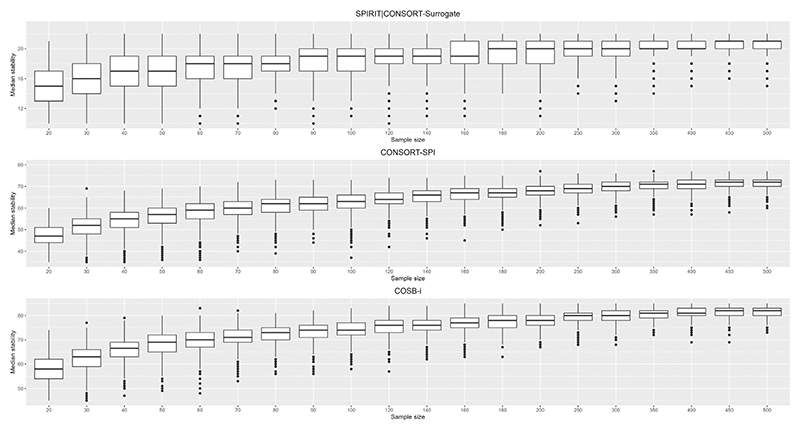
BACKGROUND AND OBJECTIVE: The minimum sample size for multistakeholder Delphi surveys remains understudied. Drawing from three large international multistakeholder Delphi surveys, this study aimed to: 1) investigate the effect of increasing sample size on replicability of results; 2) assess whether the level of replicability of results differed with participant characteristics: for example, gender, age, and profession. METHODS: We used data from Delphi surveys to develop guidance for improved reporting of health-care intervention trials: SPIRIT (Standard Protocol Items: Recommendations for Interventional Trials) and CONSORT (Consolidated Standards of Reporting Trials) extension for surrogate end points (n = 175, 22 items rated); CONSORT-SPI [CONSORT extension for Social and Psychological Interventions] (n = 333, 77 items rated); and core outcome set for burn care (n = 553, 88 items rated). Resampling with replacement was used to draw random subsamples from the participant data set in each of the three surveys. For each subsample, the median value of all rated survey items was calculated and compared to the medians from the full participant data set. The median number (and interquartile range) of medians replicated was used to calculate the percentage replicability (and variability). High replicability was defined as ≥80% and moderate as 60% and <80% RESULTS: The average median replicability (variability) as a percentage of total number of items rated from the three datasets was 81% (10%) at a sample size of 60. In one of the datasets (CONSORT-SPI), a ≥80% replicability was reached at a sample size of 80. On average, increasing the sample size from 80 to 160 increased the replicability of results by a further 3% and reduced variability by 1%. For subgroup analysis based on participant characteristics (eg, gender, age, professional role), using resampled samples of 20 to 100 showed that a sample size of 20 to 30 resulted to moderate replicability levels of 64% to 77%. CONCLUSION: We found that a minimum sample size of 60-80 participants in multistakeholder Delphi surveys provides a high level of replicability (≥80%) in the results. For Delphi studies limited to individual stakeholder groups (such as researchers, clinicians, patients), a sample size of 20 to 30 per group may be sufficient.
Overview
The claims and statistics of this paper haven’t been checked yet.
Run the check — free, no account needed. It reads the open-access text and checks the sources it cites.
Integrity signals
Registry
Cites
Statistics
Figures
Verification
Claims the paper makes
The claims and statistics of this paper haven’t been checked yet.
Run the check — free, no account needed. It reads the open-access text and checks the sources it cites.
Claims other papers make about this one
Each is checked against this paper’s own text: does it say what the citing paper says it does?
The cited source says what the claim attributes to it.
In the citing paper
“There is no formal sample size calculation for Delphi studies [46, 47].”
From Essential Information About Chronobiology and Chronotherapy for the Optimal Care of People With Bipolar Disorders: An Expert Consensus (2026) · cites this paper as [46]
The cited source says what the claim attributes to it.
In the citing paper
“Publications suggest that the results of single stakeholder Delphi studies stabilise [44], and achieve moderate replicability, with 20–30 participants [46].”
From Essential Information About Chronobiology and Chronotherapy for the Optimal Care of People With Bipolar Disorders: An Expert Consensus (2026) · cites this paper as [46]
Self-check
Percentages, sums and reported differences re-computed from the paper’s own numbers.
The self-check needs the paper’s full text.
Citations
Cites
Sample sizes for saturation in qualitative research: A systematic review of empirical tests
Hennink, M., & Kaiser, B. N. (2022) · Social Science & Medicine · doi:10.1016/j.socscimed.2021.114523 · Cited by 6,311
The Delphi method as a research tool: an example, design considerations and applications
Okoli, C., & Pawlowski, S. D. (2004) · Information & Management · doi:10.1016/j.im.2003.11.002 · Cited by 4,771
The Delphi Technique: Making Sense of Consensus
Hsu, C.-C., & Sandford, B. A. (2007) · University of Massachusetts Amherst · doi:10.7275/pdz9-th90 · Cited by 4,500 · cited 3×
“It has been used to build consensus in various exercises such as needs assessment, policy determination, estimation of disease prevalence, and development of clinical and health reporting guidelines [6–9].”
Consensus development methods, and their use in clinical guideline development.
Murphy, M., Black, Lamping, McKee, M., Sanderson, Askham, & Marteau (1998) · Health Technology Assessment · doi:10.3310/hta2030 · Cited by 2,076
Guidance for Developers of Health Research Reporting Guidelines
Moher, D., Schulz, K. F., Simera, I., & Altman, D. G. (2010) · PLoS Medicine · doi:10.1371/journal.pmed.1000217 · Cited by 1,437
International Encyclopedia of Education
(1986) · Oxford Review of Education · doi:10.1080/0305498860120107 · Cited by 1,261
Delphi Technique in Health Sciences: A Map
Niederberger, M., & Spranger, J. (2020) · Frontiers in Public Health · doi:10.3389/fpubh.2020.00457 · Cited by 1,072
Stability of response characteristics of a Delphi panel: application of bootstrap data expansion
Akins, R. B., Tolson, H., & Cole, B. R. (2005) · BMC Medical Research Methodology · doi:10.1186/1471-2288-5-37 · Cited by 994
Consensus development methods, and their use in clinical guideline development.
Murphy, M. P., Black, N. A., Lamping, D. L., et al. (1998) · PubMed · Cited by 965
Cruz Rivera, S., Liu, X., Chan, A.-W., Denniston, A. K., Calvert, M. J., The SPIRIT-AI and CONSORT-AI Working Group, SPIRIT-AI and CONSORT-AI Steering Group, Darzi, A., Holmes, C., Yau, C., et al. (2020) · Nature Medicine · doi:10.1038/s41591-020-1037-7 · Cited by 933
The Delphi technique: a critique
Goodman, C. (1987) · Journal of Advanced Nursing · doi:10.1111/j.1365-2648.1987.tb01376.x · Cited by 928
Delphi methodology in health research: how to do it?
Trevelyan, E., & Robinson, N. (2015) · European Journal of Integrative Medicine · doi:10.1016/j.eujim.2015.07.002 · Cited by 801
Using the Delphi expert consensus method in mental health research
Jorm, A. F. (2015) · Australian & New Zealand Journal of Psychiatry · doi:10.1177/0004867415600891 · Cited by 765
The wisdom of crowds : why the many are smarter than the few
Surowiecki, J. (2005) · Cited by 760
Gattrell, W. T., Logullo, P., van Zuuren, E. J., Price, A., Hughes, E. L., Blazey, P., Winchester, C. C., Tovey, D., Goldman, K., Hungin, A. P., et al. (2024) · PLOS Medicine · doi:10.1371/journal.pmed.1004326 · Cited by 701
Cruz Rivera, S., Liu, X., Chan, A.-W., Denniston, A. K., Calvert, M. J., Ashrafian, H., Beam, A. L., Collins, G. S., Darzi, A., Deeks, J. J., et al. (2020) · The Lancet Digital Health · doi:10.1016/s2589-7500(20)30219-3 · Cited by 486
A Delphi study to build consensus on the definition and use of big data in obesity research
Vogel, C., Zwolinsky, S., Griffiths, C., Hobbs, M., Henderson, E. J., & Wilkins, E. L. (2019) · International Journal of Obesity · doi:10.1038/s41366-018-0313-9 · Cited by 478
Rivera, S. C., Liu, X., Chan, A.-W., Denniston, A. K., & Calvert, M. J. (2020) · BMJ · doi:10.1136/bmj.m3210 · Cited by 463
Consensus Development Methods: A Review of Best Practice in Creating Clinical Guidelines
Black, N. A., Murphy, M., Lamping, D. L., McKee, M., Sanderson, C. F. B., Askham, J., & Marteau, T. M. (1999) · Journal of Health Services Research & Policy · doi:10.1177/135581969900400410 · Cited by 452
on behalf of the CONSORT-SPI Group, Montgomery, P., Grant, S., Mayo-Wilson, E., Macdonald, G. M., Michie, S., Hopewell, S., & Moher, D. (2018) · Trials · doi:10.1186/s13063-018-2733-1 · Cited by 350
Thabane, L., Hopewell, S., Lancaster, G. A., Bond, C. M., Coleman, C. L., Campbell, M. J., & Eldridge, S. M. (2016) · Pilot and Feasibility Studies · doi:10.1186/s40814-016-0065-z · Cited by 216
The Delphi method—more research please
Humphrey-Murto, S. M., & de Wit, M. P. T. (2018) · Journal of Clinical Epidemiology · doi:10.1016/j.jclinepi.2018.10.011 · Cited by 152
Protocol for CONSORT-SPI: an extension for social and psychological interventions
Montgomery, P., Grant, S., Hopewell, S., Macdonald, G. M., Moher, D., Michie, S., & Mayo-Wilson, E. (2013) · Implementation Science · doi:10.1186/1748-5908-8-99 · Cited by 116
Dodd, S. R., Gorst, S. L., Young, A. E., Lucas, S. W., & Williamson, P. R. (2023) · Journal of Clinical Epidemiology · doi:10.1016/j.jclinepi.2023.03.022 · Cited by 89
Patient participation in Delphi surveys to develop core outcome sets: systematic review
Barrington, H., Young, B., & Williamson, P. R. (2021) · BMJ Open · doi:10.1136/bmjopen-2021-051066 · Cited by 69
Butcher, N. J., Monsour, A., Mew, E. J., Szatmári, P., Pierro, A., Kelly, L. E., Farid‐Kapadia, M., Chee-A-Tow, A., Saeed, L. H., Monga, S., et al. (2019) · Trials · doi:10.1186/s13063-019-3248-0 · Cited by 61
Manyara, A. M., Davies, P. A., Stewart, D., Weir, C. J., Young, A. E., Blazeby, J. M., Butcher, N. J., Bujkiewicz, S., Chan, A., Dawoud, D., et al. (2024) · BMJ · doi:10.1136/bmj-2023-078524 · Cited by 57
Self-citationDimairo, M., Coates, E. J., Pallmann, P., Todd, S., Julious, S. A., Jaki, T., Wason, J. M. S., Mander, A., Weir, C. J., König, F., et al. (2018) · BMC Medicine · doi:10.1186/s12916-018-1196-2 · Cited by 56
Rudan, I., Yoshida, S., Wazny, K., Chan, K. Y., & Cousens, S. (2016) · Journal of Global Health · doi:10.7189/jogh.06.010502 · Cited by 53
Yoshida, S., Rudan, I., & Cousens, S. (2016) · Journal of Global Health · doi:10.7189/jogh.06.010503 · Cited by 48
Schildkraut, J. A., Gallagher, J., Morimoto, K., Lange, C. G., HAWORTH, C. S., Floto, R. A., Hoefsloot, W., Griffith, D. E., Wagner, D., & van Ingen, J. (2020) · Respiratory Medicine · doi:10.1016/j.rmed.2020.106164 · Cited by 46
Kwakkenbos, L., Juszczak, E., Hemkens, L. G., Sampson, M., Fröbert, O., Relton, C., Gale, C., Zwarenstein, M., Langan, S., Moher, D., et al. (2018) · Research Integrity and Peer Review · doi:10.1186/s41073-018-0053-3 · Cited by 37
Manyara, A. M., Davies, P. A., Stewart, D., Weir, C. J., Young, A. E., Blazeby, J. M., Butcher, N. J., Bujkiewicz, S., Chan, A., Dawoud, D., et al. (2024) · BMJ · doi:10.1136/bmj-2023-078525 · Cited by 36
Self-citationManyara, A. M., Davies, P. A., Stewart, D., Weir, C. J., Young, A. E., Butcher, N. J., Bujkiewicz, S., Chan, A., Collins, P. G. S., Dawoud, D., et al. (2022) · BMJ Open · doi:10.1136/bmjopen-2022-064304 · Cited by 26
Self-citationYoung, A. E., Brookes, S. T., Rumsey, N., & Blazeby, J. M. (2017) · BMJ Open · doi:10.1136/bmjopen-2017-017267 · Cited by 24
Imran, M., Kwakkenbos, L., McCall, S. J., McCord, K. A., Fröbert, O., Hemkens, L. G., Zwarenstein, M., Relton, C., Rice, D. B., Langan, S., et al. (2021) · BMJ Open · doi:10.1136/bmjopen-2021-049093 · Cited by 23
Mixed methods and the Delphi method
Taghipoorreyneh, M. (2022) · Elsevier eBooks · doi:10.1016/b978-0-12-818630-5.11078-4 · Cited by 17
Davies, P. A., Davies, A. K., Kirkham, J. J., & Young, A. E. (2021) · Journal of Clinical Epidemiology · doi:10.1016/j.jclinepi.2021.12.011 · Cited by 6
Reporting Factorial Trials (RAFT) StudyPreprint
Hall, S., Birchenall, M., Montgomery, A. A., et al. (2021) · Open Science Framework · doi:10.17605/osf.io/kw5sv
Cited by
Sorted by citations
Revisiting the Delphi technique - Research thinking and practice: A discussion paper
Hasson, F., Keeney, S., & McKenna, H. (2025) · International Journal of Nursing Studies · doi:10.1016/j.ijnurstu.2025.105119 · Cited by 157
Sample size and consensus methods used in Delphi studies are heterogeneous: meta-research study
Škrinjar, I., Vučić, K., & Puljak, L. (2026) · Journal of Clinical Epidemiology · doi:10.1016/j.jclinepi.2026.112262 · Cited by 29
A Core Outcome Set for Adult General ICU Patients
Kjær, M. N., Bruun, C. R. L., Granholm, A., Møller, M. H., Rasmussen, B. S., Mortensen, C. B., Poulsen, L. M., Strøm, T., Lærkner, E., Brøchner, A. C., et al. (2025) · Critical Care Medicine · doi:10.1097/ccm.0000000000006556 · Cited by 27
Using the Delphi Method to Establish Expert Consensus: A Practical Guide
Jorm, A. (2025) · Advancing Methods for Interdisciplinarity in the Social Sciences · doi:10.1007/978-981-96-8357-4 · Cited by 22
Muringa, T. P., & Shava, E. (2024) · International Journal of Public Leadership · doi:10.1108/ijpl-04-2024-0032 · Cited by 13
Metadata
- Authors
- Manyara, A. M., Purvis, A., Ciani, O., Collins, G. S., & Taylor, R. S.
- Affiliations
- University of Bristol (GB)
- University of Glasgow (GB)
- Bocconi University (IT)
- MRC/CSO Social and Public Health Sciences Unit (GB)
- Corresponding author
- Manyara, Anthony Muchai
- Venue
- Journal of Clinical Epidemiology
- Publisher
- Elsevier BV
- Published
- 2024-10
- Volume
- 174
- Pages
- 111485
- ISSN
- 0895-4356 (ISSN-L)
- PMC
- PMC7617918
- OpenAlex
- W4401027269
- Cited by
- 163
- References
- 36
- Citations by year
- 2026: 93 · 2025: 67 · 2024: 3
- FWCI
- 116.49
- Type
- journal article
- Language
- en
- Open access
- hybrid
- doi.org
- Licence
- Locations
- Journal of Clinical Epidemiology (publishedVersion, cc-by)
- PubMed (publishedVersion)
- University of Birmingham Research Portal (University of Birmingham) (publishedVersion, cc-by)
- ENLIGHTEN (Jurnal Bimbingan dan Konseling Islam) (acceptedVersion, cc-by-sa)
- PubMed Central (acceptedVersion, cc-by)
- Archivio istituzionale della Ricerca - Bocconi (submittedVersion, cc-by-nc-nd)
- Explore Bristol Research (submittedVersion, cc-by)
- Funders
- Cancer Research UK (C49297/A27294)
- Economic and Social Research Council
- National Institute for Health and Care Research
- UKRI MRC (MR/V038400/1, 304823-01)
- Topics
- Social Sciences › Sociology and Political Science › Delphi Technique in Research
- Social Sciences › Decision Sciences › Statistics, Probability and Uncertainty › Meta-analysis and systematic reviews
- Social Sciences › Decision Sciences › Statistics, Probability and Uncertainty › Reliability and Agreement in Measurement
- Keywords
- sample size, minimum sample size, resampling, participant characteristics, gender, age, professional roles, reporting guidelines, alcoholic beverages, core outcome set, burn treatment, surrogate endpoints, stakeholder consensus, subgroup analysis
- MeSH terms
- Adult, Delphi Technique, Female, Humans, Male, Middle Aged, Surveys and Questionnaires, Research Design, Reproducibility of Results, Sample Size
About these checks
Registry, retraction, Cites and statistics results are computed, not judged, with one exception: a printed reference that no index lists is read once by a model before it counts as a citation error. Claims are extracted by a model and kept only when their quote appears verbatim in the text; each cited source is then checked, with a model’s help, for whether it says what the claim relies on. Those verdicts can be wrong — read the claim’s quote and the cited source before relying on one.
Statistics and arithmetic are recomputed, not judged.
Confidence bands are shown only for fields calibrated on our annotated test set. None is calibrated yet, so no band is shown.
What counts as a claim ›How we measure confidence ›How we check this ›
Are you an author, or do you see a problem with this page? Request a review
