

Leatherback hatchling sea-finding in response to artificial lighting: Interaction between wavelength and moonlight
The DOI matches its Crossref record; 44 of the 48 references it cites were found in a registry or an index; none of the 65 sources its claims cite is checked for support yet.
Overview
CoChat Summary
TL;DR
In field experiments at Pacuare, Costa Rica, leatherback hatchlings were tested with six artificial light colors under moonlit and moonless conditions. Artificial light disrupted sea-finding, with blue/green/yellow/white causing misorientation on moonless nights and blue/white causing misorientation on moonlit nights; orange/red were less disruptive but still impaired orientation.
Key findings
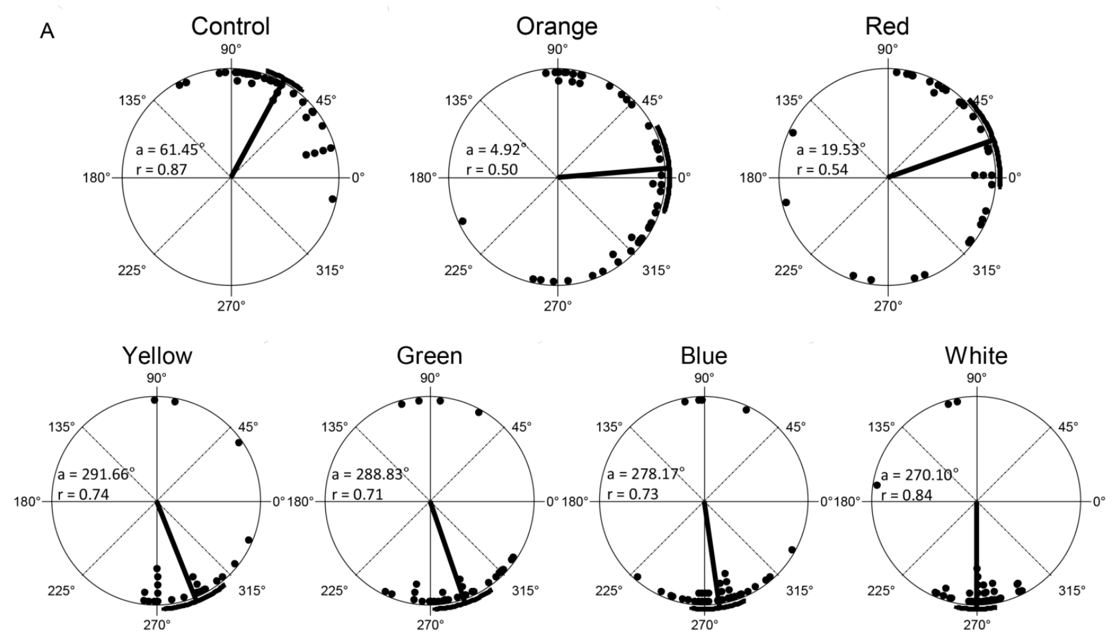
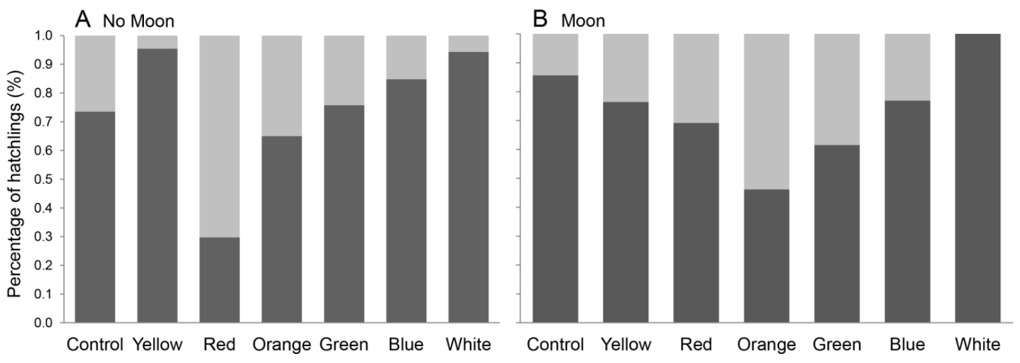
- On moonless nights, orientation differed significantly among light treatments (Watson-Williams F = 45.25, p < 0.0001). Hatchlings under blue, green, yellow, and white lights were predominantly misoriented toward the light source: white 92.1%, blue 86.1%, yellow 79.2%, and green 74.3% exited in group 4 (toward the light). Red and orange caused disorientation; red had 22% “no exit,” while orange had 0% “no exit.”
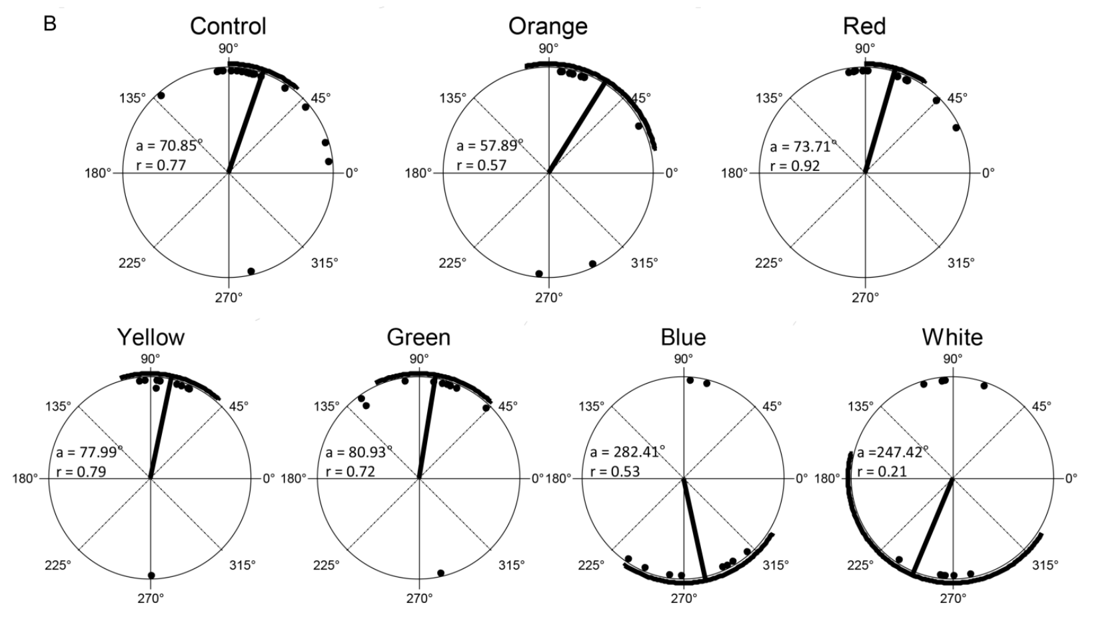
- On moonlit nights, only blue and white differed significantly from the control (control vs blue: F = 33.02, p < 0.001; control vs white: F = 11.08, p = 0.003). Rayleigh tests for blue and white under moonlight were not significant (blue Z = 2.84, p = 0.054; white Z = 0.42, p = 0.66).
- Crawling duration was shortest under yellow light (mean = 1.14 min, n = 36) and longest under red light (mean = 1.83 min, n = 41). Oriented and misoriented hatchlings left fastest (group 1: 1.33 ± 0.18 min; group 4: 1.40 ± 0.18 min), compared with group 2 (1.83 ± 0.19 min) and group 3 (1.77 ± 0.34 min).
- On moonless nights, wavy tracks were more frequent under red light (70.3%) than under orange light (35%) (χ² = 9.58, df = 1, p = 0.002, n = 87). Light pollution from Limón was detected at a mean angle of 30° (~45 km away), and more disoriented hatchlings were in group 2 (toward Limón) than group 3.
Methods
- Study conducted at Pacuare beach, Costa Rica, during the leatherback hatchling season (May–August) in 2013. Thirty-nine clutches laid on the first kilometer of beach were relocated to a protected fenced hatchery due to inundation risk; after emergence, seven hatchlings per nest were randomly assigned to light treatments.
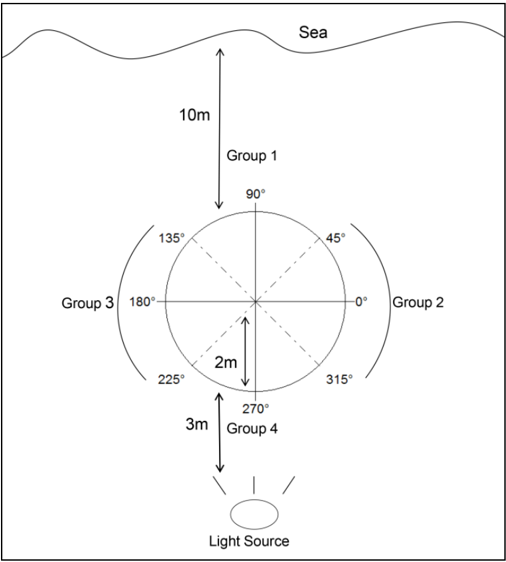
- Seven treatments were used: control (dark), orange, red, blue, green, yellow, and white. Conventional LED headlamps (28–35 lumens) were fixed 1 m above sand, 5 m from a 2-m-radius release circle, opposite the sea. Natural sky light was measured with a Sky Quality Meter; orientation angle, crawling duration (max 4 min), track pattern (straight “S” or wavy “W”), and exit groups 1–4 were recorded.
- Analyses used circular statistics (Oriana v4), Rayleigh tests, Watson-Williams F-tests, a General Linear Model, Bonferroni post-hoc tests, and χ² tests, with Statistica Release 10 and SPSS v20.0.
Limitations
- The paper does not include an explicit limitations section. It notes that small headlamps frequently used by conservationists and tourists were the light sources, so more intense lights such as those from buildings could likely cause stronger effects on hatchlings.
- Evident from the methods: experiments used hatchlings from clutches relocated to a fenced hatchery due to inundation risk, not natural in-situ nests; sample sizes per treatment vary, and moonlit comparisons in Table 2 often use n = 10 per color.
- Evident from the text and tables: treatment luminances differed (control 16.47 µcd/m²; color treatments 6.18–8.77 µcd/m²), and the paper notes red-light disorientation could result from higher brightness of that source compared to orange, though the reported treatment luminances are not fully consistent with that explanation.
Model-written summary. Check it against the paper before relying on it.
Integrity signals
Registry
Cites
Statistics
Figures
Verification
Claims the paper makes
0 Valid · 5 Not valid · 35 Not checked · 54 Own results and interpretations
A result the paper reports from its own data — it cites no other source for it, so there is none to check. The quote shows it is in the paper.
In the paper
“Orange and red lights caused a lower misorientation than other colors”
plainstates a cause- Asserted: passes — The authors put it forward as true.
- Checkable: passes — It can be checked against evidence.
- Load-bearing: passes — The paper’s conclusions depend on it.
- Based: passes — The paper gives a reason why it holds.
A result the paper reports from its own data — it cites no other source for it, so there is none to check. The quote shows it is in the paper.
In the paper
“The longest mean crawling duration occurred under red light (mean = 1.83 min, n = 41).”
plainn = 41- Asserted: passes — The authors put it forward as true.
- Checkable: passes — It can be checked against evidence.
- Load-bearing: unclear — It is unclear whether the paper’s conclusions depend on it.
- Based: passes — The paper gives a reason why it holds.
A result the paper reports from its own data — it cites no other source for it, so there is none to check. The quote shows it is in the paper.
In the paper
“In this case, the percentage of hatchlings that were within orientation group 2 were 41.4% and 46.5% for red and orange lights respectively (Table 1).”
plain- Asserted: passes — The authors put it forward as true.
- Checkable: passes — It can be checked against evidence.
- Load-bearing: unclear — It is unclear whether the paper’s conclusions depend on it.
- Based: passes — The paper gives a reason why it holds.
A result the paper reports from its own data — it cites no other source for it, so there is none to check. The quote shows it is in the paper.
In the paper
“interactions between track shape and orientation group ( F1,262= 5.2 , P = 0.006 )”
plainstates an association- Asserted: passes — The authors put it forward as true.
- Checkable: passes — It can be checked against evidence.
- Load-bearing: unclear — It is unclear whether the paper’s conclusions depend on it.
- Based: passes — The paper gives a reason why it holds.
A result the paper reports from its own data — it cites no other source for it, so there is none to check. The quote shows it is in the paper.
In the paper
“The frequency of wavy crawls was significantly higher under the red light (70.3%) than under the orange light (35%) ( X 2 = 9.58; gl = 1; p = 0.002; n = 87).”
plainstates an associationn = 87- Asserted: passes — The authors put it forward as true.
- Checkable: passes — It can be checked against evidence.
- Load-bearing: unclear — It is unclear whether the paper’s conclusions depend on it.
- Based: passes — The paper gives a reason why it holds.
43 more claims
Create a free account to see all 94 claims and to verify the 35 references still open.
- It may state two separate claims as one. 27
- Probably not a substantial claim. 29
Claims other papers make about this one
Each is checked against this paper’s own text: does it say what the citing paper says it does?
In the citing paper
“Our data, along with those of Salmon and Witherington (1995) and Rivas et al. (2015), suggest there is a tension between levels of natural and artificial light that, depending on their relative brightness, influences the degree to which misorientation occurs.”
From Brightness of the Night Sky Affects Loggerhead (Caretta caretta) Sea Turtle Hatchling Misorientation but Not Nest Site Selection (2020) · cites this paper as Rivas et al. (2015)
In the citing paper
“Studies have shown that the presence of moonlight can either mitigate or exacerbate the effects of artificial lighting, influencing hatchlings’ ability to orient themselves correctly [8,32].”
From Disorientation patterns of loggerhead sea turtle (Caretta caretta) hatchlings in Pinellas County, Florida, USA (2026) · cites this paper as [32]
In the citing paper
“Even filtered or amber LED lighting, although less attractive than white lights, can still disrupt orientation [31,32,38,39], which reinforces the need for shielding, placement, and enforcement to effectively protect hatchlings [39].”
From Disorientation patterns of loggerhead sea turtle (Caretta caretta) hatchlings in Pinellas County, Florida, USA (2026) · cites this paper as [32]
In the citing paper
“full moons are associated with reduced disorientation, while new moons tend to correlate with higher disorientation rates [8,16,32]”
From Disorientation patterns of loggerhead sea turtle (Caretta caretta) hatchlings in Pinellas County, Florida, USA (2026) · cites this paper as [32]
Statistics that don’t add up
Each reported p-value recomputed from its test statistic and degrees of freedom, each partial η² from its F, and each ratio, mean difference or B printed with a p checked against its own confidence interval.
Rated minor: it would not touch a result — a value no result rests on, a p-value that stays on the same side of the significance level, or a conflict that is clerical, resolved elsewhere in the paper, or outside its own findings.
In the paper
“Z = 1.96, p = 0.006”
Reported p = .006 · recomputed p = .050
Statistics recomputed
Every reported test result, recomputed from its test statistic and degrees of freedom. A result shows as not adding up only once an independent check has confirmed it.
- Doesn’t add upz = 1.96reported p = .006 · recomputed p = .050
“Z = 1.96, p = .006”
- Not confirmedz = 2.8reported p = .054 · recomputed p = .005
“Z = 2.8, p = .054”
- Not confirmedz = 0.42reported p = .66 · recomputed p = .674
“Z = 0.42, p = .66”
Self-check
Percentages, sums and reported differences re-computed from the paper’s own numbers.
Each contradiction between two passages listed here was confirmed by an independent check.
Rated major: it would touch a result — a value a result rests on, reported and recomputed p-values on opposite sides of the significance level, two passages that conflict with no sign which is right, or a cited work retracted before this paper was published.
In the paper
§ Hatchling orientation and interactions with natural beach lighting
“The orange light source emitted the lowest luminance value among colors tested.”
§ Hatchling orientation
“Luminances of light treatments used were: control (16.47 µcd/m 2 ), orange (8.77 µcd/m 2 ), red (8.45 µcd/m 2 ), blue (8.15 µcd/m 2 ), green (7.54 µcd/m 2 ), yellow (6.82 µcd/m 2 ), and white (6.18 µcd/m 2 ).”
Rated major: it would touch a result — a value a result rests on, reported and recomputed p-values on opposite sides of the significance level, two passages that conflict with no sign which is right, or a cited work retracted before this paper was published.
In the paper
§ Tables
“| Yellow | 0 | 0 | 1 | 4.2 | 4 | 16.6 | 0 | 0 | 19 | 79.2 |”
§ Tables
“| Control & Yellow | (32 & 24) | (17 & 10) | 139.8 | 0.18 | <0.001 | 0.67 | 1 | 54 | 25 | 22.03 | 73.52 |”
Rated minor: it would not touch a result — a value no result rests on, a p-value that stays on the same side of the significance level, or a conflict that is clerical, resolved elsewhere in the paper, or outside its own findings.
In the paper
“interactions between track shape and orientation group ( F1,262= 5.2 , P = 0.006 )”
Reported 1 · recomputed 3
Citations
Cites
Baltosser, W. H., & Zar, J. H. (1996) · Ecology · doi:10.2307/2265725 · Cited by 35,166
Endogenous rhythms of locomotion in the American horseshoe crab, Limulus polyphemus
Chabot, C. C., Betournay, S. H., Braley, N. R., & Watson, W. H. (2007) · Journal of Experimental Marine Biology and Ecology · doi:10.1016/j.jembe.2007.01.009 · Cited by 694
Hamann, M., Godfrey, M., Seminoff, J., Arthur, K., Barata, P., Bjorndal, K., Bolten, A., Broderick, A., Campbell, L., Carreras, C., et al. (2010) · Endangered Species Research · doi:10.3354/esr00279 · Cited by 641
The dark side of light: a transdisciplinary research agenda for light pollution policy
Hölker, F., Moss, T., Griefahn, B., Kloas, W., Voigt, C. C., Henckel, D., Hänel, A., Kappeler, P. M., Völker, S., Schwope, A., et al. (2010) · Ecology and Society · doi:10.5751/es-03685-150413 · Cited by 623
Global Conservation Priorities for Marine Turtles
Wallace, B. P., DiMatteo, A. D., Bolten, A. B., Chaloupka, M. Y., Hutchinson, B. J., Abreu-Grobois, F. A., Mortimer, J. A., Seminoff, J. A., Amorocho, D., Bjorndal, K. A., et al. (2011) · PLoS ONE · doi:10.1371/journal.pone.0024510 · Cited by 617
Schlacher, T. A., Dugan, J., Schoeman, D. S., Lastra, M., Jones, A., Scapini, F., McLachlan, A., & Defeo, O. (2007) · Diversity and Distributions · doi:10.1111/j.1472-4642.2007.00363.x · Cited by 420
Cloud Coverage Acts as an Amplifier for Ecological Light Pollution in Urban Ecosystems
Kyba, C. C. M., Ruhtz, T., Fischer, J., & Hölker, F. (2011) · PLoS ONE · doi:10.1371/journal.pone.0017307 · Cited by 333
The economics of global light pollution
Gallaway, T., Olsen, R. N., & Mitchell, D. M. (2010) · Ecological Economics · doi:10.1016/j.ecolecon.2009.10.003 · Cited by 218
Tuxbury, S. M., & Salmon, M. (2005) · Biological Conservation · doi:10.1016/j.biocon.2004.04.022 · Cited by 162
Lorne, J., & Salmon, M. (2007) · Endangered Species Research · doi:10.3354/esr003023 · Cited by 138
Coastal light pollution and marine turtles: assessing the magnitude of the problem
Kamrowski, R., Limpus, C., Moloney, J., & Hamann, M. (2012) · Endangered Species Research · doi:10.3354/esr00462 · Cited by 104
Witherington, B. E., & Bjorndal, K. A. (1991) · Biological Conservation · doi:10.1016/0006-3207(91)90053-c · Cited by 99
Salmon, M., & Wyneken, J. (1987) · Journal of Experimental Marine Biology and Ecology · doi:10.1016/0022-0981(87)90012-8 · Cited by 95
Temporal Pattern of Nocturnal Emergence of Loggerhead Turtle Hatchlings from Natural Nests
Witherington, B. E., Bjorndal, K. A., & McCabe, C. M. (1990) · Copeia · doi:10.2307/1446507 · Cited by 93
Thermal stress effect on tilapiaOreochromis mossambicus(Pisces: Cichlidae) blood parameters
del Río-Zaragoza, O. B., Rodríguez, M. H., & Ramírez, L. F. B. (2008) · Marine and Freshwater Behaviour and Physiology · doi:10.1080/10236240801896223 · Cited by 74
Environmental pollution and biodiversity: Light pollution and sea turtles in the Caribbean
Brei, M., Pérez‐Barahona, A., & Strobl, E. (2016) · Journal of Environmental Economics and Management · doi:10.1016/j.jeem.2016.02.003 · Cited by 74
Salmon, M., Wyneken, J., Fritz, E., & Lucas, M. (1992) · Behaviour · doi:10.1163/156853992x00309 · Cited by 74
Witherington, B. E., & Bjorndal, K. A. (1991) · Copeia · doi:10.2307/1446101 · Cited by 62
Artificial lighting and seafinding by loggerhead hatchlings: Evidence for lunar modulation.
Salmon, M., & Witherington, B. E. (1995) · Copeia · doi:10.2307/1447042 · Cited by 58
Bourgeois, S., Gilot-Fromont, E., Viallefont, A., Boussamba, F., & Deem, S. L. (2009) · Biological Conservation · doi:10.1016/j.biocon.2008.09.028 · Cited by 51
Predation of leatherback turtle hatchlings during the crawl to the water
Tomillo, P. S., Paladino, F. V., Suss, J. S., & Spotila, J. R. (2010) · Chelonian Conservation and Biology · doi:10.2744/ccb-0789.1 · Cited by 51
Disorientation of loggerhead hatchlings by artificial road lighting
McFarlane, R. W. (1963) · Copeia · doi:10.2307/1441283 · Cited by 49
Constantino, M. A., & Salmon, M. (2003) · Zoology · doi:10.1078/0944-2006-00114 · Cited by 46
Temporal changes in artificial light exposure of marine turtle nesting areas
Kamrowski, R. L., Limpus, C., Jones, R., Anderson, S., & Hamann, M. (2014) · Global Change Biology · doi:10.1111/gcb.12503 · Cited by 44
Ocean-finding in marine turtles: The importance of low horizon elevation as an orientation cue
Limpus, C., & Kamrowski, R. L. (2013) · Behaviour · doi:10.1163/1568539x-00003083 · Cited by 39
Mrosovsky, N., & Carr, A. (1967) · Behaviour · doi:10.1163/156853967x00019 · Cited by 38
Photopic spectral sensitivity of green and loggerhead sea turtles
Levenson, D. H., Eckert, S. A., Crognale, M. A., Deegan, J. F., & Jacobs, G. H. (2004) · Copeia · doi:10.1643/cp-03-217r1 · Cited by 35
Horch, K. W., Gocke, J. P., Salmon, M., & Forward, R. B. (2008) · Marine and Freshwater Behaviour and Physiology · doi:10.1080/10236240802106556 · Cited by 30
Karnad, D., Isvaran, K., Kar, C. S., & Shanker, K. (2009) · Biological Conservation · doi:10.1016/j.biocon.2009.04.004 · Cited by 28
The water-finding ability of sea turtles
Mrosovsky, N. (2008) · Brain, Behavior and Evolution · doi:10.1159/000123748 · Cited by 26
Orientation of hatchling loggerhead turtles at sea off artificially lighted and dark beaches
Witherington, B. E. (1991) · Journal of Experimental Marine Biology and Ecology · doi:10.1016/0022-0981(91)90113-b · Cited by 25
Rivas, M. L., Fernández, C., & Marco, A. (2015) · Oryx · doi:10.1017/s0030605314000775 · Cited by 25
Self-citationAustralian loggerhead sea turtle hatchlings do not avoid yellow
Fritsches, K. A. (2012) · Marine and Freshwater Behaviour and Physiology · doi:10.1080/10236244.2012.690576 · Cited by 24
Visual Wavelength Discrimination by the Loggerhead Turtle, Caretta caretta
Young, M., Salmon, M., & Forward, R. (2012) · The Biological Bulletin · doi:10.1086/bblv222n1p46 · Cited by 19
Disorientation of Hawksbill Turtle Hatchlings, Eretmochelys imbricata, by Stadium Lights
Philibosian, R. (1976) · Copeia · doi:10.2307/1443476 · Cited by 18
On the orientation circle of the leatherback turtle, Dermochelys coriacea
Mrosovsky, N., & Shettleworth, S. J. (1975) · Animal Behaviour · doi:10.1016/0003-3472(75)90134-7 · Cited by 17
The influence of the sun's position and elevated cues on the orientation of hatchling sea turtles
Mrosovsky, N. (1970) · Animal Behaviour · doi:10.1016/0003-3472(70)90008-4 · Cited by 14
Visual Acuity of Juvenile Loggerhead Sea Turtles ( Caretta caretta ): A Behavioral Approach
Moein Bartol, S., Mellgren, R. L., & Musick, J. A. (2003) · International Journal of Comparative Psychology · doi:10.46867/c4t601 · Cited by 2
The dark side of light. Light pollution kills leatherback turtle hatchlings
Zheleva, M. (2012) · Biodiscovery · doi:10.7750/biodiscovery.2012.3.4 · Cited by 1
(1985) · PubMed
Witherington, B. E., & Martin, R. E. (2014) · Florida Fish and Wildlife Conservation Commission · doi:10.6095/h6pq-3k22
(1992) · Herpetologica
(1986) · STARS (University of Central Florida)
(2005) · Murdoch University Research Portal
Research works printed but not linked: 4
- Carr, A. and Ogren, L. 1960. The ecology and migration of sea turtles IV. Bull. Am. Mus. nat. His. 121, 4-48.
- Eckert, K. and Horrocks, J.A. 2002. Sea turtles and beachfront lighting in Barbados. In: Eckert, K.L., Horrocks, J.A. (Eds.), Proceedings of 'Sea Turtles and Beachfront Lighting: An interactive Workshop for Industry Professionals and Policy-Makers in Barbados, WIDECAST Technical Report 1, pp. 5-8.
- Rivas, M.L.,Fernández, C. and Marco, A. 2014. Nesting ecology and conservation of leatherback turtle, Dermochelys coriacea, at Pacuare Nature Reserva, Costa Rica. Oryx, 1-9.
- Salmon, M. 2003. Artificial night lighting and sea turtles. Biologist, 50, 163-168.
Cited by
Why artificial light at night should be a focus for global change research in the 21st century
Davies, T. W., & Smyth, T. (2018) · Global Change Biology · doi:10.1111/gcb.13927 · Cited by 396
Are we working towards global research priorities for management and conservation of sea turtles?
Rees, A., Alfaro-Shigueto, J., Barata, P., Bjorndal, K., Bolten, A., Bourjea, J., Broderick, A., Campbell, L., Cardona, L., Carreras, C., et al. (2016) · Endangered Species Research · doi:10.3354/esr00801 · Cited by 272
Impacts of artificial light at night in marine ecosystems—A review
Marangoni, L. F. B., Davies, T., Smyth, T., Rodríguez, A., Hamann, M., Duarte, C., Pendoley, K., Berge, J., Maggi, E., & Levy, O. (2022) · Global Change Biology · doi:10.1111/gcb.16264 · Cited by 203
“However, despite growing concerns on the impacts of ALAN, studies evaluating its effects on sandy beach organisms, other than sea turtles (e.g., Rivas et al., 2015; Dimitriadis et al., 2018, see specific section 2.5. for this group), remain very scarce (e.g., Lynn, Flynn, et al., 2021;…”
InfluentialDavies, T. W., Bennie, J., Cruse, D., Blumgart, D., Inger, R., & Gaston, K. J. (2017) · Global Change Biology · doi:10.1111/gcb.13615 · Cited by 108
Biologically important artificial light at night on the seafloor
Davies, T. W., McKee, D., Fishwick, J., Tidau, S., & Smyth, T. (2020) · Scientific Reports · doi:10.1038/s41598-020-69461-6 · Cited by 91
Metadata
- Authors
- Rivas, M. L., Santidrián Tomillo, P., Diéguez Uribeondo, J., & Marco, A.
- Affiliations
- Endangered Wildlife Trust (ZA)
- Estación Biológica de Doñana (ES)
- Corresponding author
- Rivas, Marga L.
- Venue
- Journal of Experimental Marine Biology and Ecology
- Publisher
- Elsevier BV
- Published
- 2015-02
- Volume
- 463
- Pages
- 143-149
- ISSN
- 0022-0981 (ISSN-L)
- OpenAlex
- W2090051637
- Semantic Scholar
- b79b92cdabf381118725980f2ca49a1614a0df23
- Cited by
- 51
- References
- 48
- Citations by year
- 2026: 7 · 2025: 5 · 2024: 1 · 2023: 7 · 2022: 4 · 2021: 3 · 2020: 7 · 2019: 1 · 2018: 5 · 2017: 6 · 2016: 4 · 2015: 1
- FWCI
- 1.98
- Type
- journal article
- Language
- en
- Open access
- closed
- Licence
- www.elsevier.com/tdm/userlicense/1.0/ (tdm)
- Locations
- Journal of Experimental Marine Biology and Ecology (publishedVersion)
- DIGITAL.CSIC (Spanish National Research Council (CSIC)) (submittedVersion)
- Funders
- Ministry of Environment
- Topics
- Physical Sciences › Environmental Science › Nature and Landscape Conservation › Turtle Biology and Conservation
- Physical Sciences › Environmental Science › Global and Planetary Change › Impact of Light on Environment and Health
- Physical Sciences › Environmental Science › Pollution › Microplastics and Plastic Pollution
- Keywords
- Dermochelys coriacea, hatchling orientation, light pollution, light wavelength effects, moonlight, phototaxis, misorientation, disorientation, crawling behavior, nesting beaches, endangered sea turtles
About these checks
Registry, retraction, Cites and statistics results are computed, not judged, with one exception: a printed reference that no index lists is read once by a model before it counts as a citation error. Claims are extracted by a model and kept only when their quote appears verbatim in the text; each cited source is then checked, with a model’s help, for whether it says what the claim relies on. Those verdicts can be wrong — read the claim’s quote and the cited source before relying on one.
A language model drew the claims from the paper on 2026-11-24, under version 3 of the claim definition (model deepseek-v4.1-flash, prompt extract-v3).
A second model labelled each claim on 2026-11-24 (model jev-1.13-20260917, definition revision gold-guideline-v0.2).
Statistics and arithmetic are recomputed, not judged.
Confidence bands are shown only for fields calibrated on our annotated test set. None is calibrated yet, so no band is shown.
What counts as a claim ›How we measure confidence ›How we check this ›
Are you an author, or do you see a problem with this page? Request a review
Data sources
Bibliographic data: Semantic Scholar, OpenAlex, Crossref.
Contains information from the Semantic Scholar Academic Graph Datasets, made available under the ODC Attribution License (ODC-BY 1.0).
Semantic Scholar’s data is described in: Kinney, R., et al. (2023). The Semantic Scholar Open Data Platform. arXiv:2301.10140.
