

The DOI matches its Crossref record; 53 of the 53 references it cites were found in a registry or an index.
Analysis of the livelihood and health of internally displaced persons due to riverbank erosion in Bangladesh
Open accessAbstract
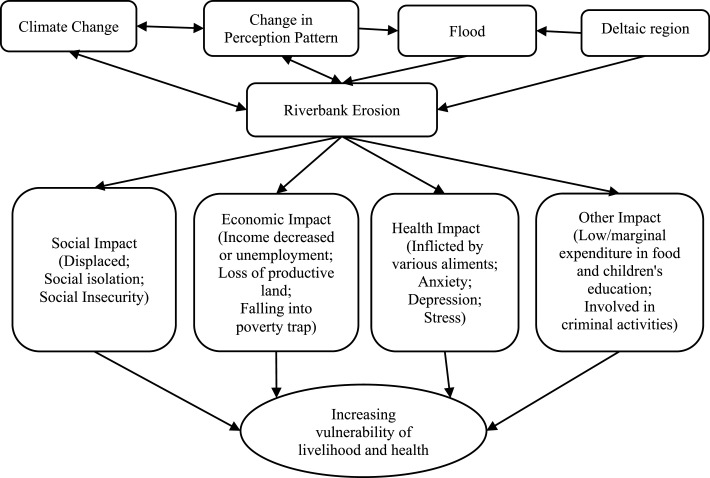
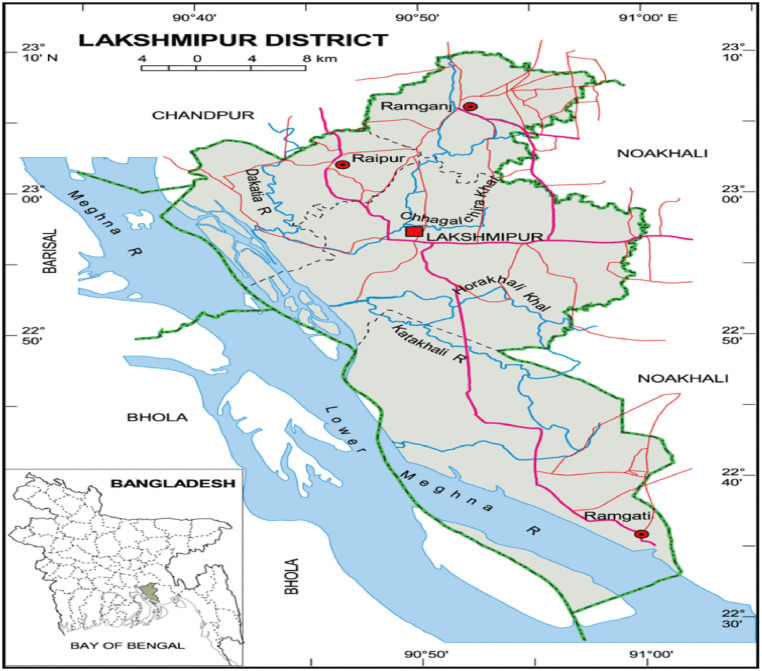
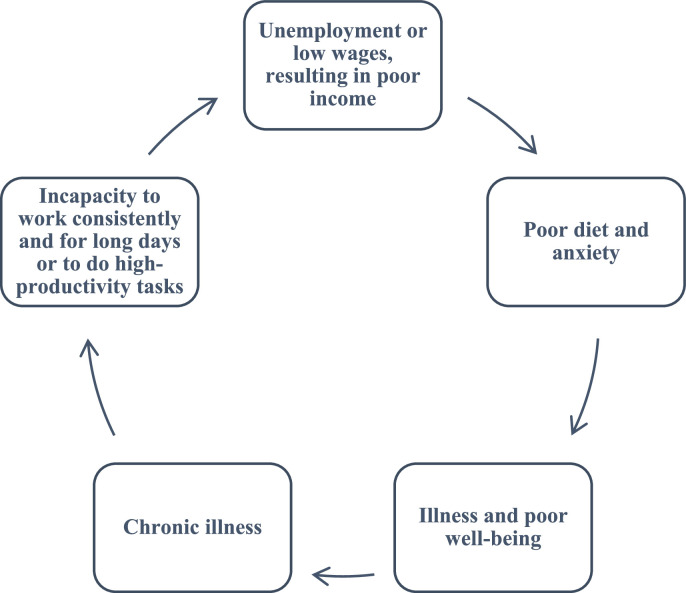
Bangladesh is particularly vulnerable to natural calamities such as flooding, cyclones, droughts, and severe riverbank erosion as a deltaic country. Riverbank erosion brings about terrible consequences such as loss of land, human displacement, social isolation, and physical and mental well-being problems. The study used a mixed-method research approach and a multi-method data collection procedure to analyse the impact of riverbank erosion on livelihood and health. Households of Internally Displaced Persons (IDPs) due to riverbank erosion in Bangladesh's Lakshmipur district were surveyed using a structured questionnaire and an unstructured interview schedule to collect quantitative and qualitative data. Thematic content analysis, and descriptive statistics were applied to identify how riverbank erosion is inextricably linked to the IDPs' socio-economic conditions and well-being vulnerability. The findings show that riverbank erosion is responsible for the IDPs' livelihood uncertainty and substantial health concerns. Uncertainty about livelihood gives rise to socio-economic instability, poverty, diseases, and medical expenses. On top of that, the displaced people faced several difficulties, including no land ownership, living in substandard housing, no access to power, use of unhygienic toilets, social isolation, and anxiety. The research also finds inadequate government or non-governmental master plans for IDPs to overcome miserable conditions. The study results will help policymakers in Bangladesh and elsewhere to better understand the needs of vulnerable riverine communities and to design and implement policies and programmes to improve those communities' capacity to withstand shocks and recover quickly.
Overview
The claims and statistics of this paper haven’t been checked yet.
Run the check — free, no account needed. It reads the open-access text and checks the sources it cites.
Integrity signals
Registry
Cites
Statistics
Figures
Verification
Claims the paper makes
The claims and statistics of this paper haven’t been checked yet.
Run the check — free, no account needed. It reads the open-access text and checks the sources it cites.
Claims other papers make about this one
Each is checked against this paper’s own text: does it say what the citing paper says it does?
The cited source says what the claim attributes to it.
In the citing paper
“Recurring floods and erosion interrupt stable housing, healthcare, and economic opportunities”
From Health and Socio-Economic Impacts of Climate-Related Displacement in Bangladesh’s Chars: Causal Evidence From a Household Survey (2026) · cites this paper as [8]
Self-check
Percentages, sums and reported differences re-computed from the paper’s own numbers.
The self-check needs the paper’s full text.
Citations
Cites
Using thematic analysis in psychology
Braun, V., & Clarke, V. (2006) · Qualitative Research in Psychology · doi:10.1191/1478088706qp063oa · Cited by 194,414
A General Inductive Approach for Analyzing Qualitative Evaluation Data
Thomas, D. R. (2006) · American Journal of Evaluation · doi:10.1177/1098214005283748 · Cited by 10,858
Using Mixed-Methods Sequential Explanatory Design: From Theory to Practice
Ivankova, N. V., Creswell, J. W., & Stick, S. L. (2006) · Field Methods · doi:10.1177/1525822x05282260 · Cited by 3,167
How climate change affects extreme weather events
Stott, P. A. (2016) · Science · doi:10.1126/science.aaf7271 · Cited by 953
Environmental refugees: a growing phenomenon of the 21st century.
Myers, N. (2002) · Philosophical Transactions of the Royal Society of London. Series B, Biological Sciences · doi:10.1098/rstb.2001.0953 · Cited by 893 · cited 1×
“Since the 1980s, some researchers have argued that environmental migration may result in mass relocation, resulting in conflict, socio-economic vulnerability, and the resolution of problems (Boas, 2014; Myers, 2002; Petrova, 2021).”
BackgroundModeling recent climate change induced extreme events in Bangladesh: A review
Dastagir, M. R. (2015) · Weather and Climate Extremes · doi:10.1016/j.wace.2014.10.003 · Cited by 221
Climate change and migration: a case study from rural Bangladesh
Kartiki, K. (2011) · Gender & Development · doi:10.1080/13552074.2011.554017 · Cited by 221
Climate change and internal migration patterns in Bangladesh: an agent-based model
Hassani‐Mahmooei, B., & Parris, B. (2012) · Environment and Development Economics · doi:10.1017/s1355770x12000290 · Cited by 169
Assessing Agricultural Livelihood Vulnerability to Climate Change in Coastal Bangladesh
Hoque, M. Z., Cui, S., Xu, L., Islam, I., Tang, J., & Ding, S. (2019) · International Journal of Environmental Research and Public Health · doi:10.3390/ijerph16224552 · Cited by 158
Millock, K. E. (2015) · Annual Review of Resource Economics · doi:10.1146/annurev-resource-100814-125031 · Cited by 150
Research works printed but not linked: 1
- Claude, 2020, Mapping landslide susceptibility and analysing its impact on community livelihoods in Gakenke District, Northern Rwanda, J. Geosci. Environ. Prot., 8, 41
Cited by
Smart governance for smart cities and nations
Kaiser, Z. R. M. A. (2024) · Journal of Economy and Technology · doi:10.1016/j.ject.2024.07.003 · Cited by 180
Sustainable smart city and Sustainable Development Goals (SDGs): A review
Kaiser, Z. R. M. A., & Deb, A. (2025) · Regional Sustainability · doi:10.1016/j.regsus.2025.100193 · Cited by 81
From risk to resilience and sustainability: Addressing urban flash floods and waterlogging
Kaiser, Z. R. M. A., & Akter, F. (2025) · Risk sciences. · doi:10.1016/j.risk.2025.100011 · Cited by 41
Mruksirisuk, P., Thanvisitthpon, N. T., Pholkern, K., Garshasbi, D., & Saguansap, P. (2023) · Journal of Environmental Management · doi:10.1016/j.jenvman.2023.119276 · Cited by 39
Kaiser, Z. R. M. A. (2023) · Sustainable Development · doi:10.1002/sd.2571 · Cited by 39
Metadata
- Authors
- Kaiser, Z. R. M. A.
- Affiliations
- University of Chittagong (BD)
- Corresponding author
- Kaiser, Z. R. M. Abdullah
- Venue
- Journal of Migration and Health
- Publisher
- Elsevier BV
- Published
- 2023
- Volume
- 7
- Pages
- 100157
- ISSN
- 2666-6235 (ISSN-L)
- PMC
- PMC9932462
- OpenAlex
- W4318473231
- Cited by
- 63
- References
- 53
- Citations by year
- 2026: 14 · 2025: 24 · 2024: 15 · 2023: 10
- FWCI
- 27.06
- Type
- journal article
- Language
- en
- Open access
- gold
- doi.org
- Licence
- Locations
- Journal of Migration and Health (publishedVersion, cc-by-nc-nd)
- PubMed Central (publishedVersion, cc-by-nc-nd)
- PubMed (publishedVersion)
- DOAJ (DOAJ: Directory of Open Access Journals) (submittedVersion, cc-by-sa)
- Topics
- Social Sciences › Sociology and Political Science › Climate Change, Adaptation, Migration
- Social Sciences › Sociology and Political Science › Hydropower, Displacement, Environmental Impact
- Social Sciences › Sociology and Political Science › Disaster Management and Resilience
- Keywords
- internally displaced persons, bank erosion, socioeconomic vulnerability, poverty, mental health, social isolation, substandard housing, access to basic services, disaster recovery, riverine communities, Bangladesh
About these checks
Registry, retraction, Cites and statistics results are computed, not judged, with one exception: a printed reference that no index lists is read once by a model before it counts as a citation error. Claims are extracted by a model and kept only when their quote appears verbatim in the text; each cited source is then checked, with a model’s help, for whether it says what the claim relies on. Those verdicts can be wrong — read the claim’s quote and the cited source before relying on one.
Statistics and arithmetic are recomputed, not judged.
Confidence bands are shown only for fields calibrated on our annotated test set. None is calibrated yet, so no band is shown.
What counts as a claim ›How we measure confidence ›How we check this ›
Are you an author, or do you see a problem with this page? Request a review
How to cite
Cite CoChat for the checks on this page, and the paper for its own findings.
- This page
- CoChat. (2026). Citation check: Analysis of the livelihood and health of internally displaced persons due to riverbank erosion in Bangladesh. https://app.cochat.ai/papers/10.1016/j.jmh.2023.100157
- The paper
- Kaiser, Z. R. M. A. (2023). Analysis of the livelihood and health of internally displaced persons due to riverbank erosion in Bangladesh. Journal of Migration and Health. https://doi.org/10.1016/j.jmh.2023.100157
Data sources
Bibliographic data: Semantic Scholar, OpenAlex, Crossref.
Contains information from the Semantic Scholar Academic Graph Datasets, made available under the ODC Attribution License (ODC-BY 1.0).
Semantic Scholar’s data is described in: Kinney, R., et al. (2023). The Semantic Scholar Open Data Platform. arXiv:2301.10140.
