

The DOI matches its Crossref record; 65 of the 65 references it cites were found in a registry or an index.
Cephalometry as an aid in the diagnosis of pediatric obstructive sleep apnoea: A systematic review and meta-analysis
Open accessAbstract
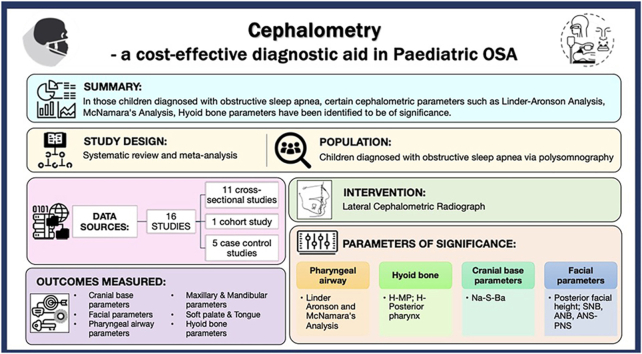
Background: Obstructive sleep apnoea (OSA) is part of a spectrum of sleep disorders causing snoring, gasping, and choking while sleeping. In children, OSA can also lead to behavioural issues, hyperactivity, and poor academic performance. Thus, early identification and management of OSA in children is crucial in preventing long-term health problems. The gold standard test for diagnosis is an overnight in-lab polysomnography (PSG). However, due to certain constraints associated with PSG, such as lack of accessibility, high expenses incurred, as well as the need for hospitalization, alternative diagnostic tools are needed. Cephalometry is a non-invasive, affordable diagnostic tool that may offer useful information in the evaluation of OSA. The present systematic review and meta-analysis aimed to evaluate the various cephalometric parameters associated with the diagnosis of OSA in children. Methods: A structured literature search was performed using the search engines PubMed, Scopus, Web of Science, Cochrane, and Google scholar from inception till July 2022. The weighted mean difference (z-test) was calculated using a random effects method (REM). Results: 16 studies were included in the review and meta-analysis was executed for each cephalometric parameter. The parameters of significance (p < 0.05) in Pediatric OSA with lower heterogeneity were associated with McNamara's and Linder-Aronson's analysis, the hyoid bone position, a retrognathic mandible, and an acute cranial base angle. Conclusions: Certain parameters in craniofacial morphology may be reliable diagnostic parameters. Further long-term studies are needed in order to shed more light in this area.
Overview
The claims and statistics of this paper haven’t been checked yet.
Run the check — free, no account needed. It reads the open-access text and checks the sources it cites.
Integrity signals
Registry
Cites
Statistics
Figures
Verification
Claims the paper makes
The claims and statistics of this paper haven’t been checked yet.
Run the check — free, no account needed. It reads the open-access text and checks the sources it cites.
Claims other papers make about this one
Each is checked against this paper’s own text: does it say what the citing paper says it does?
The cited source says what the claim attributes to it.
In the citing paper
“Consistent with recent evidence, specific cephalometric parameters — including mandibular retrognathia, hyoid bone position, and cranial base angle — show statistically significant associations with pediatric OSA; however, lateral cephalometry cannot reliably serve as a standalone diagnostic tool for sleep-disordered breathing in children [50].”
From Long-Term Changes Following Orthopedic Mandibular Advancement Therapy in Pediatric Obstructive Sleep Apnea: a 7-Year Follow-up Study (2026) · cites this paper as [50]
Self-check
Percentages, sums and reported differences re-computed from the paper’s own numbers.
The self-check needs the paper’s full text.
Citations
Cites
Downs, S. H., & Black, N. (1998) · Journal of Epidemiology and Community Health · doi:10.1136/jech.52.6.377 · Cited by 8,252
Diagnosis and Management of Obstructive Sleep Apnea: A Review
Gottlieb, D. J., & Punjabi, N. M. (2020) · JAMA · doi:10.1001/jama.2020.3514 · Cited by 1,482 · cited 1×
“7,8 Cephalometry is a diagnostic instrument that uses X-rays to provide data on the dimension and location of upper airway structures, which can aid in the diagnosis and classification of the severity of OSA.”
MethodEpidemiology of Pediatric Obstructive Sleep Apnea
Lumeng, J. C., & Chervin, R. D. (2008) · Proceedings of the American Thoracic Society · doi:10.1513/pats.200708-135mg · Cited by 1,427
Malhotra, A., & White, D. P. (2002) · The Lancet · doi:10.1016/s0140-6736(02)09464-3 · Cited by 1,260
A method of cephalometric evaluation
McNamara, J. A. (1984) · American Journal of Orthodontics · doi:10.1016/s0002-9416(84)90352-x · Cited by 1,112
Peterson’s Principles of Oral and Maxillofacial Surgery
(2022) · Springer eBooks · doi:10.1007/978-3-030-91920-7 · Cited by 911
Principles and Practice of Sleep Medicine
Kryger, M. H., Roth, T. G., & Dement, W. C. (2016) · Elsevier eBooks · doi:10.1016/c2012-0-03543-0 · Cited by 785
Pediatric Obstructive Sleep Apnea: Complications, Management, and Long-term Outcomes
Capdevila, Ó. S., Gozal, D., Dayyat, E. A., & Gozal, D. (2008) · Proceedings of the American Thoracic Society · doi:10.1513/pats.200708-138mg · Cited by 445
Natural head position, a basic consideration in the interpretation of cephalometric radiographs
Moorrees, C. F. A., & Kean, M. R. (1958) · American Journal of Physical Anthropology · doi:10.1002/ajpa.1330160206 · Cited by 433
Neelapu, B. C., Kharbanda, O. P., Sardana, H. K., Balachandran, R., Sardana, V., Kapoor, P., Gupta, A., & Vasamsetti, S. (2017) · Sleep Medicine Reviews · doi:10.1016/j.smrv.2016.01.007 · Cited by 429
Cited by
Sorted by citations
Su, Y., Wang, Z., Chang, H., Zhu, S., Zhou, Y., Cao, Z., Ma, L., Yuan, Y., Xie, Y., Niu, X., et al. (2024) · Nature and Science of Sleep · doi:10.2147/nss.s492714 · Cited by 14
Papageorgiou, S. N., Zyli, M., & Papadopoulou, A. K. (2025) · European Journal of Orthodontics · doi:10.1093/ejo/cjaf012 · Cited by 10
Aydil, S. K., Kiyan, E., Ersu, R., Kilicoglu, H., Sayar, G., & Capan, E. (2026) · Clinical Oral Investigations · doi:10.1007/s00784-026-06926-4 · Cited by 2
Liu, A., Lu, Q., Huang, X., Li, H., Hou, Z., Lin, W., Huang, T., Cui, Y., Wu, T., Xiao, Y., et al. (2026) · Nature and Science of Sleep · doi:10.2147/nss.s574045 · Cited by 2
Schmid, J. Q., Stamm, T., Middelberg, C., Wiechens, B., Hohoff, A., & Kanemeier, M. (2025) · Clinical Oral Investigations · doi:10.1007/s00784-025-06529-5 · Cited by 1
Metadata
- Authors
- S, S., Shetty, V., Priya, K., Saha, S., Jaswanth, J., & Sethi, S.
- Affiliations
- Nitte University (IN)
- The University of Adelaide (AU)
- Corresponding author
- Shetty, Vabitha
- Venue
- Journal of Oral Biology and Craniofacial Research
- Publisher
- Elsevier BV
- Published
- 2024-09
- Volume
- 14
- Issue
- 5
- Pages
- 512-521
- ISSN
- 2212-4268 (ISSN-L)
- PMC
- PMC11268354
- OpenAlex
- W4400266738
- Cited by
- 9
- References
- 65
- Citations by year
- 2026: 6 · 2025: 2 · 2024: 1
- FWCI
- 0.51
- Type
- journal article
- Language
- en
- Open access
- gold
- doi.org
- Licence
- Locations
- Journal of Oral Biology and Craniofacial Research (publishedVersion, cc-by-nc-nd)
- PubMed Central (publishedVersion, cc-by-nc-nd)
- PubMed (publishedVersion)
- DOAJ (DOAJ: Directory of Open Access Journals) (submittedVersion)
- Topics
- Health Sciences › Medicine › Physiology (medical) › Obstructive Sleep Apnea Research
- Health Sciences › Dentistry › Orthodontics › Orthodontics and Dentofacial Orthopedics
- Health Sciences › Dentistry › Oral Surgery › Temporomandibular Joint Disorders
- Keywords
- cephalometric analysis, craniofacial morphology, diagnostic parameters, McNamara analysis, hyoid bone position, retrognathic mandible
About these checks
Registry, retraction, Cites and statistics results are computed, not judged, with one exception: a printed reference that no index lists is read once by a model before it counts as a citation error. Claims are extracted by a model and kept only when their quote appears verbatim in the text; each cited source is then checked, with a model’s help, for whether it says what the claim relies on. Those verdicts can be wrong — read the claim’s quote and the cited source before relying on one.
Statistics and arithmetic are recomputed, not judged.
Confidence bands are shown only for fields calibrated on our annotated test set. None is calibrated yet, so no band is shown.
What counts as a claim ›How we measure confidence ›How we check this ›
Are you an author, or do you see a problem with this page? Request a review
