

WISDOM: An AI-powered framework for emerging research detection using weak signal analysis and advanced topic modelling
Open accessThe DOI matches its Crossref record; 61 of the 61 references it cites were found in a registry or an index; none of the 65 sources its claims cite is checked for support yet.
Abstract
The landscape of science and technology is characterized by its dynamic and evolving nature, constantly reshaped by new discoveries, innovations, and paradigm shifts. Moreover, science is undergoing a remarkable shift towards increasing interdisciplinary collaboration, where the convergence of diverse fields fosters innovative solutions to complex problems. Detecting emerging scientific topics is paramount as it enables industries, policymakers, and innovators to adapt their strategies, investments, and regulations proactively. As the common approach for detecting emerging technologies, despite being useful, bibliometric analyses may suffer from oversimplification and/or misinterpretation of complex interdisciplinary trends. In addition, relying solely on domain experts to pinpoint emerging technologies from science and technology trends might restrict the ability to systematically analyze extensive information and introduce subjective judgments into the interpretations. To overcome these drawbacks, in this work, we present an automated artificial intelligence-enabled framework, called WISDOM, for detecting emerging research themes using advanced topic modeling and weak signal analysis. The proposed approach can assist strategic planners and domain experts in more effectively recognizing and tracking trends related to emerging topics by swiftly processing and analyzing vast volumes of data, uncovering hidden cross-disciplinary patterns, and offering unbiased insights, thereby enhancing the efficiency and objectivity of the detection process. As the case technology, we assess WISDOM's performance in identifying emerging research as well as their trends, in the field of underwater sensing technologies using scientific papers published between 2004 and 2021.
Overview
CoChat Summary
TL;DR
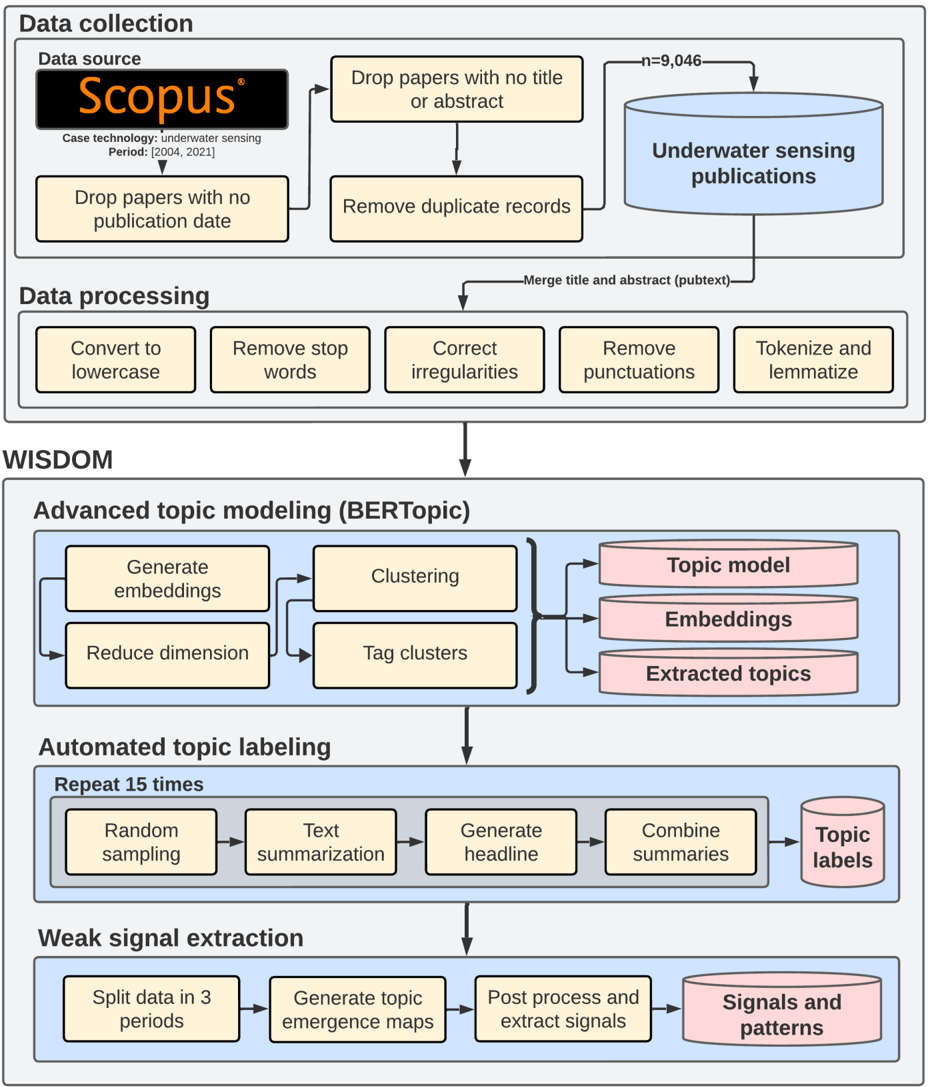
WISDOM is an AI framework combining BERTopic topic modeling, automated T5-based topic labeling, and weak-signal analysis to detect emerging research themes. In an underwater sensing case study using 9,046 Scopus publications from 2004–2021, it extracted 73 topics and classified 18 as weak signals and 5 as strong signals across three six-year periods.
Key findings
- BERTopic extracted 73 distinct topics from 9,046 underwater sensing publications; Topic65 (“submarine image enhancement and color correction”) had the highest document count, while Topics34, 55, and 63 had the lowest.
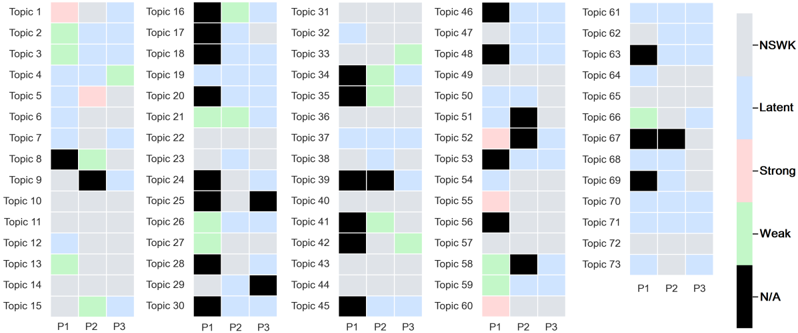
- Across P1 [2004–2009], P2 [2010–2015], and P3 [2016–2021], 18 topics appeared as weak signals in at least one period; only Topic21 (“underwater imaging”) was a weak signal in two consecutive periods (P1 and P2). None of the weak-signal topics transitioned into strong signals in subsequent periods.
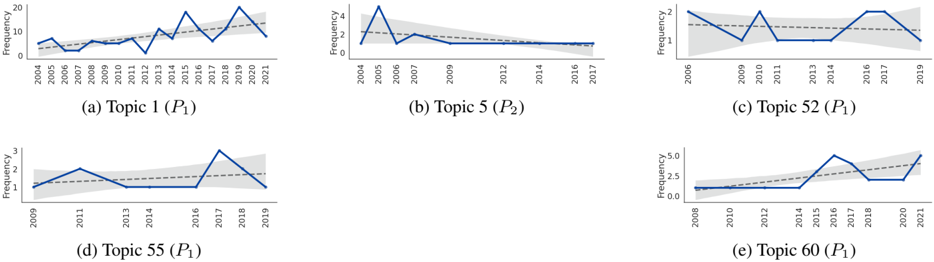
- Five topics—Topics1, 5, 52, 55, and 60—emerged as strong signals in at least one period, all in P1 except Topic5 in P2. Topics1, 55, and 60 showed upward trends; Topic60 was projected to grow, while Topic5 and 52 declined.
- Eighteen topics had consistent signal patterns across all periods; five (Topics19, 37, 61, 70, and 71) were latent signals from P1 to P3, and thirteen were NSWK signals throughout. Topic25 appeared only in P2; Topics39 and 67 appeared only in P3.
Methods
- Data: Scopus publications on underwater sensing from 2004–2021, collected on September 14, 2022; the dataset contained 9,046 publications. Publications lacking a title or abstract were excluded, and only English-language papers were considered. Title and abstract were merged into a `pubtext` feature; preprocessing included lowercasing, stop-word removal, special-character and punctuation handling, tokenization, and lemmatization.
- Topic modeling: BERTopic with SBERT embeddings, UMAP dimensionality reduction, HDBSCAN clustering, and c-TF-IDF; n-gram range was (1,2); the model was initially set to 100 topics and extracted 73. Automated labeling selected random papers per topic, applied T5 summarization and a T5-based headline generator, repeated the process fifteen times per topic, then reviewed the labels.
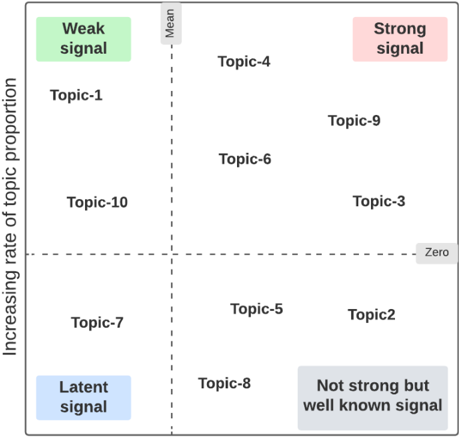
- Weak-signal analysis: topic proportions from BERTopic were used to build Topic Emergence Maps (TEMs) for three six-year intervals; quadrants classified strong, weak, latent, and not-strong-but-well-known (NSWK) signals. Temporal evolution curves included trend lines and 95% confidence intervals, and time-specific keywords were reported for recent peaks.
Limitations
- Stated: the approach was tested only on scientific publications; not all emerging technologies are immediately documented in publications, and confidential or proprietary innovations cannot be captured. Definitions of emerging technology vary, not all papers are of equal quality, and only English papers were considered; future work could use other sources, focus on high-impact research, include other languages, and monitor weak signals as they evolve.
- Stated: the method relies on a domain-expert-crafted search query (available upon request) and on title/abstract metadata because full texts were not accessible.
- Evident: the evaluation is a single-domain case study (underwater sensing) with no external ground-truth validation reported; automated labels were reviewed, but the paper does not quantify labeling accuracy or compare WISDOM against alternative detection methods.
Model-written summary. Check it against the paper before relying on it.
Integrity signals
Registry
Cites
Statistics
Figures



Verification
Claims the paper makes
0 Valid · 7 Not valid · 50 Not checked · 78 Own results and interpretations
A result the paper reports from its own data — it cites no other source for it, so there is none to check. The quote shows it is in the paper.
In the paper
“the collected dataset contained 9,046 publications”
§ WISDOM: AN AI-POWERED FRAMEWORK FOR EMERGING RESEARCH DETECTION USING WEAK SIGNAL ANALYSIS AND ADVANCED TOPIC MODELING > 3.1 Data
plain- Asserted: passes — The authors put it forward as true.
- Checkable: passes — It can be checked against evidence.
- Load-bearing: unclear — It is unclear whether the paper’s conclusions depend on it.
- Based: passes — The paper gives a reason why it holds.
A result the paper reports from its own data — it cites no other source for it, so there is none to check. The quote shows it is in the paper.
In the paper
“The remaining thirteen topics, i.e., Topic10, 11, 14, 22, 31, 36, 40, 43, 44, 49, 57, 65, and 72, were classified as NSWK signals throughout the entire period”
§ WISDOM: AN AI-POWERED FRAMEWORK FOR EMERGING RESEARCH DETECTION USING WEAK SIGNAL ANALYSIS AND ADVANCED TOPIC MODELING > 4.1 Topics
plain- Asserted: passes — The authors put it forward as true.
- Checkable: passes — It can be checked against evidence.
- Load-bearing: unclear — It is unclear whether the paper’s conclusions depend on it.
- Based: passes — The paper gives a reason why it holds.
A result the paper reports from its own data — it cites no other source for it, so there is none to check. The quote shows it is in the paper.
In the paper
“Eighteen topics-Topics2, 3, 4, 8, 13, 15, 16, 21, 26, 27, 33, 34, 35, 41, 42, 58, 59, and 66-appeared as weak signals in at least one of the three examined periods”
§ WISDOM: AN AI-POWERED FRAMEWORK FOR EMERGING RESEARCH DETECTION USING WEAK SIGNAL ANALYSIS AND ADVANCED TOPIC MODELING > 4.2.1 Weak Signals
plain- Asserted: passes — The authors put it forward as true.
- Checkable: passes — It can be checked against evidence.
- Load-bearing: unclear — It is unclear whether the paper’s conclusions depend on it.
- Based: passes — The paper gives a reason why it holds.
A result the paper reports from its own data — it cites no other source for it, so there is none to check. The quote shows it is in the paper.
In the paper
“five topics-Topics19, 37, 61, 70, and 71-were identified as latent signals from P 1 to P 3”
§ WISDOM: AN AI-POWERED FRAMEWORK FOR EMERGING RESEARCH DETECTION USING WEAK SIGNAL ANALYSIS AND ADVANCED TOPIC MODELING > 4.1 Topics
plain- Asserted: passes — The authors put it forward as true.
- Checkable: passes — It can be checked against evidence.
- Load-bearing: passes — The paper’s conclusions depend on it.
- Based: passes — The paper gives a reason why it holds.
A result the paper reports from its own data — it cites no other source for it, so there is none to check. The quote shows it is in the paper.
In the paper
“Eighteen topics exhibited a consistent pattern throughout the entire analyzed period”
- Also stated in: § 6 Limitations and Future Work · plain
“Eighteen topics exhibited a consistent pattern throughout the entire analyzed period.”
§ WISDOM: AN AI-POWERED FRAMEWORK FOR EMERGING RESEARCH DETECTION USING WEAK SIGNAL ANALYSIS AND ADVANCED TOPIC MODELING > 4.1 Topics
plain- Asserted: passes — The authors put it forward as true.
- Checkable: passes — It can be checked against evidence.
- Load-bearing: unclear — It is unclear whether the paper’s conclusions depend on it.
- Based: passes — The paper gives a reason why it holds.
- Also stated in: § 6 Limitations and Future Work · plain
36 more claims
Create a free account to see all 135 claims and every source verdict.
- It may state two separate claims as one. 39
- Probably not a substantial claim. 76
Self-check
Percentages, sums and reported differences re-computed from the paper’s own numbers.
Each contradiction between two passages listed here was confirmed by an independent check.
Rated major: it would touch a result — a value a result rests on, reported and recomputed p-values on opposite sides of the significance level, two passages that conflict with no sign which is right, or a cited work retracted before this paper was published.
In the paper
§ WISDOM: AN AI-POWERED FRAMEWORK FOR EMERGING RESEARCH DETECTION USING WEAK SIGNAL ANALYSIS AND ADVANCED TOPIC MODELING > 4.2.2 Strong Signals
“three topics-Topics1, 55, and 60-demonstrated an overall upward trajectory”
§ WISDOM: AN AI-POWERED FRAMEWORK FOR EMERGING RESEARCH DETECTION USING WEAK SIGNAL ANALYSIS AND ADVANCED TOPIC MODELING > 5 Discussion and Conclusion
“only Topics1 (arctic ocean, ice, oil) and 60 (CTDA, localization of USNs) experienced an overall increasing trend”
Rated major: it would touch a result — a value a result rests on, reported and recomputed p-values on opposite sides of the significance level, two passages that conflict with no sign which is right, or a cited work retracted before this paper was published.
In the paper
§ WISDOM: AN AI-POWERED FRAMEWORK FOR EMERGING RESEARCH DETECTION USING WEAK SIGNAL ANALYSIS AND ADVANCED TOPIC MODELING > 4.2.2 Strong Signals
“Topic1 ("design and manufacturing of new aircraft with enhanced capacity")”
§ WISDOM: AN AI-POWERED FRAMEWORK FOR EMERGING RESEARCH DETECTION USING WEAK SIGNAL ANALYSIS AND ADVANCED TOPIC MODELING > 5 Discussion and Conclusion
“Topics1 (arctic ocean, ice, oil) and 60 (CTDA, localization of USNs)”
Citations
Cites
(2003) · Journal of Machine Learning Research · doi:10.5555/944919.944937 · Cited by 32,337
Sentence-BERT: Sentence Embeddings using Siamese BERT-Networks
Reimers, N., & Gurevych, I. (2019) · Proceedings of the 2019 Conference on Empirical Methods in Natural Language Processing and the 9th International Joint Conference on Natural Language Processing (EMNLP-IJCNLP) · doi:10.18653/v1/d19-1410 · Cited by 12,778
Blei, D. M., Ng, A. Y., & Jordan, M. I. (2002) · Advances in Neural Information Processing Systems 14 · doi:10.7551/mitpress/1120.003.0082 · Cited by 12,223
Exploring the Limits of Transfer Learning with a Unified Text-to-Text Transformer
Raffel, C., Shazeer, N., Roberts, A., Lee, K., Narang, S., Matena, M., Zhou, Y., Li, W., & Liu, P. J. (2019) · arXiv · doi:10.48550/arxiv.1910.10683 · Cited by 10,929
UMAP: Uniform Manifold Approximation and Projection for Dimension Reduction
McInnes, L., Healy, J., & Melville, J. (2018) · arXiv · doi:10.48550/arxiv.1802.03426 · Cited by 7,101
hdbscan: Hierarchical density based clustering
McInnes, L., Healy, J., & Astels, S. (2017) · The Journal of Open Source Software · doi:10.21105/joss.00205 · Cited by 2,833
stm : An R Package for Structural Topic Models
Roberts, M. E., Stewart, B. M., & Tingley, D. (2019) · Journal of Statistical Software · doi:10.18637/jss.v091.i02 · Cited by 1,714
BERTopic: Neural topic modeling with a class-based TF-IDF procedure
Grootendorst, M. (2022) · arXiv · doi:10.48550/arxiv.2203.05794 · Cited by 1,423 · cited 10×
“HDBSCAN allows the modeling of noise as outliers, ensuring that unrelated documents are not arbitrarily assigned to any cluster, hence; enhancing the quality of topic representations [8].”
InfluentialWhat Is an Emerging Technology?
Rotolo, D., Hicks, D., & Martin, B. R. (2015) · Research Policy · doi:10.1016/j.respol.2015.06.006 · Cited by 1,363
Managing Strategic Surprise by Response to Weak Signals
Ansoff, H. I. (1975) · California Management Review · doi:10.2307/41164635 · Cited by 1,211
Research works printed but not linked: 1
- Huebert, 2022, The arctic as emerging geopolitical flashpoint, Canada-United States Law Journal, 46, 32
Cited by
Jiang, J., Ying, F., & Dhuny, R. (2025) · Applied Sciences · doi:10.3390/app15073783 · Cited by 18
Krishnan, K., & Easwarakumar, K. S. (2025) · Scientific Reports · doi:10.1038/s41598-025-21145-9 · Cited by 3
Hladchenko, M. (2026) · arXiv (Cornell University) · doi:10.48550/arxiv.2606.03362 · Cited by 1
Tactical Data Group, S., MOSKOWITZ, H. R., Wingert, S., Tactical Data Group, S., Rappaport, S., Rappaport Consulting, N., Saharan, S., Bayad, J., & Director, E. T. (2024) · doi:10.61440/jmcns.2025.v3.65
Kim, M., & Roh, S. (2025) · Asia-pacific Journal of Convergent Research Interchange · doi:10.47116/apjcri.2025.06.06
Metadata
- Authors
- Ebadi, A., Auger, A., & Gauthier, Y.
- Affiliations
- Government of Canada (CA)
- Defence Research and Development Canada (CA)
- National Research Council Canada (CA)
- Corresponding author
- Ebadi, Ashkan
- Venue
- Journal of Informetrics
- Publisher
- Elsevier BV
- Published
- 2026-03
- Volume
- 20
- Issue
- 1
- Pages
- 101759
- ISSN
- 1751-1577 (ISSN-L)
- OpenAlex
- W4403785816
- Semantic Scholar
- 29644c5101f5f91e8ed1c2aa93b81b64ba808ecd
- Cited by
- 17
- References
- 59
- Citations by year
- 2026: 11
- FWCI
- 13.85
- Type
- journal article
- Language
- en
- Open access
- green
- arxiv.org
- Licence
- cc-by
- www.elsevier.com/tdm/userlicense/1.0/ (tdm)
- www.elsevier.com/legal/tdmrep-license (tdm)
- doi.org/10.15223/policy-017 (stm-asf)
- doi.org/10.15223/policy-037 (stm-asf)
- doi.org/10.15223/policy-012 (stm-asf)
- doi.org/10.15223/policy-029 (stm-asf)
- doi.org/10.15223/policy-004 (stm-asf)
- Locations
- Journal of Informetrics (publishedVersion)
- arXiv (Cornell University) (submittedVersion, cc-by)
- arXiv (Cornell University) (cc-by)
- Topics
- Social Sciences › Library and Information Sciences › scientometrics and bibliometrics research
- Social Sciences › General Social Sciences › Computational and Text Analysis Methods
- Health Sciences › Medicine › Public Health, Environmental and Occupational Health › Diverse Approaches in Healthcare and Education Studies
- Keywords
- topic modeling, artificial intelligence, interdisciplinary research trends
About these checks
Registry, retraction, Cites and statistics results are computed, not judged, with one exception: a printed reference that no index lists is read once by a model before it counts as a citation error. Claims are extracted by a model and kept only when their quote appears verbatim in the text; each cited source is then checked, with a model’s help, for whether it says what the claim relies on. Those verdicts can be wrong — read the claim’s quote and the cited source before relying on one.
A language model drew the claims from the paper on 2026-11-20, under version 3 of the claim definition (model deepseek-v4.1-flash, prompt extract-v3).
A second model labelled each claim on 2026-11-20 (model jev-1.13-20260917, definition revision gold-guideline-v0.2).
Statistics and arithmetic are recomputed, not judged.
Confidence bands are shown only for fields calibrated on our annotated test set. None is calibrated yet, so no band is shown.
What counts as a claim ›How we measure confidence ›How we check this ›
Are you an author, or do you see a problem with this page? Request a review
How to cite
Cite CoChat for the checks on this page, and the paper for its own findings.
- This page
- CoChat. (2026). Citation check: WISDOM: An AI-powered framework for emerging research detection using weak signal analysis and advanced topic modelling. https://app.cochat.ai/papers/10.1016/j.joi.2025.101759
- The paper
- Ebadi, A., Auger, A., & Gauthier, Y. (2026). WISDOM: An AI-powered framework for emerging research detection using weak signal analysis and advanced topic modelling. Journal of Informetrics. https://doi.org/10.1016/j.joi.2025.101759
Data sources
Bibliographic data: Semantic Scholar, OpenAlex, Crossref.
Contains information from the Semantic Scholar Academic Graph Datasets, made available under the ODC Attribution License (ODC-BY 1.0).
Semantic Scholar’s data is described in: Kinney, R., et al. (2023). The Semantic Scholar Open Data Platform. arXiv:2301.10140.
