

The DOI matches its Crossref record; 37 of the 37 references it cites were found in a registry or an index.
The stigma perceived by people bereaved by suicide and other sudden deaths: A cross-sectional UK study of 3432 bereaved adults
Open accessAbstract
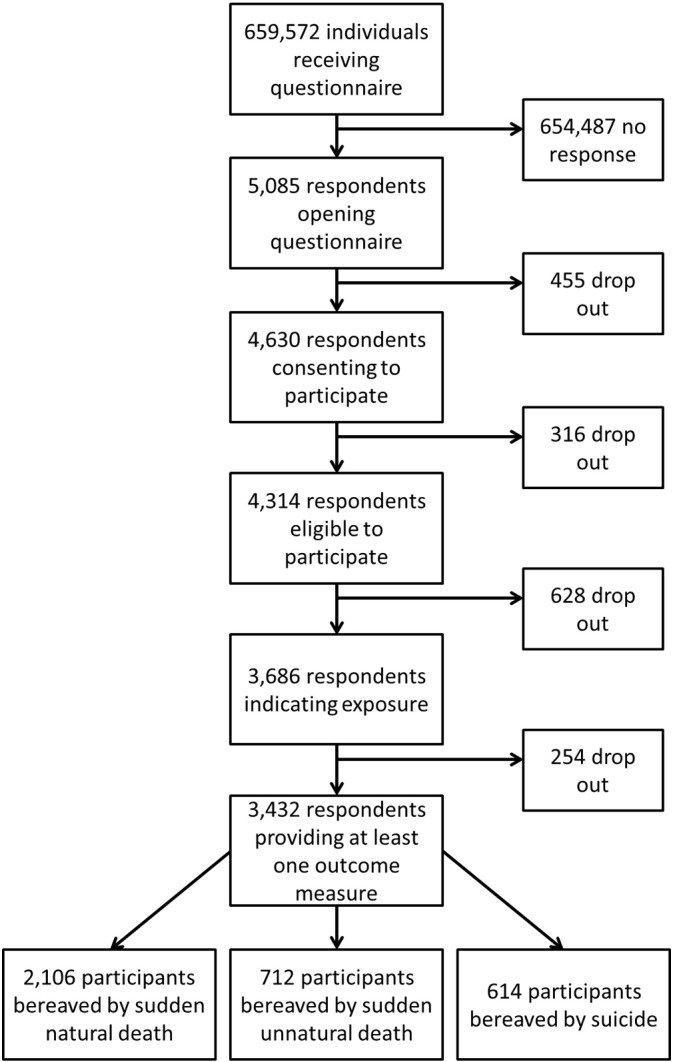
OBJECTIVE: To test the hypothesis that perceived stigma scores in young adults bereaved by suicide are significantly higher than in young adults bereaved by other sudden deaths, whether blood-related to the deceased or not. METHODS: We conducted a cross-sectional study of all staff and students aged 18-40 at 37 UK higher educational institutions in 2010, and identified 3432 respondents who had experienced a sudden bereavement of a close contact since reaching the age of 10, either due to sudden natural causes, sudden unnatural causes, or suicide. We used multivariable regression to compare scores on the stigma, shame, responsibility and guilt subscales of the Grief Experience Questionnaire, adjusting for socio-demographic factors and pre-bereavement psychopathology. RESULTS: People bereaved by suicide (n=614) had higher stigma scores than people bereaved by sudden natural death (n=2106; adjusted coefficient=2.52; 95% CI=2.13-2.90; p=<0.001) and people bereaved by sudden unnatural death (n=712; adjusted coefficient=1.69; 95% CI=1.25-2.13; p=<0.001). Shame, responsibility and guilt scores were also significantly higher in people bereaved by suicide, whether compared with bereavement by sudden natural death or sudden unnatural death. Associations were not modified by whether the bereaved was blood-related to the deceased or not. CONCLUSIONS: Stigma was perceived more acutely by the relatives and friends of those who died by suicide than those bereaved by other causes of sudden natural or sudden unnatural death. Their high levels of perceived stigma, shame, responsibility and guilt require qualitative investigation to identify whether these grief dimensions limit social functioning, help-seeking behaviour and/or support offered.
Overview
The claims and statistics of this paper haven’t been checked yet.
Run the check — free, no account needed. It reads the open-access text and checks the sources it cites.
Integrity signals
Registry
Cites
Statistics
Figures
Verification
Claims the paper makes
The claims and statistics of this paper haven’t been checked yet.
Run the check — free, no account needed. It reads the open-access text and checks the sources it cites.
Claims other papers make about this one
Each is checked against this paper’s own text: does it say what the citing paper says it does?
The cited source says what the claim attributes to it.
In the citing paper
“Suicide bereavement is also associated with other adverse outcomes [9], including an increased risk of suicide attempt [10], drop-out from a college course or job [10], poor social functioning [10], and high levels of stigma, shame, guilt, and feelings of responsibility [11].”
From Support Needs and Experiences of People Bereaved by Suicide: Qualitative Findings from a Cross-Sectional British Study of Bereaved Young Adults (2018) · cites this paper as [11]
In the citing paper
“High levels of stigma relative to other bereaved groups11 may reduce both willingness to seek help and friends’ or relatives’ readiness to offer support.9 12”
From Support received after bereavement by suicide and other sudden deaths: A cross-sectional UK study of 3432 young bereaved adults (2017) · cites this paper as [11]
Self-check
Percentages, sums and reported differences re-computed from the paper’s own numbers.
The self-check needs the paper’s full text.
Citations
Cites
Multilevel and Longitudinal Modeling Using Stata
Rabe-Hesketh, S., & Skrondal, A. (2005) · Biometrics · doi:10.1111/j.1541-0420.2006.00588_16.x · Cited by 4,626
Generalized Ordered Logit/Partial Proportional Odds Models for Ordinal Dependent Variables
Williams, R. A. (2006) · The Stata Journal Promoting communications on statistics and Stata · doi:10.1177/1536867x0600600104 · Cited by 2,136
Adult psychiatric morbidity in England, 2007: Results of a household survey
Mcmanus, S., Meltzer, H., Brugha, T., Bebbington, P., & Jenkins, R. (2009) · Unpublished · doi:10.13140/2.1.1563.5205 · Cited by 814
Stigma, shame, and blame experienced by patients with lung cancer: qualitative study
Chapple, A., Ziebland, S., & McPherson, A. (2004) · BMJ · doi:10.1136/bmj.38111.639734.7c · Cited by 789
Multilevel and Longitudinal Modeling Using Stata
Horton, N. J. (2006) · The American Statistician · doi:10.1198/tas.2006.s56 · Cited by 736
Tangney, J. P. (1990) · Journal of Personality and Social Psychology · doi:10.1037//0022-3514.59.1.102 · Cited by 601
Tangney, J. P. (1990) · Journal of Personality and Social Psychology · doi:10.1037/0022-3514.59.1.102 · Cited by 601
Effects of suicide bereavement on mental health and suicide risk
Pitman, A., Osborn, D., King, M., & Erlangsen, A. (2014) · The Lancet Psychiatry · doi:10.1016/s2215-0366(14)70224-x · Cited by 492
Self-citationNational Strategy for Suicide Prevention: Goals and Objectives for Action
Service., U. S. P. H. (2001) · PsycEXTRA Dataset · doi:10.1037/e415652005-001 · Cited by 458
The Stigma Scale: development of a standardised measure of the stigma of mental illness
King, M., Dinos, S., Shaw, J., Watson, R. J., Stevens, S., Passetti, F., Weich, S., & Serfaty, M. A. (2007) · The British Journal of Psychiatry · doi:10.1192/bjp.bp.106.024638 · Cited by 419
Cited by
Sorted by citations
The Reciprocal Relationship between Suicidality and Stigma
Carpiniello, B., & Pinna, F. (2017) · Frontiers in Psychiatry · doi:10.3389/fpsyt.2017.00035 · Cited by 252
Ammerman, B. A., Burke, T. A., Jacobucci, R., & McClure, K. (2021) · Journal of Psychiatric Research · doi:10.1016/j.jpsychires.2020.12.037 · Cited by 176
Pitman, A. L., Stevenson, F., Osborn, D. P. J., & King, M. B. (2018) · Social Science & Medicine · doi:10.1016/j.socscimed.2017.12.035 · Cited by 125
Web-Based Bereavement Care: A Systematic Review and Meta-Analysis
Wagner, B., Rosenberg, N., Hofmann, L., & Maaß, U. (2020) · Frontiers in Psychiatry · doi:10.3389/fpsyt.2020.00525 · Cited by 129
Perceived suicide stigma, secrecy about suicide loss and mental health outcomes
Oexle, N., Feigelman, W. T., & Sheehan, L. L. (2018) · Death Studies · doi:10.1080/07481187.2018.1539052 · Cited by 94
Metadata
- Authors
- Pitman, A. L., Osborn, D. P. J., Rantell, K., & King, M. B.
- Affiliations
- St Pancras Hospital (GB)
- UCL Queen Square Institute of Neurology (GB)
- Corresponding author
- Pitman, Alexandra L.
- Venue
- Journal of Psychosomatic Research
- Publisher
- Elsevier BV
- Published
- 2016-08
- Volume
- 87
- Pages
- 22-29
- ISSN
- 0022-3999 (ISSN-L)
- PMC
- PMC4988532
- OpenAlex
- W2400114439
- Cited by
- 140
- References
- 35
- Citations by year
- 2026: 13 · 2025: 12 · 2024: 12 · 2023: 16 · 2022: 25 · 2021: 13 · 2020: 14 · 2019: 12 · 2018: 11 · 2017: 9 · 2016: 3
- FWCI
- 15.60
- Type
- journal article
- Language
- en
- Open access
- hybrid
- doi.org
- Locations
- Journal of Psychosomatic Research (publishedVersion, cc-by)
- PubMed Central (publishedVersion, cc-by)
- PubMed (publishedVersion)
- UCL Discovery (University College London) (submittedVersion)
- Funders
- Medical Research Council (MRC) Population Health Scientist Fellowship (G0802441)
- Topics
- Social Sciences › Psychology › Clinical Psychology › Grief, Bereavement, and Mental Health
- Social Sciences › Psychology › Clinical Psychology › Suicide and Self-Harm Studies
- Social Sciences › Anthropology › Death, Funerary Practices, and Mourning
- Keywords
- suicide bereavement, perceived stigma, sudden death, sudden natural death, grief, shame, guilt, responsibility, young adults
- MeSH terms
- Adolescent, Adult, Bereavement, Cross-Sectional Studies, Death, Sudden, Family, Female, United Kingdom, Grief, Guilt, Humans, Male, Perception, Surveys and Questionnaires, Suicide, Young Adult, Social Stigma
About these checks
Registry, retraction, Cites and statistics results are computed, not judged, with one exception: a printed reference that no index lists is read once by a model before it counts as a citation error. Claims are extracted by a model and kept only when their quote appears verbatim in the text; each cited source is then checked, with a model’s help, for whether it says what the claim relies on. Those verdicts can be wrong — read the claim’s quote and the cited source before relying on one.
Statistics and arithmetic are recomputed, not judged.
Confidence bands are shown only for fields calibrated on our annotated test set. None is calibrated yet, so no band is shown.
What counts as a claim ›How we measure confidence ›How we check this ›
Are you an author, or do you see a problem with this page? Request a review
