

The DOI matches its Crossref record; 50 of the 51 references it cites were found in a registry or an index.
Handgrip strength and health outcomes: Umbrella review of systematic reviews with meta-analyses of observational studies
Open accessAbstract
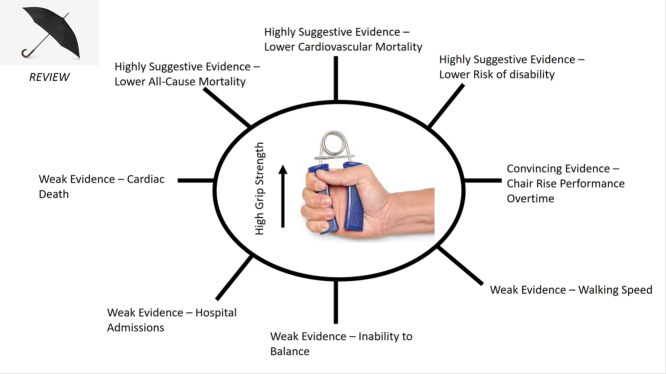
PURPOSE: The aim of the present study was to assess both the credibility and strength of evidence arising from systematic reviews with meta-analyses of observational studies on handgrip strength and health outcomes. METHODS: An umbrella review of systematic reviews with meta-analyses of observational studies was conducted. We assessed meta-analyses of observational studies based on random-effect summary effect sizes and their p values, 95% prediction intervals, heterogeneity, small-study effects, and excess significance. We graded the evidence from convincing (Class I) to weak (Class IV). RESULTS: ). No outcome presented convincing evidence. Three associations showed Class II evidence (i.e., highly suggestive): (1) higher handgrip values at baseline were associated with a minor reduction in mortality risk in the general population (n = 34 studies; sample size = 1,855,817; relative risk = 0.72, 95% confidence interval (95%CI): 0.67-0.78), (2) cardiovascular death risk in mixed populations (n = 15 studies; relative risk = 0.84, 95%CI: 0.78-0.91), and (3) incidence of disability (n = 7 studies; relative risk = 0.76, 95%CI: 0.66-0.87). CONCLUSION: The present results show that handgrip strength is a useful indicator for general health status and specifically for early all-cause and cardiovascular mortality, as well as disability. To further inform intervention strategies, future research is now required to fully understand mechanisms linking handgrip strength scores to these health outcomes.
Overview
The claims and statistics of this paper haven’t been checked yet.
Run the check — free, no account needed. It reads the open-access text and checks the sources it cites.
Integrity signals
Registry
Cites
Statistics
Figures
Verification
Claims the paper makes
The claims and statistics of this paper haven’t been checked yet.
Run the check — free, no account needed. It reads the open-access text and checks the sources it cites.
Claims other papers make about this one
Each is checked against this paper’s own text: does it say what the citing paper says it does?
The cited source says what the claim attributes to it.
In the citing paper
“HGS is a useful indicator of general health status and, specifically, of early mortality from any cardiovascular cause, as well as disability [110,111].”
From The Seven Methods for the Evaluation of Nutritional Status—ABCDEFG: Narrative Review (2026) · cites this paper as [110]
Self-check
Percentages, sums and reported differences re-computed from the paper’s own numbers.
The self-check needs the paper’s full text.
Citations
Cites
Bias in meta-analysis detected by a simple, graphical test
Egger, M., Smith, G. D., Schneider, M., & Minder, C. (1997) · BMJ · doi:10.1136/bmj.315.7109.629 · Cited by 56,722
(2014) · Medical Entomology and Zoology · Cited by 17,633
Shea, B. J., Reeves, B. C., Wells, G., Thuku, M., Hamel, C., Moran, J., Moher, D., Tugwell, P., Welch, V., Kristjansson, E., et al. (2017) · BMJ · doi:10.1136/bmj.j4008 · Cited by 10,636
A Re-Evaluation of Random-Effects Meta-Analysis
Higgins, J. P. T., Thompson, S. G., & Spiegelhalter, D. J. (2009) · Journal of the Royal Statistical Society Series A: Statistics in Society · doi:10.1111/j.1467-985x.2008.00552.x · Cited by 2,569
Quantitative Synthesis in Systematic Reviews
Lau, J., Ioannidis, J. P. A., & Schmid, C. H. (1997) · Annals of Internal Medicine · doi:10.7326/0003-4819-127-9-199711010-00008 · Cited by 2,517
Development and Validation of a Functional Fitness Test for Community-Residing Older Adults
Rikli, R. E., & Jones, C. J. (1999) · Journal of Aging and Physical Activity · doi:10.1123/japa.7.2.129 · Cited by 2,090
Midlife Hand Grip Strength as a Predictor of Old Age Disability
Rantanen, T. (1999) · JAMA · doi:10.1001/jama.281.6.558 · Cited by 1,505
The Mass Production of Redundant, Misleading, and Conflicted Systematic Reviews and Meta‐analyses
IOANNIDIS, J. P. A. (2016) · The Milbank Quarterly · doi:10.1111/1468-0009.12210 · Cited by 1,483
Uncertainty in heterogeneity estimates in meta-analyses
Ioannidis, J. P. A., Patsopoulos, N. A., & Evangelou, E. (2007) · BMJ · doi:10.1136/bmj.39343.408449.80 · Cited by 1,254
Celis-Morales, C. A., Welsh, P., Lyall, D. M., Steell, L., Petermann, F., Anderson, J., Iliodromiti, S., Sillars, A., Graham, N., Mackay, D. F., et al. (2018) · BMJ · doi:10.1136/bmj.k1651 · Cited by 772
Cited by
Sorted by citations
Items 101–200 of 283
The Seven Methods for the Evaluation of Nutritional Status—ABCDEFG: Narrative Review
Zambrano-Villacres, R., Arteaga-Pazmiño, C., Guevara Castillo, W. D., Herrera-Fontana, M. E., Domínguez Brito, L. D., Becerra Granados, L. M., Recoba-Obregón, P. E., Rodríguez-Veintimilla, D., Bressi, V., Andrade-Molina, D., et al. (2026) · Applied Sciences · doi:10.3390/app16020845 · Cited by 5
Statin-Intolerant Patients Exhibit Diminished Muscle Strength Regardless of Lipid-Lowering Therapy
Vinci, P., Girolamo, F. G. D., Pellicori, F., Panizon, E., Pirulli, A., Tosoni, L. M., Altamura, N., Rizzo, S., Perin, A., Fiotti, N., et al. (2025) · Journal of Clinical Medicine · doi:10.3390/jcm14041221 · Cited by 5
Wang, X., Wang, H., Yuan, X., Cai, S., Huang, Y., Song, Y., Zou, Z., & Stafford, R. S. (2025) · The Lancet Regional Health - Western Pacific · doi:10.1016/j.lanwpc.2025.101640 · Cited by 6
Nam, H.-K., Jang, S., Kawachi, I. I., Ma, Y., & Cho, S. (2025) · Scientific Reports · doi:10.1038/s41598-025-29619-6 · Cited by 10
Population-specific equations of age-related maximum handgrip force: a comprehensive review
Roman-Liu, D., Kamińska, J., & Tokarski, T. (2024) · PeerJ · doi:10.7717/peerj.17703 · Cited by 5
Kulyk, M., & Dzhus, M. (2024) · BMC Musculoskeletal Disorders · doi:10.1186/s12891-024-08051-3 · Cited by 5
Trends in physical fitness among Lithuanian adolescents aged 11–17 years between 1992 and 2022
Emeljanovas, A., Miežienė, B., Venckūnas, T., Lang, J. J., & Tomkinson, G. R. (2024) · Journal of Epidemiology & Community Health · doi:10.1136/jech-2024-223072 · Cited by 5
Perks, J., Zaccardi, F., Rayt, H. S., Sayers, R. D., Brady, E. M., Davies, M. J., Rowlands, A. V., Edwardson, C. L., Hall, A. P., Yates, T. E., et al. (2023) · Experimental Gerontology · doi:10.1016/j.exger.2023.112207 · Cited by 5
Marco, J. C. P. D., Pinto, A. D. A., Brazo‐Sayavera, J., Külkamp, W., de Lima, T. R., & Pelegrini, A. (2024) · Journal of Sports Sciences · doi:10.1080/02640414.2024.2364137 · Cited by 5
McMahen, C., Wright, K. E., Stanton, R., Lederman, O., Rosenbaum, S., McKeon, G., & Furzer, B. J. (2021) · Mental health and physical activity · doi:10.1016/j.mhpa.2021.100438 · Cited by 6
Brunese, M. C., Femminella, G. D., Bencivenga, L., Tafuri, F., Caiazzo, C., Rengo, G., Guerra, G., & Komici, K. (2025) · GeroScience · doi:10.1007/s11357-025-01801-8 · Cited by 4
Smith, C. B., & Hagen, E. H. (2025) · Evolution and Human Behavior · doi:10.1016/j.evolhumbehav.2024.106647 · Cited by 4
Qaisar, R., Hussain, M. A., Franzese, F., Karim, A., Ahmad, F., Awad, A., Alsaeed, M., & Alkahtani, S. A. (2025) · Scientific Reports · doi:10.1038/s41598-025-03128-y · Cited by 4
Handgrip Strength has Declined Among Adults, Particularly Males, from Shanghai Since 2000
Wang, D., Liu, Y., Lang, J. J., Klug, M. G., McGrath, R. P., & Tomkinson, G. R. (2024) · Sports Medicine - Open · doi:10.1186/s40798-024-00800-x · Cited by 5
Polo‐López, A., Andersen, L. L., Núñez‐Cortés, R., López‐Bueno, R., Cruz‐Montecinos, C., Suso‐Martí, L., & Calatayud, J. (2025) · Progress in Cardiovascular Diseases · doi:10.1016/j.pcad.2025.09.013 · Cited by 5
Predicting Disability Using a Nomogram of the Tilburg Frailty Indicator (TFI)
Gobbens, R. J. J., Santiago, L. M., Uchmanowicz, I., & van der Ploeg, T. (2023) · Healthcare · doi:10.3390/healthcare11081150 · Cited by 4
Wade-Mcbane, K., King, A., Urch, C., Johansson, L., & Wells, M. (2023) · BMJ Open · doi:10.1136/bmjopen-2023-072367 · Cited by 4
Bim, M. A., Pinto, A. D. A., Claumann, G. S., & Pelegrini, A. (2023) · American Journal of Human Biology · doi:10.1002/ajhb.24004 · Cited by 5
Qin, Z., Guo, Y., Yang, W., Kuang, Z., & Li, G. (2024) · Journal of the Formosan Medical Association · doi:10.1016/j.jfma.2024.12.018 · Cited by 4
Marco, J. C. P. D., de Lima, T. R., Pinto, A. D. A., Brazo‐Sayavera, J., & Pelegrini, A. (2024) · Sports Medicine and Health Science · doi:10.1016/j.smhs.2024.12.003 · Cited by 4
López-Moral, Á., Munguía‐Izquierdo, D., & Bueno‐Antequera, J. (2025) · BJPsych Open · doi:10.1192/bjo.2024.842 · Cited by 7
The Hidden Effects of Lockdown on Child Health: Evidence from Madrid’s ASOMAD Study
Portals-Riomao, A., Nehari, A., González‐Gross, M., Quesada, C., Gesteiro, E., & Zapico, A. G. (2025) · Sci · doi:10.3390/sci7010025 · Cited by 4
Dehghani, M., Ravanbod, H., Ardakani, M. P., Nodushan, M. H. T., Dehghani, S., & Rahmani, M. (2022) · PubMed Central · Cited by 4
Dixit, S., Gular, K., Gautam, A. P., Reddy, R. S., Ahmad, I., Tedla, J. S., & Taneja, V. (2023) · Diagnostics · doi:10.3390/diagnostics13050904 · Cited by 4
Zhang, C., Li, J., Shi, H., Liu, Y., Cui, J., Luo, X. M., Zeng, L. T., Fan, G. Q., Zhang, P. J., Zhang, P. J., et al. (2023) · Public Health · doi:10.1016/j.puhe.2023.04.023 · Cited by 4
Handgrip Strength as a Distinguishing Factor of People Training Martial Arts
Bajkowski, D. S., & Cynarski, W. J. (2023) · Applied Sciences · doi:10.3390/app13179900 · Cited by 4
Importance of Handgrip Strength as a Health Indicator in the Elderly
Kim, S. Y. (2021) · Korean Journal of Family Medicine · doi:10.4082/kjfm.42.1e · Cited by 4
Šileikienė, L., Tamošiūnas, A., Lukšienė, D., Radišauskas, R., Krančiukaitė-Butylkinienė, D., & Bobák, M. (2024) · BMC Public Health · doi:10.1186/s12889-024-18506-w · Cited by 3
The impact of ovarian aging on muscle strength and life quality in various reproductive aging stages
Luo, A., Li, H., Lv, X., Zheng, P., Lin, K., Liang, A., & Yang, S. Y. (2025) · Climacteric · doi:10.1080/13697137.2025.2470451 · Cited by 3
Kong, X., & Wang, W. (2025) · Journal of Parenteral and Enteral Nutrition · doi:10.1002/jpen.2777 · Cited by 3
Li, J., Sui, J., Tang, L., Zhao, C., Liu, R., Guo, J.-J., Zhou, T., Pan, D., Tian, Q., & Xuan, C. (2025) · American Journal of Preventive Cardiology · doi:10.1016/j.ajpc.2025.101359 · Cited by 3
de Oliveira, J., Mignoni, I., Vancampfort, D., Zou, L., Stubbs, B., Waclawovsky, A. J., & Schuch, F. B. (2026) · Journal of Psychiatric Research · doi:10.1016/j.jpsychires.2026.02.023 · Cited by 4
Faria, I. A., da Mata, D. L., Lima, A. C. D. S., Belo, M. C. P. E., de Almeida, G. C., & Brasil, A. R. D. C. (2026) · Revista Multidisciplinar do Nordeste Mineiro · doi:10.66104/0p39n076 · Cited by 3
Du, J., Shu, X., Lin, T., Liao, H., Zhang, L., & Yue, J. (2026) · Endocrine Practice · doi:10.1016/j.eprac.2026.03.095 · Cited by 3
Roth, J. V. S., Guarenghi, G. G., Ferro, R. M., Valenga, H. M., Haas, A. N., Prates, R. C., & Steffens, J. P. (2024) · Clinical Oral Investigations · doi:10.1007/s00784-024-05507-7 · Cited by 3
Function and activity capacity at 1 year after the admission to intensive care unit for COVID-19
Hussain, N., Hansson, P., Samuelsson, C. M., & Persson, C. U. (2024) · Clinical Rehabilitation · doi:10.1177/02692155241262871 · Cited by 3
Little, B. B., Reyes, M. E. P., & Malina, R. M. (2024) · American Journal of Biological Anthropology · doi:10.1002/ajpa.25017 · Cited by 4
Chisala, M. N., Hardy, R., Cooper, R., & Li, L. (2024) · Maturitas · doi:10.1016/j.maturitas.2024.108154 · Cited by 3
Solé, J. M. N., Valencia-Muntalà, L., Berbel-Arcobé, L., Benavent, D., Vidal-Montal, P., Aguilar-Coll, M., Roig-Kim, M., Narváez, J., & Gómez‐Vaquero, C. (2025) · Journal of Clinical Medicine · doi:10.3390/jcm14217751 · Cited by 3
Ertuğrul, B., & AYDIK, M. F. (2023) · Current Research in Social Sciences · doi:10.30613/curesosc.1195115 · Cited by 3
Smith, L., Sánchez, G. F. L., Soysal, P., Veronese, N., Gibson, P., Pizzol, D., Jacob, L., Butler, L. T., Barnett, Y., Oh, H. Y., et al. (2024) · Suicide and Life-Threatening Behavior · doi:10.1111/sltb.13071 · Cited by 3
Self-citationWang, M., Collings, P. J., Jang, H., Chen, Z., Luo, S., Yeung, S. L. A., Sharp, S. J., Brage, S., & Kim, Y. (2024) · Journal of Hypertension · doi:10.1097/hjh.0000000000003900 · Cited by 2
Vasconcelos, C. E. G. D. C., Peralta, M., & Marques, A. (2025) · Cancers · doi:10.3390/cancers17050754 · Cited by 2
Ceylan, S., Öztürk, Y., Güner, M., Baş, A. O., Koca, M., Balcı, C., Doğu, B. B., Cankurtaran, M., & Halil, M. G. (2025) · Revista da Associação Médica Brasileira · doi:10.1590/1806-9282.20240237 · Cited by 2
Mundi, M. S., Mechanick, J. I., Patel, J. J., Newberry, C. A., Sankararaman, S., Rosenthal, M. D., Elfadil, O. M., Bering, J., Katz, J., Stoppe, C., et al. (2025) · Journal of Parenteral and Enteral Nutrition · doi:10.1002/jpen.2790 · Cited by 3
Handgrip strength asymmetry is associated with mortality risk: Systematic review and meta-analysis
Ran, M., Yu, Y., Chen, L., & Zhou, X. (2026) · Archives of Gerontology and Geriatrics · doi:10.1016/j.archger.2026.106237 · Cited by 2
Ramos, C., Hunter, K. A., Walton, G., Whitham, A., Camp, N., Poveda, C. G., Gibson, G. R., Hough, J., & Magistro, D. (2026) · Journal of Aging Research · doi:10.1155/jare/8981398 · Cited by 2
Chen, Y., Wu, L., Li, J., Yang, M., Qi, X., Wang, M., Li, Q., & Wang, Y. (2026) · European Review of Aging and Physical Activity · doi:10.1186/s11556-026-00411-3 · Cited by 2
Begum, R., Parikh, P., Walton, D. M., & Rushton, A. (2026) · PLoS ONE · doi:10.1371/journal.pone.0354102 · Cited by 2
Encarnação, S., Vaz, P. M. F., Fortunato, Á., Forte, P. M., Vaz, C. E. A., & Monteiro, A. M. (2023) · Life · doi:10.3390/life13061374 · Cited by 2
Follow-Up of Eight-Weeks Detraining Period after Exercise Program on Health Profiles of Older Women
Leitão, L., Campos, Y., Figueira, A. C., Figueiredo, T. P., & Pereira, A. (2023) · Healthcare · doi:10.3390/healthcare11233021 · Cited by 3
Rambukwella, R., Westbury, L. D., Pearse, C. M., Ward, K. A., Cooper, C. C., & Dennison, E. M. (2024) · Primary Health Care Research & Development · doi:10.1017/s1463423624000173 · Cited by 2
Encarnação, S., Rezende, V. H. S., Gonçalves, I. M., Prata, P. D. O. R., Mansur, H. N., Sampaio, T., Forte, P. M., Teixeira, J. E., Monteiro, A. M., & Guttierres, A. P. M. (2024) · International Journal of Kinesiology and Sports Science · doi:10.7575/aiac.ijkss.v.12n.2p.11 · Cited by 1
You, Y., Wu, X., Zhang, Z., Xie, F., Lin, Y., Lv, D., & Zhao, Z. (2024) · Journal of Global Health · doi:10.7189/jogh.14.04160 · Cited by 2
Hand-grip strength in recreational downhill skiers: a comparison to normative reference values
Burtscher, J., Strasser, B., Ruedl, G., Pocecco, E., Menz, V., Philippe, M., Kopp, M., & Burtscher, M. (2024) · European Journal of Translational Myology · doi:10.4081/ejtm.2024.13021 · Cited by 2
Ryu, S., Liao, N., McDonough, D. J., & Gao, Z. (2023) · Brain Behavior and Immunity Integrative · doi:10.1016/j.bbii.2023.100003 · Cited by 2
Associação entre força de preensão manual e ângulo de fase em idosos da Estratégia Saúde da Família
Pereira, M. L. A. S., Pereira, M. H. Q., Teles, B. K. A., Corrêa, M. M., & de Oliveira, E. R. A. (2023) · Revista de Ciências Médicas e Biológicas · doi:10.9771/cmbio.v22i1.52728 · Cited by 2
Generational differences in physical health and disability in the United States and EuropePreprint
Gimeno, L., Goisis, A., Dowd, J. B., & Ploubidis, G. B. (2024) · medRxiv · doi:10.1101/2024.01.16.24301347 · Cited by 2
Williams, T. R., Walker, R., & Dearing, C. G. (2024) · Public Health Nursing · doi:10.1111/phn.13295 · Cited by 1
Sun, H., Liu, J., Tan, R., Zhang, X., Qian, X., Qi, C., & Qi, W. (2024) · Frontiers in Medicine · doi:10.3389/fmed.2024.1452811 · Cited by 1
Ramírez‐Vélez, R., Carrera-Gil, F., Dávila-Grisalez, A. A., & Izquierdo, M. (2025) · Clinical Nutrition ESPEN · doi:10.1016/j.clnesp.2025.03.003 · Cited by 1
Relationship Between Handgrip Strength and Lung Function in Adults: The Role of Sex and Age
Deng, S., Sayeed, U. B., & Wagatsuma, Y. (2025) · Cureus · doi:10.7759/cureus.83300 · Cited by 1
Effectiveness of telerehabilitation in adult cancer survivors: A systematic review
Lorca, L. A., Salazar‐Méndez, J., López-Soto, V. B., Parada-Muñoz, C. A., Berríos-Contreras, L., & Ribeiro, I. L. (2025) · Physiotherapy Practice and Research · doi:10.1177/22130683251337301 · Cited by 1
Breasail, M. Ó., Mesinovic, J., Madanhire, T., Mukwasi-Kahari, C., Ebeling, P. R., Simms, V. M., Ferrand, R. A., Ward, K. A., & Gregson, C. L. (2025) · Climacteric · doi:10.1080/13697137.2025.2496685 · Cited by 1
Association Between Handgrip Strength and Suicidal Ideation: A Systematic Review and Meta‐Analysis
Satapathy, P., Gaidhane, A. M., Vadia, N., Menon, S. V., Chennakesavulu, K., Panigrahi, R., Kaur, M., Bushi, G., Shabil, M., Jena, D., et al. (2025) · Brain and Behavior · doi:10.1002/brb3.70647 · Cited by 1
Ashari, R. S., Sabirin, R. M., Merlinda, S. T. B., Pratiwi, D. A., Tsania, M. N., & Wibowo, R. A. (2025) · BMJ Open · doi:10.1136/bmjopen-2025-102211 · Cited by 1
de Mendonça, D. L. C., Raider, J. M., Silva, L. B. B., Alonso, A. C., Greve, J. M. D., & Leme, L. E. G. (2025) · Clinics · doi:10.1016/j.clinsp.2025.100830 · Cited by 1
Roberts, L. R., Şahin, S., Nick, J. M., & D’Errico, E. (2025) · BMC Musculoskeletal Disorders · doi:10.1186/s12891-025-09361-w · Cited by 1
Arm circumference predicts 12-month mortality in older adults with hip fracture
Ceolin, C., Termini, G., Sella, S., Camozzi, V., Bertocco, A., Torres, M. O., Cecchinato, A., Diogo, M., Falb, M. P., Guidolin, F., et al. (2025) · European Geriatric Medicine · doi:10.1007/s41999-025-01364-z · Cited by 1
Ganbat, U., Byambaa, A., Feldman, B., Arishenkoff, S., Meneilly, G. S., Little, J. P., Liu-Ambrose, T. Y. L., & Madden, K. M. (2025) · Canadian Journal of Diabetes · doi:10.1016/j.jcjd.2025.12.003 · Cited by 1
Peripheral muscle strength and lung function in adults with cystic fibrosis
Lewis, T. E., Spano, J. M., Kwok, J., Moss, R. B., Smith, C. M., Mohabir, P. K., Sellers, Z. M., Cochrane-Snyman, K. C., & Milla, C. E. (2026) · Respiratory Medicine · doi:10.1016/j.rmed.2025.108624 · Cited by 1
Responsiveness of Health-Related Field-Based Physical Fitness Tests in Adults: The ADULT-FIT Project
Cuenca‐García, M., Cruz-León, C., Jiménez-Iglesias, J., Sánchez‐Parente, S., Segura‐Jiménez, V., Ortega, F. B., & Castro‐Piñero, J. (2026) · International Journal of Sports Medicine · doi:10.1055/a-2795-9380 · Cited by 1
Blanchet, C., Peralta, M., Ribeiro, T., Henriques‐Neto, D., & Marques, A. (2026) · American Journal of Preventive Medicine · doi:10.1016/j.amepre.2026.108301 · Cited by 1
Genetic predisposition to hand grip strength predicts cognitive decline
Bercovitch, R., Tio, E. S., Wickramatunga, R., Misztal, M. C., Gicas, K. M., Jager, P. L. D., Schneider, J. A., Buchman, A. S., Bennett, D. A. A., Rajji, T. K., et al. (2026) · Neurobiology of Aging · doi:10.1016/j.neurobiolaging.2026.02.008 · Cited by 1
Wu, Z., Phyo, A. Z. Z., Cribb, L., Vishwanath, S., Orchard, S. G., Owen, A. J., Woods, R., Chong, T. T. ‐., Wolfe, R., Shah, R. C., et al. (2026) · Age and Ageing · doi:10.1093/ageing/afag062 · Cited by 1
Wang, M., Yin, A., Zhang, K., Song, X., Wang, B., Cheng, Y., He, B., Shi, Z., Li, N., & Su, L. (2026) · Journal of Psychosomatic Research · doi:10.1016/j.jpsychores.2026.112661 · Cited by 1
de León‐González, E. D., Hermosillo, H. G., Cavazos, H. E. G., Hernandez, A. C. I., Pérez, A., Alcala, M. N. G., Leon, A. M. D., & Cobos-Aguilar, H. (2026) · Archives of Gerontology and Geriatrics · doi:10.1016/j.archger.2026.106257 · Cited by 1
Validity and reliability of using a low-cost handgrip dynamometer in healthy adults
Tiryaki, P., & Kaya, B. K. (2026) · Adıyaman Üniversitesi Sağlık Bilimleri Dergisi · doi:10.30569/adiyamansaglik.1780149 · Cited by 1
Frailty transitions and their association with mortality in older adults
Ataca, E., Ataca, M. C., Heybeli, C., Smith, L., Veronese, N., Tanriverdi, I., & Soysal, P. (2026) · Internal Medicine Journal · doi:10.1111/imj.70502 · Cited by 1
Self-citationBarbosa, C. G. R., Crisp, A. H., de Oliveira, J. J., Ribeiro, A. G. S. V., Oliveira, M. V. A., & Verlengia, R. (2022) · Revista Brasileira de Atividade Física & Saúde · doi:10.12820/rbafs.27e0257 · Cited by 1
López-Moral, Á., Munguía‐Izquierdo, D., & Bueno‐Antequera, J. (2023) · Advances in psychology, mental health, and behavioral studies (APMHBS) book series · doi:10.4018/978-1-6684-6040-5.ch008 · Cited by 2
Gutiérrez‐Robledo, L. M., & Pérez‐Zepeda, M. U. (2024) · Springer eBooks · doi:10.1007/978-3-031-57361-3_8 · Cited by 1
Handgrip Strength Time Profile: from BodyGrip to Gripwise
Andrade, T. F., Restivo, M. T., & Urbano, D. (2023) · Experiment@International Conference · doi:10.1109/exp.at2358782.2023.10545767 · Cited by 1
Association of muscle quality index with osteoarthritis in young and middle-aged American adults
Huang, J., Tang, H., Jia, S., Chen, J., Liang, R., Tan, C., Ren, Y., Lin, J., & Zhang, X. (2025) · Sport Sciences for Health · doi:10.1007/s11332-025-01405-x · Cited by 1
Benefits of home-based exercise training following critical SARS-CoV-2 infection: a case studyPreprint
Longobardi, I., do Prado, D. M. L., Goessler, K. F., Júnior, G. N. D. O., ANDRADE, D. C. O. D., Gualano, B., & Roschel, H. (2021) · Research Square · doi:10.21203/rs.3.rs-955861/v1 · Cited by 1
RESISTANCE TO USTILAGO NUDA OF SOME TYPES OF WINTER BARLEY OBTAINED BY SEED IRRADIATION.
Grinvald, C. (1967) · OSTI OAI (U.S. Department of Energy Office of Scientific and Technical Information)
Lin, S., Wang, F., Huang, Y., Yuan, Y., Huang, F., & Zhu, P. (2022) · Research Square · doi:10.21203/rs.3.rs-1161358/v1
Pereira, M. L. A. S., Caceres, M. C. D. S., Pereira, M. H. Q., de Oliveira, C. C., Teles, B. K. A., & de Oliveira, E. R. A. (2023) · Población y Salud en Mesoamérica · doi:10.15517/psm.v21i1.54126
巴勒斯坦技术大学卡杜里拉马拉分校女学生惯用手的一些人体测量, 与., & Abdelrazeq, B. H. (2023) · Journal of Southwest Jiaotong University · doi:10.35741/issn.0258-2724.58.5.22
Benefícios das práticas corporais de combate no idoso: revisão sistemática
de Mendonça, D. L. C. (2024) · doi:10.11606/t.5.2024.tde-23042024-165246
Chisala, M. N., Hardy, R., Cooper, R., & Li, L. (2024) · SSRN Electronic Journal · doi:10.2139/ssrn.4838988
Deng, S., Sayeed, U. B., & Wagatsuma, Y. (2024) · Cureus · doi:10.7759/cureus.71276
Dearing, C. G., Williams, T. R., & Dearing, G. C. (2024) · The Open Public Health Journal · doi:10.2174/0118749445348471241015084007
Rodrigues, I. B., Kalra, M., Zheng, R., Rabinovich, A., Ioannidis, G., Kobsar, D., Bray, S. R., Adachi, J. D., Fang, Q., & Papaioannou, A. A. (2024) · BMJ Open · doi:10.1136/bmjopen-2024-084610
Pai, M., & Vennu, V. S. (2024) · Journal of Applied Gerontology · doi:10.1177/07334648241302457
Contribution of Neuromuscular Junction Degradation to Muscle Decline in Burn Patients
Khan, I. M., Javed, M., Zuhra, H., & Qaisar, R. (2025) · Journal of the Oman Medical Association · doi:10.3390/joma2010003
Banjoya, H., Shimizu, A., Hori, S., Ushida, K., & Momosaki, R. (2025) · Journal of Oral Rehabilitation · doi:10.1111/joor.13958
Associations between absolute and relative handgrip strength with fitness and fatness
Abdelnour, D., Grove, M., II, Pulford-Thorpe, K. C., Windhurst, K., LeCrone, C., Kerr, E., & Hew‐Butler, T. (2025) · Sports Medicine International Open · doi:10.1055/a-2537-7537
Metadata
- Authors
- Soysal, P., Hurst, C., Demurtas, J., Firth, J., Howden, R., Yang, L., Tully, M. A., Koyanagi, A., Ilie, P. C., López-Sánchez, G. F., Schwingshackl, L., Veronese, N., & Smith, L.
- Affiliations
- Newcastle University (GB)
- University of Manchester (GB)
- University of North Carolina at Charlotte (US)
- Alberta Health Services (CA)
- University of Ulster (GB)
- Institució Catalana de Recerca i Estudis Avançats (ES)
- Queen Elizabeth Hospital King's Lynn NHS Foundation Trust (GB)
- University of Freiburg (DE)
- National Research Council (IT)
- Anglia Ruskin University (GB)
- Corresponding author
- Veronese, Nicola
- Smith, Lee
- ORCID
- Venue
- Journal of Sport and Health Science
- Publisher
- Elsevier BV
- Published
- 2021-05
- Volume
- 10
- Issue
- 3
- Pages
- 290-295
- ISSN
- 2213-2961 (ISSN-L)
- 2095-2546
- PMC
- PMC8167328
- OpenAlex
- W3026843787
- Cited by
- 283
- References
- 51
- Citations by year
- 2026: 76 · 2025: 58 · 2024: 53 · 2023: 41 · 2022: 30 · 2021: 21
- FWCI
- 3.03
- Type
- journal article
- Language
- en
- Open access
- diamond
- doi.org
- Licence
- Locations
- Journal of sport and health science/Journal of Sport and Health Science (publishedVersion, cc-by-nc-nd)
- PubMed Central (publishedVersion, cc-by-nc-nd)
- PubMed (publishedVersion)
- Ulster University Research Portal (Ulster University) (publishedVersion, cc-by-nc-nd)
- Anglia Ruskin Research Online (Anglia Ruskin University) (acceptedVersion)
- IRIS UniPA (University of Palermo) (submittedVersion, other-oa)
- DOAJ (DOAJ: Directory of Open Access Journals) (submittedVersion, cc-by-sa)
- Figshare (submittedVersion, cc-by-nc-nd)
- Research Explorer (The University of Manchester) (submittedVersion, other-oa)
- Newcastle University ePrints (Newcastle Univesity) (cc-by-nc-nd)
- Topics
- Health Sciences › Medicine › Physiology (medical) › Nutrition and Health in Aging
- Health Sciences › Medicine › Public Health, Environmental and Occupational Health › Physical Activity and Health
- Health Sciences › Medicine › Geriatrics and Gerontology › Frailty in Older Adults
- Keywords
- grip strength, health outcomes, mortality, cardiovascular mortality, disability, evidence quality grading, prediction intervals, small-study effects, heterogeneity
- MeSH terms
- Walking Speed, Systematic Reviews as Topic, Aged, Aged, 80 and over, Cardiovascular Diseases, Cause of Death, Postural Balance, Health Status, Hospitalization, Humans, Locomotion, Probability, Risk, Meta-Analysis as Topic, Bias, Sample Size, Hand Strength, Renal Insufficiency, Chronic, Observational Studies as Topic
About these checks
Registry, retraction, Cites and statistics results are computed, not judged, with one exception: a printed reference that no index lists is read once by a model before it counts as a citation error. Claims are extracted by a model and kept only when their quote appears verbatim in the text; each cited source is then checked, with a model’s help, for whether it says what the claim relies on. Those verdicts can be wrong — read the claim’s quote and the cited source before relying on one.
Statistics and arithmetic are recomputed, not judged.
Confidence bands are shown only for fields calibrated on our annotated test set. None is calibrated yet, so no band is shown.
What counts as a claim ›How we measure confidence ›How we check this ›
Are you an author, or do you see a problem with this page? Request a review
