

A systematic and meta-analytic review of the impact of sleep restriction on memory formation.
Open accessThe DOI matches its Crossref record; 251 of the 253 references it cites were found in a registry or an index; none of the 131 sources its claims cite is checked for support yet.
Abstract
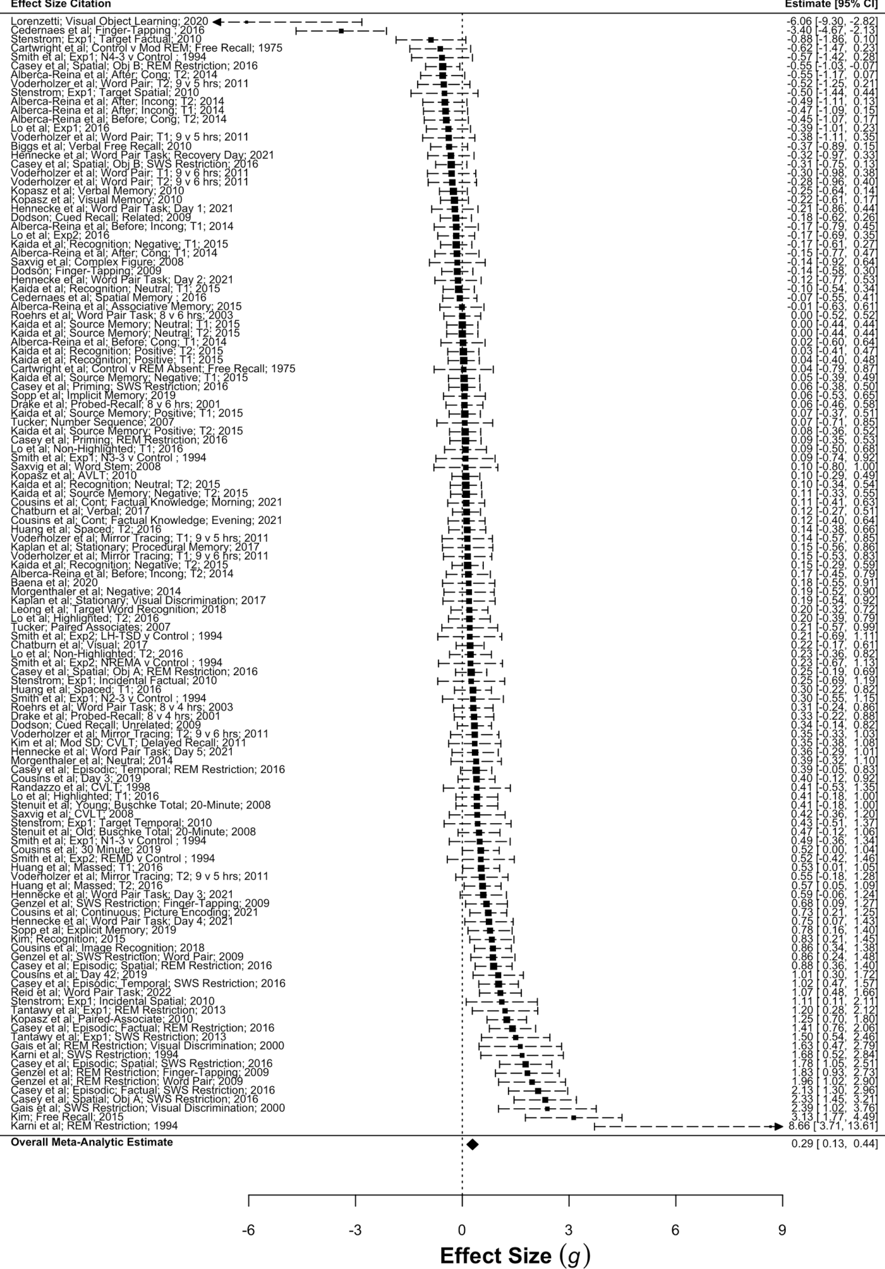
Modern life causes a quarter of adults and half of teenagers to sleep for less than is recommended (Kocevska et al., 2021). Given well-documented benefits of sleep on memory, we must understand the cognitive costs of short sleep. We analysed 125 sleep restriction effect sizes from 39 reports involving 1234 participants. Restricting sleep (3-6.5 hours) compared to normal sleep (7-11 hours) negatively affects memory formation with a small effect size (Hedges' g = 0.29, 95 % CI = [0.13, 0.44]). We detected no evidence for publication bias. When sleep restriction effect sizes were compared with 185 sleep deprivation effect sizes (Newbury et al., 2021) no statistically significant difference was found, suggesting that missing some sleep has similar consequences for memory as not sleeping at all. When the analysis was restricted to post-encoding, rather than pre-encoding, sleep loss, sleep deprivation was associated with larger memory impairment than restriction. Our findings are best accounted for by the sequential hypothesis which emphasises complementary roles of slow-wave sleep and REM sleep for memory.
Overview
CoChat Summary
TL;DR
This systematic meta-analysis of 125 effect sizes from 39 reports (1234 participants) found that sleep restriction (3–6.5 h vs 7–11 h) impairs long-term memory formation with a small effect (Hedges’ g = 0.29). Combined with total sleep deprivation data, the overall memory cost was not significantly different from not sleeping at all, and the pattern was best accounted for by sequential sleep theories emphasizing complementary SWS and REM roles.
Key findings
- Sleep restriction (3–6.5 h vs 7–11 h) impaired long-term memory formation with a small effect: Hedges’ g = 0.29, 95% CI [0.13, 0.44], p < .001; after removing 9 outliers/influential cases, g = 0.23, 95% CI [0.12, 0.35], p < .001.
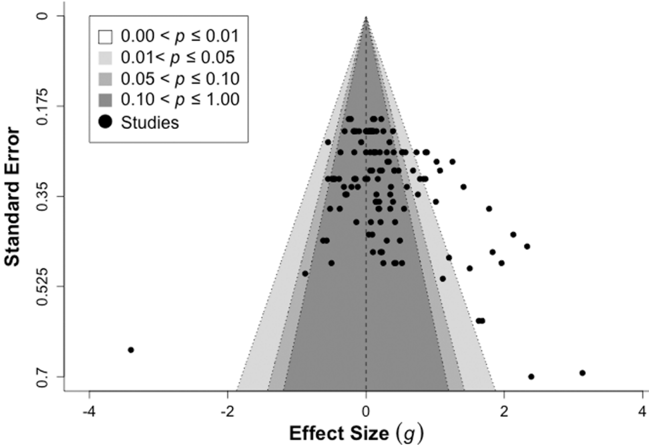
- No conclusive evidence of publication bias was detected: the three-parameter selection model showed no significant improvement when modelling publication bias (χ²(1) = 1.46, p = .228), although Egger’s test indicated funnel-plot asymmetry (z = 3.90, p < .001).
- Combining the 125 sleep-restriction effect sizes with 185 total sleep deprivation effect sizes from Newbury et al. (2021), type of sleep loss did not significantly moderate the overall effect (Q(1, 308) = 2.63, p = .105; after outlier removal Q(1, 288) = 2.16, p = .141), suggesting short sleep may have broadly similar memory consequences as no sleep.
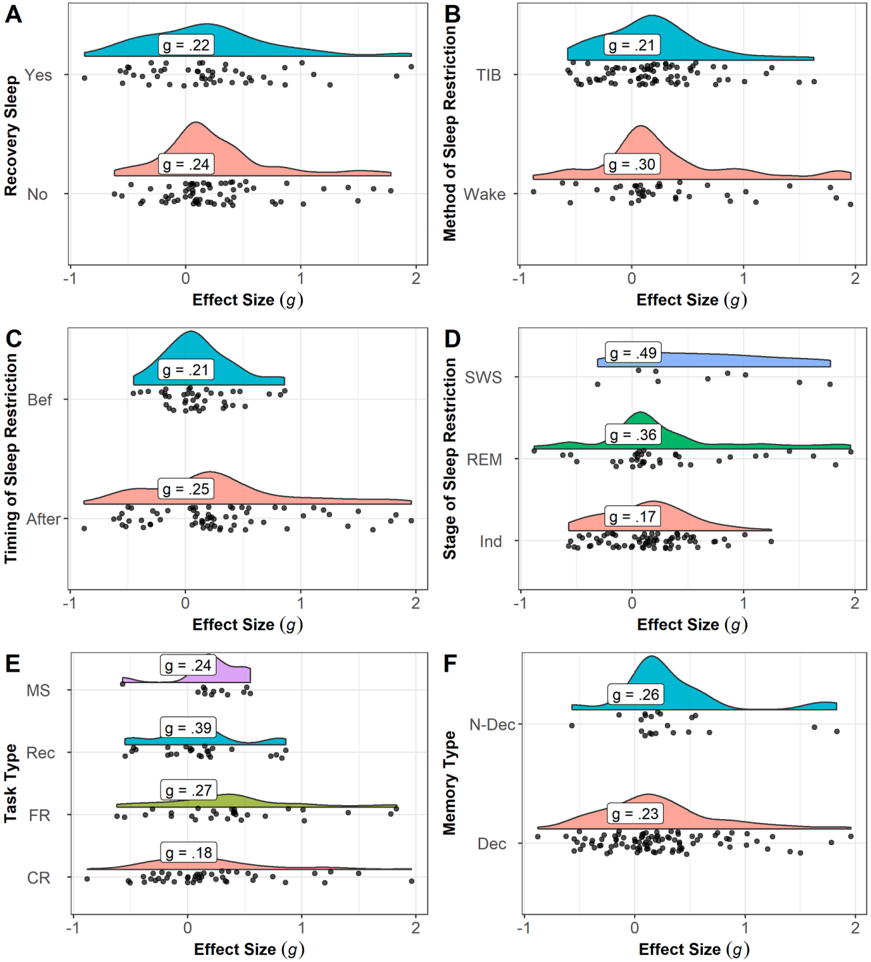
- Sleep stage moderated the effect only with outliers retained: SWS-targeted restriction g = 0.85, REM-targeted g = 0.40, indiscriminate g = 0.17 (Q(2, 122) = 11.72, p = .003); this did not survive outlier removal (p = .135). In timing analyses, sleep deprivation before encoding impaired memory more than sleep restriction before encoding (g = 0.63 vs 0.20 with outliers; g = 0.48 vs 0.20 without), whereas after encoding they were similar.
Methods
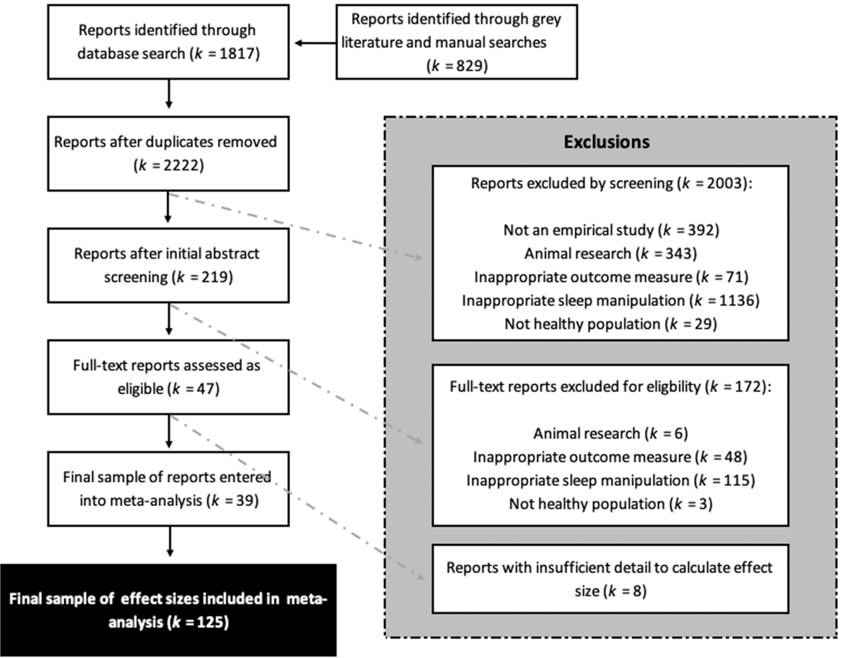
- Systematic search of EBSCOhost, PubMed, grey literature, preprints, reference lists, and author contact yielded 39 reports, 125 effect sizes, and 1234 participants; sleep restriction was 3–6.5 h over 1–14 nights versus control sleep of 7–11 h.
- Three-level random-effects meta-analysis with robust variance estimation was used to calculate Hedges’ g, with moderator analyses for sleep stage, timing, memory/task type, recovery sleep, age, methodological quality, and statistical power.
- Publication bias was assessed via contour-enhanced funnel plot, Egger’s regression, trim-and-fill, and the three-parameter selection model; sleep-restriction data were also combined with 185 total sleep deprivation effect sizes from Newbury et al. (2021).
Limitations
- The paper states that only seven grey-literature reports were identified, inclusion was English-only (51% of located effect sizes from Europe; 72% from western cultures), and only healthy typical populations were included, excluding sleep and psychiatric disorders.
- The paper states that only one effect size had a mean age above 30 years, so findings cannot be generalised to older adults; moderator analyses were underpowered and imbalanced (e.g., 13 SWS-targeted effect sizes, 12 motor-skill effect sizes, 25 non-declarative memory effect sizes), and the meta-analysis was not preregistered.
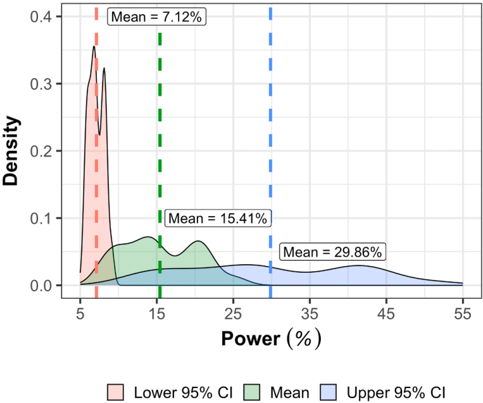
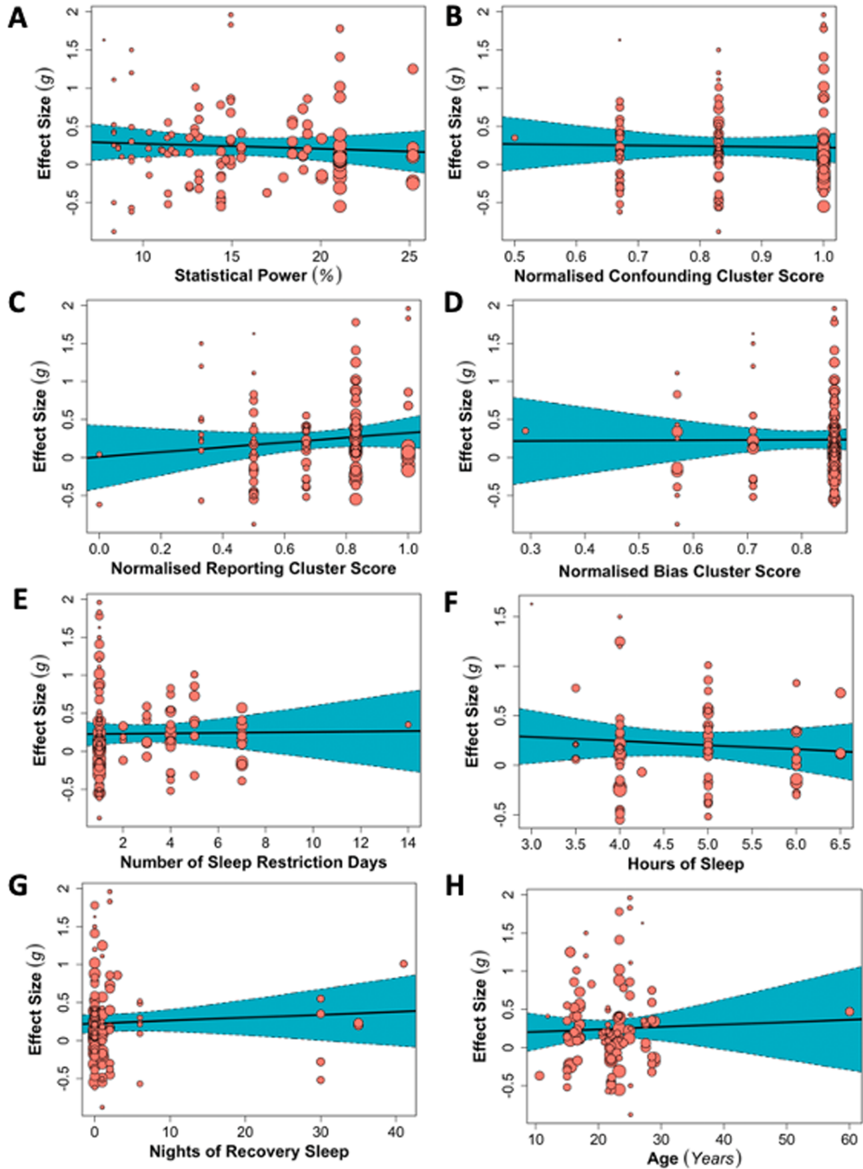
- The paper states that the meta-analysis is based on behavioural data only and that protocol differences between sleep restriction and total sleep deprivation may limit direct comparison; the text also makes evident that average statistical power to detect the meta-analytic estimate was very low (mean = 15.41%, range = 7.61%–25.19%).
Model-written summary. Check it against the paper before relying on it.
Integrity signals
Registry
Cites
Statistics
Figures

Verification
Claims the paper makes
0 Valid · 0 Not valid · 79 Not checked · 166 Own results and interpretations
A result the paper reports from its own data — it cites no other source for it, so there is none to check. The quote shows it is in the paper.
In the paper
“When the analysis was restricted to post-encoding, rather than pre-encoding, sleep loss, sleep deprivation was associated with larger memory impairment than restriction.”
§ A systematic and meta-analytic review of the impact of sleep restriction on memory formation > Abstract
plainstates an association- Asserted: passes — The authors put it forward as true.
- Checkable: passes — It can be checked against evidence.
- Load-bearing: passes — The paper’s conclusions depend on it.
- Based: passes — The paper gives a reason why it holds.
A result the paper reports from its own data — it cites no other source for it, so there is none to check. The quote shows it is in the paper.
In the paper
“We detected no evidence for publication bias.”
§ A systematic and meta-analytic review of the impact of sleep restriction on memory formation > Abstract
plain- Asserted: passes — The authors put it forward as true.
- Checkable: passes — It can be checked against evidence.
- Load-bearing: unclear — It is unclear whether the paper’s conclusions depend on it.
- Based: passes — The paper gives a reason why it holds.
In the paper
“When sleep restriction effect sizes were compared with 185 sleep deprivation effect sizes (Newbury et al., 2021) no statistically significant difference was found, suggesting that missing some sleep has similar consequences for memory as not sleeping at all.”
§ A systematic and meta-analytic review of the impact of sleep restriction on memory formation > Abstract
What the sources say
- Not checked yetcites Newbury et al., 2021 matched to “Sleep deprivation and memory: meta-analytic reviews of studies on sleep deprivation before and after learning” (2021) source
plain- Asserted: passes — The authors put it forward as true.
- Checkable: passes — It can be checked against evidence.
- Load-bearing: passes — The paper’s conclusions depend on it.
- Based: passes — The paper gives a reason why it holds.
A result the paper reports from its own data — it cites no other source for it, so there is none to check. The quote shows it is in the paper.
In the paper
“Restricting sleep (3-6.5 hours) compared to normal sleep (7-11 hours) negatively affects memory formation with a small effect size (Hedges' g = 0.29, 95 % CI = [0.13,0.44]).”
§ A systematic and meta-analytic review of the impact of sleep restriction on memory formation > Abstract
plainstates a causen = 1,234- Asserted: passes — The authors put it forward as true.
- Checkable: passes — It can be checked against evidence.
- Load-bearing: passes — The paper’s conclusions depend on it.
- Based: passes — The paper gives a reason why it holds.
In the paper
“Crucially, this combined sleep loss moderator analysis revealed that the type of sleep loss did not significantly moderate the magnitude of the detriment to memory”
§ A systematic and meta-analytic review of the impact of sleep restriction on memory formation > 4.1. Investigating predictions made by the sleep theories
What the sources say
- Not checked yetcites Newbury et al. (2021) matched to “Sleep deprivation and memory: meta-analytic reviews of studies on sleep deprivation before and after learning” (2021) source
plain- Asserted: passes — The authors put it forward as true.
- Checkable: passes — It can be checked against evidence.
- Load-bearing: passes — The paper’s conclusions depend on it.
- Based: passes — The paper gives a reason why it holds.
91 more claims
Create a free account to see all 245 claims and to verify the 125 references still open.
- Probably not a substantial claim. 66
- It may state two separate claims as one. 103
Statistics recomputed
Every reported test result, recomputed from its test statistic and degrees of freedom. A result shows as not adding up only once an independent check has confirmed it.
- Consistentt(33.93) = 3.64reported p < .001 · recomputed p < .001
“t(33.93)= 3.64, p < .001”
- Consistentz = 3.9reported p < .001 · recomputed p < .001
“(z = 3.90, p < .001”
- Consistentz = 4.92reported p < .001 · recomputed p < .001
“Z = 4.92, p < .001”
Self-check
Percentages, sums and reported differences re-computed from the paper’s own numbers.
Each contradiction between two passages listed here was confirmed by an independent check.
Rated major: it would touch a result — a value a result rests on, reported and recomputed p-values on opposite sides of the significance level, two passages that conflict with no sign which is right, or a cited work retracted before this paper was published.
In the paper
§ A systematic and meta-analytic review of the impact of sleep restriction on memory formation > Abstract
“When the analysis was restricted to post-encoding, rather than pre-encoding, sleep loss, sleep deprivation was associated with larger memory impairment than restriction.”
§ A systematic and meta-analytic review of the impact of sleep restriction on memory formation > 3.5. Moderator analyses with combined sleep loss data
“Sleep loss type (restriction vs. deprivation) was a significant moderator only when sleep loss occurred before encoding”
Rated minor: it would not touch a result — a value no result rests on, a p-value that stays on the same side of the significance level, or a conflict that is clerical, resolved elsewhere in the paper, or outside its own findings.
In the paper
§ A systematic and meta-analytic review of the impact of sleep restriction on memory formation > 4.8. Conclusion
“0.24 | [-0.03, 0.45]”
§ A systematic and meta-analytic review of the impact of sleep restriction on memory formation > 4.8. Conclusion
“[-0.03, 0.45] | .029*”
Rated minor: it would not touch a result — a value no result rests on, a p-value that stays on the same side of the significance level, or a conflict that is clerical, resolved elsewhere in the paper, or outside its own findings.
In the paper
§ A systematic and meta-analytic review of the impact of sleep restriction on memory formation > 4.8. Conclusion
“0.17 | [-0.02, 0.33]”
§ A systematic and meta-analytic review of the impact of sleep restriction on memory formation > 4.8. Conclusion
“[-0.02, 0.33] | .030*”
Citations
Cites
Bias in meta-analysis detected by a simple, graphical test
Egger, M., Smith, G. D., Schneider, M., & Minder, C. (1997) · BMJ · doi:10.1136/bmj.315.7109.629 · Cited by 56,722
Statistical power analyses using G∗Power 3.1: tests for correlation and regression analyses
Faul, F., Erdfelder, E., Buchner, A., & Lang, A.-G. (2009) · Behavior Research Methods · doi:10.3758/brm.41.4.1149 · Cited by 37,615
Preferred reporting items for systematic reviews and meta-analyses: The PRISMA statement
Moher, D., Liberati, A., Tetzlaff, J., Altman, D. G., & the PRISMA Group* (2009) · Annals of Internal Medicine · doi:10.7326/0003-4819-151-4-200908180-00135 · Cited by 37,554
Quantifying heterogeneity in a meta‐analysis
Higgins, J. P. T., & Thompson, S. G. (2002) · Statistics in Medicine · doi:10.1002/sim.1186 · Cited by 36,763
Nonparametric Statistics for the Behavioral Sciences
Guitton, H., & Siegel, S. (1958) · Revue économique · doi:10.2307/3498751 · Cited by 35,245
The Cochrane Collaboration's tool for assessing risk of bias in randomised trials
Higgins, J. P. T., Altman, D. G., Gotzsche, P. C., Juni, P., Moher, D., Oxman, A. D., Savovic, J., Schulz, K. F., Weeks, L., Sterne, J. A. C., et al. (2011) · BMJ · doi:10.1136/bmj.d5928 · Cited by 33,817
Conducting Meta-Analyses in R with the metafor Package
Viechtbauer, W. (2010) · Journal of Statistical Software · doi:10.18637/jss.v036.i03 · Cited by 20,464
Borenstein, M., Hedges, L. V., Higgins, J. P. T., & Rothstein, H. R. (2009) · doi:10.1002/9780470743386 · Cited by 14,225
Duval, S., & Tweedie, R. (2000) · Biometrics · doi:10.1111/j.0006-341x.2000.00455.x · Cited by 14,099
Shea, B. J., Reeves, B. C., Wells, G., Thuku, M., Hamel, C., Moran, J., Moher, D., Tugwell, P., Welch, V., Kristjansson, E., et al. (2017) · BMJ · doi:10.1136/bmj.j4008 · Cited by 10,636
Cited by
Haddaouy, A. E., Blaak, H., Elkhalladi, J., Essaidi, M., Iziki, H., Es-Sabir, F., & Omari, F. E. (2025) · BMC Nursing · doi:10.1186/s12912-025-03949-2 · Cited by 12
Meneo, D., Baldi, E., Benz, F., & Fabris, M. A. (2025) · Cogent Mental Health · doi:10.1080/28324765.2025.2541697 · Cited by 10
Dzierzewski, J. M., Hirshkowitz, M., Dautovich, N. D., Nielson, S. A., Miller, A. N., Erickson, A. J., & Vitiello, M. V. (2026) · Sleep Health · doi:10.1016/j.sleh.2026.05.011 · Cited by 9
Memory consolidation during sleep: a facilitator of new learning?
Guttesen, A. Á. V., Harrington, M. O., Fleming, M. K., Gaskell, M. G., & Cairney, S. A. (2025) · Neuropsychologia · doi:10.1016/j.neuropsychologia.2025.109320 · Cited by 8
Frías, C., Almería, M., Castejón, J., Artero, C., Caruana, G., Elias-Mas, A., Uscamaita, K. E., Hawkins, V. E., Ray, N. J., Buongiorno, M., et al. (2025) · Neurology International · doi:10.3390/neurolint17090147 · Cited by 8
Metadata
- Authors
- Crowley, R., Alderman, E., Javadi, A.-H., & Tamminen, J.
- Affiliations
- Royal Holloway University of London (GB)
- University of Kent (GB)
- Corresponding author
- Crowley, Rebecca
- Venue
- Neuroscience & Biobehavioral Reviews
- Publisher
- Elsevier BV
- Published
- 2024-12
- Volume
- 167
- Pages
- 105929
- ISSN
- 0149-7634 (ISSN-L)
- OpenAlex
- W4403566188
- Semantic Scholar
- fefdc4213c67606850ac27602819dcd8a523e052
- Cited by
- 61
- References
- 253
- Citations by year
- 2026: 44 · 2025: 16
- FWCI
- 2.42
- Type
- journal article
- Language
- en
- Open access
- hybrid
- doi.org
- Licence
- cc-by
- www.elsevier.com/tdm/userlicense/1.0/ (tdm)
- www.elsevier.com/legal/tdmrep-license (tdm)
- creativecommons.org/licenses/by/4.0/ (vor)
- Locations
- Neuroscience & Biobehavioral Reviews (publishedVersion, cc-by)
- PubMed (publishedVersion)
- Kent Academic Repository (University of Kent) (submittedVersion, cc-by)
- Funders
- Royal Holloway University of London
- Topics
- Life Sciences › Neuroscience › Cognitive Neuroscience › Sleep and Wakefulness Research
- Social Sciences › Psychology › Experimental and Cognitive Psychology › Sleep and Work-Related Fatigue
- Social Sciences › Psychology › Experimental and Cognitive Psychology › Sleep and related disorders
- Keywords
- sleep restriction, sleep deprivation, memory formation, short sleep duration, slow-wave sleep, REM sleep, cognitive impairment
- MeSH terms
- Humans, Memory, Memory Disorders, Sleep Deprivation
About these checks
Registry, retraction, Cites and statistics results are computed, not judged, with one exception: a printed reference that no index lists is read once by a model before it counts as a citation error. Claims are extracted by a model and kept only when their quote appears verbatim in the text; each cited source is then checked, with a model’s help, for whether it says what the claim relies on. Those verdicts can be wrong — read the claim’s quote and the cited source before relying on one.
A language model drew the claims from the paper on 2026-11-24, under version 3 of the claim definition (model deepseek-v4.1-flash, prompt extract-v3).
A second model labelled each claim on 2026-11-24 (model jev-1.13-20260917, definition revision gold-guideline-v0.2).
Statistics and arithmetic are recomputed, not judged.
Confidence bands are shown only for fields calibrated on our annotated test set. None is calibrated yet, so no band is shown.
What counts as a claim ›How we measure confidence ›How we check this ›
Are you an author, or do you see a problem with this page? Request a review
Data sources
Bibliographic data: Semantic Scholar, OpenAlex, Crossref.
Contains information from the Semantic Scholar Academic Graph Datasets, made available under the ODC Attribution License (ODC-BY 1.0).
Semantic Scholar’s data is described in: Kinney, R., et al. (2023). The Semantic Scholar Open Data Platform. arXiv:2301.10140.
