

A systematic and meta-analytic review of the impact of sleep restriction on memory formation.
Open accessThe DOI matches its Crossref record; 251 of the 253 references it cites were found in a registry or an index; none of the 131 sources its claims cite is checked for support yet.
Abstract
Modern life causes a quarter of adults and half of teenagers to sleep for less than is recommended (Kocevska et al., 2021). Given well-documented benefits of sleep on memory, we must understand the cognitive costs of short sleep. We analysed 125 sleep restriction effect sizes from 39 reports involving 1234 participants. Restricting sleep (3-6.5 hours) compared to normal sleep (7-11 hours) negatively affects memory formation with a small effect size (Hedges' g = 0.29, 95 % CI = [0.13, 0.44]). We detected no evidence for publication bias. When sleep restriction effect sizes were compared with 185 sleep deprivation effect sizes (Newbury et al., 2021) no statistically significant difference was found, suggesting that missing some sleep has similar consequences for memory as not sleeping at all. When the analysis was restricted to post-encoding, rather than pre-encoding, sleep loss, sleep deprivation was associated with larger memory impairment than restriction. Our findings are best accounted for by the sequential hypothesis which emphasises complementary roles of slow-wave sleep and REM sleep for memory.
Overview
CoChat Summary
TL;DR
This systematic meta-analysis of 125 effect sizes from 39 reports (1234 participants) found that sleep restriction (3–6.5 h vs 7–11 h) impairs long-term memory formation with a small effect (Hedges’ g = 0.29). Combined with total sleep deprivation data, the overall memory cost was not significantly different from not sleeping at all, and the pattern was best accounted for by sequential sleep theories emphasizing complementary SWS and REM roles.
Key findings
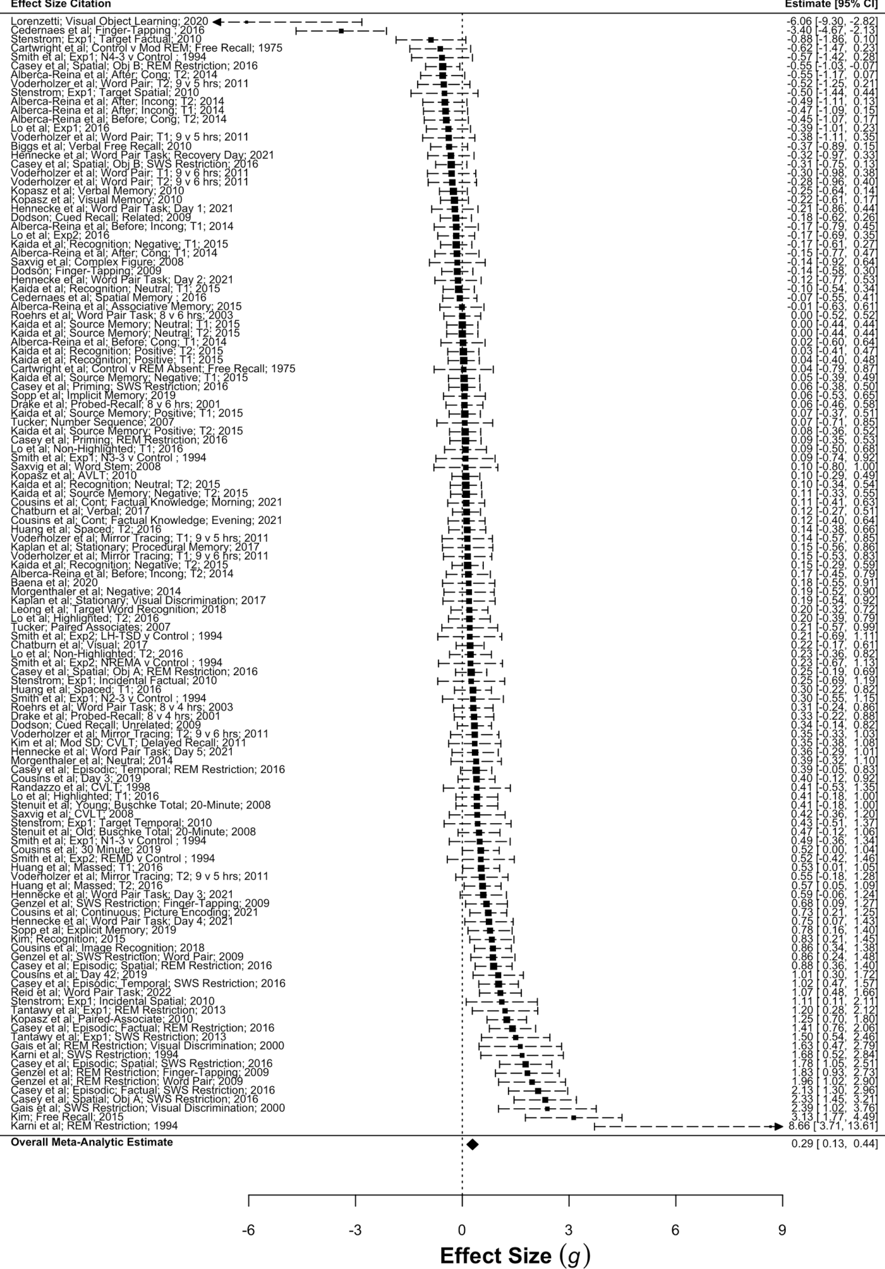
- Sleep restriction (3–6.5 h vs 7–11 h) impaired long-term memory formation with a small effect: Hedges’ g = 0.29, 95% CI [0.13, 0.44], p < .001; after removing 9 outliers/influential cases, g = 0.23, 95% CI [0.12, 0.35], p < .001.
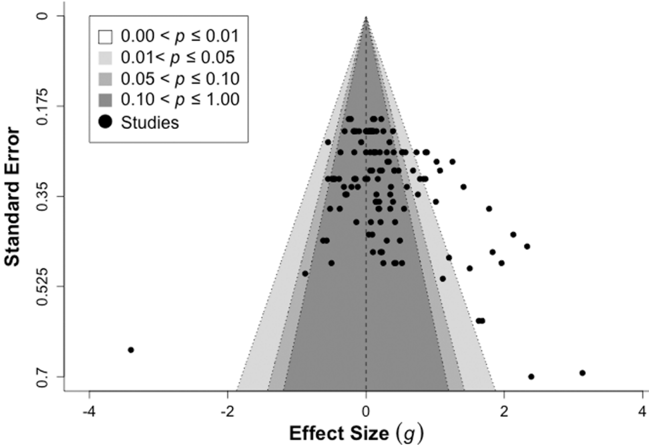
- No conclusive evidence of publication bias was detected: the three-parameter selection model showed no significant improvement when modelling publication bias (χ²(1) = 1.46, p = .228), although Egger’s test indicated funnel-plot asymmetry (z = 3.90, p < .001).
- Combining the 125 sleep-restriction effect sizes with 185 total sleep deprivation effect sizes from Newbury et al. (2021), type of sleep loss did not significantly moderate the overall effect (Q(1, 308) = 2.63, p = .105; after outlier removal Q(1, 288) = 2.16, p = .141), suggesting short sleep may have broadly similar memory consequences as no sleep.
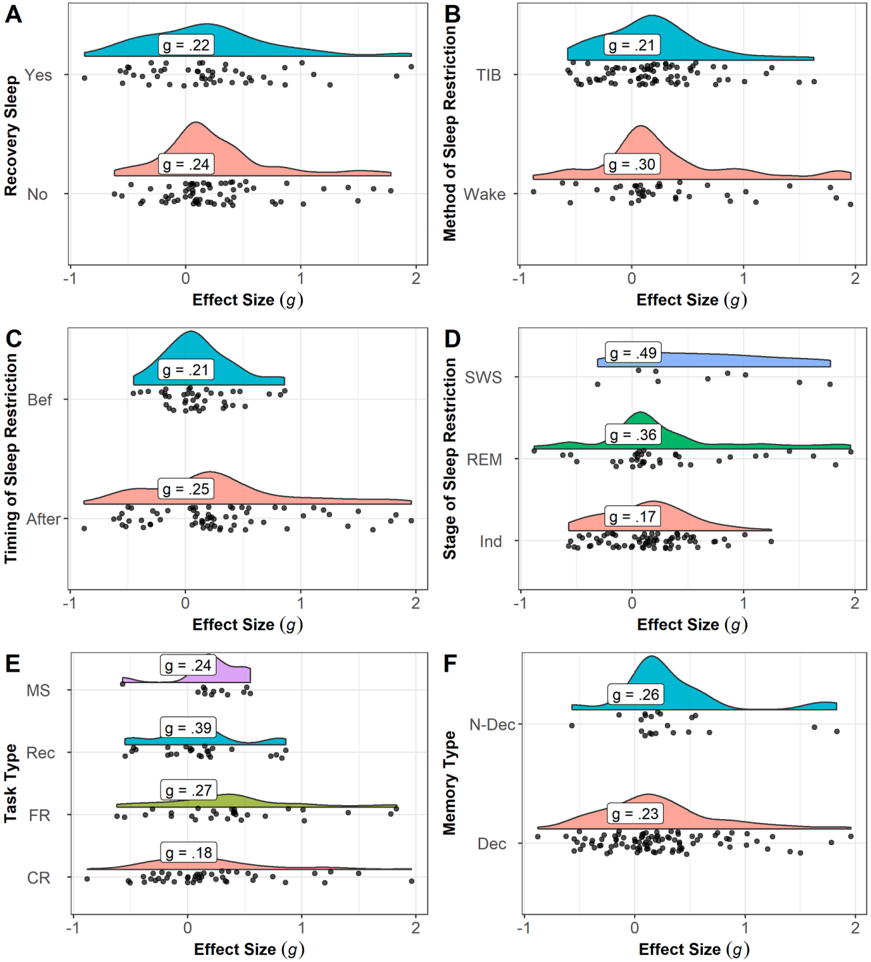
- Sleep stage moderated the effect only with outliers retained: SWS-targeted restriction g = 0.85, REM-targeted g = 0.40, indiscriminate g = 0.17 (Q(2, 122) = 11.72, p = .003); this did not survive outlier removal (p = .135). In timing analyses, sleep deprivation before encoding impaired memory more than sleep restriction before encoding (g = 0.63 vs 0.20 with outliers; g = 0.48 vs 0.20 without), whereas after encoding they were similar.
Methods
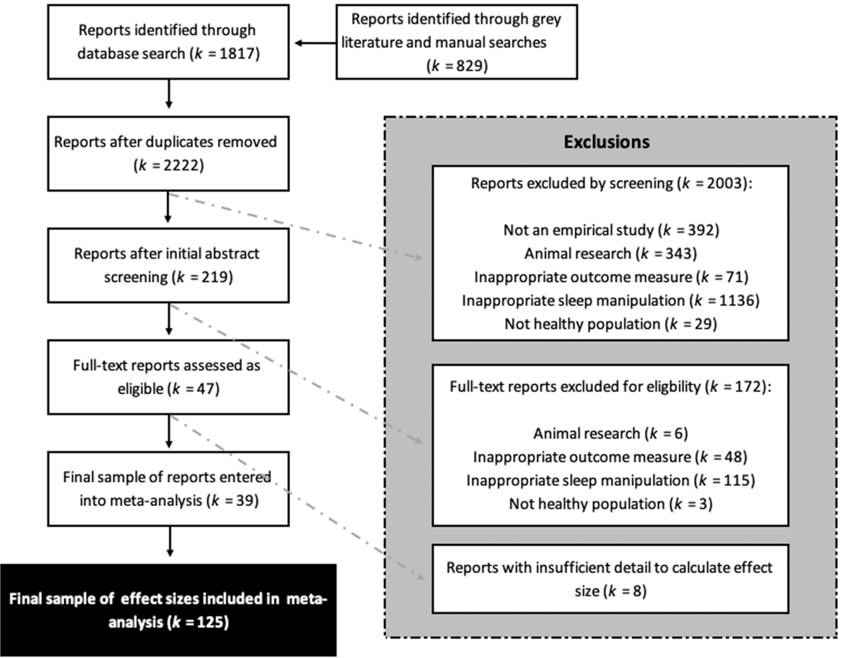
- Systematic search of EBSCOhost, PubMed, grey literature, preprints, reference lists, and author contact yielded 39 reports, 125 effect sizes, and 1234 participants; sleep restriction was 3–6.5 h over 1–14 nights versus control sleep of 7–11 h.
- Three-level random-effects meta-analysis with robust variance estimation was used to calculate Hedges’ g, with moderator analyses for sleep stage, timing, memory/task type, recovery sleep, age, methodological quality, and statistical power.
- Publication bias was assessed via contour-enhanced funnel plot, Egger’s regression, trim-and-fill, and the three-parameter selection model; sleep-restriction data were also combined with 185 total sleep deprivation effect sizes from Newbury et al. (2021).
Limitations
- The paper states that only seven grey-literature reports were identified, inclusion was English-only (51% of located effect sizes from Europe; 72% from western cultures), and only healthy typical populations were included, excluding sleep and psychiatric disorders.
- The paper states that only one effect size had a mean age above 30 years, so findings cannot be generalised to older adults; moderator analyses were underpowered and imbalanced (e.g., 13 SWS-targeted effect sizes, 12 motor-skill effect sizes, 25 non-declarative memory effect sizes), and the meta-analysis was not preregistered.
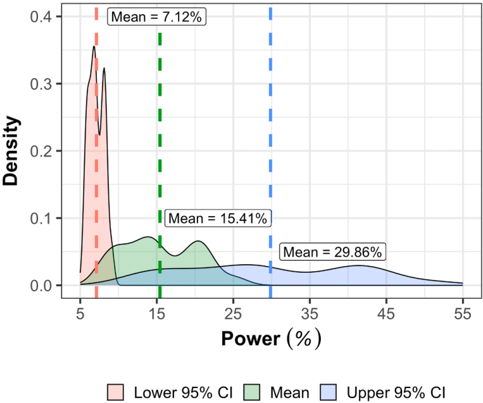
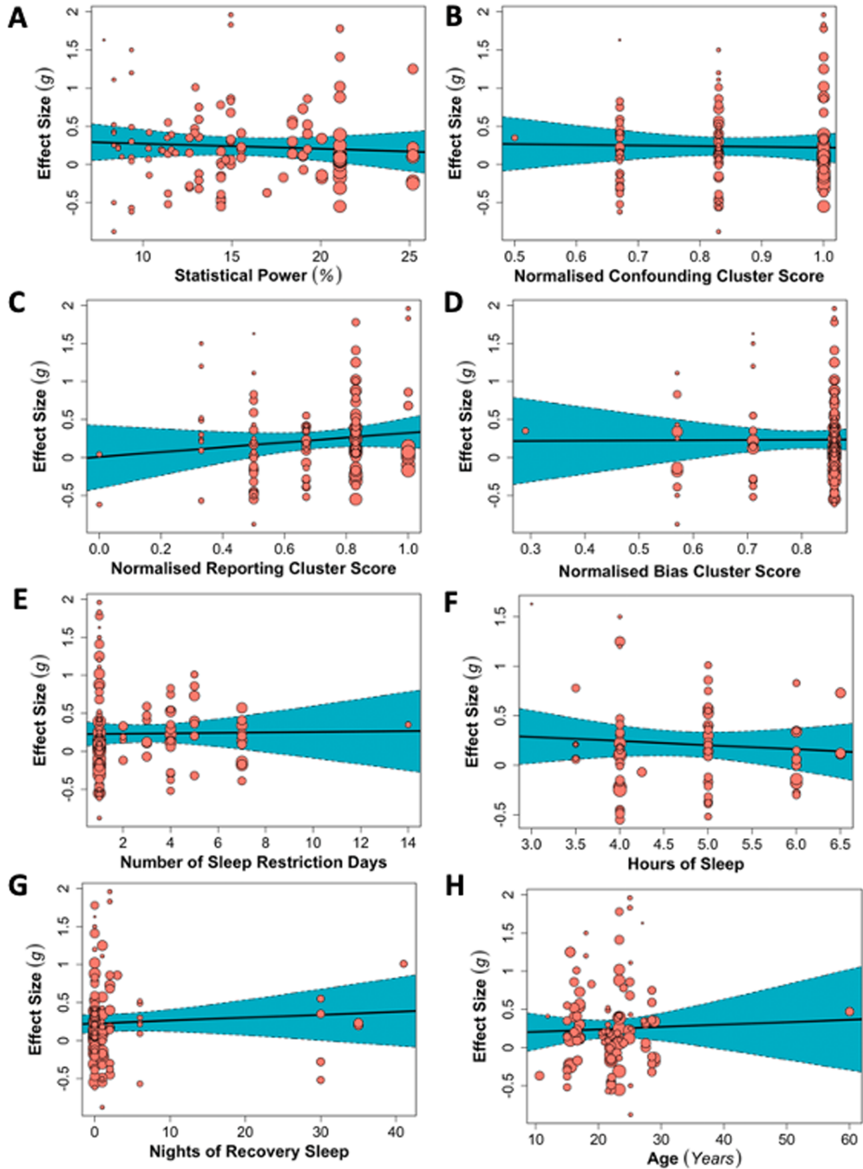
- The paper states that the meta-analysis is based on behavioural data only and that protocol differences between sleep restriction and total sleep deprivation may limit direct comparison; the text also makes evident that average statistical power to detect the meta-analytic estimate was very low (mean = 15.41%, range = 7.61%–25.19%).
Model-written summary. Check it against the paper before relying on it.
Integrity signals
Registry
Cites
Statistics
Figures

Verification
Claims the paper makes
0 Valid · 0 Not valid · 79 Not checked · 166 Own results and interpretations
A result the paper reports from its own data — it cites no other source for it, so there is none to check. The quote shows it is in the paper.
In the paper
“When the analysis was restricted to post-encoding, rather than pre-encoding, sleep loss, sleep deprivation was associated with larger memory impairment than restriction.”
§ A systematic and meta-analytic review of the impact of sleep restriction on memory formation > Abstract
plainstates an association- Asserted: passes — The authors put it forward as true.
- Checkable: passes — It can be checked against evidence.
- Load-bearing: passes — The paper’s conclusions depend on it.
- Based: passes — The paper gives a reason why it holds.
A result the paper reports from its own data — it cites no other source for it, so there is none to check. The quote shows it is in the paper.
In the paper
“We detected no evidence for publication bias.”
§ A systematic and meta-analytic review of the impact of sleep restriction on memory formation > Abstract
plain- Asserted: passes — The authors put it forward as true.
- Checkable: passes — It can be checked against evidence.
- Load-bearing: unclear — It is unclear whether the paper’s conclusions depend on it.
- Based: passes — The paper gives a reason why it holds.
In the paper
“When sleep restriction effect sizes were compared with 185 sleep deprivation effect sizes (Newbury et al., 2021) no statistically significant difference was found, suggesting that missing some sleep has similar consequences for memory as not sleeping at all.”
§ A systematic and meta-analytic review of the impact of sleep restriction on memory formation > Abstract
What the sources say
- Not checked yetcites Newbury et al., 2021 matched to “Sleep deprivation and memory: meta-analytic reviews of studies on sleep deprivation before and after learning” (2021) source
plain- Asserted: passes — The authors put it forward as true.
- Checkable: passes — It can be checked against evidence.
- Load-bearing: passes — The paper’s conclusions depend on it.
- Based: passes — The paper gives a reason why it holds.
A result the paper reports from its own data — it cites no other source for it, so there is none to check. The quote shows it is in the paper.
In the paper
“Restricting sleep (3-6.5 hours) compared to normal sleep (7-11 hours) negatively affects memory formation with a small effect size (Hedges' g = 0.29, 95 % CI = [0.13,0.44]).”
§ A systematic and meta-analytic review of the impact of sleep restriction on memory formation > Abstract
plainstates a causen = 1,234- Asserted: passes — The authors put it forward as true.
- Checkable: passes — It can be checked against evidence.
- Load-bearing: passes — The paper’s conclusions depend on it.
- Based: passes — The paper gives a reason why it holds.
In the paper
“Crucially, this combined sleep loss moderator analysis revealed that the type of sleep loss did not significantly moderate the magnitude of the detriment to memory”
§ A systematic and meta-analytic review of the impact of sleep restriction on memory formation > 4.1. Investigating predictions made by the sleep theories
What the sources say
- Not checked yetcites Newbury et al. (2021) matched to “Sleep deprivation and memory: meta-analytic reviews of studies on sleep deprivation before and after learning” (2021) source
plain- Asserted: passes — The authors put it forward as true.
- Checkable: passes — It can be checked against evidence.
- Load-bearing: passes — The paper’s conclusions depend on it.
- Based: passes — The paper gives a reason why it holds.
91 more claims
Create a free account to see all 245 claims and to verify the 125 references still open.
- Probably not a substantial claim. 66
- It may state two separate claims as one. 103
Statistics recomputed
Every reported test result, recomputed from its test statistic and degrees of freedom. A result shows as not adding up only once an independent check has confirmed it.
- Consistentt(33.93) = 3.64reported p < .001 · recomputed p < .001
“t(33.93)= 3.64, p < .001”
- Consistentz = 3.9reported p < .001 · recomputed p < .001
“(z = 3.90, p < .001”
- Consistentz = 4.92reported p < .001 · recomputed p < .001
“Z = 4.92, p < .001”
Self-check
Percentages, sums and reported differences re-computed from the paper’s own numbers.
Each contradiction between two passages listed here was confirmed by an independent check.
Rated major: it would touch a result — a value a result rests on, reported and recomputed p-values on opposite sides of the significance level, two passages that conflict with no sign which is right, or a cited work retracted before this paper was published.
In the paper
§ A systematic and meta-analytic review of the impact of sleep restriction on memory formation > Abstract
“When the analysis was restricted to post-encoding, rather than pre-encoding, sleep loss, sleep deprivation was associated with larger memory impairment than restriction.”
§ A systematic and meta-analytic review of the impact of sleep restriction on memory formation > 3.5. Moderator analyses with combined sleep loss data
“Sleep loss type (restriction vs. deprivation) was a significant moderator only when sleep loss occurred before encoding”
Rated minor: it would not touch a result — a value no result rests on, a p-value that stays on the same side of the significance level, or a conflict that is clerical, resolved elsewhere in the paper, or outside its own findings.
In the paper
§ A systematic and meta-analytic review of the impact of sleep restriction on memory formation > 4.8. Conclusion
“0.24 | [-0.03, 0.45]”
§ A systematic and meta-analytic review of the impact of sleep restriction on memory formation > 4.8. Conclusion
“[-0.03, 0.45] | .029*”
Rated minor: it would not touch a result — a value no result rests on, a p-value that stays on the same side of the significance level, or a conflict that is clerical, resolved elsewhere in the paper, or outside its own findings.
In the paper
§ A systematic and meta-analytic review of the impact of sleep restriction on memory formation > 4.8. Conclusion
“0.17 | [-0.02, 0.33]”
§ A systematic and meta-analytic review of the impact of sleep restriction on memory formation > 4.8. Conclusion
“[-0.02, 0.33] | .030*”
Citations
Cites
Bias in meta-analysis detected by a simple, graphical test
Egger, M., Smith, G. D., Schneider, M., & Minder, C. (1997) · BMJ · doi:10.1136/bmj.315.7109.629 · Cited by 56,722
Statistical power analyses using G∗Power 3.1: tests for correlation and regression analyses
Faul, F., Erdfelder, E., Buchner, A., & Lang, A.-G. (2009) · Behavior Research Methods · doi:10.3758/brm.41.4.1149 · Cited by 37,615
Preferred reporting items for systematic reviews and meta-analyses: The PRISMA statement
Moher, D., Liberati, A., Tetzlaff, J., Altman, D. G., & the PRISMA Group* (2009) · Annals of Internal Medicine · doi:10.7326/0003-4819-151-4-200908180-00135 · Cited by 37,554
Quantifying heterogeneity in a meta‐analysis
Higgins, J. P. T., & Thompson, S. G. (2002) · Statistics in Medicine · doi:10.1002/sim.1186 · Cited by 36,763
Nonparametric Statistics for the Behavioral Sciences
Guitton, H., & Siegel, S. (1958) · Revue économique · doi:10.2307/3498751 · Cited by 35,245
The Cochrane Collaboration's tool for assessing risk of bias in randomised trials
Higgins, J. P. T., Altman, D. G., Gotzsche, P. C., Juni, P., Moher, D., Oxman, A. D., Savovic, J., Schulz, K. F., Weeks, L., Sterne, J. A. C., et al. (2011) · BMJ · doi:10.1136/bmj.d5928 · Cited by 33,817
Conducting Meta-Analyses in R with the metafor Package
Viechtbauer, W. (2010) · Journal of Statistical Software · doi:10.18637/jss.v036.i03 · Cited by 20,464
Borenstein, M., Hedges, L. V., Higgins, J. P. T., & Rothstein, H. R. (2009) · doi:10.1002/9780470743386 · Cited by 14,225
Duval, S., & Tweedie, R. (2000) · Biometrics · doi:10.1111/j.0006-341x.2000.00455.x · Cited by 14,099
Shea, B. J., Reeves, B. C., Wells, G., Thuku, M., Hamel, C., Moran, J., Moher, D., Tugwell, P., Welch, V., Kristjansson, E., et al. (2017) · BMJ · doi:10.1136/bmj.j4008 · Cited by 10,636
Lakens, D. (2013) · Frontiers in Psychology · doi:10.3389/fpsyg.2013.00863 · Cited by 10,303 · cited 1×
“The standardised mean difference (Cohen ’ s d ) was calculated for each item included in our meta-analysis but given that effect sizes in Cohen ’ s d can be overestimated for small sample sizes (Lakens, 2013), each effect size was transformed according to the Hedges ’ g correction.”
MethodThe file drawer problem and tolerance for null results.
Rosenthal, R. (1979) · Psychological Bulletin · doi:10.1037/0033-2909.86.3.638 · Cited by 9,068
Downs, S. H., & Black, N. (1998) · Journal of Epidemiology and Community Health · doi:10.1136/jech.52.6.377 · Cited by 8,252
Sterne, J. A. C., Sutton, A. J., Ioannidis, J. P. A., Terrin, N., Jones, D. R., Lau, J., Carpenter, J., Rucker, G., Harbord, R. M., Schmid, C. H., et al. (2011) · BMJ · doi:10.1136/bmj.d4002 · Cited by 7,709
Regression Diagnostics: Identifying Influential Data and Sources of Collinearity
Belsley, D. A., Kuh, E., & Welsch, R. E. (1980) · Wiley Series in Probability and Statistics · doi:10.1002/0471725153 · Cited by 7,297
Regression Diagnostics -- Identifying Influential Data and Sources of Collinearity
Beaumont, C. D., Belsley, D. A., Kuh, E., & Welsch, R. E. (1981) · The Journal of the Operational Research Society · doi:10.2307/2581267 · Cited by 6,359
Methods of Meta-Analysis: Correcting Error and Bias in Research Findings
Schmidt, F. L., & Hunter, J. E. (2015) · doi:10.4135/9781483398105 · Cited by 5,542
The combination of estimates from different experiments
Cochran, W. G. (1954) · Biometrics · doi:10.2307/3001666 · Cited by 5,380
McClelland, J. L., McNaughton, B. L., & O'Reilly, R. C. (1995) · Psychological Review · doi:10.1037/0033-295x.102.3.419 · Cited by 5,256
Effect size estimates: Current use, calculations, and interpretation.
Fritz, C. O., Morris, P. E., & Richler, J. J. (2012) · Journal of Experimental Psychology: General · doi:10.1037/a0024338 · Cited by 5,199
The Handbook of Research Synthesis and Meta-Analysis
(2019) · doi:10.7758/9781610448864 · Cited by 4,553
National Sleep Foundation's sleep time duration recommendations: methodology and results summary.
Hirshkowitz, M., Whiton, K., Albert, S. M., Alessi, C., Bruni, O., DonCarlos, L., Hazen, N., Herman, J., Katz, E. S., Kheirandish-Gozal, L., et al. (2015) · Sleep Health · doi:10.1016/j.sleh.2014.12.010 · Cited by 4,404 · cited 1×
“The National Sleep Foundation recommends that adults sleep for roughly 8 hours per night, adolescents for 9 hours, and school-aged children for 10 hours (Hirshkowitz et al., 2015).”
BackgroundDiekelmann, S., & Born, J. (2010) · Nature Reviews Neuroscience · doi:10.1038/nrn2762 · Cited by 3,760
Ohayon, M. M., Carskadon, M. A., Guilleminault, C., & Vitiello, M. V. (2004) · Sleep · doi:10.1093/sleep/27.7.1255 · Cited by 3,349 · cited 2×
“Elderly individuals tend to have more fragmented and shorter sleep than younger individuals and reduced SWS durations (Carskadon et al., 1982; Feinberg and Campbell, 2010; Ohayon et al., 2004).”
BackgroundVan Dongen, H. P. A., Maislin, G., Mullington, J. M., & Dinges, D. F. (2003) · Sleep · doi:10.1093/sleep/26.2.117 · Cited by 3,173
Outlier and influence diagnostics for meta-analysis
Viechtbauer, W., & Cheung, M. W.-L. (2010) · Research Synthesis Methods · doi:10.1002/jrsm.11 · Cited by 2,949 · cited 4×
“Next, we used case deletion diagnostics to determine the influence of deleting each effect size on all parameter estimates (Cook ’ s distance) and on single parameter estimates (DFBETAs; Viechtbauer and Cheung, 2010).”
BackgroundMethodInfluentialRasch, B., & Born, J. (2013) · Physiological Reviews · doi:10.1152/physrev.00032.2012 · Cited by 2,783 · cited 5×
“…synaptic homeostasis hypothesis, molecular, structural and electrophysiological evidence is consistent with the occurrence of net synaptic potentiation during wake and net synaptic weakening during sleep (for reviews, see Cirelli and Tononi, 2020; Rasch and Born, 2013; Tononi and Cirelli, 2020).”
BackgroundMethodInfluentialTononi, G., & Cirelli, C. (2014) · Neuron · doi:10.1016/j.neuron.2013.12.025 · Cited by 2,356 · cited 2×
“It is clear then that this account pre-cludes a role for REM sleep (for a discussion, see Tononi and Cirelli, 2014) despite evidence for REM sleep involvement in downscaling (e.g., Grosmark et al., 2012; Li et al., 2017; Poe, 2017).”
BackgroundSleep function and synaptic homeostasis
Tononi, G., & Cirelli, C. (2006) · Sleep Medicine Reviews · doi:10.1016/j.smrv.2005.05.002 · Cited by 2,151 · cited 2×
“In support, the amplitude and synchronisation of slow oscillations decrease across a sleep episode, and this is thought to reflect decreasing global synaptic strengths (Esser et al., 2007; Tononi and Cirelli, 2006).”
BackgroundRobust variance estimation in meta‐regression with dependent effect size estimates
Hedges, L. V., Tipton, E., & Johnson, M. C. (2010) · Research Synthesis Methods · doi:10.1002/jrsm.5 · Cited by 2,086 · cited 1×
“To further account for this hierarchical structure, we used robust variance estimation to correct for dependencies amongst effect sizes (Hedges et al., 2010; Pustejovsky and Tipton, 2022) using the clubSandwich package in R (Pustejovsky, 2020).”
MethodPeters, J. L., Sutton, A. J., Jones, D. R., Abrams, K. R., & Rushton, L. (2008) · Journal of Clinical Epidemiology · doi:10.1016/j.jclinepi.2007.11.010 · Cited by 2,053 · cited 1×
“We first examined a contour-enhanced funnel plot displaying effect sizes according to their standard error with contour lines representing boundaries of statistical significance (e.g., p < .01, p < .05, p < .10; Peters et al., 2008).”
MethodThe Handbook of Research Synthesis.
Light, R. J., Cooper, H., & Hedges, L. V. (1994) · Journal of the American Statistical Association · doi:10.2307/2291021 · Cited by 1,868
Quantity and Quality of Sleep and Incidence of Type 2 Diabetes
Cappuccio, F. P., D'Elia, L., Strazzullo, P., & Miller, M. A. (2010) · Diabetes Care · doi:10.2337/dc09-1124 · Cited by 1,670 · cited 1×
“Physical costs have been well-documented including compromised immune system functioning (Cohen et al., 2009), obesity (Cappuccio et al., 2010), cardiometabolic diseases (Cappuccio and Miller, 2017), neuroendocrine stress (Leproult and Van Cauter, 2010), dysregulated inflammatory responses (Van…”
BackgroundA marker for the end of adolescence
Roenneberg, T., Kuehnle, T., Pramstaller, P. P., Ricken, J., Havel, M., Guth, A., & Merrow, M. (2004) · Current Biology · doi:10.1016/j.cub.2004.11.039 · Cited by 1,585 · cited 1×
“Consider, for example, adolescents who typically prefer to sleep and wake later than their early school start times allow due to the shift in chronotype associated with this phase of development (Bowers and Moyer, 2017; Roenneberg et al., 2004; 2007).”
BackgroundEffects of Sleep Deprivation on Performance: A Meta-Analysis
Pilcher, J. J., & Huffcutt, A. I. (1996) · Sleep · doi:10.1093/sleep/19.4.318 · Cited by 1,549 · cited 4×
“…memory processes emerge only under total sleep deprivation conditions (e.g., Roehrs et al., 2003) or alternatively short sleep over the longer term could have cumulative effects (e.g., Banks and Dinges, 2007; Pilcher and Huffcutt, 1996) that result in similar detriments as total sleep deprivation.”
BackgroundMethodInfluentialEpidemiology of the human circadian clock
Roenneberg, T., Kuehnle, T., Juda, M., Kantermann, T., Allebrandt, K., Gordijn, M., & Merrow, M. (2007) · Sleep Medicine Reviews · doi:10.1016/j.smrv.2007.07.005 · Cited by 1,545 · cited 4×
“Yet, many features of modern society pervasively hamper sleep opportunities (Pallesen et al., 2021; Roenneberg et al., 2007; Skeldon et al., 2017).”
BackgroundInfluentialBehavioral and Physiological Consequences of Sleep Restriction
Banks, S., & Dinges, D. F. (2007) · Journal of Clinical Sleep Medicine · doi:10.5664/jcsm.26918 · Cited by 1,505 · cited 4×
“Moreover, when sleep restriction is achieved by reducing time-in-bed, which is most common in real life (Banks and Dinges, 2007) and in the current meta-analysis (80 effect sizes), interactions between sleep stages are still disturbed.”
BackgroundResultInfluentialAppelbaum, M., Cooper, H., Kline, R. B., Mayo-Wilson, E., Nezu, A. M., & Rao, S. M. (2018) · American Psychologist · doi:10.1037/amp0000191 · Cited by 1,449 · cited 1×
“We adhered to the MARS guidelines for meta-analytic reporting (Appelbaum et al., 2018).”
MethodBelenky, G., Wesensten, N. J., Thorne, D. R., Thomas, M. L., Sing, H. C., Redmond, D. P., Russo, M. B., & Balkin, T. J. (2003) · Journal of Sleep Research · doi:10.1046/j.1365-2869.2003.00337.x · Cited by 1,436 · cited 3×
“For example, sleep restriction increases lapses in attention, vigilance, and alertness (Balkin et al., 2004; Belenky et al., 2003; Cunningham et al., 2018; Van Dongen et al., 2003) which are major causes of road traffic and workplace accidents (Chattu et al., 2018).”
BackgroundMethodEffects of sleep deprivation on cognition
Killgore, W. D. S. (2010) · Progress in Brain Research · doi:10.1016/b978-0-444-53702-7.00007-5 · Cited by 1,421 · cited 1×
“Sleep loss also impairs emotional regulation (e.g., Palmer and Alfano, 2017), sensory perception (e.g., Killgore, 2010), working memory (e.g., Frenda and Fenn, 2016), problem solving (e.g., Satterfield and Killgore, 2019), and creativity (e.g., Horne, 1988).”
BackgroundA meta-analysis of the impact of short-term sleep deprivation on cognitive variables
Lim, J., & Dinges, D. F. (2010) · Psychological Bulletin · doi:10.1037/a0018883 · Cited by 1,389 · cited 2×
“…impairs memory formation to a similar extent as total sleep loss, there are practical implications which need to be taken seriously, particularly given that comparable impairments are now documented across most cognitive domains (Berres and Erdfelder, 2021; Lim and Dinges, 2010; Lowe et al., 2017).”
BackgroundVariance imputation for overviews of clinical trials with continuous response
Follmann, D., Elliott, P., Suh, I., & Cutler, J. (1992) · Journal of Clinical Epidemiology · doi:10.1016/0895-4356(92)90054-q · Cited by 1,385
Cheung, M. W.-L. (2014) · Psychological Methods · doi:10.1037/a0032968 · Cited by 1,342
Fitting three-level meta-analytic models in R: A step-by-step tutorial
Assink, M., & Wibbelink, C. J. M. (2016) · The Quantitative Methods for Psychology · doi:10.20982/tqmp.12.3.p154 · Cited by 1,330
Structure and function of declarative and nondeclarative memory systems
Squire, L. R., & Zola, S. M. (1996) · Proceedings of the National Academy of Sciences · doi:10.1073/pnas.93.24.13515 · Cited by 1,327 · cited 1×
“Declarative memory here refers to conscious and effortful retrieval of facts (semantic memories) and events (episodic memories; Squire and Zola, 1996).”
BackgroundNorman, K. A., & O'Reilly, R. C. (2003) · Psychological Review · doi:10.1037/0033-295x.110.4.611 · Cited by 1,312 · cited 1×
“…extent to which recognition tasks, compared to recall tasks, require hippocampal involvement given recognition can be supported by a sense of familiarity and that familiarity can be achieved neocortically (Diekelmann et al., 2009; Norman, 2010; Norman and O ’ Reilly, 2003; Wixted and Squire, 2010).”
BackgroundThe impact of sleep deprivation on decision making: A review.
Harrison, Y., & Horne, J. A. (2000) · Journal of Experimental Psychology: Applied · doi:10.1037/1076-898x.6.3.236 · Cited by 1,238 · cited 2×
“Short sleep diminishes executive functioning and decision-making abilities (Harrison and Horne, 2000; Lau et al., 2019; Stojanoski et al., 2019; Tai et al., 2022) which is a particular concern for professions such as healthcare and aviation where critical decisions are made under high sleep debt…”
BackgroundSleep and synaptic homeostasis: a hypothesis
Tononi, G., & Cirelli, C. (2003) · Brain Research Bulletin · doi:10.1016/j.brainresbull.2003.09.004 · Cited by 1,217 · cited 5×
“…g for each moderating subcategory of data (categorical moderators); β = change in Hedges ’ g for one unit increase of the moderator (continuous moderators); 95 % CI = 95 % confidence intervals; * p ≤ .05, ** p ≤ .01, *** p ≤ .001. and Cirelli, 2003) – both prioritise the role of SWS over REM sleep.”
BackgroundInfluentialSleep Deprivation and Vigilant Attention
Lim, J., & Dinges, D. F. (2008) · Annals of the New York Academy of Sciences · doi:10.1196/annals.1417.002 · Cited by 1,213 · cited 2×
“…are so far limited to cognitive domains most susceptible to sleepiness such as attention and decision-making or effects of total sleep deprivation (Banks and Dinges, 2007; Harrison and Horne, 2000; Lim and Dinges, 2008, 2010; Lowe et al., 2017; Newbury et al., 2021; Pilcher and Huffcutt, 1996).”
BackgroundMander, B. A., Winer, J. R., & Walker, M. P. (2017) · Neuron · doi:10.1016/j.neuron.2017.02.004 · Cited by 1,185
Odor cues during slow-wave sleep prompt declarative memory consolidation
Rasch, B., Büchel, C., Gais, S., & Born, J. (2007) · Science · doi:10.1126/science.1138581 · Cited by 1,181
The role of sleep in learning and memory
Maquet, P. (2001) · Science · doi:10.1126/science.1062856 · Cited by 1,177 · cited 2×
“Third, we manually searched the reference lists of six seminal review papers and meta-analyses (Lowe et al., 2017; Maquet, 2001; Pilcher and Huffcutt, 1996; Rasch and Born, 2013; Stickgold et al., 2001; Walker and Stickgold, 2004).”
BackgroundMethodMechanisms of systems memory consolidation during sleep
Klinzing, J. G., Niethard, N., & Born, J. (2019) · Nature Neuroscience · doi:10.1038/s41593-019-0467-3 · Cited by 1,176 · cited 6×
“The most dominant sleep theories in the literature – the active systems consolidation theory (e.g., Klinzing et al., 2019) and the synaptic homeostasis hypothesis (Tononi Note.”
BackgroundInfluentialSleep-Dependent Learning and Memory Consolidation
Walker, M. P., & Stickgold, R. (2004) · Neuron · doi:10.1016/j.neuron.2004.08.031 · Cited by 1,113 · cited 1×
“Third, we manually searched the reference lists of six seminal review papers and meta-analyses (Lowe et al., 2017; Maquet, 2001; Pilcher and Huffcutt, 1996; Rasch and Born, 2013; Stickgold et al., 2001; Walker and Stickgold, 2004).”
MethodThe Global Problem of Insufficient Sleep and Its Serious Public Health Implications
Chattu, V. K., Manzar, M. D., Kumary, S., Burman, D., Spence, D. W., & Pandi-Perumal, S. R. (2018) · Healthcare · doi:10.3390/healthcare7010001 · Cited by 1,028
Effects of early and late nocturnal sleep on declarative and procedural memory
Plihal, W., & Born, J. (1997) · Journal of Cognitive Neuroscience · doi:10.1162/jocn.1997.9.4.534 · Cited by 1,026 · cited 2×
“…(SWS-rich) sleep and improved non-declarative memory performance following late (REM sleep-rich) sleep (Ekstrand et al., 1977; Gais et al., 2000; Plihal and Born, 1997, 1999; Wagner et al., 2001; Yordanova et al., 2008; for reviews, see Born et al., 2006; Diekelmann et al., 2009; Marshall and…”
BackgroundDependence on REM Sleep of Overnight Improvement of a Perceptual Skill
Karni, A., Tanne, D., Rubenstein, B. S., Askenasy, J. J. M., & Sagi, D. (1994) · Science · doi:10.1126/science.8036518 · Cited by 1,002
Normal Human Sleep: An Overview
Carskadon, M. A., & Dement, W. C. (2005) · Principles and Practice of Sleep Medicine · doi:10.1016/b0-72-160797-7/50009-4 · Cited by 995
Sleep and emotion regulation: An organizing, integrative review
Palmer, C. A., & Alfano, C. A. (2017) · Sleep Medicine Reviews · doi:10.1016/j.smrv.2015.12.006 · Cited by 935 · cited 1×
“Sleep loss also impairs emotional regulation (e.g., Palmer and Alfano, 2017), sensory perception (e.g., Killgore, 2010), working memory (e.g., Frenda and Fenn, 2016), problem solving (e.g., Satterfield and Killgore, 2019), and creativity (e.g., Horne, 1988).”
BackgroundSleep deprivation: Impact on cognitive performance
Alhola, P., & Polo-Kantola, P. (2007) · Neuropsychiatric Disease and Treatment · doi:10.2147/ndt.a930 · Cited by 869
Adjusting for publication bias in the presence of heterogeneity
Terrin, N., Schmid, C. H., Lau, J., & Olkin, I. (2003) · Statistics in Medicine · doi:10.1002/sim.1461 · Cited by 809
Principles and Practice of Sleep Medicine
(2017) · Elsevier eBooks · doi:10.1016/c2012-0-03543-0 · Cited by 783
Sleep, learning, and dreams: off-line memory reprocessing
Stickgold, R., Hobson, J. A., Fosse, R., & Fosse, M. (2001) · Science · doi:10.1126/science.1063530 · Cited by 762 · cited 1×
“Third, we manually searched the reference lists of six seminal review papers and meta-analyses (Lowe et al., 2017; Maquet, 2001; Pilcher and Huffcutt, 1996; Rasch and Born, 2013; Stickgold et al., 2001; Walker and Stickgold, 2004).”
MethodSzucs, D., & Ioannidis, J. P. A. (2017) · PLOS Biology · doi:10.1371/journal.pbio.2000797 · Cited by 761 · cited 1×
“These figures are somewhat higher than those typically found in psychology and cognitive neuro-science (Szucs and Ioannidis, 2017), but the widely accepted convention is still much higher at 80 % (di Stephano, 2003).”
BackgroundWhat Learning Systems do Intelligent Agents Need? Complementary Learning Systems Theory Updated
Kumaran, D., Hassabis, D., & McClelland, J. L. (2016) · Trends in Cognitive Sciences · doi:10.1016/j.tics.2016.05.004 · Cited by 759 · cited 2×
“The most well-known is the active systems consolidation theory (Klinzing et al., 2019; Kumaran et al., 2016; McClelland et al., 1995) which emphasises the importance of post-encoding SWS for transforming declarative (or hippocampal-dependent) memories.”
BackgroundSleep-dependent memory triage: evolving generalization through selective processing
Stickgold, R., & Walker, M. P. (2013) · Nature Neuroscience · doi:10.1038/nn.3303 · Cited by 755 · cited 1×
“Many theoretical accounts have since been put forward to explain the cognitive and neural mechanisms underlying these effects (for reviews, see Cordi and Rasch, 2021; Die-kelmann and Born, 2010; Feld and Born, 2017; Rasch and Born, 2013; Paller et al., 2021; Stickgold and Walker, 2013).”
BackgroundExperience-dependent changes in cerebral activation during human REM sleep
Maquet, P., Laureys, S., Peigneux, P., Fuchs, S., Petiau, C., Phillips, C., Aerts, J., Del Fiore, G., Degueldre, C., Meulemans, T., et al. (2000) · Nature Neuroscience · doi:10.1038/77744 · Cited by 747 · cited 1×
“…2002), emotional memory consolidation correlates with theta power during REM sleep and REM sleep duration (Nishida et al., 2009), and brain regions associated with procedural learning have been shown to reactivate during REM sleep (Maquet et al., 2000; Laureys et al., 2001; Peigneux et al., 2003).”
BackgroundObliviscence during sleep and waking
Jenkins, J. G., & Dallenbach, K. M. (1924) · The American Journal of Psychology · doi:10.2307/1414040 · Cited by 741
Meta-analysis with robust variance estimation: Expanding the range of working models
Pustejovsky, J. E., & Tipton, E. (2022) · Prevention Science · doi:10.1007/s11121-021-01246-3 · Cited by 737
Peters, J. L., Sutton, A. J., Jones, D. R., Abrams, K. R., & Rushton, L. (2007) · Statistics in Medicine · doi:10.1002/sim.2889 · Cited by 716
The power of statistical tests for moderators in meta-analysis
Hedges, L. V., & Pigott, T. D. (2004) · Psychological Methods · doi:10.1037/1082-989x.9.4.426 · Cited by 672
The contribution of sleep to hippocampus-dependent memory consolidation
Marshall, L., & Born, J. (2007) · Trends in Cognitive Sciences · doi:10.1016/j.tics.2007.09.001 · Cited by 667
Wagner, U., Gais, S., & Born, J. (2001) · Learning & Memory · doi:10.1101/lm.36801 · Cited by 605 · cited 1×
“…non-declarative memory performance following late (REM sleep-rich) sleep (Ekstrand et al., 1977; Gais et al., 2000; Plihal and Born, 1997, 1999; Wagner et al., 2001; Yordanova et al., 2008; for reviews, see Born et al., 2006; Diekelmann et al., 2009; Marshall and Born, 2007; Rasch and Born,…”
BackgroundSleep habits and susceptibility to the common cold
Cohen, S., Doyle, W. J., Alper, C. M., Janicki-Deverts, D., & Turner, R. B. (2009) · Archives of Internal Medicine · doi:10.1001/archinternmed.2008.505 · Cited by 605 · cited 1×
“Physical costs have been well-documented including compromised immune system functioning (Cohen et al., 2009), obesity (Cappuccio et al., 2010), cardiometabolic diseases (Cappuccio and Miller, 2017), neuroendocrine stress (Leproult and Van Cauter, 2010), dysregulated inflammatory responses (Van…”
BackgroundREM sleep, prefrontal theta, and the consolidation of human emotional memory
Nishida, M., Pearsall, J., Buckner, R. L., & Walker, M. P. (2009) · Cerebral Cortex · doi:10.1093/cercor/bhn155 · Cited by 603
Role of Sleep and Sleep Loss in Hormonal Release and Metabolism
Leproult, R., & Van Cauter, E. (2010) · Endocrine Development · doi:10.1159/000262524 · Cited by 602 · cited 1×
“…system functioning (Cohen et al., 2009), obesity (Cappuccio et al., 2010), cardiometabolic diseases (Cappuccio and Miller, 2017), neuroendocrine stress (Leproult and Van Cauter, 2010), dysregulated inflammatory responses (Van Leeuwen et al., 2009), and mental health issues (Tang et al., 2017).”
BackgroundA deficit in the ability to form new human memories without sleep
Yoo, S.-S., Hu, P. T., Gujar, N., Jolesz, F. A., & Walker, M. P. (2007) · Nature Neuroscience · doi:10.1038/nn1851 · Cited by 597 · cited 2×
“Moreover, neuroimaging evidence has demonstrated reduced encoding-related hippocampal activation following one night of sleep deprivation (Yoo et al., 2007) or one night of suppressed slow wave activity (with preserved total sleep time; Van der Werf et al., 2009).”
BackgroundSleep-dependent learning: A nap is as good as a night
Mednick, S., Nakayama, K., & Stickgold, R. (2003) · Nature Neuroscience · doi:10.1038/nn1078 · Cited by 594
Sleep forms memory for finger skills
Fischer, S., Hallschmid, M., Elsner, A. L., & Born, J. (2002) · Proceedings of the National Academy of Sciences · doi:10.1073/pnas.182178199 · Cited by 589 · cited 1×
“Further, overnight improvements in procedural memory correlate with REM sleep duration (Fischer et al., 2002), emotional memory consolidation correlates with theta power during REM sleep and REM sleep duration (Nishida et al., 2009), and brain regions associated with procedural learning have been…”
BackgroundThe whats and whens of sleep-dependent memory consolidation
Diekelmann, S., Wilhelm, I., & Born, J. (2009) · Sleep Medicine Reviews · doi:10.1016/j.smrv.2008.08.002 · Cited by 566 · cited 5×
“…of recovery sleep and the number of recovery nights were included to determine whether memory deficits remain in the absence of sleepiness due to restricted sleep (Lim and Dinges, 2008) and whether catch-up sleep compensates for lost sleep (Diekelmann et al., 2009; Sch ¨ onauer et al., 2015).”
BackgroundInfluentialVisual Discrimination Task Improvement: A Multi-Step Process Occurring During Sleep
Stickgold, R., Whidbee, D., Schirmer, B., Patel, V., & Hobson, J. A. (2000) · Journal of Cognitive Neuroscience · doi:10.1162/089892900562075 · Cited by 560
Early sleep triggers memory for early visual discrimination skills
Gais, S., Plihal, W., Wagner, U., & Born, J. (2000) · Nature Neuroscience · doi:10.1038/81881 · Cited by 558 · cited 1×
“…following early (SWS-rich) sleep and improved non-declarative memory performance following late (REM sleep-rich) sleep (Ekstrand et al., 1977; Gais et al., 2000; Plihal and Born, 1997, 1999; Wagner et al., 2001; Yordanova et al., 2008; for reviews, see Born et al., 2006; Diekelmann et al.,…”
BackgroundBorn, J., Rasch, B., & Gais, S. (2006) · The Neuroscientist · doi:10.1177/1073858406292647 · Cited by 557
REM sleep selectively prunes and maintains new synapses in development and learning
Li, W., Ma, L., Yang, G., & Gan, W.-B. (2017) · Nature Neuroscience · doi:10.1038/nn.4479 · Cited by 543 · cited 1×
“It is clear then that this account pre-cludes a role for REM sleep (for a discussion, see Tononi and Cirelli, 2014) despite evidence for REM sleep involvement in downscaling (e.g., Grosmark et al., 2012; Li et al., 2017; Poe, 2017).”
BackgroundThe neurocognitive consequences of sleep restriction: A meta-analytic review
Lowe, C. J., Safati, A., & Hall, P. A. (2017) · Neuroscience & Biobehavioral Reviews · doi:10.1016/j.neubiorev.2017.07.010 · Cited by 520 · cited 8×
“…adaptive mechanism would compensate for prolonged sleep restriction in the long-term memory domain (Drake et al., 2001), a previous meta-analysis (Lowe et al., 2017) assessed the impact of 2 – 6 hours of sleep loss and found that the effect size associated with long-term memory was in fact…”
BackgroundMethodResultInfluentialRodgers, M. A., & Pustejovsky, J. E. (2021) · Psychological Methods · doi:10.1037/met0000300 · Cited by 492 · cited 1×
“Note however that the 3-PSM does not account for dependence between effect sizes which can inflate the Type I error rate (Rodgers and Pustejovsky, 2020).”
Backgroundvan Leeuwen, W. M. A., Lehto, M., Karisola, P., Lindholm, H., Luukkonen, R., Sallinen, M., Härmä, M., Porkka-Heiskanen, T., & Alenius, H. (2009) · PLoS ONE · doi:10.1371/journal.pone.0004589 · Cited by 483
Sleep spindle activity is associated with the integration of new memories and existing knowledge
Tamminen, J., Payne, J. D., Stickgold, R., Wamsley, E. J., & Gaskell, M. G. (2010) · The Journal of Neuroscience · doi:10.1523/jneurosci.3028-10.2010 · Cited by 478 · cited 3×
“…representations are less liable to disruption and are integrated with pre-existing knowledge networks allowing for integration of new memories with existing knowledge and discovery of similarities between new and old memories (Durrant et al., 2011; Lewis et al., 2018; Tamminen et al., 2010, 2012).”
BackgroundSelf-citationSleep states and memory processes
Smith, C. (1995) · Behavioural Brain Research · doi:10.1016/0166-4328(95)00024-n · Cited by 473
Kocevska, D., Lysen, T. S., Dotinga, A., Koopman-Verhoeff, M. E., Luijk, M. P. C. M., Antypa, N., Biermasz, N. R., Blokstra, A., Brug, J., Burk, W. J., et al. (2020) · Nature Human Behaviour · doi:10.1038/s41562-020-00965-x · Cited by 473
Meta-analysis of multiple outcomes: a multilevel approach
Van den Noortgate, W., López-López, J. A., Marín-Martínez, F., & Sánchez-Meca, J. (2015) · Behavior Research Methods · doi:10.3758/s13428-014-0527-2 · Cited by 450
Sleep and emotional processing
Tempesta, D., Socci, V., De Gennaro, L., & Ferrara, M. (2018) · Sleep Medicine Reviews · doi:10.1016/j.smrv.2017.12.005 · Cited by 443 · cited 1×
“…to disproportionately impair encoding and consolidation of emotional memories over neutral memories (Crowley et al., 2019; Lipinska et al., 2019; Tempesta et al., 2018; although no moderating effect of emotionality was found following total sleep deprivation in Newbury et al., 2021), yet the…”
BackgroundSleep Disturbances in Patients with Schizophrenia: Impact and Effect of Antipsychotics
Cohrs, S. (2008) · CNS Drugs · doi:10.2165/00023210-200822110-00004 · Cited by 433 · cited 1×
“However, short sleep durations are most commonly found in these populations (Cohrs, 2008; Reynolds and Banks, 2010), and therefore, a better understanding of the consequences of sleep restriction for populations that it most affects is now warranted.”
BackgroundCognitive Function Following Acute Sleep Restriction in Children Ages 10–14
(1998) · Sleep · doi:10.1093/sleep/21.8.861 · Cited by 430
Fraley, R. C., & Vazire, S. (2014) · PLoS ONE · doi:10.1371/journal.pone.0109019 · Cited by 409
Short Sleep Duration Among Middle School and High School Students — United States, 2015
Wheaton, A. G., Jones, S. E., Cooper, A. C., & Croft, J. B. (2018) · MMWR. Morbidity and Mortality Weekly Report · doi:10.15585/mmwr.mm6703a1 · Cited by 389 · cited 1×
“Insufficient sleep is rife in this population with some estimates suggesting that 58 % – 73 % of high-school students sleep for less than the minimum recommendation for their age (Wheaton et al., 2018; see also Peltzer and Pengpid, 2016).”
BackgroundSelection Models and the File Drawer Problem
Iyengar, S., & Greenhouse, J. B. (1988) · Statistical Science · doi:10.1214/ss/1177013012 · Cited by 384
The sequential hypothesis of the function of sleep
Giuditta, A., Ambrosini, M. V., Montagnese, P., Mandile, P., Cotugno, M., Zucconi, G. G., & Vescia, S. (1995) · Behavioural Brain Research · doi:10.1016/0166-4328(95)00012-i · Cited by 382 · cited 4×
“…likely have complementary roles in memory consolidation, regardless of memory type, given the cyclic succession of sleep stages in the human sleep cycle (Giuditta, 2014; Giuditta et al., 1995; see also, Diekelmann and Born, 2010; Klinzing et al., 2019; Lewis et al., 2018; Rasch and Born, 2013).”
BackgroundInfluentialSleep fragmentation in the elderly: Relationship to daytime sleep tendency
Carskadon, M. A., Brown, E. D., & Dement, W. C. (1982) · Neurobiology of Aging · doi:10.1016/0197-4580(82)90020-3 · Cited by 377
Effects of early and late nocturnal sleep on priming and spatial memory
Plihal, W., & Born, J. (1999) · Psychophysiology · doi:10.1111/1469-8986.3650571 · Cited by 364
Biasing the content of hippocampal replay during sleep
Bendor, D., & Wilson, M. A. (2012) · Nature Neuroscience · doi:10.1038/nn.3203 · Cited by 359 · cited 1×
“…and experimentally biasing the content of such replay (using a technique known as targeted memory reactivation; for a review, see Carbone and Diekelmann, 2024) boosts memory performance for the targeted content (Bendor and Wilson, 2012; Crowley et al., 2019; Hu et al., 2020; Rasch et al., 2007).”
MethodSleep states and memory processes in humans: procedural versus declarative memory systems
Smith, C. (2001) · Sleep Medicine Reviews · doi:10.1053/smrv.2001.0164 · Cited by 355 · cited 1×
“…memory consolidation, but another family of theories, dual process theories, also argue that post-encoding REM sleep is critical for the consolidation of non-declarative information such as procedural, perceptual, and emotional memories (e.g., Plihal and Born, 1997, 1999, Smith, 1995, 2001).”
BackgroundTesting for funnel plot asymmetry of standardized mean differences
Pustejovsky, J. E., & Rodgers, M. A. (2019) · Research Synthesis Methods · doi:10.1002/jrsm.1332 · Cited by 354 · cited 1×
“…to their standard errors, and this is particularly true in the presence of small within-subject sample sizes or large between-study heterogeneity (Pustejovsky and Rodgers, 2019), and c) the performance of the trim-and-fill method decreases with increasing between-study heterogeneity (Peters et…”
BackgroundMemory reconsolidation: an update
Nader, K., & Einarsson, E. Ö. (2010) · Annals of the New York Academy of Sciences · doi:10.1111/j.1749-6632.2010.05443.x · Cited by 351
REM sleep reorganizes hippocampal excitability
Grosmark, A. D., Mizuseki, K., Pastalkova, E., Diba, K., & Buzsáki, G. (2012) · Neuron · doi:10.1016/j.neuron.2012.08.015 · Cited by 344 · cited 2×
“…cycle impair word retention more than awakenings preserving the sleep cycle (Ficca et al., 2000), and electrophysiological work in rats shows that neural signatures of memory replay during NREM sleep correlate highly with REM theta power (Grosmark et al., 2012; see also Miyawaki & Diba, 2016).”
BackgroundEsser, S. K., Hill, S. L., & Tononi, G. (2007) · Sleep · doi:10.1093/sleep/30.12.1617 · Cited by 315 · cited 1×
“In support, the amplitude and synchronisation of slow oscillations decrease across a sleep episode, and this is thought to reflect decreasing global synaptic strengths (Esser et al., 2007; Tononi and Cirelli, 2006).”
BackgroundSleep benefits subsequent hippocampal functioning
Van Der Werf, Y. D., Altena, E., Schoonheim, M. M., Sanz-Arigita, E. J., Vis, J. C., De Rijke, W., & Van Someren, E. J. W. (2009) · Nature Neuroscience · doi:10.1038/nn.2253 · Cited by 313
Sheehan, C. M., Frochen, S. E., Walsemann, K. M., & Ailshire, J. A. (2019) · Sleep · doi:10.1093/sleep/zsy221 · Cited by 313
Sleep and Cardio-Metabolic Disease
Cappuccio, F. P., & Miller, M. A. (2017) · Current Cardiology Reports · doi:10.1007/s11886-017-0916-0 · Cited by 313
Sleep Loss and “Divergent” Thinking Ability
Horne, J. A. (1988) · Sleep · doi:10.1093/sleep/11.6.528 · Cited by 311 · cited 1×
“Sleep loss also impairs emotional regulation (e.g., Palmer and Alfano, 2017), sensory perception (e.g., Killgore, 2010), working memory (e.g., Frenda and Fenn, 2016), problem solving (e.g., Satterfield and Killgore, 2019), and creativity (e.g., Horne, 1988).”
BackgroundPeigneux, P., Laureys, S., Fuchs, S., Destrebecqz, A., Collette, F., Delbeuck, X., Phillips, C., Aerts, J., Del Fiore, G., Degueldre, C., et al. (2003) · NeuroImage · doi:10.1016/s1053-8119(03)00278-7 · Cited by 308
Sleep Oscillations in the Thalamocortical System Induce Long-Term Neuronal Plasticity
Chauvette, S., Seigneur, J., & Timofeev, I. (2012) · Neuron · doi:10.1016/j.neuron.2012.08.034 · Cited by 304 · cited 1×
“…shows that synaptic connections representing recently encoded events are disproportionately strengthened during sleep (e.g., Aton et al., 2014; Chauvette et al., 2012; Ribeiro et al., 1999), yet sleep-related memory benefits, as per the synaptic homeostasis hypothesis, should be non-specific…”
BackgroundSleep EEG changes during adolescence: An index of a fundamental brain reorganization
Feinberg, I., & Campbell, I. G. (2010) · Brain and Cognition · doi:10.1016/j.bandc.2009.09.008 · Cited by 280
The relationships between memory systems and sleep stages
RAUCHS, G., DESGRANGES, B., FORET, J., & EUSTACHE, F. (2005) · Journal of Sleep Research · doi:10.1111/j.1365-2869.2005.00450.x · Cited by 280
An ultra short episode of sleep is sufficient to promote declarative memory performance
LAHL, O., WISPEL, C., WILLIGENS, B., & PIETROWSKY, R. (2008) · Journal of Sleep Research · doi:10.1111/j.1365-2869.2008.00622.x · Cited by 277
Balkin, T. J., Bliese, P. D., Belenky, G., Sing, H., Thorne, D. R., Thomas, M., Redmond, D. P., Russo, M., & Wesensten, N. J. (2004) · Journal of Sleep Research · doi:10.1111/j.1365-2869.2004.00407.x · Cited by 271
Genzel, L., Kroes, M. C. W., Dresler, M., & Battaglia, F. P. (2014) · Trends in Neurosciences · doi:10.1016/j.tins.2013.10.002 · Cited by 260
Brain Gene Expression During REM Sleep Depends on Prior Waking Experience
Ribeiro, S., Goyal, V., Mello, C. V., & Pavlides, C. (1999) · Learning & Memory · doi:10.1101/lm.6.5.500 · Cited by 259
Sleep and REM sleep disturbance in the pathophysiology of PTSD: the role of extinction memory
Pace-Schott, E. F., Germain, A., & Milad, M. R. (2015) · Biology of Mood & Anxiety Disorders · doi:10.1186/s13587-015-0018-9 · Cited by 255
Repeated Partial Sleep Deprivation Progressively Changes the EEG During Sleep and Wakefulness
Brunner, D. P., Dijk, D.-J., & Borbély, A. A. (1993) · Sleep · doi:10.1093/sleep/16.2.100 · Cited by 237
Norman, K. A. (2010) · Hippocampus · doi:10.1002/hipo.20855 · Cited by 236
Promoting memory consolidation during sleep: A meta-analysis of targeted memory reactivation
Hu, X., Cheng, L. Y., Chiu, M. H., & Paller, K. A. (2020) · Psychological Bulletin · doi:10.1037/bul0000223 · Cited by 232 · cited 1×
“…and experimentally biasing the content of such replay (using a technique known as targeted memory reactivation; for a review, see Carbone and Diekelmann, 2024) boosts memory performance for the targeted content (Bendor and Wilson, 2012; Crowley et al., 2019; Hu et al., 2020; Rasch et al., 2007).”
MethodEffects of rapid versus slow accumulation of eight hours of sleep loss
Drake, C. L., Roehrs, T. A., Burduvali, E., Bonahoom, A., Rosekind, M., & Roth, T. (2001) · Psychophysiology · doi:10.1111/1469-8986.3860979 · Cited by 231 · cited 1×
“Further, whilst some suggest that an adaptive mechanism would compensate for prolonged sleep restriction in the long-term memory domain (Drake et al., 2001), a previous meta-analysis (Lowe et al., 2017) assessed the impact of 2 – 6 hours of sleep loss and found that the effect size associated with…”
BackgroundInfluential Cases in Multilevel Modeling: A Methodological Comment
Van der Meer, T., Te Grotenhuis, M., & Pelzer, B. (2010) · American Sociological Review · doi:10.1177/0003122409359166 · Cited by 225
Sleep and synaptic down-selection
Tononi, G., & Cirelli, C. (2020) · European Journal of Neuroscience · doi:10.1111/ejn.14335 · Cited by 217 · cited 1×
“…synaptic homeostasis hypothesis, molecular, structural and electrophysiological evidence is consistent with the occurrence of net synaptic potentiation during wake and net synaptic weakening during sleep (for reviews, see Cirelli and Tononi, 2020; Rasch and Born, 2013; Tononi and Cirelli, 2020).”
BackgroundHow memory replay in sleep boosts creative problem-solving
Lewis, P. A., Knoblich, G., & Poe, G. (2018) · Trends in Cognitive Sciences · doi:10.1016/j.tics.2018.03.009 · Cited by 210 · cited 4×
“…them such that qualitative properties emerge including integration into existing networks (e.g., Tamminen et al., 2010), generalisation (e.g., Tamminen et al., 2012), detecting statistical regularities (e.g., Durrant et al., 2011), and uncovering hidden rules (e.g., Lewis et al., 2018).”
BackgroundInfluentialImpaired motor memory for a pursuit rotor task following Stage 2 sleep loss in college students
SMITH, C., & MACNEILL, C. (1994) · Journal of Sleep Research · doi:10.1111/j.1365-2869.1994.tb00133.x · Cited by 210
The hippocampus is crucial for forming non-hippocampal long-term memory during sleep
Sawangjit, A., Oyanedel, C. N., Niethard, N., Salazar, C., Born, J., & Inostroza, M. (2018) · Nature · doi:10.1038/s41586-018-0716-8 · Cited by 208 · cited 1×
“…memories encoded independently of the hippocampus which typically reflects nonconscious learning known as non-declarative memory (King et al., 2017; Sawangjit et al., 2018; Schapiro et al., 2019), the scope of the active systems consolidation theory is largely limited to post-encoding SWS…”
BackgroundTotal sleep deprivation, chronic sleep restriction and sleep disruption
Reynolds, A. C., & Banks, S. (2010) · Progress in Brain Research · doi:10.1016/b978-0-444-53702-7.00006-3 · Cited by 204
Johnson, B. T., & Hennessy, E. A. (2019) · Social Science & Medicine · doi:10.1016/j.socscimed.2019.05.035 · Cited by 201
Sleeping on the motor engram: The multifaceted nature of sleep-related motor memory consolidation
King, B. R., Hoedlmoser, K., Hirschauer, F., Dolfen, N., & Albouy, G. (2017) · Neuroscience & Biobehavioral Reviews · doi:10.1016/j.neubiorev.2017.04.026 · Cited by 201
Sleep-dependent consolidation of statistical learning.
Durrant, S. J., Taylor, C., Cairney, S., & Lewis, P. A. (2011) · Neuropsychologia · doi:10.1016/j.neuropsychologia.2011.02.015 · Cited by 197 · cited 3×
“…them such that qualitative properties emerge including integration into existing networks (e.g., Tamminen et al., 2010), generalisation (e.g., Tamminen et al., 2012), detecting statistical regularities (e.g., Durrant et al., 2011), and uncovering hidden rules (e.g., Lewis et al., 2018).”
BackgroundTrait-like vulnerability to total and partial sleep loss
Rupp, T. L., Wesensten, N. J., & Balkin, T. J. (2012) · Sleep · doi:10.5665/sleep.2010 · Cited by 186 · cited 1×
“…this is an important consideration given that many inter-individual differences do impact vulnerability to cognitive effects of sleep loss (Maire et al., 2014; Rupp et al., 2012; Van Dongen et al., 2004) and nightly sleep durations are known to differ between cultures (Cheung et al., 2021).”
BackgroundLaureys, S., Peigneux, P., Phillips, C. L. M., Fuchs, S., Degueldre, C., Aerts, J. J., Fiore, G. D., Petiau, C., Luxen, A., der Linden, M. V., et al. (2001) · Neuroscience · doi:10.1016/s0306-4522(01)00269-x · Cited by 177
Wake deterioration and sleep restoration of human learning
Mander, B. A., Santhanam, S., Saletin, J. M., & Walker, M. P. (2011) · Current Biology · doi:10.1016/j.cub.2011.01.019 · Cited by 176
Sculpting memory during sleep: concurrent consolidation and forgetting
Feld, G. B., & Born, J. (2017) · Current Opinion in Neurobiology · doi:10.1016/j.conb.2017.02.012 · Cited by 174
The Role of Slow Wave Sleep in Memory Processing.
Walker, M. P. (2009) · Journal of Clinical Sleep Medicine · doi:10.5664/jcsm.5.2s.s20 · Cited by 170
Skeldon, A. C., Derks, G., & Dijk, D.-J. (2016) · Sleep Medicine Reviews · doi:10.1016/j.smrv.2015.05.011 · Cited by 165
Korman, M., Tkachev, V., Reis, C., Komada, Y., Kitamura, S., Gubin, D., Kumar, V., & Roenneberg, T. (2020) · Scientific Reports · doi:10.1038/s41598-020-79299-7 · Cited by 161 · cited 1×
“The common need for more sleep was evident during COVID-19 lockdowns when lack of sleep timing constraints meant populations globally lengthened their nightly sleep durations (Crowley et al., 2023; Korman et al., 2020).”
BackgroundDi Stefano, J. (2003) · Functional Ecology · doi:10.1046/j.1365-2435.2003.00782.x · Cited by 159
Abnormal sleep spindles, memory consolidation, and schizophrenia
Manoach, D. S., & Stickgold, R. (2019) · Annual Review of Clinical Psychology · doi:10.1146/annurev-clinpsy-050718-095754 · Cited by 157 · cited 1×
“This was deliberate in light of growing evidence that the mechanisms underlying sleep memory benefits differ in these populations (Cellini, 2017; Manoach and Stickgold, 2019).”
BackgroundBowers, J. M., & Moyer, A. (2017) · Sleep Health · doi:10.1016/j.sleh.2017.08.004 · Cited by 156 · cited 1×
“Consider, for example, adolescents who typically prefer to sleep and wake later than their early school start times allow due to the shift in chronotype associated with this phase of development (Bowers and Moyer, 2017; Roenneberg et al., 2004; 2007).”
BackgroundSkeldon, A. C., Phillips, A. J. K., & Dijk, D.-J. (2017) · Scientific Reports · doi:10.1038/srep45158 · Cited by 155 · cited 2×
“Yet, many features of modern society pervasively hamper sleep opportunities (Pallesen et al., 2021; Roenneberg et al., 2007; Skeldon et al., 2017).”
BackgroundMemory and Sleep: How Sleep Cognition Can Change the Waking Mind for the Better
Paller, K. A., Creery, J. D., & Schechtman, E. (2021) · Annual Review of Psychology · doi:10.1146/annurev-psych-010419-050815 · Cited by 150 · cited 1×
“Many theoretical accounts have since been put forward to explain the cognitive and neural mechanisms underlying these effects (for reviews, see Cordi and Rasch, 2021; Die-kelmann and Born, 2010; Feld and Born, 2017; Rasch and Born, 2013; Paller et al., 2021; Stickgold and Walker, 2013).”
BackgroundImpact of sleep duration on executive function and brain structure
Tai, X. Y., Chen, C., Manohar, S., & Husain, M. (2022) · Communications Biology · doi:10.1038/s42003-022-03123-3 · Cited by 148
Newbury, C. R., Crowley, R., Rastle, K., & Tamminen, J. (2021) · Psychological Bulletin · doi:10.1037/bul0000348 · Cited by 142
Self-citationRisk of bias: a simulation study of power to detect study-level moderator effects in meta-analysis
Hempel, S., Miles, J. N., Booth, M. J., Wang, Z., Morton, S. C., & Shekelle, P. G. (2013) · Systematic Reviews · doi:10.1186/2046-4053-2-107 · Cited by 137 · cited 5×
“…total sleep deprivation after encoding meta-analysis in Newbury et al. (2021) are comparable across a number of factors known to affect statistical power of moderating effects including number of effect sizes and balance in the number of effect sizes between moderator levels (Hempel et al., 2013).”
BackgroundInfluentialSleep less, think worse: The effect of sleep deprivation on working memory.
Frenda, S. J., & Fenn, K. M. (2016) · Journal of Applied Research in Memory and Cognition · doi:10.1016/j.jarmac.2016.10.001 · Cited by 137
Slow-wave sleep and the consolidation of long-term memory
Born, J. (2010) · The World Journal of Biological Psychiatry · doi:10.3109/15622971003637637 · Cited by 136
Regulation of Hippocampal Firing by Network Oscillations during Sleep
Miyawaki, H., & Diba, K. (2016) · Current Biology · doi:10.1016/j.cub.2016.02.024 · Cited by 132
Dietrich, S. K., Francis-Jimenez, C. M., Knibbs, M. D., Umali, I. L., & Truglio‐Londrigan, M. (2016) · The JBI Database of Systematic Reviews and Implementation Reports · doi:10.11124/jbisrir-2016-003088 · Cited by 129
Sleep enhances explicit recollection in recognition memory
Drosopoulos, S., Wagner, U., & Born, J. (2005) · Learning & Memory · doi:10.1101/lm.83805 · Cited by 128
Poe, G. R. (2017) · The Journal of Neuroscience · doi:10.1523/jneurosci.0820-16.2017 · Cited by 124
Prevalence of Shift Work Disorder: A Systematic Review and Meta-Analysis
Pallesen, S., Bjorvatn, B., Waage, S., Harris, A., & Sagoe, D. (2021) · Frontiers in Psychology · doi:10.3389/fpsyg.2021.638252 · Cited by 123
Sleep promotes cortical response potentiation following visual experience
Aton, S. J., Suresh, A., Broussard, C., & Frank, M. G. (2014) · SLEEP · doi:10.5665/sleep.3830 · Cited by 122 · cited 1×
“Similarly, evidence shows that synaptic connections representing recently encoded events are disproportionately strengthened during sleep (e.g., Aton et al., 2014; Chauvette et al., 2012; Ribeiro et al., 1999), yet sleep-related memory benefits, as per the synaptic homeostasis hypothesis, should be…”
BackgroundNeurobiology of Sleep and Memory
Peters, B. H. (1978) · Archives of Neurology · doi:10.1001/archneur.1978.00500270066019 · Cited by 122
Morning recall of verbal material depends on prior sleep organization
Ficca, G., Lombardo, P., Rossi, L., & Salzarulo, P. (2000) · Behavioural Brain Research · doi:10.1016/s0166-4328(00)00177-7 · Cited by 121 · cited 1×
“…et al., 2000), awakenings targeting the natural succession of the sleep cycle impair word retention more than awakenings preserving the sleep cycle (Ficca et al., 2000), and electrophysiological work in rats shows that neural signatures of memory replay during NREM sleep correlate highly with REM…”
BackgroundSleep duration and health correlates among university students in 26 countries
Peltzer, K., & Pengpid, S. (2016) · Psychology, Health & Medicine · doi:10.1080/13548506.2014.998687 · Cited by 117
Estimating adolescent sleep need using dose-response modeling
Short, M. A., Weber, N., Reynolds, C., Coussens, S., & Carskadon, M. A. (2018) · Sleep · doi:10.1093/sleep/zsy011 · Cited by 116
Interplay of chronotype and school timing predicts school performance
Goldin, A. P., Sigman, M., Braier, G., Golombek, D. A., & Leone, M. J. (2020) · Nature Human Behaviour · doi:10.1038/s41562-020-0820-2 · Cited by 115
Time to Be SHY? Some Comments on Sleep and Synaptic Homeostasis
Tononi, G., & Cirelli, C. (2012) · Neural Plasticity · doi:10.1155/2012/415250 · Cited by 113
Effects of aging on slow-wave sleep dynamics and human spatial navigational memory consolidation
Varga, A. W., Ducca, E. L., Kishi, A., Fischer, E., Parekh, A., Koushyk, V., Yau, P. L., Gumb, T., Leibert, D. P., Wohlleber, M. E., et al. (2016) · Neurobiology of Aging · doi:10.1016/j.neurobiolaging.2016.03.008 · Cited by 108
Slow Wave Sleep and REM Sleep Awakenings Do Not Affect Sleep Dependent Memory Consolidation
Genzel, L., Dresler, M., Wehrle, R., Grözinger, M., & Steiger, A. (2009) · Sleep · doi:10.1093/sleep/32.3.302 · Cited by 107
Risk factors associated with short sleep duration among Chinese school-aged children
Li, S., Zhu, S., Jin, X., Yan, C., Wu, S., Jiang, F., & Shen, X. (2010) · Sleep Medicine · doi:10.1016/j.sleep.2010.03.018 · Cited by 103
Ethanol and Sleep Loss: A “Dose” Comparison of Impairing Effects
Roehrs, T., Burduvali, E., Bonahoom, A., Drake, C., & Roth, T. (2003) · Sleep · doi:10.1093/sleep/26.8.981 · Cited by 101
A review of the relationship between emotional learning and memory, sleep, and PTSD
Colvonen, P. J., Straus, L. D., Acheson, D., & Gehrman, P. (2019) · Current Psychiatry Reports · doi:10.1007/s11920-019-0987-2 · Cited by 101
The role of the human hippocampus in familiarity-based and recollection-based recognition memory
Wixted, J. T., & Squire, L. R. (2010) · Behavioural Brain Research · doi:10.1016/j.bbr.2010.04.020 · Cited by 98
Schapiro, A. C., Reid, A. G., Morgan, A., Manoach, D. S., Verfaellie, M., & Stickgold, R. (2019) · Hippocampus · doi:10.1002/hipo.23101 · Cited by 94 · cited 1×
“…of the hippocampus which typically reflects nonconscious learning known as non-declarative memory (King et al., 2017; Sawangjit et al., 2018; Schapiro et al., 2019), the scope of the active systems consolidation theory is largely limited to post-encoding SWS transforming declarative…”
BackgroundPreliminary observations on the effects of sleep time in a sleep restriction paradigm
Guilleminault, C., Powell, N. B., Martinez, S., Kushida, C., Raffray, T., Palombini, L., & Philip, P. (2003) · Sleep Medicine · doi:10.1016/s1389-9457(03)00061-3 · Cited by 93
Age and individual variability in performance during sleep restriction
BLIESE, P. D., WESENSTEN, N. J., & BALKIN, T. J. (2006) · Journal of Sleep Research · doi:10.1111/j.1365-2869.2006.00557.x · Cited by 93
Memory consolidation in sleep disorders.
Cellini, N. (2017) · Sleep Medicine Reviews · doi:10.1016/j.smrv.2016.09.003 · Cited by 93
Preferential Consolidation of Emotional Memory During Sleep: A Meta-Analysis
Lipinska, G., Stuart, B., Thomas, K. G. F., Baldwin, D. S., & Bolinger, E. (2019) · Frontiers in Psychology · doi:10.3389/fpsyg.2019.01014 · Cited by 90
Cheung, B. Y., Takemura, K. N., Ou, C. H. K., Gale, A., & Heine, S. J. (2021) · PLoS ONE · doi:10.1371/journal.pone.0250671 · Cited by 90
Memory encoding is impaired after multiple nights of partial sleep restriction
Cousins, J. N., Sasmita, K., & Chee, M. W. L. (2018) · Journal of Sleep Research · doi:10.1111/jsr.12578 · Cited by 89
How robust are sleep-mediated memory benefits?
Cordi, M. J., & Rasch, B. (2021) · Current Opinion in Neurobiology · doi:10.1016/j.conb.2020.06.002 · Cited by 87
Shifting from implicit to explicit knowledge: Different roles of early- and late-night sleep
Yordanova, J., Kolev, V., Verleger, Bataghva, Z., Born, J., & Wagner, U. (2008) · Learning & Memory · doi:10.1101/lm.897908 · Cited by 86 · cited 1×
“…performance following late (REM sleep-rich) sleep (Ekstrand et al., 1977; Gais et al., 2000; Plihal and Born, 1997, 1999; Wagner et al., 2001; Yordanova et al., 2008; for reviews, see Born et al., 2006; Diekelmann et al., 2009; Marshall and Born, 2007; Rasch and Born, 2013; Rauchs et al.,…”
BackgroundCrew Schedules, Sleep Deprivation, and Aviation Performance
Caldwell, J. A. (2012) · Current Directions in Psychological Science · doi:10.1177/0963721411435842 · Cited by 85 · cited 5×
“…representations are less liable to disruption and are integrated with pre-existing knowledge networks allowing for integration of new memories with existing knowledge and discovery of similarities between new and old memories (Durrant et al., 2011; Lewis et al., 2018; Tamminen et al., 2010, 2012).”
BackgroundInfluentialVoderholzer, U., Piosczyk, H., Holz, J., Landmann, N., Feige, B., Loessl, B., Kopasz, M., Doerr, J. P., Riemann, D., & Nissen, C. (2011) · Sleep Medicine · doi:10.1016/j.sleep.2010.07.017 · Cited by 85
Sleep deprivation increases formation of false memory
Lo, J. C., Chong, P. L. H., Ganesan, S., Leong, R. L. F., & Chee, M. W. L. (2016) · Journal of Sleep Research · doi:10.1111/jsr.12436 · Cited by 85
Nere, A., Hashmi, A., Cirelli, C., & Tononi, G. (2013) · Frontiers in Neurology · doi:10.3389/fneur.2013.00143 · Cited by 80
Kim, H. J., Kim, J. H., Park, K.-D., Choi, K.-G., & Lee, H. W. (2011) · Sleep Medicine · doi:10.1016/j.sleep.2010.09.010 · Cited by 78
Sleep memory processing: the sequential hypothesis
Giuditta, A. (2014) · Frontiers in Systems Neuroscience · doi:10.3389/fnsys.2014.00219 · Cited by 75
Tang, N. K. Y., Fiecas, M. J. A., Afolalu, E. F., & Wolke, D. (2017) · SLEEP · doi:10.1093/sleep/zsw079 · Cited by 75
The sleep benefit in episodic memory: An integrative review and a meta-analysis.
Berres, S., & Erdfelder, E. (2021) · Psychological Bulletin · doi:10.1037/bul0000350 · Cited by 74
The why and how of sleep-dependent synaptic down-selection
Cirelli, C., & Tononi, G. (2022) · Seminars in Cell & Developmental Biology · doi:10.1016/j.semcdb.2021.02.007 · Cited by 74 · cited 2×
“According to the synaptic homeostasis hypothesis (Cirelli and Tononi, 2021; Tononi and Cirelli, 2003, 2006, 2012), learning is achieved through increased synaptic strength (potentiation).”
BackgroundEvidence for two distinct sleep-related long-term memory consolidation processes
Schönauer, M., Grätsch, M., & Gais, S. (2015) · Cortex · doi:10.1016/j.cortex.2014.08.005 · Cited by 73
Sleep to Upscale, Sleep to Downscale: Balancing Homeostasis and Plasticity
Born, J., & Feld, G. B. (2012) · Neuron · doi:10.1016/j.neuron.2012.09.007 · Cited by 73
THE EFFECT OF SLEEP ON HUMAN LONG-TERM MEMORY
EKSTRAND, B. R., BARRETT, T. R., WEST, J. N., & MAIER, W. G. (1977) · Neurobiology of Sleep and Memory · doi:10.1016/b978-0-12-222350-1.50029-5 · Cited by 70 · cited 1×
“…memory performance following early (SWS-rich) sleep and improved non-declarative memory performance following late (REM sleep-rich) sleep (Ekstrand et al., 1977; Gais et al., 2000; Plihal and Born, 1997, 1999; Wagner et al., 2001; Yordanova et al., 2008; for reviews, see Born et al.,…”
BackgroundTesting Moderator Variable Hypotheses Meta-Analytically
Aguinis, H. (1998) · Journal of Management · doi:10.1016/s0149-2063(99)80074-9 · Cited by 68
Blue-enriched office light competes with natural light as a zeitgeber
Vetter, C., Juda, M., Lang, D., Wojtysiak, A., & Roenneberg, T. (2011) · Scandinavian Journal of Work, Environment & Health · doi:10.5271/sjweh.3144 · Cited by 64
Stone, J. C., Glass, K., Munn, Z., Tugwell, P., & Doi, S. A. R. (2020) · Journal of Clinical Epidemiology · doi:10.1016/j.jclinepi.2019.09.010 · Cited by 61
Toward a more transparent, rigorous, and generative psychology
Johnson, B. T. (2021) · Psychological Bulletin · doi:10.1037/bul0000317 · Cited by 61
Kaplan, J., Ventura, J., Bakshi, A., Pierobon, A., Lackner, J. R., & DiZio, P. A. (2016) · Autonomic Neuroscience · doi:10.1016/j.autneu.2016.08.019 · Cited by 57
Does sleep-dependent consolidation favour weak memories?
Petzka, M., Charest, I., Balanos, G. M., & Staresina, B. P. (2021) · Cortex · doi:10.1016/j.cortex.2020.10.005 · Cited by 56
Science is not a signal detection problem
Wilson, B. M., Harris, C. R., & Wixted, J. T. (2020) · Proceedings of the National Academy of Sciences · doi:10.1073/pnas.1914237117 · Cited by 56
Effects of sleep and waking on the synaptic ultrastructure
Cirelli, C., & Tononi, G. (2020) · Philosophical Transactions of the Royal Society B Biological Sciences · doi:10.1098/rstb.2019.0235 · Cited by 55
Slow wave and REM sleep deprivation effects on explicit and implicit memory during sleep.
Casey, S. J., Solomons, L. C., Steier, J. S., Kabra, N., Burnside, A. M., Pengo, M. F., Moxham, J., Goldstein, L. H., & Kopelman, M. D. (2016) · Neuropsychology · doi:10.1037/neu0000314 · Cited by 55
Maire, M., Reichert, C. F., Gabel, V., Viola, A. U., Strobel, W., Krebs, J., Landolt, H. P., Bachmann, V., Cajochen, C., & Schmidt, C. (2014) · Cortex · doi:10.1016/j.cortex.2013.11.008 · Cited by 55
Cited by
Haddaouy, A. E., Blaak, H., Elkhalladi, J., Essaidi, M., Iziki, H., Es-Sabir, F., & Omari, F. E. (2025) · BMC Nursing · doi:10.1186/s12912-025-03949-2 · Cited by 12
Meneo, D., Baldi, E., Benz, F., & Fabris, M. A. (2025) · Cogent Mental Health · doi:10.1080/28324765.2025.2541697 · Cited by 10
Dzierzewski, J. M., Hirshkowitz, M., Dautovich, N. D., Nielson, S. A., Miller, A. N., Erickson, A. J., & Vitiello, M. V. (2026) · Sleep Health · doi:10.1016/j.sleh.2026.05.011 · Cited by 9
Memory consolidation during sleep: a facilitator of new learning?
Guttesen, A. Á. V., Harrington, M. O., Fleming, M. K., Gaskell, M. G., & Cairney, S. A. (2025) · Neuropsychologia · doi:10.1016/j.neuropsychologia.2025.109320 · Cited by 8
Frías, C., Almería, M., Castejón, J., Artero, C., Caruana, G., Elias-Mas, A., Uscamaita, K. E., Hawkins, V. E., Ray, N. J., Buongiorno, M., et al. (2025) · Neurology International · doi:10.3390/neurolint17090147 · Cited by 8
Metadata
- Authors
- Crowley, R., Alderman, E., Javadi, A.-H., & Tamminen, J.
- Affiliations
- Royal Holloway University of London (GB)
- University of Kent (GB)
- Corresponding author
- Crowley, Rebecca
- Venue
- Neuroscience & Biobehavioral Reviews
- Publisher
- Elsevier BV
- Published
- 2024-12
- Volume
- 167
- Pages
- 105929
- ISSN
- 0149-7634 (ISSN-L)
- OpenAlex
- W4403566188
- Semantic Scholar
- fefdc4213c67606850ac27602819dcd8a523e052
- Cited by
- 61
- References
- 253
- Citations by year
- 2026: 44 · 2025: 16
- FWCI
- 2.42
- Type
- journal article
- Language
- en
- Open access
- hybrid
- doi.org
- Licence
- cc-by
- www.elsevier.com/tdm/userlicense/1.0/ (tdm)
- www.elsevier.com/legal/tdmrep-license (tdm)
- creativecommons.org/licenses/by/4.0/ (vor)
- Locations
- Neuroscience & Biobehavioral Reviews (publishedVersion, cc-by)
- PubMed (publishedVersion)
- Kent Academic Repository (University of Kent) (submittedVersion, cc-by)
- Funders
- Royal Holloway University of London
- Topics
- Life Sciences › Neuroscience › Cognitive Neuroscience › Sleep and Wakefulness Research
- Social Sciences › Psychology › Experimental and Cognitive Psychology › Sleep and Work-Related Fatigue
- Social Sciences › Psychology › Experimental and Cognitive Psychology › Sleep and related disorders
- Keywords
- sleep restriction, sleep deprivation, memory formation, short sleep duration, slow-wave sleep, REM sleep, cognitive impairment
- MeSH terms
- Humans, Memory, Memory Disorders, Sleep Deprivation
About these checks
Registry, retraction, Cites and statistics results are computed, not judged, with one exception: a printed reference that no index lists is read once by a model before it counts as a citation error. Claims are extracted by a model and kept only when their quote appears verbatim in the text; each cited source is then checked, with a model’s help, for whether it says what the claim relies on. Those verdicts can be wrong — read the claim’s quote and the cited source before relying on one.
A language model drew the claims from the paper on 2026-11-24, under version 3 of the claim definition (model deepseek-v4.1-flash, prompt extract-v3).
A second model labelled each claim on 2026-11-24 (model jev-1.13-20260917, definition revision gold-guideline-v0.2).
Statistics and arithmetic are recomputed, not judged.
Confidence bands are shown only for fields calibrated on our annotated test set. None is calibrated yet, so no band is shown.
What counts as a claim ›How we measure confidence ›How we check this ›
Are you an author, or do you see a problem with this page? Request a review
Data sources
Bibliographic data: Semantic Scholar, OpenAlex, Crossref.
Contains information from the Semantic Scholar Academic Graph Datasets, made available under the ODC Attribution License (ODC-BY 1.0).
Semantic Scholar’s data is described in: Kinney, R., et al. (2023). The Semantic Scholar Open Data Platform. arXiv:2301.10140.
