

The DOI matches its Crossref record; 236 of the 238 references it cites were found in a registry or an index, and 2 are not checked yet.
Gene therapy for the leukodystrophies: From preclinical animal studies to clinical trials.
Open accessAbstract
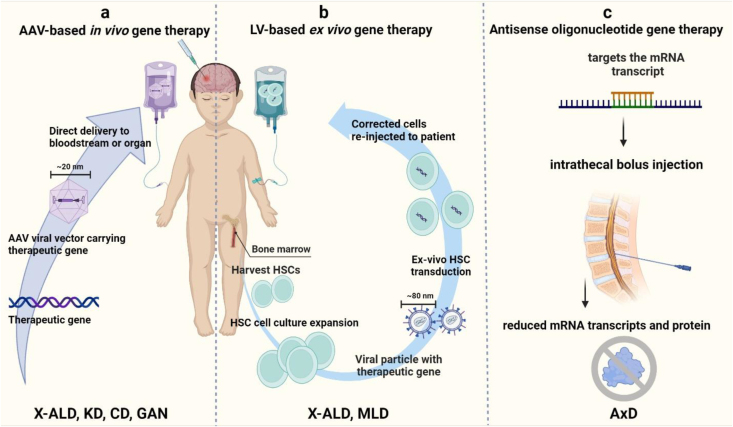
Leukodystrophies are progressive single gene disorders affecting the white matter of the brain. Several gene therapy trials are in progress to address the urgent unmet need for this patient population. We performed a comprehensive literature review of all gene therapy clinical trials listed in www.clinicaltrials.gov through August 2024, and the relevant preclinical studies that enabled clinical translation. Of the approximately 50 leukodystrophies described to date, only eight have existing gene therapy clinical trials: metachromatic leukodystrophy, X-linked adrenoleukodystrophy, globoid cell leukodystrophy, Canavan disease, giant axonal neuropathy, GM2 gangliosidoses, Alexander disease and Pelizaeus-Merzbacher disease. What led to the emergence of gene therapy trials for these specific disorders? What preclinical data or disease context was enabling? For each of these eight disorders, we first describe its pathophysiology and clinical presentation. We discuss the impact of gene therapy delivery route, targeted cell type, delivery modality, dosage, and timing on therapeutic efficacy. We note that use of allogeneic hematopoietic stem cell transplantation in some leukodystrophies allowed for an accelerated path to clinic even in the absence of available animal models. In other leukodystrophies, small and large animal model studies enabled clinical translation of experimental gene therapies. Human clinical trials for the leukodystrophies include ex vivo lentiviral gene delivery, in vivo AAV-mediated gene delivery, and intrathecal antisense oligonucleotide approaches. We outline adverse events associated with each modality focusing specifically on genotoxicity and immunotoxicity. We review monitoring and management of events related to insertional mutagenesis and immune responses. The data presented in this review show that gene therapy, while promising, requires systematic monitoring to account for the precarious disease biology and the adverse events associated with new technology.
Overview
The claims and statistics of this paper haven’t been checked yet.
Run the check — free, no account needed. It reads the open-access text and checks the sources it cites.
Integrity signals
Registry
Cites
Statistics
Figures
Verification
Claims the paper makes
The claims and statistics of this paper haven’t been checked yet.
Run the check — free, no account needed. It reads the open-access text and checks the sources it cites.
Claims other papers make about this one
Each is checked against this paper’s own text: does it say what the citing paper says it does?
The source backs part of the claim, not all of it — or backs it for a different population, condition or comparison.
In the citing paper
“Although its relevance to ACBD5 deficiency remains to be established, current advances in the treatment options for leukodystrophies may also benefit the treatment of ACBD5 patients (Metovic et al., 2024; Wolf et al., 2025).”
From The neurological pathology of peroxisomal ACBD5 deficiency – lessons from patients and mouse models (2025) · cites this paper as Metovic et al., 2024
Experimental — accuracy not yet measured
Self-check
Percentages, sums and reported differences re-computed from the paper’s own numbers.
The self-check needs the paper’s full text.
Citations
Cites
Efficient selection for high-expression transfectants with a novel eukaryotic vector
Niwa, H., Yamamura, K., & Miyazaki, J. (1991) · Gene · doi:10.1016/0378-1119(91)90434-d · Cited by 5,149
Single-Dose Gene-Replacement Therapy for Spinal Muscular Atrophy
Mendell, J. R., Al-Zaidy, S., Shell, R., Arnold, W. D., Rodino-Klapac, L. R., Prior, T. W., Lowes, L., Alfano, L., Berry, K., Church, K., et al. (2017) · New England Journal of Medicine · doi:10.1056/nejmoa1706198 · Cited by 2,381
Complement and its role in innate and adaptive immune responses
Dunkelberger, J. R., & Song, W.-C. (2010) · Cell Research · doi:10.1038/cr.2009.139 · Cited by 1,932
A serious adverse event after successful gene therapy for X-linked severe combined immunodeficiency
Hacein-Bey-Abina, S., von Kalle, C., Schmidt, M., Le Deist, F., Wulffraat, N., McIntyre, E., Radford, I., Villeval, J.-L., Fraser, C. C., Cavazzana-Calvo, M., et al. (2003) · New England Journal of Medicine · doi:10.1056/nejm200301163480314 · Cited by 1,867
Insertional oncogenesis in 4 patients after retrovirus-mediated gene therapy of SCID-X1
Hacein-Bey-Abina, S., Garrigue, A., Wang, G. P., Soulier, J., Lim, A., Morillon, E., Clappier, E., Caccavelli, L., Delabesse, E., Beldjord, K., et al. (2008) · Journal of Clinical Investigation · doi:10.1172/jci35700 · Cited by 1,854
Hematopoietic Stem Cell Gene Therapy with a Lentiviral Vector in X-Linked Adrenoleukodystrophy
Cartier, N., Hacein-Bey-Abina, S., Bartholomae, C. C., Veres, G., Schmidt, M., Kutschera, I., Vidaud, M., Abel, U., Dal-Cortivo, L., Caccavelli, L., et al. (2009) · Science · doi:10.1126/science.1171242 · Cited by 1,508 · cited 1×
“These patients initially experienced clinical stabilization and discontinuation of active demyelination starting 14 – 16 months after gene therapy infusion, but three of the four patients eventually experienced severe neurologic decompensation in the setting of disease progression [87,88].”
BackgroundIntravascular AAV9 preferentially targets neonatal neurons and adult astrocytes
Foust, K. D., Nurre, E., Montgomery, C. L., Hernandez, A., Chan, C. M., & Kaspar, B. K. (2009) · Nature Biotechnology · doi:10.1038/nbt.1515 · Cited by 1,456 · cited 1×
“Other important CNS-speci fi c AAV capsid features include: 1) BBB penetrance, which allows less invasive IV delivery of CNS-targeted gene therapies [39,40]; 2) retrograde and anterograde axonal transport [41,42], which increases CNS transduction and targets leuko-axonopathies; and 3) non-human…”
BackgroundHowe, S. J., Mansour, M. R., Schwarzwaelder, K., Bartholomae, C., Hubank, M., Kempski, H., Brugman, M. H., Pike-Overzet, K., Chatters, S. J., de Ridder, D., et al. (2008) · Journal of Clinical Investigation · doi:10.1172/jci35798 · Cited by 1,286
Lentiviral Hematopoietic Stem Cell Gene Therapy Benefits Metachromatic Leukodystrophy
Biffi, A., Montini, E., Lorioli, L., Cesani, M., Fumagalli, F., Plati, T., Baldoli, C., Martino, S., Calabria, A., Canale, S., et al. (2013) · Science · doi:10.1126/science.1233158 · Cited by 1,180
Clinical use of lentiviral vectors
Milone, M. C., & O’Doherty, U. (2018) · Leukemia · doi:10.1038/s41375-018-0106-0 · Cited by 930 · cited 1×
“Recombinant lentiviral (LV) vectors have undergone multiple generations of engineering to enhance safety and ef fi ciency of HSC-directed gene delivery [11] and they are the viral vector of choice for ex vivo HSC-directed gene therapy.”
Background
Research works printed but not linked: 3
- Williams, 2022, Myelodysplastic syndromes after Eli-cel gene therapy for cerebral adrenoleukodystrophy (CALD) [ASGCT abstract 11], Mol Ther, 30, 5S1
- Fumagalli, 2024, Atidarsagene autotemcel (hematopoietic stem cell-gene therapy) preserves cognitive and motor development in metachromatic leukodystrophy with up to 12 years follow-up [ACMG abstract 005], GIM Open, 2, 100882
- Eichler, 2023, Initial biomarker and clinical findings from the CANaspire canavan disease gene therapy trial: exploration of connections between NAA and disease severity
Cited by
Sorted by citations
Treatment of leukodystrophies: Advances and challenges.
Wolf, N. I., van der Knaap, M. S., & Engelen, M. (2025) · European Journal of Paediatric Neurology · doi:10.1016/j.ejpn.2025.03.016 · Cited by 11
Antisense oligonucleotides: A promising advancement in neurodegenerative disease treatment
Dudzisz, K., & Wandzik, I. (2025) · European Journal of Pharmacology · doi:10.1016/j.ejphar.2025.177644 · Cited by 9
The neurological pathology of peroxisomal ACBD5 deficiency – lessons from patients and mouse models
Dawes, M. L., Haberlander, J. P., Islinger, M., & Schrader, M. (2025) · Frontiers in Molecular Neuroscience · doi:10.3389/fnmol.2025.1602343 · Cited by 7
Stem cell and gene therapies for leukodystrophies
Lin, W., Zhang, M., Zheng, S., & Lian, Q. (2025) · Molecular Therapy — Methods & Clinical Development · doi:10.1016/j.omtm.2025.101527 · Cited by 7
Gene therapy for neurologic disorders
Eichler, F., & Brown, R. H. (2024) · Neurotherapeutics · doi:10.1016/j.neurot.2024.e00453 · Cited by 5
Self-citation
Metadata
- Authors
- Metovic, J., Li, Y., Gong, Y., & Eichler, F.
- Affiliations
- Harvard University (US)
- Corresponding author
- Eichler, Florian
- Venue
- Neurotherapeutics
- Publisher
- Elsevier BV
- Published
- 2024-07
- Volume
- 21
- Issue
- 4
- Pages
- e00443
- ISSN
- 1878-7479 (ISSN-L)
- PMC
- PMC11418141
- OpenAlex
- W4402509692
- Cited by
- 16
- References
- 237
- Citations by year
- 2026: 7 · 2025: 8 · 2024: 1
- FWCI
- 1.10
- Type
- journal article
- Language
- en
- Open access
- gold
- doi.org
- Licence
- Locations
- Neurotherapeutics (publishedVersion, cc-by)
- PubMed Central (publishedVersion, cc-by)
- PubMed (publishedVersion)
- DOAJ (DOAJ: Directory of Open Access Journals) (submittedVersion)
- Funders
- National Institute of Neurological Disorders and Stroke (R01NS082331, R01NS072446, U54NS115052)
- Topics
- Life Sciences › Biochemistry, Genetics and Molecular Biology › Genetics › Virus-based gene therapy research
- Health Sciences › Medicine › Genetics (clinical) › Lysosomal Storage Disorders Research
- Life Sciences › Biochemistry, Genetics and Molecular Biology › Molecular Biology › RNA Interference and Gene Delivery
- Keywords
- leukodystrophy, gene therapy, clinical trials, animal models, metachromatic leukodystrophy, X-linked adrenoleukodystrophy, Krabbe disease, Canavan disease, giant axonal neuropathy, GM2 gangliosidoses, Alexander disease, Pelizaeus-Merzbacher disease, lentiviral gene delivery, AAV gene delivery, antisense oligonucleotides, hematopoietic stem cell transplantation, insertional mutagenesis, genotoxicity, immunotoxicity, white matter disease
- MeSH terms
- Animals, Clinical Trials as Topic, Disease Models, Animal, Humans, Genetic Therapy
About these checks
Registry, retraction, Cites and statistics results are computed, not judged, with one exception: a printed reference that no index lists is read once by a model before it counts as a citation error. Claims are extracted by a model and kept only when their quote appears verbatim in the text; each cited source is then checked, with a model’s help, for whether it says what the claim relies on. Those verdicts can be wrong — read the claim’s quote and the cited source before relying on one.
Statistics and arithmetic are recomputed, not judged.
Confidence bands are shown only for fields calibrated on our annotated test set. None is calibrated yet, so no band is shown.
What counts as a claim ›How we measure confidence ›How we check this ›
Are you an author, or do you see a problem with this page? Request a review
