

The DOI matches its Crossref record.
Maintenance and Support Model within the ERP Systems Lifecycle: Action Research in an Implementer Company
Open accessAbstract
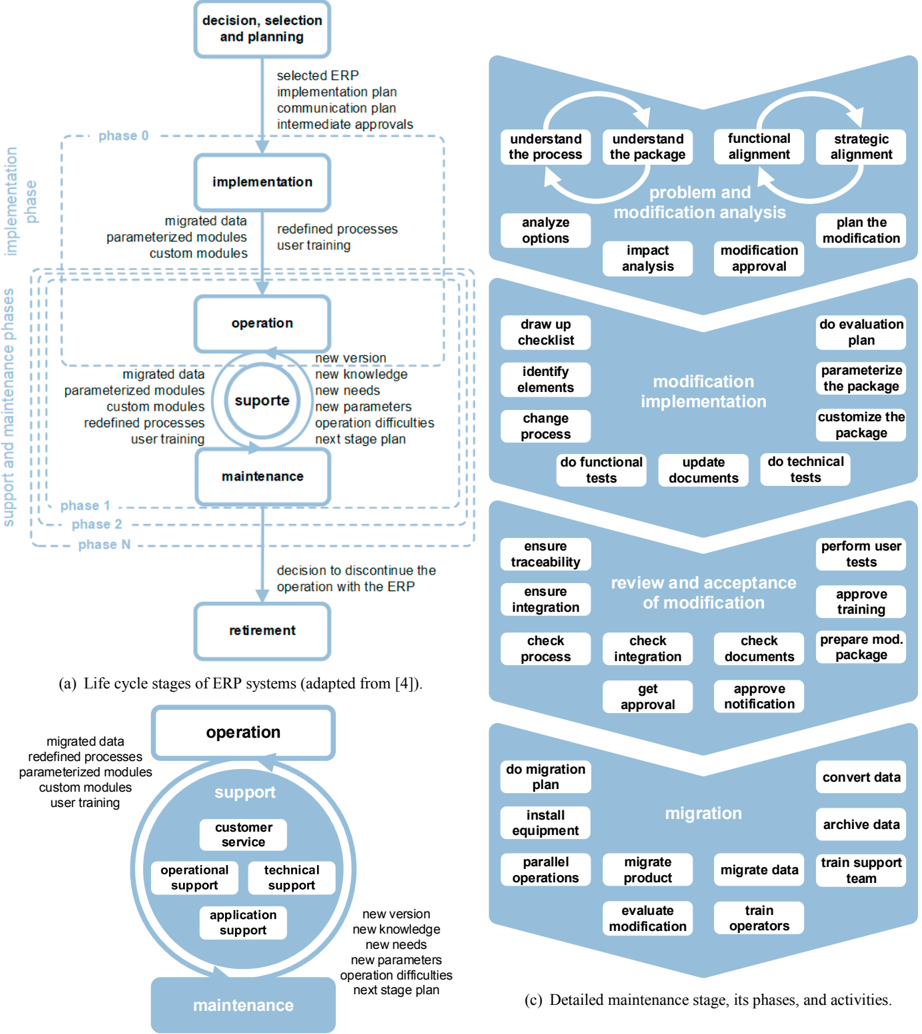
Organizations continue to adopt ERP systems. It seems to be a way to increase efficiency and gain advantages over competitors. Traditionally, decision, selection, planning, and implementation phases were the focus of ERP systems lifecycle. However, main problems of several implementation failures were related to lack of customer support and adequate maintenance. This paper presents a proposal of a maintenance and support (M&S) model within ERP systems lifecycle which includes 4 support activities and 41 maintenance activities separated by 4 phases, respectively, problem and modification analysis, implementation of modification, revision and acceptance phase and migration. Differently from others, at this model, the support is autonomous from maintenance, evidencing its role between operation and maintenance. It is also presented an action research performed in an ERP implementer company where an evaluation of maturity level of all 45 M&S activities were made. The analysis of existing M&S practices in this company allowed to understand this implementer has significant weaknesses with 20% of its processes (9) not or poorly implemented, and therefore, presenting great opportunities for improvement. Some of these practices were discussed.
Overview
The claims and statistics of this paper haven’t been checked yet.
Run the check — free, no account needed. It reads the open-access text and checks the sources it cites.
Integrity signals
Registry
Cites
Statistics
Figures
Verification
Claims the paper makes
The claims and statistics of this paper haven’t been checked yet.
Run the check — free, no account needed. It reads the open-access text and checks the sources it cites.
Claims other papers make about this one
Each is checked against this paper’s own text: does it say what the citing paper says it does?
The source backs part of the claim, not all of it — or backs it for a different population, condition or comparison.
In the citing paper
“The post-ERP implementation stage, especially the usage and evaluation phases, has become an important phase of the ERP life cycle (Amado & Belfo, 2021; Sheu et al., 2014).”
From ERP Post-Implementation Phase: Deployment of the Unified Theory of Acceptance and Use of Technology (UTAUT) Model on User Acceptance (2023) · cites this paper as Amado & Belfo, 2021
Experimental — accuracy not yet measured
Self-check
Percentages, sums and reported differences re-computed from the paper’s own numbers.
The self-check needs the paper’s full text.
Citations
Cites
No references could be resolved yet.
Research works printed but not linked: 20
- F. Belfo and H. Faria, “Quadrante estratégico para empresas implementadoras de sistemas ERP de código aberto – Casos de implementadores de Odoo em Portugal,” in Proceedings da CAPSI’2019, 19.a Conferência da Associação Portuguesa de Sistemas de Informação, 2019, pp. 1–20.
- R. P. Estebanez, A. Trigo, and F. Belfo, “ERP systems adoption evolution in Iberian companies during the global financial and economic crisis and recession (2007–2014),” in 2016 2nd International Conference on Information Management (ICIM), 2016, pp. 116–120. · DOI
- Law, C. C. Chen, 2010, “Managing the full ERP life-cycle: Considerations of maintenance and support requirements and IT governance practice as integral elements of the formula for successful ERP adoption,”, Comput. Ind.
- de Souza, 2000, “Ciclo de vida de sistemas ERP,”, Cad. Pesqui. em Adm., 1
- Ng, G. G. Gable, 2002, “An ERP-client benefit-oriented maintenance taxonomy,”, J. Syst. Softw.
- Wang, 2006, “Effects of internal support and consultant quality on the consulting process and ERP system quality,”, Decis. Support Syst., 10.1016/j.dss.2005.08.005 · DOI
- C. S. P. Ng, G. Gable, and T. Chan, “An ERP maintenance model,” in Proceedings of the 36th Annual Hawaii International Conference on System Sciences, HICSS 2003, 2003.
- S. Hecht, H. Wittges, and H. Krcmar, “It capabilities in ERP maintenance - A review of the ERP post-implementation literature,” in 19th European Conference on Information Systems, ECIS 2011, 2011.
- Nah, S. Faja, 2001, “Characteristics of ERP software maintenance: A multiple case study,”, J. Softw. Maint. Evol.
- H. J. Kung and C. Hsu, “Software maintenance life cycle model,” in Conference on Software Maintenance, 1998.
- Ghobadian et al, 2007, “Organizational alignment and performance: past, present and future,”, Manag. Decis.
- Prieto, 2011, “Strategic alignment and performance: Brazilian companies in the medical diagnostics sector,”, Serv. Ind. J., 31, 1405, 10.1080/02642060903576050 · DOI
- Siggelkow, 2001, “Change in the presence of fit: The rise, the fall, and the renaissance of Liz Claiborne,”, Acad. Manag. J., 44, 838, 10.2307/3069418 · DOI
- Kappelman, 2016, “The 2015 SIM IT Issues and Trends Study.,”, MIS Q. Exec., 15
- Luftman, 2011, “Key issues for IT executives 2011: Cautious optimism in uncertain economic times,”, MIS Q. Exec., 10, 7
- Kappelman, 2013, “Key Issues of IT Organizations and Their Leadership: The 2013 SIM IT Trends Study.,”, MIS Q. Exec., 12
- Reich, 1996, “Measuring the linkage between business and information technology objectives,”, MIS Q., 55, 10.2307/249542 · DOI
- Al-Mudimigh, M. Zairi, 2001, “ERP software implementation: an integrative framework,”, Eur. J. Inf. Syst., 10, 216, 10.1057/palgrave.ejis.3000406 · DOI
- Belfo, 2013, “A Framework to Enhance Business and Information Technology Alignment Through Incentive Policy,”, Int. J. Inf. Syst. Serv. Sect., 5, 1, 10.4018/jisss.2013040101 · DOI
- Belfo, 2011, “Developing an Instrument to Assess Information Technology Staff Motivation,”, Commun. Comput. Inf. Sci., 220, 230
Cited by
Sorted by citations
Butarbutar, Z. T., Handayani, P. W., Suryono, R. R., & Wibowo, W. S. (2023) · Cogent Business & Management · doi:10.1080/23311975.2023.2264001 · Cited by 42
Mohamad Zain, M. R., Tajul Urus, S., Trinh, T., Amirul, S. M., & Tuan Mat, T. Z. (2023) · Asia-Pacific Management Accounting Journal · doi:10.24191/apmaj.v18i1-05 · Cited by 6
Metadata
- Authors
- Amado, A., & Belfo, F. P.
- Affiliations
- Universidade Politécnica de Coimbra (PT)
- Corresponding author
- Belfo, Fernando Paulo
- Venue
- Procedia Computer Science
- Publisher
- Elsevier BV
- Published
- 2021
- Volume
- 181
- Pages
- 580-588
- ISSN
- 1877-0509 (ISSN-L)
- OpenAlex
- W3132762543
- Cited by
- 31
- References
- 0
- Citations by year
- 2026: 6 · 2025: 3 · 2024: 4 · 2023: 11 · 2022: 5 · 2021: 2
- FWCI
- 10.05
- Type
- conference paper
- Language
- en
- Open access
- diamond
- doi.org
- Licence
- Locations
- Procedia Computer Science (publishedVersion, cc-by-nc-nd)
- Topics
- Social Sciences › Business, Management and Accounting › Management Information Systems › ERP Systems Implementation and Impact
- Physical Sciences › Computer Science › Information Systems › Software Engineering Research
- Physical Sciences › Computer Science › Information Systems › Software Engineering Techniques and Practices
- Keywords
- enterprise resource planning, ERP implementation, post-implementation support, software maintenance, migration
About these checks
Registry, retraction, Cites and statistics results are computed, not judged, with one exception: a printed reference that no index lists is read once by a model before it counts as a citation error. Claims are extracted by a model and kept only when their quote appears verbatim in the text; each cited source is then checked, with a model’s help, for whether it says what the claim relies on. Those verdicts can be wrong — read the claim’s quote and the cited source before relying on one.
Statistics and arithmetic are recomputed, not judged.
Confidence bands are shown only for fields calibrated on our annotated test set. None is calibrated yet, so no band is shown.
What counts as a claim ›How we measure confidence ›How we check this ›
Are you an author, or do you see a problem with this page? Request a review
