

The DOI matches its Crossref record; 34 of the 35 references it cites were found in a registry or an index.
Cognitive Behavioral Therapy for Eating Disorders
Open accessAbstract
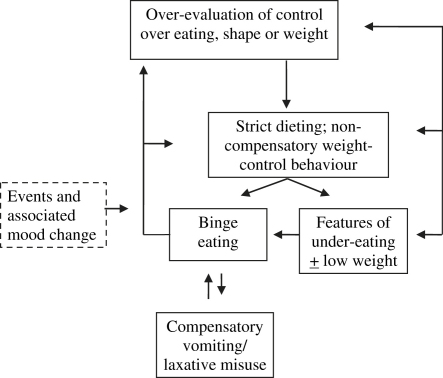
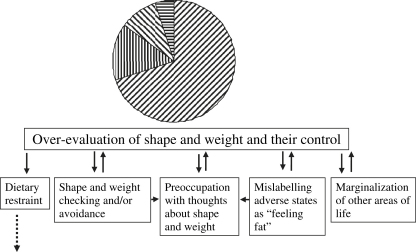
Cognitive behavioral therapy (CBT) is the leading evidence-based treatment for bulimia nervosa. A new "enhanced" version of the treatment appears to be more potent and has the added advantage of being suitable for all eating disorders, including anorexia nervosa and eating disorder not otherwise specified. This article reviews the evidence supporting CBT in the treatment of eating disorders and provides an account of the "transdiagnostic" theory that underpins the enhanced form of the treatment. It ends with an outline of the treatment's main strategies and procedures.
Overview
The claims and statistics of this paper haven’t been checked yet.
Run the check — free, no account needed. It reads the open-access text and checks the sources it cites.
Integrity signals
Registry
Cites
Statistics
Figures
Verification
Claims the paper makes
The claims and statistics of this paper haven’t been checked yet.
Run the check — free, no account needed. It reads the open-access text and checks the sources it cites.
Claims other papers make about this one
Each is checked against this paper’s own text: does it say what the citing paper says it does?
The cited source says what the claim attributes to it.
In the citing paper
“Cognitive behavioral therapy (CBT) is an effective treatment for eating disorders (Hay et al., 2014; Murphy, Straebler, Cooper, & Fairburn, 2010; NICE, 2017).”
From A new cognitive behavior therapy for adolescents with avoidant/restrictive food intake disorder in a day treatment setting: A clinical case series. (2019) · cites this paper as Murphy, Straebler, Cooper, & Fairburn, 2010
In the citing paper
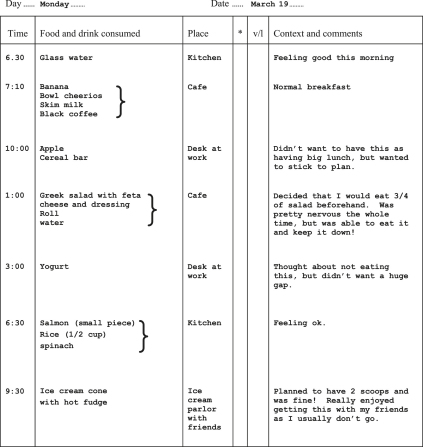
“One particularly relevant process has been called 'real-time self-monitoring' around eating, related behaviors, and feelings [12].”
From Food and Mood: Just-in-Time Support for Emotional Eating (2013) · cites this paper as [12]
In the citing paper
“The rationale for the criticality of monitoring is that 'it helps patients to be more aware of what is happening in the moment so that they can begin to make changes to behavior that may have seemed automatic or beyond their control' [12].”
From Food and Mood: Just-in-Time Support for Emotional Eating (2013) · cites this paper as [12]
Self-check
Percentages, sums and reported differences re-computed from the paper’s own numbers.
The self-check needs the paper’s full text.
Citations
Cites
Diagnostic and Statistical Manual of Mental Disorders
American Psychiatric Association (2013) · doi:10.1176/appi.books.9780890425596 · Cited by 116,369
Diagnostic and Statistical Manual of Mental Disorders
Williams, J. B. W., & First, M. B. (2013) · Oxford University Press eBooks · doi:10.1093/acrefore/9780199975839.013.104 · Cited by 109,845
Cognitive behaviour therapy for eating disorders: a “transdiagnostic” theory and treatment
Fairburn, C. G., Cooper, Z., & Shafran, R. (2003) · Behaviour Research and Therapy · doi:10.1016/s0005-7967(02)00088-8 · Cited by 3,374
Self-citation(2008) · Cited by 1,397
Self-citationFairburn, C. G., & Harrison, P. J. (2003) · The Lancet · doi:10.1016/s0140-6736(03)12378-1 · Cited by 1,396
Self-citationCognitive Behavior Therapy and Eating Disorders
Ghaderi, A. (2008) · Cognitive Behaviour Therapy · doi:10.1080/16506070802473239 · Cited by 1,244
A Guide to Treatments that Work
Nathan, P. E., & Gorman, J. M. (2007) · Oxford University Press eBooks · doi:10.1093/med/9780195304145.001.0001 · Cited by 1,082
Clinical perfectionism: A cognitive behavioural analysis
Shafran, R., Cooper, Z., & Fairburn, C. G. (2002) · Behaviour Research and Therapy · doi:10.1016/s0005-7967(01)00059-6 · Cited by 984
Self-citationFairburn, C. G., Cooper, Z., Doll, H. A., O’Connor, M. E., Bohn, K., Hawker, D. M., Wales, J. A., & Palmer, R. L. (2009) · American Journal of Psychiatry · doi:10.1176/appi.ajp.2008.08040608 · Cited by 829
Self-citationKazdin, A. E., & Nock, M. K. (2003) · Journal of Child Psychology and Psychiatry · doi:10.1111/1469-7610.00195 · Cited by 774
Research works printed but not linked: 1
- Dalle Grave R, Fairburn CG. Intensive CBT for eating disorders. New York: Guilford Press, in press.
Cited by
Sorted by citations
Managing body image difficulties of adult cancer patients: Lessons from available research
Fingeret, M. C., Teo, I., & Epner, D. E. (2013) · Cancer · doi:10.1002/cncr.28469 · Cited by 316
Fairburn, C. G., Bailey‐Straebler, S., Basden, S. L., Doll, H., Jones, R., Murphy, R., O'Connor, M. E., & Cooper, Z. (2015) · Behaviour Research and Therapy · doi:10.1016/j.brat.2015.04.010 · Cited by 314
Self-citationThe Enigmatic Persistence of Anorexia Nervosa
Walsh, B. T. (2013) · American Journal of Psychiatry · doi:10.1176/appi.ajp.2012.12081074 · Cited by 323
Feeding and reward: Perspectives from three rat models of binge eating
Corwin, R. L., Avena, N. M., & Boggiano, M. M. (2011) · Physiology & Behavior · doi:10.1016/j.physbeh.2011.04.041 · Cited by 298
Dokras, A., Stener-Victorin, E., Yildiz, B. O., Li, R., Ottey, S., Shah, D., Epperson, N., & Teede, H. (2018) · Fertility and Sterility · doi:10.1016/j.fertnstert.2018.01.038 · Cited by 285
Metadata
- Authors
- Murphy, R., Straebler, S., Cooper, Z., & Fairburn, C. G.
- Affiliations
- Warneford Hospital (GB)
- Corresponding author
- Murphy, Rebecca
- Venue
- Psychiatric Clinics of North America
- Publisher
- Elsevier BV
- Published
- 2010-09
- Volume
- 33
- Issue
- 3
- Pages
- 611-627
- ISSN
- 0193-953X (ISSN-L)
- PMC
- PMC2928448
- OpenAlex
- W1988419267
- Cited by
- 435
- References
- 35
- Citations by year
- 2026: 36 · 2025: 27 · 2024: 38 · 2023: 28 · 2022: 30 · 2021: 27 · 2020: 34 · 2019: 29 · 2018: 27 · 2017: 31 · 2016: 17 · 2015: 28 · 2014: 24 · 2013: 24 · 2012: 18
- FWCI
- 2.61
- Type
- journal article
- Language
- en
- Open access
- hybrid
- doi.org
- Licence
- Locations
- Psychiatric Clinics of North America (publishedVersion, cc-by)
- PubMed Central (publishedVersion, cc-by)
- PubMed (publishedVersion)
- Funders
- Wellcome Trust (046386, 079113, 079113/Z/06/Z)
- Topics
- Social Sciences › Psychology › Clinical Psychology › Eating Disorders and Behaviors
- Social Sciences › Psychology › Experimental and Cognitive Psychology › Anxiety, Depression, Psychometrics, Treatment, Cognitive Processes
- Health Sciences › Nursing › Nutrition and Dietetics › Nutrition, Health and Food Behavior
- Keywords
- cognitive behavioral therapy, eating disorders, bulimia nervosa, anorexia nervosa, eating disorder not otherwise specified, transdiagnostic model, treatment options
- MeSH terms
- Feeding and Eating Disorders, Humans, Models, Psychological, Patient Participation, Self Concept, Cognitive Behavioral Therapy
About these checks
Registry, retraction, Cites and statistics results are computed, not judged, with one exception: a printed reference that no index lists is read once by a model before it counts as a citation error. Claims are extracted by a model and kept only when their quote appears verbatim in the text; each cited source is then checked, with a model’s help, for whether it says what the claim relies on. Those verdicts can be wrong — read the claim’s quote and the cited source before relying on one.
Statistics and arithmetic are recomputed, not judged.
Confidence bands are shown only for fields calibrated on our annotated test set. None is calibrated yet, so no band is shown.
What counts as a claim ›How we measure confidence ›How we check this ›
Are you an author, or do you see a problem with this page? Request a review
