

The DOI matches its Crossref record; 33 of the 33 references it cites were found in a registry or an index.
How to improve adherence with quarantine: rapid review of the evidence
Open accessPublished version of a preprint
Abstract
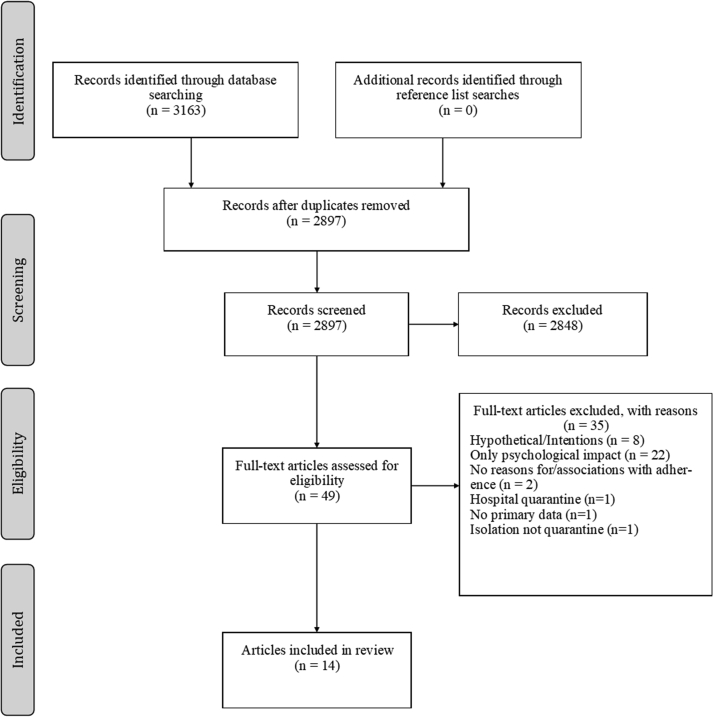
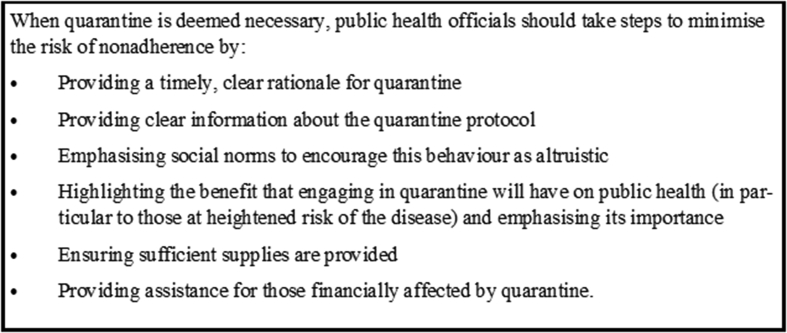
OBJECTIVES: The December 2019 outbreak of coronavirus has once again thrown the vexed issue of quarantine into the spotlight, with many countries asking their citizens to 'self-isolate' if they have potentially come into contact with the infection. However, adhering to quarantine is difficult. Decisions on how to apply quarantine should be based on the best available evidence to increase the likelihood of people adhering to protocols. We conducted a rapid review to identify factors associated with adherence to quarantine during infectious disease outbreaks. STUDY DESIGN: The study design is a rapid evidence review. METHODS: We searched Medline, PsycINFO and Web of Science for published literature on the reasons for and factors associated with adherence to quarantine during an infectious disease outbreak. RESULTS: We found 3163 articles and included 14 in the review. Adherence to quarantine ranged from as little as 0 up to 92.8%. The main factors which influenced or were associated with adherence decisions were the knowledge people had about the disease and quarantine procedure, social norms, perceived benefits of quarantine and perceived risk of the disease, as well as practical issues such as running out of supplies or the financial consequences of being out of work. CONCLUSIONS: People vary in their adherence to quarantine during infectious disease outbreaks. To improve this, public health officials should provide a timely, clear rationale for quarantine and information about protocols; emphasise social norms to encourage this altruistic behaviour; increase the perceived benefit that engaging in quarantine will have on public health; and ensure that sufficient supplies of food, medication and other essentials are provided.
Overview
The claims and statistics of this paper haven’t been checked yet.
Run the check — free, no account needed. It reads the open-access text and checks the sources it cites.
Integrity signals
Registry
Cites
Statistics
Figures
Verification
Claims the paper makes
The claims and statistics of this paper haven’t been checked yet.
Run the check — free, no account needed. It reads the open-access text and checks the sources it cites.
Claims other papers make about this one
Each is checked against this paper’s own text: does it say what the citing paper says it does?
In the citing paper
“Consistent with previous studies,10,36,37 our review presents a range of negative psychological impacts of mass quarantine, such as low life satisfaction, emotional isolation and fear of infection.23–25,30,32,34,35”
From Social consequences of mass quarantine during epidemics: a systematic review with implications for the COVID-19 response (2020) · cites this paper as [37]
Self-check
Percentages, sums and reported differences re-computed from the paper’s own numbers.
The self-check needs the paper’s full text.
Citations
Cites
The Psychological Impact of Quarantine and How to Reduce It: Rapid Review of the Evidence
Brooks, S. K., Webster, R. K., Smith, L. E., Woodland, L., Wessely, S., Greenberg, N., & Rubin, G. J. (2020) · doi:10.2139/ssrn.3532534 · Cited by 16,394
Self-citationThe psychological impact of quarantine and how to reduce it: Rapid review of the evidence
Brooks, S. K., Webster, R. K., Smith, L. E., Woodland, L., Wessely, S., Greenberg, N., & Rubin, G. J. (2020) · The Lancet · doi:10.1016/s0140-6736(20)30460-8 · Cited by 16,378
Self-citationThe Health Belief Model and Preventive Health Behavior
Rosenstock, I. M. (1974) · Health Education Monographs · doi:10.1177/109019817400200405 · Cited by 3,643
Demographic and attitudinal determinants of protective behaviours during a pandemic: A review
Bish, A., & Michie, S. (2010) · British Journal of Health Psychology · doi:10.1348/135910710x485826 · Cited by 1,246
Killian, L. M., & Turner, R. A. (1972) · Cited by 1,143
Construct Validation of the Health Belief Model
Cummings, K. M., Jette, A. M., & Rosenstock, I. M. (1978) · Health Education Monographs · doi:10.1177/109019817800600406 · Cited by 1,000
The psychological effects of quarantining a city
Rubin, G. J., & Wessely, S. (2020) · BMJ · doi:10.1136/bmj.m313 · Cited by 999
Self-citationUnderstanding, compliance and psychological impact of the SARS quarantine experience
REYNOLDS, D. L., GARAY, J. R., DEAMOND, S. L., MORAN, M. K., GOLD, W., & STYRA, R. (2008) · Epidemiology and Infection · doi:10.1017/s0950268807009156 · Cited by 895
Slovic, P., Fischhoff, B., & Lichtenstein, S. (1981) · Springer eBooks · doi:10.1007/978-1-4899-2168-0_17 · Cited by 712
Lippke, S. (2014) · Sage eBooks · doi:10.4135/9781483332222.n225 · Cited by 625
Factors influencing compliance with quarantine in Toronto during the 2003 SARS outbreak
DiGiovanni, C., Conley, J., Chiu, D., & Zaborski, J. (2004) · Biosecurity and Bioterrorism: Biodefense Strategy, Practice, and Science · doi:10.1089/bsp.2004.2.265 · Cited by 483
A systematic review of factors affecting vaccine uptake in young children
Smith, L., Amlôt, R., Weinman, J. A., Yiend, J., & Rubin, G. J. (2017) · Vaccine · doi:10.1016/j.vaccine.2017.09.046 · Cited by 469
Self-citationIs There a Case for Quarantine? Perspectives from SARS to Ebola
Barbisch, D., Koenig, K. L., & Shih, F.-Y. (2015) · Disaster Medicine and Public Health Preparedness · doi:10.1017/dmp.2015.38 · Cited by 361
Accepted monitoring or endured quarantine? Ebola contacts' perceptions in Senegal
Desclaux, A., Badji, D., Ndione, A. G., & Sow, K. (2017) · Social Science & Medicine · doi:10.1016/j.socscimed.2017.02.009 · Cited by 275
Social consequences of Ebola containment measures in Liberia
Pellecchia, U., Crestani, R., Decroo, T., Van den Bergh, R., & Al-Kourdi, Y. (2015) · PLOS ONE · doi:10.1371/journal.pone.0143036 · Cited by 262
The Problem of Behaviour Change: From Social Norms to an Ingroup Focus
Reynolds, K. J., Subašić, E., & Tindall, K. (2015) · Social and Personality Psychology Compass · doi:10.1111/spc3.12155 · Cited by 214
Risk Perception and Compliance With Quarantine During the SARS Outbreak
Cava, M. A., Fay, K. E., Beanlands, H. J., McCay, E. A., & Wignall, R. (2005) · Journal of Nursing Scholarship · doi:10.1111/j.1547-5069.2005.00059.x · Cited by 186
Braunack‐Mayer, A., Tooher, R. L., Collins, J. E., Street, J., & Marshall, H. S. (2013) · BMC Public Health · doi:10.1186/1471-2458-13-344 · Cited by 163
Caleo, G., Duncombe, J., Jephcott, F. L., Lokuge, K., Mills, C., Looijen, E., Theoharaki, F., Kremer, R., Kleijer, K., Squire, J. S., et al. (2018) · BMC Public Health · doi:10.1186/s12889-018-5158-6 · Cited by 141
Attitudes Toward The Use Of Quarantine In A Public Health Emergency In Four Countries
Blendon, R. J., DesRoches, C. M., Cetron, M. S., Benson, J. M., Meinhardt, T. J., & Pollard, W. E. (2006) · Health Affairs · doi:10.1377/hlthaff.25.w15 · Cited by 140
Mother Nature versus human nature: public compliance with evacuation and quarantine
Manuell, M., & Cukor, J. (2011) · Disasters · doi:10.1111/j.1467-7717.2010.01219.x · Cited by 138
Evidence and Effectiveness in Decisionmaking for Quarantine
Bensimon, C. M., & Upshur, R. E. G. (2007) · American Journal of Public Health · doi:10.2105/ajph.2005.077305 · Cited by 92
Kavanagh, A. M., Bentley, R., Mason, K., McVernon, J., Petrony, S., Fielding, J., LaMontagne, A. D., & Studdert, D. M. (2011) · BMC Infectious Diseases · doi:10.1186/1471-2334-11-2 · Cited by 54
Teh, B. W., Olsen, K., Black, J., Cheng, A. C., Aboltins, C. A., Bull, K., Johnson, P. D. R., Grayson, M. L., & Torresi, J. (2011) · Scandinavian Journal of Infectious Diseases · doi:10.3109/00365548.2011.631572 · Cited by 42
Hsu, C., Chen, T., Chang, M., & Chang, Y. (2006) · American Journal of Infection Control · doi:10.1016/j.ajic.2005.11.008 · Cited by 42
McVernon, J., Mason, K., Petrony, S., Nathan, P. M., LaMontagne, A. D., Bentley, R., Fielding, J., Studdert, D. M., & Kavanagh, A. M. (2011) · BMC Infectious Diseases · doi:10.1186/1471-2334-11-257 · Cited by 41
Risk/Benefit Analysis in Water Resources Planning and Management
(1981) · Springer eBooks · doi:10.1007/978-1-4899-2168-0 · Cited by 35
Severe Acute Respiratory Syndrome: Did Quarantine Help?
Schabas, R. (2004) · Canadian Journal of Infectious Diseases and Medical Microbiology · doi:10.1155/2004/521892 · Cited by 33
Kavanagh, A. M., Mason, K., Bentley, R., Studdert, D. M., McVernon, J., Fielding, J., Petrony, S., Gurrin, L. C., & LaMontagne, A. D. (2012) · BMC Infectious Diseases · doi:10.1186/1471-2334-12-311 · Cited by 31
Smith, R. E. (1952) · BMJ · doi:10.1136/bmj.2.4774.34 · Cited by 29
Isolation compliance among university students during a mumps outbreak, Kansas 2006
Soud, F., Cortese, M. M., Curns, A. T., Edelson, P. J., Bitsko, R. H., Jordan, H. T., HUANG, A. S., Villalon-Gomez, J. M., & Dayan, G. H. (2008) · Epidemiology and Infection · doi:10.1017/s0950268808000629 · Cited by 25
Greenberger, M. (2018) · American Journal of Public Health · doi:10.2105/ajph.2018.304682 · Cited by 22
Porten, K., Faensen, D., & Krause, G. (2006) · Journal of Public Health Management and Practice · doi:10.1097/00124784-200605000-00004 · Cited by 20
Cited by
Sorted by citations
Impact of delays on effectiveness of contact tracing strategies for COVID-19: a modelling study
Kretzschmar, M. E., Rozhnova, G., Bootsma, M. C. J., van Boven, M., van de Wijgert, J. H. H. M., & Bonten, M. J. M. (2020) · The Lancet Public Health · doi:10.1016/s2468-2667(20)30157-2 · Cited by 697
Nivette, A., Ribeaud, D., Murray, A., Steinhoff, A., Bechtiger, L., Hepp, U., Shanahan, L., & Eisner, M. (2021) · Social Science & Medicine · doi:10.1016/j.socscimed.2020.113370 · Cited by 575
COVID-19 Lockdown: Housing Built Environment’s Effects on Mental Health
Amerio, A., Brambilla, A., Morganti, A., Aguglia, A., Bianchi, D. G., Santi, F., Costantini, L., Odone, A., Costanza, A., Signorelli, C., et al. (2020) · International Journal of Environmental Research and Public Health · doi:10.3390/ijerph17165973 · Cited by 539
COVID-19 and Bangladesh: Challenges and How to Address Them
Anwar, S., Nasrullah, M., & Hosen, M. J. (2020) · Frontiers in Public Health · doi:10.3389/fpubh.2020.00154 · Cited by 458
Braithwaite, I., Callender, T., Bullock, M., & Aldridge, R. W. (2020) · The Lancet Digital Health · doi:10.1016/s2589-7500(20)30184-9 · Cited by 330
Metadata
- Authors
- Webster, R. K., Brooks, S. K., Smith, L. E., Woodland, L., Wessely, S., & Rubin, G. J.
- Affiliations
- University of Sheffield (GB)
- King's College London (GB)
- Corresponding author
- Webster, R.K.
- Venue
- Public Health
- Publisher
- Elsevier BV
- Published
- 2020-05
- Volume
- 182
- Pages
- 163-169
- ISSN
- 0033-3506 (ISSN-L)
- PMC
- PMC7194967
- OpenAlex
- W3012344084
- Cited by
- 422
- References
- 33
- Citations by year
- 2026: 11 · 2025: 17 · 2024: 39 · 2023: 43 · 2022: 85 · 2021: 148 · 2020: 79
- FWCI
- 15.77
- Type
- journal article
- Language
- en
- Open access
- hybrid
- doi.org
- Licence
- Locations
- Public Health (publishedVersion, cc-by-nc-nd)
- medRxiv (acceptedVersion, cc-by-nc-nd)
- PubMed Central (publishedVersion, cc-by-nc-nd)
- PubMed (publishedVersion)
- White Rose Research Online (University of Leeds, The University of Sheffield, University of York) (acceptedVersion)
- Research Portal (King's College London) (submittedVersion, cc-by-nc-nd)
- OSF Preprints (OSF Preprints) (submittedVersion, cc-by)
- OSF Preprints (OSF Preprints) (submittedVersion)
- Funders
- National Institute for Health Research
- Topics
- Social Sciences › Sociology and Political Science › COVID-19 Prevention and Impact
- Health Sciences › Medicine › Public Health, Environmental and Occupational Health › Public Health Policies and Education
- Physical Sciences › Mathematics › Modeling and Simulation › COVID-19 epidemiological studies
- Keywords
- self-isolation, infectious disease outbreaks, COVID-19 pandemic, social norms, risk perception, perceived benefits, public health communication, altruism
- MeSH terms
- COVID-19, Culture, Disease Outbreaks, Humans, Health Knowledge, Attitudes, Practice, Pneumonia, Viral, Public Health, Quarantine, Time Factors, Coronavirus Infections, Guideline Adherence, Pandemics, Sociological Factors, Social Norms
About these checks
Registry, retraction, Cites and statistics results are computed, not judged, with one exception: a printed reference that no index lists is read once by a model before it counts as a citation error. Claims are extracted by a model and kept only when their quote appears verbatim in the text; each cited source is then checked, with a model’s help, for whether it says what the claim relies on. Those verdicts can be wrong — read the claim’s quote and the cited source before relying on one.
Statistics and arithmetic are recomputed, not judged.
Confidence bands are shown only for fields calibrated on our annotated test set. None is calibrated yet, so no band is shown.
What counts as a claim ›How we measure confidence ›How we check this ›
Are you an author, or do you see a problem with this page? Request a review
