

Enhancing microglial antioxidant capacity via the ascorbate transporter SVCT2 delays onset and modifies disease progression in mouse models of Alzheimer's disease
Open accessThe DOI matches its Crossref record; 89 of the 89 references it cites were found in a registry or an index; none of the 65 sources its claims cite is checked for support yet.
Abstract
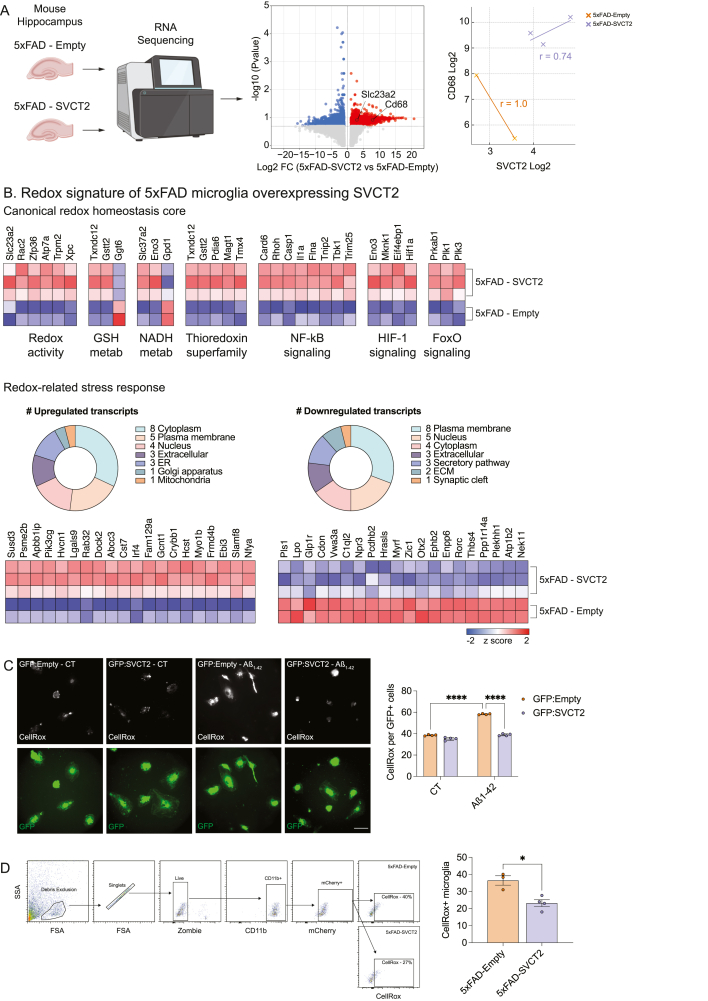
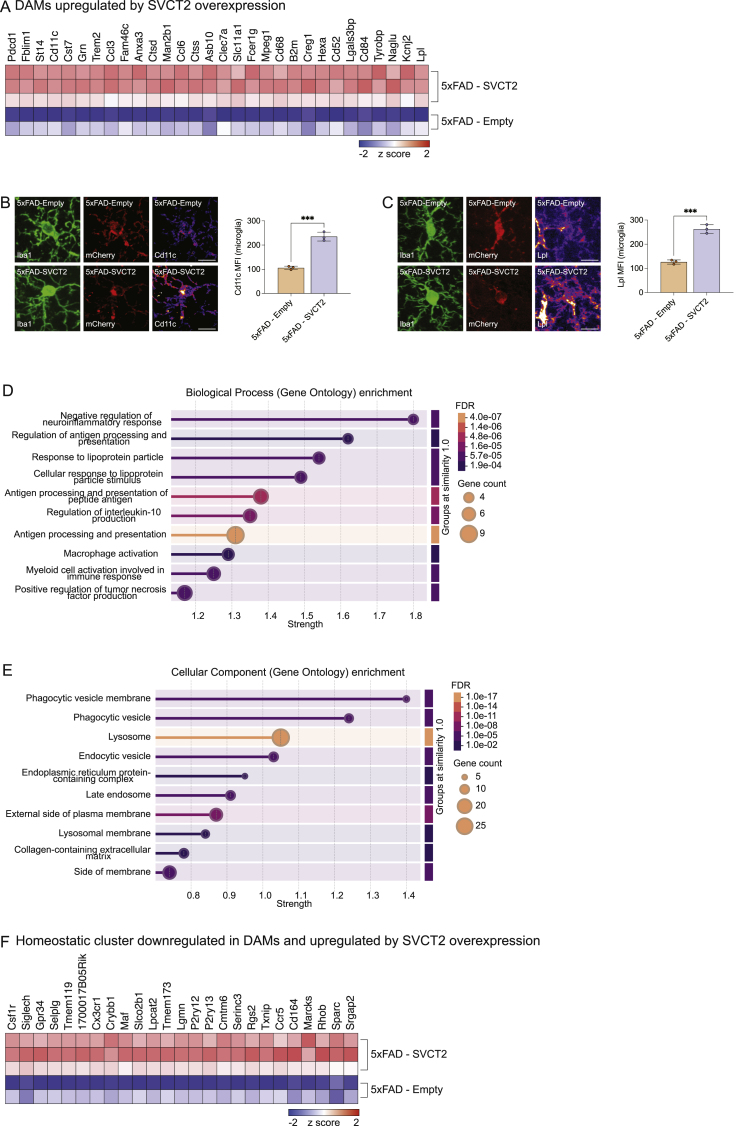
Despite clear evidence that vitamin C levels are depleted in the brains of Alzheimer's disease (AD) patients, dietary supplementation has consistently failed in clinical trials, suggesting a critical bottleneck not in systemic supply, but in its transport into brain cells. Here, we identify this bottleneck as a progressive downregulation of the ascorbate transporter, Slc23a2, also known as SVCT2, in microglia. Then we hypothesized that bypassing this cellular deficiency via targeted SVCT2 overexpression in microglia could either prevent the onset of pathology or rescue established functional deficits. Indeed, overexpressing SVCT2 in microglia before disease onset in 5xFAD mice triggered a profound redox reprogramming, resulting in a unique "hybrid" neuroprotective microglial phenotype that co-expressed both homeostatic and disease-associated markers. Functionally, this leads to decreased amyloid plaque burden and strengthens the synaptic bioenergetic capacity, which consequently prevents the development of synaptic and memory deficits. Strikingly, when employed after disease establishment, SVCT2 overexpression rescued synaptic plasticity and memory performance despite not affecting the existing amyloid burden. This rescue was driven by changes in the microglial secretory pathways. Collectively, these findings resolve a long-standing clinical paradox by establishing that neuroprotection depends not on systemic vitamin C intake but on the brain's cellular uptake machinery. This offers a mechanistic explanation for the failure of dietary supplementation in AD and identifies SVCT2 as a promising therapeutic target against the neurodegenerative process in AD.
Overview
CoChat Summary
TL;DR
In 5xFAD and APP/PS1 mice, microglial SVCT2 declines with AD-like pathology, and AAV9-CD68-driven SVCT2 overexpression in microglia before onset reduces amyloid burden and prevents synaptic and memory deficits. When delivered after disease establishment, SVCT2 overexpression rescues synaptic plasticity and memory without reducing amyloid, linked to redox reprogramming, a hybrid microglial state, synaptic mitochondrial bioenergetics, and late-stage secretory pathway remodeling.
Key findings
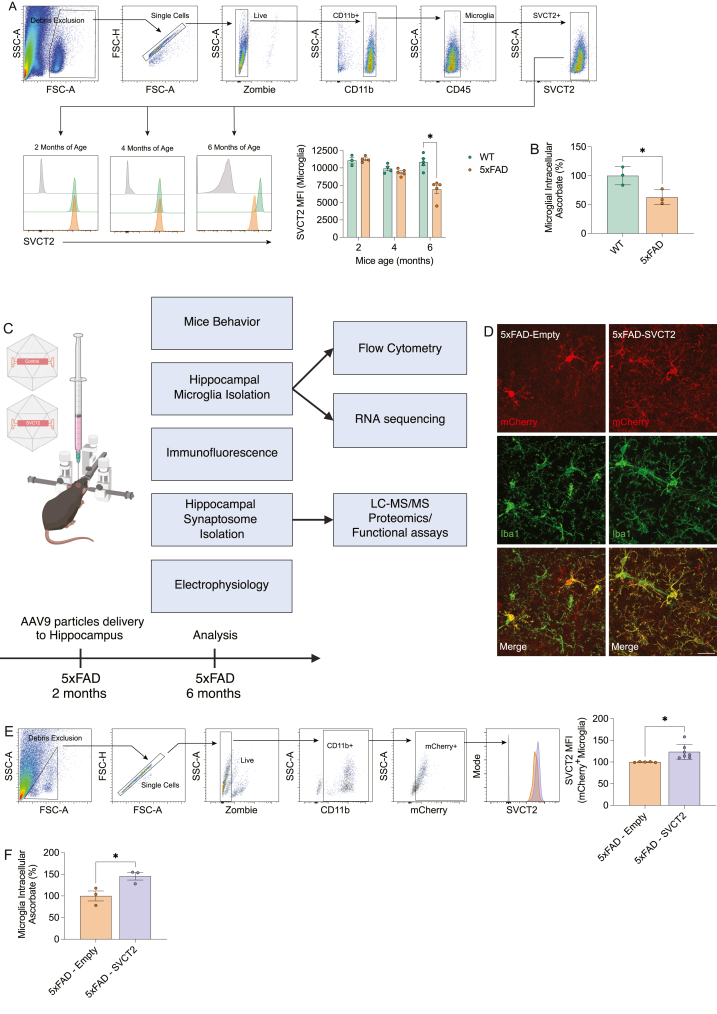
- Microglial SVCT2 expression declined age-dependently in 5xFAD mice at 2, 4, and 6 months, with significantly lower intracellular ascorbate in 5xFAD microglia at 6 months; APP/PS1 microglia also showed diminished SVCT2.
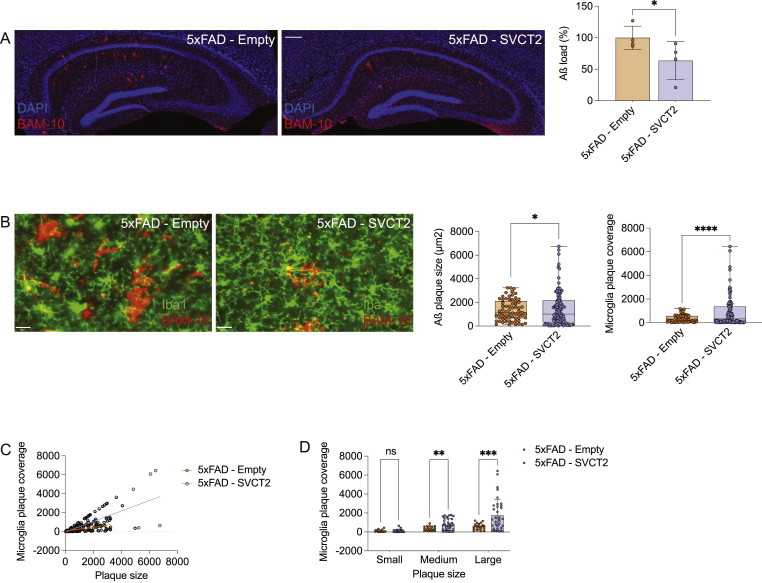
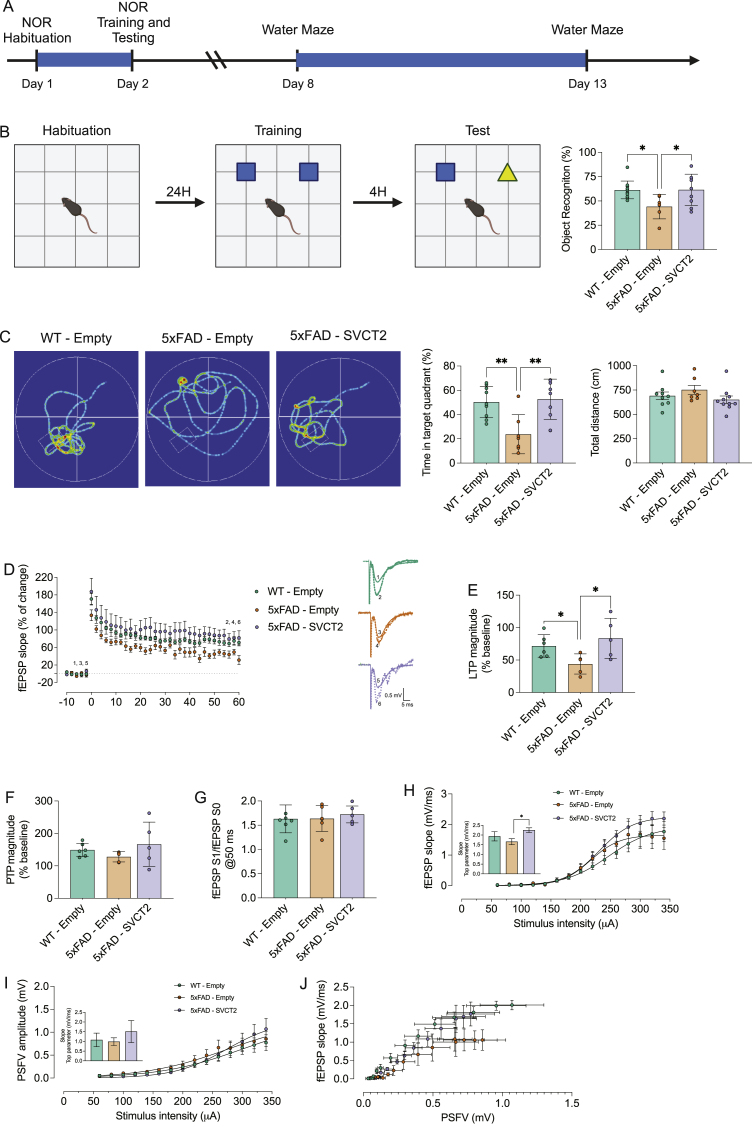
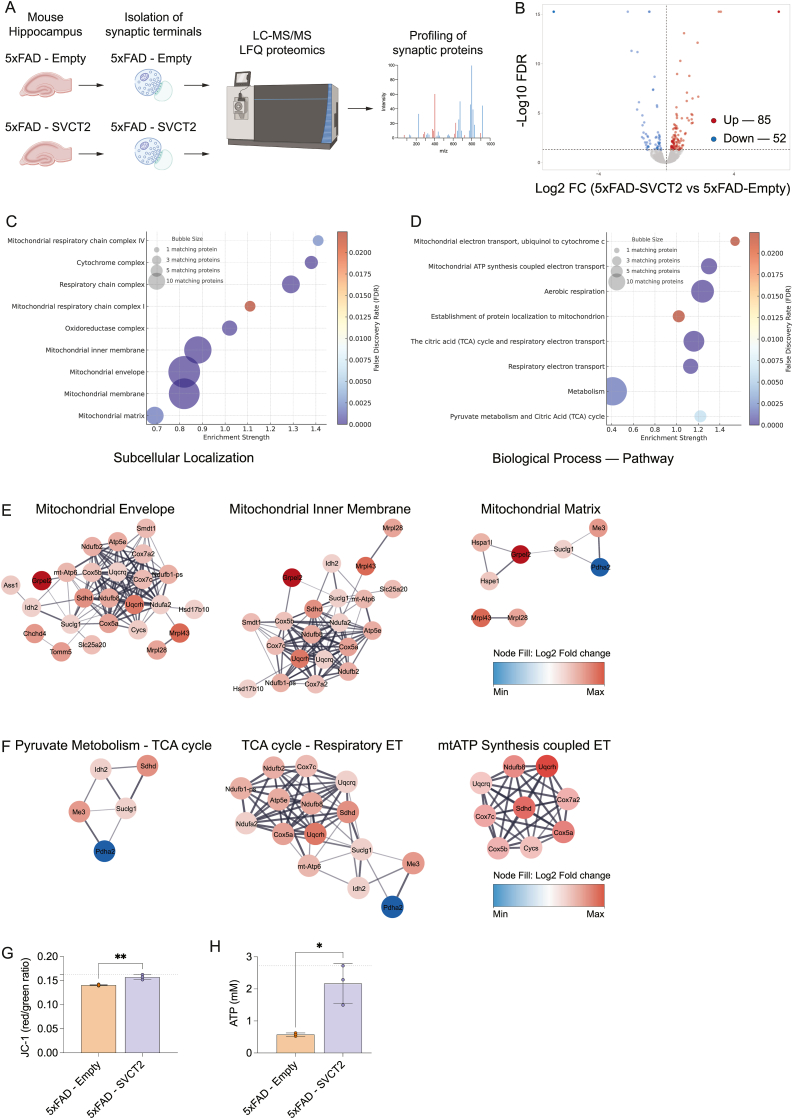
- Early SVCT2 overexpression (AAV9 at 2 months, analysis at 6 months) produced 328 upregulated and 193 downregulated microglial transcripts, a “hybrid” DAM/homeostatic phenotype, decreased amyloid plaque area and size, enhanced microglial plaque coverage, prevented NOR and MWM memory deficits, and enhanced LTP; synaptosome proteomics found 85 upregulated and 52 downregulated proteins, with increased mitochondrial membrane potential and ATP.
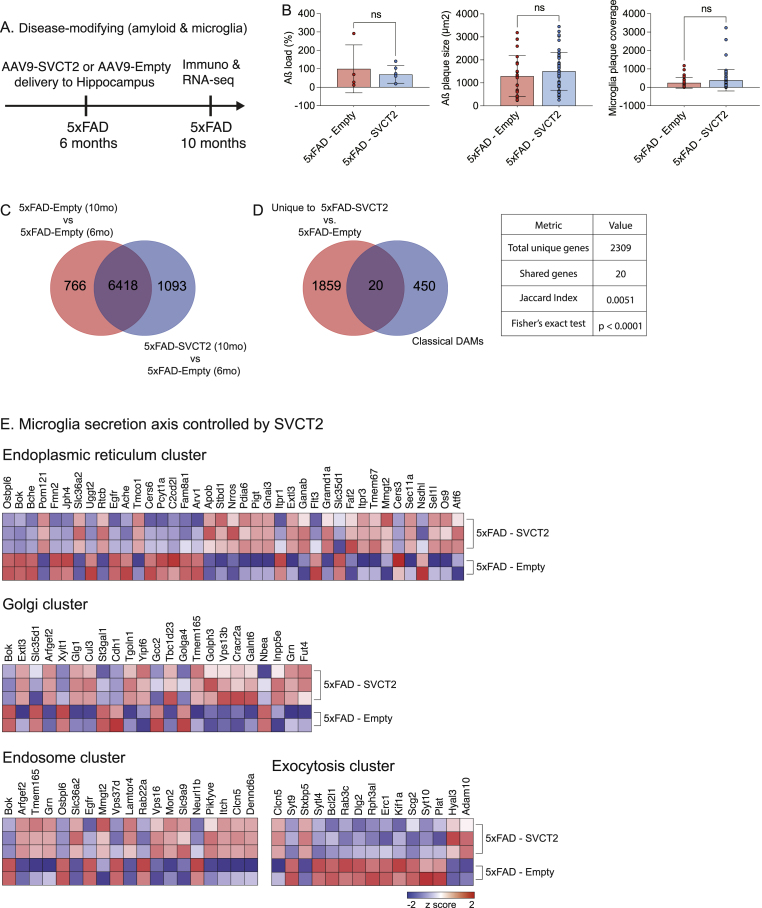
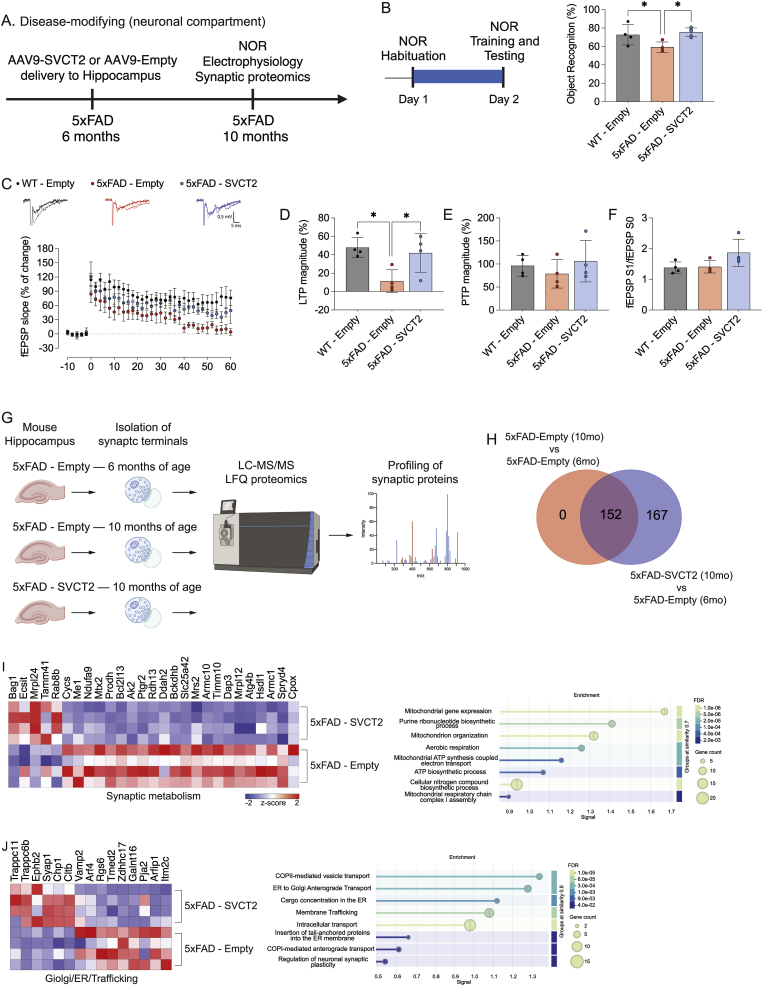
- Late SVCT2 overexpression (AAV9 at 6 months, analysis at 10 months) did not significantly alter amyloid load, plaque size, or microglial plaque coverage, but rescued NOR memory and LTP; it modified 1,093 genes specifically, with only 20 transcripts shared with a canonical DAM set of 2,309 unique genes (Jaccard index 0.0051; Fisher’s exact p < 0.0001), and 167 synaptic proteins were uniquely altered.
- In APP/PS1 mice, microglial SVCT2 overexpression decreased amyloid burden and increased excitatory synaptic density.
Methods
- Female heterozygous 5xFAD and APP/PS1 mice received hippocampal stereotaxic injections of AAV9-CD68:SVCT2-IRES-mCherry or AAV9-CD68:mCherry control; early intervention was at 2 months with analysis at 6 months, and late intervention was at 6 months with analysis at 10 months.
- Outcomes included Novel Object Recognition and Morris Water Maze, hippocampal electrophysiology (fEPSP, LTP, PTP, PPF, input/output), flow cytometry, MACS-isolated microglial RNA-seq, synaptosome LC-MS/MS proteomics, Aβ1-42 ELISA, ascorbate measurements, immunofluorescence imaging, and primary rat microglial cultures.
- Analyses used blinded procedures, Gaussian testing by D’Agostino-Pearson omnibus test, significance at P < 0.05, GraphPad Prism/Python; RNA-seq thresholds were fold change < −1.5 or >1.5, p < 0.05, FDR < 0.1; proteomics used Benjamini–Hochberg FDR ≤ 0.05.
Limitations
- Stated: the study used transgenic mouse models (5xFAD and APP/PS1) that do not capture the full heterogeneity or comorbidities of human AD; AAV9-CD68 translational safety, immunogenicity, and optimal human brain delivery need further investigation; more granular redox-sensitive signaling and secretome composition are needed; long-term efficacy and durability of SVCT2 modulation, especially late-stage, remain to be determined.
- Evident from the text: only female mice were used (5xFAD heterozygous females and exclusively female APP/PS1 mice), limiting sex-generalizability.
- Evident from the text: several key experiments used small group sizes (e.g., N = 3 per group for ascorbate measurements and some imaging/flow analyses; N = 4–5 mice per group for late-stage amyloid and behavior).
Model-written summary. Check it against the paper before relying on it.
Integrity signals
Registry
Cites
Statistics
Figures
Verification
Claims the paper makes
0 Valid · 1 Not valid · 50 Not checked · 196 Own results and interpretations
A result the paper reports from its own data — it cites no other source for it, so there is none to check. The quote shows it is in the paper.
In the paper
“Paired-pulse facilitation (PPF) assay, designed to probe presynaptic alterations, indicated no significant differences in glutamate release probabilities or quantal content between groups (Fig. 5G)”
§ Enhancing microglial antioxidant capacity via the ascorbate transporter SVCT2 delays onset and modifies disease progression in mouse models of Alzheimer's disease > Results > Overexpressing SVCT2 in microglia before disease onset prevents memory deficits and synaptic plasticity impairments in the 5xFAD mice
hedged- Asserted: passes — The authors put it forward as true.
- Checkable: passes — It can be checked against evidence.
- Load-bearing: passes — The paper’s conclusions depend on it.
- Based: passes — The paper gives a reason why it holds.
A result the paper reports from its own data — it cites no other source for it, so there is none to check. The quote shows it is in the paper.
In the paper
“Specifically, the maximum fEPSP slope, a critical parameter indicating synaptic strength, was higher in hippocampal slices from SVCT2-overexpressing 5xFAD microglia than in slices from control 5xFAD microglia (Fig. 5H).”
§ Enhancing microglial antioxidant capacity via the ascorbate transporter SVCT2 delays onset and modifies disease progression in mouse models of Alzheimer's disease > Results > Overexpressing SVCT2 in microglia before disease onset prevents memory deficits and synaptic plasticity impairments in the 5xFAD mice
plainstates an association- Asserted: passes — The authors put it forward as true.
- Checkable: passes — It can be checked against evidence.
- Load-bearing: passes — The paper’s conclusions depend on it.
- Based: passes — The paper gives a reason why it holds.
A result the paper reports from its own data — it cites no other source for it, so there is none to check. The quote shows it is in the paper.
In the paper
“Functionally, this leads to decreased amyloid plaque burden and strengthens the synaptic bioenergetic capacity, which consequently prevents the development of synaptic and memory deficits.”
§ Enhancing microglial antioxidant capacity via the ascorbate transporter SVCT2 delays onset and modifies disease progression in mouse models of Alzheimer's disease > Abstract
plainstates a cause- Asserted: passes — The authors put it forward as true.
- Checkable: passes — It can be checked against evidence.
- Load-bearing: passes — The paper’s conclusions depend on it.
- Based: passes — The paper gives a reason why it holds.
A result the paper reports from its own data — it cites no other source for it, so there is none to check. The quote shows it is in the paper.
In the paper
“We also observed an increase in excitatory synaptic density in the hippocampus of APP/PS1 mice overexpressing SVCT2 in microglia compared to APP/PS1 mice injected with the control virus (Suppl. Fig. 4E).”
§ Enhancing microglial antioxidant capacity via the ascorbate transporter SVCT2 delays onset and modifies disease progression in mouse models of Alzheimer's disease > Results > SVCT2 overexpression in 5xFAD microglia decreases amyloid pathology
plainstates a cause- Asserted: passes — The authors put it forward as true.
- Checkable: passes — It can be checked against evidence.
- Load-bearing: unclear — It is unclear whether the paper’s conclusions depend on it.
- Based: passes — The paper gives a reason why it holds.
A result the paper reports from its own data — it cites no other source for it, so there is none to check. The quote shows it is in the paper.
In the paper
“Furthermore, SVCT2 overexpression in microglia induced a decrease in amyloid plaque size and, critically, enhanced microglial coverage of amyloid deposits (Fig. 4B).”
§ Enhancing microglial antioxidant capacity via the ascorbate transporter SVCT2 delays onset and modifies disease progression in mouse models of Alzheimer's disease > Results > SVCT2 overexpression in 5xFAD microglia decreases amyloid pathology
plainstates a cause- Asserted: passes — The authors put it forward as true.
- Checkable: passes — It can be checked against evidence.
- Load-bearing: passes — The paper’s conclusions depend on it.
- Based: passes — The paper gives a reason why it holds.
178 more claims
Create a free account to see all 247 claims and to verify the 59 references still open.
- It may state two separate claims as one. 48
- Probably not a substantial claim. 23
- The quote only partly states this claim. 1
Self-check
Percentages, sums and reported differences re-computed from the paper’s own numbers.
Each contradiction between two passages listed here was confirmed by an independent check.
Rated major: it would touch a result — a value a result rests on, reported and recomputed p-values on opposite sides of the significance level, two passages that conflict with no sign which is right, or a cited work retracted before this paper was published.
In the paper
§ Enhancing microglial antioxidant capacity via the ascorbate transporter SVCT2 delays onset and modifies disease progression in mouse models of Alzheimer's disease > Methods > Experimental procedures
“incubation with saline (control) or Aβ1-42 oligomers (1 μg/ml) for 3 h.”
§ Enhancing microglial antioxidant capacity via the ascorbate transporter SVCT2 delays onset and modifies disease progression in mouse models of Alzheimer's disease > Results > SVCT2 overexpression reconfigures the redox landscape of 5xFAD microglia
“Cultures were challenged with Aβ1-42 oligomers (1 μM for 3 h) or control saline.”
Citations
Cites
Szklarczyk, D., Gable, A. L., Lyon, D., Junge, A., Wyder, S., Huerta-Cepas, J., Simonovic, M., Doncheva, N. T., Morris, J. H., Bork, P., et al. (2019) · Nucleic Acids Research · doi:10.1093/nar/gky1131 · Cited by 17,749
A Unique Microglia Type Associated with Restricting Development of Alzheimer’s Disease
Keren-Shaul, H., Spinrad, A., Weiner, A., Matcovitch-Natan, O., Dvir-Szternfeld, R., Ulland, T. K., David, E., Baruch, K., Lara-Astaiso, D., Toth, B., et al. (2017) · Cell · doi:10.1016/j.cell.2017.05.018 · Cited by 5,493
NF-κB AND REL PROTEINS: Evolutionarily Conserved Mediators of Immune Responses
Ghosh, S., May, M. J., & Kopp, E. B. (1998) · Annual Review of Immunology · doi:10.1146/annurev.immunol.16.1.225 · Cited by 5,182
Oakley, H., Cole, S. L., Logan, S., Maus, E., Shao, P., Craft, J., Guillozet-Bongaarts, A., Ohno, M., Disterhoft, J., Van Eldik, L., et al. (2006) · The Journal of Neuroscience · doi:10.1523/jneurosci.1202-06.2006 · Cited by 3,530
Friard, O., & Gamba, M. (2016) · Methods in Ecology and Evolution · doi:10.1111/2041-210x.12584 · Cited by 3,437
Krasemann, S., Madore, C., Cialic, R., Baufeld, C., Calcagno, N., El Fatimy, R., Beckers, L., O’Loughlin, E., Xu, Y., Fanek, Z., et al. (2017) · Immunity · doi:10.1016/j.immuni.2017.08.008 · Cited by 2,979
Mitochondrial TCA cycle metabolites control physiology and disease
Martínez-Reyes, I., & Chandel, N. S. (2020) · Nature Communications · doi:10.1038/s41467-019-13668-3 · Cited by 2,813
Microglia promote learning-dependent synapse formation through brain-derived neurotrophic factor
Parkhurst, C. N., Yang, G., Ninan, I., Savas, J. N., Yates, J. R., Lafaille, J. J., Hempstead, B. L., Littman, D. R., & Gan, W.-B. (2013) · Cell · doi:10.1016/j.cell.2013.11.030 · Cited by 2,599
Oxidative Damage Is the Earliest Event in Alzheimer Disease
Nunomura, A., Perry, G., Aliev, G., Hirai, K., Takeda, A., Balraj, E. K., Jones, P. K., Ghanbari, H., Wataya, T., Shimohama, S., et al. (2001) · Journal of Neuropathology & Experimental Neurology · doi:10.1093/jnen/60.8.759 · Cited by 1,885
Nolfi-Donegan, D., Braganza, A., & Shiva, S. (2020) · Redox Biology · doi:10.1016/j.redox.2020.101674 · Cited by 1,488
Cited by
Efficacy of antioxidants as a therapy for Alzheimer's disease: a meta-analysis
Li, J., Chen, B., Jiang, J., Feng, Y., Zhang, R., Li, D. M., Wang, R., Long, Z., Ge, L., Guo, Y., et al. (2026) · Frontiers in Nutrition · doi:10.3389/fnut.2026.1878597 · Cited by 3
Ain, Q., Martínez‐Cerdeño, V., Traber, M. G., Leonard, S., Finno, C. J., Lin, X., Lozano, R., & Tassone, F. (2026) · Nutrition Research · doi:10.1016/j.nutres.2026.10.001
Metadata
- Authors
- Portugal, C. C., Santos, E. C. S., Monteiro-Pacheco, A., Costa-Pinto, S., Almeida, T. O., Tedim-Moreira, J., Gavin, D., Canedo, T., Oliveira, F., Cardoso, I., Summavielle, T., Vaz, S. H., Socodato, R., & Relvas, J. B.
- Affiliations
- Universidade do Porto (PT)
- i3S - Instituto de Investigação e Inovação em Saúde, Universidade do Porto (PT)
- University of Lisbon (PT)
- Corresponding author
- Portugal, Camila C.
- Socodato, Renato
- Relvas, João B.
- ORCID
- Venue
- Redox Biology
- Publisher
- Elsevier BV
- Published
- 2025-10
- Volume
- 86
- Pages
- 103851
- ISSN
- 2213-2317 (ISSN-L)
- PMC
- PMC12445587
- OpenAlex
- W4413801239
- Cited by
- 2
- References
- 87
- Citations by year
- 2026: 2
- FWCI
- 0.47
- Type
- journal article
- Language
- en
- Open access
- gold
- doi.org
- Licence
- cc-by-nc-nd
- www.elsevier.com/tdm/userlicense/1.0/ (tdm)
- www.elsevier.com/legal/tdmrep-license (tdm)
- creativecommons.org/licenses/by-nc-nd/4.0/ (vor)
- Locations
- Redox Biology (publishedVersion, cc-by-nc-nd)
- PubMed Central (publishedVersion, cc-by-nc-nd)
- Europe PMC (PubMed Central) (publishedVersion, cc-by-nc-nd)
- PubMed (publishedVersion)
- DOAJ (DOAJ: Directory of Open Access Journals) (submittedVersion)
- Funders
- Rede Nacional de Espectrometria de Massa (ROTEIRO/0028/2013, LISBOA-01-0145-FEDER-022125)
- Fundação para a Ciência e a Tecnologia (PTDC/BTM-SAL/32147/2017, 2024.05324, EXPL/MED-NEU/0588/2021, 2023.06380, 57/2016, SFRH/BD/147981/2019, 57/2017, UI/BD/151552/2021, SFRH/BD/147277/2019)
- Institut Sukan Negara (952455)
- European Regional Development Fund
- International Society for Neurochemistry
- Brown Foundation Institute of Molecular Medicine for the Prevention of Human Diseases
- Topics
- Life Sciences › Neuroscience › Cellular and Molecular Neuroscience › Alzheimer's disease research and treatments
- Life Sciences › Neuroscience › Neurology › Neuroinflammation and Neurodegeneration Mechanisms
- Life Sciences › Neuroscience › Neurology › Neurological Disease Mechanisms and Treatments
- Keywords
- Alzheimer's disease, SVCT2, SLC23A2, microglia, vitamin C, antioxidant capacity, 5xFAD mice, amyloid plaques, synaptic plasticity, memory impairment, neuroprotection, therapeutic target
- MeSH terms
- Alzheimer Disease, Animals, Antioxidants, Ascorbic Acid, Disease Models, Animal, Humans, Mice, Transgenic, Oxidation-Reduction, Microglia, Disease Progression, Mice, Sodium-Coupled Vitamin C Transporters
About these checks
Registry, retraction, Cites and statistics results are computed, not judged, with one exception: a printed reference that no index lists is read once by a model before it counts as a citation error. Claims are extracted by a model and kept only when their quote appears verbatim in the text; each cited source is then checked, with a model’s help, for whether it says what the claim relies on. Those verdicts can be wrong — read the claim’s quote and the cited source before relying on one.
A language model drew the claims from the paper on 2026-11-27, under version 3 of the claim definition (model deepseek-v4.1-flash, prompt extract-v3).
A second model labelled each claim on 2026-11-27 (model jev-1.13-20260917, definition revision gold-guideline-v0.2).
Statistics and arithmetic are recomputed, not judged.
Confidence bands are shown only for fields calibrated on our annotated test set. None is calibrated yet, so no band is shown.
What counts as a claim ›How we measure confidence ›How we check this ›
Are you an author, or do you see a problem with this page? Request a review
How to cite
Cite CoChat for the checks on this page, and the paper for its own findings.
- This page
- CoChat. (2026). Citation check: Enhancing microglial antioxidant capacity via the ascorbate transporter SVCT2 delays onset and modifies disease progression in mouse models of Alzheimer's disease. https://app.cochat.ai/papers/10.1016/j.redox.2025.103851
- The paper
- Portugal, C. C., Santos, E. C. S., Monteiro-Pacheco, A., Costa-Pinto, S., Almeida, T. O., Tedim-Moreira, J., Gavin, D., Canedo, T., Oliveira, F., Cardoso, I., Summavielle, T., Vaz, S. H., Socodato, R., & Relvas, J. B. (2025). Enhancing microglial antioxidant capacity via the ascorbate transporter SVCT2 delays onset and modifies disease progression in mouse models of Alzheimer's disease. Redox Biology. https://doi.org/10.1016/j.redox.2025.103851
Data sources
Bibliographic data: Semantic Scholar, OpenAlex, Crossref.
Contains information from the Semantic Scholar Academic Graph Datasets, made available under the ODC Attribution License (ODC-BY 1.0).
Semantic Scholar’s data is described in: Kinney, R., et al. (2023). The Semantic Scholar Open Data Platform. arXiv:2301.10140.
