

The DOI matches its Crossref record; 30 of the 30 references it cites were found in a registry or an index.
Group mindfulness-based intervention for distressing voices: A pragmatic randomised controlled trial
Open accessAbstract
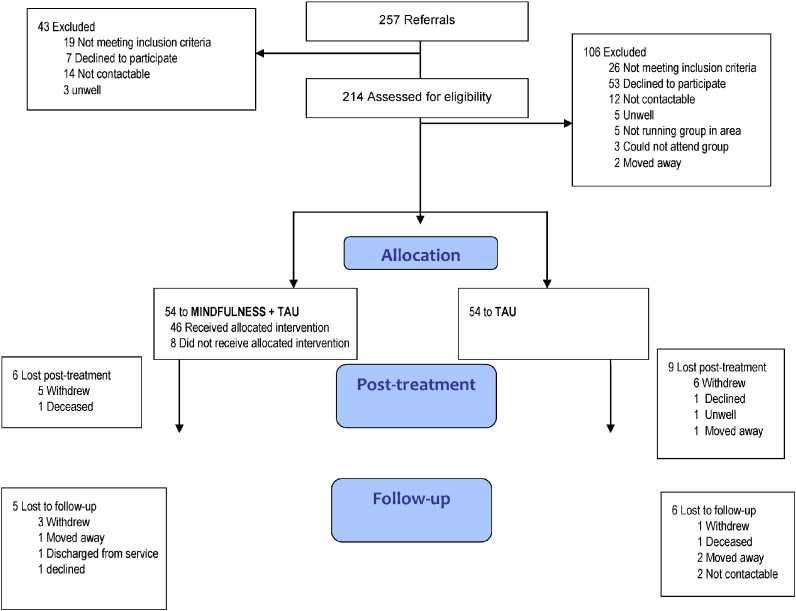
Group Person-Based Cognitive Therapy (PBCT) integrates cognitive therapy and mindfulness to target distinct sources of distress in psychosis. The present study presents data from the first randomised controlled trial investigating group PBCT in people distressed by hearing voices. One-hundred and eight participants were randomised to receive either group PBCT and Treatment As Usual (TAU) or TAU only. While there was no significant effect on the primary outcome, a measure of general psychological distress, results showed significant between-group post-intervention benefits in voice-related distress, perceived controllability of voices and recovery. Participants in the PBCT group reported significantly lower post-treatment levels of depression, with this effect maintained at six-month follow-up. Findings suggest PBCT delivered over 12weeks effectively impacts key dimensions of the voice hearing experience, supports meaningful behaviour change, and has lasting effects on mood.
Overview
The claims and statistics of this paper haven’t been checked yet.
Run the check — free, no account needed. It reads the open-access text and checks the sources it cites.
Integrity signals
Registry
Cites
Statistics
Figures
Verification
Claims the paper makes
The claims and statistics of this paper haven’t been checked yet.
Run the check — free, no account needed. It reads the open-access text and checks the sources it cites.
Claims other papers make about this one
Each is checked against this paper’s own text: does it say what the citing paper says it does?
The source backs part of the claim, not all of it — or backs it for a different population, condition or comparison.
In the citing paper
“Recent randomised control studies and meta-analyses showed that mindfulness-based interventions significantly improved DM, negative emotions, positive symptoms and negative symptoms compared with control groups.43–49”
From Dispositional Mindfulness and Psychotic Symptoms in Schizophrenia Spectrum Disorders: The Mediating Roles of Rumination and Negative Emotion (2022) · cites this paper as [45]
Experimental — accuracy not yet measured
Self-check
Percentages, sums and reported differences re-computed from the paper’s own numbers.
The self-check needs the paper’s full text.
Citations
Cites
The Hospital Anxiety and Depression Scale
Zigmond, A. S., & Snaith, R. P. (1983) · Acta Psychiatrica Scandinavica · doi:10.1111/j.1600-0447.1983.tb09716.x · Cited by 47,139
Statistical Analysis With Missing Data
Lahiff, M., Little, R. J. A., & Rubin, D. B. (1989) · Journal of the American Statistical Association · doi:10.2307/2289883 · Cited by 17,385
Depression and quality of life in older persons: A review
Sivertsen, H., Bjørkløf, G. H., Engedal, K., Selbæk, G., & Helvik, A.-S. (2015) · Dementia and Geriatric Cognitive Disorders · doi:10.1159/000437299 · Cited by 14,152
The validity of the Hospital Anxiety and Depression Scale
Bjelland, I., Dahl, A. A., Haug, T. T., & Neckelmann, D. (2002) · Journal of Psychosomatic Research · doi:10.1016/s0022-3999(01)00296-3 · Cited by 9,779 · cited 1×
“The HADS has well established psychometric properties (Zigmond and Snaith, 1983) and reliability (α 0.83 for anxiety and 0.82 for depression; Bjelland et al., 2002).”
MethodInfluentialStatistical Analysis With Missing Data
Ghosh, S., Little, R. J. A., & Rubin, D. B. (1988) · Technometrics · doi:10.2307/1269814 · Cited by 4,730
HADDOCK, G., McCARRON, J., TARRIER, N., & FARAGHER, E. B. (1999) · Psychological Medicine · doi:10.1017/s0033291799008661 · Cited by 1,461
National Collaborating Centre for Mental Health
Veale, D. M. (2006) · Research Portal (King's College London) · Cited by 941
CORE: Clinical Outcomes in Routine Evaluation
Evans, C., Mellor-Clark, J., Margison, F., Barkham, M., Audin, K., Connell, J., & McGrath, G. (2000) · Journal of Mental Health · doi:10.1080/713680250 · Cited by 560
Cognitive Therapy for Delusions, Voices and Paranoia
Chadwick, P., Birchwood, M. J., & Trower, P. (1996) · Cited by 419
Self-citationUnderstanding Psychology as a Science: An Introduction to Scientific and Statistical Inference
Dienes, Z. P. (2008) · Cited by 418
The omnipotence of voices: testing the validity of a cognitive model
Birchwood, M. J., & Chadwick, P. (1997) · Psychological Medicine · doi:10.1017/s0033291797005552 · Cited by 314
Self-citationCognitive Therapy for Delusions, Voices and Paranoia
Wetzler, S. E. (1997) · American Journal of Psychotherapy · doi:10.1176/appi.psychotherapy.1997.51.2.301 · Cited by 310
Mindfulness interventions for psychosis: A meta-analysis
Khoury, B., Lecomte, T., Gaudiano, B. A., & Paquin, K. (2013) · Schizophrenia Research · doi:10.1016/j.schres.2013.07.055 · Cited by 292 · cited 2×
“Evidence is building for the benefits of groupmindfulness-based interventions (MBIs) for psychosis (Chadwick et al., 2005; Khoury et al., 2013; Lopez-Navarro et al., 2015), including for distressing voices (Chadwick et al.”
BackgroundMindfulness groups for people with psychosis
Chadwick, P., Taylor, K. N., & Abba, N. (2005) · Behavioural and Cognitive Psychotherapy · doi:10.1017/s1352465805002158 · Cited by 292 · cited 2×
“Evidence is building for the benefits of groupmindfulness-based interventions (MBIs) for psychosis (Chadwick et al., 2005; Khoury et al., 2013; Lopez-Navarro et al., 2015), including for distressing voices (Chadwick et al.”
BackgroundSelf-citationCognitive therapy for command hallucinations: randomised controlled trial
Trower, P., Birchwood, M., Meaden, A., Byrne, S., Nelson, A., & Ross, K. (2004) · British Journal of Psychiatry · doi:10.1192/bjp.184.4.312 · Cited by 268
Person‐Based Cognitive Therapy for Distressing Psychosis
Chadwick, P. (2006) · Wiley eBooks · doi:10.1002/9780470713075 · Cited by 252
Self-citationChadwick, P., Hughes, S., Russell, D., Russell, I., & Dagnan, D. (2009) · Behavioural and Cognitive Psychotherapy · doi:10.1017/s1352465809990166 · Cited by 219 · cited 5×
“The planned sample size of 60 participants per treatment arm was based on yielding 80% power for detecting an effect size of d = 0.56 (Chadwick et al., 2009) with a Student's t-test, two-sided 5% alpha and an attrition rate of 18%.”
BackgroundMethodInfluentialSelf-citationThomas, N., Hayward, M., PETERS, E. R., van der Gaag, M., Bentall, R. P., Jenner, J. A., Strauss, C., Sommer, I. E., Johns, L., Varese, F., et al. (2014) · Schizophrenia Bulletin · doi:10.1093/schbul/sbu037 · Cited by 215
Self-citationThe Hospital Anxiety and Depression Scale (HADS)
Zigmond, A. S., & Snaith, R. P. (1983) · Cited by 173
Responding mindfully to distressing psychosis: A grounded theory analysis
Abba, N., Chadwick, P., & Stevenson, C. (2008) · Psychotherapy Research · doi:10.1080/10503300701367992 · Cited by 159
Self-citationBirchwood, M. J., Michail, M., Meaden, A., Tarrier, N., Lewis, S. W., Wykes, T., Davies, L. M., Dunn, G., & PETERS, E. R. (2014) · The Lancet Psychiatry · doi:10.1016/s2215-0366(14)70247-0 · Cited by 155
What are the effects of group cognitive behaviour therapy for voices? A randomised control trial
Wykes, T., Hayward, P., Thomas, N., Green, N. H., Surguladze, S., Fannon, D. G., & Landau, S. (2005) · Schizophrenia Research · doi:10.1016/j.schres.2005.03.013 · Cited by 141
Greenwood, K., Sweeney, A., Williams, S., Garety, P. A., Kuipers, E., Scott, J. L., & PETERS, E. R. (2009) · Schizophrenia Bulletin · doi:10.1093/schbul/sbp117 · Cited by 136
Penn, D. L., Meyer-Kalos, P., Evans, E., Wirth, R. J., Cai, K., & Burchinal, M. (2009) · Schizophrenia Research · doi:10.1016/j.schres.2008.12.009 · Cited by 120
Challenging the omnipotence of voices: group cognitive behavior therapy for voices
Chadwick, P., Sambrooke, S., Rasch, S., & Davies, E. (2000) · Behaviour Research and Therapy · doi:10.1016/s0005-7967(99)00126-6 · Cited by 116
Self-citationGroup person-based cognitive therapy for distressing voices: Pilot data from nine groups
Dannahy, L., Hayward, M., Strauss, C., Turton, W., Harding, E., & Chadwick, P. (2010) · Journal of Behavior Therapy and Experimental Psychiatry · doi:10.1016/j.jbtep.2010.07.006 · Cited by 82
Self-citationLópez-Navarro, E., Del Canto, C., Belber, M., Mayol, A., Fernández-Alonso, O., Lluis, J., Munar, E., & Chadwick, P. (2015) · Schizophrenia Research · doi:10.1016/j.schres.2015.08.016 · Cited by 66 · cited 2×
“Evidence is building for the benefits of groupmindfulness-based interventions (MBIs) for psychosis (Chadwick et al., 2005; Khoury et al., 2013; Lopez-Navarro et al., 2015), including for distressing voices (Chadwick et al.”
BackgroundSelf-citationGroup person‐based cognitive therapy for chronic depression: a pilot randomized controlled trial
Strauss, C., Hayward, M., & Chadwick, P. (2012) · British Journal of Clinical Psychology · doi:10.1111/j.2044-8260.2012.02036.x · Cited by 35
Self-citationStrauss, C., Hayward, M., & Chadwick, P. (2012) · British Journal of Clinical Psychology · Cited by 28
Self-citationGroup Person‐based Cognitive Therapy for Distressing Psychosis
Strauss, C., & Hayward, M. (2013) · Wiley eBooks · doi:10.1002/9781118499184.ch16 · Cited by 5
Self-citation
Cited by
Sorted by citations
Mindfulness Meditation and Psychopathology
Wielgosz, J., Goldberg, S. B., Kral, T. R. A., Dunne, J. D., & Davidson, R. J. (2019) · Annual Review of Clinical Psychology · doi:10.1146/annurev-clinpsy-021815-093423 · Cited by 435
Adverse events in meditation practices and meditation‐based therapies: a systematic review
Farias, M., Maraldi, E., Wallenkampf, K. C., & Lucchetti, G. (2020) · Acta Psychiatrica Scandinavica · doi:10.1111/acps.13225 · Cited by 262
Bighelli, I., Salanti, G., Huhn, M., Schneider‐Thoma, J., Krause, M., Reitmeir, C., Wallis, S., Schwermann, F., Pitschel‐Walz, G., Barbui, C., et al. (2018) · World Psychiatry · doi:10.1002/wps.20577 · Cited by 199
Louise, S., Fitzpatrick, M., Strauss, C., Rossell, S. L., & Thomas, N. (2018) · Schizophrenia Research · doi:10.1016/j.schres.2017.05.023 · Cited by 160
Self-citationJansen, J. E., Gleeson, J., Bendall, S., Rice, S., & Alvarez-Jimenez, M. (2020) · Schizophrenia Research · doi:10.1016/j.schres.2019.11.016 · Cited by 144
Metadata
- Authors
- Chadwick, P., Strauss, C., Jones, A.-M., Kingdon, D., Ellett, L., Dannahy, L., & Hayward, M.
- Affiliations
- King's College London (GB)
- University of Sussex (GB)
- University of Southampton (GB)
- Royal Holloway University of London (GB)
- Southern Health and Social Care Trust (GB)
- Corresponding author
- Chadwick, Paul
- Venue
- Schizophrenia Research
- Publisher
- Elsevier BV
- Published
- 2016-08
- Volume
- 175
- Issue
- 1-3
- Pages
- 168-173
- ISSN
- 0920-9964 (ISSN-L)
- PMC
- PMC4967452
- OpenAlex
- W2339126503
- Cited by
- 116
- References
- 30
- Citations by year
- 2026: 5 · 2025: 7 · 2024: 12 · 2023: 9 · 2022: 11 · 2021: 13 · 2020: 16 · 2019: 11 · 2018: 14 · 2017: 14 · 2016: 3
- FWCI
- 12.44
- Type
- journal article
- Language
- en
- Open access
- hybrid
- doi.org
- Licence
- Locations
- Schizophrenia Research (publishedVersion, cc-by-nc-nd)
- Europe PMC (PubMed Central) (publishedVersion, cc-by-nc-nd)
- PubMed Central (publishedVersion, cc-by-nc-nd)
- PubMed (publishedVersion)
- ePrints Soton (University of Southampton) (acceptedVersion)
- Sussex Research Online (University of Sussex) (submittedVersion, cc-by-nc-nd)
- Figshare (submittedVersion, cc-by-nc-nd)
- Research Portal (King's College London) (submittedVersion, cc-by-nc-nd)
- Funders
- National Institute for Health and Care Research (PB-PG-0110-21239)
- Topics
- Health Sciences › Medicine › Psychiatry and Mental health › Schizophrenia research and treatment
- Social Sciences › Psychology › Clinical Psychology › Mindfulness and Compassion Interventions
- Life Sciences › Neuroscience › Cognitive Neuroscience › Hallucinations in medical conditions
- Keywords
- mindfulness-based interventions
- MeSH terms
- Adolescent, Adult, Aged, Female, Follow-Up Studies, Hallucinations, Humans, Male, Middle Aged, Psychiatric Status Rating Scales, Psychotic Disorders, Schizophrenia, Single-Blind Method, Treatment Outcome, Young Adult, Self Report, Mindfulness
About these checks
Registry, retraction, Cites and statistics results are computed, not judged, with one exception: a printed reference that no index lists is read once by a model before it counts as a citation error. Claims are extracted by a model and kept only when their quote appears verbatim in the text; each cited source is then checked, with a model’s help, for whether it says what the claim relies on. Those verdicts can be wrong — read the claim’s quote and the cited source before relying on one.
Statistics and arithmetic are recomputed, not judged.
Confidence bands are shown only for fields calibrated on our annotated test set. None is calibrated yet, so no band is shown.
What counts as a claim ›How we measure confidence ›How we check this ›
Are you an author, or do you see a problem with this page? Request a review
