

The DOI matches its Crossref record; 2 of the 2 references it cites were found in a registry or an index.
Participation in community-based healthcare interventions and non-communicable diseases early detection of general population in Indonesia
Open accessAbstract
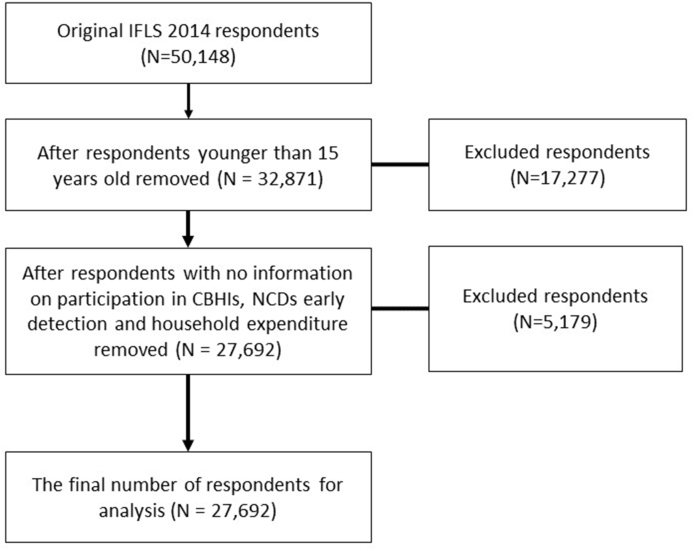
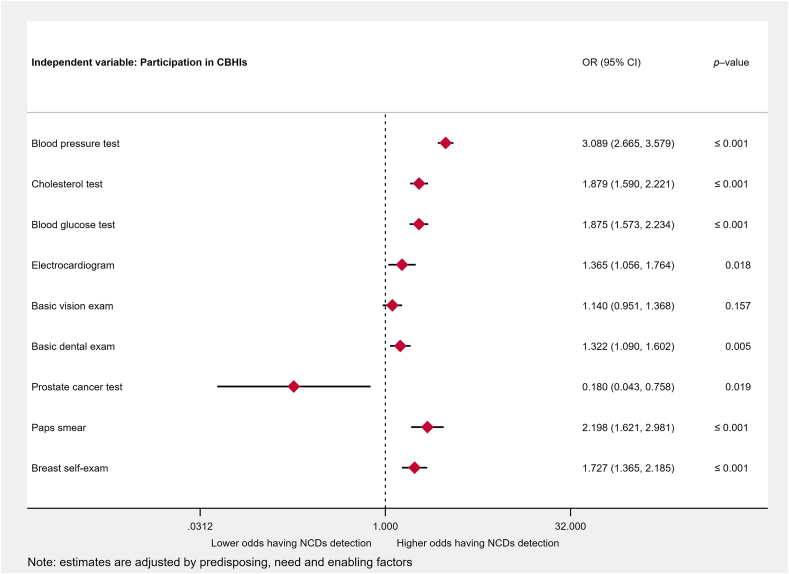
Background: Community-based Healthcare Interventions (CBHIs) are regarded as a critical component of healthcare task-sharing in LMICs and have the potential to address LMICs' health system weaknesses to improve NCDs prevention care. This study aims to investigate the relationship between participation in CBHIs and NCDs early detection at medical facilities among Indonesians. Methods: Data come from the fifth Indonesian Family Life Survey (2014-2015), a total of 27,692 individuals (14,820 female and 12,872 male individuals age 15 and older). Multiple ordered logistics and logistics regression was used to assess the association between individual participation in CBHI and early detection of NCDs at medical facilities. Findings: Participation in CBHIs are associated with higher odds of having regular blood pressure test (adjusted odds ratio [OR], 3.09; 95% confidence interval [CI], 2.67-3.58), cholesterol test (adjusted OR, 1.88; 95% CI, 1.60-2.22), blood glucose test (adjusted OR, 1.88; 95% CI, 1.58-2.23), electrocardiogram (adjusted OR, 1.37; 95% CI, 1.06-1.76) and basic dental examination (adjusted OR, 1.32; 95% CI, 1.09-1.60) at medical facilities. The odds of having pap smears (adjusted OR, 2.20; 95% CI, 1.62-2.98) and breast self-examination (adjusted OR, 1.73; 95% CI, 1.37-2.19) among females who participated in CBHIs are substantially larger than those who did not participate in CBHIs. No significant association is shown for the basic vision examination (adjusted OR, 1.14; 95% CI, 0.95-1.37), while the association of participation in CBHIs on prostate cancer checkup (adjusted OR, 0.18; 95% CI, 0.04-0.76) was negative and significant. The results were controlled with a wide range of predisposing, enabling and need factors for NCDs early detection. Conclusion: and recommendation: CBHIs may benefit NCDs early detection for the general population in Indonesia. Policymakers and health practitioners need to design CBHIs programs that are attractive to the population, especially men and younger people.
Overview
The claims and statistics of this paper haven’t been checked yet.
Run the check — free, no account needed. It reads the open-access text and checks the sources it cites.
Integrity signals
Registry
Cites
Statistics
Figures
Verification
Claims the paper makes
The claims and statistics of this paper haven’t been checked yet.
Run the check — free, no account needed. It reads the open-access text and checks the sources it cites.
Claims other papers make about this one
Each is checked against this paper’s own text: does it say what the citing paper says it does?
The check wasn’t confident either way, so it gives no verdict — never disputed.
In the citing paper
“While these risk factors are well documented globally, few systematic, community-based studies have quantified the burden of undiagnosed hypertension in young adults in Pakistan.”
From Prevalence of Undiagnosed Hypertension in Young Adults: A Community-Based Study (2025) · cites this paper as [10]
Experimental — accuracy not yet measured
Self-check
Percentages, sums and reported differences re-computed from the paper’s own numbers.
The self-check needs the paper’s full text.
Citations
Cites
Lozano, R., Naghavi, M., Foreman, K., Lim, S., Shibuya, K., Aboyans, V., Abraham, J., Adair, T., Aggarwal, R., Ahn, S. Y., et al. (2012) · The Lancet · doi:10.1016/s0140-6736(12)61728-0 · Cited by 14,070
Bennett, J. E., Stevens, G. A., Mathers, C. D., Bonita, R., Rehm, J., Kruk, M. E., Riley, L. M., Dain, K., Kengne, A. P., Chalkidou, K., et al. (2018) · The Lancet · doi:10.1016/s0140-6736(18)31992-5 · Cited by 1,336
Research works printed but not linked: 49
- Abdel-Aziz, 2016, Assessing the impact of a community-based health and nutrition education on the management of diarrhea in an urban district, Cairo, Egypt, Global Journal of Health Science, 8, 46
- Abeid, 2015, A community-based intervention for improving health-seeking behavior among sexual violence survivors: A controlled before and after design study in rural Tanzania, Global Health Action, 8, 10.3402/gha.v8.28608 · DOI
- de-Graft Aikins, 2014, Chronic non-communicable diseases and the challenge of universal health coverage: Insights from community-based cardiovascular disease research in urban poor communities in accra, Ghana, BMC Public Health, 14, 1
- Allen, 2017, Quantifying the global distribution of premature mortality from non-communicable diseases, Journal of Public Health, 39, 698, 10.1093/pubmed/fdx008 · DOI
- Allen, 2017, Are WHO “best buys” for non-communicable diseases effective in low-income and lower-middle-income countries? A systematic review, Lancet Global Health, 5, S17, 10.1016/S2214-109X(17)30124-9 · DOI
- Allen, 2018, Evaluation of research on interventions aligned to WHO ‘best buys’ for NCDs in low-income and lower-middle-income countries: A systematic review from 1990 to 2015, BMJ global health, 3, 10.1136/bmjgh-2017-000535 · DOI
- Anderson, 2008, Guideline implementation for breast healthcare in low‐income and middle‐income countries: Overview of the Breast Health Global Initiative Global Summit 2007, Cancer, 113, 2221, 10.1002/cncr.23844 · DOI
- Andresen, 2013, Performance of the 10-item center for epidemiologic studies depression scale for caregiving research, SAGE Open Medicine, 1, 10.1177/2050312113514576 · DOI
- Bennett, 2004, The role of community-based health insurance within the health care financing system: A framework for analysis, Health Policy and Planning, 19, 147, 10.1093/heapol/czh018 · DOI
- Chang, 2019, Measuring population ageing: An analysis of the global burden of disease study 2017, The Lancet Public Health, 4, e159, 10.1016/S2468-2667(19)30019-2 · DOI
- Checkley, 2014, Management of NCD in low-and middle-income countries, Global heart, 9, 431, 10.1016/j.gheart.2014.11.003 · DOI
- Devkota, 2016, Barriers to treatment and control of hypertension among hypertensive participants: A community-based cross-sectional mixed method study in municipalities of kathmandu, Nepal, Frontiers in cardiovascular medicine, 3, 26, 10.3389/fcvm.2016.00026 · DOI
- Ekman, 2004, Community-based health insurance in low-income countries: A systematic review of the evidence, Health Policy and Planning, 19, 249, 10.1093/heapol/czh031 · DOI
- Fauveau, 1991, Effect on mortality of community-based maternity-care programme in rural Bangladesh, The Lancet, 338, 1183, 10.1016/0140-6736(91)92041-Y · DOI
- Ferdinand, 2012, Community‐based approaches to prevention and management of hypertension and cardiovascular disease, Journal of Clinical Hypertension, 14, 336, 10.1111/j.1751-7176.2012.00622.x · DOI
- Ferlay, 2015, Cancer incidence and mortality worldwide: Sources, methods and major patterns in GLOBOCAN 2012, International Journal of Cancer, 136, E359, 10.1002/ijc.29210 · DOI · Paper page
- Ford, 2002, Does exercise reduce inflammation? Physical activity and C-reactive protein among US adults, Epidemiology, 561, 10.1097/00001648-200209000-00012 · DOI
- Fornari, 2013, Children first study: How an educational program in cardiovascular prevention at school can improve parents' cardiovascular risk, European journal of preventive cardiology, 20, 301, 10.1177/2047487312437617 · DOI
- Golden, 2012, Social ecological approaches to individuals and their contexts: Twenty years of health education & behavior health promotion interventions, Health Education & Behavior, 39, 364, 10.1177/1090198111418634 · DOI · Paper page
- Gonfa, 2021, Predictors of women's awareness of common non-communicable diseases screening during preconception period in manna district, southwest Ethiopia: Implication for wellness check-up, BMC Health Services Research, 21, 1, 10.1186/s12913-021-06067-2 · DOI
- Gosling, 2003, A very brief measure of the Big-Five personality domains, Journal of Research in Personality, 37, 504, 10.1016/S0092-6566(03)00046-1 · DOI · Paper page
- Jacobs, 2018, Evaluation of a community-based intervention to improve maternal and neonatal health service coverage in the most rural and remote districts of Zambia, PLoS One, 13, 10.1371/journal.pone.0190145 · DOI
- Keetile, 2021, Factors associated with and socioeconomic inequalities in breast and cervical cancer screening among women aged 15–64 years in Botswana, PLoS One, 16, 10.1371/journal.pone.0255581 · DOI
- Kusnawan, 2015, Rural and urban differences in the eye health of high school students, Althea Medical Journal, 2, 448, 10.15850/amj.v2n3.507 · DOI
- Kusuma, 2022, The presence of Posyandu as an approach in improving health development in the community, Jurnal EduHealth, 13, 137
- Lassi, 2014, The conceptual framework and assessment methodology for the systematic reviews of community-based interventions for the prevention and control of infectious diseases of poverty, Infectious diseases of poverty, 3, 1, 10.1186/2049-9957-3-22 · DOI
- Li, 2016, The impact of predisposing, enabling, and need factors in utilization of health services among rural residents in Guangxi, China, BMC Health Services Research, 16, 1, 10.1186/s12913-016-1825-4 · DOI
- Marella, 2019, Factors influencing disability inclusion in general eye health services in bandung, Indonesia: A qualitative study, International Journal of Environmental Research and Public Health, 16, 23, 10.3390/ijerph16010023 · DOI
- Mc Namara, 2020, Implementing screening interventions in community pharmacy to promote interprofessional coordination of primary care–a mixed methods evaluation, Research in Social and Administrative Pharmacy, 16, 160, 10.1016/j.sapharm.2019.04.011 · DOI
- McLeroy, 2003, Community-based interventions, American Journal of Public Health, 93, 529, 10.2105/AJPH.93.4.529 · DOI · Paper page
- Menard, 2002, Vol. 106
- Negi, 2022, Intersecting sex-related inequalities in self-reported testing for and prevalence of Non-Communicable Disease (NCD) risk factors in Kerala, BMC Public Health, 22, 1, 10.1186/s12889-022-12956-w · DOI
- Owens, 2015, Principles for developing digital health interventions for prostate cancer: A community-based design approach with african American men, International conference on human aspects of it for the aged population, 1, 12
- Philip, 2018, Community-based interventions for health promotion and disease prevention in noncommunicable diseases: A narrative review, Journal of Education and Health Promotion, 7, 12
- Pratono, 2018, Long-term care in Indonesia: The role of integrated service post for elderly, Journal of Aging and Health, 30, 1556, 10.1177/0898264318794732 · DOI
- Purnamasari, 2019, The emergence of non-communicable disease in Indonesia, Acta Med Indones, 50, 273
- Sarrafzadegan, 2009, Do lifestyle interventions work in developing countries? Findings from the isfahan healthy heart program in the Islamic Republic of Iran, Bulletin of the World Health Organization, 87, 39, 10.2471/BLT.07.049841 · DOI
- Schröders, 2017, How is Indonesia coping with its epidemic of chronic noncommunicable diseases? A systematic review with meta-analysis, PLoS One, 12, 10.1371/journal.pone.0179186 · DOI
- Singh, 2011, What are the evidence based public health interventions for prevention and control of NCDs in relation to India?, Indian Journal of Community Medicine: Official Publication of Indian Association of Preventive & Social Medicine, 36, S23
- Song, 2019, Utilisation of national community-based blood pressure monitoring service among adult Chinese and its association with hypertension treatment and blood pressure control—a mediation analysis, BMC Geriatrics, 19, 1, 10.1186/s12877-019-1176-1 · DOI
- Strauss, 2016, Vol. 1
- Subramanian, 2018, Cost and affordability of non-communicable disease screening, diagnosis and treatment in Kenya: Patient payments in the private and public sectors, PLoS One, 13, 10.1371/journal.pone.0190113 · DOI
- Sujarwoto, 2020, Participation in community-based health care interventions (CBHIs) and its association with hypertension awareness, control and treatment in Indonesia, PLoS One, 15, 10.1371/journal.pone.0244333 · DOI
- Thabrany, 2006, Human resources in decentralized health systems in Indonesia: Challenges for Equity, Regional Health Forum, 10, 75
- Tripathy, 2021, How effective was implementation of the package of essential non-communicable disease (PEN) interventions: A review of evidence?, Diabetes & Metabolic Syndrome: Clinical Research Reviews, 15, 10.1016/j.dsx.2021.102266 · DOI
- Widyaningsih, 2022, Missed opportunities in hypertension risk factors screening in Indonesia: A mixed-methods evaluation of integrated health post (POSBINDU) implementation, BMJ Open, 12, 10.1136/bmjopen-2021-051315 · DOI
- Wray, 2022, Promoting informed prostate cancer screening decision-making for African American men in a community-based setting, Cancer Causes & Control, 33, 503, 10.1007/s10552-021-01544-9 · DOI
- Yip, 2007, Does social capital enhance health and well-being? Evidence from rural China, Social Science & Medicine, 64, 35, 10.1016/j.socscimed.2006.08.027 · DOI
- Zare, 2016, The effect of health belief model-based education on knowledge and prostate cancer screening behaviors: A randomized controlled trial, International journal of community based nursing and midwifery, 4, 57
Cited by
Sorted by citations
Prevalence of Undiagnosed Hypertension in Young Adults: A Community-Based Study
Mughal, M. Z. U. A., Saad, M., Singh, G. D., Tariq, O. M., Farooq, M. A., & Ahmad, M. (2025) · Cureus · doi:10.7759/cureus.88426 · Cited by 3
Metadata
- Authors
- Sujarwoto, & Maharani, A.
- Affiliations
- Manchester Metropolitan University (GB)
- ORCID
- Maharani, Asri
- Venue
- SSM - Population Health
- Publisher
- Elsevier BV
- Published
- 2022-09
- Volume
- 19
- Pages
- 101236
- ISSN
- 2352-8273 (ISSN-L)
- PMC
- PMC9513697
- OpenAlex
- W4297895637
- Cited by
- 28
- References
- 2
- Citations by year
- 2026: 3 · 2025: 17 · 2024: 6 · 2023: 2
- FWCI
- 5.52
- Type
- journal article
- Language
- en
- Open access
- gold
- doi.org
- Licence
- Locations
- SSM - Population Health (publishedVersion, cc-by)
- PubMed Central (publishedVersion, cc-by)
- PubMed (publishedVersion)
- Research Explorer (The University of Manchester) (publishedVersion, cc-by)
- e-space (Manchester Metropolitan University) (acceptedVersion)
- DOAJ (DOAJ: Directory of Open Access Journals) (submittedVersion, cc-by-sa)
- Funders
- Direktorat Jenderal Pendidikan Tinggi
- Topics
- Health Sciences › Medicine › Public Health, Environmental and Occupational Health › Health Promotion and Cardiovascular Prevention
- Health Sciences › Medicine › Pediatrics, Perinatology and Child Health › Public Health and Nutrition
- Health Sciences › Medicine › Public Health, Environmental and Occupational Health › Global Health and Epidemiology
- Keywords
- non-communicable diseases, early detection, health care utilization, blood pressure screening, cholesterol screening, blood glucose screening, electrocardiogram, dental examination, Pap smear, breast self-examination, prostate cancer screening, vision screening, task sharing, low- and middle-income countries, Indonesia, health system weaknesses, health education
About these checks
Registry, retraction, Cites and statistics results are computed, not judged, with one exception: a printed reference that no index lists is read once by a model before it counts as a citation error. Claims are extracted by a model and kept only when their quote appears verbatim in the text; each cited source is then checked, with a model’s help, for whether it says what the claim relies on. Those verdicts can be wrong — read the claim’s quote and the cited source before relying on one.
Statistics and arithmetic are recomputed, not judged.
Confidence bands are shown only for fields calibrated on our annotated test set. None is calibrated yet, so no band is shown.
What counts as a claim ›How we measure confidence ›How we check this ›
Are you an author, or do you see a problem with this page? Request a review
