

Tracing isotopically labeled selenium nanoparticles in plants via single-particle ICP-mass spectrometry
Open accessThe DOI matches its Crossref record; 66 of the 66 references it cites were found in a registry or an index; 1 of the 37 sources its claims cite were checked for support.
Abstract
Agronomic biofortification using selenium nanoparticles (SeNPs) shows potential for addressing selenium deficiency but further research on SeNPs-plants interaction is required before it can be effectively used to improve nutritional quality. In this work, single-particle inductively coupled plasma-mass spectrometry (SP-ICP-MS) was used for tracing isotopically labeled SeNPs (82SeNPs) in Oryza sativa L. tissues. For this purpose, SeNPs with natural isotopic abundance and 82SeNPs were synthesized by a chemical method. The NPs characterization by transmission electron microscopy (TEM) confirmed that enriched NPs maintained the basic properties of unlabeled NPs, showing spherical shape, monodispersity, and sizes in the nano-range (82.8 ± 6.6 nm and 73.2 ± 4.4 nm for SeNPs and 82SeNPs, respectively). The use of 82SeNPs resulted in an 11-fold enhancement in the detection power for ICP-MS analysis, accompanied by an improvement in the signal-to-background ratio and a reduction of the size limits of detection from 89.9 to 39.9 nm in SP-ICP-MS analysis. This enabled 82SeNPs to be tracked in O. sativa L. plants cultivated under foliar application of 82SeNPs. Tracing studies combining SP-ICP-MS and TEM-energy-dispersive X-ray spectroscopy data confirmed the uptake of intact 82SeNPs by rice leaves, with most NPs remaining in the leaves and very few particles translocated to shoots and roots. Translocation of Se from leaves to roots and shoots was found to be lower when applied as NPs compared to selenite application. From the size distributions, as obtained by SP-ICP-MS, it can be concluded that a fraction of the 82SeNPs remained within the same size range as that of the applied NP suspension, while other fraction underwent an agglomeration process in the leaves, as confirmed by TEM images. This illustrates the potential of SP-ICP-MS analysis of isotopically enriched 82SeNPs for tracing NPs in the presence of background elements within complex plant matrices, providing important information about the uptake, accumulation, and biotransformation of SeNPs in rice plants.
Overview
CoChat Summary
TL;DR
Isotopically enriched 82Se selenium nanoparticles (82SeNPs) were synthesized and tracked in rice (Oryza sativa L.) by single-particle ICP-MS after foliar application. The 82Se label improved detection and showed that intact 82SeNPs were taken up by leaves, largely remained there, and translocated less than selenite.
Key findings
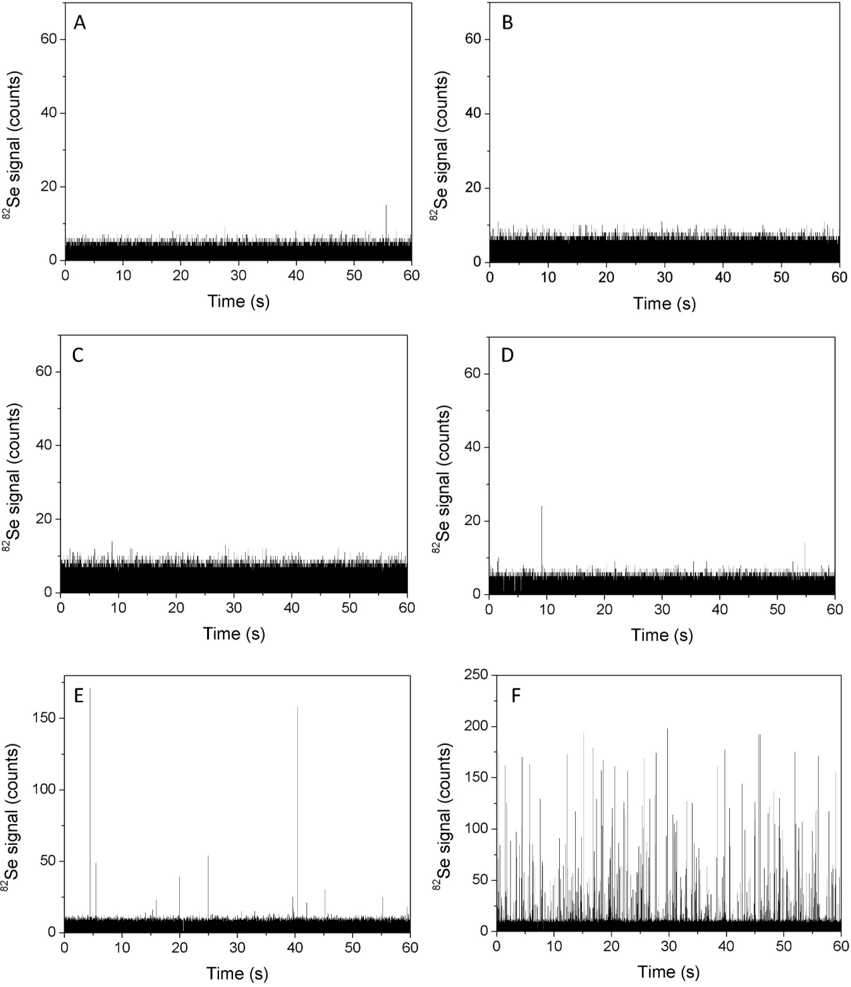
- 82Se labeling gave an ~11-fold enhancement in ICP-MS detection power and improved signal-to-background ratio; SP-ICP-MS size limit of detection dropped from 89.9 nm for natural SeNPs to 39.9 nm for 82SeNPs.
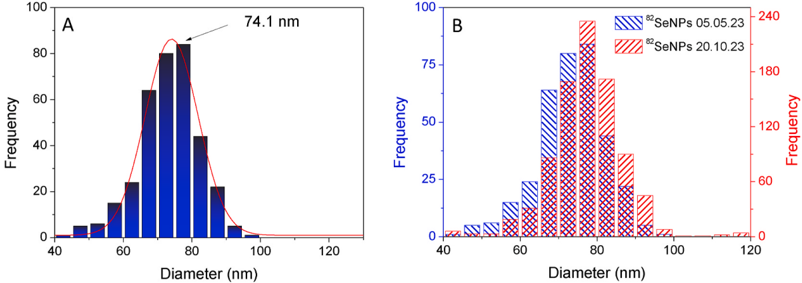
- TEM sizes were 82.8 ± 6.6 nm for SeNPs and 73.2 ± 4.4 nm for 82SeNPs; SP-ICP-MS gave 74.1 ± 7.8 nm for 82SeNPs (p > 0.05 vs TEM), and 82SeNPs were stable after 5 months (77.4 ± 7.3 nm vs 74.1 ± 7.8 nm, p > 0.05).
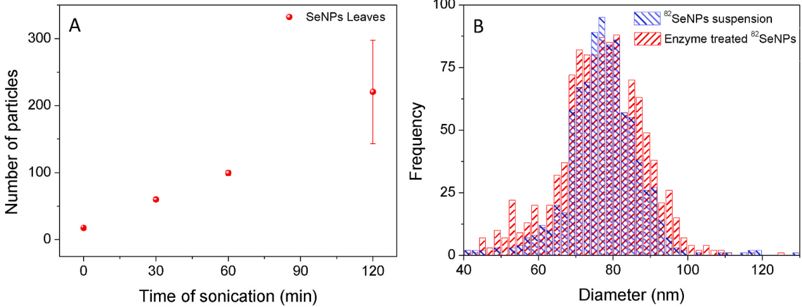
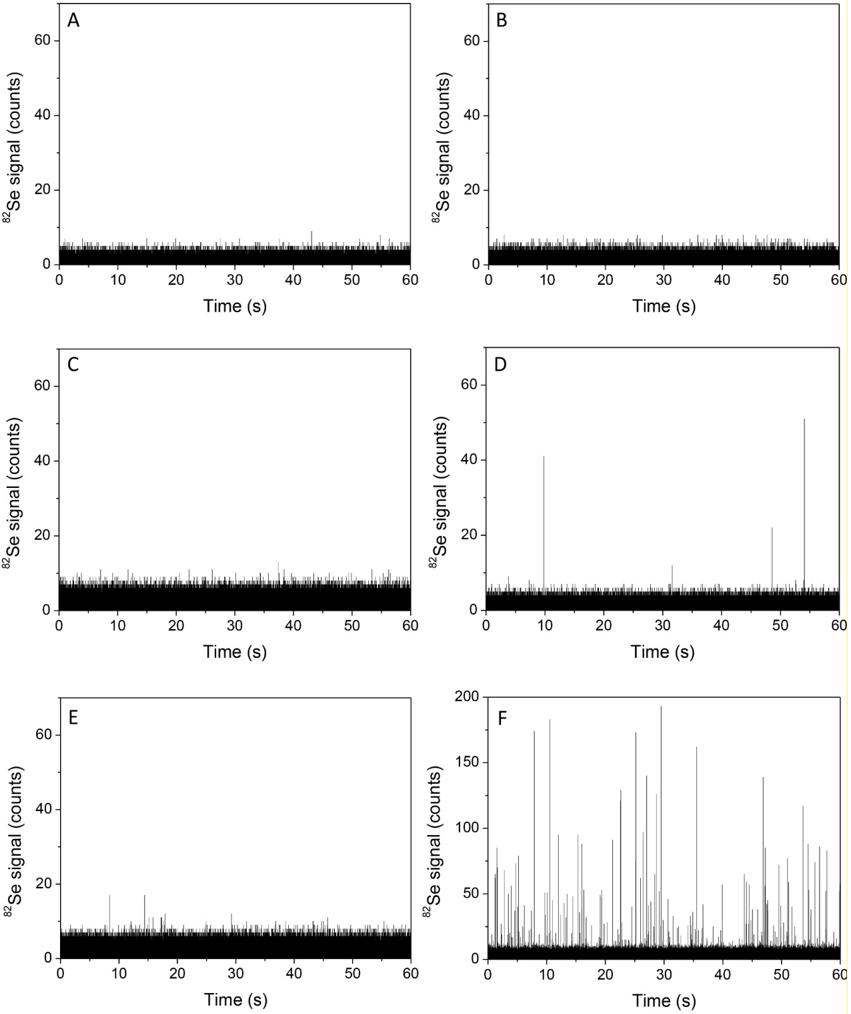
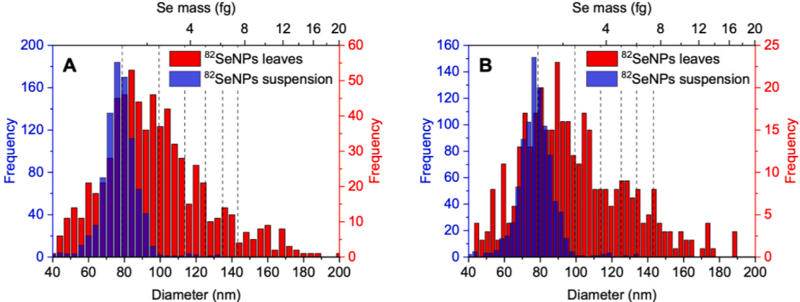
- In foliar-treated rice, SP-ICP-MS detected 375–804 events in leaves, but none or very few in roots and shoots; leaf size distributions showed a fraction in the original 70–90 nm range and a second distribution up to 200 nm, indicating agglomeration, confirmed by HR-TEM.
- Total Se in leaves was similar between Na2SeO3 and 82SeNPs (no statistical difference), but Na2SeO3 caused greater translocation to roots, shoots, and grains; grains had 2- and 4-fold higher Se for Na2SeO3 than 82SeNPs in NM and G varieties, respectively.
Methods
- Completely randomized 4 × 2 factorial design: treatments were control, 82SeNPs, sodium selenite, and AuNPs; two rice varieties were NM (Nuovo Maratelli) and G (Guadiamar). Plants were grown in pots under greenhouse conditions and foliar-sprayed at 30 days with 10 mg L−1 Se (82SeNPs or selenite) or 1 mg L−1 AuNPs; four applications were made except for AuNPs (two), with harvest at ~45 days and some plants grown to grain maturity.
- SeNPs were synthesized by ascorbic acid reduction of Na2SeO3 with PVA as stabilizer; 82SeNPs were synthesized from enriched 82Se. NPs were characterized by UV-vis, TEM, and SP-ICP-MS.
- Bulk ICP-MS after acid digestion measured total Se/Au; SP-ICP-MS after enzymatic digestion with Macerozyme R-10 (120 min sonication optimized) used a quadrupole ICP-MS monitoring 82Se and 197Au; TEM-EDS confirmed elemental composition of extracted NPs.
Limitations
- Stated: mechanisms of uptake, translocation, and biotransformation were outside the scope; particle-based concentration quantification was beyond scope; high dispersion in particle counts was attributed to plant-to-plant variability and possibly the digestion procedure; size histograms for roots/shoots could not be obtained due to low particle concentration; no SeNPs were detected in selenite-treated plants, possibly due to low sensitivity or high ionic background; the agglomeration process is not fully understood.
- Evident: SP-ICP-MS sizing assumes spherical, pure SeNPs and relies on complementary TEM/EDS; grain data came from one pot per group transplanted to maturity, and the AuNP group had only two pots and was used for digestion optimization rather than Se tracing.
Model-written summary. Check it against the paper before relying on it.
Integrity signals
Registry
Cites
Statistics
Figures
Verification
Claims the paper makes
1 Valid · 2 Not valid · 22 Not checked · 67 Own results and interpretations
The cited sources support only part of this claim — read each source’s verdict below.
In the paper
“The presence of an absorption peak at 265 nm (Fig. S1), indicative of surface plasmon resonance excitation, confirmed the formation of SeNPs in both suspensions; this peak results from the reduction of selenite to SeNPs [21,39,40].”
§ Tracing isotopically labeled selenium nanoparticles in plants via single-particle ICP-mass spectrometry > 3.1. Characterization of SeNPs and 82 SeNPs
What the sources say
- Not checked — no full text of the sourcecites [21] B.M. Freire, Y.T. Cavalcanti, C.N. Lange, J.C. Pieretti, R.M. Pereira, M. C. Gonçalves, G. Nakazato, A.B. Seabra, B.L. Batista, Evaluation of collision/ reaction gases in single-particle ICP-MS for sizing selenium nanoparticles and assessment of their antibacterial activity, Nanotechnol 33 (2022) 355702, https:// doi.org/10.1088/1361-6528/ac723e. source
- Partly supportedcites [39] S.M. Joshi, S. De Britto, S. Jogaiah, S.I. Ito, Mycogenic selenium nanoparticles as potential new generation broad spectrum antifungal molecules, Biomolecules 9 (2019) 419, https://doi.org/10.3390/biom9090419. sourceExperimental — accuracy not yet measured
Our copy supports the mechanism the citation is offered for — the Results §3.4 (p. n/a) states the color change was 'caused by the reduction of sodium selenite to elemental selenium' and that a UV–Vis scan (200–400 nm) gave a peak 'indicating the synthesis of SeNPs', echoed in the Discussion (§4). However, the peak it reports is at 260 nm (Figure 5), not 265 nm, and no passage in our copy attributes the peak to surface plasmon resonance excitation; nor does our copy describe confirmation 'in both suspensions' — it synthesized SeNPs from three fractions of T. atroviride (culture filtrate, cell lysate, cell wall debris, §2.3/§3.1) and reports a single characterized SeNP preparation. So the wavelength value and the SPR interpretation attributed here are not in this source. (LLM, conf=0.78)
- Not checked — no full text of the sourcecites [40] V. Kantorová, G. Krausová, I. Hyršlová, M. Loula, O. Mestek, A. Kaňa, Determination of selenium nanoparticles in fermented dairy products, Spectrochim. Acta B: At. Spectrosc. 199 (2023) 106592, https://doi.org/10.1016/j. sab.2022.106592. source
plainstates a cause- Asserted: passes — The authors put it forward as true.
- Checkable: passes — It can be checked against evidence.
- Load-bearing: passes — The paper’s conclusions depend on it.
- Based: passes — The paper gives a reason why it holds.
A result the paper reports from its own data — it cites no other source for it, so there is none to check. The quote shows it is in the paper.
In the paper
“The rice grains of the Na 2 SeO 3 treated group presented significantly higher (2-and 4-fold) Se concentrations than the grains of the 82 SeNPs treated group for NM and G varieties, respectively.”
§ Tracing isotopically labeled selenium nanoparticles in plants via single-particle ICP-mass spectrometry > 3.2. Gold and selenium accumulation in rice tissues from different varieties
plainstates an association- Asserted: passes — The authors put it forward as true.
- Checkable: passes — It can be checked against evidence.
- Load-bearing: passes — The paper’s conclusions depend on it.
- Based: passes — The paper gives a reason why it holds.
A result the paper reports from its own data — it cites no other source for it, so there is none to check. The quote shows it is in the paper.
In the paper
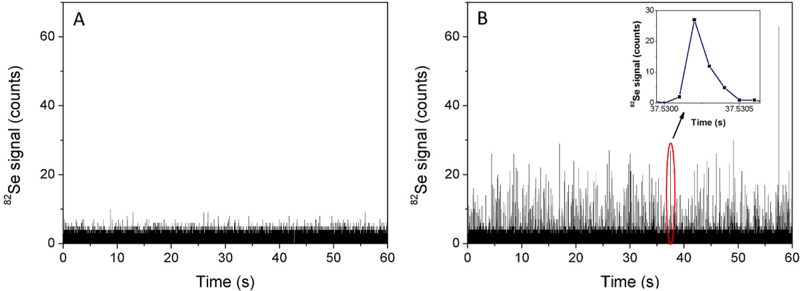
“As can be seen in Fig. 1A, it was not possible to distinguish between the signal events generated by natural SeNPs and the background signal under the selected measurement conditions.”
§ Tracing isotopically labeled selenium nanoparticles in plants via single-particle ICP-mass spectrometry > 3.1. Characterization of SeNPs and 82 SeNPs
plain- Asserted: passes — The authors put it forward as true.
- Checkable: passes — It can be checked against evidence.
- Load-bearing: passes — The paper’s conclusions depend on it.
- Based: passes — The paper gives a reason why it holds.
A result the paper reports from its own data — it cites no other source for it, so there is none to check. The quote shows it is in the paper.
In the paper
“In addition, the theoretical LoD size determined according to Eq. ( 1) was lowered to less than half, from 89.9 for SeNPs to 39.9 for 82 SeNPs.”
- Also stated in: § Abstract · plain
“a reduction of the size limits of detection from 89.9 to 39.9 nm in SP-ICP-MS analysis.”
§ Tracing isotopically labeled selenium nanoparticles in plants via single-particle ICP-mass spectrometry > 3.1. Characterization of SeNPs and 82 SeNPs
plainstates a cause- Asserted: passes — The authors put it forward as true.
- Checkable: passes — It can be checked against evidence.
- Load-bearing: passes — The paper’s conclusions depend on it.
- Based: passes — The paper gives a reason why it holds.
- Also stated in: § Abstract · plain
A result the paper reports from its own data — it cites no other source for it, so there is none to check. The quote shows it is in the paper.
In the paper
“However, the use of ionic Se results in a greater translocation to other plant parts.”
- Also stated in: § Abstract · plain
“Translocation of Se from leaves to roots and shoots was found to be lower when applied as NPs compared to selenite application.”
§ Tracing isotopically labeled selenium nanoparticles in plants via single-particle ICP-mass spectrometry > 3.2. Gold and selenium accumulation in rice tissues from different varieties
plainstates a cause- Asserted: passes — The authors put it forward as true.
- Checkable: passes — It can be checked against evidence.
- Load-bearing: passes — The paper’s conclusions depend on it.
- Based: passes — The paper gives a reason why it holds.
- Also stated in: § Abstract · plain
42 more claims
Create a free account to see all 92 claims and to verify the 33 references still open.
- It may state two separate claims as one. 32
- The quote only partly states this claim. 2
- Probably not a substantial claim. 15
Self-check
Percentages, sums and reported differences re-computed from the paper’s own numbers.
Self-check results appear here once an independent check has confirmed them.
Cited works that were retracted
Works this paper cites that were later retracted, from the retraction notices publishers deposit. Major when the notice came out before this paper was published.
Rated major: it would touch a result — a value a result rests on, reported and recomputed p-values on opposite sides of the significance level, two passages that conflict with no sign which is right, or a cited work retracted before this paper was published.
In the paper
“Murali, 2022, Fate, bioaccumulation and toxicity of engineered nanomaterials in plants: current challenges and future prospects, Sci. Total Environ., 811, 10.1016/j.scitotenv.2021.152249”
Cited work 10.1016/j.scitotenv.2021.152249 · retracted 2022-03-10 · notice 10.1016/j.scitotenv.2021.152249 · this paper published 2024-09
Citations
Cites
1 retracted
Murali, M., Gowtham, H. G., Singh, S. B., Shilpa, N., Aiyaz, M., Alomary, M. N., Alshamrani, M., Salawi, A., Almoshari, Y., Ansari, M. A., et al. (2022) · Science of The Total Environment · doi:10.1016/j.scitotenv.2021.152249 · Cited by 114
RetractedPace, H. E., Rogers, N. J., Jarolimek, C., Coleman, V. A., Higgins, C. P., & Ranville, J. F. (2011) · Analytical Chemistry · doi:10.1021/ac201952t · Cited by 816
A Uniform, Objective, and Adaptive System for Expressing Rice Development
Counce, P. A., Keisling, T. C., & Mitchell, A. J. (2000) · Crop Science · doi:10.2135/cropsci2000.402436x · Cited by 807
Single Particle Inductively Coupled Plasma Mass Spectrometry: A Powerful Tool for Nanoanalysis
Laborda, F., Bolea, E., & Jiménez-Lamana, J. (2014) · Analytical Chemistry · doi:10.1021/ac402980q · Cited by 505
Selenium deficiency risk predicted to increase under future climate change
Jones, G. D., Droz, B., Greve, P., Gottschalk, P., Poffet, D., McGrath, S. P., Seneviratne, S. I., Smith, P., & Winkel, L. H. E. (2017) · Proceedings of the National Academy of Sciences · doi:10.1073/pnas.1611576114 · Cited by 440
Single Particle ICP-MS: Advances toward routine analysis of nanomaterials
Montaño, M. D., Olesik, J. W., Barber, A., Challis, K., & Ranville, J. F. (2016) · Analytical and Bioanalytical Chemistry · doi:10.1007/s00216-016-9676-8 · Cited by 392
Hussain, B., Lin, Q., Hamid, Y., Sanaullah, M., Di, L., Hashmi, M. L. U. R., Khan, M. B., He, Z., & Yang, X. (2020) · Science of The Total Environment · doi:10.1016/j.scitotenv.2020.136497 · Cited by 357
Mozhayeva, D., & Engelhard, C. (2020) · Journal of Analytical Atomic Spectrometry · doi:10.1039/c9ja00206e · Cited by 292
Nanoparticles in Agroindustry: Applications, Toxicity, Challenges, and Trends
Paramo, L. A., Feregrino-Pérez, A. A., Guevara, R., Mendoza, S., & Esquivel, K. (2020) · Nanomaterials · doi:10.3390/nano10091654 · Cited by 292
Evidence on the size-dependent absorption spectral evolution of selenium nanoparticles
Lin, Z.-H., & Chris Wang, C. R. (2005) · Materials Chemistry and Physics · doi:10.1016/j.matchemphys.2005.02.023 · Cited by 279
Environmental impacts of nanomaterials
Kabir, E., Kumar, V., Kim, K.-H., Yip, A. C. K., & Sohn, J. R. (2018) · Journal of Environmental Management · doi:10.1016/j.jenvman.2018.07.087 · Cited by 277
Peters, R., Herrera-Rivera, Z., Undas, A., van der Lee, M., Marvin, H., Bouwmeester, H., & Weigel, S. (2015) · Journal of Analytical Atomic Spectrometry · doi:10.1039/c4ja00357h · Cited by 249
Role of nano-selenium in health and environment
Kumar, A., & Prasad, K. S. (2021) · Journal of Biotechnology · doi:10.1016/j.jbiotec.2020.11.004 · Cited by 249
ICP-MS for the analysis at the nanoscale – a tutorial review
Meermann, B., & Nischwitz, V. (2018) · Journal of Analytical Atomic Spectrometry · doi:10.1039/c8ja00037a · Cited by 230
Srivastava, N., & Mukhopadhyay, M. (2015) · Bioprocess and Biosystems Engineering · doi:10.1007/s00449-015-1413-8 · Cited by 225
Mycogenic Selenium Nanoparticles as Potential New Generation Broad Spectrum Antifungal Molecules
Joshi, S., De Britto, S., Jogaiah, S., & Ito, S.-I. (2019) · Biomolecules · doi:10.3390/biom9090419 · Cited by 223
Boroumand, S., Safari, M., Shaabani, E., Shirzad, M., & Faridi-Majidi, R. (2019) · Materials Research Express · doi:10.1088/2053-1591/ab2558 · Cited by 200
Wang, Y.-D., Wang, X., & Wong, Y.-S. (2013) · Food Chemistry · doi:10.1016/j.foodchem.2013.05.095 · Cited by 168
Li, C., Dang, F., Li, M., Zhu, M., Zhong, H., Hintelmann, H. H., & Zhou, D. (2017) · Nanotoxicology · doi:10.1080/17435390.2017.1344740 · Cited by 166
Bao, D., Oh, Z. G., & Chen, Z. (2016) · Frontiers in Plant Science · doi:10.3389/fpls.2016.00032 · Cited by 154
Selenium and nano-selenium in agroecosystems
El-Ramady, H. R., Domokos-Szabolcsy, É., Abdalla, N. A., Alshaal, T. A., Shalaby, T. A., Sztrik, A., Prokisch, J., & Fári, M. (2014) · Environmental Chemistry Letters · doi:10.1007/s10311-014-0476-0 · Cited by 145
Wang, K., Wang, Y., Li, K., Wan, Y., Wang, Q., Zhuang, Z., Guo, Y., & Li, H. (2020) · Journal of Nanobiotechnology · doi:10.1186/s12951-020-00659-6 · Cited by 143
Laborda, F., Giménez-Ingalaturre, A. C., Bolea, E., & Castillo, J. R. (2020) · Spectrochimica Acta Part B Atomic Spectroscopy · doi:10.1016/j.sab.2020.105883 · Cited by 136
Hadrup, N., & Ravn‐Haren, G. (2021) · Journal of Trace Elements in Medicine and Biology · doi:10.1016/j.jtemb.2021.126801 · Cited by 130
Multiple Method Analysis of TiO2 Nanoparticle Uptake in Rice (Oryza sativa L.) Plants
Deng, Y., Petersen, E. J., Challis, K., Rabb, S. A., Holbrook, R. D., Ranville, J. F., Nelson, B. C., & Xing, B. (2017) · Environmental Science & Technology · doi:10.1021/acs.est.7b01364 · Cited by 123
Hadrup, N., & Ravn‐Haren, G. (2023) · Journal of Trace Elements in Medicine and Biology · doi:10.1016/j.jtemb.2023.127235 · Cited by 123
Selenium and Nano-Selenium Biofortification for Human Health: Opportunities and Challenges
El-Ramady, H. R., Faizy, S. E.-D. A., Abdalla, N. A., Taha, H. S., Domokos-Szabolcsy, É., Fári, M., Elsakhawy, T. A., Omara, A. E.-D., Shalaby, T., Bayoumi, Y. A., et al. (2020) · Soil Systems · doi:10.3390/soilsystems4030057 · Cited by 118
Farooq, M. U., Tang, Z., Zeng, R., Liang, Y., Zhang, Y., Zheng, T., Hla, H., Ye, X., Jia, X., & Zhu, J. (2019) · Journal of the Science of Food and Agriculture · doi:10.1002/jsfa.9502 · Cited by 113
Dan, Y., Ma, X., Zhang, W., Liu, K., Stephan, C., & Shi, H. (2016) · Analytical and Bioanalytical Chemistry · doi:10.1007/s00216-016-9565-1 · Cited by 110
Resano, M., Aramendía, M., García-Ruiz, E., Bazo, A., Bolea-Fernandez, E., & Vanhaecke, F. (2022) · Chemical Science · doi:10.1039/d1sc05452j · Cited by 102
Self-citationLaycock, A., Clark, N. J., Clough, R., Smith, R., & Handy, R. D. (2022) · Environmental Science Nano · doi:10.1039/d1en00680k · Cited by 100
Selenium biofortification of rice grains and implications on macronutrients quality
Lidon, F. C., Oliveira, K., Ribeiro, M. M., Pelica, J., Pataco, I. M. M., Ramalho, J. C., Leitão, A. E., Almeida, A. S., Scotti‐Campos, P., Ribeiro-Barros, A. I., et al. (2018) · Journal of Cereal Science · doi:10.1016/j.jcs.2018.03.010 · Cited by 97
Wang, C., Cheng, T., Liu, H., Zhou, F., Zhang, J., Zhang, M., Liu, X., Shi, W., & Cao, T. (2021) · Journal of Environmental Sciences · doi:10.1016/j.jes.2020.11.005 · Cited by 91
Jiménez-Lamana, J., Wojcieszek, J., Jakubiak, M., Asztemborska, M., & Szpunar, J. (2016) · Journal of Analytical Atomic Spectrometry · doi:10.1039/c6ja00201c · Cited by 89
Wang, Q., Yao, Y., Li, J., Wan, Y., Huang, Q., Guo, Y., & Li, H. (2017) · Journal of Agricultural and Food Chemistry · doi:10.1021/acs.jafc.6b05149 · Cited by 89
Lamana, J. J., Abad-Álvaro, I., Bierła, K., Laborda, F., Szpunar, J., & Łobiński, R. (2018) · Journal of Analytical Atomic Spectrometry · doi:10.1039/c7ja00378a · Cited by 87
Bolea-Fernandez, E., Leite, D., Rua-Ibarz, A., Liu, T., Woods, G., Aramendia, M., Resano, M., & Vanhaecke, F. (2019) · Analytica Chimica Acta · doi:10.1016/j.aca.2019.05.077 · Cited by 87
Self-citationdos Reis, A. R., El-Ramady, H., Santos, E. F., Gratão, P. L., & Schomburg, L. (2017) · Plant Ecophysiology · doi:10.1007/978-3-319-56249-0_13 · Cited by 84
Chen, X., Yin, G., Zhao, N., Gan, T., Yang, R., Xia, M., Feng, C., Chen, Y., & Huang, Y. (2020) · Spectrochimica Acta Part A Molecular and Biomolecular Spectroscopy · doi:10.1016/j.saa.2020.118827 · Cited by 71
Assessment of ZnO-NPs toxicity in maize: an integrative microRNAomic approach
Adhikari, S., Adhikari, A., Ghosh, S., Roy, D., Azahar, I., Basuli, D., & Hossain, Z. (2020) · Chemosphere · doi:10.1016/j.chemosphere.2020.126197 · Cited by 67
Incorporation of Selenium Derived from Nanoparticles into Plant Proteins in Vivo
Wang, Y., Feng, L.-J., Sun, X.-D., Zhang, M., Duan, J.-L., Xiao, F., Lin, Y., Zhu, F.-P., Kong, X.-P., Ding, Z., et al. (2023) · ACS Nano · doi:10.1021/acsnano.3c03739 · Cited by 66
Ionic Selenium and Nanoselenium as Biofortifiers and Stimulators of Plant Metabolism
Márquez, V. G., Morelos-Moreno, Á., Benavides‐Mendoza, A., & Medrano-Macías, J. (2020) · Agronomy · doi:10.3390/agronomy10091399 · Cited by 61
Bolea‐Fernandez, E., Leite, D., Rua-Ibarz, A., Balcaen, L. I. L., Aramendía, M., Resano, M., & Vanhaecke, F. (2017) · Journal of Analytical Atomic Spectrometry · doi:10.1039/c7ja00138j · Cited by 58
Self-citationNath, J., Dror, I., Landa, P., Vanek, T., Kaplan-Ashiri, I., & Berkowitz, B. (2018) · Environmental Pollution · doi:10.1016/j.envpol.2018.07.084 · Cited by 48
Yeshno, E., Arnon, S., & Dahan, O. (2019) · Hydrology and Earth System Sciences · doi:10.5194/hess-23-3997-2019 · Cited by 44
Moreno-Martín, G., Sanz-Landaluze, J., León‐González, M. E., & Madrid, Y. (2020) · The Science of The Total Environment · doi:10.1016/j.scitotenv.2020.138453 · Cited by 44
Freire, B. M., Lange, C. N., Cavalcanti, Y. T., Monteiro, L. R., Pieretti, J. C., Seabra, A. B., & Batista, B. L. (2024) · Plant Stress · doi:10.1016/j.stress.2024.100372 · Cited by 42
Self-citationHuang, Y., Tsz-Shan Lum, J., & Sze-Yin Leung, K. (2020) · Journal of Analytical Atomic Spectrometry · doi:10.1039/d0ja00180e · Cited by 36
Plant natural variability may affect safety assessment data
Batista, R., & Oliveira, M. (2010) · Regulatory Toxicology and Pharmacology · doi:10.1016/j.yrtph.2010.08.019 · Cited by 30
Aramendía, M., García-Mesa, J. C., Alonso, E. V., Garde, R., Bazo, A., Resano, J., & Resano, M. (2022) · Analytica Chimica Acta · doi:10.1016/j.aca.2022.339738 · Cited by 30
Self-citationGammelgaard, B., Stürup, S., & Christensen, M. V. (2012) · Metallomics · doi:10.1039/c2mt00163b · Cited by 29
Optimisation of DRC ICP-MS for determining selenium in plants
Sucharová, J. (2011) · Journal of Analytical Atomic Spectrometry · doi:10.1039/c1ja10095e · Cited by 25
Dael, P. V., Lewis, J., & Barclay, D. (2004) · Journal of Trace Elements in Medicine and Biology · doi:10.1016/j.jtemb.2004.04.005 · Cited by 23
Wojcieszek, J., Lamana, J. J., Ruzik, L., Szpunar, J., & Jarosz, M. (2020) · Nanomaterials · doi:10.3390/nano10081480 · Cited by 21
There is plenty of room at the plant science: A review of nanoparticles applied to plant cultures
Freitas, D. C., de Andrade, A. M., da Costa, L. F., Azevedo, R. A., & Arruda, M. A. Z. (2020) · Annals of Applied Biology · doi:10.1111/aab.12640 · Cited by 20
Determination of selenium nanoparticles in fermented dairy products
Kantorová, V., Krausová, G., Hyršlová, I., Loula, M., Mestek, O., & Kaňa, A. (2023) · Spectrochimica Acta Part B: Atomic Spectroscopy · doi:10.1016/j.sab.2022.106592 · Cited by 19
Perez, M. B., Lipinski, V. M., Filippini, M. F., Madrid, K. C., Arruda, M. A. Z., & Wuilloud, R. G. (2021) · Food Additives & Contaminants Part A · doi:10.1080/19440049.2021.1933206 · Cited by 17
Synthesis and characterization of isotopically labeled silver nanoparticles for tracing studies
Laycock, A., Stolpe, B., Römer, I., Dybowska, A., Valsami-Jones, E., Lead, J. R., & Rehkämper, M. (2014) · Environ. Sci.: Nano · doi:10.1039/c3en00100h · Cited by 16
da Silva, A. B. S., & Arruda, M. A. Z. (2023) · Spectrochimica Acta Part B: Atomic Spectroscopy · doi:10.1016/j.sab.2023.106663 · Cited by 16
Paniz, F. P., Pedron, T., Procópio, V. A., Lange, C. N., Freire, B. M., & Batista, B. L. (2023) · Toxics · doi:10.3390/toxics11040362 · Cited by 15
Self-citationBiosynthesis of nano selenium in plants
Verstegen, J., & Günther, K. (2023) · Artificial Cells, Nanomedicine, and Biotechnology · doi:10.1080/21691401.2022.2155660 · Cited by 14
Freire, B. M., Cavalcanti, Y. T., Lange, C. N., Pieretti, J. C., Pereira, R. M., Gonçalves, M. C., Nakazato, G., Seabra, A. B., & Batista, B. L. (2022) · Nanotechnology · doi:10.1088/1361-6528/ac723e · Cited by 13
Self-citationElemental chemical composition and As speciation in rice varieties selected for biofortification
Freire, B. M., Santos, V. D. S., Neves, P. D. C. F., Reis, J. M. O. S., de Souza, S. S., Barbosa, F., & Batista, B. L. (2020) · Analytical Methods · doi:10.1039/d0ay00294a · Cited by 12
Self-citationThe synthesis of selenium nаnоpаrtiсle (SeNPs) – Review
Badgar, K. (2019) · Acta Agraria Debreceniensis · doi:10.34101/actaagrar/1/2359 · Cited by 7
Sizing silver nanoparticles in biological matrices by spICP-MS
de Souza, A. L. M., Pedron, T., Pereira, R. M., da Silva, F. F., Lange, C. N., Seabra, A. B., & Batista, B. L. (2023) · Journal of Trace Elements and Minerals · doi:10.1016/j.jtemin.2023.100054 · Cited by 4
Self-citationSales, E., Miedes, E., & Marqués, L. (2021) · Agronomy · doi:10.3390/agronomy11112125 · Cited by 2
Cited by
Deng, G., Fan, Z., Wang, Z., & Peng, M. (2025) · Plant and Soil · doi:10.1007/s11104-025-07661-7 · Cited by 24
Atomic spectrometry update – a review of advances in environmental analysis
Cairns, W. R. L., Butler, O. T., Cavoura, O., Davidson, C. M., Torró, J. L. T., & von der Au, M. (2024) · Journal of Analytical Atomic Spectrometry · doi:10.1039/d4ja90056a · Cited by 19
Freire, B. M., Lange, C. N., Augusto, C. C., Onwuatu, F. R., Rodrigues, G. D. P., Pieretti, J. C., Seabra, A. B., & Batista, B. L. (2024) · ACS Agricultural Science & Technology · doi:10.1021/acsagscitech.4c00613 · Cited by 17
Self-citationFeng, J., Adeel, M., & Rui, Y. (2026) · Current Pollution Reports · doi:10.1007/s40726-026-00397-7 · Cited by 17
Gong, H., Wang, Y., Pan, L., Liu, Y., Xu, W., Zhai, H., Zhang, Y., Shao, H., Tang, G., & Ge, C. (2025) · Ecotoxicology and Environmental Safety · doi:10.1016/j.ecoenv.2025.117880 · Cited by 11
Metadata
- Authors
- Freire, B. M., Rua-Ibarz, A., Nakadi, F. V., Bolea-Fernandez, E., Barriuso-Vargas, J. J., Lange, C. N., Aramendía, M., Batista, B. L., & Resano, M.
- Affiliations
- Universidad de Zaragoza (ES)
- Universidade Federal do ABC (BR)
- Corresponding author
- Batista, Bruno Lemos
- Resano, Martín
- ORCID
- Venue
- Talanta
- Publisher
- Elsevier BV
- Published
- 2024-09
- Volume
- 277
- Pages
- 126417
- ISSN
- 0039-9140 (ISSN-L)
- OpenAlex
- W4399561882
- Semantic Scholar
- f2c659e02404d7fb3eb42c119394e96f48b23012
- Cited by
- 17
- References
- 66
- Citations by year
- 2026: 8 · 2025: 6 · 2024: 3
- FWCI
- 3.19
- Type
- journal article
- Language
- en
- Open access
- hybrid
- doi.org
- Licence
- cc-by-nc-nd
- www.elsevier.com/tdm/userlicense/1.0/ (tdm)
- www.elsevier.com/legal/tdmrep-license (tdm)
- creativecommons.org/licenses/by-nc-nd/4.0/ (vor)
- Locations
- Talanta (publishedVersion, cc-by-nc-nd)
- SSRN Electronic Journal (submittedVersion)
- Zaguan (University of Zaragoza Repository) (publishedVersion, cc-by-nc-nd)
- PubMed (publishedVersion)
- Funders
- European Commission (MCIN /AEI/ 10.13039/501100011033, 10.13039/501100011033, 13039/501100011033, 501100011033, HORIZON2020, /AEI/10.13039/501100011033, 101034288)
- Fundação de Amparo à Pesquisa do Estado de São Paulo (2022/04254–6, 2020/00284-2)
- Coordenação de Aperfeiçoamento de Pessoal de Nível Superior
- Universidad de Zaragoza
- European Regional Development Fund (MCIN/AEI/10, 10.13039/501100011033, 13039/501100011033, AEI/10.13039/501100011033, 501100011033/ and, 501100011033, MCIN/ AEI/ 10.13039/501100011033)
- Agencia Estatal de Investigación (AEI//10.13039/501100011033/, 501100011033, 10.13039/501100011033, MCIN/AEI/10.13039/501 100 011 033, 13039, .13039/501100011033, 10.13039, AEI/10, PID2021-122455NB-I00)
- NextGenerationEU
- Topics
- Health Sciences › Nursing › Nutrition and Dietetics › Selenium in Biological Systems
- Physical Sciences › Materials Science › Materials Chemistry › Nanoparticles: synthesis and applications
- Life Sciences › Agricultural and Biological Sciences › Plant Science › Plant Micronutrient Interactions and Effects
- Keywords
- selenium nanoparticles, 82Se, single particle ICP-MS, rice, biofortification, selenium deficiency, foliar application, nanoparticle uptake, nanoparticle translocation, selenite, nanoparticle agglomeration
- MeSH terms
- Isotope Labeling, Particle Size, Oryza, Selenium, Mass Spectrometry, Plant Leaves, Nanoparticles, Metal Nanoparticles
About these checks
Registry, retraction, Cites and statistics results are computed, not judged, with one exception: a printed reference that no index lists is read once by a model before it counts as a citation error. Claims are extracted by a model and kept only when their quote appears verbatim in the text; each cited source is then checked, with a model’s help, for whether it says what the claim relies on. Those verdicts can be wrong — read the claim’s quote and the cited source before relying on one.
The claim verdicts this report counts are experimental: their accuracy is not yet measured.
A language model drew the claims from the paper on 2026-11-19, under version 3 of the claim definition (model deepseek-v4.1-flash, prompt extract-v3).
A second model labelled each claim on 2026-11-19 (model jev-1.13-20260917, definition revision gold-guideline-v0.2).
Cited sources are checked with a language model’s help (qwen3.8-omni-flash).
Statistics and arithmetic are recomputed, not judged.
Confidence bands are shown only for fields calibrated on our annotated test set. None is calibrated yet, so no band is shown.
What counts as a claim ›How we measure confidence ›How we check this ›
Are you an author, or do you see a problem with this page? Request a review
Data sources
Bibliographic data: Semantic Scholar, OpenAlex, Crossref.
Contains information from the Semantic Scholar Academic Graph Datasets, made available under the ODC Attribution License (ODC-BY 1.0).
Semantic Scholar’s data is described in: Kinney, R., et al. (2023). The Semantic Scholar Open Data Platform. arXiv:2301.10140.
