

The DOI matches its Crossref record.
Exploratory analysis of fines for water pollution in Bangladesh
Overview
The claims and statistics of this paper haven’t been checked yet.
Run the check — free, no account needed. It reads the open-access text and checks the sources it cites.
Integrity signals
Registry
Cites
Statistics
Figures

Verification
Claims the paper makes
The claims and statistics of this paper haven’t been checked yet.
Run the check — free, no account needed. It reads the open-access text and checks the sources it cites.
Claims other papers make about this one
Each is checked against this paper’s own text: does it say what the citing paper says it does?
The source backs part of the claim, not all of it — or backs it for a different population, condition or comparison.
In the citing paper
“The reasons for the enforcement failure are insufficient resources (knowledge, human resources, and funds) [4,12]; economic corruption [4,12]; weak political will [4,13]; and inadequate coordination among concerned agencies [14].”
From Water Pollution and the Textile Industry in Bangladesh: Flawed Corporate Practices or Restrictive Opportunities? (2019) · cites this paper as [13]
Experimental — accuracy not yet measuredThe source backs part of the claim, not all of it — or backs it for a different population, condition or comparison.
In the citing paper
“This is within the range of the fines reported by Haque [13].”
From Water Pollution and the Textile Industry in Bangladesh: Flawed Corporate Practices or Restrictive Opportunities? (2019) · cites this paper as [13]
Experimental — accuracy not yet measuredThe source backs part of the claim, not all of it — or backs it for a different population, condition or comparison.
In the citing paper
“The mean cost of 13.9 million BDT among the participating companies is almost the same as the average annual operational cost of 13.3 million BDT previously reported for an ETP with around 50 m 3 /h capacity [13].”
From Water Pollution and the Textile Industry in Bangladesh: Flawed Corporate Practices or Restrictive Opportunities? (2019) · cites this paper as [13]
Experimental — accuracy not yet measuredThe cited source says what the claim attributes to it.
In the citing paper
“Moreover, the maximum fine was 3000 times the minimum fine; this suggests how randomly the fines are determined [13].”
From Water Pollution and the Textile Industry in Bangladesh: Flawed Corporate Practices or Restrictive Opportunities? (2019) · cites this paper as [13]
The cited source says what the claim attributes to it.
In the citing paper
“The estimated annual operating cost for textile dyeing factory is around 13,350,000 BDT [13] and is significantly higher than the average reported fine of 1,965,000 BDT.”
From Water Pollution and the Textile Industry in Bangladesh: Flawed Corporate Practices or Restrictive Opportunities? (2019) · cites this paper as [13]
The cited source says what the claim attributes to it.
In the citing paper
“In the case of Bangladesh, the DoE has not been recording inspection results in a consistent manner [12], nor sharing the existing data in a transparent way due to internal bureaucracy and pressure from industrial sectors to avoid interference in their business [13].”
From Water Pollution and the Textile Industry in Bangladesh: Flawed Corporate Practices or Restrictive Opportunities? (2019) · cites this paper as [13]
The cited source says what the claim attributes to it.
In the citing paper
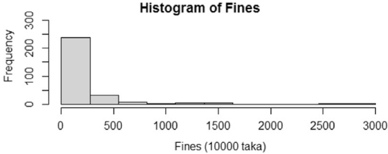
“Analysis of the penalties revealed that the mean fine amount was 1,965,000 Bangladesh Taka (BDT) (1 USD = 80 BDT), with a maximum of 30,000,000 BDT and a minimum of 10,000 BDT.”
From Water Pollution and the Textile Industry in Bangladesh: Flawed Corporate Practices or Restrictive Opportunities? (2019) · cites this paper as [13]
Self-check
Percentages, sums and reported differences re-computed from the paper’s own numbers.
The self-check needs the paper’s full text.
Citations
Cites
No references could be resolved yet.
Research works printed but not linked: 10
- Arguedas, 2013, Pollution standards, technology investment and fines for non-compliance, J. Regul. Econ., 44, 156, 10.1007/s11149-013-9217-8 · DOI
- Azad, 2014, Environmental pollution in Bangladesh: need for a legal overhaul, Bangladesh Law Assoc. J., 1, 81
- Coria, 2015, State-dependent enforcement to foster the adoption of new technologies, Environ. Resour. Econ., 62, 359, 10.1007/s10640-015-9943-8 · DOI
- Dasgupta, 2001, Inspections, pollution prices, and environmental performance: evidence from China, Ecol. Econ., 36, 487, 10.1016/S0921-8009(00)00249-4 · DOI
- Gray, 2011, The effectiveness of environmental monitoring and enforcement: a review of the empirical evidence, Rev. Environ. Econ. Policy, Req., 017, 017
- Heyes, 2000, Implementing environmental regulation: enforcement and compliance, J. Regul. Econ., 17, 107, 10.1023/A:1008157410380 · DOI
- Miah, 2013, Cost-effective treatment technology on textile industrial wastewater in Bangladesh, J. Chem. Eng., 27, 32, 10.3329/jce.v27i1.15855 · DOI
- Oljaca, 1998, Penalty functions for environmental violations: evidence from water quality enforcement, J. Regul. Econ., 14, 255, 10.1023/A:1008031307103 · DOI
- Rahman, 2014, Economic analysis of alternative pollution abatement policies: the case of Buriganga River, Bangladesh, Interdiscip. Environ. Rev., 15, 66, 10.1504/IER.2014.062138 · DOI
- Wiener, 2004, The regulation of technology, and the technology of regulation, Technol. Soc., 26, 483, 10.1016/j.techsoc.2004.01.033 · DOI
Cited by
Sorted by citations
Sakamoto, M., Ahmed, T., Begum, S., & Huq, H. (2019) · Sustainability · doi:10.3390/su11071951 · Cited by 172
Metadata
- Authors
- Haque, N.
- Venue
- Water Resources and Industry
- Publisher
- Elsevier BV
- Published
- 2017-12
- Volume
- 18
- Pages
- 1-8
- ISSN
- 2212-3717
- Cited by
- 29
- References
- 0
- Language
- en
About these checks
Registry, retraction, Cites and statistics results are computed, not judged, with one exception: a printed reference that no index lists is read once by a model before it counts as a citation error. Claims are extracted by a model and kept only when their quote appears verbatim in the text; each cited source is then checked, with a model’s help, for whether it says what the claim relies on. Those verdicts can be wrong — read the claim’s quote and the cited source before relying on one.
Statistics and arithmetic are recomputed, not judged.
Confidence bands are shown only for fields calibrated on our annotated test set. None is calibrated yet, so no band is shown.
What counts as a claim ›How we measure confidence ›How we check this ›
Are you an author, or do you see a problem with this page? Request a review
How to cite
Cite CoChat for the checks on this page, and the paper for its own findings.
- This page
- CoChat. (2026). Citation check: Exploratory analysis of fines for water pollution in Bangladesh. https://app.cochat.ai/papers/10.1016/j.wri.2017.05.001
- The paper
- Haque, N. (2017). Exploratory analysis of fines for water pollution in Bangladesh. Water Resources and Industry. https://doi.org/10.1016/j.wri.2017.05.001
