

The DOI matches its Crossref record; 98 of the 102 references it cites were found in a registry or an index.
Dissection of a rapidly evolving wheat resistance gene cluster by long-read genome sequencing accelerated the cloning of Pm69
Open accessPublished version of a preprint
Abstract
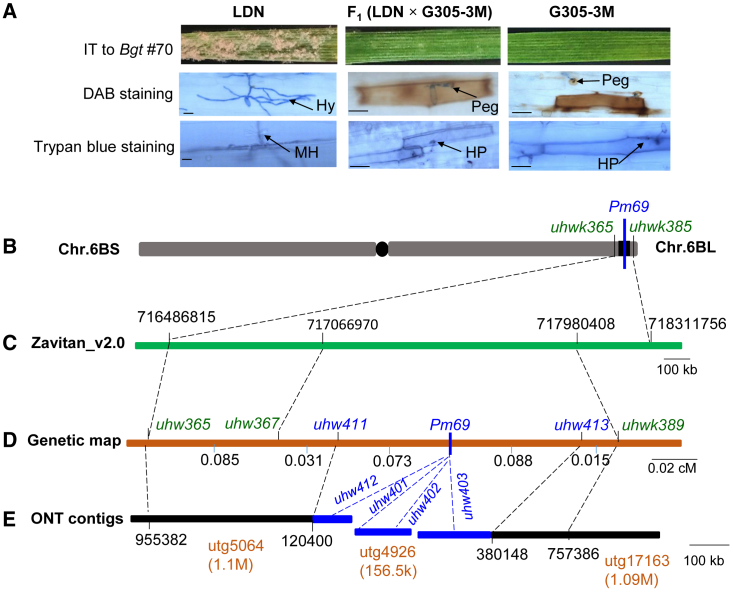
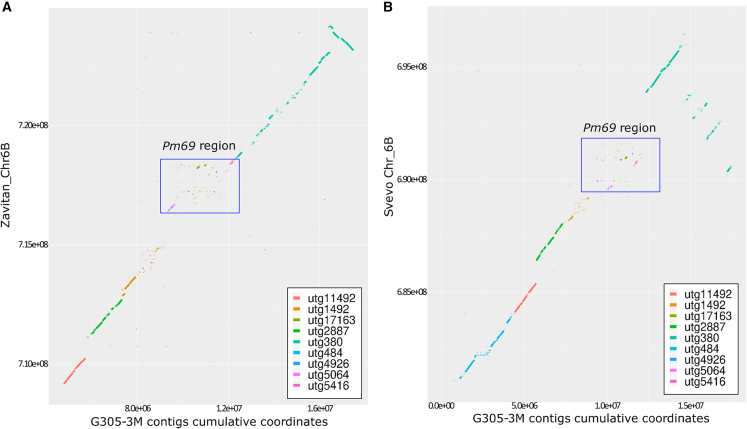
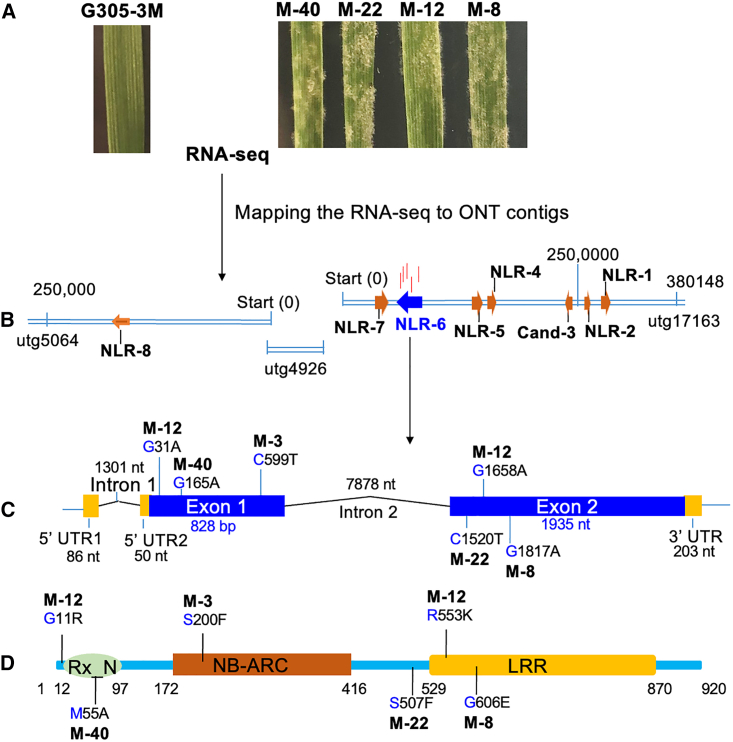
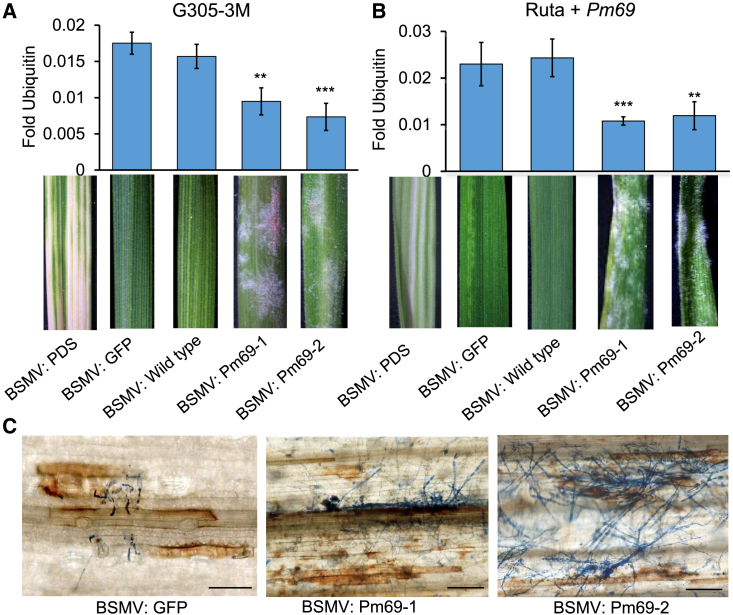
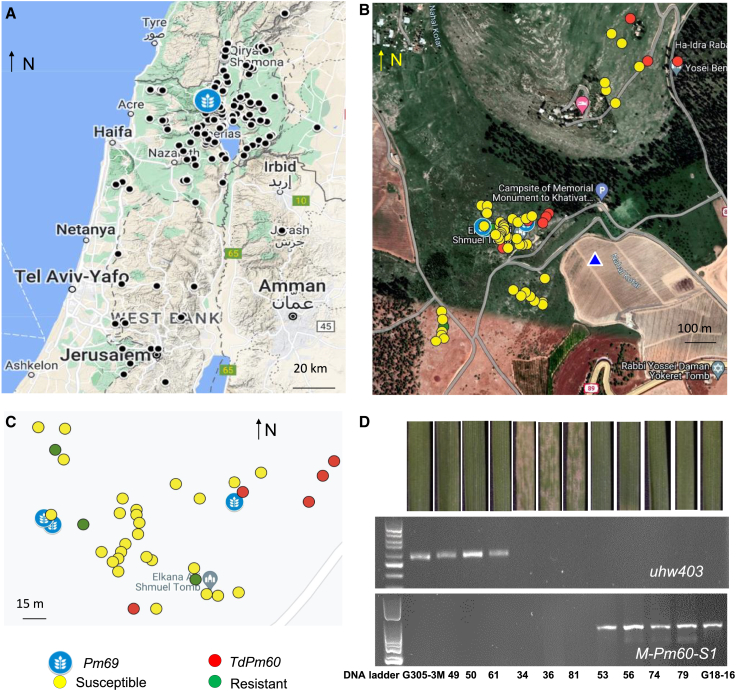
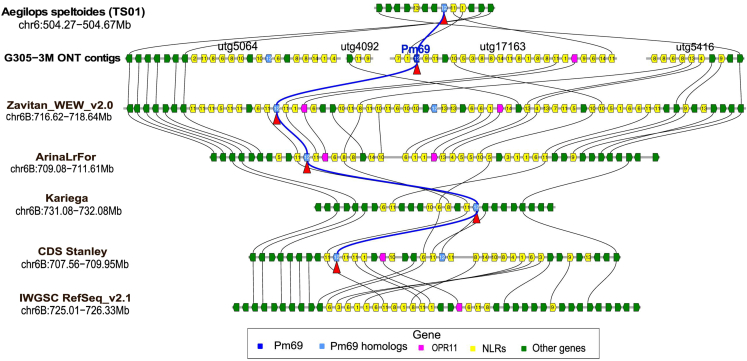
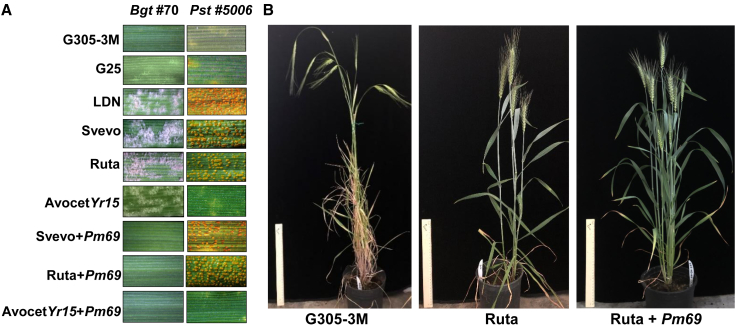
Gene cloning in repeat-rich polyploid genomes remains challenging. Here, we describe a strategy for overcoming major bottlenecks in cloning of the powdery mildew resistance gene (R-gene) Pm69 derived from tetraploid wild emmer wheat. A conventional positional cloning approach was not effective owing to suppressed recombination. Chromosome sorting was compromised by insufficient purity. A Pm69 physical map, constructed by assembling Oxford Nanopore Technology (ONT) long-read genome sequences, revealed a rapidly evolving nucleotide-binding leucine-rich repeat (NLR) R-gene cluster with structural variations. A single candidate NLR was identified by anchoring RNA sequencing reads from susceptible mutants to ONT contigs and was validated by virus-induced gene silencing. Pm69 is likely a newly evolved NLR and was discovered in only one location across the wild emmer wheat distribution range in Israel. Pm69 was successfully introgressed into cultivated wheat, and a diagnostic molecular marker was used to accelerate its deployment and pyramiding with other R-genes.
Overview
The claims and statistics of this paper haven’t been checked yet.
Run the check — free, no account needed. It reads the open-access text and checks the sources it cites.
Integrity signals
Registry
Cites
Statistics
Figures
Verification
Claims the paper makes
The claims and statistics of this paper haven’t been checked yet.
Run the check — free, no account needed. It reads the open-access text and checks the sources it cites.
Self-check
Percentages, sums and reported differences re-computed from the paper’s own numbers.
The self-check needs the paper’s full text.
Citations
Cites
Highly accurate protein structure prediction with AlphaFold
Jumper, J., Evans, R., Pritzel, A., Green, T., Figurnov, M., Ronneberger, O., Tunyasuvunakool, K., Bates, R., Žídek, A., Potapenko, A., et al. (2021) · Nature · doi:10.1038/s41586-021-03819-2 · Cited by 43,764
Aligning sequence reads, clone sequences and assembly contigs with BWA-MEMPreprint
Li, H. (2013) · arXiv (Cornell University) · doi:10.48550/arxiv.1303.3997 · Cited by 10,846
Walker, B. J., Abeel, T., Shea, T., Priest, M., Abouelliel, A., Sakthikumar, S., Cuomo, C. A., Zeng, Q., Wortman, J. R., Young, S., et al. (2014) · PLoS ONE · doi:10.1371/journal.pone.0112963 · Cited by 9,130
Shifting the limits in wheat research and breeding using a fully annotated reference genome
Appels, R., Eversole, K., Stein, N., Feuillet, C., Keller, B., Rogers, J., Pozniak, C. J., Choulet, F., Distelfeld, A., Poland, J., et al. (2018) · Science · doi:10.1126/science.aar7191 · Cited by 3,183
Self-citationOpportunities and challenges in long-read sequencing data analysis
Amarasinghe, S. L., Su, S., Dong, X., Zappia, L., Ritchie, M. E., & Gouil, Q. (2020) · Genome Biology · doi:10.1186/s13059-020-1935-5 · Cited by 2,530
PacBio Sequencing and its Applications
Rhoads, A., & Au, K. F. (2015) · Genomics, Proteomics & Bioinformatics · doi:10.1016/j.gpb.2015.08.002 · Cited by 2,135
Shizuya, H., Birren, B. W., Kim, U. J., Mancino, V., Slepak, T. I., Tachiiri, Y., & Simon, M. I. (1992) · Proceedings of the National Academy of Sciences · doi:10.1073/pnas.89.18.8794 · Cited by 1,672
A Putative ABC Transporter Confers Durable Resistance to Multiple Fungal Pathogens in Wheat
Krattinger, S. G., Lagudah, E. S., Spielmeyer, W., Singh, R. P., Huerta‐Espino, J., McFadden, H., Bossolini, E., Selter, L. L., & Keller, B. (2009) · Science · doi:10.1126/science.1166453 · Cited by 1,387
Three decades of nanopore sequencing
Deamer, D., Akeson, M., & Branton, D. (2016) · Nature Biotechnology · doi:10.1038/nbt.3423 · Cited by 1,292
De novo assembly and analysis of RNA-seq data
Robertson, G., Schein, J. E., Chiu, R., Corbett, R., Field, M. A., Jackman, S. D., Mungall, K. L., Lee, S. S., Okada, H. M., Qian, J. Q., et al. (2010) · Nature Methods · doi:10.1038/nmeth.1517 · Cited by 1,028
Research works printed but not linked: 1
- McIntosh, 2020, Catalogue of gene symbols for wheat: 2020 supplement, Annu. Wheat Newsl., 66, 116
Cited by
Sorted by citations
Mishra, S., Roychowdhury, R., Ray, S., Hada, A., Kumar, A., Sarker, U., Aftab, T., & Das, R. (2024) · Plant Stress · doi:10.1016/j.stress.2024.100427 · Cited by 205
Self-citationPlant pangenomes for crop improvement, biodiversity and evolution
Schreiber, M., Jayakodi, M., Stein, N., & Mascher, M. (2024) · Nature Reviews Genetics · doi:10.1038/s41576-024-00691-4 · Cited by 163
Fighting wheat powdery mildew: from genes to fields
Wang, B., Meng, T., Xiao, B., Yu, T., Yue, T., Jin, Y., & Ma, P. (2023) · Theoretical and Applied Genetics · doi:10.1007/s00122-023-04445-4 · Cited by 94
Wheat powdery mildew resistance gene Pm13 encodes a mixed lineage kinase domain-like protein
Li, H., Men, W., Ma, C., Liu, Q., Dong, Z., Tian, X., Wang, C., Liu, C., Gill, H. S., Ma, P., et al. (2024) · Nature Communications · doi:10.1038/s41467-024-46814-7 · Cited by 67
Li, M., Zhang, H., Xiao, H., Zhu, K., Shi, W., Zhang, D., Wang, Y., Yang, L., Wu, Q., Xie, J., et al. (2024) · Nature Communications · doi:10.1038/s41467-024-47497-w · Cited by 64
Self-citationBreeding Wheat for Powdery Mildew Resistance: Genetic Resources and Methodologies—A Review
Bapela, T., Shimelis, H., Terefe, T., Bourras, S., Sánchez‐Martín, J., Douchkov, D., Desiderio, F., & Tsilo, T. J. (2023) · Agronomy · doi:10.3390/agronomy13041173 · Cited by 48
Fine mapping of Pm71, a novel powdery mildew resistance gene from emmer wheat
Zhang, J., Yang, H., Han, G., Xu, H., Liu, R., Yu, N., Han, R., Li, Y., Li, J., Dai, Y., et al. (2025) · The Crop Journal · doi:10.1016/j.cj.2025.01.003 · Cited by 39
Self-citationA head-to-head NLR gene pair from wild emmer confers stripe rust resistance in wheat
Hu, Y., Li, M., Li, Y., Du, L., Xie, R., Ni, F., Xia, C., Wang, K., Huang, Y., Xu, B., et al. (2025) · Nature Genetics · doi:10.1038/s41588-025-02207-0 · Cited by 39
Self-citationHan, G., Liu, H., Zhu, S., Gu, T., Cao, L., Yan, H., Jin, Y., Wang, J., Liu, S., Zhou, Y., et al. (2023) · Plant Biotechnology Journal · doi:10.1111/pbi.14165 · Cited by 38
Ma, C., Tian, X., Dong, Z., Li, H., Chen, X., Liu, W., Yin, G., Ma, S., Zhang, L., Cao, A., et al. (2024) · Nature Communications · doi:10.1038/s41467-024-52670-2 · Cited by 37
An atypical NLR pair TdCNL1/TdCNL5 from wild emmer confers powdery mildew resistance in wheat
Zhu, K., Li, M., Dong, L., Zhang, H., Zhang, D., Lu, P., Wu, Q., Xie, J., Chen, Y., Guo, G., et al. (2025) · Nature Genetics · doi:10.1038/s41588-025-02208-z · Cited by 36
Self-citationWheat genomics: genomes, pangenomes, and beyond
Tiwari, V. K., Saripalli, G., Sharma, P. K., & Poland, J. (2024) · Trends in Genetics · doi:10.1016/j.tig.2024.07.004 · Cited by 34
Verma, K., Kumari, K., Rawat, M., Devi, K., & Joshi, R. (2025) · Journal of soil science and plant nutrition · doi:10.1007/s42729-025-02443-7 · Cited by 34
Coordinated function of paired NLRs confers Yr84-mediated stripe rust resistance in wheat
Klymiuk, V., Wiebe, K., Chawla, H. S., Ens, J., Subramaniam, R., & Pozniak, C. J. (2025) · Nature Genetics · doi:10.1038/s41588-025-02203-4 · Cited by 35
Self-citationMmbando, G. S. (2024) · Plant Stress · doi:10.1016/j.stress.2024.100366 · Cited by 31
The wheat NLR pair RXL /Pm5e confers resistance to powdery mildew
Guo, G., Bai, K., Hou, Y., Gong, Z. H., Zhang, H., Wu, Q., Lu, P., Li, M., Dong, L., Xie, J., et al. (2025) · Plant Biotechnology Journal · doi:10.1111/pbi.14584 · Cited by 29
Accelerating wheat improvement through trait characterization: advances and perspectives
Roychowdhury, R., Ghatak, A., Kumar, M., Samantara, K., Weckwerth, W., & Chaturvedi, P. (2024) · Physiologia Plantarum · doi:10.1111/ppl.14544 · Cited by 22
Self-citationEvaluation and genetic dissection of the powdery mildew resistance in 558 wheat accessions
Jin, Y., Han, G., Zhang, W., Bu, B., Zhao, Y., Wang, J., Liu, R., Yang, H. G., Xu, H., & Ma, P. (2024) · New Crops · doi:10.1016/j.ncrops.2024.100018 · Cited by 22
The Spectrum of Diverse Disease-Resistance Genes Cloned and Characterized in the Triticeae Tribe
Li, Y., Govta, L., Sung, Y., Coaker, G., & Fahima, T. (2025) · Annual Review of Phytopathology · doi:10.1146/annurev-phyto-121323-031121 · Cited by 18
Self-citationAn NLR pair in the Pm68 locus confers powdery mildew resistance in durum and common wheat
He, H., Tang, Q., Zhang, Q., Zhu, S., Lv, S., Bao, Y., Liang, J., Wang, J., Wang, J., Xu, H., et al. (2025) · Nature Communications · doi:10.1038/s41467-025-64048-z · Cited by 19
Han, G., Wang, J., Yan, H., Gu, T., Cao, L., Liu, S., Li, X., Zhou, Y., Fan, J., Shi, Z., et al. (2023) · The Crop Journal · doi:10.1016/j.cj.2023.09.003 · Cited by 17
Fine mapping of the powdery mildew resistance gene PmXQ-0508 in bread wheat
Qian, Z., Han, G., Yu, N., Liu, C., Han, R., Jameson, P. E., Wang, J., Zhao, Y., Xiao, B., Liu, R., et al. (2024) · The Crop Journal · doi:10.1016/j.cj.2024.05.016 · Cited by 17
Gong, B., Chen, L., Zhang, H., Zhu, W., Xu, L., Cheng, Y., Wang, Y., Zeng, J., Fan, X., Sha, L., et al. (2024) · Theoretical and Applied Genetics · doi:10.1007/s00122-023-04525-5 · Cited by 15
Pm37 as a susceptible Sr22 allele confers resistance to wheat powdery mildew and leaf rust
Jin, Y., Li, W., Li, Y., Li, D., Yan, H., Chen, S., Han, G., Xiao, B., Li, B., Lu, P., et al. (2026) · Nature Communications · doi:10.1038/s41467-026-69717-1 · Cited by 14
Self-citationHan, G., Wang, J., Yan, H., Cao, L., Liu, S., Xiu-quan, L. I., Zhou, Y., Liu, W., Tian-tian, G. U., Shi, Z., et al. (2023) · Journal of Integrative Agriculture · doi:10.1016/j.jia.2023.10.004 · Cited by 14
Zhang, H., Li, M., Wang, G., Zhu, K., Guo, G., Fu, H., Hu, C., Chu, Z., Hu, J., Wu, Q., et al. (2025) · Nature Communications · doi:10.1038/s41467-025-64049-y · Cited by 14
Self-citationWei, W., Liu, N., Zhang, S., Zhang, J., Pan, W. X., Xie, X., Yang, Z., Sun, J., Ma, J., Hu, Z., et al. (2024) · The Crop Journal · doi:10.1016/j.cj.2024.01.015 · Cited by 13
Self-citationHe, H., Wang, J., Liang, J., Zhang, Q., Xue, M., Chen, Z., Tang, Q., Chen, X., Zhu, S., & Wang, Y. (2024) · Plant Communications · doi:10.1016/j.xplc.2024.101070 · Cited by 13
Warsi, Z. I., Khatoon, K., Singh, P., & Rahman, L. U. (2023) · Frontiers in Plant Science · doi:10.3389/fpls.2023.1238838 · Cited by 12
Effect of Powdery Mildew on the Photosynthetic Parameters and Leaf Microstructure of Melon
Tian, M., Yu, R., Yang, W., Guo, S., Liu, S., Du, H., Liang, J., & Zhang, X. (2024) · Agriculture · doi:10.3390/agriculture14060886 · Cited by 12
Kunz, L., Jigisha, J., Menardo, F., Sotiropoulos, A. G., Zbinden, H., Zou, S., Tang, D., Hückelhoven, R., Keller, B., & Müller, M. C. (2025) · PLoS Pathogens · doi:10.1371/journal.ppat.1012799 · Cited by 12
Wheat genomics frontiers for gene discovery and breeding applications
Waqas, M., Rasheed, A., & Peng, J. (2025) · WheatOmics · doi:10.1007/s44412-025-00002-6 · Cited by 11
Song, R., Zhang, D., Jingxin, Y., Cheng, Y., Song, X., Zhao, W., Xia, M., Zhang, Y., Wei, L., Cheng, M., et al. (2024) · The Crop Journal · doi:10.1016/j.cj.2024.07.010 · Cited by 11
Self-citationTwo complementary NLRs from wild emmer wheat confer powdery mildew resistance
Yang, Z., Liu, N., Xie, X., Wei, W., Bai, Y., Sun, J., Pan, W. X., Yang, J., Wang, W., Xie, X., et al. (2025) · Nature Communications · doi:10.1038/s41467-025-64052-3 · Cited by 11
Self-citationCao, Q., Zhu, Z., Xu, D., Wu, J., Xu, X., Dong, Y., Bian, Y., Ding, F., Zhao, D., Tu, Y., et al. (2024) · The Crop Journal · doi:10.1016/j.cj.2024.05.011 · Cited by 10
Wu, D., Wang, F., Chen, L., Mao, Y., Li, Y., Zhu, W., Xu, L., Zhang, Y., Wang, Y., Zeng, J., et al. (2024) · BMC Plant Biology · doi:10.1186/s12870-024-05703-3 · Cited by 10
Self-citationIslam, B. U., Mir, S., Dar, M. S., Khan, G. H., Shikari, A. B., Sofi, N. U. R., Mohiddin, F. A., Ahangar, M. A., Jehangir, I. A., Kumar, S., V, et al. (2023) · Plants · doi:10.3390/plants12183239 · Cited by 9
Gong, B., Gao, J. Q., Xie, Y., Zhang, H., Zhu, W., Xu, L., Cheng, Y., Wang, Y., Zeng, J., Fan, X., et al. (2024) · Theoretical and Applied Genetics · doi:10.1007/s00122-024-04756-0 · Cited by 9
Self-citationEvaluation and identification of powdery mildew-resistant genes in 137 wheat relatives
Wang, J., Xu, H., Qie, Y., Han, R., Sun, X., Zhao, Y., Xiao, B., Qian, Z., Huang, X., Liu, R., et al. (2024) · Frontiers in Genetics · doi:10.3389/fgene.2024.1342239 · Cited by 9
Wu, D., Zhao, X., Xie, Y., Li, L., Li, Y., Zhu, W., Xu, L., Wang, Y., Zeng, J., Cheng, Y., et al. (2024) · Plant Disease · doi:10.1094/pdis-12-23-2799-re · Cited by 9
Self-citationWei, Y., Zhang, T., Jin, Y., Li, W., Kong, L., Liu, X., Xing, L., Cao, A., & Zhang, R. (2024) · Frontiers in Plant Science · doi:10.3389/fpls.2024.1401525 · Cited by 9
Wang, T., Li, G., Jiang, C., Zhou, Y., Yang, E., Li, J., Zhang, P., Dundas, I., & Yang, Z. (2023) · Plants · doi:10.3390/plants12223885 · Cited by 8
Are cereal grasses a single genetic system?
Mascher, M., Marone, M. P., Schreiber, M., & Stein, N. (2024) · Nature Plants · doi:10.1038/s41477-024-01674-3 · Cited by 8
Hou, F., Chen, H., Zhang, T., Jin, Y., Kong, L., Liu, X., Xing, L., Cao, A., & Zhang, R. (2024) · Plant Disease · doi:10.1094/pdis-11-23-2495-re · Cited by 7
Qian, Z., Liu, R., Liu, X., Qie, Y., Wang, J., Yin, Y., Xin, Q., Yu, N., Zhang, J., Li, Y., et al. (2024) · Frontiers in Plant Science · doi:10.3389/fpls.2024.1387427 · Cited by 7
Self-citationGenome‐wide association studies on resistance to powdery mildew in cultivated emmer wheat
Lhamo, D., Li, G., Song, G., Li, X., Sen, T. Z., Gu, Y., Xu, X., & Xu, S. S. (2024) · The Plant Genome · doi:10.1002/tpg2.20493 · Cited by 7
Molecular identification of a Pm4 allele conferring powdery mildew resistance in durum wheat DR88
Han, G., Xing, L., Gu, T., Jin, Y., Shi, F., Yan, H., Zhuo, S., Shi, Z., Wang, J., Zhou, Y., et al. (2024) · BMC Plant Biology · doi:10.1186/s12870-024-05884-x · Cited by 7
Self-citationA Unique Expression Profile Responding to Powdery Mildew in Wild Emmer Wheat D430
Dai, Y., Yu, N., Xu, H., Liu, S., Zhang, J., Liu, R., Li, J., Li, Y., Xiao, B., Pan, G., et al. (2024) · International Journal of Molecular Sciences · doi:10.3390/ijms26010242 · Cited by 6
Self-citationThe diversity of cloned wheat powdery mildew resistance genes and the resistance mechanisms
Saqlain, M., Chen, T., Ma, J., Nosherwan, M., Yang, Z., Wu, D., Zhou, Y., Kang, H., & Li, Y. (2026) · WheatOmics · doi:10.1007/s44412-026-00008-8 · Cited by 6
Self-citationValentini, G., Hurtado‐Gonzales, O. P., Xavier, L. F. S., He, R., Gill, U., Song, Q., & Pastor-Corrales, M. A. (2025) · Theoretical and Applied Genetics · doi:10.1007/s00122-025-04856-5 · Cited by 6
Wan, W., Zhao, R., Zhao, P., Tang, Q., Lv, G., Chen, T., Wang, L., Zang, S., Wu, R., Wang, Z., et al. (2026) · Engineering · doi:10.1016/j.eng.2026.02.027 · Cited by 5
Self-citationJan, F., Rathore, M., Saini, D. K., Singh, A., Qureshi, N., Aggarwal, N., Bashir, M., Shakeel, M., Gupta, V., Kumar, S., et al. (2026) · The Plant Genome · doi:10.1002/tpg2.70174 · Cited by 5
Genome‐wide association study for powdery mildew resistance in CIMMYT 's spring wheat germplasm
Bhadana, D., Kaur, P., Kaur, R., Ravat, V. K., Ashutosh, A., Kumar, R., & Vasistha, N. K. (2024) · Plant Pathology · doi:10.1111/ppa.14031 · Cited by 5
Progress and innovations of gene cloning in wheat and its close relatives
Korchanová, Z., Milovanov, A. V., Švec, M., Doležel, J., Bartoš, J., & Valárik, M. (2025) · Theoretical and Applied Genetics · doi:10.1007/s00122-025-04897-w · Cited by 5
Self-citationCharacterization and mapping of a rust resistance locus in the common bean landrace G19833
Valentini, G., Pastor-Corrales, M. A., Hurtado‐Gonzales, O. P., Xavier, L. F. S., Gill, U., & Song, Q. (2025) · G3 Genes Genomes Genetics · doi:10.1093/g3journal/jkaf168 · Cited by 4
Gong, B., Zhang, H., Lu, Y., Chen, L., Zhu, W., Xu, L., Wu, D., Cheng, Y., Wang, Y., Zeng, J., et al. (2025) · Plant Cell & Environment · doi:10.1111/pce.70278 · Cited by 4
Self-citationRivera-Burgos, L. A., VanGessel, C. J., Guedira, M., Smith, J. M., Marshall, D., Jin, Y., Rouse, M. N., & Brown‐Guedira, G. (2024) · Theoretical and Applied Genetics · doi:10.1007/s00122-024-04702-0 · Cited by 4
Fine mapping of a powdery mildew resistance gene PmLF540 from wild emmer wheat
Liu, R., Xu, H., Yu, N., Zhang, J., Li, Y., Li, J., Dai, Y., Xiao, B., Pan, G., Li, D., et al. (2025) · Theoretical and Applied Genetics · doi:10.1007/s00122-025-04954-4 · Cited by 4
Self-citationLiu, X., Yang, C., Wu, S., Dong, H., Wang, G., Han, X., Fan, B., Shang, Y., Dang, C., Xie, C., et al. (2024) · International Journal of Molecular Sciences · doi:10.3390/ijms25126603 · Cited by 4
Xing, L., Gu, T., Shi, F., Jin, Y., Fu, X., Han, G., Xu, H., Zhou, Y., Liu, W., He, M., et al. (2024) · Plant Disease · doi:10.1094/pdis-02-24-0297-re · Cited by 3
Jin, Y., Yu, Z., Su, F., Fang, T., Liu, S., Xu, H., Wang, J., Xiao, B., Han, G., Li, H., et al. (2024) · Plant Disease · doi:10.1094/pdis-08-23-1667-re · Cited by 3
Citrus PR4A is involved in the defense responses against Xanthomonas citri subsp. citri.
Hao, C., Han, J., Yan, P., Ouyang, J., Sheng, L., Long, G., Deng, Z., Cao, Y., & Ma, X. (2024) · Journal of Integrative Agriculture · doi:10.1016/j.jia.2024.11.011 · Cited by 3
Genetic Dissection of the Powdery Mildew Resistance in a Cultivated Emmer Wheat Accession
Liu, R., Jin, Y., Yu, N., Xu, H., Sun, X., Wang, J., Liu, X., Zhang, J., Li, J., Li, Y., et al. (2025) · Agronomy · doi:10.3390/agronomy15040980 · Cited by 3
Self-citationXiao, B., Qie, Y., Jin, Y., Yu, N., Sun, N., Liu, W., Wang, X., Wang, J., Qian, Z., Zhao, Y., et al. (2024) · Scientific Reports · doi:10.1038/s41598-024-64998-2 · Cited by 3
Fu, B., Lin, Z., Yan, L., Zhang, Q., Liu, C., Cai, J., Guo, W., Liu, Y., Zhai, W., Gong, S., et al. (2025) · Frontiers in Plant Science · doi:10.3389/fpls.2024.1489013 · Cited by 3
Zhao, Y., Han, G., Qie, Y., Song, J., Zi, Y., Xiao, B., Wang, J., Qian, Z., Huang, X., Liu, R., et al. (2024) · Molecular Breeding · doi:10.1007/s11032-024-01467-8 · Cited by 2
Gao, H., Zhuo, S., Hao, J., Bi, J., Zhao, H., Li, Y., Liu, J., & Kong, D. (2025) · BMC Plant Biology · doi:10.1186/s12870-025-07222-1 · Cited by 2
Self-citationPan-NLRome of Spinacia facilitates the rapid discovery of downy mildew resistance genes
She, H., Wang, H., Xu, Z., Zhang, H., & Liu, Z. (2026) · Frontiers in Plant Science · doi:10.3389/fpls.2026.1766206 · Cited by 2
The I gene defines a dynamic NLR cluster conferring broad potyvirus resistance in common bean
Alvarez-Diaz, J. C., Soler‐Garzón, A., Teano, G., Verdenaud, M., roudaut, A., Klopp, C., Prejean, M.-V., Pflieger, S., Porch, T. G., Desbiez, C., et al. (2026) · Nature Communications · doi:10.1038/s41467-026-73550-x · Cited by 2
Kumar, R. R., Niraj, R. R. K., Goswami, S., Thimmegowda, V., MISHRA, G. P., Mishra, D. C., Rai, G. K., Kumar, S. N., Chinnusamy, V., Tyagi, A., et al. (2024) · 3 Biotech · doi:10.1007/s13205-024-03989-6 · Cited by 2
Chen, X., Wang, Y., Fan, J., Fa, J., Tan, Q., Liu, G., Zhang, H., & Wang, Y. (2024) · Agronomy · doi:10.3390/agronomy14040667 · Cited by 2
Fine mapping of two recessive powdery mildew resistance genes from Aegilops tauschii accession CIae8
Tang, X., Dai, F., Hao, Y., Chen, Y., Zhang, J., Wang, G., Li, X., Peng, X., Xu, T., Yuan, C., et al. (2023) · Theoretical and Applied Genetics · doi:10.1007/s00122-023-04454-3 · Cited by 2
Li, Y., Yu, N., Xu, H., Geng, L., Qie, Y., Liu, X., Sun, X., Wang, J., Xin, Q., Zhang, J., et al. (2025) · Plant Disease · doi:10.1094/pdis-02-25-0366-re · Cited by 1
Self-citationJiang, Z., Hu, W., Jiang, W., Zhang, Y., Lu, C., Liu, D., & Gao, D. (2026) · Plant Pathology · doi:10.1111/ppa.70109 · Cited by 1
Self-citationGuan, Y., Wang, K., Wang, Y., Zhao, J., & Hu, H. (2026) · Journal of Integrative Agriculture · doi:10.1016/j.jia.2026.07.017 · Cited by 1
Zhang, J., Jie, Y., Yan, L., Wang, M., Dong, Y., Pang, Y., Ren, C., Song, J., Chen, X., Li, X., et al. (2024) · BMC Plant Biology · doi:10.1186/s12870-024-05433-6 · Cited by 1
Self-citationZhao, Y., Ma, F., Wang, J., Han, M., Liu, X., Shafique, A., Xiao, L., Wang, X., Xu, J., Wang, X., et al. (2025) · Theoretical and Applied Genetics · doi:10.1007/s00122-025-04921-z · Cited by 1
Self-citationKadam, S. K., Youn, J.-S., & Kim, J. (2026) · BMC Plant Biology · doi:10.1186/s12870-025-08093-2 · Cited by 1
Wheat NLR Genes: Genomic Diversity, Functional Mechanisms, and Advances in Resistance Gene Discovery
Zamir, H., Shah, D. A., Ahmad, H., Rauf, F., Khan, S., Jamali, Z. H., & Korai, S. K. (2026) · Journal of Phytopathology · doi:10.1111/jph.70331 · Cited by 1
Sheng, W., Chen, L., Ma, J., Saqlain, M., Latif, M. H., Zhang, K., Yang, J., Nosherwan, M., Zhu, W., Xu, L., et al. (2026) · Pathogens · doi:10.3390/pathogens15060653 · Cited by 1
Self-citationHuang, X., Jin, X., Ren, X., Wu, W., Ji, W., Feng, L., Jiang, B., Hao, M., Ning, S., Yuan, Z., et al. (2023) · Pathogens · doi:10.3390/pathogens12020241 · Cited by 1
Self-citationChen, W., Li, J., Fan, L., Qi, D., Zhang, H., Hao, Y., Liang, M., Bo, C., Sun, S., Wang, X., et al. (2024) · Agronomy · doi:10.3390/agronomy14040744
Allelic variation and effects of earliness per se (Eps) genes in wheat cultivars of Pakistan
Iltaf, B., Qayyum, H., Suleman, H. M., Raza, A., ur-Rehman, S., Khalid, H., Abbasi, K., Tanvir, K., Mukhtar, M., Zulfiqar, S., et al. (2024) · International Journal of Applied and Experimental Biology · doi:10.56612/ijaaeb.v1i1.101
Kaur, R., Tyagi, V., Dhariwal, R., Sheikh, I., Dhaliwal, H. S., Sivasamy, M., Sivakumar, T., Kumar, S., Ravat, V. K., & Vasistha, N. K. (2025) · bioRxiv (Cold Spring Harbor Laboratory) · doi:10.1101/2025.04.12.648525
Liu, X., Wang, C., Wang, Y., Wu, S., Dong, H., Shang, Y., Dang, C., Xie, C., Fan, B., Tong, Y., et al. (2025) · Plants · doi:10.3390/plants14172652
Li, D., Li, Y., Yu, N., Geng, L., Qie, Y., Xu, H., Wang, B., Guo, J., Li, J., Sun, N., et al. (2025) · BMC Plant Biology · doi:10.1186/s12870-025-07800-3
Self-citationSu, Z., Takenaka, S., Kakitani, M., Nitta, M., Gorafi, Y. S. A., & Nasuda, S. (2025) · BMC Plant Biology · doi:10.1186/s12870-025-07944-2
Shang, L., Li, S. G., Li, Y., Wang, F., Chen, S., Zeng, K., Yanling, H., Li, Y., Wei, Z., Zhang, L., et al. (2026) · Euphytica · doi:10.1007/s10681-026-03677-x
Self-citationFine mapping and candidate gene dissection of the wheat powdery mildew resistance gene PmPBDH
Jin, Y., Li, J., Li, D., Yu, N., Zhao, Y., Wang, B., Guo, J., Zhang, J., Pan, G., Li, Y., et al. (2026) · Theoretical and Applied Genetics · doi:10.1007/s00122-026-05202-z
Self-citationSun, J., Pan, W., Wei, W., Liu, N., Yang, Z., Ma, J., Saqlain, M., Chen, S., Zhang, J., Zhang, B., et al. (2026) · The Crop Journal · doi:10.1016/j.cj.2026.03.013
Self-citationJiang, C., Wan, M., Jiang, T., Tan, J. Y. T., Boro, A., Yang, E., Yang, Z., & Li, G. (2026) · Plants · doi:10.3390/plants15091308
Pandey, B., Singh, M., & Mishra, A. K. (2026) · Journal of Genetic Engineering and Biotechnology · doi:10.1016/j.jgeb.2026.100700
Hao, C., Mao, H., Zong, Y., Lu, P., Wang, X., Liu, J., Xiao, J., Zhang, L., Li, L., Guo, W., et al. (2026) · Journal of Integrative Agriculture · doi:10.1016/j.jia.2026.05.036
Bridging paradoxes in recombination at NLR cluster: A structural genomics perspective
Teano, G., roudaut, A., Gratias, A., & Geffroy, V. (2026) · Current Opinion in Plant Biology · doi:10.1016/j.pbi.2026.102908
TaR3H interacts with Pm21 and confers powdery mildew resistance
Si, C., Dong, Z., Cao, S., Luo, C., Hao, S., Wang, W., Hu, W., Liu, M.-Y., Zhang, R., Liu, J. J., et al. (2026) · Journal of Experimental Botany · doi:10.1093/jxb/erag297
Genotyping Advancements for Mitigating Biotic Stress-Induced Damage in Wheat
Negi, C., Singh, M., Vasistha, N. K., Singh, D., Kumar, K., & Vyas, P. (2026) · Springer eBooks · doi:10.1007/978-981-95-8785-8_13
Roychowdhury, R., Samantara, K., Das, S., Das, S. P., Kumar, A., Kumar, A., Sarker, U., & Sajeevan, R. S. (2026) · Current Plant Biology · doi:10.1016/j.cpb.2026.100651
Self-citationMapping and Transfer of the Powdery Mildew Resistance Gene Pm26 from Wild Emmer Wheat to Bread Wheat
Zhang, T., Li, F., Li, Z., Liu, A., Hao, X., Yu, Y., Ma, J., Xie, C., Wu, J., & Li, J. (2026) · Plant Disease · doi:10.1094/pdis-12-25-2526-re
Yang, H. F., Zhong, S., Chen, C., Tan, F., & Luo, P. (2026) · Theoretical and Applied Genetics · doi:10.1007/s00122-026-05360-0
Metadata
- Authors
- Li, Y., Wei, Z.-Z., Sela, H., Govta, L., Klymiuk, V., Roychowdhury, R., Chawla, H. S., Ens, J., Wiebe, K., Bocharova, V., Ben-David, R., Pawar, P. B., Zhang, Y., Jaiwar, S., Molnár, I., Doležel, J., Coaker, G., Pozniak, C. J., & Fahima, T.
- Affiliations
- University of Haifa (IL)
- Sichuan Academy of Agricultural Sciences (CN)
- University of Saskatchewan (CA)
- China Agricultural University (CN)
- Czech Academy of Sciences, Institute of Experimental Botany (CZ)
- University of California, Davis (US)
- Corresponding author
- Fahima, Tzion
- ORCID
- Venue
- Plant Communications
- Publisher
- Elsevier BV
- Published
- 2024-01
- Volume
- 5
- Issue
- 1
- Pages
- 100646
- ISSN
- 2590-3462 (ISSN-L)
- PMC
- PMC10811346
- OpenAlex
- W4383197277
- Cited by
- 103
- References
- 102
- Citations by year
- 2026: 25 · 2025: 26 · 2024: 42
- FWCI
- 16.23
- Type
- journal article
- Language
- en
- Open access
- gold
- doi.org
- Licence
- Locations
- Plant Communications (publishedVersion, cc-by-nc-nd)
- bioRxiv (Cold Spring Harbor Laboratory) (acceptedVersion, cc-by-nc-nd)
- PubMed Central (publishedVersion, cc-by-nc-nd)
- PubMed (publishedVersion)
- eScholarship (California Digital Library) (submittedVersion, cc-by-nc-nd)
- Funders
- Genome Canada
- United States-Israel Binational Science Foundation (2019654)
- Israel Science Foundation (1366/18, 2289/16, 2342/18)
- National Science Foundation (1937855)
- Council for Higher Education
- European Regional Development Fund (CZ.02.1.01/0.0/0.0/16_019/0000827)
- United States - Israel Binational Science Foundation
- U.S. Department of Agriculture (2020-67013-32577)
- Topics
- Life Sciences › Agricultural and Biological Sciences › Plant Science › Wheat and Barley Genetics and Pathology
- Life Sciences › Agricultural and Biological Sciences › Plant Science › Powdery Mildew Fungal Diseases
- Life Sciences › Agricultural and Biological Sciences › Plant Science › Plant Disease Resistance and Genetics
- Keywords
- powdery mildew resistance, disease resistance genes, NLR, nucleotide-binding leucine-rich repeat, wild emmer wheat, tetraploid wheat, long-read genome sequencing, Oxford Nanopore, physical map, suppressed recombination, structural variants, virus-induced gene silencing, candidate gene identification
- MeSH terms
- Chromosome Mapping, Cloning, Molecular, Multigene Family, Triticum, Genes, Plant
About these checks
Registry, retraction, Cites and statistics results are computed, not judged, with one exception: a printed reference that no index lists is read once by a model before it counts as a citation error. Claims are extracted by a model and kept only when their quote appears verbatim in the text; each cited source is then checked, with a model’s help, for whether it says what the claim relies on. Those verdicts can be wrong — read the claim’s quote and the cited source before relying on one.
Statistics and arithmetic are recomputed, not judged.
Confidence bands are shown only for fields calibrated on our annotated test set. None is calibrated yet, so no band is shown.
What counts as a claim ›How we measure confidence ›How we check this ›
Are you an author, or do you see a problem with this page? Request a review
