

The DOI matches its Crossref record; 88 of the 90 references it cites were found in a registry or an index; none of the 52 sources its claims cite is checked for support yet.
Ex vivo modification of hematopoietic stem and progenitor cells for gene therapy
Open accessAbstract
The development of viral vectors has been particularly critical for genetic therapies of hematological diseases. Before the development of retrovirus vectors (RVVs), gene transfer into mammalian cells was accomplished by transduction of DNA plasmids by chemical means and later by electroporation. The main limitation of these methods is the inefficiency of transfer of intact sequences, and particularly with electroporation significant cell death of the manipulated cells. The earliest successful human gene therapy trials utilized γ-RVVs and many of the techniques developed in the 1980s. A breakthrough for the field was the exploitation and development of HIV for transfer vectors, termed lentivirus vectors. In this review, we highlight uses of retro- and lentivirus vectors in monogenic diseases in which hematopoietic stem cells are used in the autologous setting to treat immunodeficiencies, hemoglobinopathies and metabolic diseases. The three authors' perspective represent experiences in the field over four decades that encompasses both basic translational research and development and oversight of early and ongoing gene therapy trials utilizing viral vectors.
Overview
CoChat Summary
Written by AI from the paper’s full text.
TL;DR
This review summarizes four decades of ex vivo hematopoietic stem and progenitor cell (HSPC) gene therapy using γ-retroviral and lentiviral vectors for immunodeficiencies, hemoglobinopathies, and metabolic/lysosomal diseases. It highlights curative clinical results, the shift to lentiviral vectors, and persistent risks including insertional oncogenesis, manufacturing complexity, and limited access.
Key findings
- Lentiviral vectors (LVVs) have become the predominant HSPC gene-transfer platform, with hundreds of patients treated safely and three LVV products recently FDA-approved for HSC gene therapies; γ-retroviral vectors remain useful but carry enhancer-driven insertional oncogenesis risk.
- In ADA-SCID, γ-retroviral HSC gene therapy treated more than 60 patients, with one vector-related T cell leukemia; a SIN LVV ADA-SCID therapy reported 50 treated patients with 100% survival, 96% event-free survival, 2 engraftment failures, and no insertional events out to 6–11 years.
- In XSCID, 20 patients treated with γ-retroviral vectors had high immune restoration but a significant number developed T leukoproliferative complications; subsequent SIN γ-retroviral and SIN LVV approaches treated 9 and more than 30 patients, respectively, with immune reconstitution and no clonal expansion.
- For metabolic and hemoglobin disorders, cALD gene therapy in 32 patients showed benefit at median 6-year follow-up but was complicated by insertional mutagenesis and hematological malignancy; MLD therapy in 29 pediatric patients had 26 alive at median 3.16 years (range 0.64–7.51), and MPS I therapy in 8 patients showed metabolic correction at median 2.1 years.
Methods
- Narrative review by three authors with four decades of experience in basic, translational, and clinical HSPC gene therapy.
- Evidence drawn from preclinical animal models, early and ongoing human gene therapy trials, long-term follow-up studies, and approved products for immunodeficiencies, leukodystrophies, mucopolysaccharidoses, and hemoglobinopathies.
- No systematic search strategy, meta-analysis, or new primary data collection is described.
Limitations
- Stated in the paper: high financial costs and commercialization challenges limit gene therapy for rare and ultra-rare diseases; manufacturing of LVVs remains complex and can cause pipeline delays; cytotoxic conditioning is still needed for high-level engraftment; access to approved therapies remains limited; follow-up for gene-editing approaches is short and few patients have been treated.
- Evident from the text: this is a narrative review rather than a systematic review, so selection and emphasis may reflect the authors’ perspectives and experience.
- Evident from the text: the authors report multiple financial and advisory conflicts of interest, including founderships, equity, consulting, and vector licensing relationships with gene therapy companies.
Model-written summary. Check it against the paper before relying on it.
Integrity signals
Registry
Cites
Statistics
Figures
Verification
Claims the paper makes
28 Own interpretation · 18 Check pending · 10 No full text of the sources · 10 Not checked yet · 7 No basis given · 2 Sources not found · 1 Own result
A claim is checked only against the cited paper’s full text, never its abstract, and none is available for its sources.
In the paper
“These enhancer sequences unfortunately were also implicated in insertional oncogenesis that developed in the very first successful trial in severe combined immunodeficiency (SCID) and later in other trials.15,16”
§ Ex vivo modification of hematopoietic stem and progenitor cells for gene therapy > INTRODUCTION
What the sources say
- Not checked — no full text of the sourcecites [15] Hacein-Bey-Abina, 2003, LMO2-associated clonal T cell proliferation in two patients after gene therapy for SCID-X1, Science source
- Not checked — no full text of the sourcecites [16] Howe, 2008, Insertional mutagenesis combined with acquired somatic mutations causes leukemogenesis following gene therapy of SCID-X1 patients, J. Clin. Invest. source
plainstates an association- Asserted: passes — The authors put it forward as true.
- Checkable: passes — It can be checked against evidence.
- Load-bearing: passes — The paper’s conclusions depend on it.
- Based: passes — The paper gives a reason why it holds.
A statement the paper makes itself — it cites no source for it, so there is none to check. The quote shows it is in the paper.
In the paper
“The development of viral vectors has been particularly critical for genetic therapies of hematological diseases.”
§ Ex vivo modification of hematopoietic stem and progenitor cells for gene therapy > Abstract
boostedstates a cause- Asserted: passes — The authors put it forward as true.
- Checkable: passes — It can be checked against evidence.
- Load-bearing: passes — The paper’s conclusions depend on it.
- Based: passes — The paper gives a reason why it holds.
A statement the paper makes itself — it cites no source for it, so there is none to check. The quote shows it is in the paper.
In the paper
“HSCs are both rare and typically quiescent cells and early on it became apparent that murine HSCs were more efficiently transduced using viral vectors than human HSCs.”
§ Ex vivo modification of hematopoietic stem and progenitor cells for gene therapy > INTRODUCTION
plainstates a cause- Asserted: passes — The authors put it forward as true.
- Checkable: passes — It can be checked against evidence.
- Load-bearing: unclear — It is unclear whether the paper’s conclusions depend on it.
- Based: passes — The paper gives a reason why it holds.
A statement the paper makes itself — it cites no source for it, so there is none to check. The quote shows it is in the paper.
In the paper
“γ-RVVs require cell division for efficient integration into the host genome.”
§ Ex vivo modification of hematopoietic stem and progenitor cells for gene therapy > INTRODUCTION
plainstates a cause- Asserted: passes — The authors put it forward as true.
- Checkable: passes — It can be checked against evidence.
- Load-bearing: passes — The paper’s conclusions depend on it.
- Based: passes — The paper gives a reason why it holds.
A claim is checked only against the cited paper’s full text, never its abstract, and none is available for its sources.
In the paper
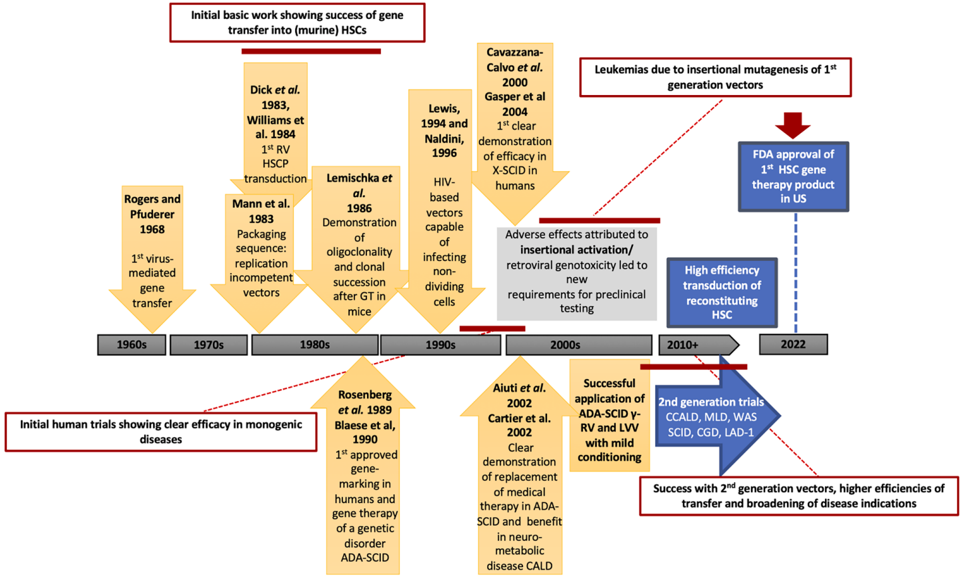
“Thus, the major breakthrough in the field was adoption of γ-retroviruses as vectors to transfer DNA into HSPCs (Figure 1).4,5”
§ Ex vivo modification of hematopoietic stem and progenitor cells for gene therapy > INTRODUCTION
What the sources say
- Not checked — no full text of the sourcecites [4] Williams, 1984, Introduction of new genetic material into pluripotent haematopoietic stem cells of the mouse, Nature source
- Not checked — no full text of the sourcecites [5] Dick, 1985, Introduction of a selectable gene into primitive stem cells capable of long-term reconstitution of the hemopoietic system of W/Wv mice, Cell source
plainstates a cause- Asserted: passes — The authors put it forward as true.
- Checkable: passes — It can be checked against evidence.
- Load-bearing: unclear — It is unclear whether the paper’s conclusions depend on it.
- Based: passes — The paper gives a reason why it holds.
- Probably not a substantial claim. 13
- It may state two separate claims as one. 38
- The quote only partly states this claim. 1
Create a free account to see these claims.
Create a free account to see these assumptions.
26 more claims
Create a free account to see all 76 claims and to verify the 33 references still open.
Self-check
Percentages, sums and reported differences re-computed from the paper’s own numbers.
Each contradiction between two passages listed here was confirmed by an independent check.
Rated minor: it would not touch a result — a value no result rests on, a p-value that stays on the same side of the significance level, or a conflict that is clerical, resolved elsewhere in the paper, or outside its own findings.
In the paper
§ Ex vivo modification of hematopoietic stem and progenitor cells for gene therapy > VIRAL VECTORS USE IN GENE THERAPY FOR HEMOGLOBINOPATHIES
“leading to the incorporation of shRNA targeting knockdown of BCL11 in LVV in clinical trials by the Williams laboratory [81][82][83][84]”
§ Ex vivo modification of hematopoietic stem and progenitor cells for gene therapy > References
“81. Guda, S.A., Guda, A.A., Soldatov, M.A., Lomachenko, K.A., Bugaev, A.L., Lamberti, C., Gawelda, W., Bressler, C., Smolentsev, G., Soldatov, A.V., and Joly, Y. (2015). Optimized Finite Difference Method for the Full-Potential XANES Simulations: Application to Molecular Adsorption Geometries in MOFs and Metal-Ligand Intersystem Crossing Transients.”
Rated minor: it would not touch a result — a value no result rests on, a p-value that stays on the same side of the significance level, or a conflict that is clerical, resolved elsewhere in the paper, or outside its own findings.
In the paper
§ Ex vivo modification of hematopoietic stem and progenitor cells for gene therapy > CHRONIC GRANULOMATOUS DISEASE
“A first patient has been treated at Great Ormond Street Hospital with good early results.41”
§ Ex vivo modification of hematopoietic stem and progenitor cells for gene therapy > References
“41. Aguila, H.N., Lai, W.C., Lu, Y.S., and Pakes, S.P. (1988). Experimental Mycoplasma pulmonis infection of rats suppresses humoral but not cellular immune response. Lab. Anim. Sci. 38, 138-142.”
Citations
Cites
In Vivo Gene Delivery and Stable Transduction of Nondividing Cells by a Lentiviral Vector
Naldini, L., Blömer, U., Gallay, P., Ory, D., Mulligan, R., Gage, F. H., Verma, I. M., & Trono, D. (1996) · Science · doi:10.1126/science.272.5259.263 · Cited by 4,903
LMO2 -Associated Clonal T Cell Proliferation in Two Patients after Gene Therapy for SCID-X1
Hacein-Bey-Abina, S., Von Kalle, C., Schmidt, M., McCormack, M. P., Wulffraat, N., Leboulch, P., Lim, A., Osborne, C. S., Pawliuk, R., Morillon, E., et al. (2003) · Science · doi:10.1126/science.1088547 · Cited by 3,587
Gene Therapy of Human Severe Combined Immunodeficiency (SCID)-X1 Disease
Cavazzana-Calvo, M., Hacein-Bey, S., Basile, G. D. S., Gross, F., Yvon, E., Nusbaum, P., Selz, F., Hue, C., Certain, S., Casanova, J.-L., et al. (2000) · Science · doi:10.1126/science.288.5466.669 · Cited by 2,167
Mann, R., Mulligan, R. C., & Baltimore, D. (1983) · Cell · doi:10.1016/0092-8674(83)90344-6 · Cited by 1,776
T Lymphocyte-Directed Gene Therapy for ADA − SCID: Initial Trial Results After 4 Years
Blaese, R. M., Culver, K. W., Miller, A. D., Carter, C. S., Fleisher, T. A., Clerici, M., Shearer, G. M., Chang, L., Chiang, Y. L., Tolstoshev, P., et al. (1995) · Science · doi:10.1126/science.270.5235.475 · Cited by 1,546
Transfer of purified herpes virus thymidine kinase gene to cultured mouse cells
Wigler, M. H., Silverstein, S. J., Lee, L., Pellicer, À., Cheng, Y., & Axel, R. (1977) · Cell · doi:10.1016/0092-8674(77)90333-6 · Cited by 1,352
Transcription Start Regions in the Human Genome Are Favored Targets for MLV Integration
Wu, X., Li, Y., Crise, B., & Burgess, S. M. (2003) · Science · doi:10.1126/science.1083413 · Cited by 1,305
Howe, S. J., Mansour, M. R., Schwarzwaelder, K., Bartholomae, C., Hubank, M., Kempski, H., Brugman, M. H., Pike-Overzet, K., Chatters, S. J., de Ridder, D., et al. (2008) · Journal of Clinical Investigation · doi:10.1172/jci35798 · Cited by 1,286
Self-citationTransfusion independence and HMGA2 activation after gene therapy of human β-thalassaemia
Cavazzana-Calvo, M., Payen, E., Negre, O., Wang, G., Hehir, K., Fusil, F., Down, J., Denaro, M., Brady, T., Westerman, K., et al. (2010) · Nature · doi:10.1038/nature09328 · Cited by 1,276
Ott, M. G., Schmidt, M., Schwarzwaelder, K., Stein, S., Siler, U., Koehl, U., Glimm, H., Kühlcke, K., Schilz, A., Kunkel, H., et al. (2006) · Nature Medicine · doi:10.1038/nm1393 · Cited by 1,051
Self-citation
Research works printed but not linked: 1
- Pai, 2023, Universal survival and superior immune reconstitution after lentiviral gene therapy with low dose conditioning for X-linked SCID (SCID-X1), Mol. Ther., 31, 1
Cited by
Shu, J., Xie, X., Wang, S., Du, Z., Huang, P. Y., Chen, Y., & He, Z. (2025) · Frontiers in Cell and Developmental Biology · doi:10.3389/fcell.2025.1595897 · Cited by 6
Toward Precision Medicine: Gene Therapy Applications in the Management of Uveal Melanoma
Azani, A., Ghassemifar, V., Mehrdad, Z., Saberivand, M., Pour, A. B., Tahmasebi, S., Gharedaghi, H., Sharafi, M., Foroozand, H., Meigoli, M. S. S., et al. (2025) · Cancer Reports · doi:10.1002/cnr2.70425 · Cited by 2
Reduced-intensity conditioning in LV-mediated gene therapy for Fabry disease targeting HSPCs
Khan, A., Barber, D. L., Foley, R., Keating, A., West, M. L., & Medin, J. A. (2025) · Molecular Therapy · doi:10.1016/j.ymthe.2025.07.054 · Cited by 1
Hurnikova, J., Venkatesan, J. K., Liu, W., Madry, H., Cucchiarini, M., & Petrovová, E. (2026) · SLAS TECHNOLOGY · doi:10.1016/j.slast.2026.100404 · Cited by 1
Eapen, M., & Williams, D. A. (2026) · Cytotherapy · doi:10.1016/j.jcyt.2026.102906 · Cited by 1
Self-citation
Metadata
- Authors
- Williams, D. A., Kohn, D. B., & Thrasher, A. J.
- Affiliations
- Boston Children's Hospital (US)
- University of California, Los Angeles (US)
- University College London (GB)
- Corresponding author
- Williams, David A.
- Venue
- Molecular Therapy
- Publisher
- Elsevier BV
- Published
- 2025-05
- Volume
- 33
- Issue
- 5
- Pages
- 2141-2153
- ISSN
- 1525-0016 (ISSN-L)
- PMC
- PMC12126793
- OpenAlex
- W4409101084
- Semantic Scholar
- 20b0e735fb8de73368c0e6f9fa8ee239c292dbe5
- Cited by
- 11
- References
- 90
- Citations by year
- 2026: 7 · 2025: 4
- FWCI
- 1.18
- Type
- journal article
- Language
- en
- Open access
- hybrid
- doi.org
- Licence
- Locations
- Molecular Therapy (publishedVersion, cc-by-nc-nd)
- PubMed (publishedVersion)
- PubMed Central (publishedVersion)
- Topics
- Life Sciences › Biochemistry, Genetics and Molecular Biology › Genetics › Virus-based gene therapy research
- Life Sciences › Biochemistry, Genetics and Molecular Biology › Molecular Biology › RNA Interference and Gene Delivery
- Health Sciences › Medicine › Hematology › Hematopoietic Stem Cell Transplantation
- Keywords
- hematopoietic stem and progenitor cells, gene therapy, retroviral vectors, lentiviral vectors, HIV-based vectors, autologous transplantation, immunodeficiency, hemoglobinopathies, metabolic disorders, monogenic disorders, viral vectors, gene transfer efficiency
- MeSH terms
- Animals, Clinical Trials as Topic, Genetic Vectors, Hematopoietic Stem Cells, Humans, Retroviridae, Genetic Therapy, Lentivirus, Gene Transfer Techniques, Hematopoietic Stem Cell Transplantation
About these checks
Registry, retraction, Cites and statistics results are computed, not judged, with one exception: a printed reference that no index lists is read once by a model before it counts as a citation error. Claims are extracted by a model and kept only when their quote appears verbatim in the text; each cited source is then checked, with a model’s help, for whether it says what the claim relies on. Those verdicts can be wrong — read the claim’s quote and the cited source before relying on one.
A language model drew the claims from the paper on 2026-11-12, under version 3 of the claim definition (model deepseek-v4.1-flash, prompt extract-v3).
A second model labelled each claim on 2026-11-12 (model jev-1.13-20260917, definition revision gold-guideline-v0.2).
Statistics and arithmetic are recomputed, not judged.
Confidence bands are shown only for fields calibrated on our annotated test set. None is calibrated yet, so no band is shown.
What counts as a claim ›How we measure confidence ›How we check this ›
Are you an author, or do you see a problem with this page? Request a review
