

The DOI matches its Crossref record; 100 of the 100 references it cites were found in a registry or an index.
The interleukin-6 receptor as a target for prevention of coronary heart disease: a mendelian randomisation analysis
Open accessAbstract
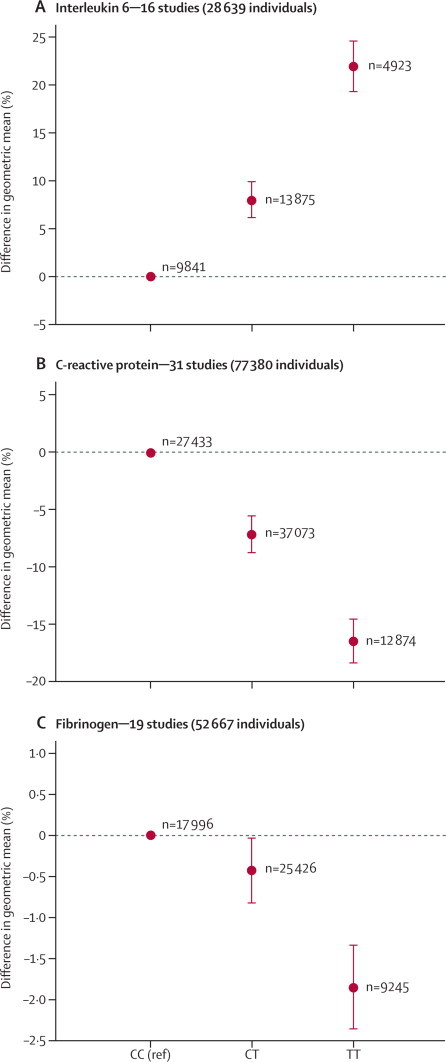
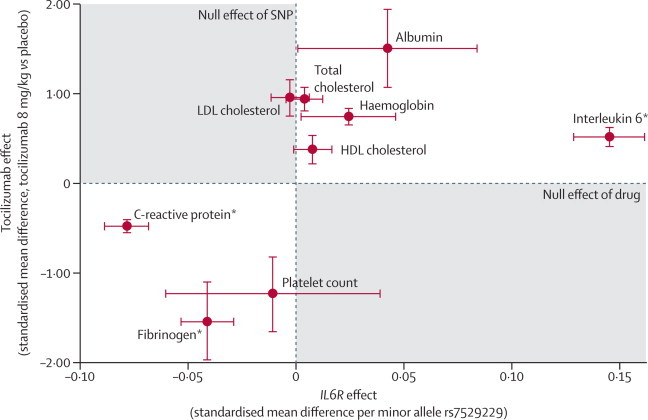
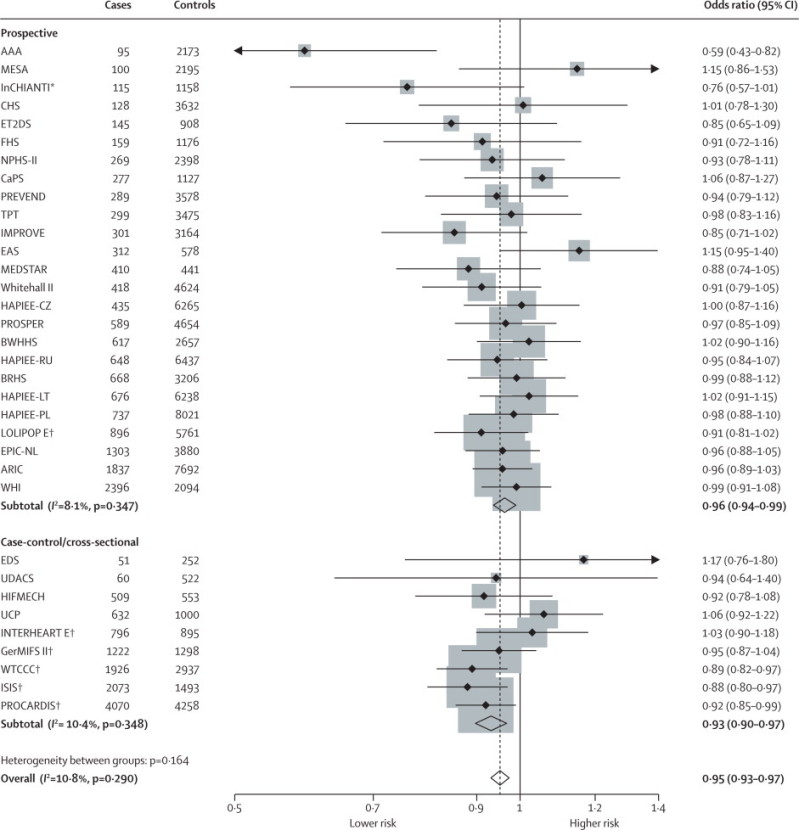
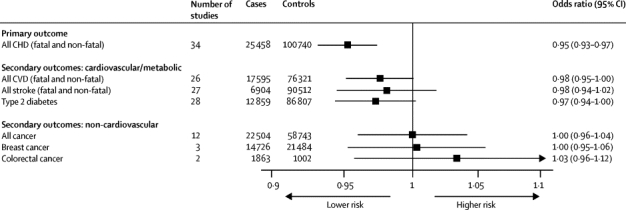
BACKGROUND: A high circulating concentration of interleukin 6 is associated with increased risk of coronary heart disease. Blockade of the interleukin-6 receptor (IL6R) with a monoclonal antibody (tocilizumab) licensed for treatment of rheumatoid arthritis reduces systemic and articular inflammation. However, whether IL6R blockade also reduces risk of coronary heart disease is unknown. METHODS: Applying the mendelian randomisation principle, we used single nucleotide polymorphisms (SNPs) in the gene IL6R to evaluate the likely efficacy and safety of IL6R inhibition for primary prevention of coronary heart disease. We compared genetic findings with the effects of tocilizumab reported in randomised trials in patients with rheumatoid arthritis. FINDINGS: In 40 studies including up to 133,449 individuals, an IL6R SNP (rs7529229) marking a non-synonymous IL6R variant (rs8192284; p.Asp358Ala) was associated with increased circulating log interleukin-6 concentration (increase per allele 9·45%, 95% CI 8·34-10·57) as well as reduced C-reactive protein (decrease per allele 8·35%, 95% CI 7·31-9·38) and fibrinogen concentrations (decrease per allele 0·85%, 95% CI 0·60-1·10). This pattern of effects was consistent with IL6R blockade from infusions of tocilizumab (4-8 mg/kg every 4 weeks) in patients with rheumatoid arthritis studied in randomised trials. In 25,458 coronary heart disease cases and 100,740 controls, the IL6R rs7529229 SNP was associated with a decreased odds of coronary heart disease events (per allele odds ratio 0·95, 95% CI 0·93-0·97, p=1·53×10(-5)). INTERPRETATION: On the basis of genetic evidence in human beings, IL6R signalling seems to have a causal role in development of coronary heart disease. IL6R blockade could provide a novel therapeutic approach to prevention of coronary heart disease that warrants testing in suitably powered randomised trials. Genetic studies in populations could be used more widely to help to validate and prioritise novel drug targets or to repurpose existing agents and targets for new therapeutic uses. FUNDING: UK Medical Research Council; British Heart Foundation; Rosetrees Trust; US National Heart, Lung, and Blood Institute; Du Pont Pharma; Chest, Heart and Stroke Scotland; Wellcome Trust; Coronary Thrombosis Trust; Northwick Park Institute for Medical Research; UCLH/UCL Comprehensive Medical Research Centre; US National Institute on Aging; Academy of Finland; Netherlands Organisation for Health Research and Development; SANCO; Dutch Ministry of Public Health, Welfare and Sports; World Cancer Research Fund; Agentschap NL; European Commission; Swedish Heart-Lung Foundation; Swedish Research Council; Strategic Cardiovascular Programme of the Karolinska Institutet; Stockholm County Council; US National Institute of Neurological Disorders and Stroke; MedStar Health Research Institute; GlaxoSmithKline; Dutch Kidney Foundation; US National Institutes of Health; Netherlands Interuniversity Cardiology Institute of the Netherlands; Diabetes UK; European Union Seventh Framework Programme; National Institute for Healthy Ageing; Cancer Research UK; MacArthur Foundation.
Overview
The claims and statistics of this paper haven’t been checked yet.
Run the check — free, no account needed. It reads the open-access text and checks the sources it cites.
Integrity signals
Registry
Cites
Statistics
Figures
Verification
Claims the paper makes
The claims and statistics of this paper haven’t been checked yet.
Run the check — free, no account needed. It reads the open-access text and checks the sources it cites.
Claims other papers make about this one
Each is checked against this paper’s own text: does it say what the citing paper says it does?
The source backs part of the claim, not all of it — or backs it for a different population, condition or comparison.
In the citing paper
“genetic evidence suggests that IL-6 may be causal for atherosclerotic cardiovascular disease, 24,25”
From Comprehensive Long-Term Changes in Cardiovascular Risk Biomarkers With Tirzepatide (2026) · cites this paper as [25]
Experimental — accuracy not yet measuredThe source backs part of the claim, not all of it — or backs it for a different population, condition or comparison.
In the citing paper
“Genome-wide association studies (GWAS), meta-analysis, exome analysis and single nucleotide polymorphism (SNP) mapping have associated IL-6, IL-6R and gp130 with inflammatory diseases such as RA and coronary artery disease (263–269).”
From IL-6 in inflammation, autoimmunity and cancer (2021) · cites this paper as [265]
Experimental — accuracy not yet measuredThe source backs part of the claim, not all of it — or backs it for a different population, condition or comparison.
In the citing paper
“We also identified associations between IL6R pQTLs and CAD, rheumatoid arthritis and 7 other disease traits (Supplementary Table S12), thereby supporting the findings of the study69.”
From Genetic determinants of plasma protein levels in the Estonian population (2024) · cites this paper as [69]
Experimental — accuracy not yet measuredThe cited source says what the claim attributes to it.
In the citing paper
“One large study reported a near significant effect ( P = 0.06) of a functional variant causing impaired signalling at the IL-6 receptor with reduced risk of developing diabetes mellitus 44.”
From Type 2 diabetes mellitus and psychological stress — a modifiable risk factor (2017) · cites this paper as [44]
The cited source says what the claim attributes to it.
In the citing paper
“A previous study has shown a link between IL6R and CAD69.”
From Genetic determinants of plasma protein levels in the Estonian population (2024) · cites this paper as [69]
In the citing paper
“Confirming the role of IL-6 in health, in a large Mendelian randomization analysis, the IL6R SNP rs7529229, marking a non-synonymous IL6R variant (rs8192284; p.Asp358Ala), was associated with increased circulating IL-6 levels24.”
From Inflammageing: chronic inflammation in ageing, cardiovascular disease, and frailty (2018) · cites this paper as [24]
In the citing paper
“Variants in the IL6R gene have been found to be associated with increased risk of coronary artery disease24, rheumatoid arthritis, atrial fibrillation, and abdominal aortic aneurysm, and with increased susceptibility to asthma, type 1 diabetes, and depression36,37.”
From Inflammageing: chronic inflammation in ageing, cardiovascular disease, and frailty (2018) · cites this paper as [24]
In the citing paper
“CETP inhibitors exert their relatively modest cardioprotective effects on the basis that in addition to their HDL-C raising effects, more potent CETP inhibitors also lower apolipoprotein B 22,23,75 .”
From Integrating genomics with biomarkers and therapeutic targets to invigorate cardiovascular drug development (2021) · cites this paper as [23]
In the citing paper
“The approach outlined here to obtaining a scaling estimate has generally held true for lipid-lowering therapies and risk of cardiovascular disease 22,23,40,92 but there are several potential reasons why the derivation of such a scaling for other therapeutic target-indication pairs may pose a challenge.”
From Integrating genomics with biomarkers and therapeutic targets to invigorate cardiovascular drug development (2021) · cites this paper as [23]
In the citing paper
“However, using SNPs located in CETP associated with HDL-C at genome-wide significant levels in a drug-target MR suggests that modifying HDL-C via CETP, is likely to reduce risk of CHD 23,103 .”
From Integrating genomics with biomarkers and therapeutic targets to invigorate cardiovascular drug development (2021) · cites this paper as [23]
In the citing paper
“CETP 23 variants associate with of CHD; APOA1 117 variants do not associate with risk of CHD”
From Integrating genomics with biomarkers and therapeutic targets to invigorate cardiovascular drug development (2021) · cites this paper as [23]
In the citing paper
“Various statistical methods have been proposed to reduce weak instrument bias due to sample overlap and bias due to winner’s curse (see Section 3) 43– 45 .”
From Guidelines for performing Mendelian randomization investigations (2020) · cites this paper as [43]
Self-check
Percentages, sums and reported differences re-computed from the paper’s own numbers.
The self-check needs the paper’s full text.
Citations
Cites
Preferred Reporting Items for Systematic Reviews and Meta-Analyses: the PRISMA statement
Moher, D., Liberati, A., Tetzlaff, J., Altman, D. G., & for the PRISMA Group (2009) · BMJ · doi:10.1136/bmj.b2535 · Cited by 83,823
Preferred Reporting Items for Systematic Reviews and Meta-Analyses: The PRISMA Statement
Moher, D., Liberati, A., Tetzlaff, J., Altman, D. G., & The PRISMA Group (2009) · PLoS Medicine · doi:10.1371/journal.pmed.1000097 · Cited by 64,042
Measuring inconsistency in meta-analyses
Higgins, J. P. T., Thompson, S. G., Deeks, J. J., & Altman, D. G. (2003) · BMJ · doi:10.1136/bmj.327.7414.557 · Cited by 63,139
Preferred reporting items for systematic reviews and meta-analyses: the PRISMA Statement.
(2009) · PubMed Central · Cited by 44,859
Friedewald, W. T., Levy, R. I., & Fredrickson, D. S. (1972) · Clinical Chemistry · doi:10.1093/clinchem/18.6.499 · Cited by 32,423
Atherosclerosis--an inflammatory disease
Ross, R. (1999) · New England Journal of Medicine · doi:10.1056/nejm199901143400207 · Cited by 21,725
Wang, G., Ma, R., Qiao, G., Wada, K., Aizawa, Y., & Satoh, T. (2015) · Integrative Medicine International · doi:10.1159/000368408 · Cited by 18,762
Haploview: analysis and visualization of LD and haplotype maps
Barrett, J. C., Fry, B., Maller, J., & Daly, M. J. (2004) · Bioinformatics · doi:10.1093/bioinformatics/bth457 · Cited by 14,563
The Human Genome Browser at UCSC
Kent, W. J., Sugnet, C. W., Furey, T. S., Roskin, K. M., Pringle, T. H., Zahler, A. M., & Haussler, A. D. (2002) · Genome Research · doi:10.1101/gr.229102 · Cited by 10,400
Davey Smith, G., & Ebrahim, S. (2003) · International Journal of Epidemiology · doi:10.1093/ije/dyg070 · Cited by 5,882
Cited by
Sorted by citations
Antiinflammatory Therapy with Canakinumab for Atherosclerotic Disease
Ridker, P. M., Everett, B. M., Thuren, T., MacFadyen, J. G., Chang, W. H., Ballantyne, C., Fonseca, F., Nicolau, J., Koenig, W., Anker, S. D., et al. (2017) · New England Journal of Medicine · doi:10.1056/nejmoa1707914 · Cited by 9,482
Mendelian Randomization Analysis With Multiple Genetic Variants Using Summarized Data
Burgess, S., Butterworth, A., & Thompson, S. G. (2013) · Genetic Epidemiology · doi:10.1002/gepi.21758 · Cited by 6,050
Mendelian randomization: genetic anchors for causal inference in epidemiological studies
Davey Smith, G., & Hemani, G. (2014) · Human Molecular Genetics · doi:10.1093/hmg/ddu328 · Cited by 4,677
Inflammageing: chronic inflammation in ageing, cardiovascular disease, and frailty
Ferrucci, L., & Fabbri, E. (2018) · Nature Reviews Cardiology · doi:10.1038/s41569-018-0064-2 · Cited by 3,690
Guidelines for performing Mendelian randomization investigations
Burgess, S., Smith, G. D., Davies, N. M., Dudbridge, F., Gill, D., Glymour, M. M., Hartwig, F. P., Holmes, M. V., Minelli, C., Relton, C. L., et al. (2019) · Wellcome Open Research · doi:10.12688/wellcomeopenres.15555.1 · Cited by 1,828
Metadata
- Authors
- Swerdlow, D. I.
- Affiliations
- University College London (GB)
- Corresponding author
- Daniel I. Swerdlow
- ORCID
- Daniel I. Swerdlow
- Venue
- The Lancet
- Publisher
- Elsevier BV
- Published
- 2012-03
- Volume
- 379
- Issue
- 9822
- Pages
- 1214-1224
- ISSN
- 0099-5355 (ISSN-L)
- 0140-6736
- PMC
- PMC3316968
- OpenAlex
- W2143727405
- Cited by
- 1,146
- References
- 100
- Citations by year
- 2026: 78 · 2025: 86 · 2024: 94 · 2023: 89 · 2022: 84 · 2021: 110 · 2020: 89 · 2019: 80 · 2018: 74 · 2017: 77 · 2016: 67 · 2015: 56 · 2014: 63 · 2013: 65 · 2012: 32
- FWCI
- 8.45
- Type
- journal article
- Language
- en
- Open access
- hybrid
- doi.org
- Licence
- Locations
- The Lancet (publishedVersion, cc-by)
- Europe PMC (PubMed Central) (publishedVersion, cc-by)
- PubMed Central (publishedVersion, cc-by)
- PubMed (publishedVersion)
- Pure Amsterdam UMC (publishedVersion, other-oa)
- Bristol Research (University of Bristol) (publishedVersion, cc-by)
- LSHTM Research Online (London School of Hygiene and Tropical Medicine) (acceptedVersion)
- Edinburgh Research Explorer (University of Edinburgh) (submittedVersion, other-oa)
- Data Archiving and Networked Services (DANS) (submittedVersion, other-oa)
- Data Archiving and Networked Services (DANS) (submittedVersion)
- Leiden Repository (Leiden University) (submittedVersion)
- UCL Discovery (University College London) (submittedVersion)
- ORCA Online Research @Cardiff (Cardiff University) (submittedVersion)
- Lithuanian University of Health Sciences (submittedVersion)
- University of Groningen research database (University of Groningen / Centre for Information Technology) (submittedVersion)
- Funders
- MRC population health scientist fellowship (G0802432)
- National Institutes of Health (NIH), the MRC, and the British Heart Foundation (BHF (RG/10/12/28456)
- BHF (Schillingford) clinical training fellowship (FS/07/011)
- US National Heart, Lung, and Blood Institute (HHSN268200900009C)
- National Human Genome Research Institute (U01HG005152)
- Cancer Research UK (C1298/A8362, C150/A5660)
- IKEM (Czech Republic) (00023001)
- National Institute for Healthy Ageing (05060810)
- NIH/NHLBI (5215810-55000000041)
- BHF (RG 08/008 and PG/07/133/24260, RG/04/003)
- Netherlands Organisation for Health Research and Development (90700342)
- BHF senior fellowship (FS 05/125)
- British Heart Foundation (RG/10/12/28456)
- contract no. (HHSN268200625226C)
- NHLBI in collaboration with MESA investigators (N01 HC-95159, N01-HC-95160, N01-HC-95161, N01-HC-95162, N01-HC-95163, N01-HC-95164, N01-HC-95165, N01-HC-95166, N01-HC-95167, N01-HC-95168, N01-HC-95169, and RR-024156)
- Wellcome Trust (064947/Z/01/Z and 081081/Z/06/Z)
- National Institute on Aging (1R01 AG23522-01)
- Intramural Research Program of the National Institute on Aging, NIH, Department of Health and Human Services (Z01 AG000954-06, ISGS (R01 NS42733), (R01 NS39987), Z01 AG000015-50)
- European Commission (QLG1-CT-2002-00896)
- Dutch Kidney Foundation (Grant E033)
- GENECURE (FP-6 LSHM CT 2006 037697)
- NIH (grant LM010098)
- The Netherlands Organisation for Health Research and Development (grant 916.761.70)
- European Union's Seventh Framework Programme (FP7/2007-2013)
- NHLBI (RFP-NHLBI-WH-11-10, HL36310)
- Veni grant Organization for Scientific Research (NWO) (2001.064)
- NIH; National Institute on Aging (AG13196)
- MRC (grant NHLBI 33014)
- Topics
- Life Sciences › Biochemistry, Genetics and Molecular Biology › Genetics › Genetic Associations and Epidemiology
- Health Sciences › Medicine › Rheumatology › Rheumatoid Arthritis Research and Therapies
- Health Sciences › Medicine › Cardiology and Cardiovascular Medicine › Lipoproteins and Cardiovascular Health
- Keywords
- IL-6 receptor, tocilizumab, coronary artery disease, primary prevention, C-reactive protein, fibrinogen, rheumatoid arthritis, genetic variants, monoclonal antibodies
- MeSH terms
- Coronary Disease, Gene Frequency, Genotype, Humans, Phenotype, Genetic Variation, Signal Transduction, Randomized Controlled Trials as Topic, Treatment Outcome, Inflammation Mediators, Receptors, Interleukin-6, Polymorphism, Single Nucleotide, Genetic Association Studies, Mendelian Randomization Analysis, Antibodies, Monoclonal, Humanized
About these checks
Registry, retraction, Cites and statistics results are computed, not judged, with one exception: a printed reference that no index lists is read once by a model before it counts as a citation error. Claims are extracted by a model and kept only when their quote appears verbatim in the text; each cited source is then checked, with a model’s help, for whether it says what the claim relies on. Those verdicts can be wrong — read the claim’s quote and the cited source before relying on one.
Statistics and arithmetic are recomputed, not judged.
Confidence bands are shown only for fields calibrated on our annotated test set. None is calibrated yet, so no band is shown.
What counts as a claim ›How we measure confidence ›How we check this ›
Are you an author, or do you see a problem with this page? Request a review
