

A two-decade comparison of prevalence of dementia in individuals aged 65 years and older from three geographical areas of England: results of the Cognitive Function and Ageing Study I and II
Open accessThe DOI matches its Crossref record; 39 of the 40 references it cites were found in a registry or an index.
Abstract
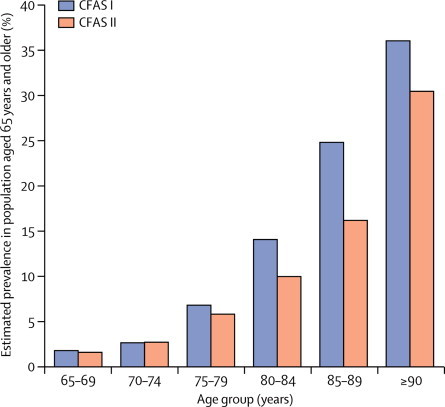
BACKGROUND: The prevalence of dementia is of interest worldwide. Contemporary estimates are needed to plan for future care provision, but much evidence is decades old. We aimed to investigate whether the prevalence of dementia had changed in the past two decades by repeating the same approach and diagnostic methods as used in the Medical Research Council Cognitive Function and Ageing Study (MRC CFAS) in three of the original study areas in England. METHODS: Between 1989 and 1994, MRC CFAS investigators did baseline interviews in populations aged 65 years and older in six geographically defined areas in England and Wales. A two stage process, with screening followed by diagnostic assessment, was used to obtain data for algorithmic diagnoses (geriatric mental state-automated geriatric examination for computer assisted taxonomy), which were then used to estimate dementia prevalence. Data from three of these areas--Cambridgeshire, Newcastle, and Nottingham--were selected for CFAS I. Between 2008 and 2011, new fieldwork was done in the same three areas for the CFAS II study. For both CFAS I and II, each area needed to include 2500 individuals aged 65 years and older to provide power for geographical and generational comparison. Sampling was stratified according to age group (65-74 years vs ≥75 years). CFAS II used identical sampling, approach, and diagnostic methods to CFAS I, except that screening and assessement were combined into one stage. Prevalence estimates were calculated using inverse probability weighting methods to adjust for sampling design and non-response. Full likelihood Bayesian models were used to investigate informative non-response. FINDINGS: 7635 people aged 65 years or older were interviewed in CFAS I (9602 approached, 80% response) in Cambridgeshire, Newcastle, and Nottingham, with 1457 being diagnostically assessed. In the same geographical areas, the CFAS II investigators interviewed 7796 individuals (14,242 approached, 242 with limited frailty information, 56% response). Using CFAS I age and sex specific estimates of prevalence in individuals aged 65 years or older, standardised to the 2011 population, 8·3% (884,000) of this population would be expected to have dementia in 2011. However, CFAS II shows that the prevalence is lower (6·5%; 670,000), a decrease of 1·8% (odds ratio for CFAS II vs CFAS I 0·7, 95% CI 0·6-0·9, p=0·003). Sensitivity analyses suggest that these estimates are robust to the change in response. INTERPRETATION: This study provides further evidence that a cohort effect exists in dementia prevalence. Later-born populations have a lower risk of prevalent dementia than those born earlier in the past century. FUNDING: UK Medical Research Council.
Overview
The claims and statistics of this paper haven’t been checked yet.
Free: it reads the open-access text and checks the first 5 claims that cite a source we can check. Create a free account to check every claim.
Integrity signals
Registry
Cites
Statistics
Figures
Verification
Claims the paper makes
The claims and statistics of this paper haven’t been checked yet.
Free: it reads the open-access text and checks the first 5 claims that cite a source we can check. Create a free account to check every claim.
Claims other papers make about this one
Each is checked against this paper’s own text: does it say what the citing paper says it does?
In the citing paper
“A study in the UK population suggests that the prevalence of dementia may be decreasing, a finding interpreted to reflect the beneficial effects of controlling blood pressure and other risk factors (Matthews et al., 2013).”
From The Pathobiology of Vascular Dementia (2013) · cites this paper as Matthews et al., 2013
Self-check
Percentages, sums and reported differences re-computed from the paper’s own numbers.
The self-check needs the paper’s full text.
Citations
Cites
Global prevalence of dementia: a Delphi consensus study
Ferri, C. P., Prince, M., Brayne, C., Brodaty, H., Fratiglioni, L., Ganguli, M., Hall, K., Hasegawa, K., Hendrie, H., Huang, Y., et al. (2005) · The Lancet · doi:10.1016/s0140-6736(05)67889-0 · Cited by 5,332
Self-citationThe global prevalence of dementia: a systematic review and metaanalysis.
Prince, M., Bryce, R., Albanese, E., Wimo, A., Ribeiro, W., & Ferri, C. P. (2013) · Alzheimer's & Dementia · doi:10.1016/j.jalz.2012.11.007 · Cited by 4,941
Participation Rates in Epidemiologic Studies
Galea, S., & Tracy, M. (2007) · Annals of Epidemiology · doi:10.1016/j.annepidem.2007.03.013 · Cited by 1,877
Health and Deprivation: Inequality and the North
Townsend, P. D., Phillimore, P., & Beattie, A. (1987) · DOAJ (DOAJ: Directory of Open Access Journals) · Cited by 1,473
Marmot, M. G., Allen, J., Goldblatt, P., Boyce, T., McNeish, D., Grady, M., & Geddes, I. (2010) · Europe PMC (PubMed Central) · Cited by 1,404
The worldwide economic impact of dementia 2010
Wimo, A., Jönsson, L., Bond, J., Prince, M., Winblad, B., & International, A. D. (2013) · Alzheimer's & Dementia · doi:10.1016/j.jalz.2012.11.006 · Cited by 1,141
Self-citationMeng, X., & D’Arcy, C. (2012) · PLoS ONE · doi:10.1371/journal.pone.0038268 · Cited by 876
Rates and risk factors for dementia and Alzheimer’s disease: Results from EURODEM pooled analyses
Launer, L. J., Andersen, K., Dewey, M. E., Letenneur, L., Ott, A., Amaducci, L. A., Brayne, C., Copeland, J. R. M., Dartigues, J.-F., Kragh-Sorensen, P., et al. (1999) · Neurology · doi:10.1212/wnl.52.1.78 · Cited by 758
Self-citationCopeland, J. R. M., Dewey, M. E., & Griffiths-Jones, H. M. (1986) · Psychological Medicine · doi:10.1017/s0033291700057779 · Cited by 750
Health and deprivation. Inequality and the North
Mackenbach, J. P. (1988) · Health Policy · doi:10.1016/0168-8510(88)90006-1 · Cited by 661
Cited by
Items 701–800 of 1,000
Health expenditure in hospitals
OECD (2018) · Health at a glance. Europe · doi:10.1787/health_glance_eur-2018-32-en · Cited by 7
Dietary interventions for maintaining cognitive function in cognitively healthy people in late life
Siervo, M., Lara, J., Munro, A., Tang, E. Y. H., Rutjes, A. W., & Stephan, B. C. M. (2015) · Cochrane Database of Systematic Reviews · doi:10.1002/14651858.cd011910 · Cited by 7
de Miguel‐Díez, J., López‐de‐Andrés, A., Jiménez‐García, R., Hernández‐Barrera, V., Carabantes-Alarcón, D., Zamorano‐León, J. J., Omaña-Palanco, R., González‐Barcala, F. J., & Cuadrado‐Corrales, N. (2023) · Respiratory Medicine · doi:10.1016/j.rmed.2023.107223 · Cited by 7
Care home residents on the move: the significance of cultural context for physical activity
Bowes, A. M., Dawson, A. S. F., Greasley‐Adams, C., Jepson, R. G., & McCabe, L. (2021) · Ageing and Society · doi:10.1017/s0144686x20001920 · Cited by 7
Challenges in efficacy research: the case of feeding alternatives in patients with dementia
Zapka, J. G., Amella, E. J., Magwood, G., Madisetti, M., Garrow, D. A., & Aselage, M. (2014) · Journal of Advanced Nursing · doi:10.1111/jan.12365 · Cited by 7
Dementia Research: Populations, Progress, Problems, and Predictions
Hunter, S., Smailagic, N., & Brayne, C. (2018) · Journal of Alzheimer s Disease · doi:10.3233/jad-179927 · Cited by 7
Self-citationCreavin, S., Noel-Storr, A. H., Richard, E., Creavin, A. L., Cullum, S. J., Ben‐Shlomo, Y., & Purdy, S. (2017) · Cochrane Database of Systematic Reviews · doi:10.1002/14651858.cd012558 · Cited by 7
Suchsland, M. Z., Gaster, B., Raetz, J., Belza, B. L., McGuire, L. C., Olivari, B. S., Tracy, K. K., & Fitzpatrick, A. L. (2023) · BMC Health Services Research · doi:10.1186/s12913-023-09991-7 · Cited by 7
The effects of midlife diet on late-life cognition : an epidemiological approach
Eskelinen, M. H. (2014) · UEF eRepo (University of Eastern Finland) · Cited by 7
Treatment with adipose stem cells in a patient with moderate Alzheimer's disease: case report
Anestakis, D., Tsolaki, M., Zygouris, S., Tsoutsikas, V., & Koliakos, G. (2015) · Journal of Neurorestoratology · doi:10.2147/jn.s92869 · Cited by 7
Hooshmand, B. (2013) · Figshare · Cited by 7
Teichmann, B., Bauer, J. M., Beyreuther, K. T., & Kruse, A. (2019) · Zeitschrift für Gerontologie und Geriatrie · doi:10.1007/s00391-019-01632-1 · Cited by 7
Lawson, R. A., Richardson, S. J., Kershaw, D., Davis, D. H. J., Stephan, B. C. M., Robinson, L., Brayne, C., Barnes, L., Burn, D. J., Yarnall, A. J., et al. (2021) · Journal of Parkinson s Disease · doi:10.3233/jpd-212849 · Cited by 7
Self-citationOn Short Cuts: The Complexity of Studying the Early Diagnosis and Prevention of Alzheimer’s Disease
Leibing, A. (2016) · Palgrave Macmillan UK eBooks · doi:10.1057/978-1-137-54097-3_3 · Cited by 7
Trends of Dementia among Community-Dwelling Adults in Ontario, Canada, 2010–2015
Vanderkruk, K., Eberg, M., Mahootchi, T., Esensoy, A. V., & Seitz, D. P. (2020) · Dementia and Geriatric Cognitive Disorders · doi:10.1159/000508687 · Cited by 7
Famitafreshi, H., & Karimian, M. (2018) · The Open Pharmacology Journal · doi:10.2174/1874143601808010001 · Cited by 7
Stephen, R. (2020) · UEF eRepo (University of Eastern Finland) · Cited by 7
Introduction to living with advanced dementia series
Brown, M., & Tolson, D. (2020) · Nursing Older People · doi:10.7748/nop.2020.e1169 · Cited by 7
Health benefits of encore careers for baby boomers
Topiwala, A., Patel, S., & Ebmeier, K. P. (2014) · Maturitas · doi:10.1016/j.maturitas.2014.02.005 · Cited by 7
Gamble, L. D., Clare, L., Martyr, A., Caulfield, M., Charlwood, C., Hulme, C. T., Oyebode, J. R., & Prina, M. A. (2025) · BMC Medicine · doi:10.1186/s12916-025-04443-x · Cited by 7
Lin, Y., Zhang, Q., Wang, T., & Zeng, Z. (2022) · BMJ Open · doi:10.1136/bmjopen-2021-050410 · Cited by 7
Demencia de inicio en edades avanzadas: aspectos clínicos y fisiopatológicos diferenciales
Marín-Carmona, J. M., & Formiga, F. (2015) · Revista Española de Geriatría y Gerontología · doi:10.1016/j.regg.2015.06.005 · Cited by 7
Ikeda, S., Washida, K., Tanaka, T., Kitajima, E., Chiba, T., Fukuma, K., Yoshimoto, T., Saitô, S., Hattori, Y., & Ihara, M. (2021) · Journal of Stroke and Cerebrovascular Diseases · doi:10.1016/j.jstrokecerebrovasdis.2021.105656 · Cited by 7
A Spatial Dashboard for Alzheimer's Disease in New South Wales
Robertson, H. A., Nicholas, N., Dhagat, A., & Travaglia, J. (2017) · Studies in health technology and informatics · doi:10.3233/978-1-61499-783-2-126 · Cited by 7
Advance directives in dementia research
Jongsma, K. R. (2016) · RePub (Erasmus University Rotterdam) · Cited by 7
Bogdan, A., Fabre, R., Desmidt, T., Golebiowski, J., Topin, J., Bethus, I., Hanon, O., Boutoleau‐Bretonnière, C., Wagemann, N., Annweiler, C., et al. (2023) · Journal of Alzheimer s Disease · doi:10.3233/jad-230162 · Cited by 6
Small vessels, dementia and chronic diseases–molecular mechanisms and pathophysiology
Wardlaw, J. M., & Horsburgh, K. J. (2016) · Clinical Science · doi:10.1042/cs20160376 · Cited by 6
Whitehouse, P. J., & George, D. R. (2015) · Journal of Alzheimer s Disease · doi:10.3233/jad-150663 · Cited by 6
Ethische Fragen bei demenziellen Erkrankungen
Helmchen, H. (2016) · Springer eBooks · doi:10.1007/978-3-662-49916-0_17 · Cited by 6
Lenzen, S., Bakx, P., Bom, J. A. M., & van Doorslaer, E. K. A. (2021) · Medical Care · doi:10.1097/mlr.0000000000001539 · Cited by 6
Decreasing trend in the incidence and prevalence of dementia: a systematic review
Mayer, F., Remoli, G., Bacigalupo, I., Palazzesi, I., Piscopo, P., Bellomo, G., Canevelli, M., Corbo, M., Vanacore, N., & Lacorte, E. (2021) · Minerva Medica · doi:10.23736/s0026-4806.21.07454-1 · Cited by 6
Mortality from respiratory diseases
OECD (2018) · Health at a glance. Europe · doi:10.1787/health_glance_eur-2018-12-en · Cited by 6
Han, G., Liang, Z.-H., Guo, L., & Liu, M. (2025) · Revista de Neurología · doi:10.31083/rn36394 · Cited by 6
Inequalities in the Duration and Lifetime Risk of Dementia in the United States
Hudomiet, P., Hurd, M. D., & Rohwedder, S. (2025) · Demography · doi:10.1215/00703370-12175489 · Cited by 6
Benefits and Risks of Add-On Therapies for Alzheimer’s Disease
Magierski, R., & Sobów, T. (2015) · Neurodegenerative Disease Management · doi:10.2217/nmt.15.39 · Cited by 6
Rochoy, M., Chazard, E., Gautier, S., & Bordet, R. (2019) · The Journal of Prevention of Alzheimer s Disease · doi:10.14283/jpad.2019.5 · Cited by 6
Dementia diagnosis rates and the impact of ethnicity, rurality and deprivation
Hazan, J., Liu, K. Y., Isaacs, J. D., & Mukadam, N. (2024) · Aging & Mental Health · doi:10.1080/13607863.2024.2374936 · Cited by 6
Sarikaya, İ., Kamel, W. A., Ateyah, K., Essa, N., Altailji, S., & Sarıkaya, A. (2021) · World Journal of Nuclear Medicine · doi:10.4103/wjnm.wjnm_53_18 · Cited by 6
Epidemiology of Mental Disorders (Including Cross-Cultural Comparisons)
Kua, E. H., & Mahendran, R. (2017) · Mental health and illness worldwide · doi:10.1007/978-981-10-2414-6_5 · Cited by 6
van de Vorst, I. E., Vaartjes, I. C. H., Bots, M. L., & Koek, H. L. (2018) · International Journal of Geriatric Psychiatry · doi:10.1002/gps.4960 · Cited by 6
Patients, patient records, and ethical principles.
Kluge, E.-H. W. (1995) · PubMed · Cited by 7
Wren, M., Keegan, C., Walsh, B., Bergin, A., Eighan, J., Brick, A., Connolly, S., Watson, D., & Banks, J. (2017) · Archive of European Integration (AEI) (University of Pittsburgh) · Cited by 6
A proposal for a UK Dementia Eye Care Pathway
Shah, R., Hancock, B., Bowen, M. A., & Edgar, D. F. (2015) · City Research Online (City University London) · Cited by 6
Delrieu, J. (2022) · Wiley eBooks · doi:10.1002/9781119484288.ch63 · Cited by 5
Addressing global diversity in dementia research with the COSMIC collaboration
Lipnicki, D. M., Vella, A. S., Jiang, J., Mewton, L. R., Matison, A. P., Mather, K. A., Thalamuthu, A., Catts, V. S., Chen, R., Husein, N. K., et al. (2025) · Neuroscience · doi:10.1016/j.neuroscience.2025.07.036 · Cited by 5
OECD (2018) · Health at a glance. Europe · doi:10.1787/health_glance_eur-2018-19-en · Cited by 5
Muñoz, D. G., & Weishaupt, N. (2017) · Elsevier eBooks · doi:10.1016/b978-0-12-801942-9.00005-7 · Cited by 5
Prevention Is Better Than Cure: Public Understanding of Preventing Neurodegenerative Disorders
Thomson, A., Kenten, C., Banerjee, S., Browning, S., Pouncey, T., Horne, R., Cooper, C., & DeNPRU‐QM (2025) · International Journal of Geriatric Psychiatry · doi:10.1002/gps.70038 · Cited by 5
Cleary, O., & McAvoy, H. (2015) · Lenus, The Irish Health Repository (Dr Steevens Hospital Library) · Cited by 5
Pain among Persons with Dementia: The Family Caregiver’s View Point
(2014) · DOAJ (DOAJ: Directory of Open Access Journals) · Cited by 5
How efficient are rodent models for Alzheimer’s disease drug discovery?
Guo, B., & Zhou, Q. (2017) · Expert Opinion on Drug Discovery · doi:10.1080/17460441.2018.1398730 · Cited by 5
UPDATE ON PREVENTION TRIALS IN ALZHEIMER’S DISEASE
Vellas, B. J. (2014) · The Journal of Prevention of Alzheimer s Disease · doi:10.14283/jpad.2014.30 · Cited by 5
The determinants of cognitive decline and dementia
Brayne, C., & Matthews, F. E. (2019) · BMJ · doi:10.1136/bmj.l4946 · Cited by 5
Self-citationFukuoka, T., Irie, S., Watanabe, Y., Kutsuna, T., & Abe, A. (2022) · Pilot and Feasibility Studies · doi:10.1186/s40814-022-01122-z · Cited by 5
Forecasting Health Expectancy – What the Future Might Hold
Jagger, C., & Kingston, A. (2020) · International handbooks of population · doi:10.1007/978-3-030-37668-0_10 · Cited by 5
Self-citationÖhman, H. (2018) · Helda - University of Helsinki Institutional Repository · Cited by 5
Work Family Conflict and Career Progression of Female School Teachers: A Pilot Study
Farooqui, M. Z., & Alwi, S. K. K. (2023) · Pakistan Journal of Humanities and Social Sciences · doi:10.52131/pjhss.2023.1102.0557 · Cited by 5
Turning silver to gold: Policies for an ageing population
Dale, M. (2014) · ResearchSpace (University of Auckland) · Cited by 5
Ashby-Mitchell, K. (2014) · Journal of Gerontology & Geriatric Research · doi:10.4172/2167-7182.1000166 · Cited by 5
Silent lives: why do we fail community-dwelling people with dementia?
Mukaetova-Ladinska, E. B. (2017) · Age and Ageing · doi:10.1093/ageing/afx028 · Cited by 5
Noble, A. J., Lane, S., Lloyd, P., Morris, B., Bell, S., Shillito, T., Dixon, P., & Marson, A. G. (2024) · BMJ Open · doi:10.1136/bmjopen-2024-089126 · Cited by 5
Leisman, G., Alfasi, R., Meiron, O., & D'Angiulli, A. (2026) · Wiley Interdisciplinary Reviews Cognitive Science · doi:10.1002/wcs.70020 · Cited by 4
Cognitive impairment in medical inpatients
Torisson, G. (2015) · Lund University Publications (Lund University) · Cited by 4
Neurochemical Aspects of Dementia
Farooqui, A. A. (2019) · Elsevier eBooks · doi:10.1016/b978-0-12-816347-4.00001-5 · Cited by 4
Dementia: beyond multi-morbidity
Iliffe, S., & Manthorpe, J. (2017) · Journal of Public Mental Health · doi:10.1108/jpmh-05-2017-0019 · Cited by 4
Tang, J. Y. ‐., Wong, G. H. Y., Luo, H., Liu, T., & Lum, T. Y. S. (2019) · Aging & Mental Health · doi:10.1080/13607863.2019.1636204 · Cited by 4
OECD (2018) · Health at a glance. Europe · doi:10.1787/health_glance_eur-2018-52-en · Cited by 4
Reserva cognitiva e os diferentes perfis de ganho cognitivo em idosos: Uma scoping review
Brandebusque, J. C., Cipolli, G. C., Alonso, V., Defanti, F. M. G., & Cachioni, M. (2020) · Psico · doi:10.15448/1980-8623.2020.4.33842 · Cited by 4
Scoping review of dementia primary prevention policies in England: do they balance reach and agency?
Walsh, S., Birch, J. M., Merrick, R. L., Wallace, L. M. K., Kuhn, I. L., Clare, L., Mytton, O. T., Lafortune, L., Wills, W., & Brayne, C. (2025) · BMJ Public Health · doi:10.1136/bmjph-2025-002631 · Cited by 4
Self-citationTuijt, R., Livingston, G., Gould, R. L., Jones, R., Verdaguer, E. S., & Orgeta, V. (2018) · BMJ Open · doi:10.1136/bmjopen-2017-021074 · Cited by 4
Menschen und Demenz: Wie begegnen wir den Bedürfnissen der Betroffenen und denen ihrer Angehörigen?
Zieschang, T., & Bauer, J. M. (2017) · Zeitschrift für Gerontologie und Geriatrie · doi:10.1007/s00391-016-1167-1 · Cited by 4
Duval, G. T., Schott, A., Rolland, Y., Gautier, J., Blain, H., Duque, G., & Annweiler, C. (2023) · PLoS ONE · doi:10.1371/journal.pone.0281634 · Cited by 4
Nutrition, Exercise, and Cognitive Rehabilitation for Dementia Prevention
Takakura, T. (2024) · Juntendō Igaku/Juntendo igaku · doi:10.14789/jmj.jmj23-0032-r · Cited by 4
Edjolo, A. (2014) · theses.fr (ABES) · doi:10.70675/17908641z8817z4d4dz9326z1188742e5e8f · Cited by 4
Ein langes gesundes Leben? Neue Erkenntnisse durch die Nutzung bevölkerungsbezogener Sekundärdaten
Doblhammer, G. (2019) · AStA Wirtschafts- und Sozialstatistisches Archiv · doi:10.1007/s11943-019-00242-y · Cited by 4
Beattie, J. M., Higginson, I. J., McDonagh, T. A., & Gao, W. (2022) · BMC Medicine · doi:10.1186/s12916-021-02210-2 · Cited by 4
Répartition géographique des médecins
OECD (2015) · Panorama de la santé · doi:10.1787/health_glance-2015-42-fr · Cited by 4
Dementia risk reduction: it’s never too early, it’s never too late
Mitchell, S., Lucas, C., Norton, M., & Phipps, L. E. (2016) · Perspectives in Public Health · doi:10.1177/1757913915623219 · Cited by 4
Khan, Q. U. A., & Graff‐Radford, N. R. (2017) · Wiley eBooks · doi:10.1002/9781118661895.ch11 · Cited by 4
Dementia in veterans and non-veterans in England: a cross-sectional survey
Greig, F., McManus, S., & Fear, N. T. (2021) · Occupational Medicine · doi:10.1093/occmed/kqaa213 · Cited by 4
Global trends in the prevalence of dementia
幹枝, 山., & 健二, 和. (2018) · Nippon Ronen Igakkai Zasshi Japanese Journal of Geriatrics · doi:10.3143/geriatrics.55.547 · Cited by 4
Howland, R. H. (2016) · Journal of Psychosocial Nursing and Mental Health Services · doi:10.3928/02793695-20160219-04 · Cited by 4
Camarillo, J., Rizzo, A. V., Castro, J. E. C., & Downer, B. G. (2023) · Journal of Alzheimer s Disease · doi:10.3233/jad-230286 · Cited by 4
Kutschar, P., Bauer, Z., Gnass, I., & Osterbrink, J. (2017) · Nursing Inquiry · doi:10.1111/nin.12182 · Cited by 4
Knapp, M. R. J., & Iemmi, V. (2016) · WORLD SCIENTIFIC eBooks · doi:10.1142/9789813140516_0001 · Cited by 4
Iliffe, S. (2014) · Journal of Primary Health Care · doi:10.1071/hc14247 · Cited by 4
Turusheva, A. V., & Frolova, E. V. (2018) · Vrach · doi:10.29296/25877305-2018-09-06 · Cited by 4
Woodhall, E., & Shaw, S. (2023) · British Journal of Occupational Therapy · doi:10.1177/03080226231201741 · Cited by 4
Ikram, H., Zakir, R., & Haleem, D. J. (2018) · Pakistan Journal of Pharmaceutical Sciences · doi:10.36721/pjps/31/2/02.03.2018/4501/439-445 · Cited by 4
Interpretation of dementia diagnosis and treatment trends in the UK over time
Brayne, C. (2017) · The Lancet Public Health · doi:10.1016/s2468-2667(17)30030-0 · Cited by 4
Self-citationAdmiral Nursing: combining specialist dementia and hospice care
Dening, K. H., Crowther, J., & Tolman, S. (2017) · Nursing and Palliative Care · doi:10.15761/npc.1000151 · Cited by 4
Die Versorgung für die nächste Dekade sichern: Gerontopsychiatrie in der Krise?
Rapp, M. A. (2019) · Psychiatrische Praxis · doi:10.1055/a-0971-5551 · Cited by 4
Rochoy, M. (2019) · theses.fr (ABES) · doi:10.70675/4560bf49z9fd2z42a9z83e6zdd4b8e4e87ea · Cited by 3
Social class, dementia and the fourth age
Jones, I. R. (2017) · Wiley eBooks · doi:10.1002/9781119397984.ch10 · Cited by 3
Climate Change Effects on Sustainable Field Crops Production in Egypt: Challenges and Prospective
El-Harty, E. H., & Ammar, M. H. (2025) · Sustainability Sciences in Asia and Africa · doi:10.1007/978-981-96-9630-7_10 · Cited by 3
Availability and use of diagnostic technologies
OECD (2018) · Health at a glance. Europe · doi:10.1787/health_glance_eur-2018-53-en · Cited by 3
Education and Environment Dementia Risk Factors: A Literature Review
Gallistl, J. (2022) · Journal of Intellectual Disability - Diagnosis and Treatment · doi:10.6000/2292-2598.2022.10.01.3 · Cited by 3
Society within the Brain: How Social Networks Interact with Our Brain, Behavior and Health as We Age
Chey, J. (2023) · Cambridge University Press eBooks · doi:10.1017/9781108974325 · Cited by 3
Ramlall, S. (2014) · Cited by 3
Trends in Dementia Prevalence Across Latin America and the Caribbean
Llibre‐Guerra, J. J., Wu, Y., Acosta, I., Soria, C., Sosa, A. L., Acosta, D. M., Jiménez‐Velázquez, I. Z., Guerra, M., Salas, A., Lu, R., et al. (2026) · JAMA Neurology · doi:10.1001/jamaneurol.2026.2305 · Cited by 3
Metadata
- Authors
- Matthews, F. E., Arthur, A., Barnes, L. E., Bond, J., Jagger, C., Robinson, L., & Brayne, C.
- Affiliations
- University of Cambridge (GB)
- University of East Anglia (GB)
- Newcastle University (GB)
- Corresponding author
- Brayne, Carol
- Venue
- The Lancet
- Publisher
- Elsevier BV
- Published
- 2013-10
- Volume
- 382
- Issue
- 9902
- Pages
- 1405-1412
- ISSN
- 0099-5355 (ISSN-L)
- 0140-6736
- PMC
- PMC3906607
- OpenAlex
- W2102315975
- Semantic Scholar
- 2e6f35b50f133a6ece9eba71c4114df43c37054d
- Cited by
- 1,155
- References
- 40
- Citations by year
- 2026: 15 · 2025: 34 · 2024: 33 · 2023: 47 · 2022: 51 · 2021: 76 · 2020: 104 · 2019: 98 · 2018: 218 · 2017: 97 · 2016: 102 · 2015: 157 · 2014: 99 · 2013: 23
- FWCI
- 88.34
- Type
- journal article
- Language
- en
- Open access
- hybrid
- doi.org
- Licence
- cc-by
- www.elsevier.com/tdm/userlicense/1.0/ (tdm)
- creativecommons.org/licenses/by/3.0/ (vor)
- Locations
- The Lancet (publishedVersion, cc-by)
- Europe PMC (PubMed Central) (publishedVersion, cc-by)
- PubMed Central (publishedVersion, cc-by)
- PubMed (publishedVersion)
- Repository@Hull (Worktribe) (University of Hull) (submittedVersion, cc-by)
- UEA Digital Repository (University of East Anglia) (submittedVersion)
- Newcastle University ePrints (Newcastle Univesity)
- Funders
- UK Medical Research Council (G0601022)
- MRC (U105292687)
- Topics
- Health Sciences › Medicine › Psychiatry and Mental health › Dementia and Cognitive Impairment Research
- Health Sciences › Medicine › Public Health, Environmental and Occupational Health › Aging, Health, and Disability
- Health Sciences › Medicine › Psychiatry and Mental health › Mental Health Treatment and Access
- Keywords
- dementia prevalence, older adults, cognitive function, Geriatric Mental State, dementia screening, nonresponse adjustment, inverse probability weighting, dementia care planning, England, Cambridgeshire, Newcastle, Nottingham, MRC Cognitive Function and Ageing Study
- MeSH terms
- Aged, Aged, 80 and over, Dementia, England, Female, Humans, Male, Residence Characteristics, Cohort Studies, Cohort Effect, Prevalence, Age Distribution, Sex Distribution
About these checks
Registry, retraction, Cites and statistics results are computed, not judged, with one exception: a printed reference that no index lists is read once by a model before it counts as a citation error. Claims are extracted by a model and kept only when their quote appears verbatim in the text; each cited source is then checked, with a model’s help, for whether it says what the claim relies on. Those verdicts can be wrong — read the claim’s quote and the cited source before relying on one.
Statistics and arithmetic are recomputed, not judged.
Confidence bands are shown only for fields calibrated on our annotated test set. None is calibrated yet, so no band is shown.
What counts as a claim ›How we measure confidence ›How we check this ›
Are you an author, or do you see a problem with this page? Request a review
Data sources
Bibliographic data: Semantic Scholar, OpenAlex, Crossref.
Contains information from the Semantic Scholar Academic Graph Datasets, made available under the ODC Attribution License (ODC-BY 1.0).
Semantic Scholar’s data is described in: Kinney, R., et al. (2023). The Semantic Scholar Open Data Platform. arXiv:2301.10140.
