

Effectiveness of a 6-year multidomain vascular care intervention to prevent dementia (preDIVA): a cluster-randomised controlled trial
Open accessThe DOI matches its Crossref record; 24 of the 24 references it cites were found in a registry or an index.
Abstract
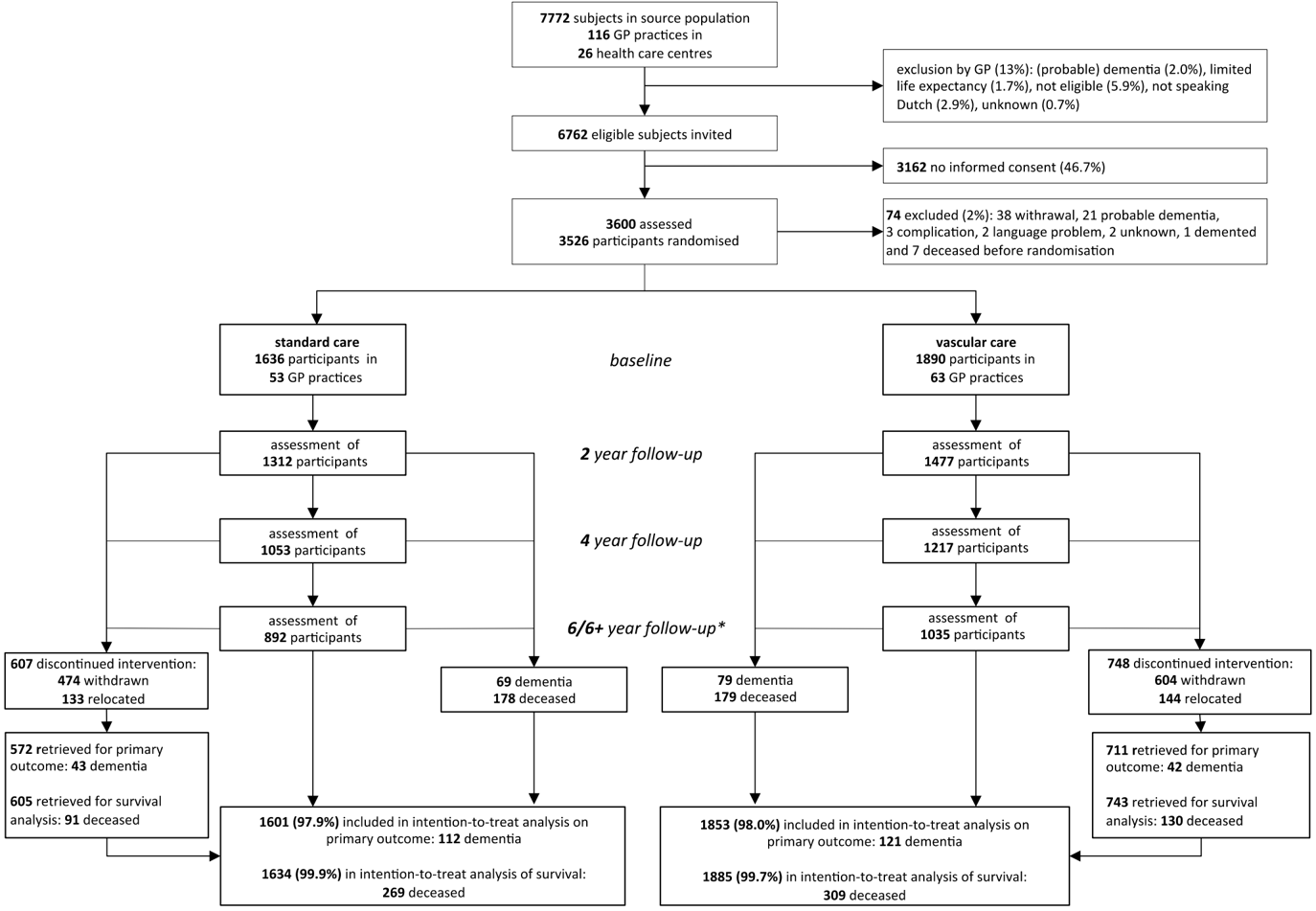
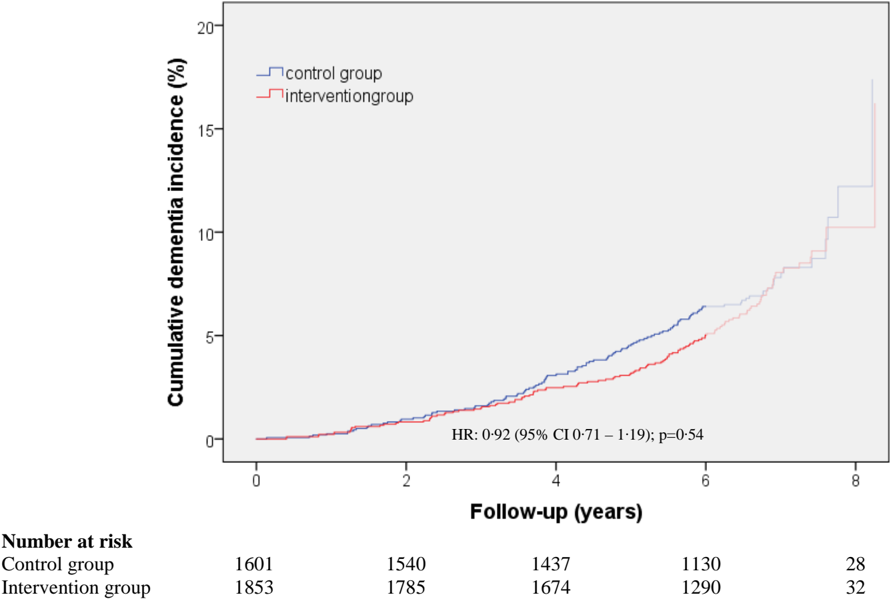
Background Cardiovascular risk factors are associated with an increased risk of dementia. We assessed whether a multidomain intervention targeting these factors can prevent dementia in a population of community-dwelling older people.Methods In this open-label, cluster-randomised controlled trial, we recruited individuals aged 70-78 years through participating general practices in the Netherlands. General practices within each health-care centre were randomly assigned (1:1), via a computer-generated randomisation sequence, to either a 6-year nurse-led, multidomain cardiovascular intervention or control (usual care). The primary outcomes were cumulative incidence of dementia and disability score (Academic Medical Center Linear Disability Score [ALDS]) at 6 years of follow-up. The main secondary outcomes were incident cardiovascular disease and mortality. Outcome assessors were masked to group assignment. Analyses included all participants with available outcome data. This trial is registered with ISRCTN, number ISRCTN29711771.Findings Between June 7, 2006, and March 12, 2009, 116 general practices (3526 participants) within 26 health-care centres were recruited and randomly assigned: 63 (1890 participants) were assigned to the intervention group and 53 (1636 participants) to the control group. Primary outcome data were obtained for 3454 (98%) participants; median follow-up was 6·7 years (21 341 person-years). Dementia developed in 121 (7%) of 1853 participants in the intervention group and in 112 (7%) of 1601 participants in the control group (hazard ratio [HR] 0·92, 95% CI 0·71-1·19; p=0·54). Mean ALDS scores measured during follow-up did not differ between groups (85·7 [SD 6·8] in the intervention group and 85·7 [7·1] in the control group; adjusted mean difference -0·02, 95% CI -0·38 to 0·42; p=0·93). 309 (16%) of 1885 participants died in the intervention group, compared with 269 (16%) of 1634 participants in the control group (HR 0·98, 95% CI 0·80-1·18; p=0·81). Incident cardiovascular disease did not differ between groups (273 [19%] of 1469 participants in the intervention group and 228 [17%] of 1307 participants in the control group; HR 1·06, 95% CI 0·86-1·31; p=0·57).Interpretation A nurse-led, multidomain intervention did not result in a reduced incidence of all-cause dementia in an unselected population of older people. This absence of effect might have been caused by modest baseline cardiovascular risks and high standards of usual care. Future studies should assess the efficacy of such interventions in selected populations.Funding Dutch Ministry of Health, Welfare and Sport; Dutch Innovation Fund of Collaborative Health Insurances; and Netherlands Organisation for Health Research and Development.
Overview
The claims and statistics of this paper haven’t been checked yet.
Free: it reads the open-access text and checks the first 5 claims that cite a source we can check. Create a free account to check every claim.
Integrity signals
Registry
Cites
Statistics
Figures
Verification
Claims the paper makes
The claims and statistics of this paper haven’t been checked yet.
Free: it reads the open-access text and checks the first 5 claims that cite a source we can check. Create a free account to check every claim.
Claims other papers make about this one
Each is checked against this paper’s own text: does it say what the citing paper says it does?
The source backs part of the claim, not all of it — or backs it for a different population, condition or comparison.
In the citing paper
“but the effect on dementia incidence had wide confidence intervals (2 RCTs; n = 7256, follow-up 6 to 13 years RR 0.94, 0.76 -1.18). (263, 264)”
From Dementia prevention, intervention, and care: 2024 report of the Lancet standing Commission (2024) · cites this paper as [264]
Experimental — accuracy not yet measuredThe source backs part of the claim, not all of it — or backs it for a different population, condition or comparison.
In the citing paper
“Sub‐analyses of these trials, however, revealed that there was benefit in people with increased risk of dementia.”
From Mental health care for older adults: recent advances and new directions in clinical practice and research (2022) · cites this paper as [107]
Experimental — accuracy not yet measuredThe cited source says what the claim attributes to it.
In the citing paper
“While two multidomain studies did not find clear cognitive benefits, 139,140 the Finnish Geriatric Intervention Study to Prevent Cognitive Impairment and Disability”
From 2023 Alzheimer's disease facts and figures (2023) · cites this paper as [139]
The cited source says what the claim attributes to it.
In the citing paper
“Two previous large RCTs that aimed at dementia risk reduction and ran via primary care, found no positive effects of the tested lifestyle intervention on their primary outcomes (dementia incidence, disability, and cognitive performance) [41, 42].”
From Multidomain Dementia Risk Reduction in Primary Care is Feasible: A Proof-of-concept study (2024) · cites this paper as [41]
In the citing paper
“On the other hand, several trials have had neutral results for maintenance of cognition155,157 (Table 2).”
From Defining Optimal Brain Health in Adults: A Presidential Advisory From the American Heart Association/American Stroke Association (2017) · cites this paper as [155]
1 more claim about this paper
Create a free account to see every claim other papers make about this one.
Self-check
Percentages, sums and reported differences re-computed from the paper’s own numbers.
The self-check needs the paper’s full text.
Citations
Cites
Diagnostic and Statistical Manual of Mental Disorders
Williams, J. B. W., & First, M. (2013) · Encyclopedia of Social Work · doi:10.1093/acrefore/9780199975839.013.104 · Cited by 109,519
A Randomized Trial of Intensive versus Standard Blood-Pressure Control
The SPRINT Research Group (2015) · New England Journal of Medicine · doi:10.1056/nejmoa1511939 · Cited by 6,325
The global prevalence of dementia: a systematic review and metaanalysis.
Prince, M., Bryce, R., Albanese, E., Wimo, A., Ribeiro, W., & Ferri, C. P. (2013) · Alzheimer's & Dementia · doi:10.1016/j.jalz.2012.11.007 · Cited by 4,941
Ngandu, T., Lehtisalo, J., Solomon, A., Levälahti, E., Ahtiluoto, S., Antikainen, R., Bäckman, L., Hänninen, T., Jula, A., Laatikainen, T., et al. (2015) · The Lancet · doi:10.1016/s0140-6736(15)60461-5 · Cited by 3,689
Treatment of hypertension in patients 80 years of age or older
Beckett, N. S., Peters, R., Fletcher, A. E., Staessen, J. A., Liu, L., Dumitrascu, D., Stoyanovsky, V., Antikainen, R. L., Nikitin, Y., Anderson, C., et al. (2008) · New England Journal of Medicine · doi:10.1056/nejmoa0801369 · Cited by 3,092
Potential for primary prevention of Alzheimer's disease: an analysis of population-based data
Norton, S., Matthews, F. E., Barnes, D. E., Yaffe, K., & Brayne, C. (2014) · The Lancet Neurology · doi:10.1016/s1474-4422(14)70136-x · Cited by 2,466
Forette, F., Seux, M.-L., Staessen, J. A., Thijs, L., Birkenhäger, W. H., Babarskiene, M.-R., Babeanu, S., Bossini, A., Gil-Extremera, B., Girerd, X., et al. (1998) · The Lancet · doi:10.1016/s0140-6736(98)03086-4 · Cited by 1,441
Incidence of dementia over three decades in the Framingham heart study
Satizabal, C. L., Beiser, A. S., Chouraki, V., Chêne, G., Dufouil, C., & Seshadri, S. (2016) · New England Journal of Medicine · doi:10.1056/nejmoa1504327 · Cited by 1,051
Peters, R., Beckett, N., Forette, F., Tuomilehto, J., Clarke, R., Ritchie, C., Waldman, A., Walton, I., Poulter, R., Ma, S., et al. (2008) · The Lancet Neurology · doi:10.1016/s1474-4422(08)70143-1 · Cited by 770
Daviglus, M. L., Bell, C. C., Berrettini, W., Bowen, P. E., Connolly, E. S., Cox, N. J., Dunbar-Jacob, J. M., Granieri, E. C., Hunt, G., McGarry, K., et al. (2010) · Annals of Internal Medicine · doi:10.7326/0003-4819-153-3-201008030-00260 · Cited by 463
Research works printed but not linked: 2
- 2012, Guideline on cardiovascular risk management (first revision), Huisarts Wet, 55, 14
- 27. Organization WH. Global recommendations on physical activity for health. Chapter 4.4 Age group: 65 years and above. World Health Organization 2015: 29-32 (ISBN 978 92 4 159 997
Cited by
Items 201–300 of 698
Infectious Disease Burden and the Risk of Alzheimer’s Disease: A Population-Based Study
Douros, A., Santella, C., Dell’Aniello, S., Azoulay, L., Renoux, C., Suissa, S., & Brassard, P. (2021) · Journal of Alzheimer's Disease · doi:10.3233/jad-201534 · Cited by 37
“However, randomizedcontrolledtrialsstudyingtheeffectsof multimodalinterventionstargetingseveralofthese riskfactorsshowedlittle[3]ornoefficacy[4,5].”
Moon, S. Y., Park, Y. K., Jeong, J. H., Hong, C. H., Jung, J., Na, H. R., Cho, S. H., Kim, H. S., Song, H., Choi, M., et al. (2025) · Alzheimer s & Dementia · doi:10.1002/alz.14517 · Cited by 37
“13,14 Additionally,the SoUth Korean study to PrEvent cognitive impaiRment and protect BRAIN health through lifestyle intervention in at-risk elderly people (SUPER-BRAIN)trialdemonstratedthatadaptingthemultidomainintervention (MI) outlined in the FINGER study to fit the cultural and circumstantial…”
Anstey, K. J., Peters, R., Clare, L., Lautenschlager, N. T., Dodge, H. H., Barnes, D. E., Shahar, S., Brodaty, H., & Rees, G. (2017) · International Psychogeriatrics · doi:10.1017/s1041610217001685 · Cited by 36
“However, despite subgroup analyses indicating positive future directions for further research, the overall results for other such trials have been disappointing, (Moll van Charante et al ., 2016; Andrieu et al ., 2017).”
Gupta, A., Prakash, N. B., & Sannyasi, G. (2021) · Indian Journal of Psychological Medicine · doi:10.1177/02537176211033316 · Cited by 36
van Wanrooij, L. L., Borsboom, D., van Charante, E. P. M., Richard, E., & van Gool, W. A. (2019) · International Psychogeriatrics · doi:10.1017/s1041610218002387 · Cited by 37
Self-citationvan Bussel, E. F., Richard, E., Busschers, W. B., Steyerberg, E. W., van Gool, W. A., van Charante, E. P. M., & Hoevenaar‐Blom, M. P. (2019) · Journal of Clinical Hypertension · doi:10.1111/jch.13617 · Cited by 36
Self-citationSon, S., Speechley, M. R., Zou, G., Kivipelto, M., Mangialasche, F., Feldman, H., Chertkow, H. M., Belleville, S., Nygaard, H. A., Hachinski, V., et al. (2024) · The Journal of Prevention of Alzheimer s Disease · doi:10.14283/jpad.2024.105 · Cited by 36
“.”
McEvoy, C. T., Leng, Y., Peeters, G. M. E. E., Kaup, A. R., Allen, I. E., & Yaffe, K. S. (2019) · Nutrition Research · doi:10.1016/j.nutres.2019.02.008 · Cited by 35
“The PreDIVA trial [16] involving 3,526 older adults, assessed the effectiveness of a multi-domain intervention to optimize diet, physical activity, smoking, weight and blood pressure, compared to usual primary care, on dementia incidence.”
BackgroundMethodInfluentialBeyond the amyloid cascade: An update of Alzheimer's disease pathophysiology
Gouilly, D., Rafiq, M., Nogueira, L., Salabert, A., Payoux, P., Péran, P., & Pariente, J. (2023) · Revue Neurologique · doi:10.1016/j.neurol.2022.12.006 · Cited by 35
Age at cardiovascular disease onset, dementia risk, and the role of lifestyle factors
van Gennip, A. C. E., van Sloten, T. T., Fayossé, A., Sabia, S., & Singh‐Manoux, A. (2023) · Alzheimer s & Dementia · doi:10.1002/alz.13562 · Cited by 34
“To address the burden of old-age dementia due to increases in life expectancy, our findings high-light the importance of prevention of early-onset CVD, and lifestyle modification as a secondary prevention mechanism in those with CVD.”
BackgroundUdeh‐Momoh, C. T., Maina, R., Anazodo, U., Akinyemi, R., Atwoli, L., Baker, L. D., Bassil, D. T., Blackmon, K., Bosire, E. N., Chemutai, G., et al. (2024) · Alzheimer s & Dementia · doi:10.1002/alz.14344 · Cited by 35
Smith, P. J., Mabe, S., Sherwood, A., Doraiswamy, P. M., Welsh-Bohmer, K. A., Burke, J. R., Kraus, W. E., Lin, P., Browndyke, J. N., Babyak, M. A., et al. (2020) · Journal of Alzheimer s Disease · doi:10.3233/jad-200374 · Cited by 33
Lee, S., Harada, K., Bae, S., Harada, K., Makino, K., Anan, Y., Suzuki, T., & Shimada, H. (2023) · Frontiers in Aging Neuroscience · doi:10.3389/fnagi.2023.1005410 · Cited by 33
Can lifestyle changes prevent cognitive impairment?
Kivipelto, M., Mangialasche, F., & Ngandu, T. (2017) · The Lancet Neurology · doi:10.1016/s1474-4422(17)30080-7 · Cited by 32
Cognitive decline and dementia in women after menopause: Prevention strategies
Stefanowski, B., Kucharski, M., Szeliga, A., Snopek, M., Kostrzak, A., Smolarczyk, R., Maciejewska-Jeske, M., Duszewska, A. M., Niwczyk, O., Drozd, S., et al. (2022) · Maturitas · doi:10.1016/j.maturitas.2022.10.012 · Cited by 32
Xiong, S., Hou, N., Tang, F., Li, J., & Deng, H. (2023) · Diabetology & Metabolic Syndrome · doi:10.1186/s13098-023-01186-8 · Cited by 32
“Several trials have also shown benefits of multidomain life-style interventions on improving cognitive function in older people with an elevated risk of dementia [31–33].”
BackgroundContador, I., Buch-Vicente, B., del Ser, T., Velasco, S. L., Villarejo‐Galende, A., Benito‐León, J., & Bermejo‐Pareja, F. (2024) · Journal of Clinical Medicine · doi:10.3390/jcm13144100 · Cited by 32
“Other similar studies, such as the French MAPT trial [284] and the Dutch PreDIVA trial [285], designed with the same objectives, could not achieve similar cognitive results.”
ResultCurrent and Future Treatments of Vascular Cognitive Impairment
Ip, B. Y. M., Ko, H., Lam, B. Y. K., Au, L. W. C., Lau, A. Y. L., Huang, J., Kwok, A. J., Leng, X., Cai, Y., Leung, T. W. H., et al. (2024) · Stroke · doi:10.1161/strokeaha.123.044174 · Cited by 32
The Current Landscape of Prevention Trials in Dementia
Lee, J., Howard, R. S., & Schneider, L. S. (2022) · Neurotherapeutics · doi:10.1007/s13311-022-01236-5 · Cited by 33
Hoevenaar-Blom, M. P., Richard, E., Moll van Charante, E. P., van Wanrooij, L. L., Busschers, W. B., van Dalen, J. W., & van Gool, W. A. (2021) · JAMA Neurology · doi:10.1001/jamaneurol.2021.3542 · Cited by 30
Self-citationAkenine, U., Barbera, M., Beishuizen, C. R. L., Pour, M. F., Guillemont, J., Rosenberg, A., Coley, N., Mangialasche, F., Salo, L., Savy, S., et al. (2020) · BMJ Open · doi:10.1136/bmjopen-2020-037050 · Cited by 30
Self-citationSindi, S., Thunborg, C., Rosenberg, A., Andersen, P., Andrieu, S., Broersen, L. M., Coley, N., Couderc, C., Duval, C. Z., Irving, G. F., et al. (2022) · The Journal of Prevention of Alzheimer s Disease · doi:10.14283/jpad.2022.4 · Cited by 30
Lee, E. H., Kim, G. H., Park, H. K., Kang, H. J., Park, Y. K., Lee, H. A., Hong, C. H., Moon, S. Y., Kang, W., Oh, H., et al. (2023) · Frontiers in Aging Neuroscience · doi:10.3389/fnagi.2023.1266955 · Cited by 30
van Middelaar, T., Hoevenaar‐Blom, M. P., van Gool, W. A., van Charante, E. P. M., van Dalen, J. W., Deckers, K., Köhler, S., & Richard, E. (2018) · Alzheimer s Research & Therapy · doi:10.1186/s13195-018-0389-4 · Cited by 30
Self-citationN-of-1 Clinical Trials in Nutritional Interventions Directed at Improving Cognitive Function
Soldevila‐Domenech, N., Boronat, A., Langohr, K., & de la Torre, R. (2019) · Frontiers in Nutrition · doi:10.3389/fnut.2019.00110 · Cited by 30
Dawson, J., Broomfield, N. M., Dani, K., Dickie, D. A., Doney, A. S. F., Forbes, K. P. N., Houston, J. G., Kean, S., Lees, K. R., McConnachie, A., et al. (2018) · European Stroke Journal · doi:10.1177/2396987318771426 · Cited by 29
“These treatments reduce, but do not eliminate, risk of recurrent stroke and other vascular events and the effect of these treatments on cognitive decline is unclear.(4,5) Since white matter hyperintensities (WMHs) on brain magnetic resonance imaging (MRI) are associated with higher risk of recurrent stroke and cogniti…”
BackgroundMaintaining brain health across the lifespan
García‐García, I., Donica, O., Cohen, A. A., Gonseth, S., Heini, A. F., Nusslé, S. C., Pichard, C., Rietschel, E., Tanačković, G., Folli, S., et al. (2023) · Neuroscience & Biobehavioral Reviews · doi:10.1016/j.neubiorev.2023.105365 · Cited by 28
Liu, W., Qin, R., Zhang, X., Li, G., Qiu, Y., Zhang, G., & Chen, L. (2024) · Journal of Clinical Nursing · doi:10.1111/jocn.17432 · Cited by 29
Daly, T. P. (2023) · Cerebral Circulation - Cognition and Behavior · doi:10.1016/j.cccb.2023.100193 · Cited by 28
“…with omega-3 supplementation and lifestyle intervention and the Dutch “ Prevention of dementia by intensive vascular care ” (PreDIVA) studies did not find significant beneficial effects on cognition of these interventions in populations of similar ages in these different European countries [24,25].”
BackgroundChaaya, M., Phung, T. K. T., Atweh, S., Asmar, K. E., Karam, G., Khoury, R. M., Ghandour, L. A., Ghusn, H., Assaad, S., Prince, M. J., et al. (2017) · Preventive Medicine Reports · doi:10.1016/j.pmedr.2017.11.006 · Cited by 28
“…while adjusting for other socio-economic and CVDRF. Additional evidence from the preDIVA RCT, a 6-year multi-domain vascular care intervention, further emphasized the role of treating high blood pressure among the uncontrolled group in reducing the risk of dementia (Moll van Charante et al., 2016).”
BackgroundUncertainty and health literacy in dementia care
Lo, R. Y. (2019) · Tzu Chi Medical Journal · doi:10.4103/tcmj.tcmj_116_19 · Cited by 30
“However, the final results of multidomain interventional studies are not satisfactory [16,17].”
BackgroundLundin, S. K., Hu, X., Feng, J., Lundin, K. K., Li, L., Chen, Y., Schulz, P. E., & Tao, C. (2024) · EBioMedicine · doi:10.1016/j.ebiom.2024.105378 · Cited by 27
Soldevila‐Domenech, N., Ayala‐García, A., Barbera, M., Lehtisalo, J., Forcano, L., Diaz-Ponce, A. M., Zwan, M. D., van der Flier, W. M., Ngandu, T., Kivipelto, M., et al. (2025) · Alzheimer s Research & Therapy · doi:10.1186/s13195-025-01691-0 · Cited by 27
“…efficacy gathered from prior single-domain or multimodal interventions, considering the necessity for sufficient intensity (as general lifestyle recommendations alone may not be enough to influence cognitive change) [61], while also ensuring that participant motivation is sustained in the long-run.”
Park, J. E., Jeon, S. Y., Kim, S. A., Kim, J. H., Kim, S. H., Lee, K., Hwang, Y. J., Jung, G., Suk, H. W., Park, S., et al. (2019) · Journal of Alzheimer s Disease · doi:10.3233/jad-190016 · Cited by 27
“…cognitive function following a 2-year multidomain intervention [6], whereas the intermediate-intensity French Multido-main Alzheimer Preventive Trial (MAPT) and the lower-intensity Dutch Prevention of Dementia by Intensive Vascular Care (PreDIVA) identified negative cognitive outcomes [7, 8].”
InfluentialMamalaki, E., Charisis, S., Anastasiou, C. A., Ntanasi, E., Georgiadi, K., Balomenos, V., Kosmidis, M. H., Dardiotis, E., Hadjigeorgiou, G. M., Sakka, P., et al. (2022) · Nutrients · doi:10.3390/nu14142818 · Cited by 27
Röhr, S., Pabst, A., Baber, R., Engel, C., Glaesmer, H., Hinz, A., Schroeter, M. L., Witte, A. V., Zeynalova, S., Villringer, A., et al. (2022) · Journal of Alzheimer s Disease · doi:10.3233/jad-220474 · Cited by 27
Educational Attainment and Dementia: Mediation by Mid‐Life Vascular Risk Factors
Liu, C., Ma, Y., Hofman, A., Waziry, R., Koton, S., Pike, J. R., Windham, B. G., Power, M. C., Sharrett, A. R., & Gottesman, R. F. (2023) · Annals of Neurology · doi:10.1002/ana.26647 · Cited by 27
“The 2-year FINGER trial(35) found that the intervention was beneficial across demographic groups, while the 6-year preDIVA trial and the 3-year MAPT trials found no benefit.(36,37) While some evidence from the observational literature(38) has suggested that targeting those with low socioeconomic status for dementia pr…”
BackgroundTainta, M., Ecay‐Torres, M., de Arriba, M., Barandiarán, M., Otaegui-Arrazola, A., Iriondo, A., García‐Sebastián, M., Estanga, A., Saldias, J., Clerigué, M., et al. (2024) · Alzheimer s Research & Therapy · doi:10.1186/s13195-024-01393-z · Cited by 27
“…Alzheimer Preventive Trial - MAPT, and the Dutch Prevention of Dementia by Intensive Vascular care - PreDIVA) have confirmed that interventions on risk and protective factors represent a window of opportunity for dementia prevention in participants with increased risk and frailty [13–15].”
BackgroundKim, Y., Kang, Y., Kim, B. R., Kim, J., & Kim, G. H. (2024) · Behaviour and Information Technology · doi:10.1080/0144929x.2024.2362406 · Cited by 27
Prevention of cognitive decline in old age—varying effects of interventions in different populations
Qiu, C., Johansson, G., Zhu, F., Kivipelto, M., & Winblad, B. G. (2019) · Annals of Translational Medicine · doi:10.21037/atm.2019.06.19 · Cited by 27
“Netherlands (27) N=3,526; age 70–78; general”
BackgroundTeuschl, Y., Ihle‐Hansen, H., Matz, K., Dachenhausen, A., Ratajczak, P., Tuomilehto, J., Ursin, M. H., Hagberg, G., Thommessen, B., Øksengård, A. R., et al. (2018) · European Journal of Neurology · doi:10.1111/ene.13684 · Cited by 26
“However, a nurse-led vascular multidomain intervention in elderly people did not find any effect on cognition after 6 years [9].”
Background“Exceptional brain aging” without Alzheimer’s disease: triggers, accelerators, and the net sum game
Vemuri, P. (2018) · Alzheimer s Research & Therapy · doi:10.1186/s13195-018-0373-z · Cited by 26
“However, the results from intervention studies based on a reduction of vascular risk factors [34] highlights the need for longitudinal biomarker studies in midlife that focus on understanding the mechanisms of action of the suggested risk factors as early ADP changes evolve.”
BackgroundBreeze, P. R., Thomas, C., Thokala, P., Lafortune, L., Brayne, C., & Brennan, A. (2020) · Medical Decision Making · doi:10.1177/0272989x20946758 · Cited by 26
“indicate that lifestyle interventions can have small beneficial effects.(6,7) Diabetes prevention programs (DPPs) are effective in reducing the incidence of diabetes and lowering the risk of cardiovascular diseases.”
BackgroundResultNeuvonen, E., Lehtisalo, J., Solomon, A., Antikaínen, R., Havulinna, S., Hänninen, T., Laatikainen, T. K., Lindström, J., Rautio, N., Soininen, H. S., et al. (2022) · Aging Clinical and Experimental Research · doi:10.1007/s40520-022-02088-x · Cited by 26
“Other large, but less intensive lifestyle-based trials have not confirmed these findings [20, 21], suggesting that adherence to intervention activities and lifestyle changes may play a crucial role in the success of lifestyle interventions [5].”
BackgroundLiu, X., Ma, Z., Zhu, X., Zheng, Z., Li, J., Fu, J., Shao, Q., Han, X., Wang, X., Wang, Z., et al. (2022) · American Journal of Geriatric Psychiatry · doi:10.1016/j.jagp.2022.10.006 · Cited by 26
Zeng, Z., Fauvel, S., Tan, B. T. H., Wang, D., Qiu, Y., Chew, P., Leung, C., Shen, Z., & Chin, J. J. (2018) · International Conference on Crowd Science and Engineering (ICCSE) · doi:10.1145/3265689.3265719 · Cited by 26
“about 38% in a 6-year Dutch trial for preventing dementia [42].”
BackgroundPonvel, P., Shahar, S., Singh, D. K. A., Ludin, A. F. M., Subramaniam, P., Ibrahim, N., Haron, H., Ismail, A., Ai-Vyrn, C., Mohamad, M., et al. (2025) · Alzheimer s Research & Therapy · doi:10.1186/s13195-025-01722-w · Cited by 25
Handels, R. L. H., & Wimo, A. B. (2017) · Aging & Mental Health · doi:10.1080/13607863.2017.1390730 · Cited by 25
“The latter has been evaluated by various trials (Ngandu et al., 2015; Richard et al., 2016; van Charante et al., 2016; Vellas et al., 2014) on the primary prevention of dementia before the first dementia-related symptoms occur.”
BackgroundKim, S., McMaster, M., Torres, S. J., Cox, K. L., Lautenschlager, N. T., Rebok, G. W., Pond, D. C., D’Este, C. A., McRae, I., Cherbuin, N., et al. (2018) · BMJ Open · doi:10.1136/bmjopen-2017-019329 · Cited by 25
Hooper, C., Coley, N., Barreto, P. D. S., Payoux, P., Salabert, A., Andrieu, S., Weiner, M. W., & Vellas, B. J. (2020) · The Journal of Prevention of Alzheimer s Disease · doi:10.14283/jpad.2020.4 · Cited by 27
“2 Using similar multidomain lifestyle interventions to those used in MAPT (nutritional and exercise counselling and cognitive training), other trials have explored the effects of multidomain interventions targeting a healthier lifestyle on cognitive function in older adults (23-26).”
Methodvan Dalen, J. W., Mutsaerts, H. J. M. M., Petr, J., Caan, M. W. A., van Charante, E. P. M., MacIntosh, B. J., van Gool, W. A., Nederveen, A. J., & Richard, E. (2020) · Journal of Cerebral Blood Flow & Metabolism · doi:10.1177/0271678x20966975 · Cited by 25
“Visit BP was operationalized as the mean of two measurements taken using an automated BP monitor (M6 OMRON Healthcare, Kyoto, Japan) in sitting position, according to a standard protocol.(10) MRI scan 1 took place after the preDIVA two-year assessment (17 June 2011 to 20 July 2011), scan 2 around the time of final pre…”
BackgroundMethodSelf-citationMcGrattan, A., van Aller, C., Narytnyk, A., Reidpath, D. D., Keage, H. A. D., Mohan, D., Su, T. T., Stephan, B. C. M., Robinson, L. A., & Siervo, M. (2020) · Critical Reviews in Food Science and Nutrition · doi:10.1080/10408398.2020.1848785 · Cited by 25
“…three multidomain lifestyle-based prevention trials have been completed: the FINGER trial (Ngandu et al. 2015), the French Multidomain Alzheimer Preventive Trial (MAPT) (Andrieu et al. 2017), and the Dutch Prevention of Dementia by Intensive Vascular Care (PreDIVA) (Moll van Charante et al. 2016).”
BackgroundLotan, R., Ganmore, I., Livny, A., Itzhaki, N., Waserman, M., Shelly, S., Zacharia, M., Moshier, E. L., Uribarri, J., Beisswenger, P. J., et al. (2021) · Journal of Alzheimer s Disease · doi:10.3233/jad-210131 · Cited by 25
“…the intervention similarly to other lifestyle modifications trials such as the FINGER trial that intervened for 2 years [40], the pre-DIVA [41] that intervened for 6 years, and the MIND trial that is still ongoing, and has an intervention of 3 years (clinicalTrial.gov…”
Alzheimer's disease and other dementias: update on research
Schneider, L. S. (2016) · The Lancet Neurology · doi:10.1016/s1474-4422(16)30356-8 · Cited by 25
Jennings, A., Shannon, O. M., Gillings, R., Lee, V., Elsworthy, R. J., Bundy, R., Rao, G., Hanson, S., Hardeman, W., Paddick, S., et al. (2024) · BMC Medicine · doi:10.1186/s12916-024-03815-z · Cited by 24
Lee, W., Peng, L., Lin, M.-H., Lin, C., & Chen, L. (2022) · The journal of nutrition health & aging · doi:10.1007/s12603-022-1843-3 · Cited by 24
“The TIGER study strengthened the intervention effects through empowering the participants with the intrinsic motivation strategies by electing group leaders to enhance the participation in activities, completion of home-based activities, and maintaining healthy lifestyle (26, 30).”
BackgroundLazar, E. B., Sherzai, A. Z., Adeghate, J. O., & Sherzai, D. (2021) · Frontiers in Bioscience-Scholar · doi:10.52586/s550 · Cited by 24
on the behalf of Strokavenir network, Mendyk, A., Duhamel, A., Béjot, Y., Leys, D., Derex, L., Dereeper, O., Detante, O., Garcia, P., Godefroy, O., et al. (2018) · Trials · doi:10.1186/s13063-018-2483-0 · Cited by 24
Mechanisms of interventions targeting modifiable factors for dementia risk reduction
Matton, A., Stephen, R., Daniilidou, M., Barbera, M., Alanko, V., Ballin, M., Ford, J. K., Hemiö, K., Lehtisalo, J., Rocha, S. L., et al. (2025) · Molecular Neurodegeneration · doi:10.1186/s13024-025-00845-w · Cited by 25
A new Graph Gaussian embedding method for analyzing the effects of cognitive training
Xu, M., Wang, Z., Zhang, H., Pantazis, D., Wang, H., & Li, Q. (2020) · PLoS Computational Biology · doi:10.1371/journal.pcbi.1008186 · Cited by 23
“, the Finnish Geriatric Intervention Study to Prevent Cognitive Impairment and Disability (FINGER) [6], the French Multidomain Alzheimer Preventive Trial (MAPT) [7], the Dutch Prevention of Dementia by Intensive Vascular Care (Pre-DIVA) [8], the Drug and Alcohol Intervention Service for Youth (DAISY) [9], etc.”
BackgroundShannon, O. M., Lee, V. Y., Bundy, R., Gillings, R., Jennings, A., Stephan, B. C. M., Hornberger, M., Balanos, G. M., Paddick, S., Hanson, S., et al. (2021) · BMJ Open · doi:10.1136/bmjopen-2020-042823 · Cited by 24
Chew, K. A., Xu, X., Siongco, P., Villaraza, S. G., Phua, A. K. S., Wong, Z. X., Chung, C. Y., Tang, N., Chew, E., Henry, C. J., et al. (2021) · Alzheimer s & Dementia Translational Research & Clinical Interventions · doi:10.1002/trc2.12141 · Cited by 24
Moon, S. Y., Kim, S., Choi, S. H., Hong, C. H., Park, Y. K., Na, H. R., Song, H., Park, H. K., Choi, M., Lee, S. M., et al. (2022) · Neurotherapeutics · doi:10.1007/s13311-022-01276-x · Cited by 23
“Although the French Multidomain Alzheimer Preventive Trial (MAPT) [5] and the Dutch Prevention of Dementia by Intensive Vascular Care (PreDIVA) trial [6] reported a lack of effect on the primary outcomes, exploratory subgroup analyses in both studies have provided evidence that interventions yielded cognitive benefits…”
ResultImproving risk indexes for Alzheimer’s disease and related dementias for use in midlife
Reuben, A., Moffitt, T. E., Abraham, W. C., Ambler, A. P., Elliott, M. L., Hariri, A. R., Harrington, H., Hogan, S., Houts, R., Ireland, D. R., et al. (2022) · Brain Communications · doi:10.1093/braincomms/fcac223 · Cited by 23
Sá, C. A. D., Saretto, C. B., Cardoso, A. M., Remor, A. P., Breda, C. O., & Corralo, V. D. S. (2023) · Molecular and Cellular Biochemistry · doi:10.1007/s11010-023-04733-z · Cited by 23
“Van Charante et al. [35] assessed the impact of a multi-domain intervention based on guidelines for lifestyle change, correct medication intake, blood pressure control, and nutritional care on dementia prevention.”
Association of a healthy lifestyle with mortality in older people
Robb, C. E., Carr, P. R., Ball, J., Owen, A. J., Beilin, L. J., Newman, A. B., Nelson, M. R., Reid, C. M., Orchard, S. G., Neumann, F., et al. (2023) · BMC Geriatrics · doi:10.1186/s12877-023-04247-9 · Cited by 23
Ng, P. E. M., Nicholas, S. O., Wee, S. L., Yau, T. Y., Chan, A., Chng, I., Yap, L. K. P., & Ng, T. P. (2021) · Scientific Reports · doi:10.1038/s41598-021-83408-5 · Cited by 24
Alanko, V., Udeh‐Momoh, C. T., Kivipelto, M., & Matton, A. (2022) · The Journal of Prevention of Alzheimer s Disease · doi:10.14283/jpad.2022.9 · Cited by 23
Akushevich, I. V., Kolpakov, S. A., Yashkin, A. P., & Kravchenko, J. S. (2022) · American Journal of Hypertension · doi:10.1093/ajh/hpac063 · Cited by 23
Sha, F., Zhao, Z.-Y., Wei, C., Yang, Z., & Li, B. (2022) · Journal of Alzheimer s Disease · doi:10.3233/jad-215677 · Cited by 22
“Three previous randomized controlled trials, respectively FINGER [11], MAPT [12], and Pre-DIVA [13], were conducted to prevent dementia through lifestyle interventions, and only FINGER found positive effects.”
AI-Based Predictive Modelling of the Onset and Progression of Dementia
Hanke, S., Mangialasche, F., Bödenler, M., Neumayer, B., Ngandu, T., Mecocci, P., Untersteiner, H., & Stögmann, E. (2022) · Smart Cities · doi:10.3390/smartcities5020036 · Cited by 22
Low Values for Blood Pressure, BMI, and Non-HDL Cholesterol and the Risk of Late-Life Dementia
den Brok, M. G. H. E., Eggink, E., Hoevenaar‐Blom, M. P., van Gool, W. A., van Charante, E. P. M., Richard, E., & van Dalen, J. W. (2022) · Neurology · doi:10.1212/wnl.0000000000200954 · Cited by 22
“DEMENTIA DIAGNOSIS The adjudication process for the outcome dementia has previously been described in detail.(18) In short, a clinical dementia diagnosis was evaluated by an independent outcome adjudication committee, according to the Diagnostic and Statistical Manual of Mental Disorders IV (DSM-IV).”
MethodSelf-citationSimulating the multicausality of Alzheimer's disease with system dynamics
Uleman, J. F., Melis, R. J. F., Ntanasi, E., Scarmeas, N., Hoekstra, A. G., Quax, R., Rikkert, M. G. M. O., & Initiative, T. A. D. N. (2023) · Alzheimer s & Dementia · doi:10.1002/alz.12923 · Cited by 22
“Healthy dietary patterns** Mediterranean diet score (1-55) 34.”
Peng, T., Chiou, J., Chen, Y., & Chen, J. (2024) · The journal of nutrition health & aging · doi:10.1016/j.jnha.2023.100004 · Cited by 22
Tsukakoshi, D., Yamamoto, S., Takeda, S., Furuhashi, K., & Sato, M. (2022) · Therapeutics and Clinical Risk Management · doi:10.2147/tcrm.s350748 · Cited by 22
Noach, S. D., Witteman, B. J. M., Boss, H. M., & Janse, A. (2023) · Cerebral Circulation - Cognition and Behavior · doi:10.1016/j.cccb.2023.100166 · Cited by 21
“As a result, the differences between the intervention group and the control group were quite small in terms of management of cardiovascular risk factors, meaning the impact of the intervention could have been too low to affect lifestyle change [36].”
BackgroundMethodResultInfluentialMcEwen, S. C., Merrill, D. A., Bramen, J. E., Porter, V. R., Panos, S. E., Kaiser, S. A., Hodes, J. F., Ganapathi, A. S., Bell, L., Bookheimer, T., et al. (2021) · Alzheimer s & Dementia Translational Research & Clinical Interventions · doi:10.1002/trc2.12191 · Cited by 21
Coon, D. W., & Gómez‐Morales, A. (2022) · Clinical Gerontologist · doi:10.1080/07317115.2022.2114396 · Cited by 21
“…in two other large European RCTs (i.e., MPAT and PreDIVA) lacked effects on primary outcomes; however, additional analyses of these studies revealed cognitive benefits among participants at increased risk of dementia (Andrieu et al., 2017; Chhertri, et al., 2018; Moll van Charante et al., 2016).”
ResultFeng, X.-W., Hadizadeh, M., Zheng, L.-H., & Li, W.-H. (2022) · Journal of Clinical Medicine · doi:10.3390/jcm11195903 · Cited by 22
“To date, Europe has completed three large‐scale multi‐field prevention trials based on lifestyle: the Finnish Geriatric Intervention Study to Prevent Cognitive Impairment and Disability (FINGER) [76], the French Multidomain Alzheimer Preventive Trial (MAPT) [77], and the Dutch Prevention of Dementia by Intensive Vascu…”
MethodPrävention von kognitivem Abbau und Demenz durch Behandlung von Risikofaktoren
Escher, C. M., & Jessen, F. (2019) · Der Nervenarzt · doi:10.1007/s00115-019-0759-6 · Cited by 21
My Healthy Brain: a multimodal lifestyle program to promote brain health
Mace, R. A., Greenberg, J., Stauder, M. J., Reynolds, G., & Vranceanu, A. (2021) · Aging & Mental Health · doi:10.1080/13607863.2021.1904828 · Cited by 21
“…Ngandu et al., 2015; SPRINT MIND Investigators for the SPRINT Research Group et al., 2019) and have small effects that fade over time (Andrieu et al., 2017; Lam, Chan, Leung, Fung, & Leung, 2015; Moll van Charante et al., 2016; SPRINT MIND Investigators for the SPRINT Research Group et al., 2019).”
BackgroundCrivelli, L., Suemoto, C. K., Sosa, A. L., Lopera, F. J., Aguillón, D., Allegri, R., Nitríni, R., Calandri, I. L., Velilla-Jiménez, L. M., Yassuda, M. S., et al. (2026) · The Lancet · doi:10.1016/s0140-6736(26)01278-x · Cited by 23
Zhao, Y., Ou, Y., Ma, Y., Huang, Y., Bi, Y., Tan, L., & Yu, J. (2022) · Alzheimer s Research & Therapy · doi:10.1186/s13195-022-01019-2 · Cited by 20
Lennon, M. J., & Sachdev, P. S. (2026) · Neuropsychopharmacology · doi:10.1038/s41386-026-02331-3 · Cited by 19
Fourteau, M., Giudici, K. V., Rolland, Y., Vellas, B. J., & Barreto, P. D. S. (2020) · Journal of Aging Research and Lifestyle · doi:10.14283/jarlife.2020.6 · Cited by 20
Waterink, L., Bakker, E. D., Visser, L. N. C., Mangialasche, F., Kivipelto, M., Deckers, K., Köhler, S., Sikkes, S. A. M., Prins, N. D., Scheltens, P., et al. (2022) · Frontiers in Psychiatry · doi:10.3389/fpsyt.2022.877460 · Cited by 19
Treacy, C., Levenstein, J. M., Jefferies, A., Metse, A. P., Schaumberg, M. A., Villani, A. M., Bouças, A. P., Hermens, D. F., Lagopoulos, J., & Andrews, S. C. (2023) · Journal of Alzheimer s Disease · doi:10.3233/jad-230193 · Cited by 19
Wuthrich, V. M., Rapee, R. M., Draper, B., Brodaty, H., Low, L., & Naismith, S. L. (2018) · International Psychogeriatrics · doi:10.1017/s1041610218001485 · Cited by 19
“Several studies have examined the impact of reducing vascular risk (e.g. PreDIVA study; Moll van Charante et al., 2016; Richard et al., 2009) or physical inactivity (Sink et al., 2015) in randomized controlled trials (RCT), but these modifications have failed to result in reductions in cognitive…”
BackgroundThe Israel Registry for Alzheimer’s Prevention (IRAP) Study: Design and Baseline Characteristics
Ravona‐Springer, R., Sharvit‐Ginon, I., Ganmore, I., Greenbaum, L., Bendlin, B. B., Sternberg, S. A., Livny, A., Domachevsky, L., Sandler, I., Ben‐Haim, S., et al. (2020) · Journal of Alzheimer s Disease · doi:10.3233/jad-200623 · Cited by 19
Tariq, S., d’Esterre, C. D., Sajobi, T. T., Smith, E. E., Longman, R. S., Frayne, R., Coutts, S. B., Forkert, N. D., & Barber, P. A. (2018) · BMC Geriatrics · doi:10.1186/s12877-018-0858-4 · Cited by 20
“tive training, and vascular risk management as a multi-domain treatment approach improves or maintains cognitive function in at risk elderly when compared to healthy controls [24, 41].”
BackgroundFranchini, F., Musicco, M., Ratto, F., Storti, G., Shofany, J., Caltagirone, C., & Santo, S. G. D. (2019) · Journal of Alzheimer s Disease · doi:10.3233/jad-190495 · Cited by 18
“However, a post-hoc analysis of data from the pre-DIVA trial [68, 69]—a multicenter trial aimed to verifying the effectiveness of a 6-year multidomain vascular care intervention to prevent dementia—LIBRA scores were not useful in identifying high-risk individuals…”
Co‐design of dementia prevention program for Aboriginal Australians (DAMPAA)
Mateo‐Arriero, I., Lalović, A., Dowden, G., Markey, L., Cox, K. L., Flicker, L. A., Bessarab, D. C., Thompson, S., Kickett, C., Woods, D., et al. (2023) · Alzheimer s & Dementia · doi:10.1002/alz.13032 · Cited by 18
Yang, Z., Lange, F., Xia, Y., Chertavian, C., Cabolis, K., Sajic, M., Werring, D. J., Tachtsidis, I., & Smith, K. J. (2024) · Stroke · doi:10.1161/strokeaha.124.047154 · Cited by 18
Martínez-Montas, G. F., Sanz-Matesanz, M., Sillero, J. D. D. B., & Martínez-Aranda, L. M. (2025) · Healthcare · doi:10.3390/healthcare13030276 · Cited by 18
“Some studies have shown mixed results [97–99], where multidomain cardiovascular interventions involving participants aged 70–78 years ( n = 3526) [101] and the Alzheimer’s Multidomain Prevention Trial (MAPT), which combined polyunsaturated fatty acids, cognitive training, and physical activity for…”
Jia, F., Liu, F., Li, X., Shi, X., Liu, Y., & Cao, F. (2020) · Aging & Mental Health · doi:10.1080/13607863.2020.1828270 · Cited by 18
“In the past few years, three large multidomain trials (FINGER, MAPT, and PreDIVA) have been completed (Ngandu et al., 2015; Sink et al., 2016; Vellas, Andrieu, Sampaio, Coley, & Wilcock, 2014).”
BackgroundMultidomain Dementia Risk Reduction in Primary Care is Feasible: A Proof-of-concept study
Van Asbroeck, S., Köhler, S., Wimmers, S. C. P. M., Muris, J. W. M., van Boxtel, M. P. J., & Deckers, K. (2024) · Journal of Alzheimer’s Disease · doi:10.3233/jad-240229 · Cited by 17
Vrijsen, J., Abu-Hanna, A., de Rooij, S. E., & Smidt, N. (2021) · BMJ Open · doi:10.1136/bmjopen-2021-049918 · Cited by 17
Current and Emerging Therapeutic Approaches for Vascular Cognitive Impairment and Dementia
Goodall, L., Lennon, M. J., Sachdev, P. S., Gorelick, P. B., Kovacic, J. C., & Samaras, K. (2026) · Journal of the American College of Cardiology · doi:10.1016/j.jacc.2025.09.1502 · Cited by 17
Observational studies in Alzheimer disease: bridging preclinical studies and clinical trials
Brenowitz, W. D., & Yaffe, K. S. (2022) · Nature Reviews Neurology · doi:10.1038/s41582-022-00733-7 · Cited by 18
The need for systems thinking to advance Alzheimer's disease research
Uleman, J. F., Quax, R., Melis, R. J. F., Hoekstra, A. G., & Rikkert, M. G. M. O. (2024) · Psychiatry Research · doi:10.1016/j.psychres.2024.115741 · Cited by 17
“Furthermore, while large-scale multifactorial randomized controlled trials aimed at dementia prevention have shown promising results (Ngandu et al., 2015), their overall outcomes are mixed (Andrieu et al., 2017; Richard et al., 2019; van Charante et al., 2016).”
Background
Metadata
- Authors
- van Charante, E. P. M., Richard, E., Eurelings, L. S., van Dalen, J.-W., Ligthart, S. A., van Bussel, E. F., Hoevenaar-Blom, M. P., Vermeulen, M., & van Gool, W. A.
- Affiliations
- Radboud University Nijmegen (NL)
- Amsterdam UMC Location University of Amsterdam (NL)
- Venue
- The Lancet
- Publisher
- Elsevier BV
- Published
- 2016-08
- Volume
- 388
- Issue
- 10046
- Pages
- 797-805
- ISSN
- 0099-5355 (ISSN-L)
- 0140-6736
- OpenAlex
- W2505483170
- Cited by
- 611
- References
- 24
- Citations by year
- 2026: 48 · 2025: 54 · 2024: 67 · 2023: 55 · 2022: 85 · 2021: 74 · 2020: 71 · 2019: 50 · 2018: 58 · 2017: 40 · 2016: 8
- FWCI
- 46.19
- Type
- journal article
- Language
- en
- Open access
- Licence
- cc-by-nc-nd
- www.elsevier.com/tdm/userlicense/1.0/ (tdm)
- Locations
- The Lancet (publishedVersion)
- PubMed (publishedVersion)
- Pure Amsterdam UMC (publishedVersion)
- Apollo (University of Cambridge) (acceptedVersion, cc-by-nc-nd)
- Data Archiving and Networked Services (DANS) (submittedVersion)
- Radboud Repository (Radboud University) (submittedVersion)
- Apollo
- Funders
- Dutch Ministry of Health, Welfare and Sport (grant number 50-50110-98-020)
- Dutch Innovation Fund of Collaborative Health Insurances (grant number 05-234)
- Netherlands Organisation for Health Research and Development (grant number 62000015)
- Topics
- Health Sciences › Medicine › Psychiatry and Mental health › Dementia and Cognitive Impairment Research
- Health Sciences › Medicine › Public Health, Environmental and Occupational Health › Health Promotion and Cardiovascular Prevention
- Life Sciences › Neuroscience › Neurology › Neurological Disease Mechanisms and Treatments
- Keywords
- dementia prevention, multidomain intervention, cardiovascular risk factors, older adults, nurse-led intervention, community-dwelling older adults, disability, mortality, cardiovascular disease, general practice, primary prevention, vascular care, cognitive decline, blood pressure, cholesterol, physical activity, smoking cessation, alcohol consumption reduction, depression screening, medication review
- MeSH terms
- Aged, Cardiovascular Diseases, Dementia, Female, Follow-Up Studies, Humans, Male, Netherlands, Research Design, Risk Factors, Dementia, Vascular, Confounding Factors, Epidemiologic, Incidence, Odds Ratio, Treatment Outcome, Nurse's Role, Kaplan-Meier Estimate, Independent Living, General Practice
About these checks
Registry, retraction, Cites and statistics results are computed, not judged, with one exception: a printed reference that no index lists is read once by a model before it counts as a citation error. Claims are extracted by a model and kept only when their quote appears verbatim in the text; each cited source is then checked, with a model’s help, for whether it says what the claim relies on. Those verdicts can be wrong — read the claim’s quote and the cited source before relying on one.
Statistics and arithmetic are recomputed, not judged.
Confidence bands are shown only for fields calibrated on our annotated test set. None is calibrated yet, so no band is shown.
What counts as a claim ›How we measure confidence ›How we check this ›
Are you an author, or do you see a problem with this page? Request a review
Data sources
Bibliographic data: Semantic Scholar, OpenAlex, Crossref.
Contains information from the Semantic Scholar Academic Graph Datasets, made available under the ODC Attribution License (ODC-BY 1.0).
Semantic Scholar’s data is described in: Kinney, R., et al. (2023). The Semantic Scholar Open Data Platform. arXiv:2301.10140.
