

Effectiveness of a 6-year multidomain vascular care intervention to prevent dementia (preDIVA): a cluster-randomised controlled trial
Open accessThe DOI matches its Crossref record; 24 of the 24 references it cites were found in a registry or an index.
Abstract
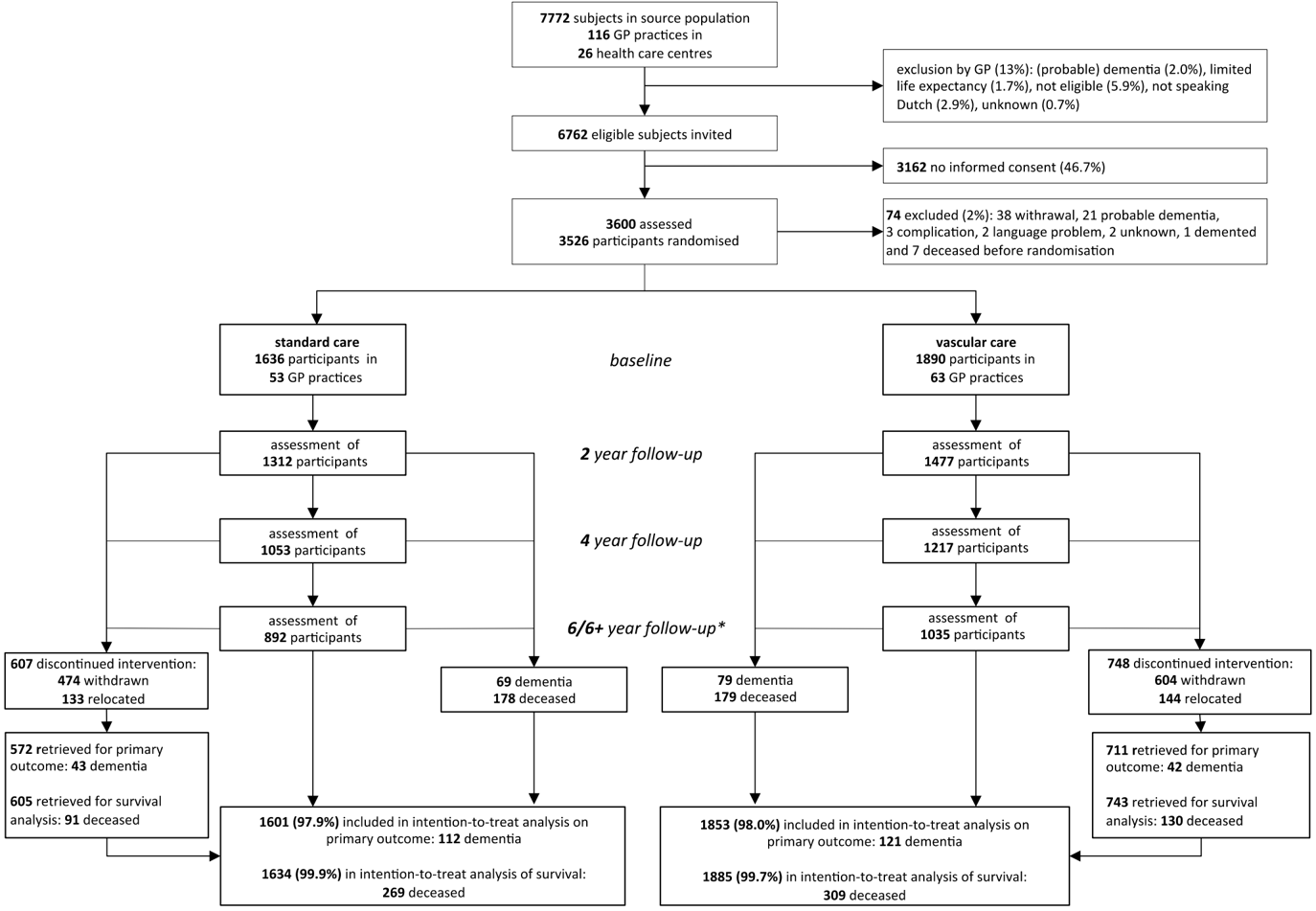
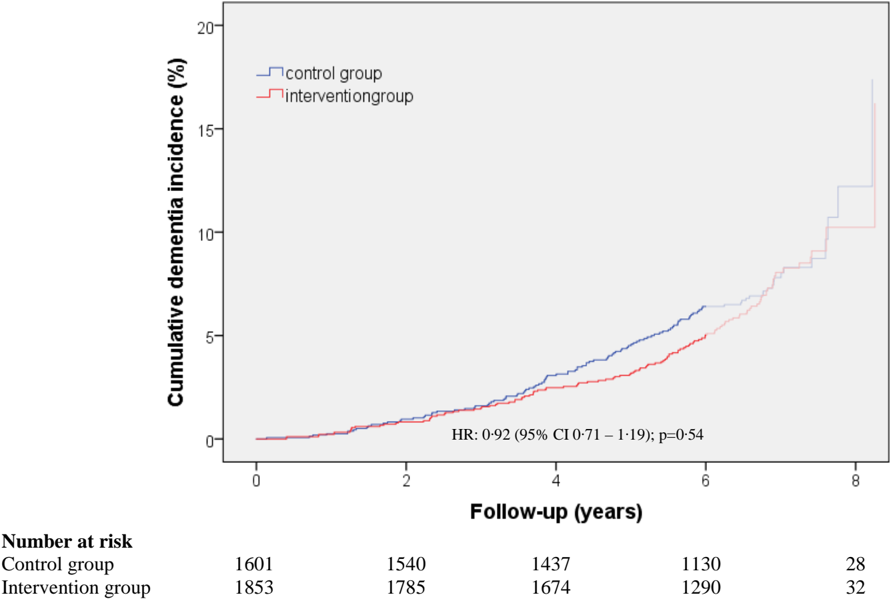
Background Cardiovascular risk factors are associated with an increased risk of dementia. We assessed whether a multidomain intervention targeting these factors can prevent dementia in a population of community-dwelling older people.Methods In this open-label, cluster-randomised controlled trial, we recruited individuals aged 70-78 years through participating general practices in the Netherlands. General practices within each health-care centre were randomly assigned (1:1), via a computer-generated randomisation sequence, to either a 6-year nurse-led, multidomain cardiovascular intervention or control (usual care). The primary outcomes were cumulative incidence of dementia and disability score (Academic Medical Center Linear Disability Score [ALDS]) at 6 years of follow-up. The main secondary outcomes were incident cardiovascular disease and mortality. Outcome assessors were masked to group assignment. Analyses included all participants with available outcome data. This trial is registered with ISRCTN, number ISRCTN29711771.Findings Between June 7, 2006, and March 12, 2009, 116 general practices (3526 participants) within 26 health-care centres were recruited and randomly assigned: 63 (1890 participants) were assigned to the intervention group and 53 (1636 participants) to the control group. Primary outcome data were obtained for 3454 (98%) participants; median follow-up was 6·7 years (21 341 person-years). Dementia developed in 121 (7%) of 1853 participants in the intervention group and in 112 (7%) of 1601 participants in the control group (hazard ratio [HR] 0·92, 95% CI 0·71-1·19; p=0·54). Mean ALDS scores measured during follow-up did not differ between groups (85·7 [SD 6·8] in the intervention group and 85·7 [7·1] in the control group; adjusted mean difference -0·02, 95% CI -0·38 to 0·42; p=0·93). 309 (16%) of 1885 participants died in the intervention group, compared with 269 (16%) of 1634 participants in the control group (HR 0·98, 95% CI 0·80-1·18; p=0·81). Incident cardiovascular disease did not differ between groups (273 [19%] of 1469 participants in the intervention group and 228 [17%] of 1307 participants in the control group; HR 1·06, 95% CI 0·86-1·31; p=0·57).Interpretation A nurse-led, multidomain intervention did not result in a reduced incidence of all-cause dementia in an unselected population of older people. This absence of effect might have been caused by modest baseline cardiovascular risks and high standards of usual care. Future studies should assess the efficacy of such interventions in selected populations.Funding Dutch Ministry of Health, Welfare and Sport; Dutch Innovation Fund of Collaborative Health Insurances; and Netherlands Organisation for Health Research and Development.
Overview
The claims and statistics of this paper haven’t been checked yet.
Free: it reads the open-access text and checks the first 5 claims that cite a source we can check. Create a free account to check every claim.
Integrity signals
Registry
Cites
Statistics
Figures
Verification
Claims the paper makes
The claims and statistics of this paper haven’t been checked yet.
Free: it reads the open-access text and checks the first 5 claims that cite a source we can check. Create a free account to check every claim.
Claims other papers make about this one
Each is checked against this paper’s own text: does it say what the citing paper says it does?
The source backs part of the claim, not all of it — or backs it for a different population, condition or comparison.
In the citing paper
“but the effect on dementia incidence had wide confidence intervals (2 RCTs; n = 7256, follow-up 6 to 13 years RR 0.94, 0.76 -1.18). (263, 264)”
From Dementia prevention, intervention, and care: 2024 report of the Lancet standing Commission (2024) · cites this paper as [264]
Experimental — accuracy not yet measuredThe source backs part of the claim, not all of it — or backs it for a different population, condition or comparison.
In the citing paper
“Sub‐analyses of these trials, however, revealed that there was benefit in people with increased risk of dementia.”
From Mental health care for older adults: recent advances and new directions in clinical practice and research (2022) · cites this paper as [107]
Experimental — accuracy not yet measuredThe cited source says what the claim attributes to it.
In the citing paper
“While two multidomain studies did not find clear cognitive benefits, 139,140 the Finnish Geriatric Intervention Study to Prevent Cognitive Impairment and Disability”
From 2023 Alzheimer's disease facts and figures (2023) · cites this paper as [139]
The cited source says what the claim attributes to it.
In the citing paper
“Two previous large RCTs that aimed at dementia risk reduction and ran via primary care, found no positive effects of the tested lifestyle intervention on their primary outcomes (dementia incidence, disability, and cognitive performance) [41, 42].”
From Multidomain Dementia Risk Reduction in Primary Care is Feasible: A Proof-of-concept study (2024) · cites this paper as [41]
In the citing paper
“On the other hand, several trials have had neutral results for maintenance of cognition155,157 (Table 2).”
From Defining Optimal Brain Health in Adults: A Presidential Advisory From the American Heart Association/American Stroke Association (2017) · cites this paper as [155]
1 more claim about this paper
Create a free account to see every claim other papers make about this one.
Self-check
Percentages, sums and reported differences re-computed from the paper’s own numbers.
The self-check needs the paper’s full text.
Citations
Cites
Diagnostic and Statistical Manual of Mental Disorders
Williams, J. B. W., & First, M. (2013) · Encyclopedia of Social Work · doi:10.1093/acrefore/9780199975839.013.104 · Cited by 109,519
A Randomized Trial of Intensive versus Standard Blood-Pressure Control
The SPRINT Research Group (2015) · New England Journal of Medicine · doi:10.1056/nejmoa1511939 · Cited by 6,325
The global prevalence of dementia: a systematic review and metaanalysis.
Prince, M., Bryce, R., Albanese, E., Wimo, A., Ribeiro, W., & Ferri, C. P. (2013) · Alzheimer's & Dementia · doi:10.1016/j.jalz.2012.11.007 · Cited by 4,941
Ngandu, T., Lehtisalo, J., Solomon, A., Levälahti, E., Ahtiluoto, S., Antikainen, R., Bäckman, L., Hänninen, T., Jula, A., Laatikainen, T., et al. (2015) · The Lancet · doi:10.1016/s0140-6736(15)60461-5 · Cited by 3,689
Treatment of hypertension in patients 80 years of age or older
Beckett, N. S., Peters, R., Fletcher, A. E., Staessen, J. A., Liu, L., Dumitrascu, D., Stoyanovsky, V., Antikainen, R. L., Nikitin, Y., Anderson, C., et al. (2008) · New England Journal of Medicine · doi:10.1056/nejmoa0801369 · Cited by 3,092
Potential for primary prevention of Alzheimer's disease: an analysis of population-based data
Norton, S., Matthews, F. E., Barnes, D. E., Yaffe, K., & Brayne, C. (2014) · The Lancet Neurology · doi:10.1016/s1474-4422(14)70136-x · Cited by 2,466
Forette, F., Seux, M.-L., Staessen, J. A., Thijs, L., Birkenhäger, W. H., Babarskiene, M.-R., Babeanu, S., Bossini, A., Gil-Extremera, B., Girerd, X., et al. (1998) · The Lancet · doi:10.1016/s0140-6736(98)03086-4 · Cited by 1,441
Incidence of dementia over three decades in the Framingham heart study
Satizabal, C. L., Beiser, A. S., Chouraki, V., Chêne, G., Dufouil, C., & Seshadri, S. (2016) · New England Journal of Medicine · doi:10.1056/nejmoa1504327 · Cited by 1,051
Peters, R., Beckett, N., Forette, F., Tuomilehto, J., Clarke, R., Ritchie, C., Waldman, A., Walton, I., Poulter, R., Ma, S., et al. (2008) · The Lancet Neurology · doi:10.1016/s1474-4422(08)70143-1 · Cited by 770
Daviglus, M. L., Bell, C. C., Berrettini, W., Bowen, P. E., Connolly, E. S., Cox, N. J., Dunbar-Jacob, J. M., Granieri, E. C., Hunt, G., McGarry, K., et al. (2010) · Annals of Internal Medicine · doi:10.7326/0003-4819-153-3-201008030-00260 · Cited by 463
Research works printed but not linked: 2
- 2012, Guideline on cardiovascular risk management (first revision), Huisarts Wet, 55, 14
- 27. Organization WH. Global recommendations on physical activity for health. Chapter 4.4 Age group: 65 years and above. World Health Organization 2015: 29-32 (ISBN 978 92 4 159 997
Cited by
Items 101–200 of 698
Fadzil, N. H. M., Shahar, S., Rajikan, R., Singh, D. K. A., Ludin, A. F. M., Subramaniam, P., Ibrahim, N., Vanoh, D., Ali, N. M., & Noah, S. A. M. (2022) · International Journal of Environmental Research and Public Health · doi:10.3390/ijerph19074000 · Cited by 71
Primary prevention of dementia: from modifiable risk factors to a public brain health agenda?
Hussenoeder, F. S., & Riedel-Heller, S. G. (2018) · Social Psychiatry and Psychiatric Epidemiology · doi:10.1007/s00127-018-1598-7 · Cited by 70
“Similar interventions which were not initially targeted to high-risk groups have failed to show positive results [58, 69].”
Mediterranean Lifestyle in Relation to Cognitive Health: Results from the HELIAD Study
Anastasiou, C. A., Yannakoulia, M., Kontogianni, M. D., Kosmidis, M. H., Mamalaki, E., Dardiotis, E., Hadjigeorgiou, G. M., Sakka, P., Tsapanou, A., Lykou, A., et al. (2018) · Nutrients · doi:10.3390/nu10101557 · Cited by 72
“, those with more vascular factors, higher future dementia risk scores, brain amyloid positivity or carriers of the e4 allele of Apolipoprotein E) [48,49].”
BackgroundGiudici, K. V., de Souto Barreto, P., Beard, J., Cantet, C., Araujo de Carvalho, I., Rolland, Y., & Vellas, B. (2020) · Maturitas · doi:10.1016/j.maturitas.2020.06.012 · Cited by 64
groups, F. T. M.-A. A. H., Rosenberg, A., Coley, N., Soulier, A., Kulmala, J., Soininen, H., Andrieu, S., Kivipelto, M., & Barbera, M. (2020) · BMC Geriatrics · doi:10.1186/s12877-020-1493-4 · Cited by 69
Wang, B., Wang, N., Sun, Y. B., Tan, X. W., Zhang, J., & Lu, Y. (2022) · Neurology · doi:10.1212/wnl.0000000000201231 · Cited by 71
Martemucci, G., Khalil, M., Luca, A. D., Abdallah, H., & D‘Alessandro, A. G. (2024) · Metabolites · doi:10.3390/metabo14060327 · Cited by 70
“Oxidative stress and damage to brain macromolecules play crucial roles in the development of neurodegenerative diseases [440].”
BackgroundRaising awareness for dementia risk reduction through a public health campaign: a pre-post study
Heger, I., Köhler, S., van Boxtel, M., de Vugt, M., Hajema, K., Verhey, F., & Deckers, K. (2020) · BMJ Open · doi:10.1136/bmjopen-2020-041211 · Cited by 68
Meng, X., Fang, S., Zhang, S., Li, H., Ma, D., Ye, Y., Su, J.-P., & Sun, J. (2022) · International Journal of Nursing Studies · doi:10.1016/j.ijnurstu.2022.104236 · Cited by 68
Cerebral Small Vessel Disease Progression and the Risk of Dementia: A 14-Year Follow-Up Study
Jacob, M. A., Cai, M., van de Donk, V., Bergkamp, M. I., Marques, J. P., Norris, D. G., Kessels, R. P. C., Claassen, J. A. H. R., Duering, M., Tuladhar, A. M., et al. (2023) · American Journal of Psychiatry · doi:10.1176/appi.ajp.20220380 · Cited by 65
Deckers, K., Köhler, S., van Boxtel, M., Verhey, F., Brayne, C., & Fleming, J. (2018) · Aging & Mental Health · doi:10.1080/13607863.2017.1280767 · Cited by 64
“…have investigated the effects of single or multivariate risk factor reduction on cognitive decline or dementia incidence (Ngandu et al., 2016; van Charante et al., 2016), the evidence for most factors comes from observational studies (Barnes & Yaffe, 2011; Deckers et al., 2015; Plassman,…”
BackgroundBott, N. T., Hall, A., Madero, E. N., Glenn, J. M., Fuseya, N., Gills, J. L., & Gray, M. (2019) · Nutrients · doi:10.3390/nu11092258 · Cited by 56
“The preDIVA study (ISRCTN29711771) was a Dutch cluster-randomized control trial that evaluated the effect of a nurse-led multidomain intervention on cardiovascular risk factors and its effect on dementia incidence and disability in a sample of community-dwelling older adults aged 70–78 years [18,27].”
BackgroundBarthold, D., Joyce, G., Brinton, R. D., Wharton, W., Kehoe, P. G., & Zissimopoulos, J. (2020) · PLoS ONE · doi:10.1371/journal.pone.0229541 · Cited by 64
Moon, S. Y., Hong, C. H., Jeong, J. H., Park, Y. K., Na, H. R., Song, H.-S., Kim, B. C., Park, K. W., Park, H. K., Choi, M., et al. (2021) · Aging · doi:10.18632/aging.203213 · Cited by 63
Physical Exercise as Personalized Medicine for Dementia Prevention?
Müllers, P., Taubert, M., & Müller, N. G. (2019) · Frontiers in Physiology · doi:10.3389/fphys.2019.00672 · Cited by 65
Hansson, O., Svensson, M., Gustavsson, A.-M., Andersson, E., Yang, Y., Nägga, K., Hållmarker, U., James, S., & Deierborg, T. (2019) · Alzheimer's Research & Therapy · doi:10.1186/s13195-019-0538-4 · Cited by 57
van Dalen, J. W., Marcum, Z. A., Gray, S. L., Barthold, D., Moll van Charante, E. P., van Gool, W. A., Crane, P. K., Larson, E. B., & Richard, E. (2021) · Neurology · doi:10.1212/wnl.0000000000010996 · Cited by 52
“The PreDIVA trial was registered with ISRCTN, number ISRCTN29711771.”
MethodResultInfluentialSelf-citationColey, N., Giulioli, C., Aisen, P. S., Vellas, B., & Andrieu, S. (2022) · Ageing Research Reviews · doi:10.1016/j.arr.2022.101777 · Cited by 62
Epidemiology and Risk Factors for Dementia
Dintica, C. S., & Yaffe, K. S. (2022) · Psychiatric Clinics of North America · doi:10.1016/j.psc.2022.07.011 · Cited by 62
Early Stages of Alzheimer's Disease: Evolving the Care Team for Optimal Patient Management
Galvin, J. E., Aisen, P., Langbaum, J. B., Rodriguez, E., Sabbagh, M., Stefanacci, R., Stern, R. A., Vassey, E. A., de Wilde, A., West, N., et al. (2021) · Frontiers in Neurology · doi:10.3389/fneur.2020.592302 · Cited by 56
Stephen, R., Barbera, M., Peters, R., Ee, N., Zheng, L., Lehtisalo, J., Kulmala, J., Håkansson, K., Chowdhary, N., Dua, T., et al. (2021) · Frontiers in Neurology · doi:10.3389/fneur.2021.763573 · Cited by 62
Epidemiologic Trends, Social Determinants, and Brain Health: The Role of Life Course Inequalities
Hilal, S., & Brayne, C. (2022) · Stroke · doi:10.1161/strokeaha.121.032609 · Cited by 62
Modifiable cardiovascular risk factors and genetics for targeted prevention of dementia
Rasmussen, I. J., & Frikke‐Schmidt, R. (2023) · European Heart Journal · doi:10.1093/eurheartj/ehad293 · Cited by 62
Altomare, D., Molinuevo, J. L., Ritchie, C. W., Ribaldi, F., Carrera, E., Dubois, B., Jessen, F., McWhirter, L., Scheltens, P., van Duijn, C. M., et al. (2021) · Alzheimer s Research & Therapy · doi:10.1186/s13195-021-00827-2 · Cited by 62
Chételat, G., Lutz, A., Klimecki, O., Frison, É., Asselineau, J., Schlosser, M., Arenaza‐Urquijo, E. M., Mézenge, F., Kuhn, E., Moulinet, I., et al. (2022) · JAMA Neurology · doi:10.1001/jamaneurol.2022.3185 · Cited by 60
“Years in retirement 7 (5-13) 9 (5-13) 6 (4-10)”
Yang, Q., Lyu, X., Lin, Q., Wang, Z., Tang, L., Zhao, Y., & Lyu, Q.-Y. (2021) · International Journal of Nursing Studies · doi:10.1016/j.ijnurstu.2021.104110 · Cited by 59
Coley, N., Coniasse-Brioude, D., Igier, V., Fournier, T., Poulain, J., Andrieu, S., for the ACCEPT study group, Andrieu, S., Coley, N., Gardette, V., et al. (2021) · Alzheimer s Research & Therapy · doi:10.1186/s13195-021-00904-6 · Cited by 59
Lower dementia risk with different classes of antihypertensive medication in older patients
van Middelaar, T., van Vught, L. A., van Charante, E. P. M., Eurelings, L. S. M., Ligthart, S. A., van Dalen, J. W., van den Born, B. J. H., Richard, E., & van Gool, W. A. (2017) · Journal of Hypertension · doi:10.1097/hjh.0000000000001411 · Cited by 53
Self-citationHeart health meets cognitive health: evidence on the role of blood pressure
Palta, P., Albert, M., & Gottesman, R. F. (2021) · The Lancet Neurology · doi:10.1016/s1474-4422(21)00248-9 · Cited by 58
Population Neuroscience: Dementia Epidemiology Serving Precision Medicine and Population Health
Ganguli, M., Albanese, E., Seshadri, S. S., Bennett, D. A., Lyketsos, C. G., Kukull, W. A., Skoog, I. G., & Hendrie, H. C. (2018) · Alzheimer Disease & Associated Disorders · doi:10.1097/wad.0000000000000237 · Cited by 57
Feng, L., Romero-García, R., Suckling, J., Tan, J. S., Larbi, A., Cheah, I. K.-M., Wong, G. C. L., Tsakok, M. F. H., Lanskey, B., Lim, D., et al. (2020) · Aging · doi:10.18632/aging.202374 · Cited by 57
Wei, J., Wang, L., Kulshreshtha, A., & Xu, H. (2022) · Journal of the American Heart Association · doi:10.1161/jaha.121.022959 · Cited by 57
Alzheimer's disease: Only prevention makes sense
Viña, J., & Sanz‐Ros, J. (2018) · European Journal of Clinical Investigation · doi:10.1111/eci.13005 · Cited by 57
“A 6‐year multidomain vascular intervention did not result in a reduced incidence of all‐ cause dementia; nevertheless, the study included an unselected population of older people (ie not at risk of dementia) and future studies might assess the efficacy in more selected clusters of patients.(25) And we would like to ad…”
BackgroundIs more always better? Dose effect in a multidomain intervention in older adults at risk of dementia
Belleville, S., Cloutier, S., Mellah, S., Willis, S. L., Vellas, B. J., Andrieu, S., Coley, N., Ngandu, T., & MAPT/DSA group (2022) · Alzheimer s & Dementia · doi:10.1002/alz.12544 · Cited by 58
“In the case of a significant interaction, dosemodels were assessed individually in the groups separated by the median for age (74 years) and CAIDE score (7), sex, education level (levels 1, 2, and 3 vs levels 4 and 5), entry criteria for frailty (one vs twoor three entry criteria), andpresence of anAPOE allele.”
MethodGuo, J., Brickman, A. M., Manly, J. J., Reitz, C., Schupf, N., Mayeux, R. P., & Gu, Y. (2021) · Alzheimer's & Dementia · doi:10.1002/alz.12359 · Cited by 56
Barbera, M., Mangialasche, F., Jongstra, S., Guillemont, J., Ngandu, T., Beishuizen, C., Coley, N., Brayne, C., Andrieu, S., Richard, E., et al. (2018) · Journal of Alzheimer’s Disease · doi:10.3233/jad-170858 · Cited by 50
Self-citationBarreto, P. D. S., Pothier, K., Soriano, G., Lussier, M., Bherer, L., Guyonnet, S., Piau, A., Ousset, P., & Vellas, B. J. (2021) · The Journal of Prevention of Alzheimer s Disease · doi:10.14283/jpad.2020.70 · Cited by 61
“In recent years, the multidomain strategy, an approach characterized by the combination of several lifestyle interventions, have received increasing attention, with the development of large randomized controlled trial (RCT) by our team (1) and others (2, 3).”
BackgroundHampel, H., Vergallo, A., Caraci, F., Cuello, A. C., Lemercier, P., Vellas, B., Giudici, K. V., Baldacci, F., Hänisch, B., Haberkamp, M., et al. (2021) · Neuropharmacology · doi:10.1016/j.neuropharm.2020.108081 · Cited by 50
Bucholc, M., Bauermeister, S., Kaur, D., McClean, P. L., & Todd, S. (2022) · Alzheimer s & Dementia Translational Research & Clinical Interventions · doi:10.1002/trc2.12248 · Cited by 55
Schlosser, M., Demnitz‐King, H., Whitfield, T. J., Wirth, M., & Marchant, N. L. (2020) · BMC Psychiatry · doi:10.1186/s12888-020-02884-7 · Cited by 53
Blood pressure-lowering interventions to prevent dementia: a systematic review and meta-analysis
van Middelaar, T., van Vught, L. A., van Gool, W. A., Simons, E. M. F., van den Born, B.-J. H., Moll van Charante, E. P., & Richard, E. (2018) · Journal of Hypertension · doi:10.1097/hjh.0000000000001829 · Cited by 39
Self-citationParavascular spaces: entry to or exit from the brain?
Bakker, E. N. T. P., Naessens, D. M. P., & VanBavel, E. (2019) · Experimental Physiology · doi:10.1113/ep087424 · Cited by 54
“Studies are ongoing to unravel this complicated relationship, including some that address the question of whether antihypertensive treatment can prevent or delay dementia (Moll van Charante et al., 2016).”
BackgroundFrom beta amyloid to altered proteostasis in Alzheimer’s disease
Bruni, A. C., Bernardi, L., & Gabelli, C. (2020) · Ageing Research Reviews · doi:10.1016/j.arr.2020.101126 · Cited by 53
Association between physical activity and conversion from mild cognitive impairment to dementia
Kim, Y. J., Han, K., Baek, M. S., Cho, H., Lee, E. J., & Lyoo, C. H. (2020) · Alzheimer s Research & Therapy · doi:10.1186/s13195-020-00707-1 · Cited by 52
Prevention of cognitive impairment: scientific guidance and windows of opportunity
Gorelick, P. B. (2017) · Journal of Neurochemistry · doi:10.1111/jnc.14113 · Cited by 51
“Dementia developed in 7% of the intervention and control groups, respectively, and thus, there was no difference in the occurrence of dementia (p = 0.54) (Moll van Charante et al. 2016).”
BackgroundInfluentialDeckers, K., Zwan, M. D., Soons, L. M., Waterink, L., Beers, S., van Houdt, S., Stiensma, B., Kwant, J. Z., Wimmers, S. C. P. M., Heutz, R. A. M., et al. (2024) · Alzheimer s Research & Therapy · doi:10.1186/s13195-024-01495-8 · Cited by 51
“…3-year change in memory function) and the Dutch Prevention of Dementia by Intensive Vascular Care (pre-DIVA; incident dementia) did not reach their primary endpoint, but showed potential beneficial effects on cognition in specific subgroups of older people with increased risk of dementia [9, 10].”
BackgroundTanaka, M., Saitô, S., Inoue, T., Satoh‐Asahara, N., & Ihara, M. (2019) · International Journal of Molecular Sciences · doi:10.3390/ijms20092139 · Cited by 51
Anstey, K. J., Cherbuin, N., Kim, S., McMaster, M., D'Este, C., Lautenschlager, N., Rebok, G., McRae, I., Torres, S. J., Cox, K. L., et al. (2020) · Journal of Medical Internet Research · doi:10.2196/19431 · Cited by 43
“Studies have been conducted in a primary care setting with older adults to address the management of cardiovascular risk factors [23,24] to reduce the risk of dementia.”
BackgroundColey, N., Hoevenaar‐Blom, M. P., van Dalen, J., Moll van Charante, E. P., Kivipelto, M., Soininen, H., Andrieu, S., Richard, E., & PRODEMOS consortium, T. P. S. G. (2020) · Alzheimer's & Dementia · doi:10.1002/alz.12169 · Cited by 45
Self-citationAlzheimer disease seen through the lens of sex and gender
Castro‐Aldrete, L., Einsiedler, M., Martínková, J., Depypere, H. T., Ang, T. F. A., Mielke, M. M., Sindi, S., Eyre, H. A., Au, R., Dimech, A. S., et al. (2025) · Nature Reviews Neurology · doi:10.1038/s41582-025-01071-0 · Cited by 50
“However, the Pre-DIVA trial results showed a stronger beneficial effect of the intervention among participants with untreated hypertension at baseline 238 , which suggests that targeting at-risk groups could help to optimize outcomes.”
How can urban environments support dementia risk reduction? A qualitative study
Röhr, S., Rodriguez, F. S., Siemensmeyer, R., Müller, F., Romero‐Ortuño, R., & Riedel-Heller, S. G. (2021) · International Journal of Geriatric Psychiatry · doi:10.1002/gps.5626 · Cited by 49
Alzheimer Disease: Standard of Diagnosis, Treatment, Care, and Prevention
Teipel, S. J., Gustafson, D., Ossenkoppele, R., Hansson, O., Babiloni, C., Wagner, M., Riedel-Heller, S. G., Kilimann, I., & Tang, Y. (2022) · Journal of Nuclear Medicine · doi:10.2967/jnumed.121.262239 · Cited by 48
Sugimoto, T., Sakurai, T., Akatsu, H., Doi, T., Fujiwara, Y., Hirakawa, A., Kinoshita, F., Kuzuya, M., Lee, S., Matsuo, K., et al. (2021) · The Journal of Prevention of Alzheimer s Disease · doi:10.14283/jpad.2021.29 · Cited by 48
“- Social participation: Participants are to be assessed for social participation using the questionnaire about social engagement in eight types of groups (34): (1) neighborhood associations/senior citizen clubs/ fire-fighting teams (Local Community); (2) hobby groups (Hobby); (3) sports groups or clubs (Sports); (4) p…”
BackgroundMethodResultInfluentialProgress on dementia—leaving no one behind
Prince, M. J. (2017) · The Lancet · doi:10.1016/s0140-6736(17)31757-9 · Cited by 47
Farina, F. R., Bridgeman, K., Gregory, S., Crivelli, L., Foote, I. F., Jutila, O.-E. I., Kucikova, L., Mariano, L. I., Nguyen, K.-H., Thayanandan, T., et al. (2024) · The Lancet Healthy Longevity · doi:10.1016/j.lanhl.2024.100665 · Cited by 45
Liang, C.-K., Lee, W.-J., Hwang, A.-C., Lin, C.-S., Chou, M.-Y., Peng, L.-N., Lin, M.-H., & Chen, L.-K. (2021) · Archives of Gerontology and Geriatrics · doi:10.1016/j.archger.2021.104392 · Cited by 45
Reparaz-Escudero, I., Izquierdo, M., Bischoff-Ferrari, H. A., Martínez-Lage, P., & Sáez de Asteasu, M. L. (2024) · Ageing Research Reviews · doi:10.1016/j.arr.2024.102463 · Cited by 45
Cunningham, E. L., Todd, S. A., Passmore, P., Bullock, R., & McGuinness, B. (2021) · Cochrane Database of Systematic Reviews · doi:10.1002/14651858.cd004034.pub4 · Cited by 45
Asim, A., Jastrzębski, M. K., & Kaczor, A. A. (2025) · Molecules · doi:10.3390/molecules30142975 · Cited by 46
Dementia prevention and reserve against neurodegenerative disease
Perneczky, R. (2019) · Phlebolymphology · doi:10.31887/dcns.2019.21.1/rperneczky2 · Cited by 45
Huang, Z., Guo, Y., Ruan, Y., Sun, S., Lin, T., Ye, J., Li, J., He, L., Wang, S., Shi, Y., et al. (2020) · Frontiers in Aging Neuroscience · doi:10.3389/fnagi.2020.601487 · Cited by 46
“However, two other large multidomain lifestyle intervention trials (MAPT and PreDIVA) have found negative results (Moll van Charante et al., 2016; Andrieu et al., 2017).”
BackgroundRöhr, S., Kivipelto, M., Mangialasche, F., Ngandu, T., & Riedel-Heller, S. G. (2022) · Current Opinion in Psychiatry · doi:10.1097/yco.0000000000000792 · Cited by 46
Visit-To-Visit Blood Pressure Variability and the Risk of Dementia in Older People
van Middelaar, T., van Dalen, J. W., van Gool, W. A., van den Born, B.-J. H., van Vught, L. A., Moll van Charante, E. P., & Richard, E. (2018) · Journal of Alzheimer’s Disease · doi:10.3233/jad-170757 · Cited by 40
Self-citationDementia treatment versus prevention
Perneczky, R. (2019) · Phlebolymphology · doi:10.31887/dcns.2019.21.1/rperneczky · Cited by 46
Park, H. K., Jeong, J. H., Moon, S. Y., Park, Y. K., Hong, C. H., Na, H. R., Song, H.-S., Lee, S. M., Choi, M., Park, K. W., et al. (2020) · Journal of Clinical Neurology · doi:10.3988/jcn.2020.16.2.292 · Cited by 38
MRI-based biomarkers of accelerated aging and dementia risk in midlife: how close are we?
Elliott, M. L. (2020) · Ageing Research Reviews · doi:10.1016/j.arr.2020.101075 · Cited by 44
Röhr, S., Zülke, A. E., Luppa, M., Brettschneider, C., Weißenborn, M., Kühne, F., Zöllinger, I., Samos, F.-A. Z., Bauer, A., Döhring, J., et al. (2021) · International Journal of Environmental Research and Public Health · doi:10.3390/ijerph18020408 · Cited by 44
Wang, X., Bakulski, K. M., Paulson, H. L., Albin, R. L., & Park, S. K. (2023) · Scientific Reports · doi:10.1038/s41598-023-34648-0 · Cited by 45
Zhang, B., Huang, X., Wang, X., Chen, X., Zheng, C., Shao, W., Wang, G., & Zhang, W. (2022) · Scientific Reports · doi:10.1038/s41598-022-17207-x · Cited by 44
Pekkala, T., Hall, A., Lötjönen, J. M. P., Mattila, J., Soininen, H. S., Ngandu, T., Laatikainen, T. K., Kivipelto, M., & Solomon, A. (2016) · Journal of Alzheimer s Disease · doi:10.3233/jad-160560 · Cited by 43
Beishuizen, C. R. L., Coley, N., van Charante, E. P. M., van Gool, W. A., Richard, E., & Andrieu, S. (2017) · Journal of the American Geriatrics Society · doi:10.1111/jgs.14834 · Cited by 43
Self-citationSystematic Multi-Domain Alzheimer’s Risk Reduction Trial (SMARRT): Study Protocol
Yaffe, K. S., Barnes, D. E., Rosenberg, D. E., Dublin, S., Kaup, A. R., Ludman, E. J., Vittinghoff, E., Peltz, C. B., Renz, A. D., Adams, K. J., et al. (2018) · Journal of Alzheimer s Disease · doi:10.3233/jad-180634 · Cited by 44
Multimodal Precision Prevention - A New Direction in Alzheimer's Disease
Barbera, M., Perera, D., Matton, A., Mangialasche, F., Rosenberg, A., Middleton, L. T., Ngandu, T., Solomon, A., & Kivipelto, M. (2023) · The Journal of Prevention of Alzheimer s Disease · doi:10.14283/jpad.2023.114 · Cited by 42
“…in preDIVA participants with elevated and untreated blood pressure at baseline who initiated antihypertensive treatment as part of the intervention (24), and in MAPT participants with an increased risk of dementia such as high Cardiovascular Risk Factors, Aging and Dementia (CAIDE) Risk Score (of…”
BackgroundValentin‐Escalera, J., Leclerc, M., & Calon, F. (2024) · Journal of Alzheimer s Disease · doi:10.3233/jad-230118 · Cited by 43
“…including PUFA and MUFA, combined with changes in other lifestyle habits, attract a growing interest as a mode of intervention in dementia [2, 9, 10, 20, 23, 25, 27, 31, 64, 76, 81–86], there are many gaps in our understanding of their causal association with brain function that deserve…”
BackgroundSwartz, R. H., Longman, R. S., Lindsay, M. P., Lund, R., Ganesh, A., Eskes, G. A., Austin, M., Bechard, L., Bhangu, J. S., Bruto, V. C., et al. (2025) · Alzheimer s & Dementia · doi:10.1002/alz.14324 · Cited by 44
“Building on previous multidomain lifestyle modification trials such as FINGER, 131 preDIVA, 132 and MAPT, 133 the results from several trials in progress are anticipated.”
Huang, L. K., Yin, X., Li, W., Cao, Y., Chen, Y., Lao, L., Zhang, Z., Mi, Y., & Xu, S. (2021) · Journal of Alzheimer s Disease · doi:10.3233/jad-201353 · Cited by 42
“However, pharmacological treatments are proven to have limited effects [9, 10]; consequently, a growing amount of attention has been directed to non-pharmacological interventions to preserve cognitive function and improve quality of life in patients with VCIND [11].”
BackgroundBermejo‐Pareja, F., & del Ser, T. (2024) · Journal of Clinical Medicine · doi:10.3390/jcm13020536 · Cited by 43
van Dalen, J. W., Moll van Charante, E. P., Caan, M. W. A., Scheltens, P., Majoie, C. B. L. M., Nederveen, A. J., van Gool, W. A., & Richard, E. (2017) · Stroke · doi:10.1161/strokeaha.117.017207 · Cited by 41
“The preDIVA trial (Prevention of Dementia by Intensive Vascular Care) has been described in detail previously.(15) In brief, preDIVA was an open-label, cluster-randomized controlled trial in 3526 community-dwelling individuals aged 70 to 78 years, recruited through participating general practices in the Netherlands.”
BackgroundMethodSelf-citationTabue-Teguo, M., Barreto de Souza, P., Cantet, C., Andrieu, S., Simo, N., Fougère, B., Dartigues, J. F., & Vellas, B. (2018) · The Journal of nutrition, health and aging · doi:10.1007/s12603-018-1024-6 · Cited by 41
Xu, X., Chew, K. A., Wong, Z. X., Phua, A. K. S., Chong, E. J. Y., Teo, C. K., Sathe, N., Chooi, Y. C., Chia, W. P. F., Henry, C. J., et al. (2022) · The Journal of Prevention of Alzheimer s Disease · doi:10.14283/jpad.2022.5 · Cited by 41
“The SINGER study will recruit participants who are (1) aged 60-77 years, (2) at risk of dementia as determined by a CAIDE score of ≥6, (3) have modifiable lifestyle factors (fulfilling ≥1 of the LIBRA Questionnaires for diet, cognitive activity, physical activity), (4) Montreal Cognitive Assessment (MoCA) score betwee…”
BackgroundMethodSolfrizzi, V., Agosti, P., Lozupone, M., Custodero, C., Schilardi, A., Valiani, V., Santamato, A., Sardone, R., Dibello, V., Lena, L. D., et al. (2018) · Neuroscience & Biobehavioral Reviews · doi:10.1016/j.neubiorev.2018.10.022 · Cited by 45
Liu, T., Luo, H., Tang, J. Y. ‐., & Wong, G. H. Y. (2018) · Aging & Mental Health · doi:10.1080/13607863.2018.1539833 · Cited by 41
“In Europe, there were three multi-domain interventional RCTs on dementia, the Prevention of Dementia by Intensive Vascular Care (PreDIVA) (van Charante et al., 2016), the Finnish Geriatric Intervention Study to Prevent Cognitive Impairment and Disability (FINGER) (Ngandu et al., 2015), and…”
BackgroundPathways of Prevention: A Scoping Review of Dietary and Exercise Interventions for Neurocognition
Smith, P. J. (2019) · Brain Plasticity · doi:10.3233/bpl-190083 · Cited by 42
Yu, O.-C., Jung, B., Go, H.-Y., Park, M.-J., & Ha, I. (2020) · BMJ Open · doi:10.1136/bmjopen-2019-034924 · Cited by 41
Planning and optimising a digital intervention to protect older adults’ cognitive health
Essery, R., Pollet, S., Smith, K. A., Mowbray, F., Slodkowska‐Barabasz, J., Denison‐Day, J., Hayter, V., Bradbury, K. J., Grey, E., Western, M. J., et al. (2021) · Pilot and Feasibility Studies · doi:10.1186/s40814-021-00884-2 · Cited by 41
Trials and Treatments for Vascular Brain Health: Risk Factor Modification and Cognitive Outcomes
Kivipelto, M., Palmer, K., Hoang, T. D. M., & Yaffe, K. S. (2022) · Stroke · doi:10.1161/strokeaha.121.032614 · Cited by 42
A Population Perspective on Prevention of Dementia
Eggink, E., Moll van Charante, E. P., van Gool, W. A., & Richard, E. (2019) · Journal of Clinical Medicine · doi:10.3390/jcm8060834 · Cited by 38
“Another challenge is the observed improvement on primary and secondary outcomes of the control group in some multi-domain intervention studies [57,58].”
BackgroundMethodSelf-citationRisk of dementia associated with psychotic disorders in later life: the health in men study (HIMS)
Almeida, O. P., Ford, A. H., Hankey, G. J., Yeap, B. B., Golledge, J., & Flicker, L. A. (2018) · Psychological Medicine · doi:10.1017/s003329171800065x · Cited by 40
“…obesity and hypertension, smoking and limited education have all been recognised as potential targets (Norton et al. 2014), although systematic attempts to address these risk factors have had only modest success (Lautenschlager et al. 2008; Ngandu et al. 2015; Moll van Charante et al. 2016).”
BackgroundPhipps, C. J., Murman, D. L., & Warren, D. E. (2021) · Brain Sciences · doi:10.3390/brainsci11101283 · Cited by 40
Yang, J. J., Keohane, L. M., Pan, X.-F., Qu, R., Shu, X.-O., Lipworth, L., Braun, K., Steinwandel, M. D., Dai, Q., Shrubsole, M., et al. (2022) · Neurology · doi:10.1212/wnl.0000000000200774 · Cited by 39
Barreto, P. D. S., Rolland, Y., Cesari, M., Dupuy, C., Andrieu, S., Vellas, B. J., & for the MAPT study group (2017) · Age and Ageing · doi:10.1093/ageing/afx164 · Cited by 40
“To the best of our knowledge, the only two long-term RCTs [9, 10] among older adults at-risk for cognitive decline that operationalised multidomain interventions found mixed results regarding the effects of the interventions on PA.”
BackgroundInfluentialHypertension management in older adults
Bilen, O., & WENGER, N. K. (2020) · F1000Research · doi:10.12688/f1000research.20323.1 · Cited by 42
Clinical trials in vascular cognitive impairment following SPRINT-MIND: An international perspective
Elahi, F. M., Alladi, S., Black, S. E., Claassen, J. A. H. R., DeCarli, C. S., Hughes, T. M., Moonen, J. E. F., Pajewski, N. M., Price, B. R., Satizábal, C. L., et al. (2023) · Cell Reports Medicine · doi:10.1016/j.xcrm.2023.101089 · Cited by 40
Causal cardiovascular risk factors for dementia: insights from observational and genetic studies
Kjeldsen, E. W., & Frikke‐Schmidt, R. (2024) · Cardiovascular Research · doi:10.1093/cvr/cvae235 · Cited by 39
“152 Similarly, the Multidomain Alzheimer Preventive Trial showed no cognitive benefits over a 3-year period.”
Wang, W., Davis, P. B., Qi, X., Gurney, M. E., Perry, G. L., Volkow, N. D., Kaelber, D. C., & Xu, R. (2025) · Journal of Alzheimer s Disease · doi:10.1177/13872877251351329 · Cited by 38
“36 40 While these studies show that multidomain interventions are feasible, their effects are modest and inconclusive, 41 highlighting the challenges of multidomain prevention trials for dementia.”
Hsu, Y., Chou, M.-Y., Chu, C., Liao, M.-C., Wang, Y., Lin, Y., Chen, L., & Liang, C. (2019) · The journal of nutrition health & aging · doi:10.1007/s12603-019-1246-2 · Cited by 38
Katayama, O., Lee, S., Bae, S., Makino, K., Shinkai, Y., Chiba, I., Harada, K., & Shimada, H. (2021) · Archives of Gerontology and Geriatrics · doi:10.1016/j.archger.2021.104376 · Cited by 38
Eggink, E., Hafdi, M., Hoevenaar-Blom, M. P., Song, M., Andrieu, S., Barnes, L. E., Birck, C., Brooks, R. L., Coley, N., Ford, E., et al. (2021) · BMJ Open · doi:10.1136/bmjopen-2021-049762 · Cited by 37
Self-citationCollins, R., Silarova, B., & Clare, L. (2019) · Journal of Alzheimer’s Disease · doi:10.3233/jad-180608 · Cited by 37
“with some clinical trials such as FINGER [73], preDIVA [74] and MAPT [75] have advanced current knowledge and understanding of modifiable risk factors, continued research is needed [76] especially given the time lag involved in the translation of research into policy [77].”
Hafdi, M., Hoevenaar-Blom, M. P., Beishuizen, C. R. L., Moll van Charante, E. P., Richard, E., & van Gool, W. A. (2020) · Journal of the American Medical Directors Association · doi:10.1016/j.jamda.2019.05.010 · Cited by 37
Self-citation
Metadata
- Authors
- van Charante, E. P. M., Richard, E., Eurelings, L. S., van Dalen, J.-W., Ligthart, S. A., van Bussel, E. F., Hoevenaar-Blom, M. P., Vermeulen, M., & van Gool, W. A.
- Affiliations
- Radboud University Nijmegen (NL)
- Amsterdam UMC Location University of Amsterdam (NL)
- Venue
- The Lancet
- Publisher
- Elsevier BV
- Published
- 2016-08
- Volume
- 388
- Issue
- 10046
- Pages
- 797-805
- ISSN
- 0099-5355 (ISSN-L)
- 0140-6736
- OpenAlex
- W2505483170
- Cited by
- 611
- References
- 24
- Citations by year
- 2026: 48 · 2025: 54 · 2024: 67 · 2023: 55 · 2022: 85 · 2021: 74 · 2020: 71 · 2019: 50 · 2018: 58 · 2017: 40 · 2016: 8
- FWCI
- 46.19
- Type
- journal article
- Language
- en
- Open access
- Licence
- cc-by-nc-nd
- www.elsevier.com/tdm/userlicense/1.0/ (tdm)
- Locations
- The Lancet (publishedVersion)
- PubMed (publishedVersion)
- Pure Amsterdam UMC (publishedVersion)
- Apollo (University of Cambridge) (acceptedVersion, cc-by-nc-nd)
- Data Archiving and Networked Services (DANS) (submittedVersion)
- Radboud Repository (Radboud University) (submittedVersion)
- Apollo
- Funders
- Dutch Ministry of Health, Welfare and Sport (grant number 50-50110-98-020)
- Dutch Innovation Fund of Collaborative Health Insurances (grant number 05-234)
- Netherlands Organisation for Health Research and Development (grant number 62000015)
- Topics
- Health Sciences › Medicine › Psychiatry and Mental health › Dementia and Cognitive Impairment Research
- Health Sciences › Medicine › Public Health, Environmental and Occupational Health › Health Promotion and Cardiovascular Prevention
- Life Sciences › Neuroscience › Neurology › Neurological Disease Mechanisms and Treatments
- Keywords
- dementia prevention, multidomain intervention, cardiovascular risk factors, older adults, nurse-led intervention, community-dwelling older adults, disability, mortality, cardiovascular disease, general practice, primary prevention, vascular care, cognitive decline, blood pressure, cholesterol, physical activity, smoking cessation, alcohol consumption reduction, depression screening, medication review
- MeSH terms
- Aged, Cardiovascular Diseases, Dementia, Female, Follow-Up Studies, Humans, Male, Netherlands, Research Design, Risk Factors, Dementia, Vascular, Confounding Factors, Epidemiologic, Incidence, Odds Ratio, Treatment Outcome, Nurse's Role, Kaplan-Meier Estimate, Independent Living, General Practice
About these checks
Registry, retraction, Cites and statistics results are computed, not judged, with one exception: a printed reference that no index lists is read once by a model before it counts as a citation error. Claims are extracted by a model and kept only when their quote appears verbatim in the text; each cited source is then checked, with a model’s help, for whether it says what the claim relies on. Those verdicts can be wrong — read the claim’s quote and the cited source before relying on one.
Statistics and arithmetic are recomputed, not judged.
Confidence bands are shown only for fields calibrated on our annotated test set. None is calibrated yet, so no band is shown.
What counts as a claim ›How we measure confidence ›How we check this ›
Are you an author, or do you see a problem with this page? Request a review
Data sources
Bibliographic data: Semantic Scholar, OpenAlex, Crossref.
Contains information from the Semantic Scholar Academic Graph Datasets, made available under the ODC Attribution License (ODC-BY 1.0).
Semantic Scholar’s data is described in: Kinney, R., et al. (2023). The Semantic Scholar Open Data Platform. arXiv:2301.10140.
